
Principles of REMOTE SENSING Remote Sensing Platforms and

- Slides: 15
Principles of REMOTE SENSING Remote Sensing Platforms and Orbits
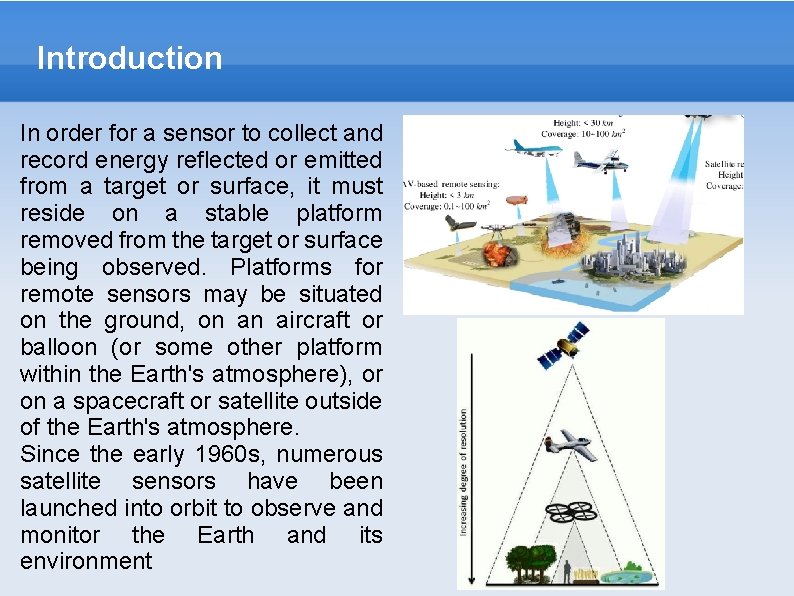
Introduction In order for a sensor to collect and record energy reflected or emitted from a target or surface, it must reside on a stable platform removed from the target or surface being observed. Platforms for remote sensors may be situated on the ground, on an aircraft or balloon (or some other platform within the Earth's atmosphere), or on a spacecraft or satellite outside of the Earth's atmosphere. Since the early 1960 s, numerous satellite sensors have been launched into orbit to observe and monitor the Earth and its environment
Development of remote sensing systems - The modern discipline of remote sensing arose with the development of flight. The balloonist G. Tournachon (alias Nadar) made photographs of Paris from his balloon in 1858. Messenger pigeons, kites, rockets and unmanned balloons were also used for early images. - Systematic aerial photography was developed for military surveillance and reconnaissance purposes beginning in World War I and reaching a climax during the Cold War with the use of modified combat aircraft. - The advent of earth resources satellite sensors (those with a primary objective of mapping and monitoring land cover) occurred when the first Landsat satellite was launched in July 1972. - A more recent development is that of increasingly smaller sensor pods such as those used by law enforcement and the military, in both manned and unmanned platforms. The development of artificial satellites in the latter half of the 20 th century allowed remote sensing to progress to a global scale as of the end of the Cold War. .
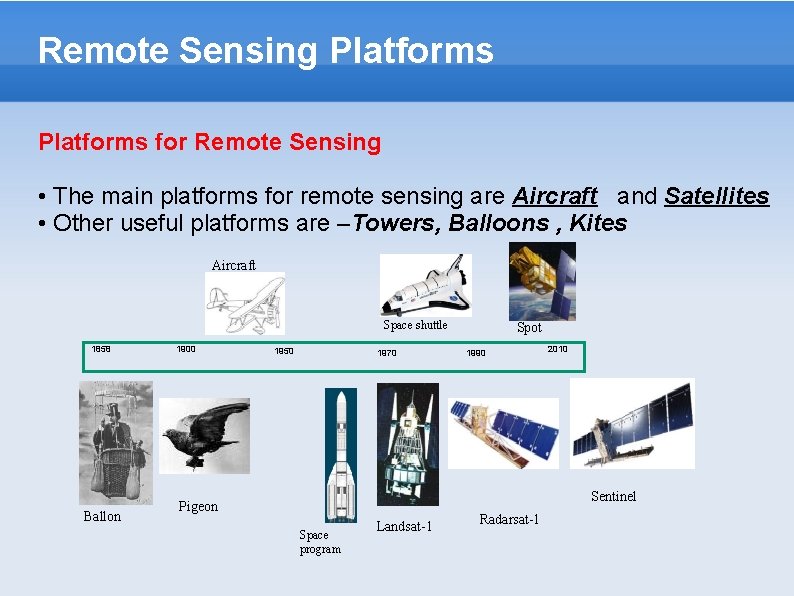
Remote Sensing Platforms for Remote Sensing • The main platforms for remote sensing are Aircraft and Satellites • Other useful platforms are –Towers, Balloons , Kites Aircraft Space shuttle 1858 Ballon 1900 1950 1970 Spot 1990 2010 Sentinel Pigeon Space program Landsat-1 Radarsat-1
Type of platforms Ground-based sensors are often used to record detailed information about the surface which is compared with information collected from aircraft or satellite sensors. -Sensors may be placed on a ladder, scaffolding, tall building, cherry-picker, crane, etc. -Aircraft are often used to collect very detailed images and facilitate the collection of data over virtually any portion of the Earth's surface at any time. -In space, remote sensing is sometimes conducted from the space shuttle or, more commonly, from satellites.
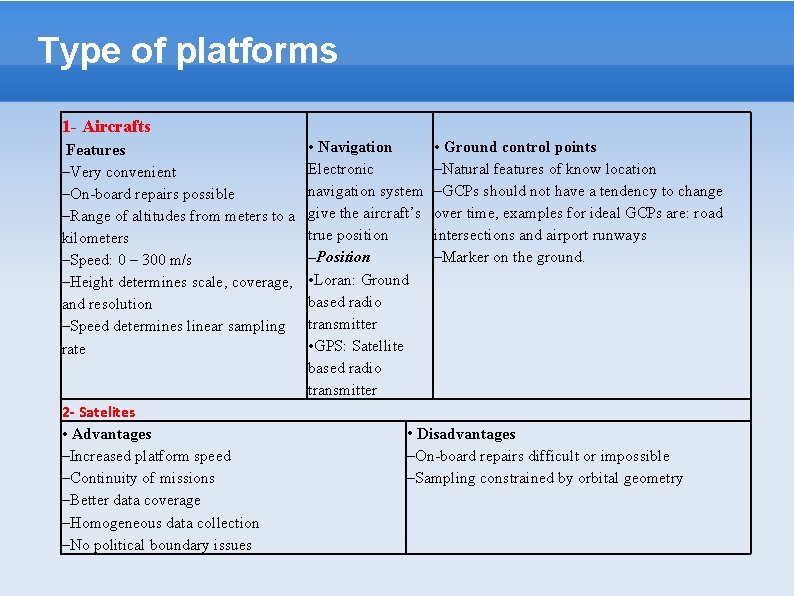
Type of platforms 1 - Aircrafts Features –Very convenient –On-board repairs possible –Range of altitudes from meters to a kilometers –Speed: 0 – 300 m/s –Height determines scale, coverage, and resolution –Speed determines linear sampling rate 2 - Satelites • Advantages –Increased platform speed –Continuity of missions –Better data coverage –Homogeneous data collection –No political boundary issues • Navigation Electronic navigation system give the aircraft’s true position –Position • Loran: Ground based radio transmitter • GPS: Satellite based radio transmitter • Ground control points –Natural features of know location –GCPs should not have a tendency to change over time, examples for ideal GCPs are: road intersections and airport runways –Marker on the ground. • Disadvantages –On-board repairs difficult or impossible –Sampling constrained by orbital geometry
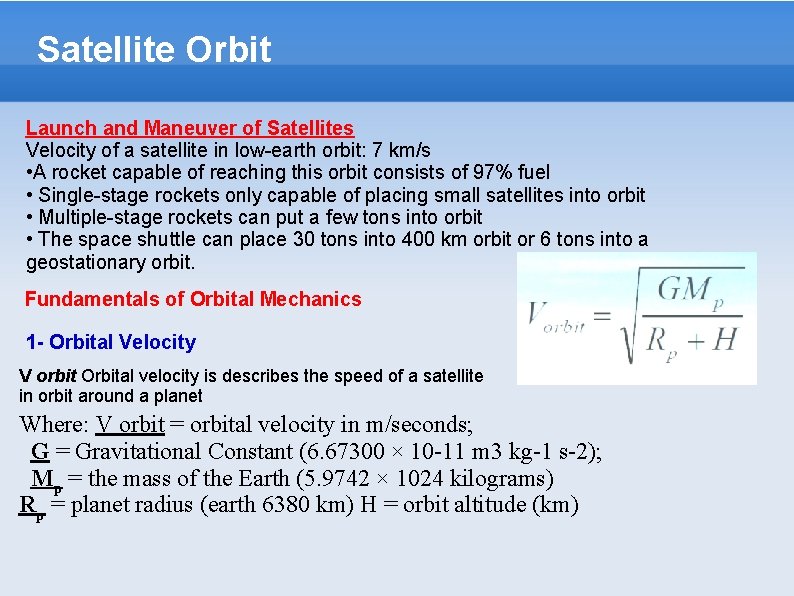
Satellite Orbit Launch and Maneuver of Satellites Velocity of a satellite in low-earth orbit: 7 km/s • A rocket capable of reaching this orbit consists of 97% fuel • Single-stage rockets only capable of placing small satellites into orbit • Multiple-stage rockets can put a few tons into orbit • The space shuttle can place 30 tons into 400 km orbit or 6 tons into a geostationary orbit. Fundamentals of Orbital Mechanics 1 - Orbital Velocity V orbit Orbital velocity is describes the speed of a satellite in orbit around a planet Where: V orbit = orbital velocity in m/seconds; G = Gravitational Constant (6. 67300 × 10 -11 m 3 kg-1 s-2); Mp = the mass of the Earth (5. 9742 × 1024 kilograms) Rp = planet radius (earth 6380 km) H = orbit altitude (km)
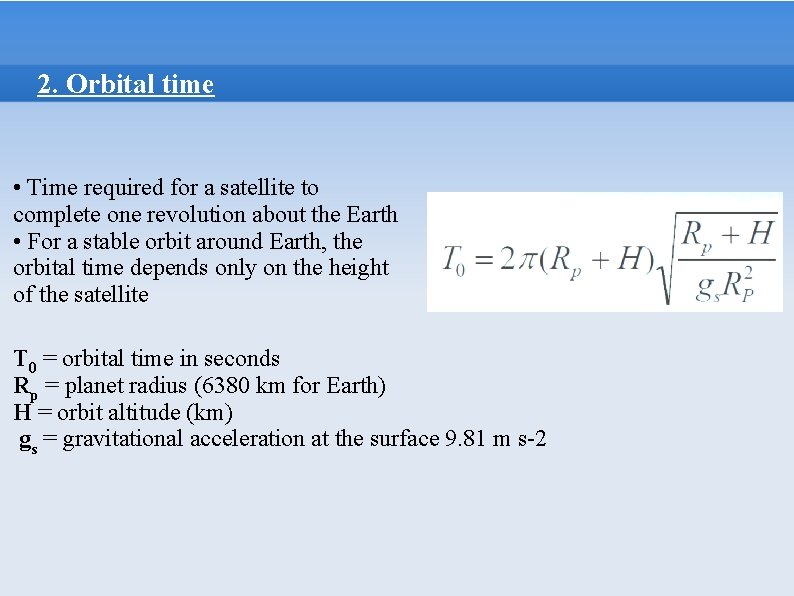
2. Orbital time • Time required for a satellite to complete one revolution about the Earth • For a stable orbit around Earth, the orbital time depends only on the height of the satellite T 0 = orbital time in seconds Rp = planet radius (6380 km for Earth) H = orbit altitude (km) gs = gravitational acceleration at the surface 9. 81 m s-2
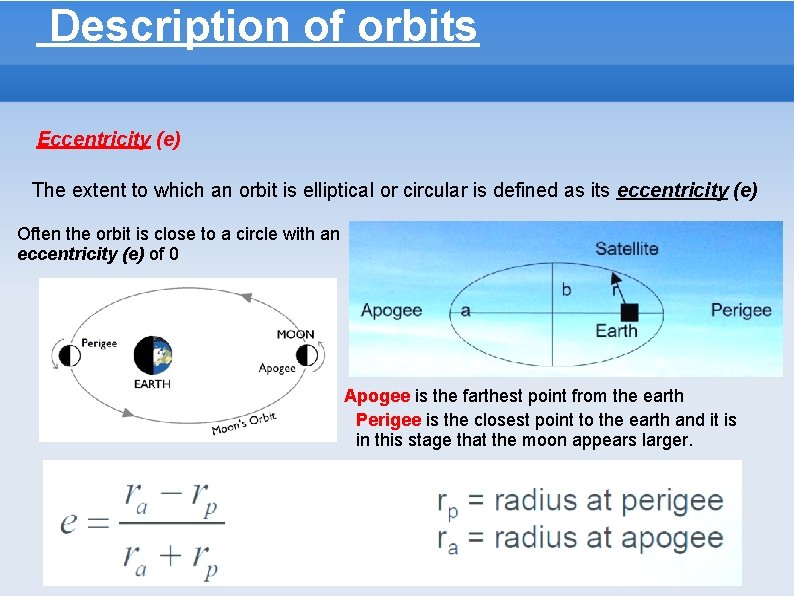
Description of orbits Eccentricity (e) The extent to which an orbit is elliptical or circular is defined as its eccentricity (e) Often the orbit is close to a circle with an eccentricity (e) of 0 Apogee is the farthest point from the earth Perigee is the closest point to the earth and it is in this stage that the moon appears larger.
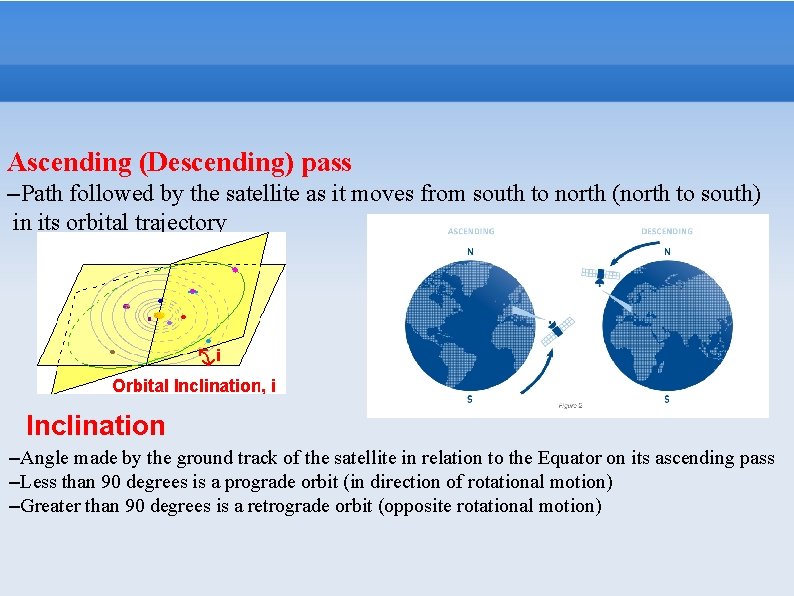
Ascending (Descending) pass –Path followed by the satellite as it moves from south to north (north to south) in its orbital trajectory Inclination –Angle made by the ground track of the satellite in relation to the Equator on its ascending pass –Less than 90 degrees is a prograde orbit (in direction of rotational motion) –Greater than 90 degrees is a retrograde orbit (opposite rotational motion)
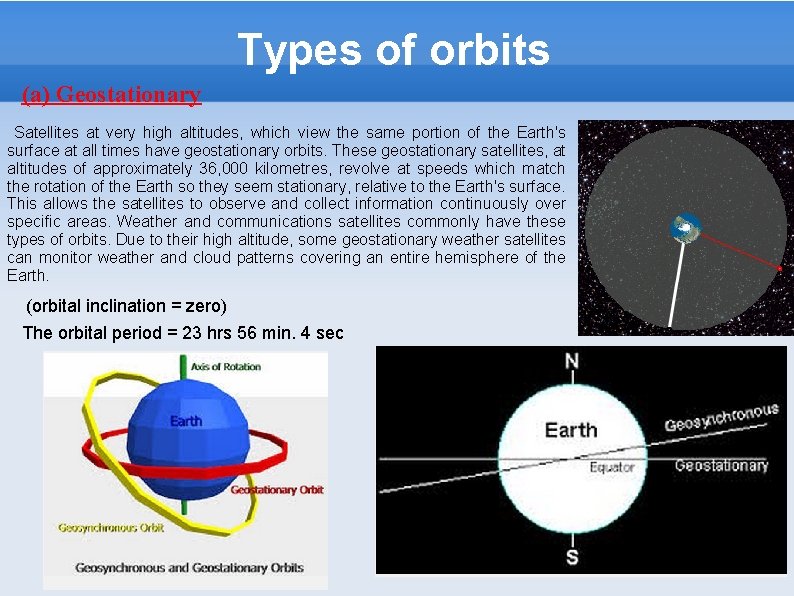
Types of orbits (a) Geostationary Satellites at very high altitudes, which view the same portion of the Earth's surface at all times have geostationary orbits. These geostationary satellites, at altitudes of approximately 36, 000 kilometres, revolve at speeds which match the rotation of the Earth so they seem stationary, relative to the Earth's surface. This allows the satellites to observe and collect information continuously over specific areas. Weather and communications satellites commonly have these types of orbits. Due to their high altitude, some geostationary weather satellites can monitor weather and cloud patterns covering an entire hemisphere of the Earth. (orbital inclination = zero) The orbital period = 23 hrs 56 min. 4 sec
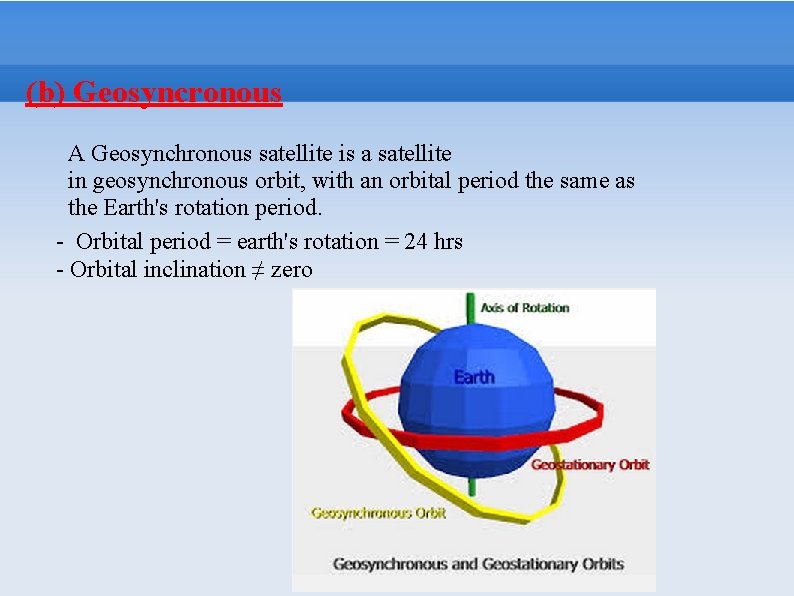
(b) Geosyncronous A Geosynchronous satellite is a satellite in geosynchronous orbit, with an orbital period the same as the Earth's rotation period. - Orbital period = earth's rotation = 24 hrs - Orbital inclination ≠ zero
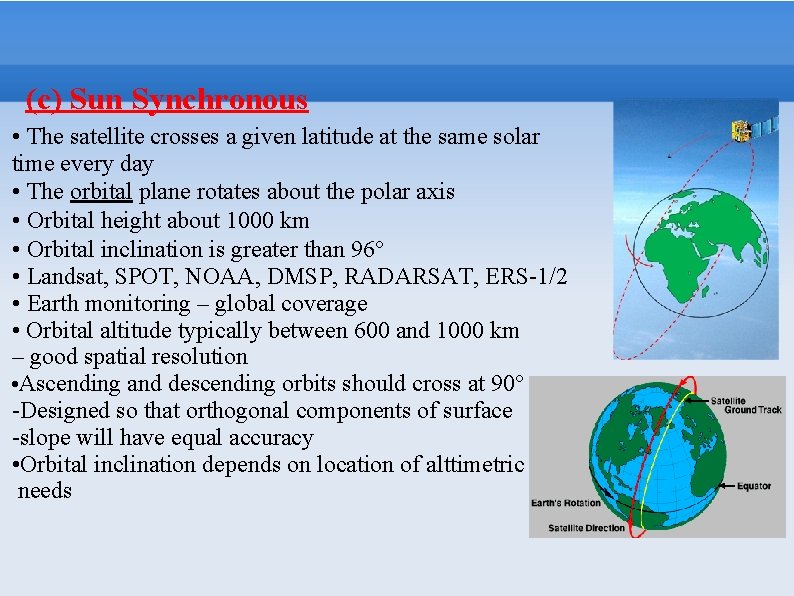
(c) Sun Synchronous • The satellite crosses a given latitude at the same solar time every day • The orbital plane rotates about the polar axis • Orbital height about 1000 km • Orbital inclination is greater than 96° • Landsat, SPOT, NOAA, DMSP, RADARSAT, ERS-1/2 • Earth monitoring – global coverage • Orbital altitude typically between 600 and 1000 km – good spatial resolution • Ascending and descending orbits should cross at 90° -Designed so that orthogonal components of surface -slope will have equal accuracy • Orbital inclination depends on location of alttimetric needs
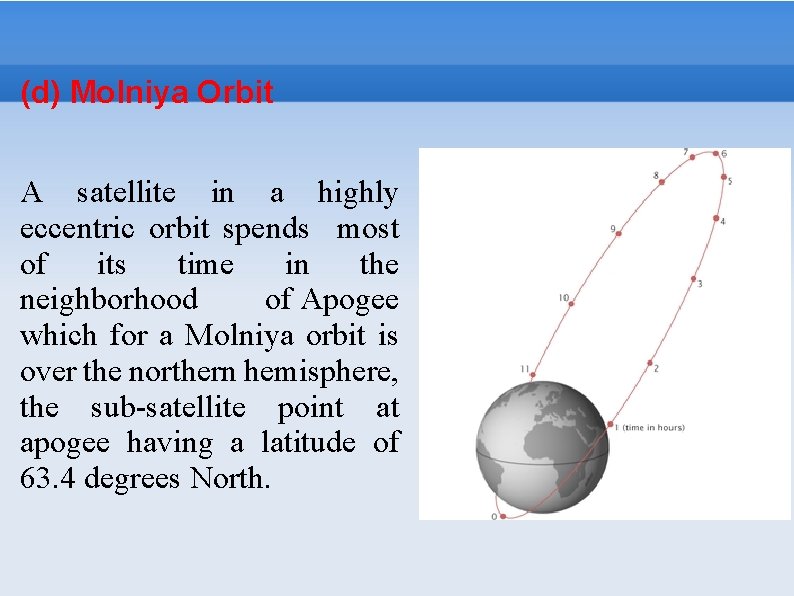
(d) Molniya Orbit A satellite in a highly eccentric orbit spends most of its time in the neighborhood of Apogee which for a Molniya orbit is over the northern hemisphere, the sub-satellite point at apogee having a latitude of 63. 4 degrees North.
References - Noam Levin. 1999. Fundamentals of Remote Sensing. Trieste, Italy; 225 p. - Xiang et al. , 2018. Mini-UAV-based Remote Sensing: Techniques, Applications and Prospectives. https: //www. researchgate. net/publication/329801746_Mini-UAVbased_Remote_Sensing_Techniques_Applications_and_Prospectives/figures? lo=1 - Nixon et al. , 2017. An overview of the Mexican Crop Observation, Management and Production Analysis Services System (COMPASS) Project (English translation). Conference 39 th convention of the Asociación de Técnicos Azucare. - REMOTE SENSING OF THE ENVIRONMENT. GEOG 4093/5093 - 4 Spring 2006 - https: //earthobservatory. nasa. gov/features/Orbits. Catalog - https: //en. wikipedia. org/wiki/Remote_sensing - Journey to Space: Geosynchronous video (full): https: //www. youtube. com/watch? v=SBXYed. Xlsf. A