
Principles of Quality Instruction in Web Classes George
Principles of Quality Instruction in Web Classes George Kontos, Ed. D. Assistant Professor george. kontos@wku. edu Kontos 1
Background l The Seven Principles of Good Practice in Undergraduate Education were developed by Arthur Chickering and Zelda Gamson. l These principles first appeared in the American Association for Higher Education (AAHE) Bulletin (Chickering and Gamson, 1987). Kontos 2

The Seven Principles of Good Practice in Undergraduate Education Chickering and Gamson (1987) concluded that good practice in undergraduate education: 1. 2. 3. 4. 5. 6. 7. Encourages contact between students and faculty, Encourages cooperation among students, Encourages active learning, Gives prompt feedback, Emphasizes time on task, Communicates high expectations, and Respects diverse talents and ways of learning. Kontos 3
The Seven Principles of Good Practice in Undergraduate Education These principles were initially conceived for faceto-face instruction Later they were implemented for technologybased teaching in Chickering and Ehrmann’s paper (Chickering and Ehrmann, 1996). Others have tried to apply the principles in online teaching. Kontos 4
Principle 1 Contact Between Students and Faculty is Encouraged General Benefits: l Interest in the subject matter is stimulated l Motivation to fight back and keep on working when going through times is enhanced l Planning for the future is encouraged Kontos 5
Principle 2 Cooperation Among Students is Encouraged General Benefits: l Learning is enhanced by team effort l Involvement when learning with others is increased l Critical thinking is enhanced when sharing ideas with others Kontos 6
Principle 3 Active Learning is Encouraged General Benefits: l Learning is more lasting when it is active learning l Learning becomes part of the learner when it is dynamic rather than passive l Kontos 7
Principle 4 Prompt Feedback is Given General Benefits: l Learning is focused when timely feedback is given l Learning is improved when learners are told what their weak points are and this is done without delay Kontos 8
Principle 5 Time on Task is Encouraged General Benefits: l Learning is effective when time on task is emphasized l Effective time management is crucial for students and professionals alike Kontos 9
Principle 6 High Expectations are Communicated General Benefits: l High expectations usually translate into high achievements l Keeping high standards is rewarding for both teacher and learners Kontos 10
Principle 7 Diverse Talents and Ways of Learning Are Respected General Benefits: l Incorporating various learning styles in the classroom facilitates learning l Recognizing and respecting that there is more than one way to learn is appreciated and brings desirable results Kontos 11
An Example An Undergraduate Online Course Taught With the Seven Principles in Mind: l BT 180 C Introduction to Computer Systems Kontos 12
BT 180 C Introduction to Computer Systems l Developed in Spring 2003 by George Kontos and Linda Todd of Bowling Green Community College, Western Kentucky University l A Blackboard Course l First Time Taught by Todd: Summer 2003 l Then, Being Taught by Kontos, almost every semester Kontos 13
BT 180 C Introduction to Computer Systems l l l Concepts (Computer Terminology) Practice (Lab Activities) History The Internet and the Web Ethical Issues Operating Systems - Microsoft Windows, Unix, Linux, Mac OS, etc. l Applications Software - Microsoft Office, etc. Kontos 14
BT 180 C and the Seven Principles Principle 1 Principle Web Implementation Contact • Orientation session (by phone Between or in person) Students and • Student Information Form Faculty is • Email (with meaningful Encouraged Subject lines) • Threaded discussions (Discussion Board activities) • Response time policy posted Kontos 15
BT 180 C and the Seven Principles Principle 2 Principle Online Course Implementation: Cooperation • Threaded discussions Among Students is Encouraged Kontos 16
BT 180 C and the Seven Principles Principle 3 Principle Online Course Implementation: Active Learning is Encouraged Kontos • Assignment to summarize a current technology article that made the news • Assignment to investigate a topic about a technology that is affecting our lives • A variety of hands-on practice activities • Threaded discussions 17
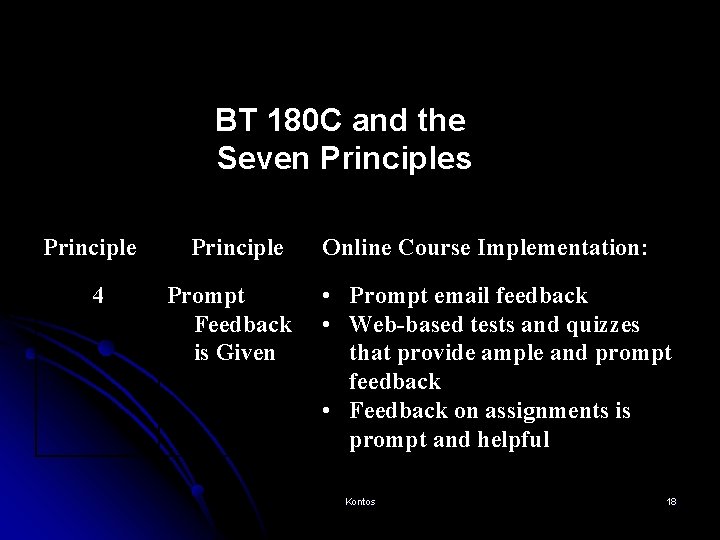
BT 180 C and the Seven Principles Principle 4 Principle Prompt Feedback is Given Online Course Implementation: • Prompt email feedback • Web-based tests and quizzes that provide ample and prompt feedback • Feedback on assignments is prompt and helpful Kontos 18
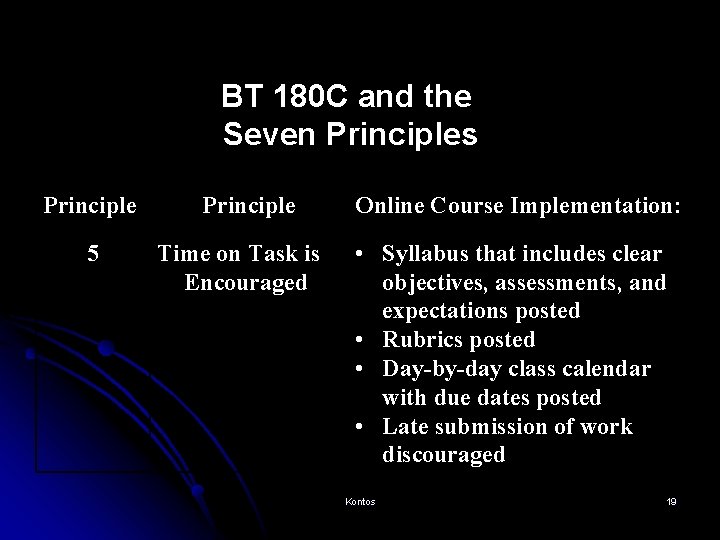
BT 180 C and the Seven Principles Principle 5 Principle Time on Task is Encouraged Online Course Implementation: • Syllabus that includes clear objectives, assessments, and expectations posted • Rubrics posted • Day-by-day class calendar with due dates posted • Late submission of work discouraged Kontos 19
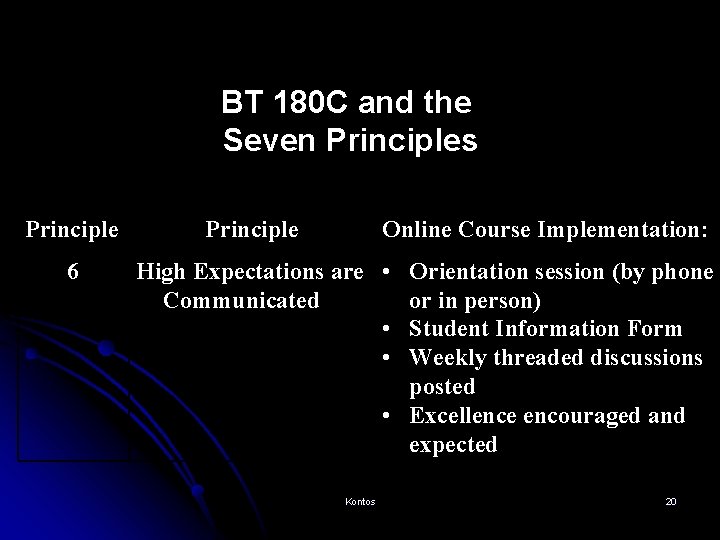
BT 180 C and the Seven Principles Principle 6 Principle Online Course Implementation: High Expectations are • Orientation session (by phone Communicated or in person) • Student Information Form • Weekly threaded discussions posted • Excellence encouraged and expected Kontos 20
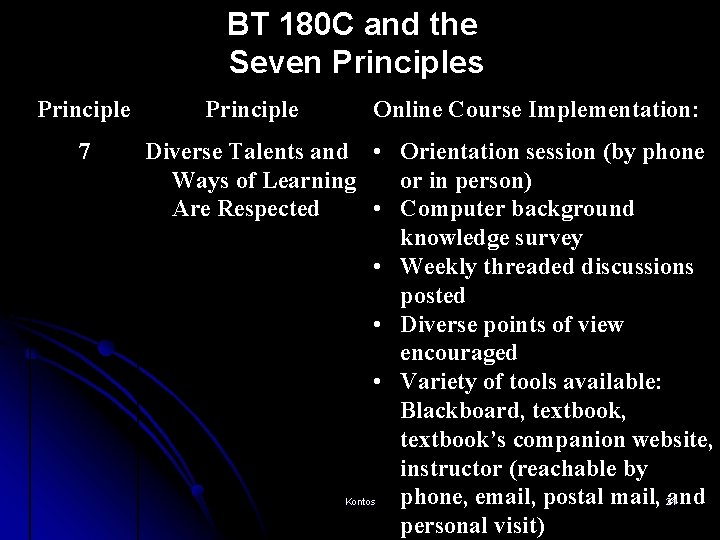
BT 180 C and the Seven Principles Principle 7 Principle Online Course Implementation: Diverse Talents and • Orientation session (by phone Ways of Learning or in person) Are Respected • Computer background knowledge survey • Weekly threaded discussions posted • Diverse points of view encouraged • Variety of tools available: Blackboard, textbook’s companion website, instructor (reachable by phone, email, postal mail, 21 and Kontos personal visit)
l Chickering, A. W. , & Gamson Z. F. (1987). Seven principles for good practice in undergraduate education. AAHE Bulletin, March 3 -7. Retrieved July 1, 2005 from http: //honolulu. hawaii. edu/intranet /committees/Fac. Dev. Com/guidebk /teachtip/7 princip. htm Kontos 22
- Slides: 22