
Principles of purification of macromolecules Genetics 222 Method

- Slides: 14
Principles of purification of macromolecules Genetics 222 Method and Logic in Experimental Genetics Reference Protein Purification: Principles and Practice Robert K. Scopes Third Edition Springer-Verlag 1994
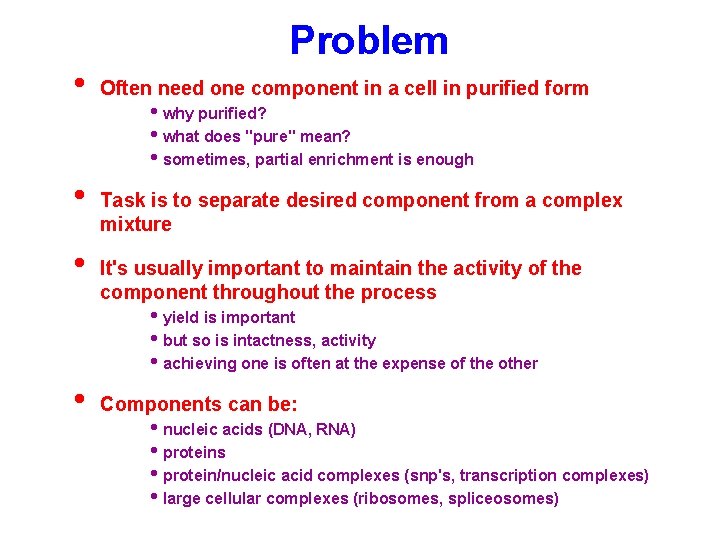
• • • Problem Often need one component in a cell in purified form • why purified? • what does "pure" mean? • sometimes, partial enrichment is enough Task is to separate desired component from a complex mixture It's usually important to maintain the activity of the component throughout the process • yield is important • but so is intactness, activity • achieving one is often at the expense of the other • Components can be: • nucleic acids (DNA, RNA) • proteins • protein/nucleic acid complexes (snp's, transcription complexes) • large cellular complexes (ribosomes, spliceosomes)
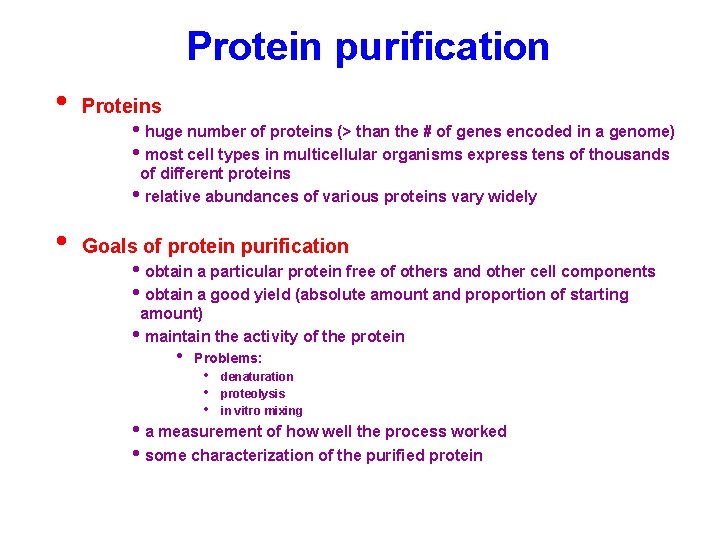
Protein purification • Proteins • huge number of proteins (> than the # of genes encoded in a genome) • most cell types in multicellular organisms express tens of thousands of different proteins • relative abundances of various proteins vary widely • Goals of protein purification • obtain a particular protein free of others and other cell components • obtain a good yield (absolute amount and proportion of starting amount) • maintain the activity of the protein • Problems: • • • denaturation proteolysis in vitro mixing • a measurement of how well the process worked • some characterization of the purified protein
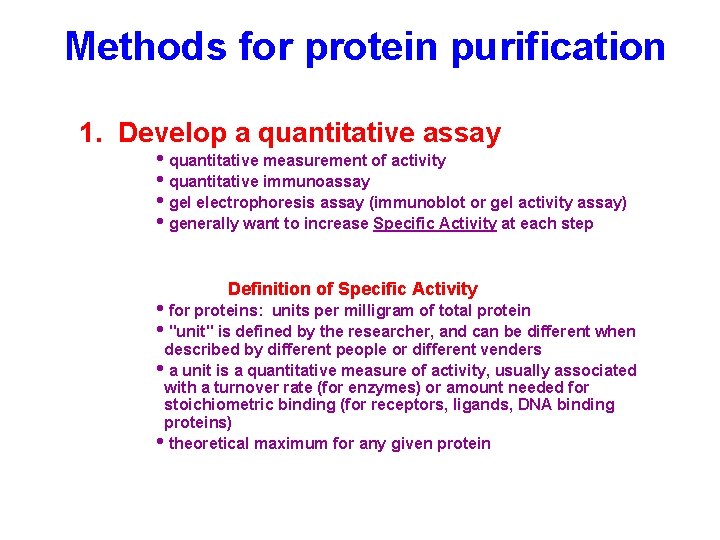
Methods for protein purification 1. Develop a quantitative assay • quantitative measurement of activity • quantitative immunoassay • gel electrophoresis assay (immunoblot or gel activity assay) • generally want to increase Specific Activity at each step Definition of Specific Activity • for proteins: units per milligram of total protein • "unit" is defined by the researcher, and can be different when described by different people or different venders • a unit is a quantitative measure of activity, usually associated with a turnover rate (for enzymes) or amount needed for stoichiometric binding (for receptors, ligands, DNA binding proteins) • theoretical maximum for any given protein
Methods for protein purification 2. Obtain source of material • whole organisms • organs or tissues • embryos • tissue culture cells • microorganisms • need to understand then weigh +'s and -'s of any particular source, e. g. : • • • how hard is it to obtain, grow, handle amount of proteolytic activity may sometimes be better to use a lower producing source that is cleaner is the protein active in a particular source? are inhibitors present in a particular source? some organs and tissues have connective tissues that are hard to remove • overproduction in a heterologous system (basis for much of biotechnology industry)
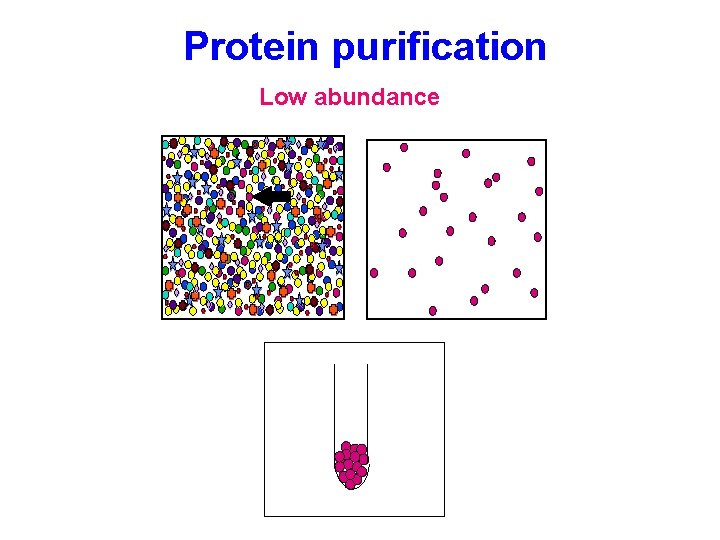
Protein purification Low abundance
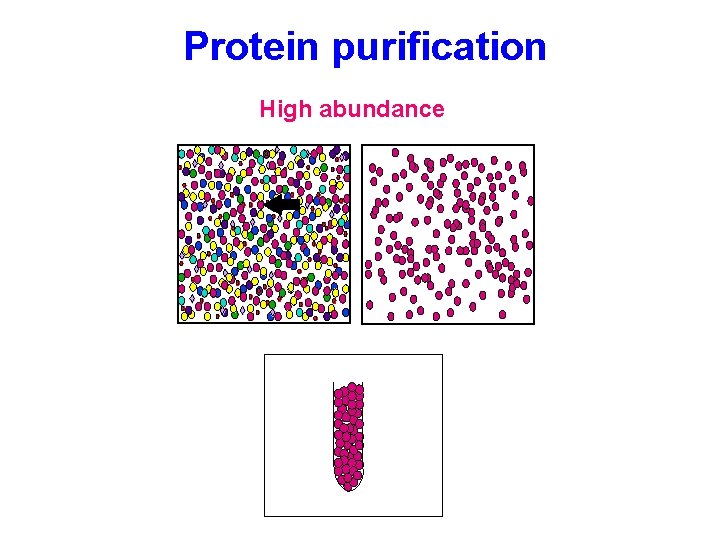
Protein purification High abundance
Methods for protein purification 3. Make an extract from source • almost always want to keep it very cold (just above freezing) • gentle breaking • in some cases can obtain big purification in one step by separating cellular compartments (e. g. , purify nuclei from cytoplasm before extracting nuclear proteins) 4. Begin separating components • remove nucleic acids, polysaccharides, cell membrane debris • ammonium sulfate precipitations, other crude fractionations (p. H or other salt precipitations, antibody clearing, "autolysis") • these crude steps are often needed to avoid ruining or overloading chromatography agents
Methods for protein purification 5. Fractionate by chromatography • several steps are almost always needed • need to assay for amount and purity at each step • need a way to decide when you're finished
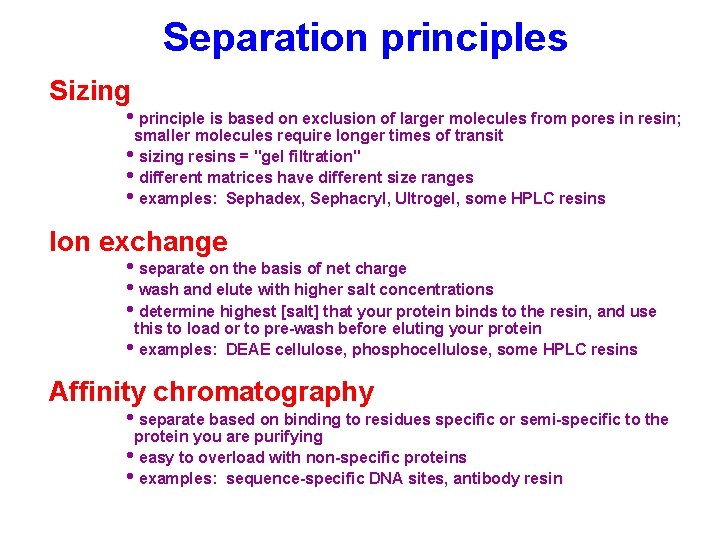
Separation principles Sizing • principle is based on exclusion of larger molecules from pores in resin; smaller molecules require longer times of transit • sizing resins = "gel filtration" • different matrices have different size ranges • examples: Sephadex, Sephacryl, Ultrogel, some HPLC resins Ion exchange • separate on the basis of net charge • wash and elute with higher salt concentrations • determine highest [salt] that your protein binds to the resin, and use this to load or to pre-wash before eluting your protein • examples: DEAE cellulose, phosphocellulose, some HPLC resins Affinity chromatography • separate based on binding to residues specific or semi-specific to the protein you are purifying • easy to overload with non-specific proteins • examples: sequence-specific DNA sites, antibody resin
Purification table
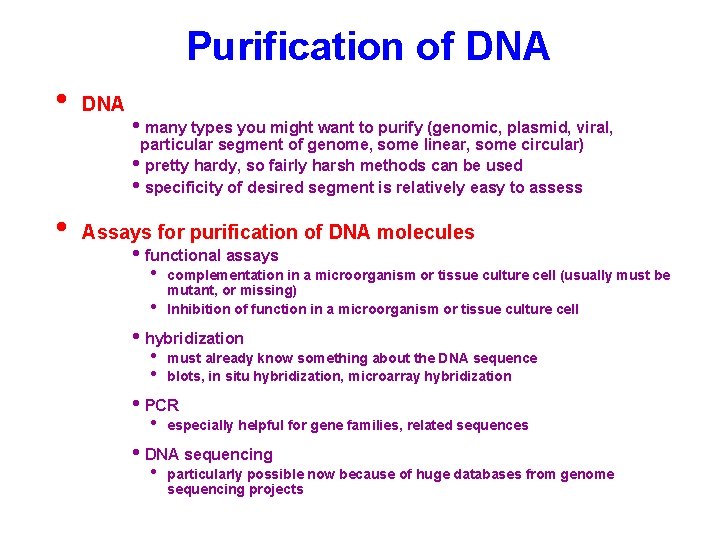
Purification of DNA • DNA • many types you might want to purify (genomic, plasmid, viral, particular segment of genome, some linear, some circular) • pretty hardy, so fairly harsh methods can be used • specificity of desired segment is relatively easy to assess • Assays for purification of DNA molecules • functional assays • • complementation in a microorganism or tissue culture cell (usually must be mutant, or missing) Inhibition of function in a microorganism or tissue culture cell • hybridization • • must already know something about the DNA sequence blots, in situ hybridization, microarray hybridization • PCR • especially helpful for gene families, related sequences • DNA sequencing • particularly possible now because of huge databases from genome sequencing projects
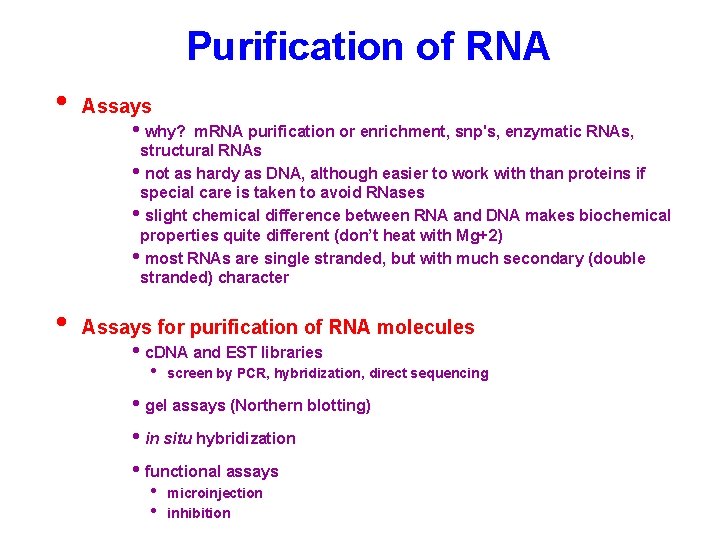
Purification of RNA • Assays • why? m. RNA purification or enrichment, snp's, enzymatic RNAs, structural RNAs • not as hardy as DNA, although easier to work with than proteins if special care is taken to avoid RNases • slight chemical difference between RNA and DNA makes biochemical properties quite different (don’t heat with Mg+2) • most RNAs are single stranded, but with much secondary (double stranded) character • Assays for purification of RNA molecules • c. DNA and EST libraries • screen by PCR, hybridization, direct sequencing • gel assays (Northern blotting) • in situ hybridization • functional assays • • microinjection inhibition
Food for Thought What are the pitfalls/caveats of purification approaches?