
Principles of Public Speaking Week 05 Who Chooses
Principles of Public Speaking Week 05
Who Chooses Your Topic? When you choose the topic, it must be strategic—you must make decisions that will achieve your purpose. Deciding a topic is frequently the most difficult part of a speech assignment. Like starting a paper…
Who Chooses Your Topic? Elements in the situation help choose a topic. Commitment to a cause: Speak on a topic that is important to you. Reputation: Speak on a topic on which you already have some knowledge and experience. Occasion: Speak on a topic adapted to ceremonial expectations, such as accepting an award.
What Makes a Good Topic? It should be important to the speaker It should have interest to the audience It should be worthy of listeners’ time
Where to Start? Take a personal inventory What public issues do you care about? Which of your interests overlap with those of the audience? Which of your experiences might be generalizable?

What Next? Good ‘ol fashioned BRAINSTORMING Then narrowing your topic Why? Most topics need to be narrowed to fit the time allowed. Narrowing also means sharpening the focus of the topic by concentrating on some part of a broad topic.
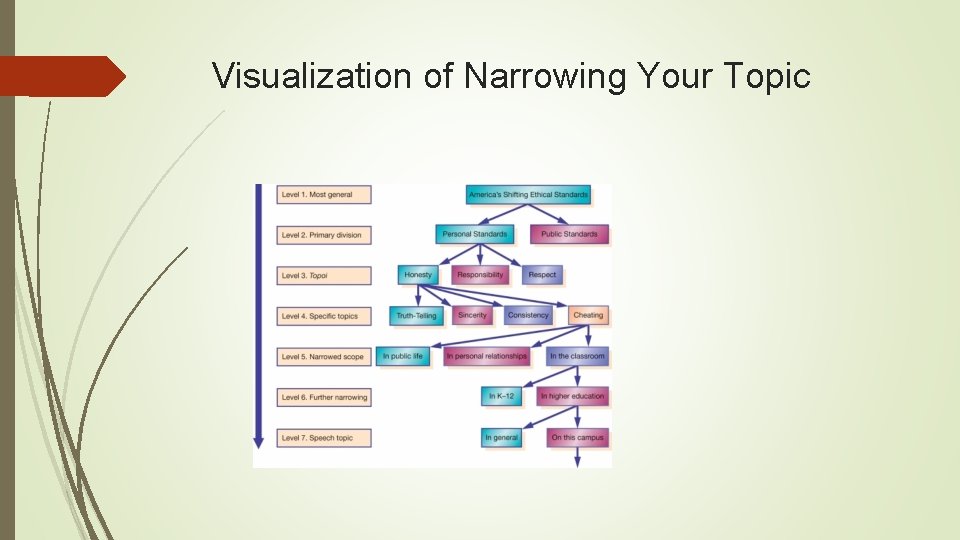
Visualization of Narrowing Your Topic
Strategy & Purpose A strategic plan is an identification of the objectives to be sought in a speech and the means for achieving them. Strong public speeches have a clear sense of purpose, which is the outcome the speaker wishes to achieve or the response desired from the audience.
Developing a Strategy The seven common purposes of a speech: Providing new information or perspective, which is the point of view from which one approaches a topic Agenda setting, which causes listeners to think about a topic that previously had escaped their attention Creating positive or negative feeling Strengthening commitment Weakening commitment Conversion, which is the replacement of a set of beliefs with another Inducing a specific action
Purposes The general purpose statement is the statement of the overall goal for the speech.
Purposes cont. The Purpose Statement The specific purpose statement is the statement of the outcome sought from the audience. It usually has three characteristics: Focuses on the audience rather than the speaker; identifies the outcome sought, not the means for achieving it Summarizes a single idea Is precise and free of vague language
Thesis Statement The thesis statement is the central idea of the claim made by the speech. It should be stated as a single sentence and worded precisely. While many speakers do not explicitly state a thesis, public speaking students are strongly advised (and often required) to do so.
Start Outlining A speech outline is a display of the organizational pattern of the speech that will help you to: Be sure that you have covered the topic adequately. Clarify and choose the best organizational strategy for your speech. Check the organizational patterns to see that it is sensible and consistent. Become familiar with the claims you want to make.
Outlining cont. List the ideas you plan to develop in the speech. Determine which of these ideas subsume to other ideas to help with organization. Diagram the relationship among ideas. Determine the order in which you want to discuss the main ideas.

Prep vs. Presentation The preparation outline is used in composing the speech. This outline is developed in enough detail to show each idea and piece of evidence fits into the overall structure. The presentation outline is the speaking outline. This outline is briefer than the preparation outline. This outline is used as a memory aid when delivering the speech.
I Know It When I See It… What Does a Good Outline Look Like? Outlines indicate the hierarchy of the importance of ideas within a speech. Main ideas are designated by Roman numerals; less important ideas are designed by capital letters, then Arabic numerals, then lowercase letters.
What else to include in Speaking Outlines? Reference to Supporting Materials and Oral Citations Speaking outlines should cue the speaker about which supporting materials to use. It is usually not necessary to include details about the citations on the note cards.

Keywords / Triggers Using an Outline in Rehearsal The speaking outline plays an important role in rehearsal. The keywords should immediately prompt you to recall the details of a supporting point—if they do not, change the keyword to one that will.
- Slides: 18