
Principles of Public Speaking Week 01 Why Study
Principles of Public Speaking Week 01
Why Study Public Speaking? Learn how to organize your communication so that it is: Clear Coherent Sensible Effective Learn how to listen both carefully and critically so that you can both understand AND evaluate.
If You Become Competent At Public Speaking, You Gain Two Skills… Strategic Planning: a process where you identify your goals and then determine how best to achieve them Learn to be a Critical Thinker: the ability to form and defend your own judgments rather than blindly accepting or instantly rejecting what you hear or read. Facts Opinions

And Now, The Selfish Reasons… IT MINIMIZES YOUR FEARS IT MAKES YOU MORE SENSITIVE TO GROUP ENVIRONMENTS IT INCREASES YOUR CONFIDENCE
The Rhetorical Situation Rhetoric: an ancient discipline that can be used to: Shape, affirm, and modify people’s values Bind people together or move them apart Celebrate significant events Convey information and help people to learn Nurture, strengthen, or change people’s beliefs Lead people to take (or not to take) action

The Rhetorical Situation cont. Situation: the context in which a speech is given Thus, A rhetorical situation is a situation in which people’s understanding can be changed through messages.
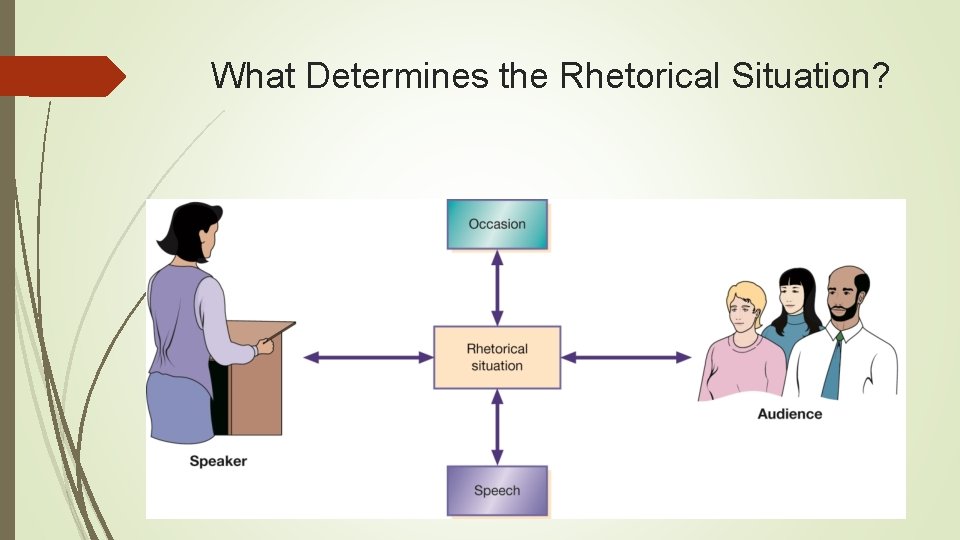
What Determines the Rhetorical Situation?

Rhetorical Situation Determinants cont. Speaker Occasion Speech content Audience

Audience Identification: trying to find common ground between what a speaker knows about the audience and what the speaker wants to say.
Occasion Ceremonial speeches are given on special occasions. Deliberative speeches advocate a policy or refute another person’s argument. Forensic speeches are concerned with rendering judgments about events in the past. The exigence is a problem that cannot be avoided but can be solved or managed by developing appropriate language.
Speaker What common roles does a speaker play? To Inform To Persuade To Entertain
- Slides: 11