
Principles of Neural Organization Lecture 2 KEYWORDS from

- Slides: 41
Principles of Neural Organization Lecture 2
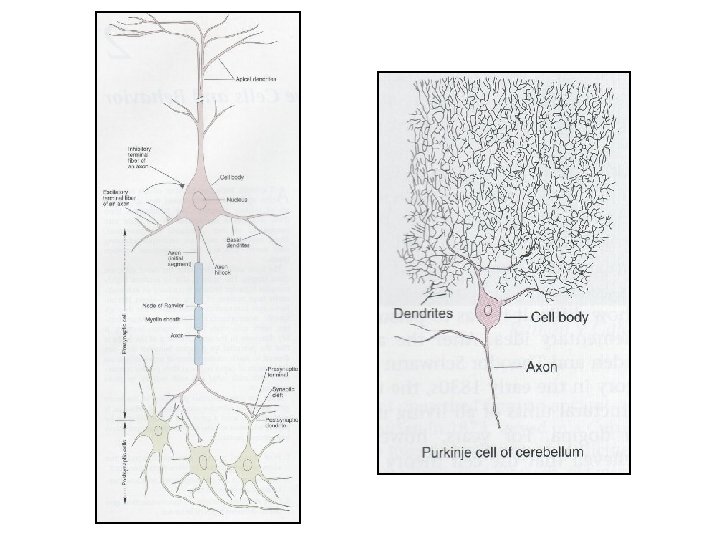
KEYWORDS from Lecture 1 Electrode, Microelectrode, Micron (1/1000 th mm), membrane, nucleus, cytoplasm, Neuron, axon, dendrite, Schwann cell/glial cell, myelin sheath, node of Ranvier, Synapse, synaptic cleft, vesicle, neurotransmitter, receptors, ions, permeability, ion channels, voltage-dependent sodium channels, neural threshold, positive feedback, sodium (Na+), potassium (K+), sodium-potassium pump, electrochemical equilibrium potentials, sodium (Na+) +55 mv, potassium (K+) -75 mv, resting potential -70 mv, polarization/ depolarization/ hyperpolarization, inhibitory post-synaptic potential (IPSP), Excitatory post-synaptic potential (EPSP), integration, axon hillock, action potential (AP), all-ornone, neuron threshold -55 mv, saltatory propagation, AP propagation
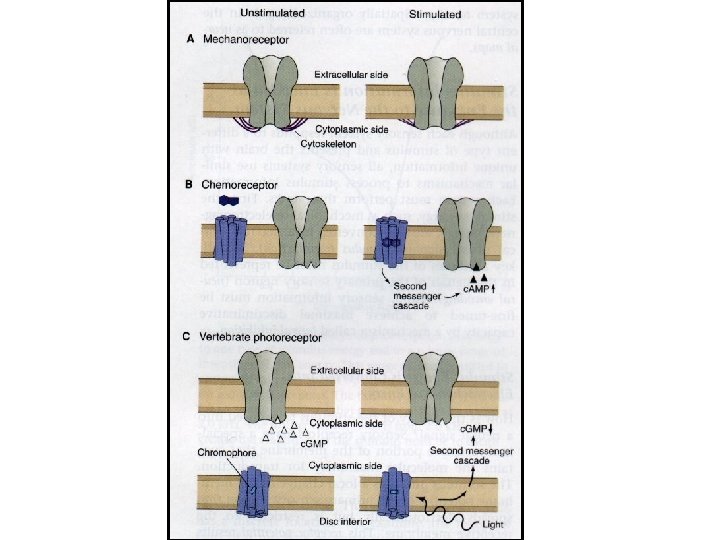
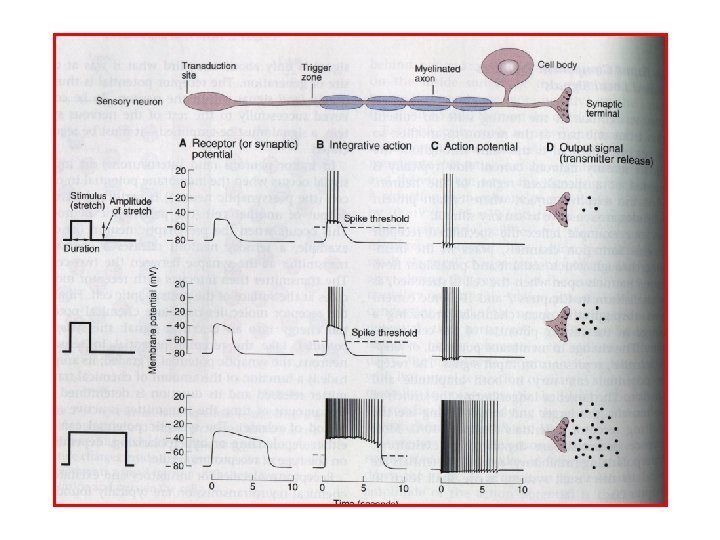
WHEN DO CELLS PRODUCE ACTION POTENTIALS? 1 -- electrical stimulation (artificial depolarization) 2 -- spatial and temporal integration of EPSPs and IPSPs across the neurone’s membrane resulting in the neuronal threshold being reached. • Generator potential 3 -- sensory stimulation (transduction) • mechanical (cytoskeleton) • chemical (receptors, second messengers) • light (hyperpolarization)
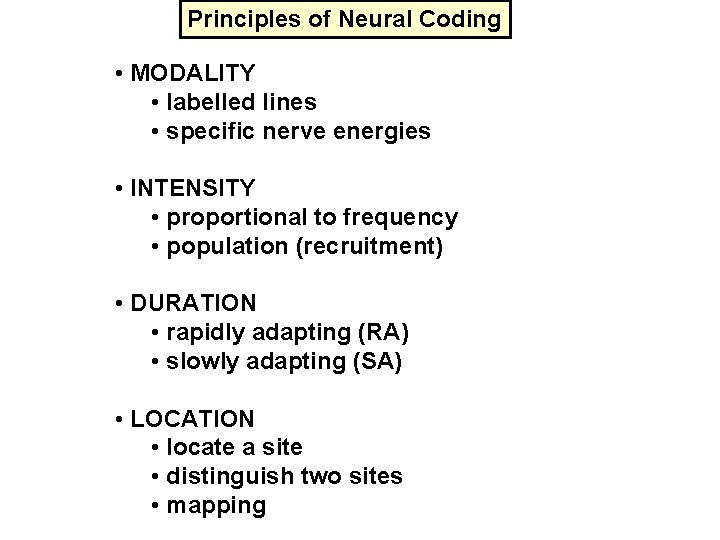
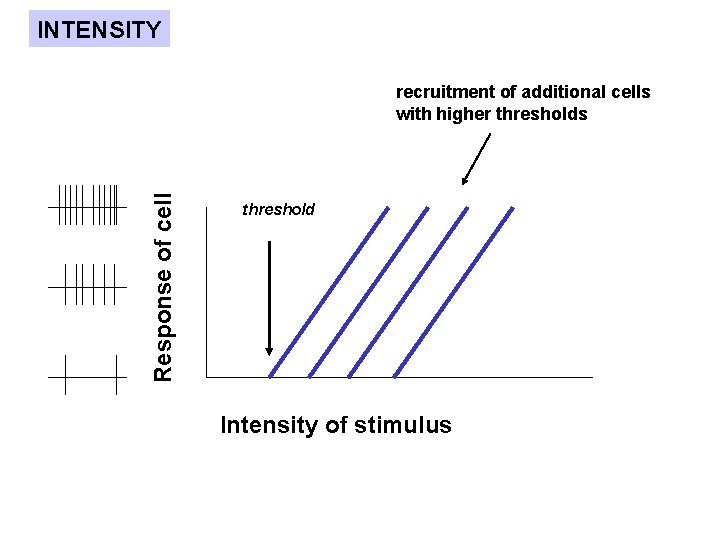
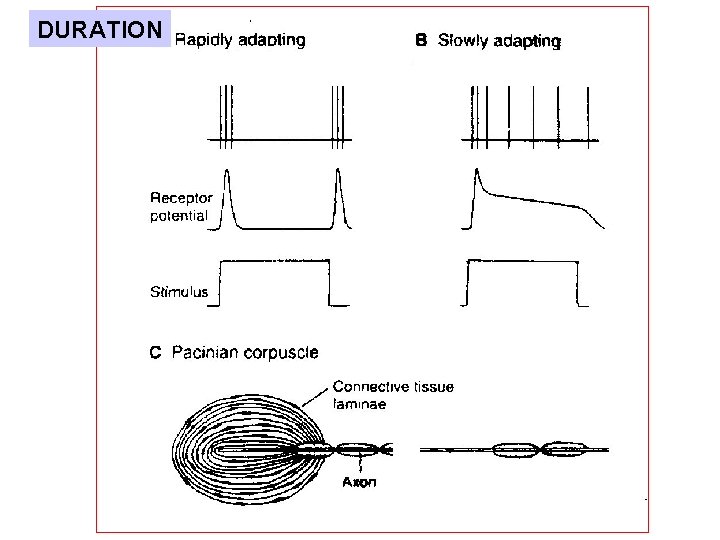
Principles of Neural Coding • MODALITY • labelled lines • specific nerve energies • INTENSITY • proportional to frequency • population (recruitment) • DURATION • rapidly adapting (RA) • slowly adapting (SA) • LOCATION • locate a site • distinguish two sites • mapping
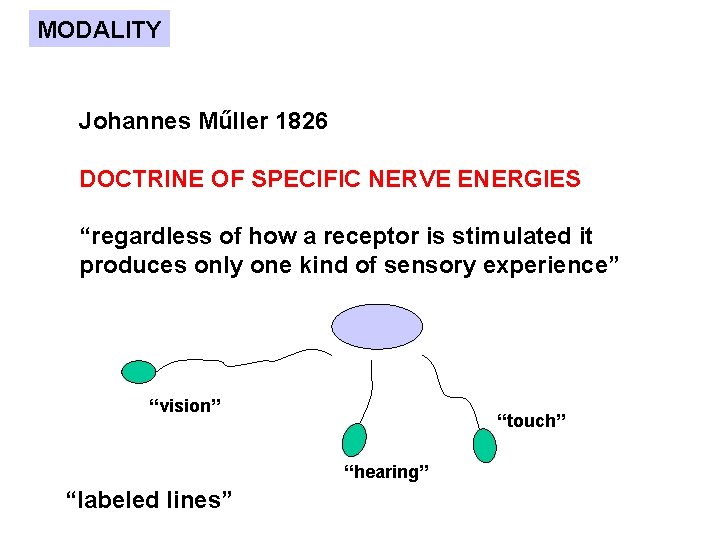
MODALITY Johannes Műller 1826 DOCTRINE OF SPECIFIC NERVE ENERGIES “regardless of how a receptor is stimulated it produces only one kind of sensory experience” “vision” “touch” “hearing” “labeled lines”
INTENSITY Response of cell recruitment of additional cells with higher thresholds threshold Intensity of stimulus
DURATION
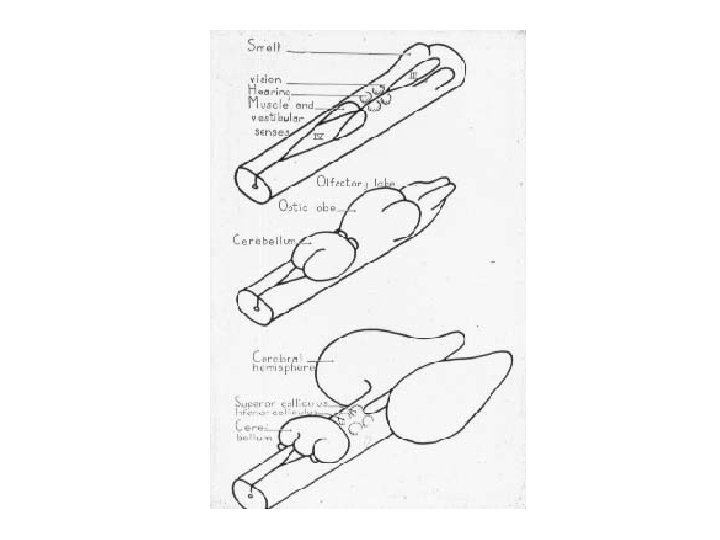
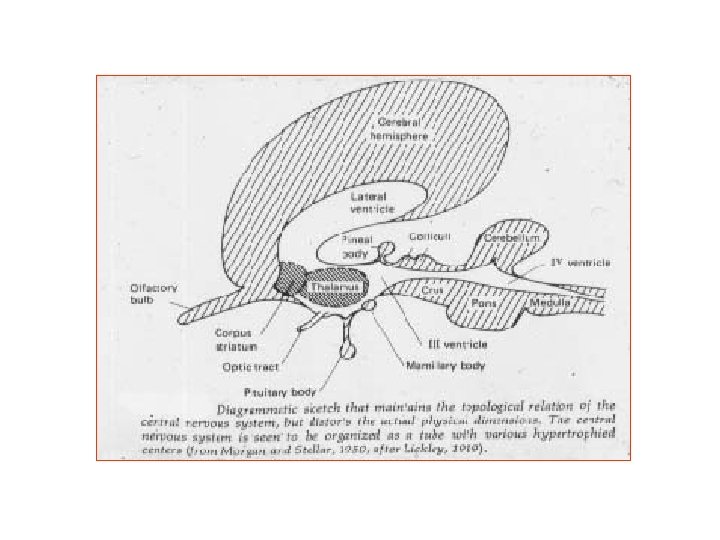
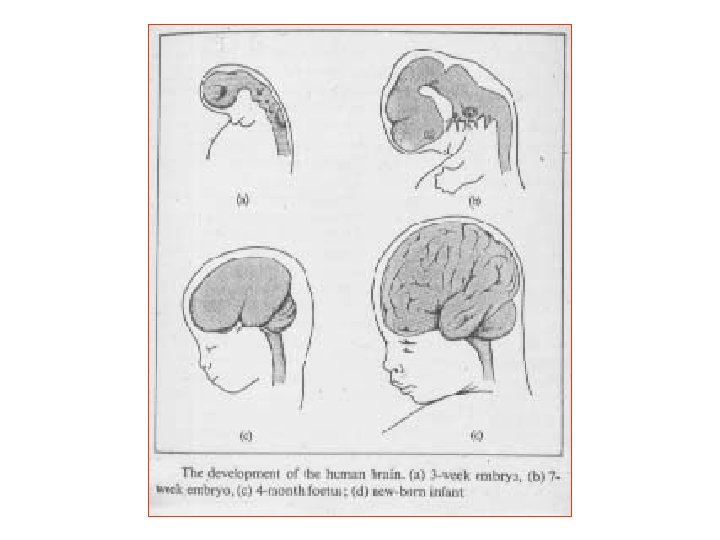
Introduction to structure of central nervous system. . .
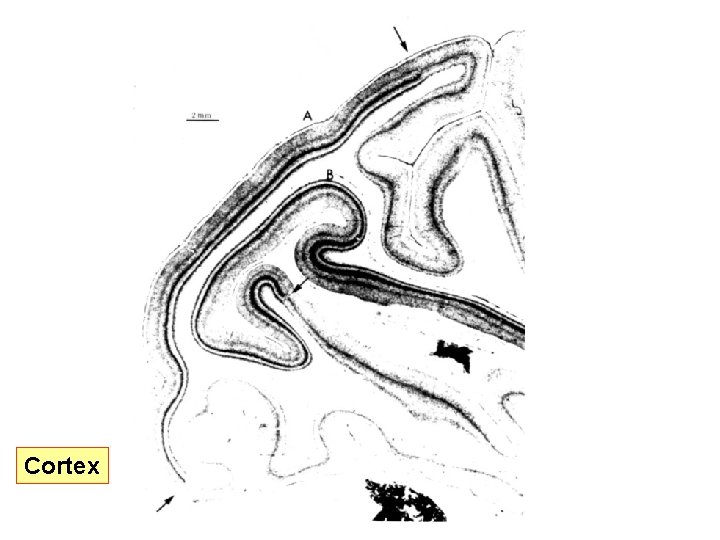
Cortex
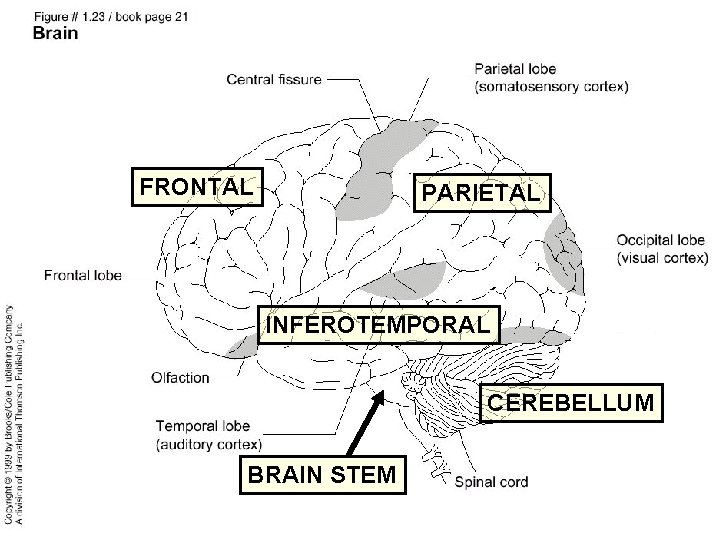
FRONTAL PARIETAL INFEROTEMPORAL CEREBELLUM BRAIN STEM
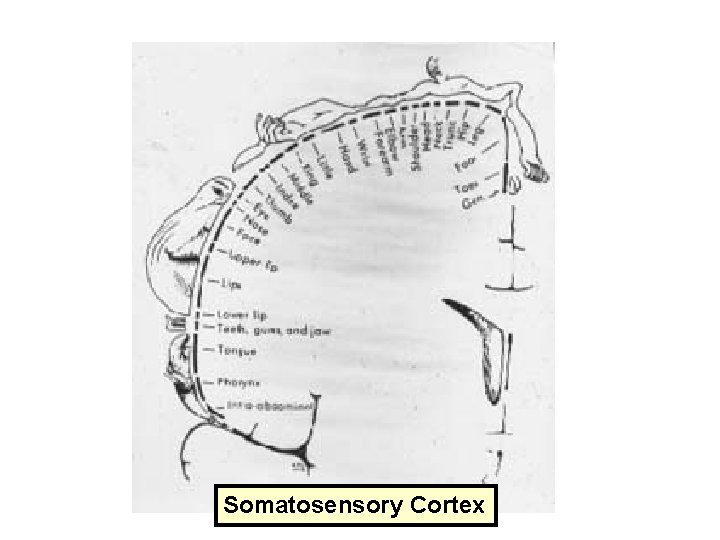
Somatosensory Cortex
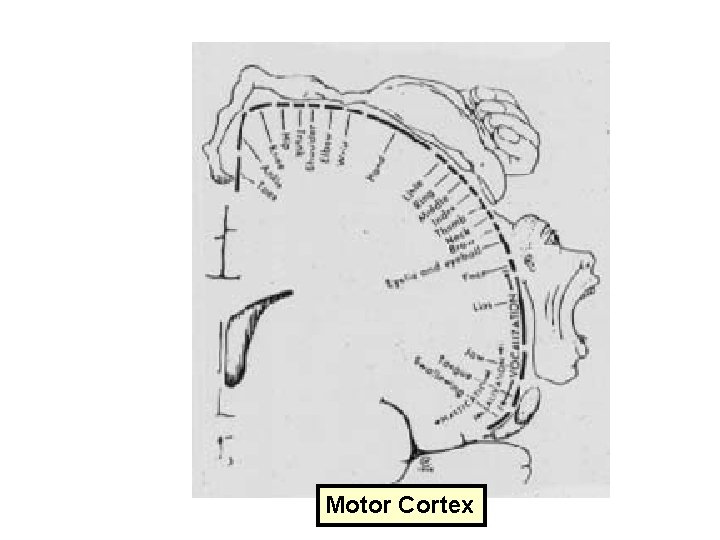
Motor Cortex
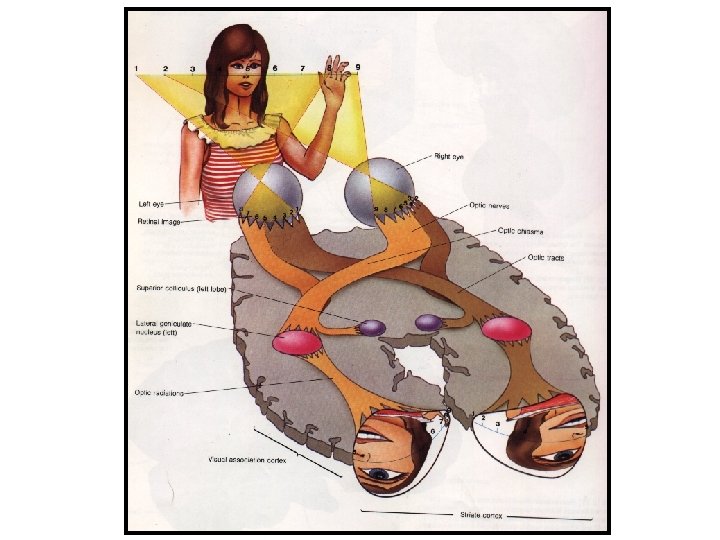
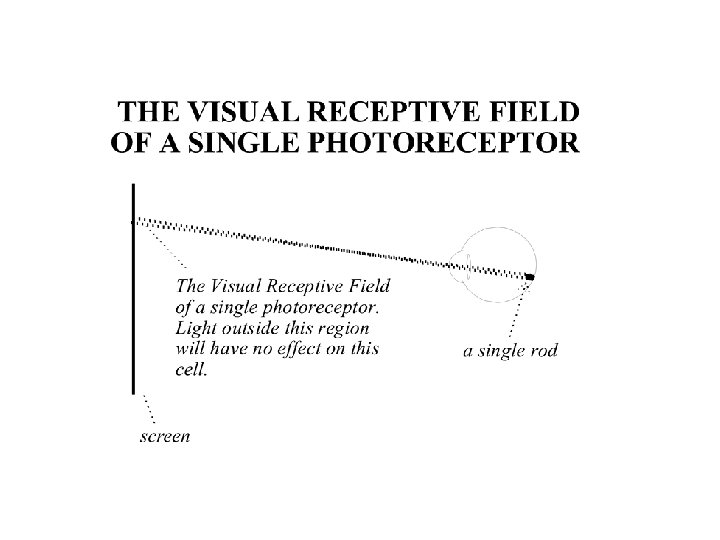
Common structure of the senses • Receptive fields • sense organ -> cortex via THALAMUS • heirarchy and parallel systems • topographic arrangement
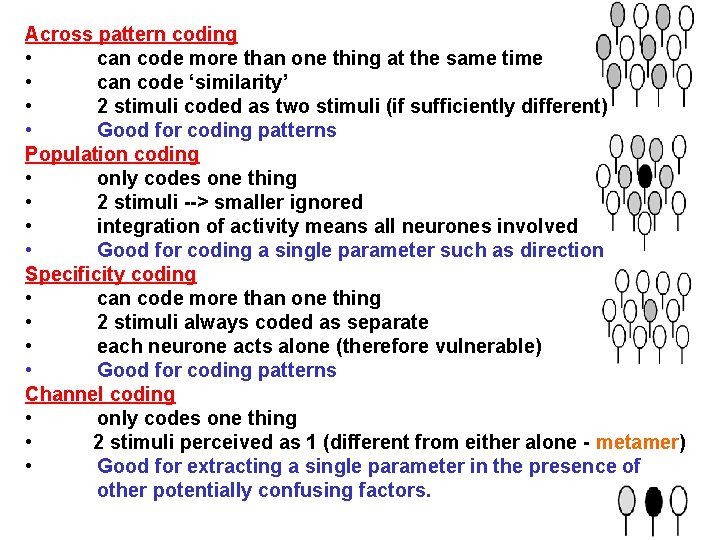
Across pattern coding • can code more than one thing at the same time • can code ‘similarity’ • 2 stimuli coded as two stimuli (if sufficiently different) • Good for coding patterns Population coding • only codes one thing • 2 stimuli --> smaller ignored • integration of activity means all neurones involved • Good for coding a single parameter such as direction Specificity coding • can code more than one thing • 2 stimuli always coded as separate • each neurone acts alone (therefore vulnerable) • Good for coding patterns Channel coding • only codes one thing • 2 stimuli perceived as 1 (different from either alone - metamer) • Good for extracting a single parameter in the presence of other potentially confusing factors.
SUMMARY Properties of neurones, action potentials, synapses Transduction in sensory cells Coding of modality, intensity, duration, location Overview of structure of the brain and some of its maps Common structure of the different senses Coding mechanisms within the senses
Psychophysics section 2
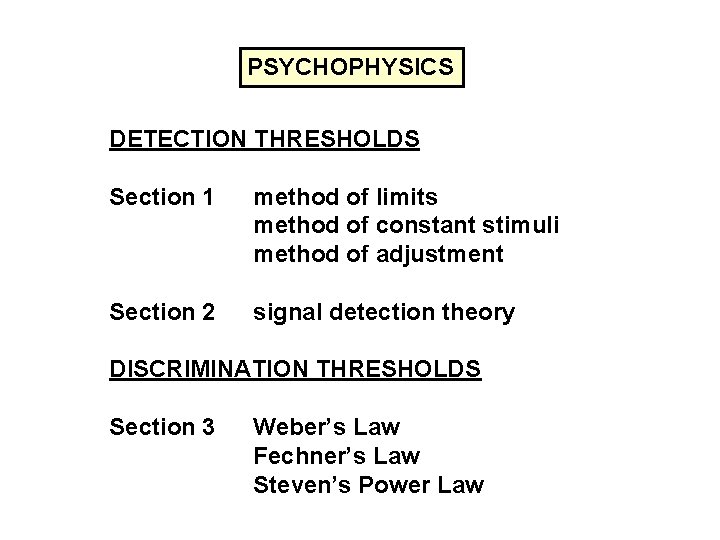
PSYCHOPHYSICS DETECTION THRESHOLDS Section 1 method of limits method of constant stimuli method of adjustment Section 2 signal detection theory DISCRIMINATION THRESHOLDS Section 3 Weber’s Law Fechner’s Law Steven’s Power Law
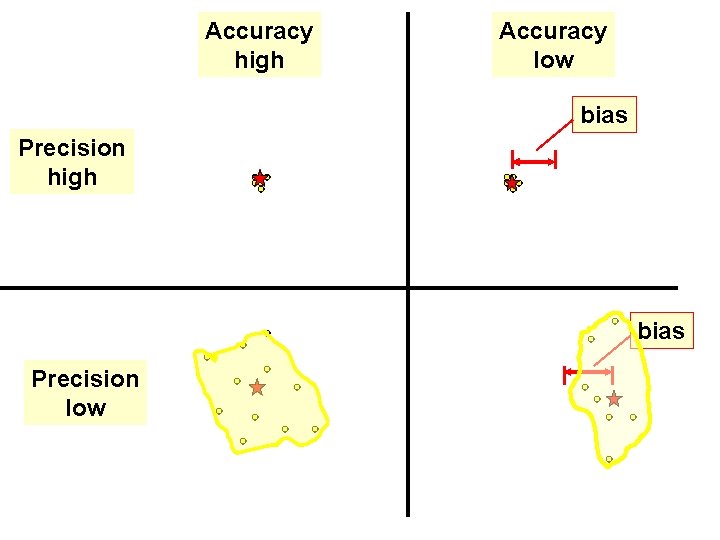
Accuracy high Accuracy low bias Precision high bias Precision low
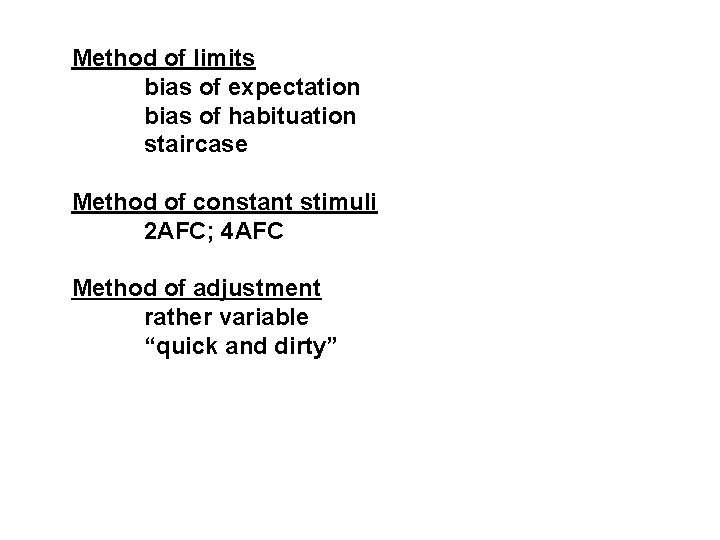
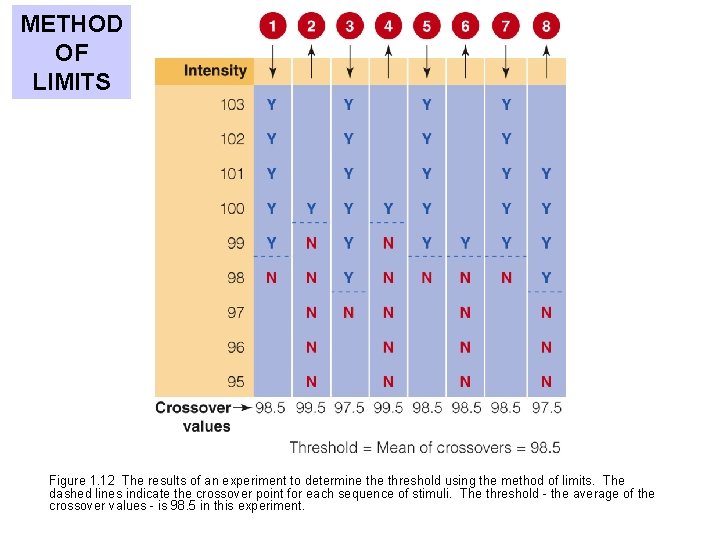
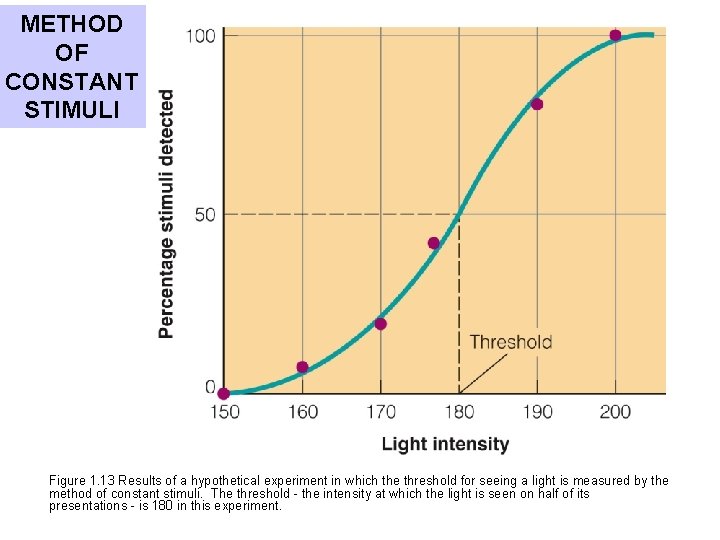
Method of limits bias of expectation bias of habituation staircase Method of constant stimuli 2 AFC; 4 AFC Method of adjustment rather variable “quick and dirty”
METHOD OF LIMITS Figure 1. 12 The results of an experiment to determine threshold using the method of limits. The dashed lines indicate the crossover point for each sequence of stimuli. The threshold - the average of the crossover values - is 98. 5 in this experiment.
METHOD OF CONSTANT STIMULI Figure 1. 13 Results of a hypothetical experiment in which the threshold for seeing a light is measured by the method of constant stimuli. The threshold - the intensity at which the light is seen on half of its presentations - is 180 in this experiment.
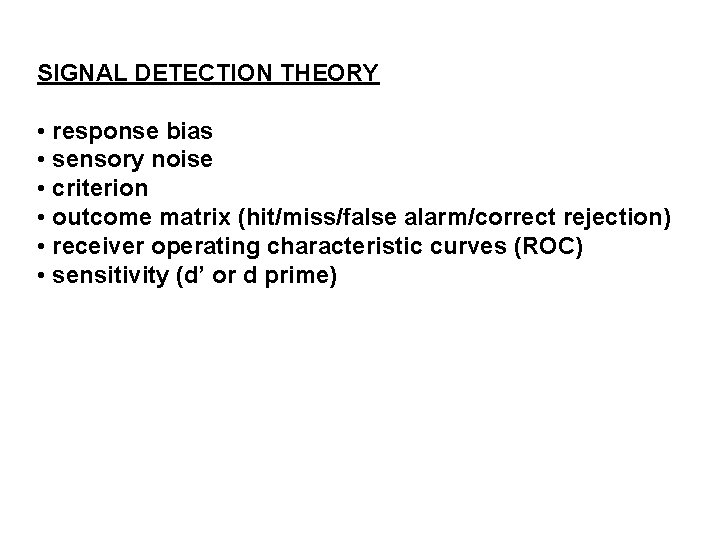
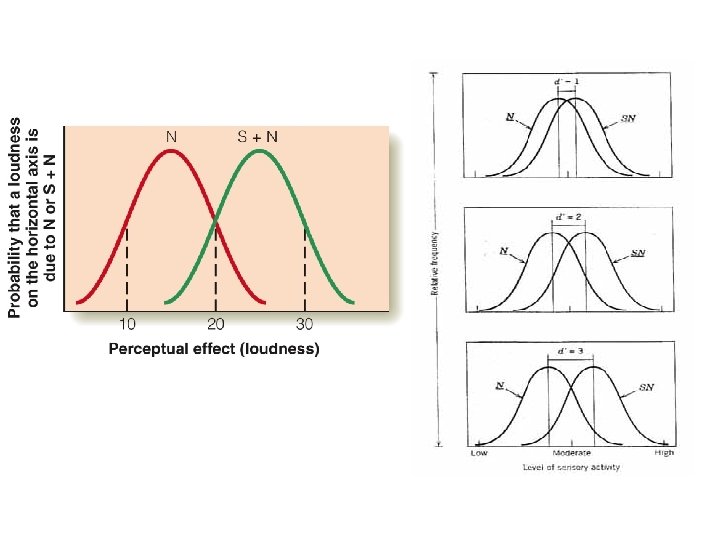
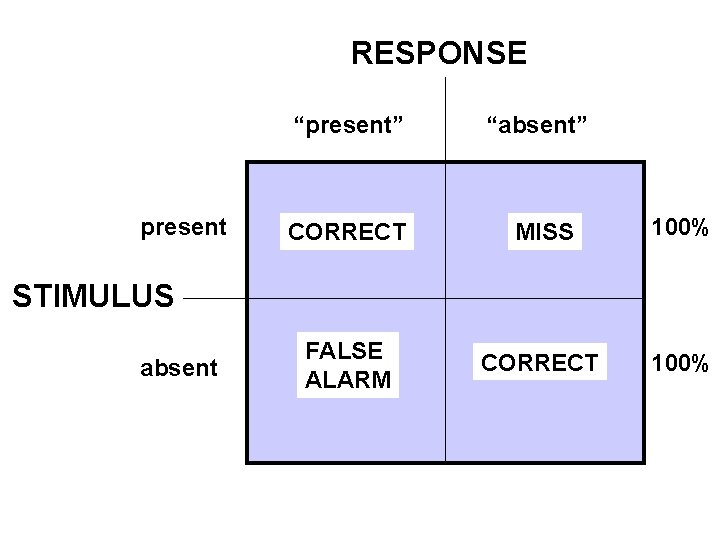
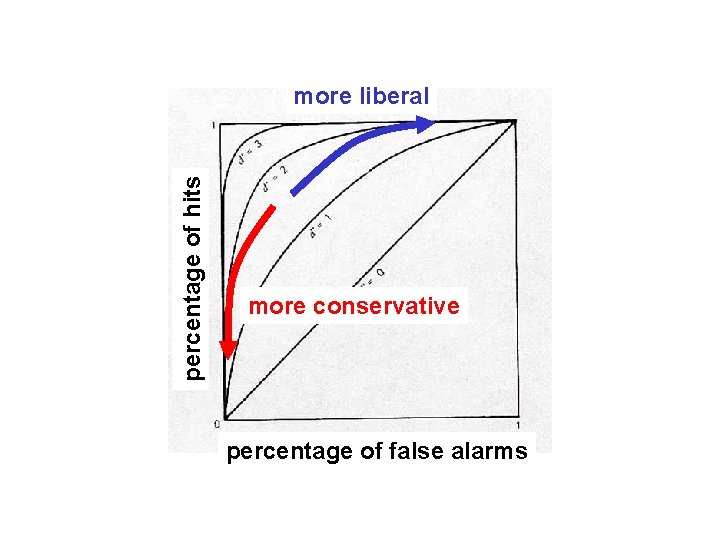
SIGNAL DETECTION THEORY • response bias • sensory noise • criterion • outcome matrix (hit/miss/false alarm/correct rejection) • receiver operating characteristic curves (ROC) • sensitivity (d’ or d prime)
RESPONSE “present” present “absent” CORRECT MISS 100% FALSE ALARM CORRECT 100% STIMULUS absent
percentage of hits more liberal more conservative percentage of false alarms
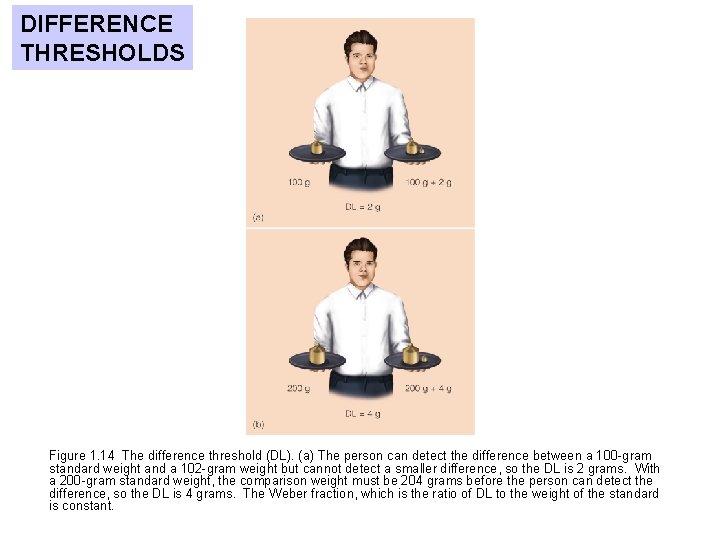
DIFFERENCE THRESHOLDS Figure 1. 14 The difference threshold (DL). (a) The person can detect the difference between a 100 -gram standard weight and a 102 -gram weight but cannot detect a smaller difference, so the DL is 2 grams. With a 200 -gram standard weight, the comparison weight must be 204 grams before the person can detect the difference, so the DL is 4 grams. The Weber fraction, which is the ratio of DL to the weight of the standard is constant.
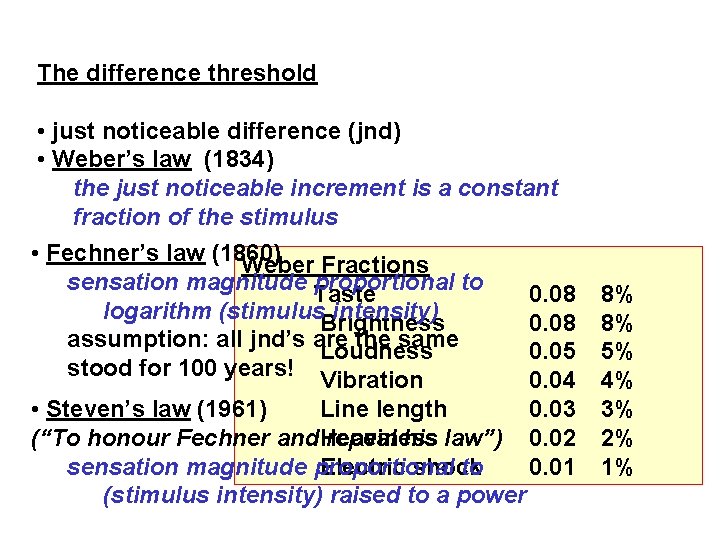
The difference threshold • just noticeable difference (jnd) • Weber’s law (1834) the just noticeable increment is a constant fraction of the stimulus • Fechner’s law (1860) Weber Fractions sensation magnitude Taste proportional to 0. 08 logarithm (stimulus. Brightness intensity) 0. 08 assumption: all jnd’s are the same Loudness 0. 05 stood for 100 years! Vibration 0. 04 • Steven’s law (1961) Line length 0. 03 (“To honour Fechner and. Heaviness repeal his law”) 0. 02 sensation magnitude proportional to Electric shock 0. 01 (stimulus intensity) raised to a power 8% 8% 5% 4% 3% 2% 1%
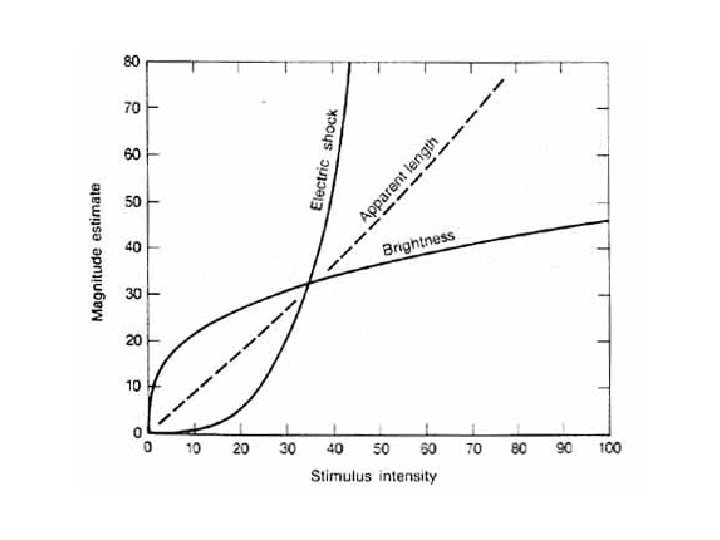
Consequences of Steven’s Law • response compression • response expansion • linear on a log scale
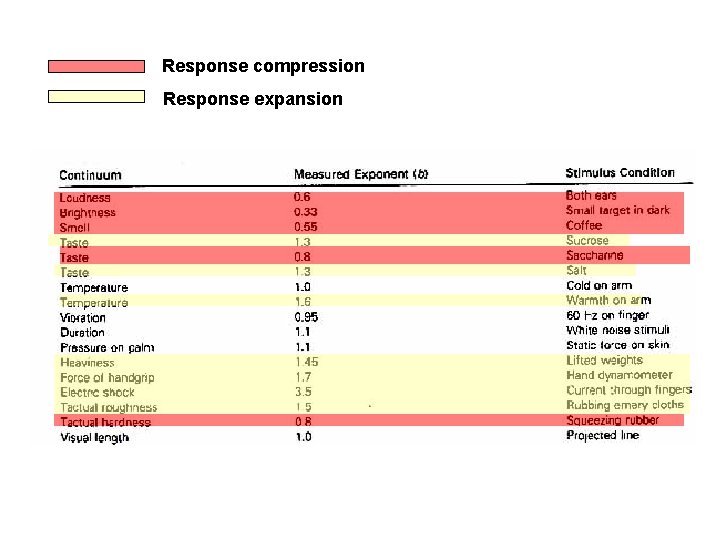
Response compression Response expansion