
Principles of National Accounting Presented by Gurnain Kaur
Principles of National Accounting Presented by: Gurnain Kaur Pasricha Sept 8, 2006
Overview National Income Accounting Relationships/Identities: Ø 1. 2. 3. 4. 5. 6. Ø Three measures of GDP. Domestic and National Product Domestic/National Product and Disposable Income Savings-Investment Gap and the Current Account Balance and Net Lending/Borrowing Measures of Government Deficit. Real vs. Nominal Measures
Gross Domestic Product GDP l l A commonly used measure of standard of living. (Other measures: GNI, GNDI all in ‘real terms’) Market value of final goods and services produced in the territory of an economy, in a given time period.
Ø ‘Final goods and services’ : Those that are available for final uses in the given time period. l Final uses: Consumption, capital formation and export Ø ‘Territory’: includes territorial waters, embassies and missions abroad.
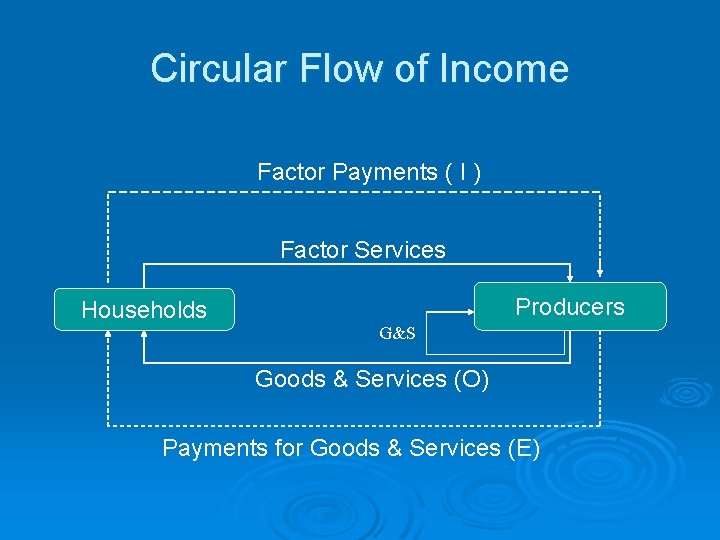
Circular Flow of Income Factor Payments ( I ) Factor Services Households Producers G&S Goods & Services (O) Payments for Goods & Services (E)
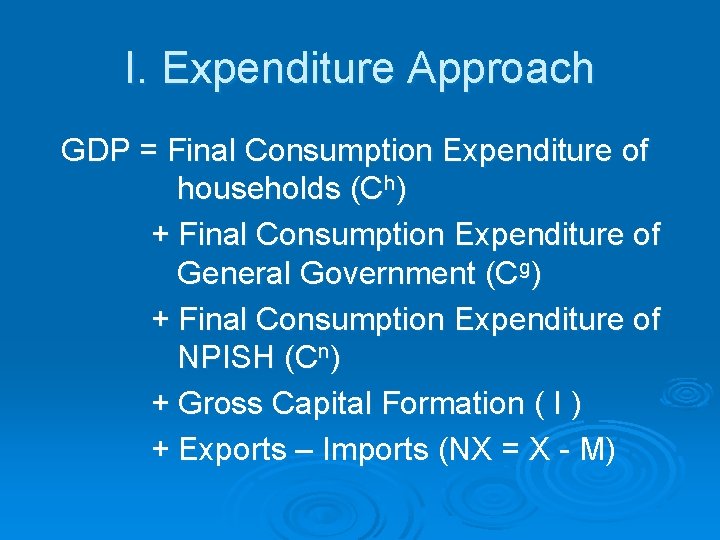
I. Expenditure Approach GDP = Final Consumption Expenditure of households (Ch) + Final Consumption Expenditure of General Government (Cg) + Final Consumption Expenditure of NPISH (Cn) + Gross Capital Formation ( I ) + Exports – Imports (NX = X - M)
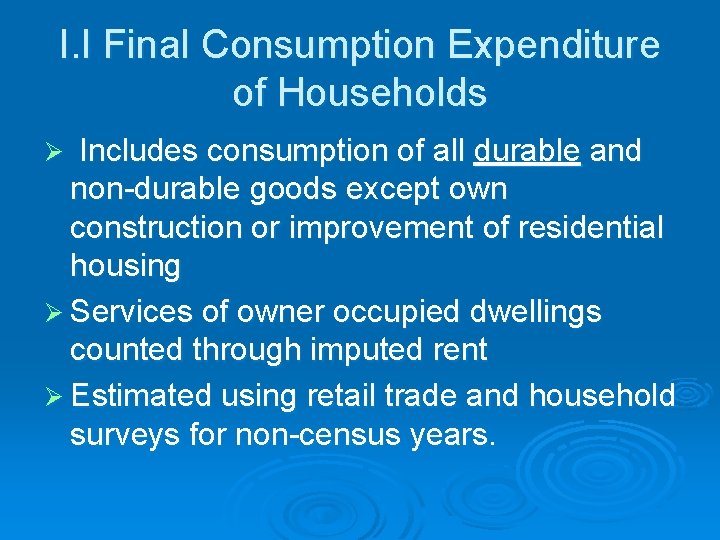
I. I Final Consumption Expenditure of Households Includes consumption of all durable and non-durable goods except own construction or improvement of residential housing Ø Services of owner occupied dwellings counted through imputed rent Ø Estimated using retail trade and household surveys for non-census years. Ø
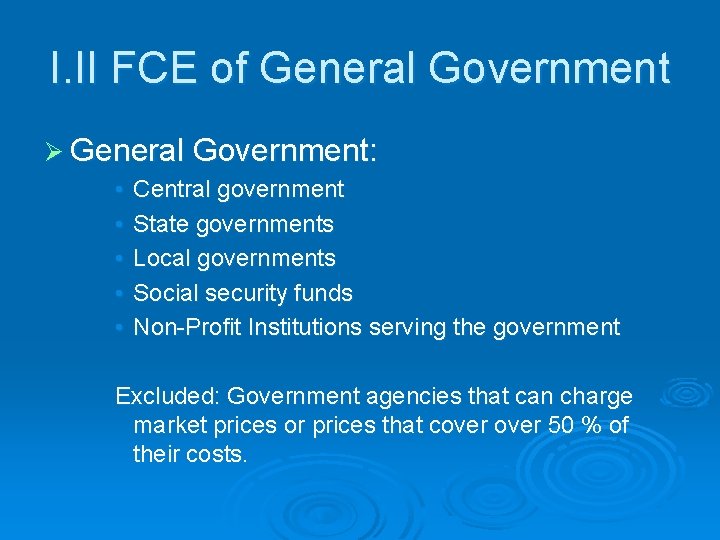
I. II FCE of General Government Ø General Government: • • • Central government State governments Local governments Social security funds Non-Profit Institutions serving the government Excluded: Government agencies that can charge market prices or prices that cover 50 % of their costs.
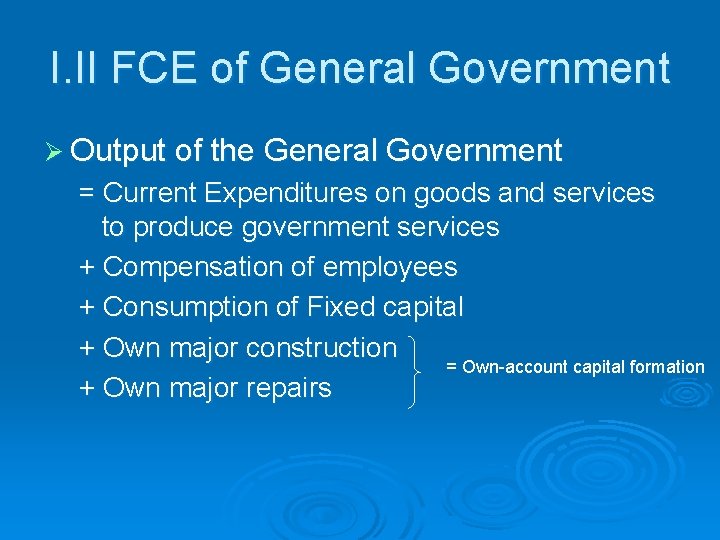
I. II FCE of General Government Ø Output of the General Government = Current Expenditures on goods and services to produce government services + Compensation of employees + Consumption of Fixed capital + Own major construction = Own-account capital formation + Own major repairs
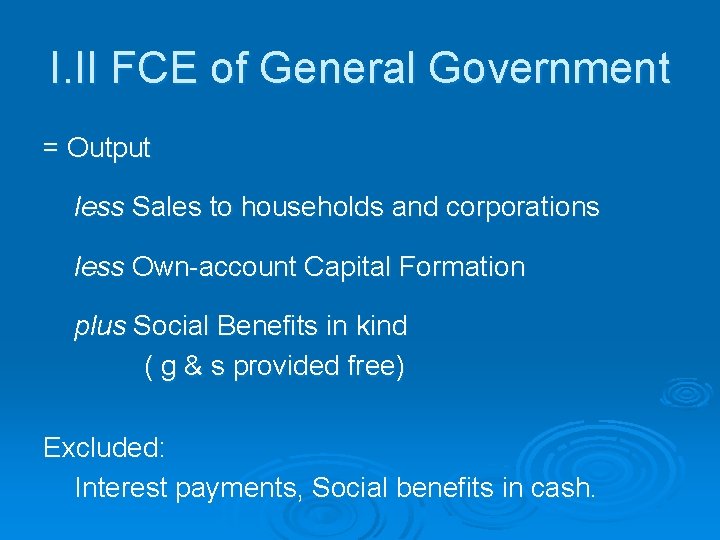
I. II FCE of General Government = Output less Sales to households and corporations less Own-account Capital Formation plus Social Benefits in kind ( g & s provided free) Excluded: Interest payments, Social benefits in cash.
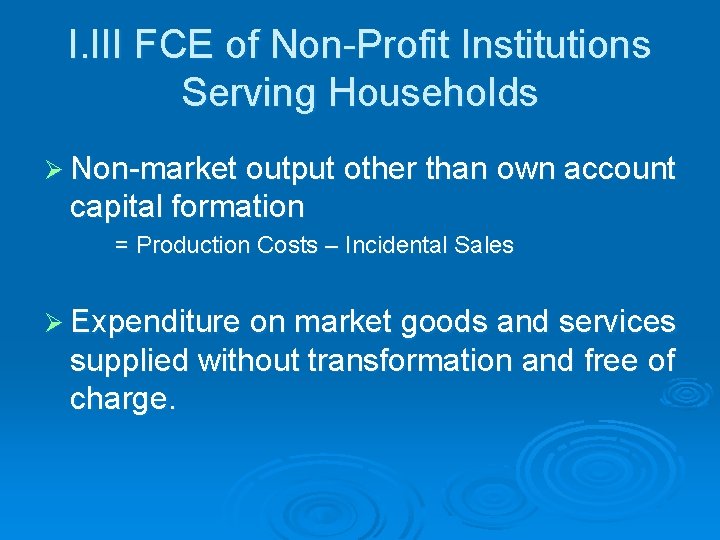
I. III FCE of Non-Profit Institutions Serving Households Ø Non-market output other than own account capital formation = Production Costs – Incidental Sales Ø Expenditure on market goods and services supplied without transformation and free of charge.
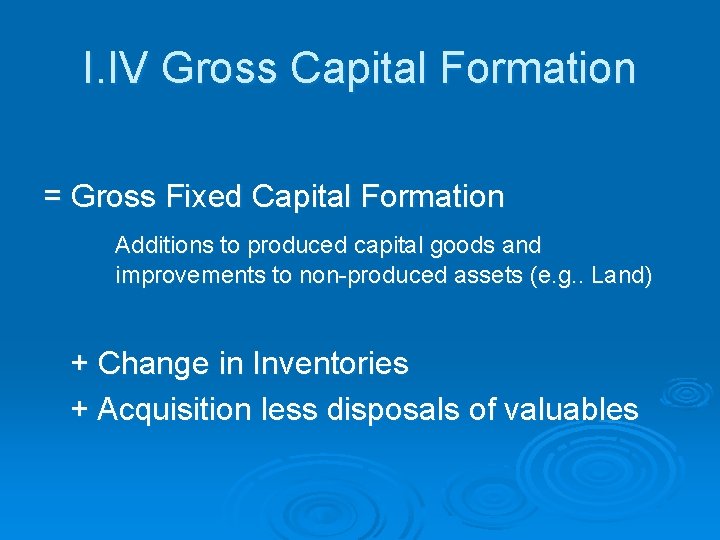
I. IV Gross Capital Formation = Gross Fixed Capital Formation Additions to produced capital goods and improvements to non-produced assets (e. g. . Land) + Change in Inventories + Acquisition less disposals of valuables
I. V Net Exports Ø Exports and Imports are transactions involving an exchange of goods and services between residents and nonresidents of an economy. Ø Exclude transactions in non-movable non- produced assets (e. g. Land), buildings and in financial assets.
Residents vs. Non-Residents Ø A resident of an economy is an economic agent whose center of economic interest is in the economy in question. l Center of interest identified by • length of stay – usually a year or more. • Ownership of land or structures Ø Treatment of : l l l Students International organizations Military personnel and civil servants
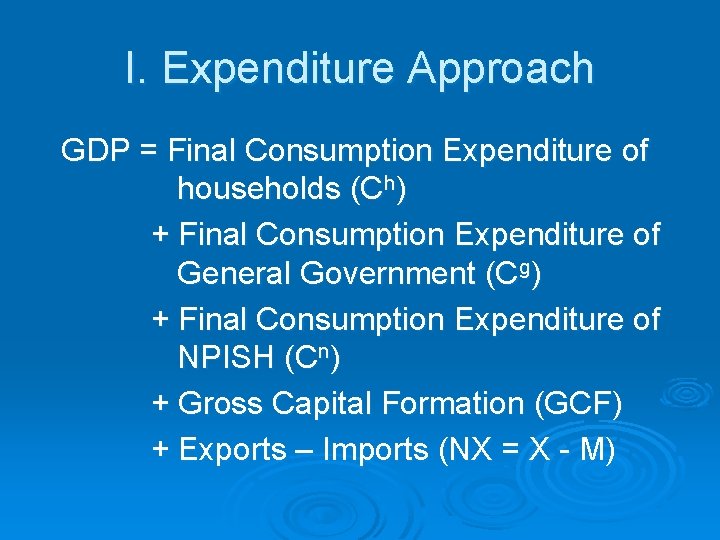
I. Expenditure Approach GDP = Final Consumption Expenditure of households (Ch) + Final Consumption Expenditure of General Government (Cg) + Final Consumption Expenditure of NPISH (Cn) + Gross Capital Formation (GCF) + Exports – Imports (NX = X - M)
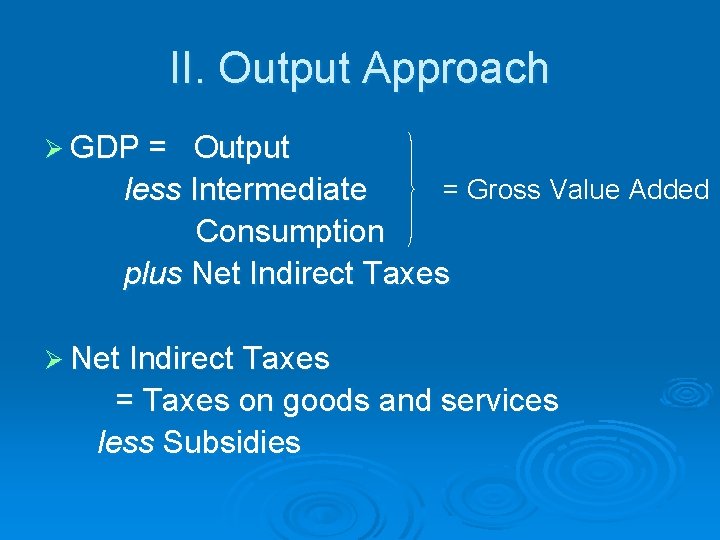
II. Output Approach Ø GDP = Output = Gross Value Added less Intermediate Consumption plus Net Indirect Taxes Ø Net Indirect Taxes = Taxes on goods and services less Subsidies
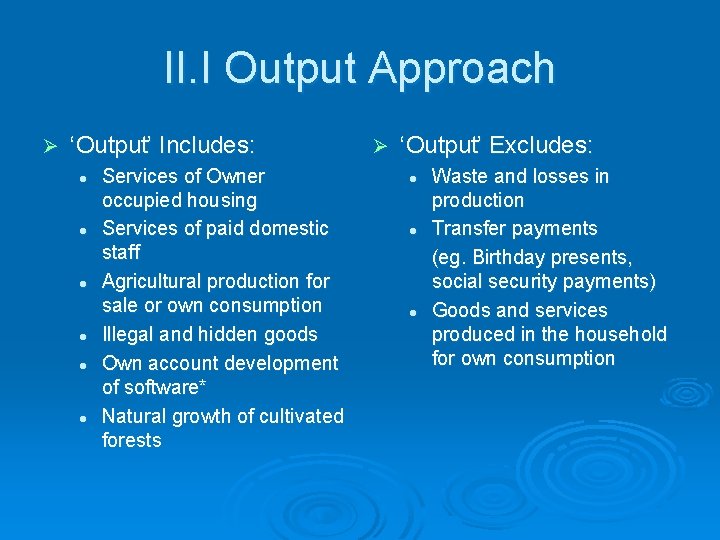
II. I Output Approach Ø ‘Output’ Includes: l l l Services of Owner occupied housing Services of paid domestic staff Agricultural production for sale or own consumption Illegal and hidden goods Own account development of software* Natural growth of cultivated forests Ø ‘Output’ Excludes: l l l Waste and losses in production Transfer payments (eg. Birthday presents, social security payments) Goods and services produced in the household for own consumption
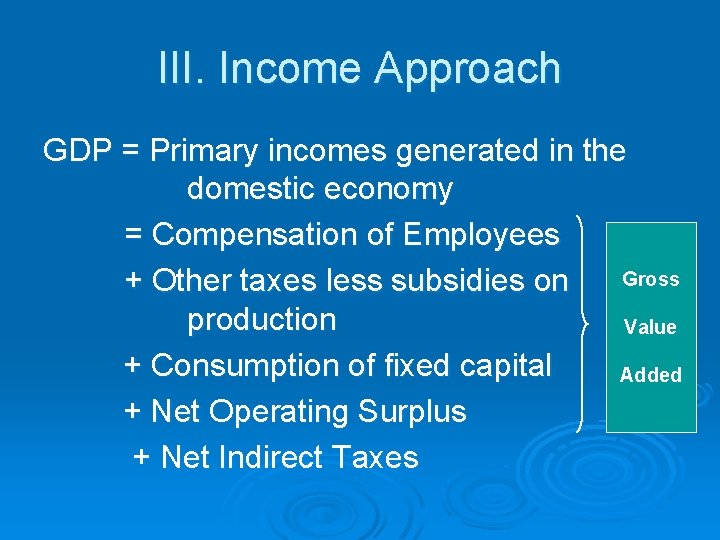
III. Income Approach GDP = Primary incomes generated in the domestic economy = Compensation of Employees Gross + Other taxes less subsidies on production Value + Consumption of fixed capital Added + Net Operating Surplus + Net Indirect Taxes
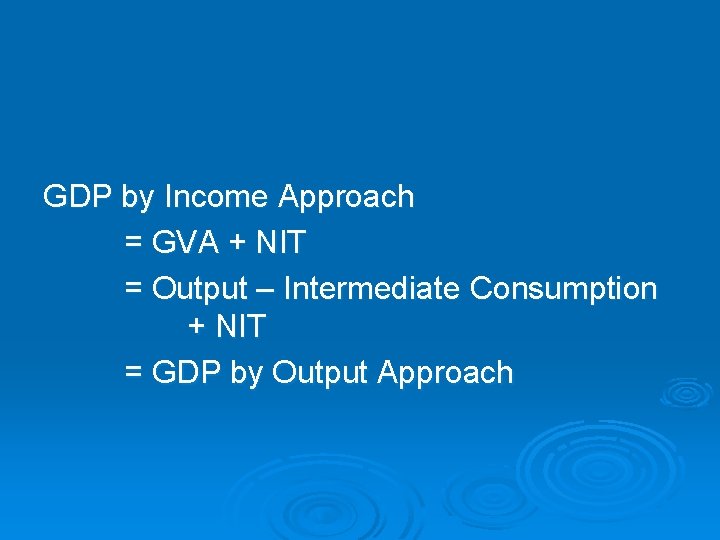
GDP by Income Approach = GVA + NIT = Output – Intermediate Consumption + NIT = GDP by Output Approach
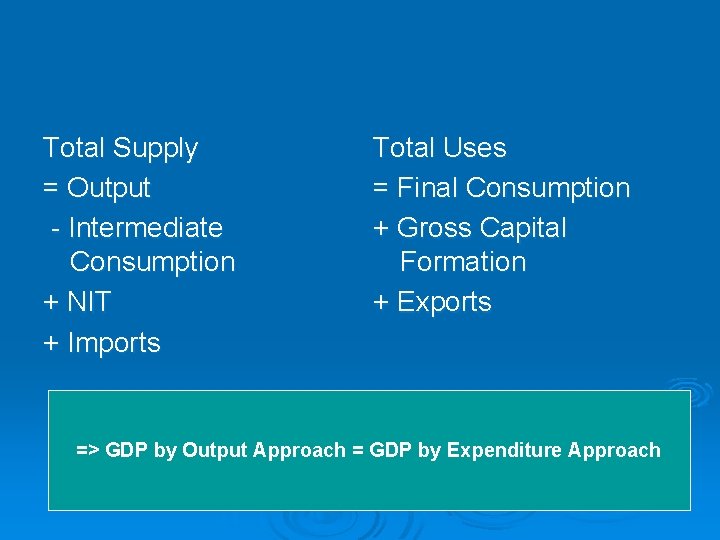
Total Supply = Output - Intermediate Consumption + NIT + Imports Total Uses = Final Consumption + Gross Capital Formation + Exports => GDP by Output Approach = GDP by Expenditure Approach
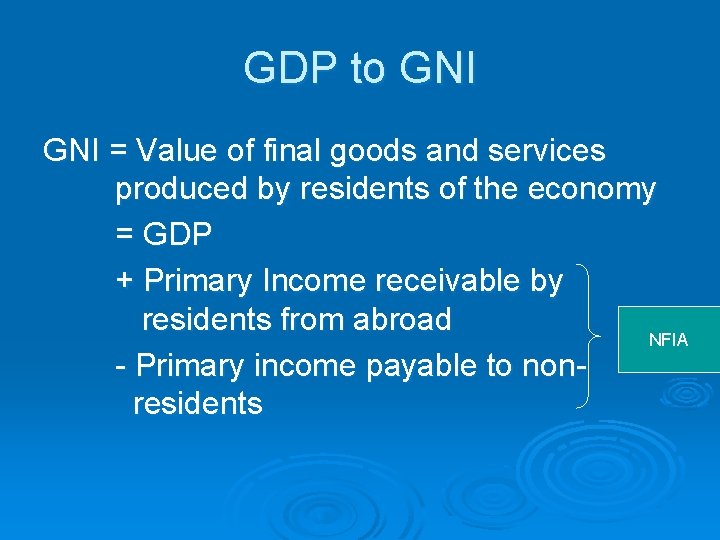
GDP to GNI = Value of final goods and services produced by residents of the economy = GDP + Primary Income receivable by residents from abroad NFIA - Primary income payable to nonresidents
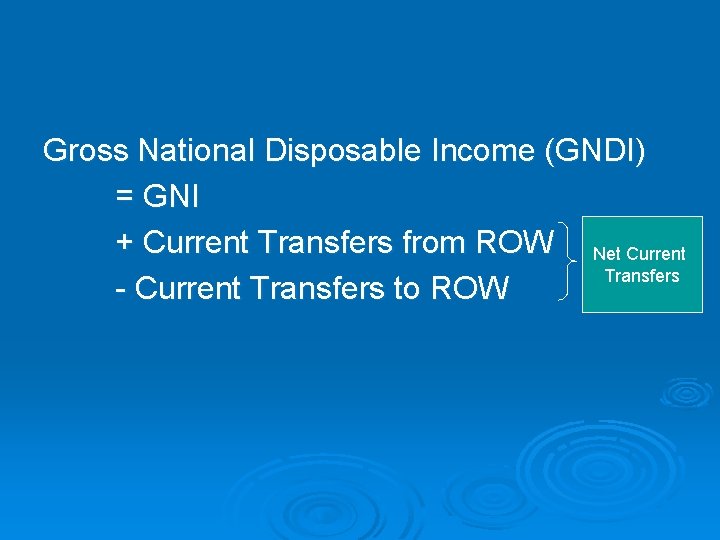
Gross National Disposable Income (GNDI) = GNI + Current Transfers from ROW Net Current Transfers - Current Transfers to ROW
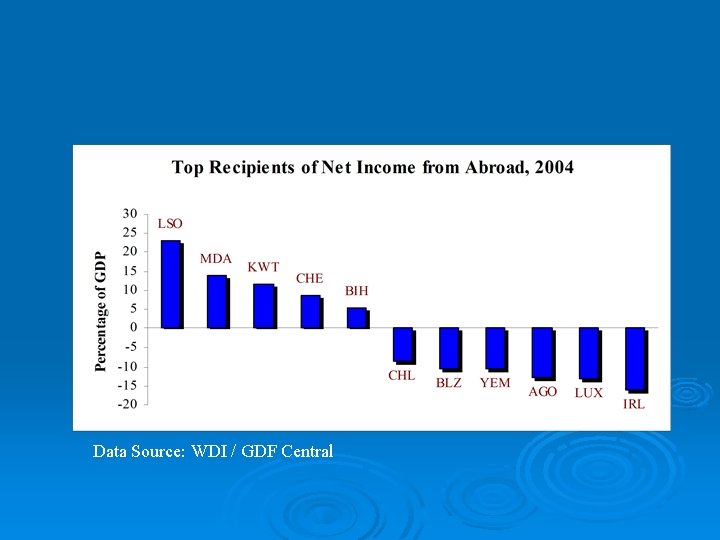
Data Source: WDI / GDF Central
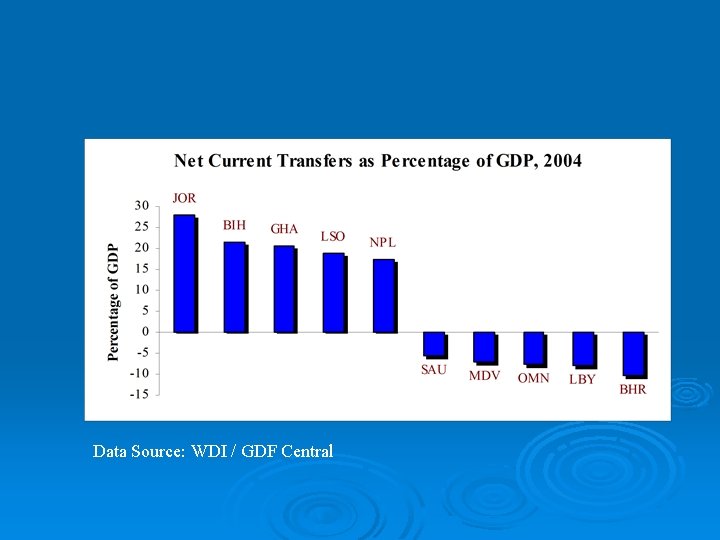
Data Source: WDI / GDF Central
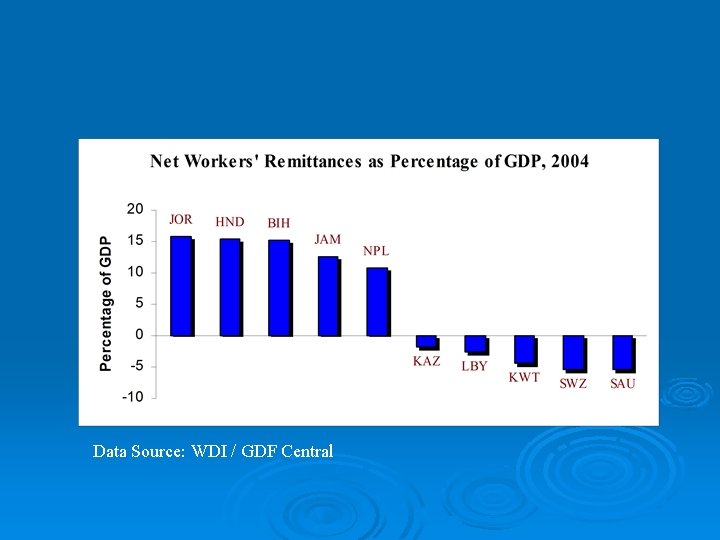
Data Source: WDI / GDF Central
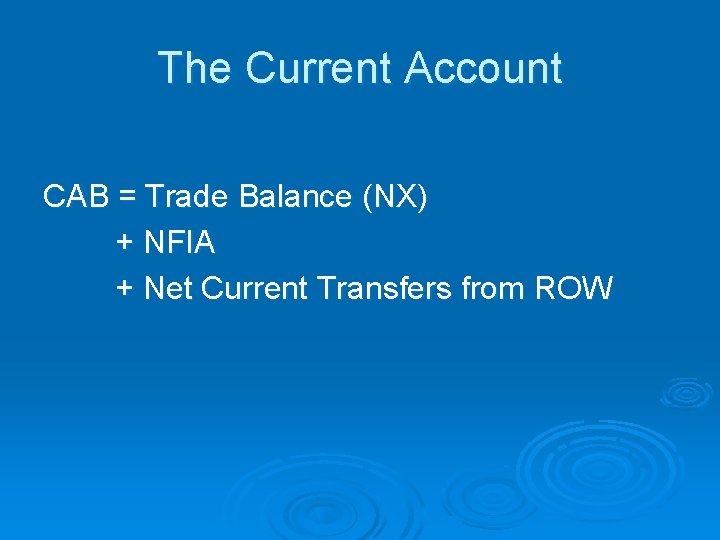
The Current Account CAB = Trade Balance (NX) + NFIA + Net Current Transfers from ROW
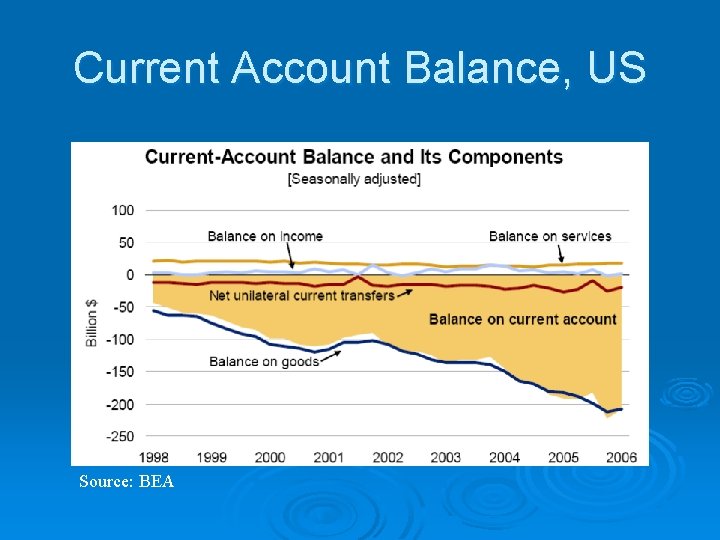
Current Account Balance, US Source: BEA
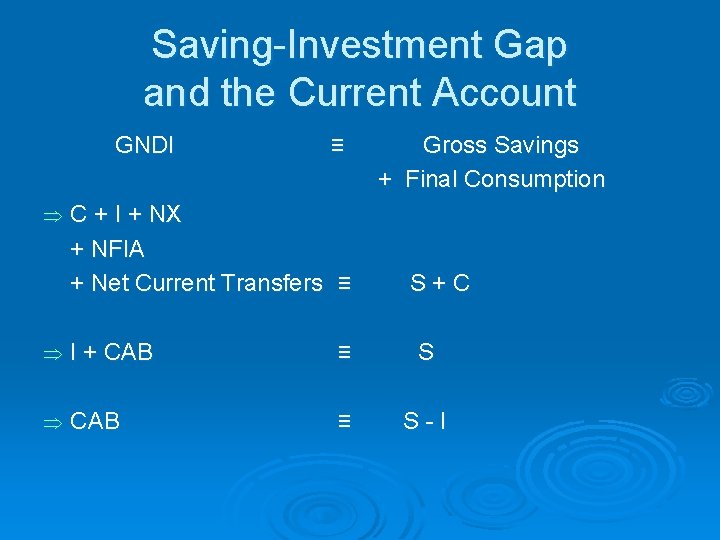
Saving-Investment Gap and the Current Account GNDI Þ ≡ C + I + NX + NFIA + Net Current Transfers ≡ Gross Savings + Final Consumption S+C Þ I + CAB ≡ S Þ CAB ≡ S-I
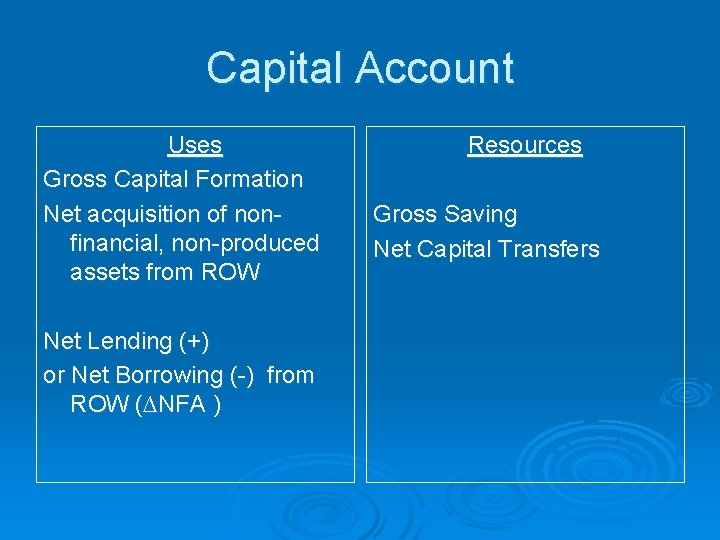
Capital Account Uses Gross Capital Formation Net acquisition of nonfinancial, non-produced assets from ROW Net Lending (+) or Net Borrowing (-) from ROW (∆NFA ) Resources Gross Saving Net Capital Transfers
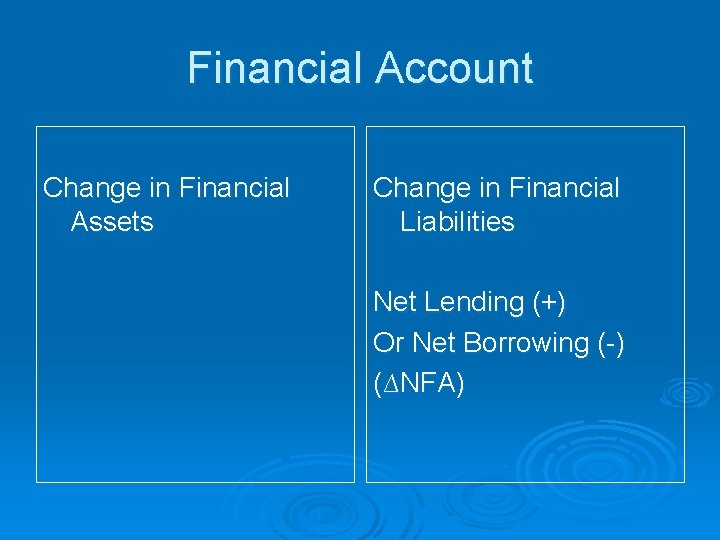
Financial Account Change in Financial Assets Change in Financial Liabilities Net Lending (+) Or Net Borrowing (-) (∆NFA)
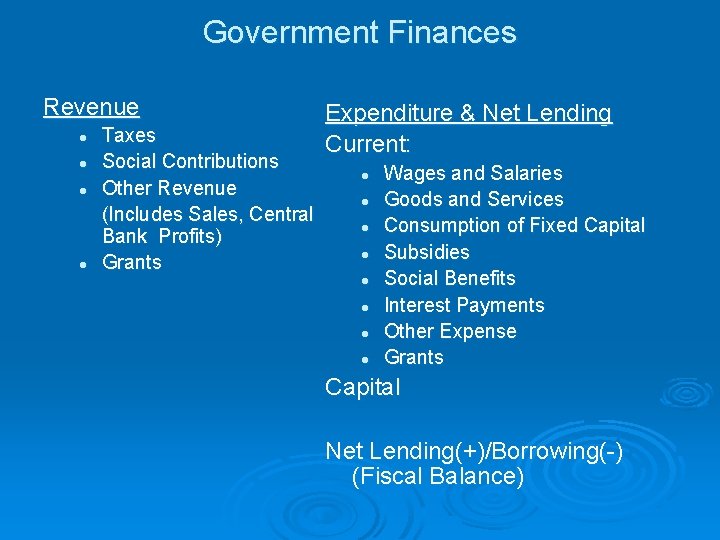
Government Finances Revenue l l Taxes Social Contributions Other Revenue (Includes Sales, Central Bank Profits) Grants Expenditure & Net Lending Current: l l l l Wages and Salaries Goods and Services Consumption of Fixed Capital Subsidies Social Benefits Interest Payments Other Expense Grants Capital Net Lending(+)/Borrowing(-) (Fiscal Balance)
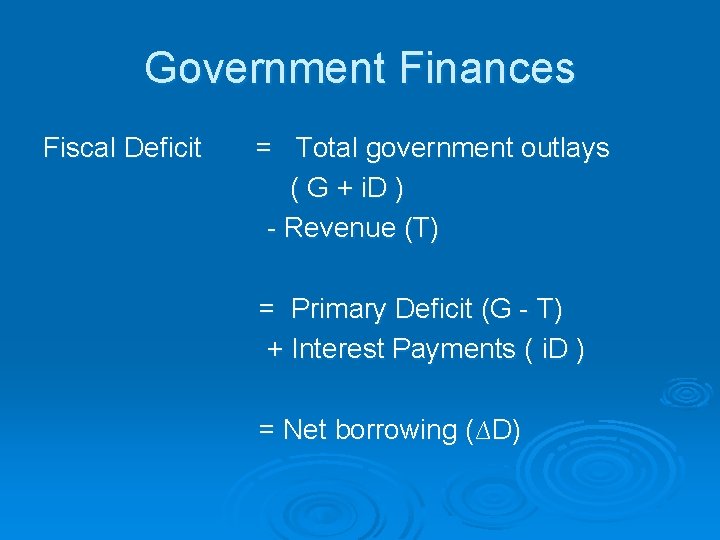
Government Finances Fiscal Deficit = Total government outlays ( G + i. D ) - Revenue (T) = Primary Deficit (G - T) + Interest Payments ( i. D ) = Net borrowing (∆D)
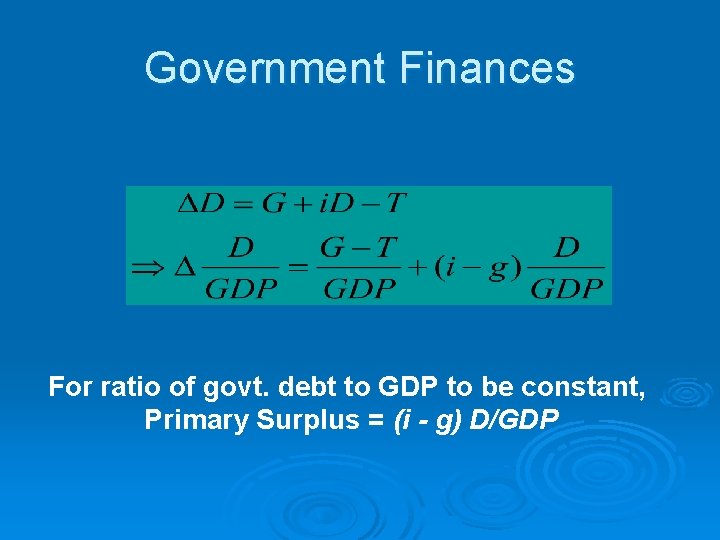
Government Finances For ratio of govt. debt to GDP to be constant, Primary Surplus = (i - g) D/GDP
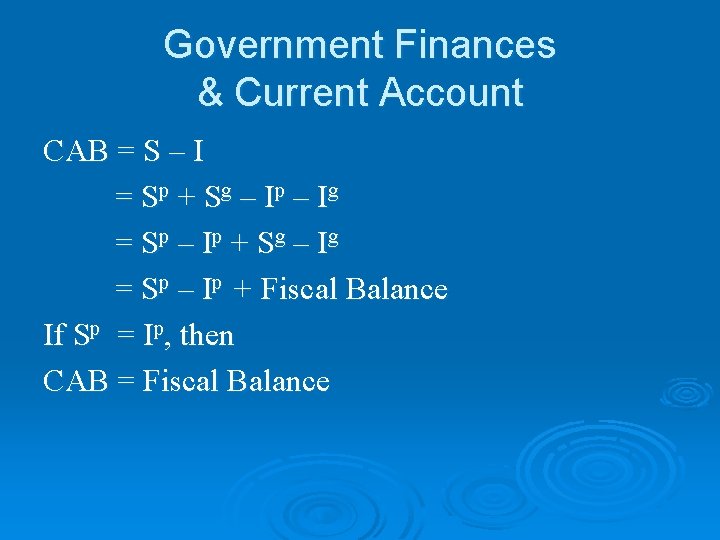
Government Finances & Current Account CAB = S – I = S p + S g – Ip – Ig = S p – Ip + S g – Ig = Sp – Ip + Fiscal Balance If Sp = Ip, then CAB = Fiscal Balance
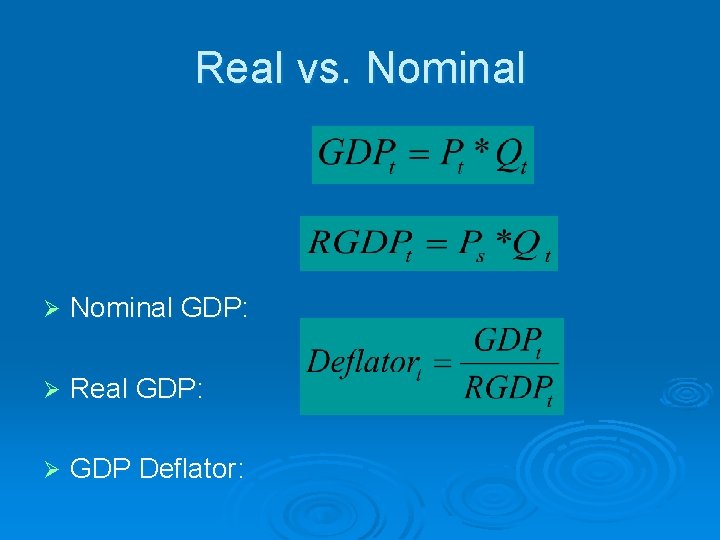
Real vs. Nominal Ø Nominal GDP: Ø Real GDP: Ø GDP Deflator:
Comparison across countries Conversion using market exchange rates Ø PPP: An exchange rate between currencies that equalizes their purchasing power. Ø l l l Eg: A Liter of Pepsi costs $2 in US and € 2. 5 in Germany, then the PPP exchange rate for Pepsi is € 1. 25/$. PPP for product groups computed as geometric average of within-group price relatives Aggregated using expenditure weights for product groups in GDP.
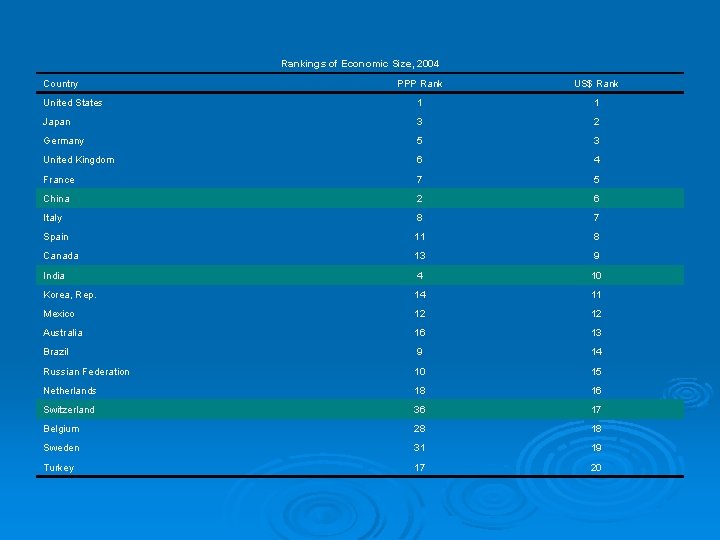
Rankings of Economic Size, 2004 Country PPP Rank US$ Rank United States 1 1 Japan 3 2 Germany 5 3 United Kingdom 6 4 France 7 5 China 2 6 Italy 8 7 Spain 11 8 Canada 13 9 India 4 10 Korea, Rep. 14 11 Mexico 12 12 Australia 16 13 Brazil 9 14 Russian Federation 10 15 Netherlands 18 16 Switzerland 36 17 Belgium 28 18 Sweden 31 19 Turkey 17 20
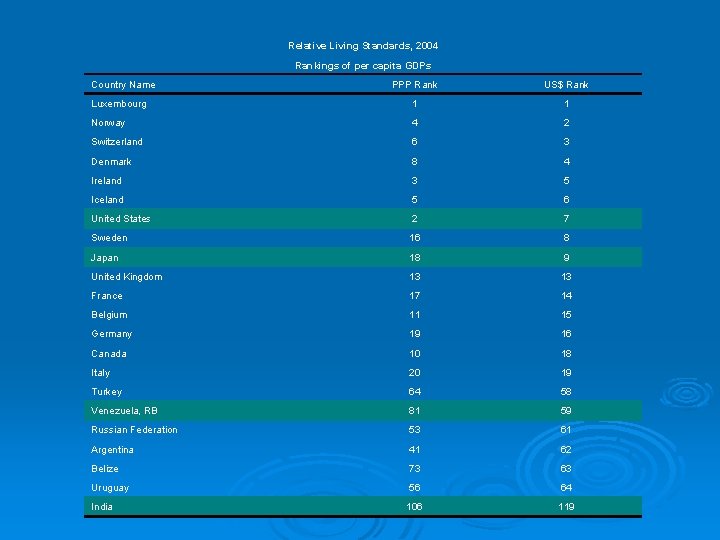
Relative Living Standards, 2004 Rankings of per capita GDPs Country Name PPP Rank US$ Rank Luxembourg 1 1 Norway 4 2 Switzerland 6 3 Denmark 8 4 Ireland 3 5 Iceland 5 6 United States 2 7 Sweden 16 8 Japan 18 9 United Kingdom 13 13 France 17 14 Belgium 11 15 Germany 19 16 Canada 10 18 Italy 20 19 Turkey 64 58 Venezuela, RB 81 59 Russian Federation 53 61 Argentina 41 62 Belize 73 63 Uruguay 56 64 India 106 119
“The wisest mind has something yet to learn. ” George Santayana (1863 - 1952)
- Slides: 39