
PRINCIPLES OF MOTIVATIONAL INTERVIEWING Deborah von Hapsburg Ph

PRINCIPLES OF MOTIVATIONAL INTERVIEWING Deborah von Hapsburg, Ph. D.
GOALS Goal 1: To introduce methods and processes to engage patients in the process of change Goal 2: To introduce the concept and principles of motivational interviewing (MI) Goal 3: To understand the decision making process and the Decision Balance method Goal 4: To introduce the Process of Change model Goal 5: To understand how MI techniques in combination with understanding decisional balance and the process of change can be used synergistically to help improve patient outcomes in Audiology Slide 2 februar 22
FACTS Fact 1: Patients with chronic illness selfmanage their conditions. Fact 2: Patients are in control no matter what we, as health professionals, do or say. Slide 3 februar 22
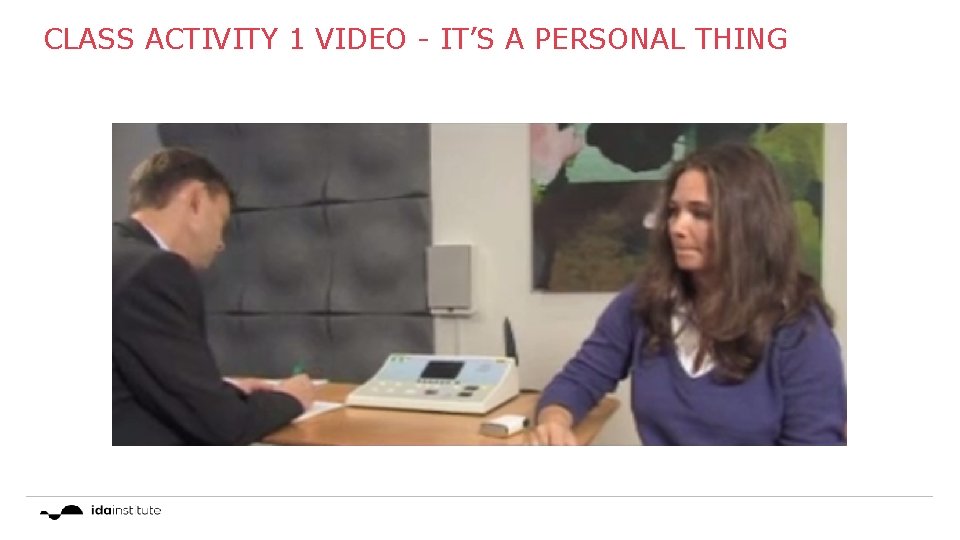
CLASS ACTIVITY 1 VIDEO - IT’S A PERSONAL THING
WAYS TO SUPPORT CLIENTS Motivational Interviewing (Miller and Rollnick, 2002, 2012) Decisional Balance (Janis and Mann, 1977) Stages of Change (Prochaska and Di. Clemente, 1983) Slide 5 februar 22
WHAT IS OUR ROLE IN PROMOTING CHANGE? Patient’s Role: Clinician’s Role: • When it comes to changing life-style and behaviors give ownership and control back to the patient. • Introduce the language or question of change and keep it on the agenda • Open the dialogue • Support patients as they do the hard work themselves Slide 6 februar 22
WHAT IS MOTIVATIONAL INTERVIEWING? “Motivational Interviewing is a collaborative, goal-oriented style of communication with particular attention to the language of change. It is designed to strengthen personal motivation for and commitment to a specific goal by eliciting and exploring the person’s own reasons for change within an atmosphere of acceptance and compassion. ” (Miller & Rollnick, 2012) Slide 7 februar 22
MOTIVATIONAL INTERVIEWING - FOUNDATIONS 1. Patient-centered counseling approach 2. Resistance to change and ambivalence are normal processes in changing behaviors, and should be recognized and accepted. 3. Motivation to change is situational and can fluctuate depending on personal experiences. 4. The main focus of MI is to facilitate behavior change by helping patients to explore and resolve their ambivalence about behavior change. 5. MI is a protocol that can be used to increase patient adherence to audiologic recommendations. (Miller & Rollnick, 2002) Slide 8 februar 22
PRINCIPLES OF MOTIVATIONAL INTERVIEWING - RULE R - Resist the righting reflex: Roll with Resistance U - Understand your client’s motivation: Develop Discrepancy L - Listen to your client: Express Empathy and Avoid Argumentation E - Empower your client: Self-Efficacy Slide 9 februar 22
ROLES IN MOTIVATIONAL INTERVIEWING Patient’s task: • To articulate and resolve his/her own ambivalence Practitioner’s tasks: • To expect and recognize ambivalence and to be directive in helping the patient examine and resolve the ambivalence Slide 10 februar 22
OVERVIEW OF STEPS IN THE MOTIVATIONAL INTERVIEW PROCESS 1. Understand the Patient Perspective 2. Identify Change Talk 3. Use a guiding style 4. Help develop discrepancy with Tools (pros and cons) 5. Understand how important it is to change 6. Understand how confident they feel about changing Slide 11 februar 22
SUMMARY OF MOTIVATIONAL INTERVIEWING 3 Core Concepts 4 Core Principles 3 Core Skills • Readiness • Ambivalence • Resistance • • • Empathic listening • Eliciting self-motivation statements • Responding to resistance Express Empathy Develop Discrepancy Roll with Resistance Support Self Efficacy Slide 12 februar 22
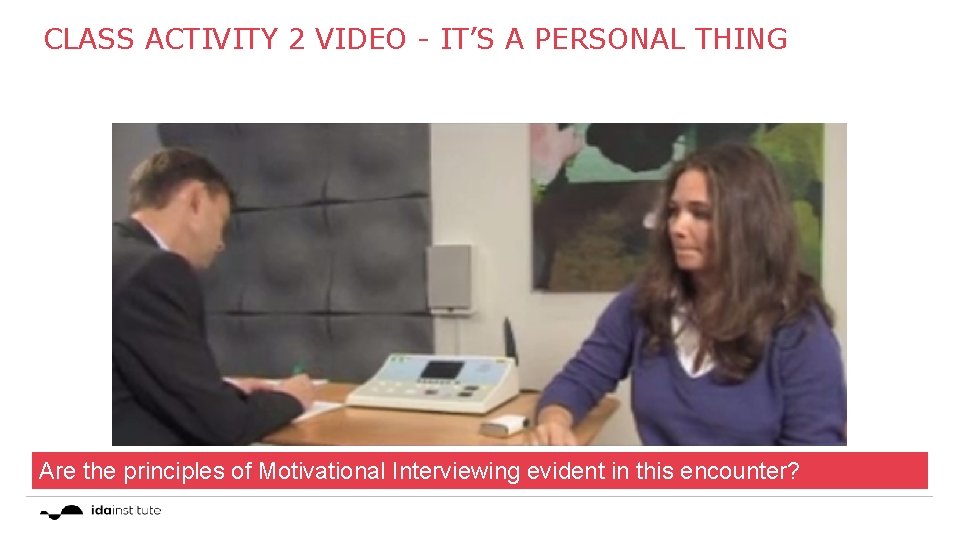
CLASS ACTIVITY 2 VIDEO - IT’S A PERSONAL THING Are the principles of Motivational Interviewing evident in this encounter?
CLASS DISCUSSION - RULE R - Resist the righting reflex: Roll with Resistance U - Understand your client’s motivation: Develop Discrepancy L - Listen to your client: Express Empathy and Avoid Argumentation E - Empower your client: Self-Efficacy Slide 14 februar 22
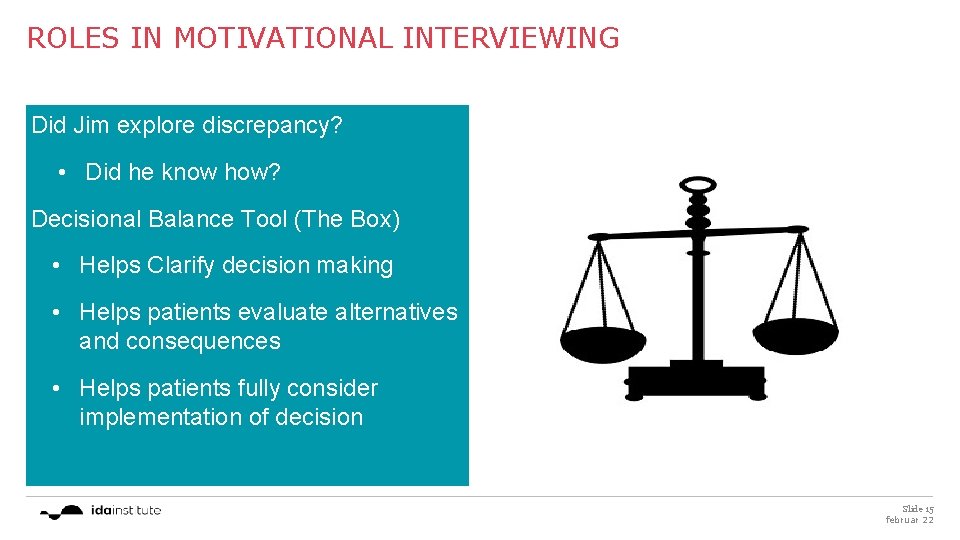
ROLES IN MOTIVATIONAL INTERVIEWING Did Jim explore discrepancy? • Did he know how? Decisional Balance Tool (The Box) • Helps Clarify decision making • Helps patients evaluate alternatives and consequences • Helps patients fully consider implementation of decision Slide 15 februar 22
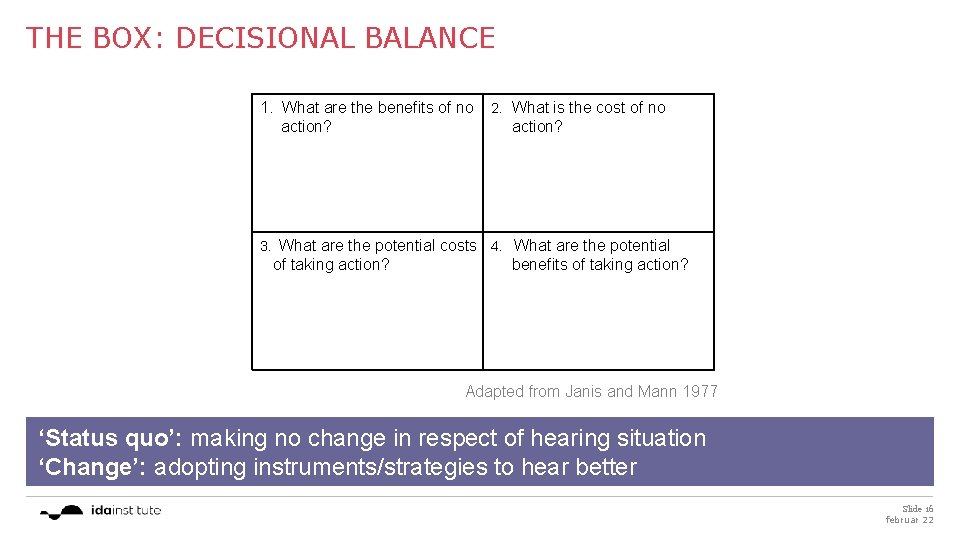
THE BOX: DECISIONAL BALANCE 1. What are the benefits of no action? 2. What is the cost of no action? 3. What are the potential costs 4. What are the potential of taking action? benefits of taking action? Adapted from Janis and Mann 1977 ‘Status quo’: making no change in respect of hearing situation ‘Change’: adopting instruments/strategies to hear better Slide 16 februar 22
TRANSTHEORETICAL MODEL AND THE STAGES OF CHANGE 1. 2. 3. 4. 5. Theory of Intentional Behavior Change Successful change only happens when a person is ready to change Change occurs over time, in a cyclical process Attitude change precedes behavior change Distinct stages mark the change process • • Pre-contemplation Contemplation Preparation Action Maintenance Relapse Permanent Exit ( Prochaska, Di. Clemente, Norcross, 1993) Slide 17 februar 22
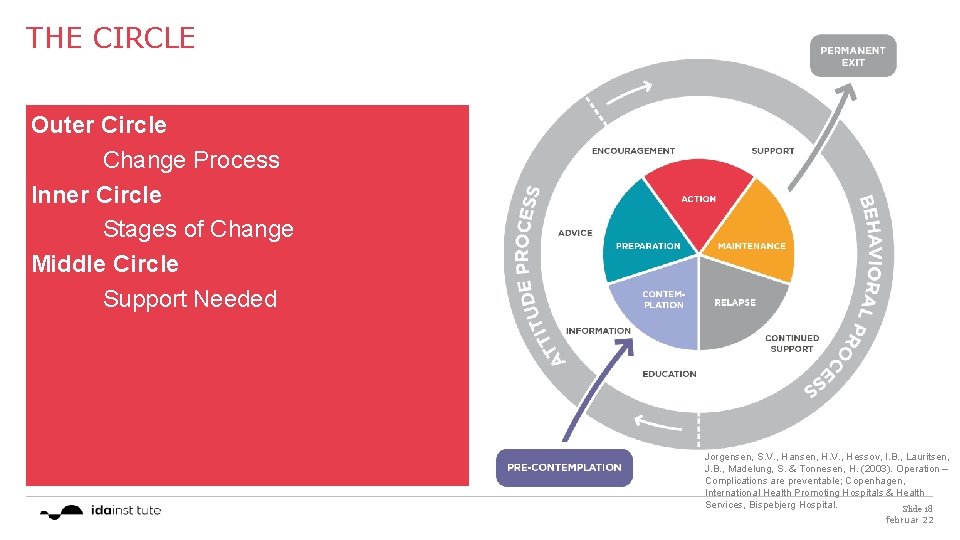
THE CIRCLE Outer Circle Change Process Inner Circle Stages of Change Middle Circle Support Needed Jorgensen, S. V. , Hansen, H. V. , Hessov, I. B. , Lauritsen, J. B. , Madelung, S. & Tonnesen, H. (2003). Operation – Complications are preventable; Copenhagen, International Health Promoting Hospitals & Health Services, Bispebjerg Hospital. Slide 18 februar 22
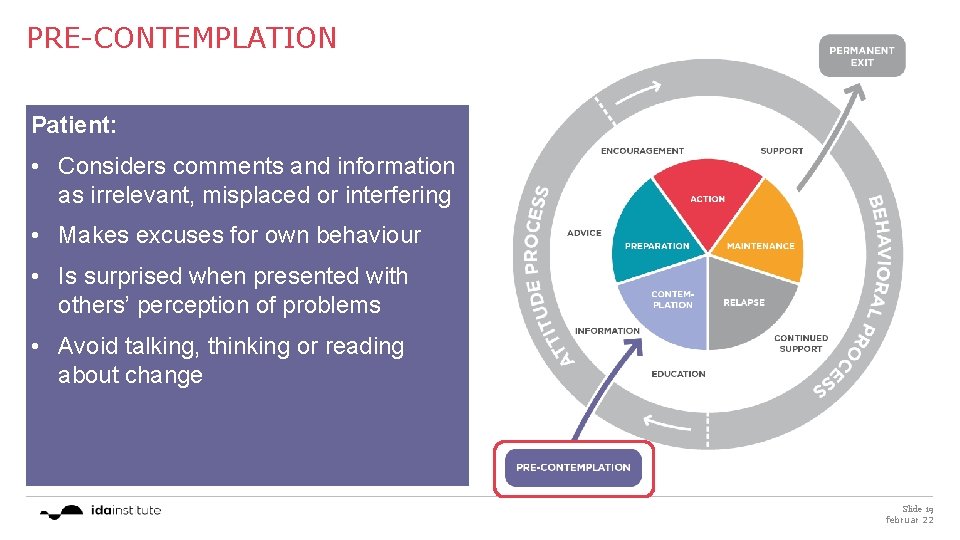
PRE-CONTEMPLATION Patient: • Considers comments and information as irrelevant, misplaced or interfering • Makes excuses for own behaviour • Is surprised when presented with others’ perception of problems • Avoid talking, thinking or reading about change Slide 19 februar 22
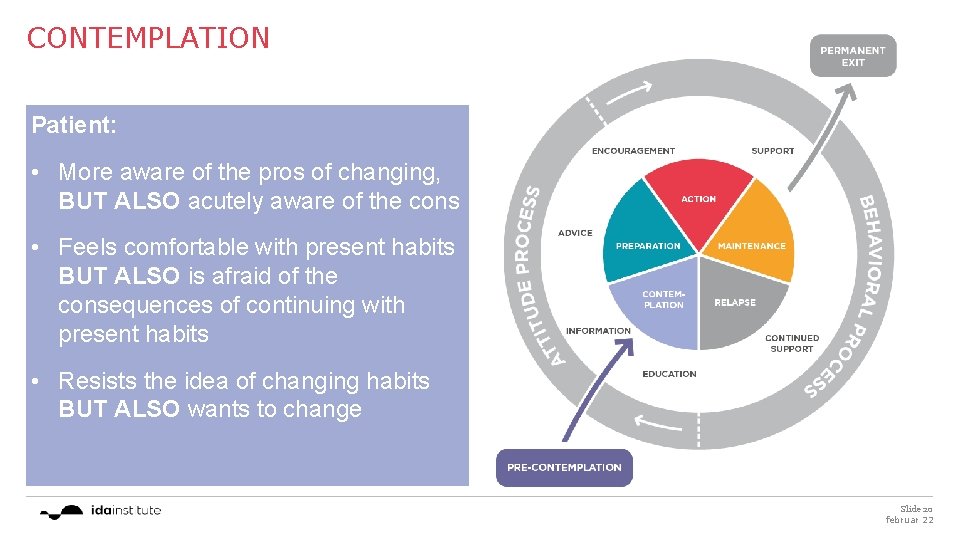
CONTEMPLATION Patient: • More aware of the pros of changing, BUT ALSO acutely aware of the cons • Feels comfortable with present habits BUT ALSO is afraid of the consequences of continuing with present habits • Resists the idea of changing habits BUT ALSO wants to change Slide 20 februar 22
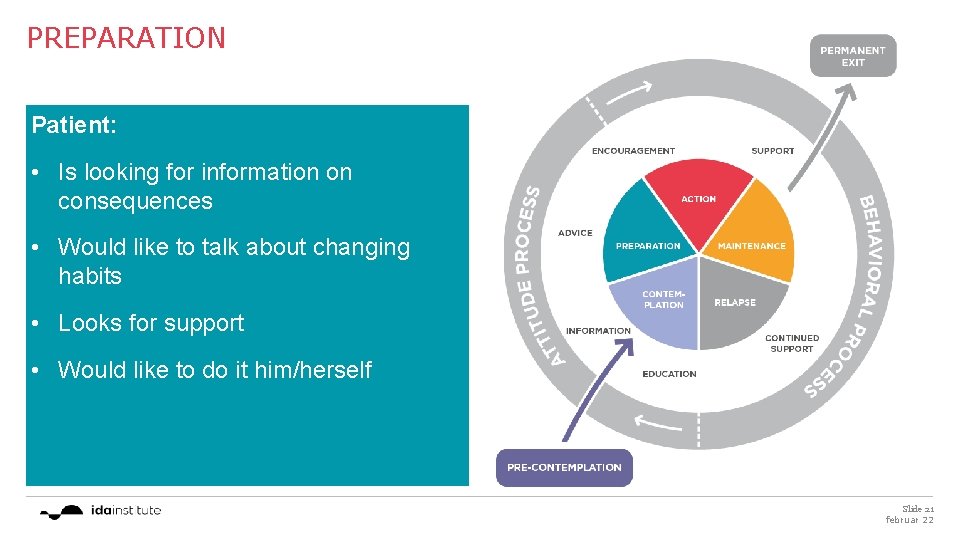
PREPARATION Patient: • Is looking for information on consequences • Would like to talk about changing habits • Looks for support • Would like to do it him/herself Slide 21 februar 22
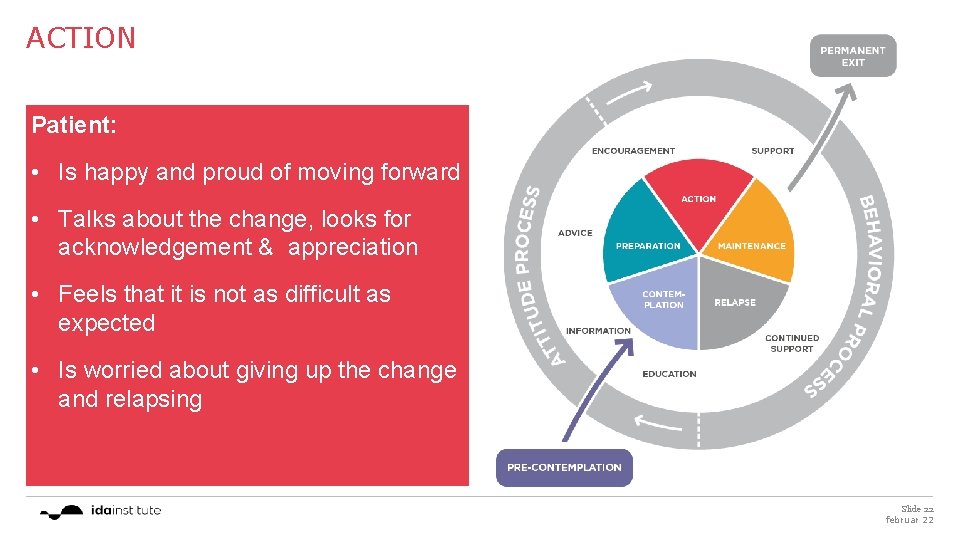
ACTION Patient: • Is happy and proud of moving forward • Talks about the change, looks for acknowledgement & appreciation • Feels that it is not as difficult as expected • Is worried about giving up the change and relapsing Slide 22 februar 22
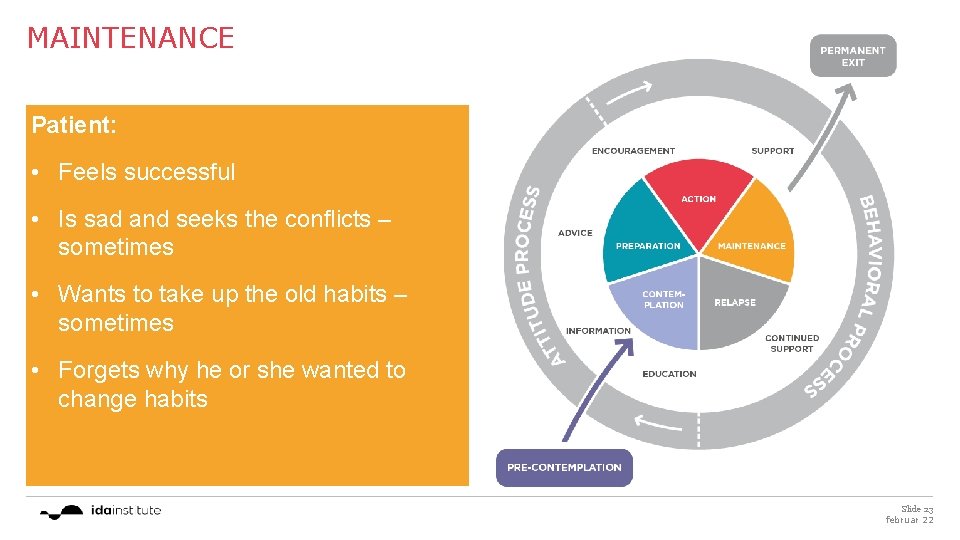
MAINTENANCE Patient: • Feels successful • Is sad and seeks the conflicts – sometimes • Wants to take up the old habits – sometimes • Forgets why he or she wanted to change habits Slide 23 februar 22
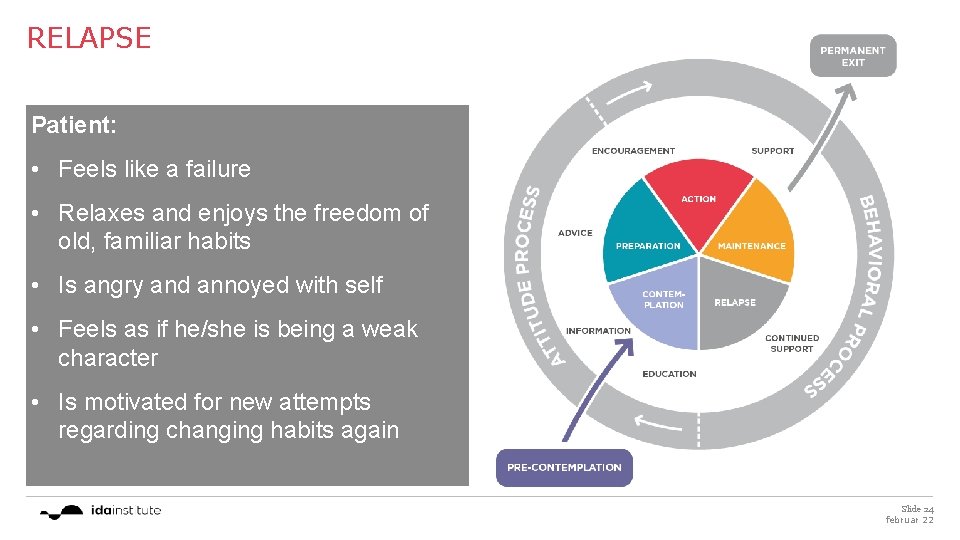
RELAPSE Patient: • Feels like a failure • Relaxes and enjoys the freedom of old, familiar habits • Is angry and annoyed with self • Feels as if he/she is being a weak character • Is motivated for new attempts regarding changing habits again Slide 24 februar 22
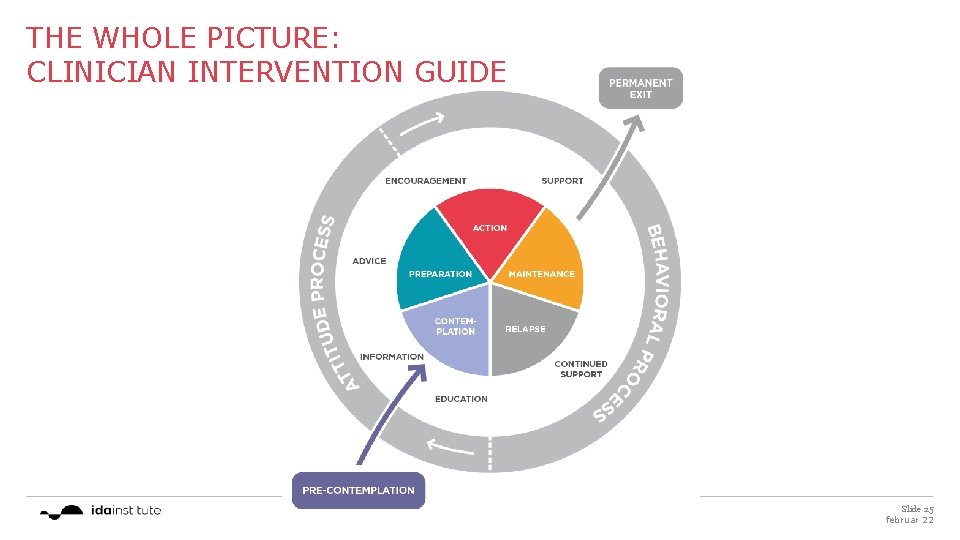
THE WHOLE PICTURE: CLINICIAN INTERVENTION GUIDE Slide 25 februar 22
SUMMARY: ENGAGING PATIENTS IN THE PROCESS OF CHANGE: • Requires use of Motivational Interviewing techniques • To engage people in structured and empathic conversations about the process of change. • It requires knowledge of the decision making process people go through, and uses tools like the decision balance sheet and the line to develop and understand discrepancy. • It requires understanding of the process and the cycle of change in order to tailor the type of counseling and support we provide. • These are used together to effectively and compassionately engage patients facing difficult decisions. Slide 26 februar 22
REFLECTION MOMENT Think about the principles of Motivational Interviewing – RULE. Which one of these principles or set of principles poses the biggest challenge for your clinical practice? Slide 27 februar 22
REFERENCES • Di. Clemente, C. C. (2003). Addiction and Change : How addictions develop and addicted people recover. New York: Guilford Press. • Greer Clark, J. (2010). The Geometry of Motivation: Circles, Lines, & Boxes, Audiology Today, 32 -40. • Miller W. , & Rollnick S. (2002). Motivational Interviewing: Preparing people for change. (2. ed. ). New York: Guilford Press. • Miller, WR and Rollnick, S (2012). Motivational Interviewing: Helping People Change (3 rd Ed. ). New York: Guilford Press. • Prochaska, J. O. , Norcross J. C. , & Di. Clemente, C. C. (1994). A revolutionary six-stage program for overcoming bad habits and moving your life positively forward. Avon Books. • Rollnick, S. , Miller, W. & Butler, C. (2008). Motivational interviewing in health care: Helping patients change behavior. New York: Guilford Press. • Rosengren, D. B. (2009). Building Motivational Interviewing Skills: A practitioner workbook. New York: Guilford Press. • Tønnesen, H. (2012). Engage in the Process of Change: Facts and Methods. Slide 28 februar 22
- Slides: 28