
Principles of Molecular Disease Lessons from the Hemoglobinopathies
Principles of Molecular Disease: Lessons from the Hemoglobinopathies Postgraduate course Human Genetics 13/12/2013 Bert Callewaert, MD, Ph. D Center for Medical Genetics Ghent University Hospital
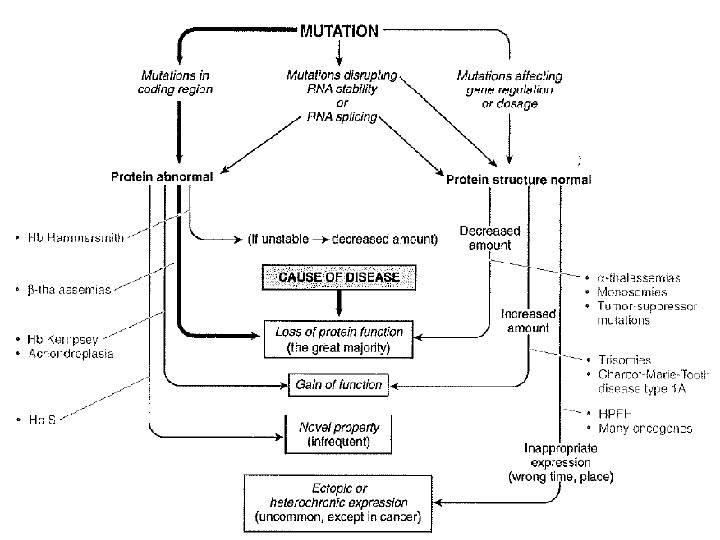
The effect of mutations on protein function • mutations resulting in a LOSS OF FUNCTIONof the protein • mutations resulting in a GAIN OF FUNCTIONof the protein • mutations resulting in a NOVEL PROPERTY by the protein • mutations resulting in gene EXPRESSION at the wrong time or place Postgraduate course Human Genetics – 09/12/11 Bert Callewaert, MD, Ph. D – Center for Medical Genetics – Ghent University Hospital

LOSS-OF-FUNCTION MUTATIONS • deletion of the entire gene (and eventually also contiguous genes) examples: microdeletion syndromes, monosomies (Turner), a-thalassemias • chromosomal rearrangements • premature stop codon (nonsense or frameshift mutations) • missense mutations may abolish protein function e. g. Catshl syndrome: loss- of – function FGFR 3 Severity of disease ~ amount of function lost FGFR 3 p. R 621 H Postgraduate course Human Genetics – 09/12/11 Bert Callewaert, MD, Ph. D – Center for Medical Genetics – Ghent University Hospital
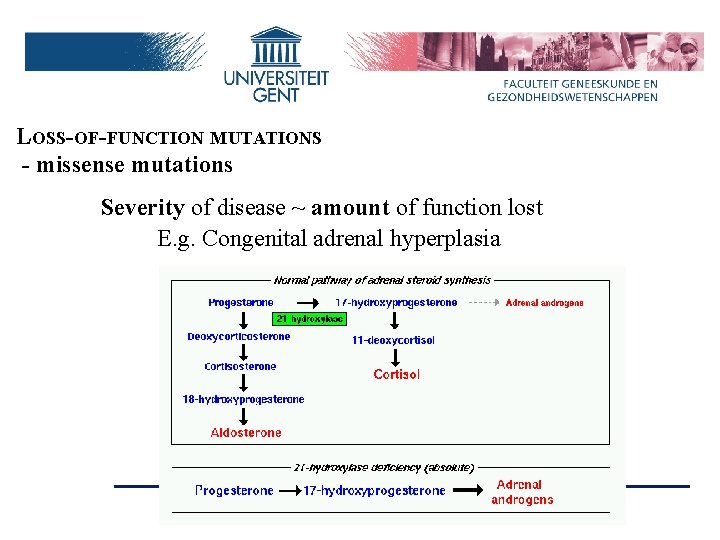
LOSS-OF-FUNCTION MUTATIONS - missense mutations Severity of disease ~ amount of function lost E. g. Congenital adrenal hyperplasia Hemoglobinopathies– Bert Callewaert, MD, Ph. D – 09/12/2011 Ghent University Hospital – Center for Medical Genetics

LOSS-OF-FUNCTION MUTATIONS - missense mutations Severity of disease ~ amount of function lost E. g. Congenital adrenal hyperplasia Enzyme Activity Phenotype CYP 21 A 2 Mutation 0% Severe (classic) Whole-gene deletion (null mutation) Large gene conversion p. Gly 111 Valfs. Ter 21 p. [Ile 237 Asn; Val 238 Glu; Met 2 40 Lys] p. Leu 308 Phefs. Ter 6 p. Gln 319 Ter p. Arg 357 Trp Minimal residual activity (<1%) c. 293 -13 A>G or c. 293 C>G 2%-11% p. Ile 173 Asn ~20%-50% Mild (non-classic) p. Pro 31 Leu p. Val 282 Leu p. Pro 454 Ser Hemoglobinopathies– Bert Callewaert, MD, Ph. D – 09/12/2011 Ghent University Hospital – Center for Medical Genetics
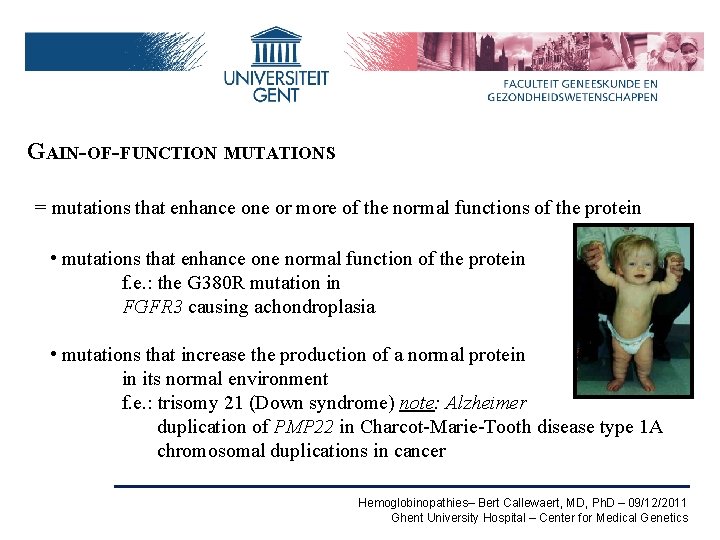
GAIN-OF-FUNCTION MUTATIONS = mutations that enhance one or more of the normal functions of the protein • mutations that enhance one normal function of the protein f. e. : the G 380 R mutation in FGFR 3 causing achondroplasia • mutations that increase the production of a normal protein in its normal environment f. e. : trisomy 21 (Down syndrome) note: Alzheimer duplication of PMP 22 in Charcot-Marie-Tooth disease type 1 A chromosomal duplications in cancer Hemoglobinopathies– Bert Callewaert, MD, Ph. D – 09/12/2011 Ghent University Hospital – Center for Medical Genetics
NOVEL PROPERTY MUTATIONS = (missense) mutations novel property of the protein +/- normal function infrequent (most AA substitutions either neutral or detrimental) e. g. sickle cell disease Hemoglobinopathies– Bert Callewaert, MD, Ph. D – 09/12/2011 Ghent University Hospital – Center for Medical Genetics
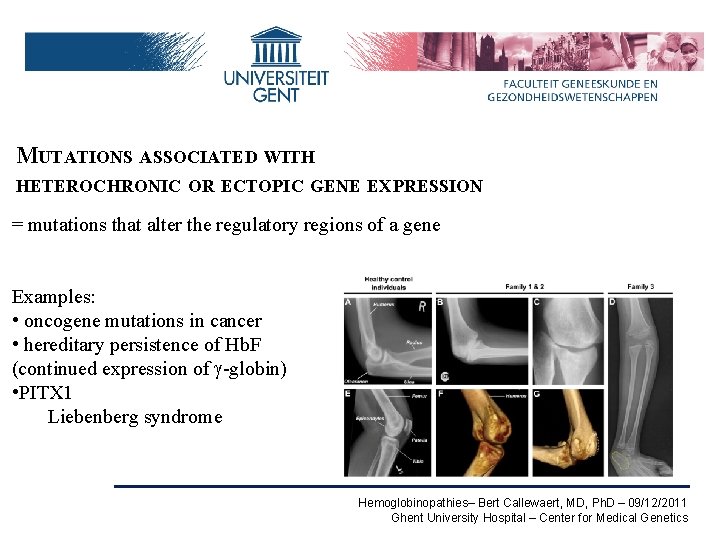
MUTATIONS ASSOCIATED WITH HETEROCHRONIC OR ECTOPIC GENE EXPRESSION = mutations that alter the regulatory regions of a gene Examples: • oncogene mutations in cancer • hereditary persistence of Hb. F (continued expression of g-globin) • PITX 1 Liebenberg syndrome Hemoglobinopathies– Bert Callewaert, MD, Ph. D – 09/12/2011 Ghent University Hospital – Center for Medical Genetics
Hemoglobinopathies • most common single-gene disorders in humans • more than 5% of the world’s population is carrier of an abnormal globin gene Hemoglobinopathies– Bert Callewaert, MD, Ph. D – 09/12/2011 Ghent University Hospital – Center for Medical Genetics
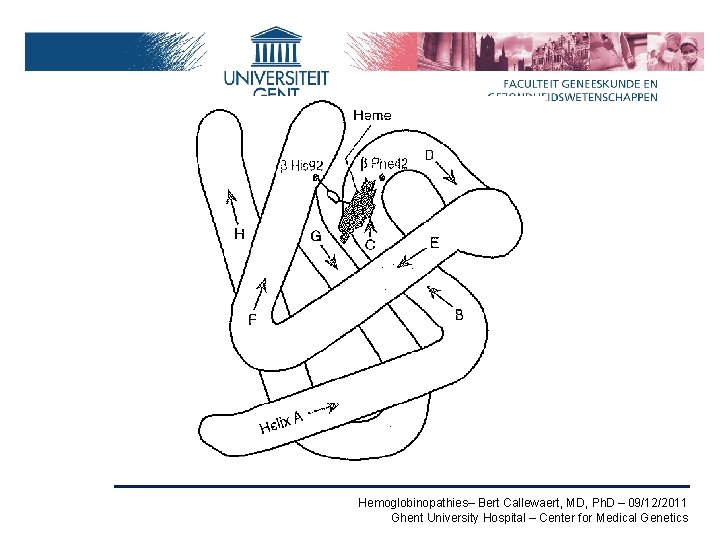
Hemoglobin • 4 subunits: 2 a (like) and 2 b (like) - chains • each subunit is composed of : - a polypeptide chain (globin) - a prosthetic group (heme): iron-containing pigment that combines with O 2 • highly conserved structure • Hb A (adult hemoglobin): a 2 b 2 Hemoglobinopathies– Bert Callewaert, MD, Ph. D – 09/12/2011 Ghent University Hospital – Center for Medical Genetics
Hemoglobinopathies– Bert Callewaert, MD, Ph. D – 09/12/2011 Ghent University Hospital – Center for Medical Genetics
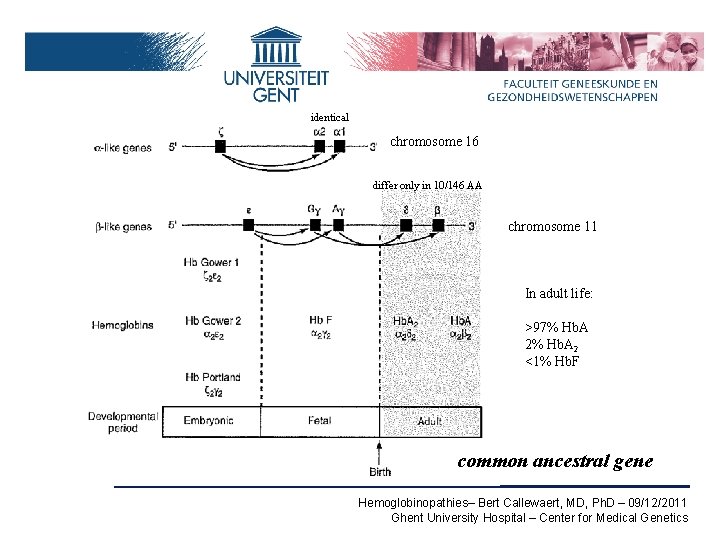
identical chromosome 16 differ only in 10/146 AA chromosome 11 In adult life: >97% Hb. A 2 <1% Hb. F common ancestral gene Hemoglobinopathies– Bert Callewaert, MD, Ph. D – 09/12/2011 Ghent University Hospital – Center for Medical Genetics
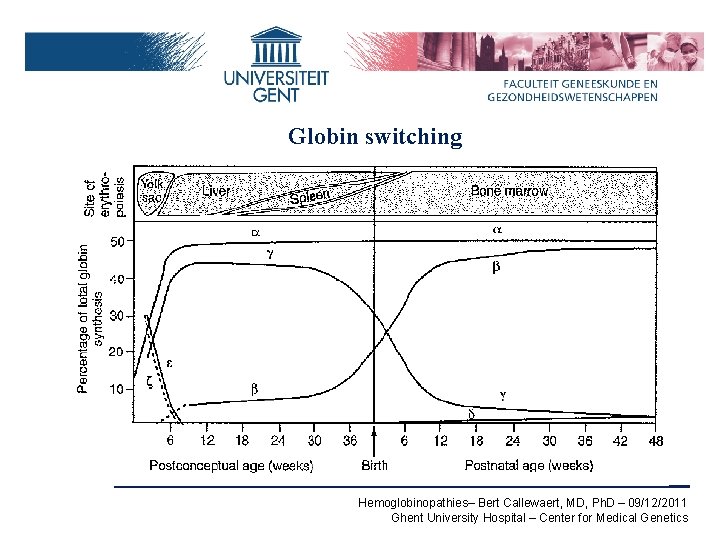
Globin switching Hemoglobinopathies– Bert Callewaert, MD, Ph. D – 09/12/2011 Ghent University Hospital – Center for Medical Genetics
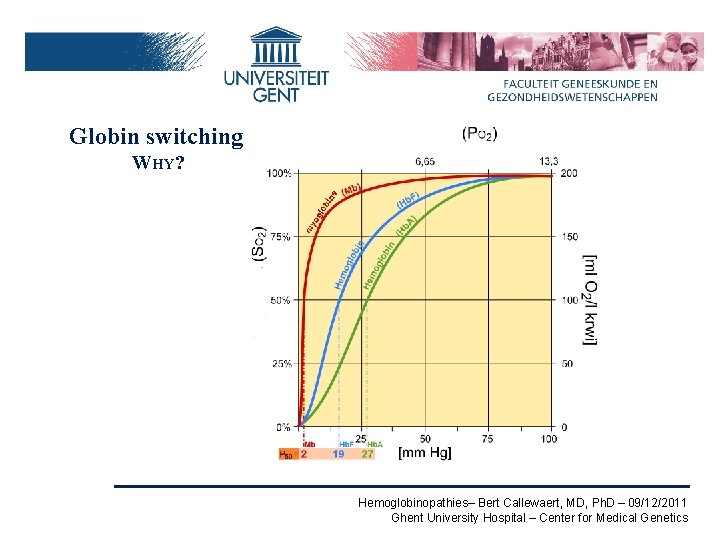
Globin switching WHY? Hemoglobinopathies– Bert Callewaert, MD, Ph. D – 09/12/2011 Ghent University Hospital – Center for Medical Genetics
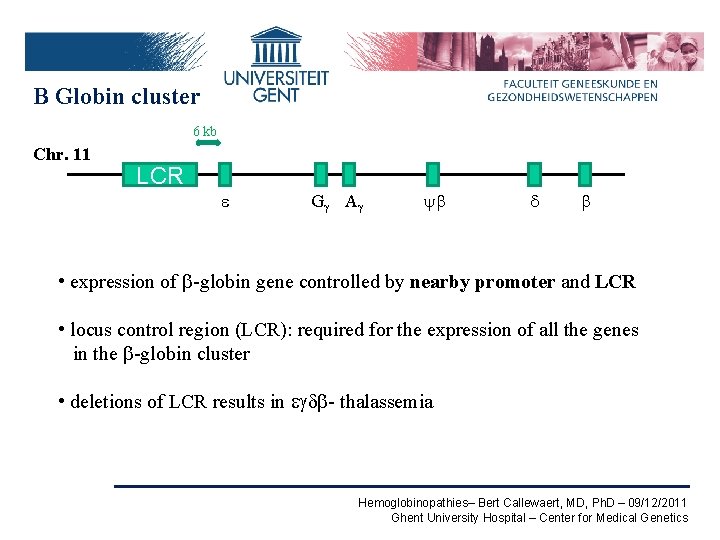
Β Globin cluster 6 kb Chr. 11 LCR e Gg Ag yb d b • expression of b-globin gene controlled by nearby promoter and LCR • locus control region (LCR): required for the expression of all the genes in the b-globin cluster • deletions of LCR results in egdb- thalassemia Hemoglobinopathies– Bert Callewaert, MD, Ph. D – 09/12/2011 Ghent University Hospital – Center for Medical Genetics
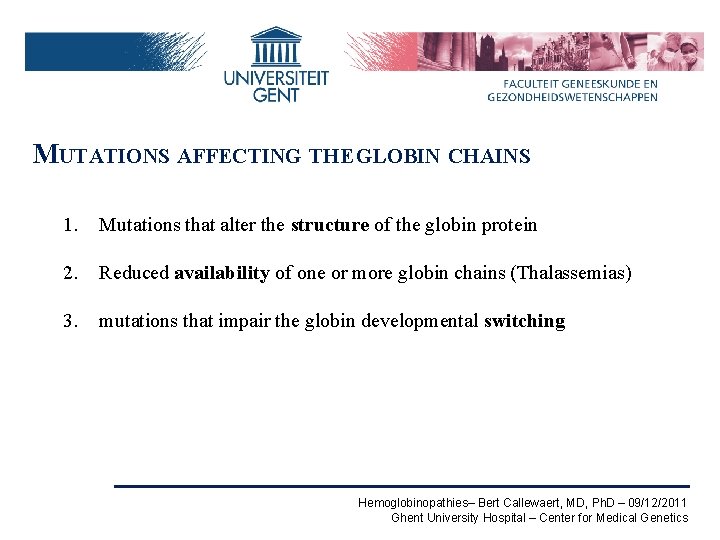
MUTATIONS AFFECTING THE GLOBIN CHAINS 1. Mutations that alter the structure of the globin protein 2. Reduced availability of one or more globin chains (Thalassemias) 3. mutations that impair the globin developmental switching Hemoglobinopathies– Bert Callewaert, MD, Ph. D – 09/12/2011 Ghent University Hospital – Center for Medical Genetics
1. STRUCTURAL VARIANTS • usually due to point mutations in one of the globin genes • more than 400 abnormal hemoglobin variants have been described • only about 50% are clinically significant • three classes: - mutants that cause hemolytic anemia - mutants that alter oxygen transport - mutants that reduce the abundance of the globin chain (thalassemias) Hemoglobinopathies– Bert Callewaert, MD, Ph. D – 09/12/2011 Ghent University Hospital – Center for Medical Genetics
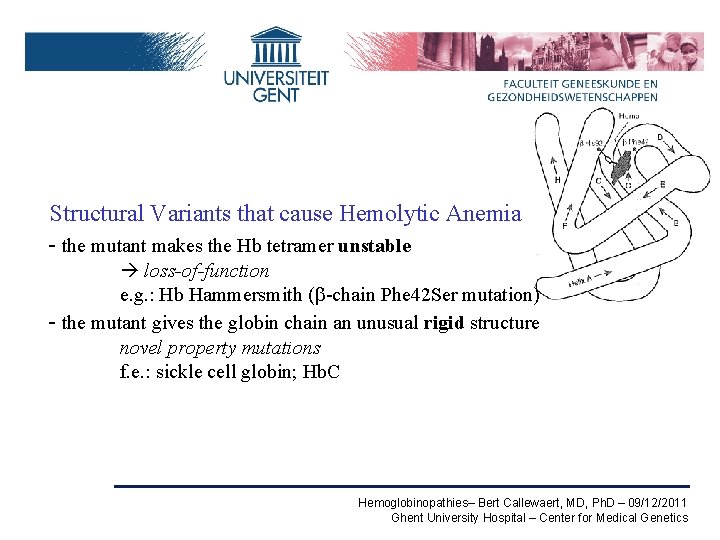
Structural Variants that cause Hemolytic Anemia - the mutant makes the Hb tetramer unstable - loss-of-function e. g. : Hb Hammersmith (b-chain Phe 42 Ser mutation) the mutant gives the globin chain an unusual rigid structure novel property mutations f. e. : sickle cell globin; Hb. C Hemoglobinopathies– Bert Callewaert, MD, Ph. D – 09/12/2011 Ghent University Hospital – Center for Medical Genetics
Sickle Cell Disease • Hb. S: first abnormal Hb detected (Glu 6 Val mutation in b-chain) • severe AR condition • common in equatorial Africa; 1/600 African Americans is born with the disease • sickle cell trait refers to the heterozygous state • about 8% of African Americans are heterozygous • heterozygotes are protected against malaria Hemoglobinopathies– Bert Callewaert, MD, Ph. D – 09/12/2011 Ghent University Hospital – Center for Medical Genetics
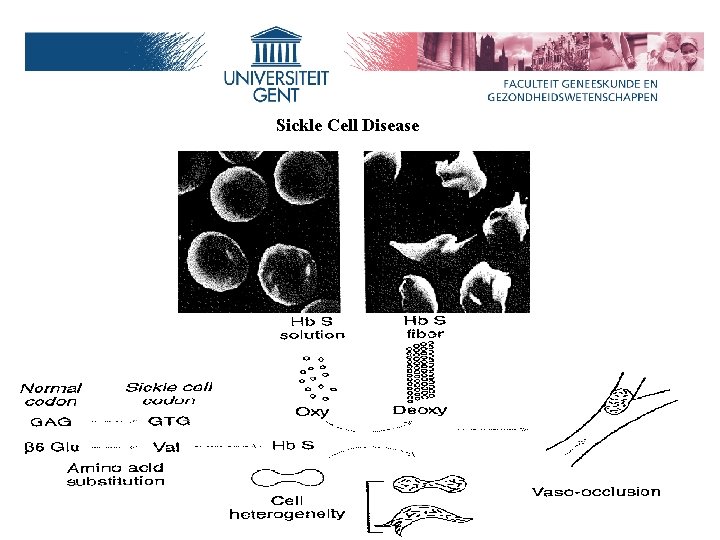
Sickle Cell Disease
1. STRUCTURAL VARIANTS • usually due to point mutations in one of the globin genes • more than 400 abnormal hemoglobin variants have been described • only about 50% are clinically significant • three classes: - mutants that cause hemolytic anemia - mutants that alter oxygen transport - mutants that reduce the abundance of the globin chain (thalassemias) Hemoglobinopathies– Bert Callewaert, MD, Ph. D – 09/12/2011 Ghent University Hospital – Center for Medical Genetics

Hemoglobin Structural Variants that alter oxygen transport • Hb Hyde Park (β-chain His 92 Tyr) ~ normal hemoglobin stability iron resistant to the enzyme methemoglobin reductase (Fe 3+ (not able to bind O 2) Fe 2+). accumulation of methemoglobin → cyanosis (usually asymptomatic) homozygous state presumably lethal. • Hb Hammersmith (β chain. Phe 42 Ser) instable Hb, lower O 2 affinity • mutations in α: β interface (Hb Kempsey) prevent oxigen related movement locked in high O 2 affinity state Polycythemia Hemoglobinopathies– Bert Callewaert, MD, Ph. D – 09/12/2011 Ghent University Hospital – Center for Medical Genetics
1. STRUCTURAL VARIANTS • usually due to point mutations in one of the globin genes • more than 400 abnormal hemoglobin variants have been described • only about 50% are clinically significant • three classes: - mutants that cause hemolytic anemia - mutants that alter oxygen transport - mutants that reduce the abundance of the globin chain (thalassemias) mutations in the coding region rate of synthesis↓ severe instability of the chains. Hemoglobinopathies– Bert Callewaert, MD, Ph. D – 09/12/2011 Ghent University Hospital – Center for Medical Genetics
2. HEMOGLOBIN SYNTHESIS DISORDERS (THALASSEMIAS) • collectively the most common human single-gene disorders! • carriers: protective advantage against malaria • > qalassa (sea): first discovered in Mediterranean area • imbalance in a : b chain ratio - ↓synthesis - instability (cfr supra) • ↑normal chains: damage to the RBCs (hemolytic anemia) • ↓Hb synthesis hypochromic, microcytic anemia • Dd Iron deficiency Hemoglobinopathies– Bert Callewaert, MD, Ph. D – 09/12/2011 Ghent University Hospital – Center for Medical Genetics
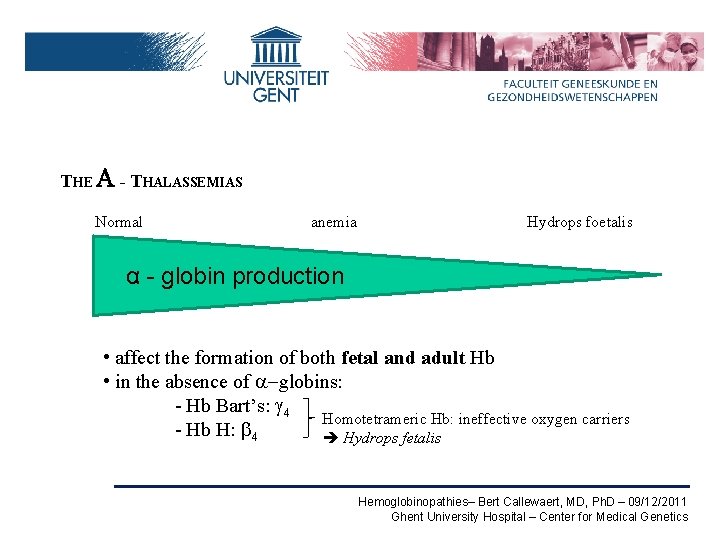
THE A - THALASSEMIAS Normal anemia Hydrops foetalis α - globin production • affect the formation of both fetal and adult Hb • in the absence of a-globins: - Hb Bart’s: g 4 Homotetrameric Hb: ineffective oxygen carriers - Hb H: b 4 Hydrops fetalis Hemoglobinopathies– Bert Callewaert, MD, Ph. D – 09/12/2011 Ghent University Hospital – Center for Medical Genetics
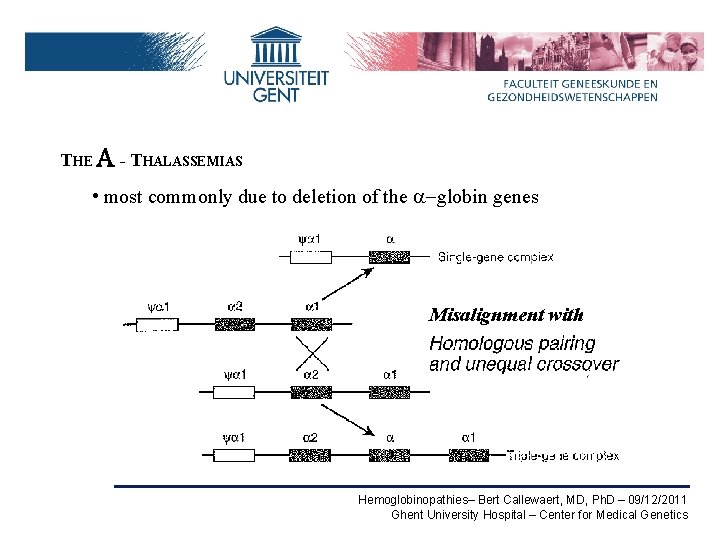
THE A - THALASSEMIAS • most commonly due to deletion of the a-globin genes Misalignment with Hemoglobinopathies– Bert Callewaert, MD, Ph. D – 09/12/2011 Ghent University Hospital – Center for Medical Genetics
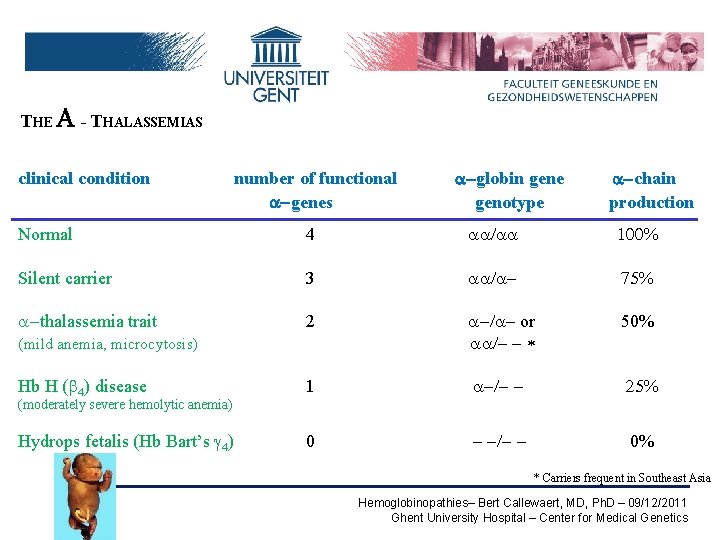
THE A - THALASSEMIAS clinical condition number of functional a-genes a-globin gene genotype a-chain production Normal 4 aa/aa 100% Silent carrier 3 aa/a- 75% a-thalassemia trait 2 a-/a- or aa/- - * 50% Hb H (b 4) disease 1 a-/- - 25% Hydrops fetalis (Hb Bart’s g 4) 0 - -/- - 0% (mild anemia, microcytosis) (moderately severe hemolytic anemia) * Carriers frequent in Southeast Asia Hemoglobinopathies– Bert Callewaert, MD, Ph. D – 09/12/2011 Ghent University Hospital – Center for Medical Genetics
THE A - THALASSEMIAS • Rare forms: - form due to the ZF deletion (named after individual ZF) - the ATR-X syndrome Hemoglobinopathies– Bert Callewaert, MD, Ph. D – 09/12/2011 Ghent University Hospital – Center for Medical Genetics
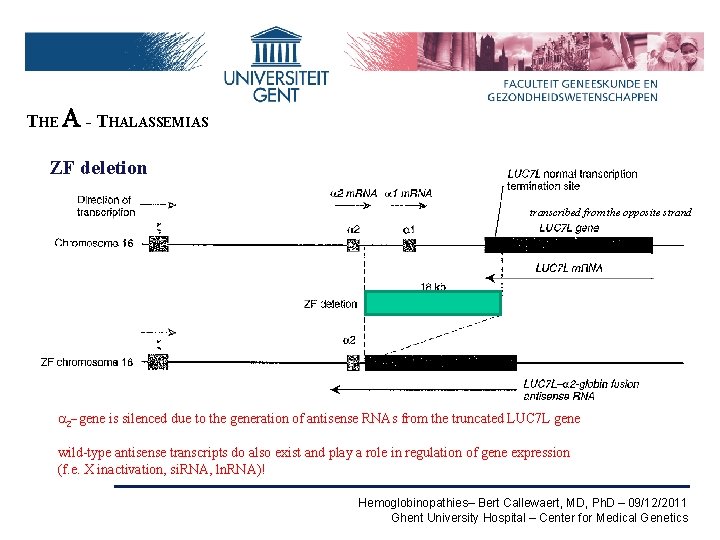
THE A - THALASSEMIAS ZF deletion transcribed from the opposite strand a 2 -gene is silenced due to the generation of antisense RNAs from the truncated LUC 7 L gene wild-type antisense transcripts do also exist and play a role in regulation of gene expression (f. e. X inactivation, si. RNA, ln. RNA)! Hemoglobinopathies– Bert Callewaert, MD, Ph. D – 09/12/2011 Ghent University Hospital – Center for Medical Genetics
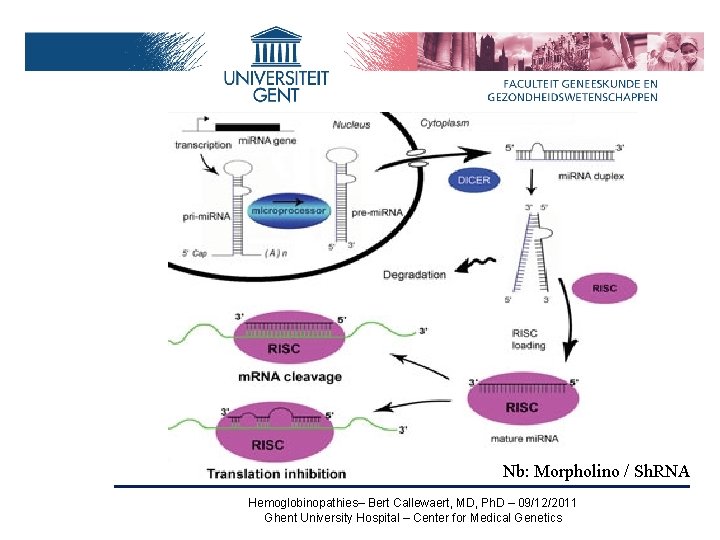
Nb: Morpholino / Sh. RNA Hemoglobinopathies– Bert Callewaert, MD, Ph. D – 09/12/2011 Ghent University Hospital – Center for Medical Genetics
THE A - THALASSEMIAS The ATR-X syndrome • MR and a-thalassemia • due to mutations in the X-linked ATRX gene • encodes a chromatin remodeling protein (methylation) • activates expression in trans • partial loss-of-function mutations result in modest reduction of a-globin synthesis • somatic (more severe) mutations in ATRX cause the a-thalassemia myelodysplasia syndrome (if germline: hydrops fetalis!) Hemoglobinopathies– Bert Callewaert, MD, Ph. D – 09/12/2011 Ghent University Hospital – Center for Medical Genetics
Hemoglobinopathies– Bert Callewaert, MD, Ph. D – 09/12/2011 Ghent University Hospital – Center for Medical Genetics
The ATR-X syndrome • Profound MR (X-L) • MC • Short stature • Genital Δ • (Mild) anemia Erythrocytes after incubation in briljant cresyl blue. Hb H inclusions : ‘golf ball’ From Gibbons R. Orphanet Journal of Rare Diseases 2006; 1: 15 Hemoglobinopathies– Bert Callewaert, MD, Ph. D – 09/12/2011 Ghent University Hospital – Center for Medical Genetics
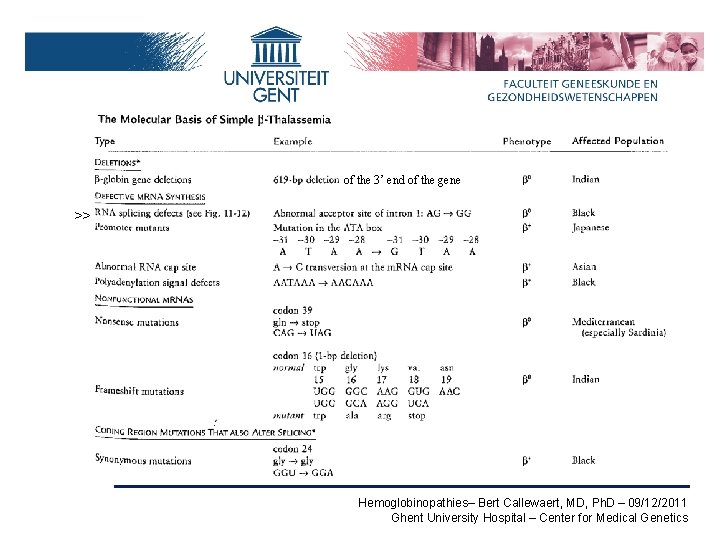
THE B - THALASSEMIAS • ↓b-globin production • two b-thalassemia alleles: usually thalassemia major (severe anemia) • one b-thalassemia allele: thalassemia minor (mild anemia, no clinic) • postnatal • precipitation of excess a-chains hemolysis • low β-chain production hypochromic, microcytic anemia • ↑Hb. A 2 (a 2 d 2) and ↑ Hb. F (a 2 g 2) • >> single-base pair substitutions (rather than deletions) • >> compound heterozygous • simple versus complex b-thalassemia Hemoglobinopathies– Bert Callewaert, MD, Ph. D – 09/12/2011 Ghent University Hospital – Center for Medical Genetics
of the 3’ end of the gene >> Hemoglobinopathies– Bert Callewaert, MD, Ph. D – 09/12/2011 Ghent University Hospital – Center for Medical Genetics
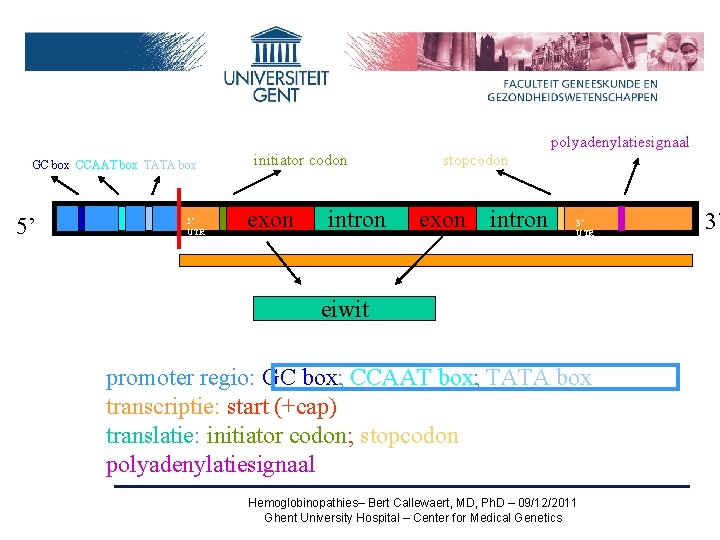
polyadenylatiesignaal GC box CCAAT box TATA box 5’ 5’ UTR initiator codon exon intron stopcodon exon intron 3’ UTR eiwit promoter regio: GC box; CCAAT box; TATA box transcriptie: start (+cap) translatie: initiator codon; stopcodon polyadenylatiesignaal Hemoglobinopathies– Bert Callewaert, MD, Ph. D – 09/12/2011 Ghent University Hospital – Center for Medical Genetics 3’
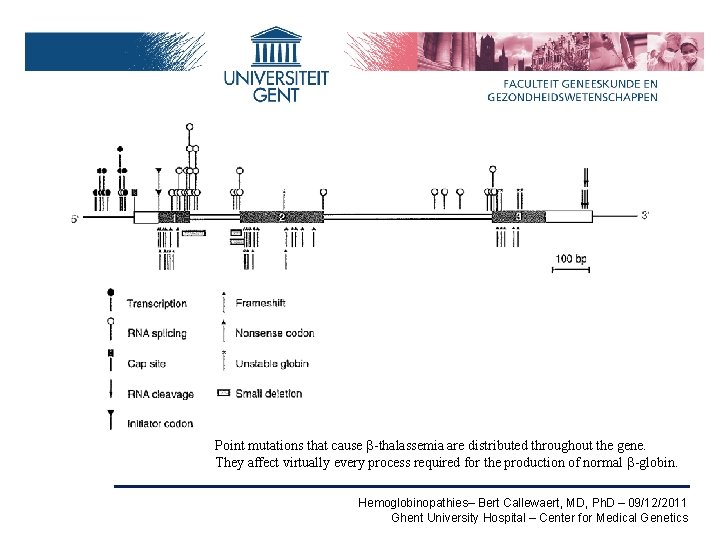
Point mutations that cause b-thalassemia are distributed throughout the gene. They affect virtually every process required for the production of normal b-globin. Hemoglobinopathies– Bert Callewaert, MD, Ph. D – 09/12/2011 Ghent University Hospital – Center for Medical Genetics
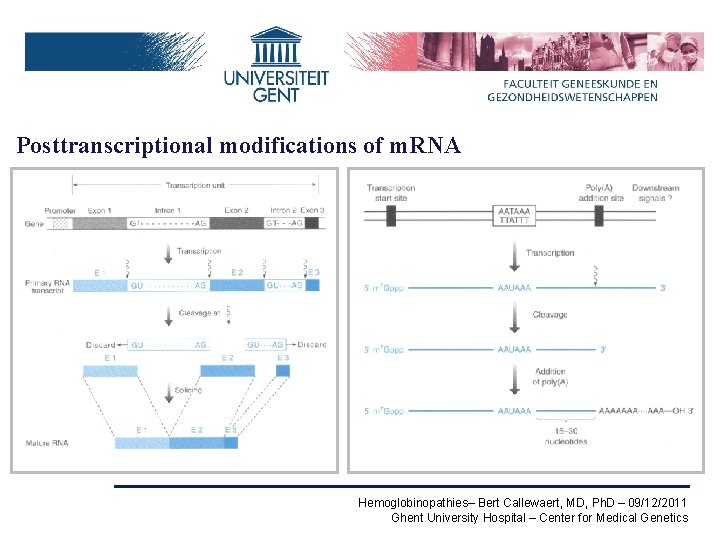
Posttranscriptional modifications of m. RNA Hemoglobinopathies– Bert Callewaert, MD, Ph. D – 09/12/2011 Ghent University Hospital – Center for Medical Genetics
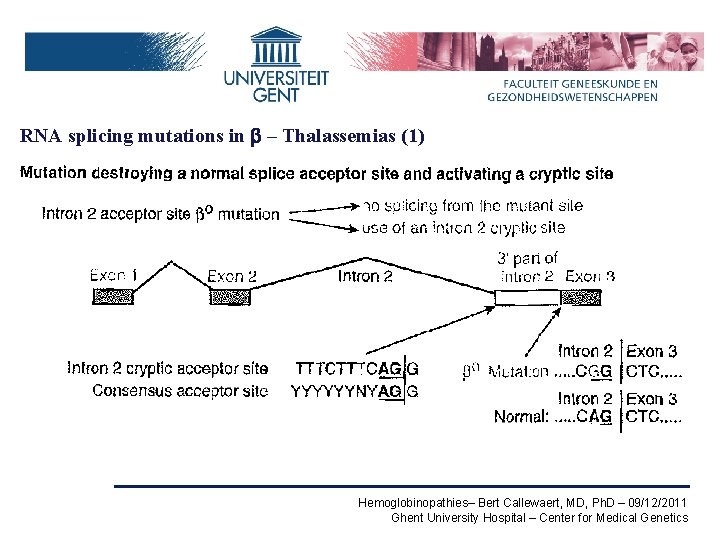
RNA splicing mutations in b – Thalassemias (1) Hemoglobinopathies– Bert Callewaert, MD, Ph. D – 09/12/2011 Ghent University Hospital – Center for Medical Genetics
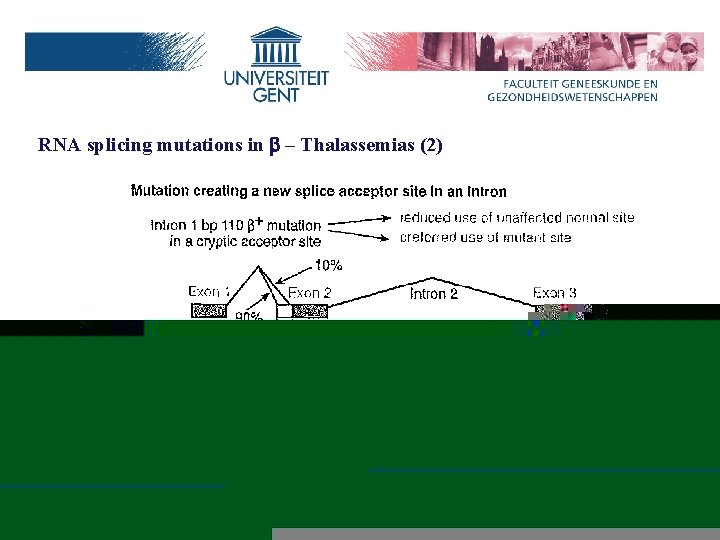
RNA splicing mutations in b – Thalassemias (2) Hemoglobinopathies– Bert Callewaert, MD, Ph. D – 09/12/2011 Ghent University Hospital – Center for Medical Genetics
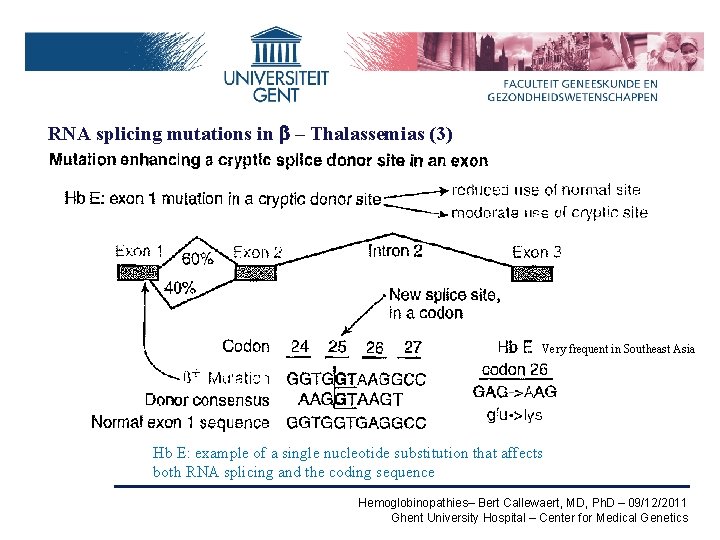
RNA splicing mutations in b – Thalassemias (3) Very frequent in Southeast Asia Hb E: example of a single nucleotide substitution that affects both RNA splicing and the coding sequence Hemoglobinopathies– Bert Callewaert, MD, Ph. D – 09/12/2011 Ghent University Hospital – Center for Medical Genetics
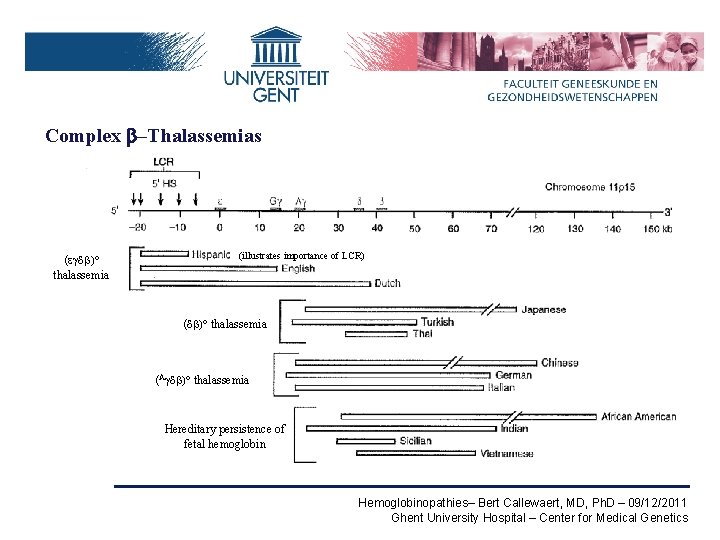
Complex b–Thalassemias (egdb)° thalassemia (illustrates importance of LCR) (db)° thalassemia (Agdb)° thalassemia Hereditary persistence of fetal hemoglobin Hemoglobinopathies– Bert Callewaert, MD, Ph. D – 09/12/2011 Ghent University Hospital – Center for Medical Genetics
3. GLOBIN DEVELOPMENTAL SWITCHING DISORDERS • hereditary persistence of fetal hemoglobin • group of clinically benign conditions • production of higher levels of Hb F than is seen in (db)° thalassemia • they impair the perinatal switch from g-globin to b-globin synthesis Hemoglobinopathies– Bert Callewaert, MD, Ph. D – 09/12/2011 Ghent University Hospital – Center for Medical Genetics
Hemoglobinopathies– Bert Callewaert, MD, Ph. D – 09/12/2011 Ghent University Hospital – Center for Medical Genetics
- Slides: 45