
Principles of Mobility and Immobility NURS 230Spring 2014
Principles of Mobility and Immobility NURS 230/Spring 2014 Professor Sporbert

Scientific Knowledge Base � Overview of exercise and activity: ◦ Body alignment �Relationship of one body part to another ◦ Body balance �Achieved by low center of gravity; enhanced by posture ◦ Coordinated body movement �A result of weight, center of gravity, and balance
Scientific Knowledge Base (cont’d) � Overview ◦ Friction of exercise and activity: �Force that occurs in a direction to oppose movement ◦ Exercise and activity �A patient’s individualized exercise program depends on the patient’s activity tolerance or the type and amount of exercise or activity that the patient is able to perform. �Isotonic exercises �Isometric exercises
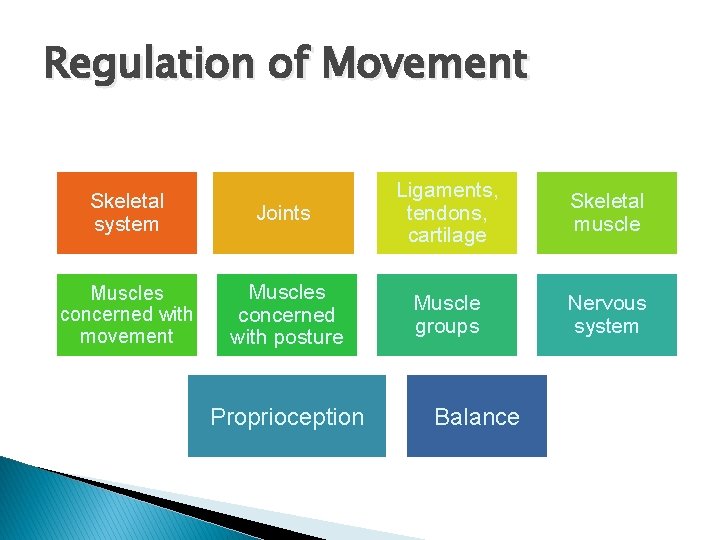
Regulation of Movement Skeletal system Muscles concerned with movement Joints Ligaments, tendons, cartilage Skeletal muscle Muscles concerned with posture Muscle groups Nervous system Proprioception Balance
Factors Influencing Activity and Exercise � Developmental ◦ ◦ changes Infants through school-aged children Adolescence Young to middle adults Older adults � Behavioral aspects ◦ Patients are more likely to incorporate an exercise program if those around them are supportive.

Factors Influencing Activity and Exercise (cont’d) � Environmental ◦ Work site ◦ Schools ◦ Community � Cultural issues and ethnic influences � Family and social support
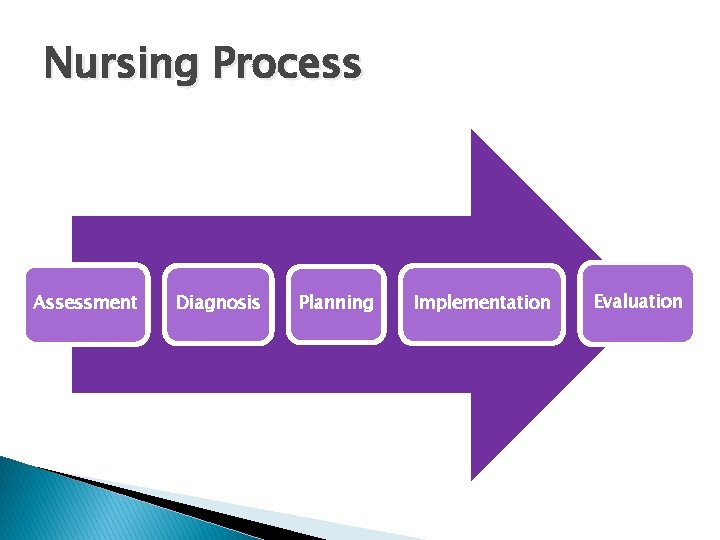
Nursing Process Assessment Diagnosis Planning Implementation Evaluation

Assessment: Standing

Mobility and Immobility � Mobility ◦ The ability to move about freely � Immobility ◦ Inability to move about freely � Bed rest ◦ An intervention that restricts clients for therapeutic reasons
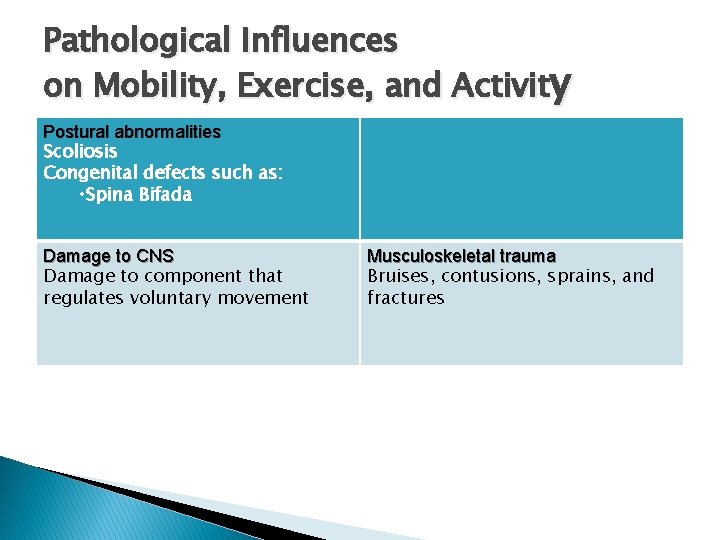
Pathological Influences on Mobility, Exercise, and Activity Postural abnormalities Scoliosis Congenital defects such as: • Spina Bifada Damage to CNS Damage to component that regulates voluntary movement Musculoskeletal trauma Bruises, contusions, sprains, and fractures
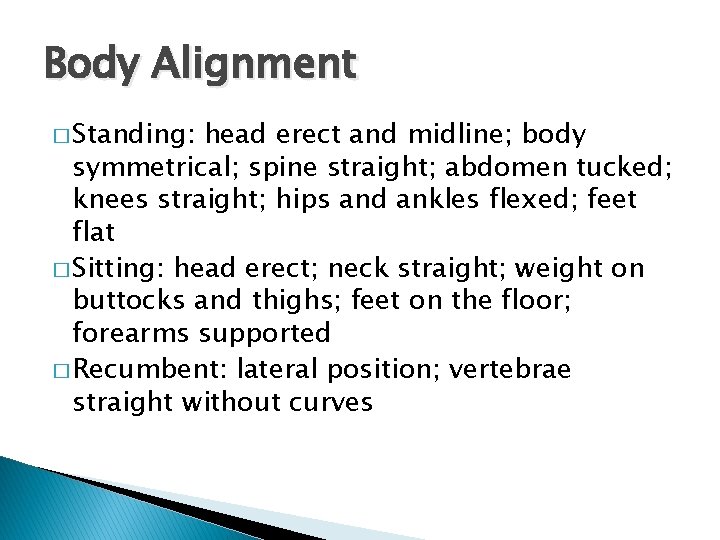
Body Alignment � Standing: head erect and midline; body symmetrical; spine straight; abdomen tucked; knees straight; hips and ankles flexed; feet flat � Sitting: head erect; neck straight; weight on buttocks and thighs; feet on the floor; forearms supported � Recumbent: lateral position; vertebrae straight without curves
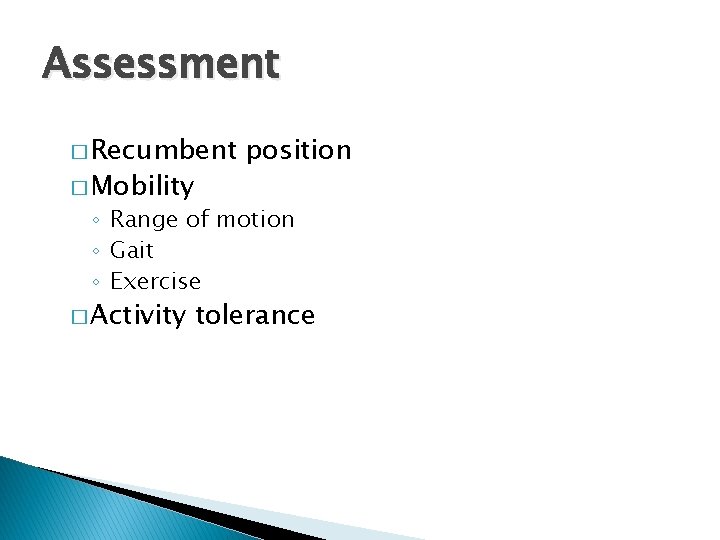
Assessment � Recumbent � Mobility position ◦ Range of motion ◦ Gait ◦ Exercise � Activity tolerance
Nursing Diagnosis � Activity intolerance � Ineffective coping � Impaired gas exchange � Risk for injury � Impaired physical mobility � Imbalanced nutrition: more than body requirements � Acute or chronic pain
Planning � Goals and outcomes ◦ Participates in prescribed physical activity while maintaining appropriate heart rate, blood pressure, and breathing rate ◦ Verbalizes an understanding of the need to gradually increase activity based on tolerance and symptoms ◦ Expresses understanding of balancing rest and activity � Setting priorities � Teamwork and collaboration
Implementation � Health promotion ◦ Teach patients to calculate maximum heart rate. ◦ Body mechanics � Acute care ◦ Musculoskeletal system ◦ Joint mobility ◦ Walking � Restorative and continuing care
Principles of Transfer and Positioning Techniques � When moving a patient, knowledge of safe transfer and positioning is crucial. � Pathological influences on body alignment and mobility: ◦ ◦ Congenital defects Disorders of bones, joints, and muscles Central nervous system damage Musculoskeletal trauma
Mobility � Range of joint motion ◦ Used to determine limitation/injury to a joint � Gait ◦ Manner or style of walking, including rhythm and speed � Exercise/activity tolerance ◦ Physical activity for conditioning body, improving health, maintaining fitness, therapy- includes physical and/or occupational
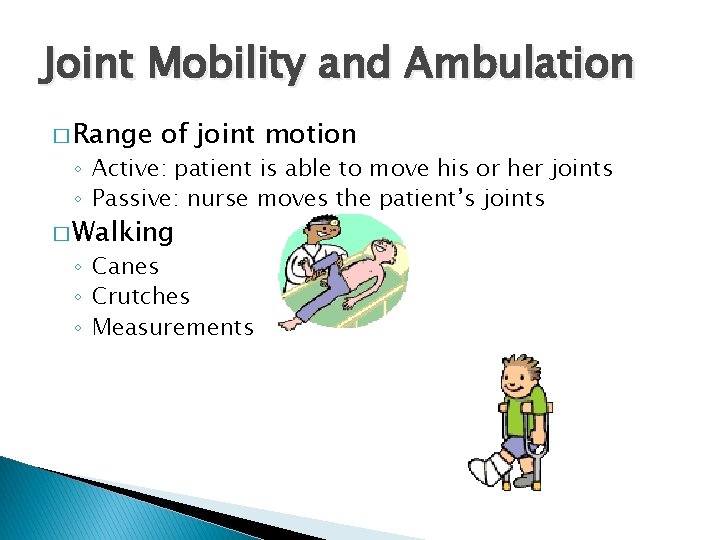
Joint Mobility and Ambulation � Range of joint motion ◦ Active: patient is able to move his or her joints ◦ Passive: nurse moves the patient’s joints � Walking ◦ Canes ◦ Crutches ◦ Measurements
Transfer Techniques � � � Immobilized patient ◦ Use of proper body mechanics moves patients safely and protects nurse from injury Dependent patient ◦ Assists patient with regaining optimal independence, joint movement, increases strength, promotes circulation, relieves pressure on skin, improves respiratory and urinary function What types of Equipment are available to you: Hoyer Lifts EZ-stands Gait Belts Wheelchairs Walkers Canes Crutches As the nurse you have to assess the mobility status of your patientsto determine the safest transfer technique and equipment
Positioning Techniques � Fowler’s � Lateral � Supine � Sims’ ◦ HOB elevated, support and align hips and spine ◦ Back lying, support with pillows, trochanter rolls, splints � Prone ◦ Face down ◦ Side lying with proper spine alignment ◦ Semiprone on right or left side with weight placed on Ilium, humerus, and clavicle
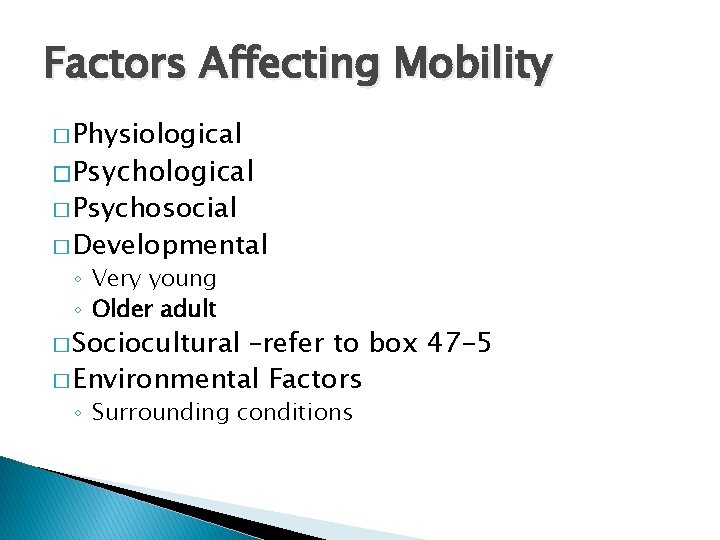
Factors Affecting Mobility � Physiological � Psychosocial � Developmental ◦ Very young ◦ Older adult � Sociocultural –refer to box 47 -5 � Environmental Factors ◦ Surrounding conditions
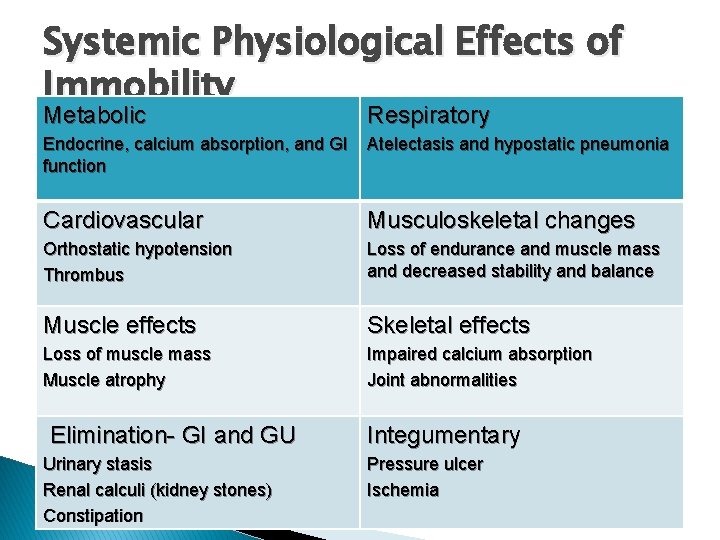
Systemic Physiological Effects of Immobility Metabolic Respiratory Endocrine, calcium absorption, and GI function Atelectasis and hypostatic pneumonia Cardiovascular Musculoskeletal changes Orthostatic hypotension Thrombus Loss of endurance and muscle mass and decreased stability and balance Muscle effects Skeletal effects Loss of muscle mass Muscle atrophy Impaired calcium absorption Joint abnormalities Elimination- GI and GU Urinary stasis Renal calculi (kidney stones) Constipation Integumentary Pressure ulcer Ischemia
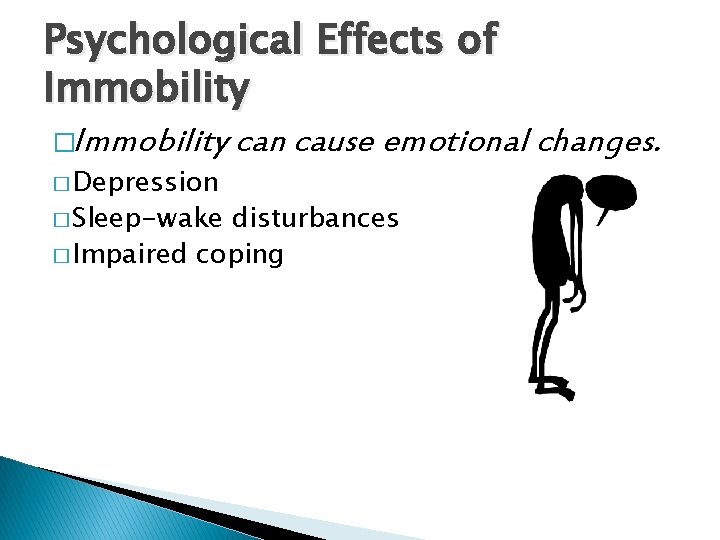
Psychological Effects of Immobility �Immobility can cause emotional changes. � Depression � Sleep-wake disturbances � Impaired coping
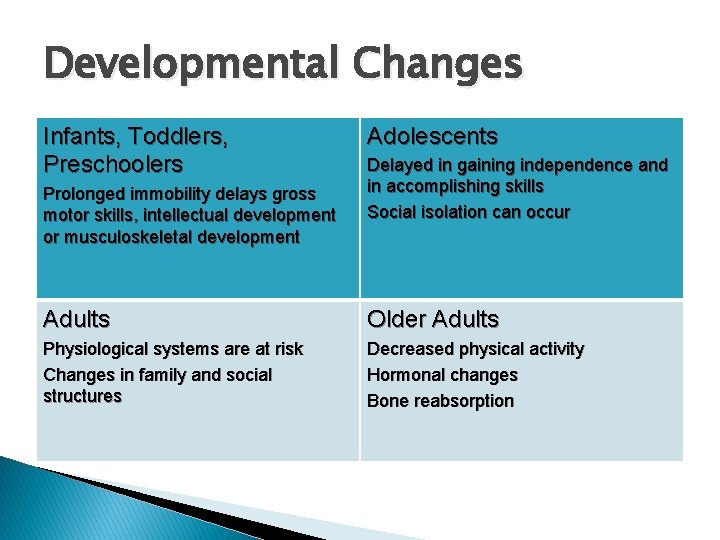
Developmental Changes Infants, Toddlers, Preschoolers Prolonged immobility delays gross motor skills, intellectual development or musculoskeletal development Adolescents Delayed in gaining independence and in accomplishing skills Social isolation can occur Adults Older Adults Physiological systems are at risk Changes in family and social structures Decreased physical activity Hormonal changes Bone reabsorption

Sociocultural Effects of Immobility � Immobility can cause an excessive amount of time and energy for the care-giver; as well as, financial constraints. � Living conditions for the client: ◦ ◦ Hospitalization. Extended care facility. Rehabilitation facility Home Care.
Assessment of the Immobile Client � Must assess the patient’s past and present mobility and the potential effects of immobility. � Health History � Physical Examination of Mobility o What is their ROM? What exercises can they do for themselves, assess their ability to move extremities - are there strengths and weaknesses? ◦ Body alignment ◦ Gait ◦ Joints ◦ Skeletal muscles ◦ Neurovascular function
Assessment of the Immobile Client Continued: � � Physiological Systems Continued ◦ Respiratory system ◦ Metabolic system – Fluid & Electrolytes/nutrition ◦ Cardiovascular system ◦ Musculoskeletal system ◦ Skin Integrity ◦ Elimination system ◦ Skeletal system ◦ Muscle effects/systems Psychological condition Developmental state Sociocultural factors
Student Exercises: Nursing Process � Group 1 -Respirtory changes � Group 2 -Cardiovascular changes � Group 3 -Elimination/Bowel and Bladder � Group 4 -Integumentary changes
Nursing Process: Immobility Complete a Nursing Care Plan for each area identified as a complication of immobility (excluding Impaired Physical Mobility). Assessment 1. What is the subjective data 2. What is the your objective data B. Nursing diagnosis: Primary diagnosis? Why? § C. Planning: order or rank the nursing diagnosis and interventions in priorities. D. 1 -2 Nursing Interventions pick and rationales-why? E. Evaluating patient care outcomes ◦ What are 1 -2 expected patient outcomes from your interventions � Include in your care plans if applicable: � 6. Think about the benefits of therapy and how it could impact improving mobility � 7. Should you incorporate physical and/or occupational therapies and why A.
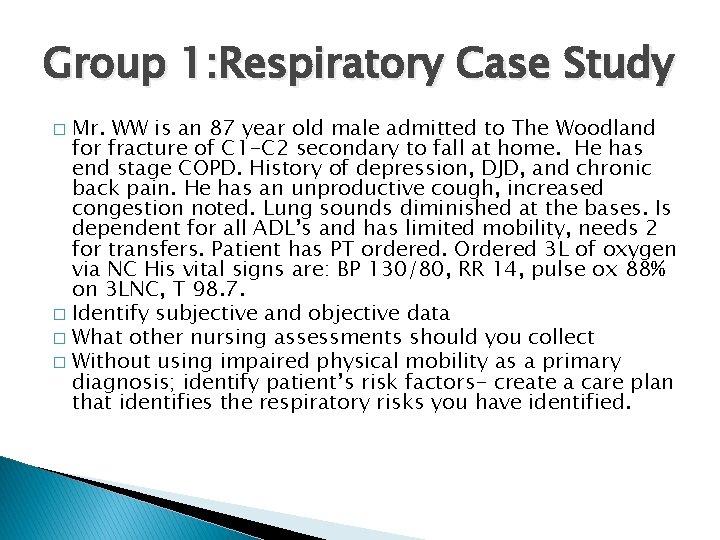
Group 1: Respiratory Case Study Mr. WW is an 87 year old male admitted to The Woodland for fracture of C 1 -C 2 secondary to fall at home. He has end stage COPD. History of depression, DJD, and chronic back pain. He has an unproductive cough, increased congestion noted. Lung sounds diminished at the bases. Is dependent for all ADL’s and has limited mobility, needs 2 for transfers. Patient has PT ordered. Ordered 3 L of oxygen via NC His vital signs are: BP 130/80, RR 14, pulse ox 88% on 3 LNC, T 98. 7. � Identify subjective and objective data � What other nursing assessments should you collect � Without using impaired physical mobility as a primary diagnosis; identify patient’s risk factors- create a care plan that identifies the respiratory risks you have identified. �
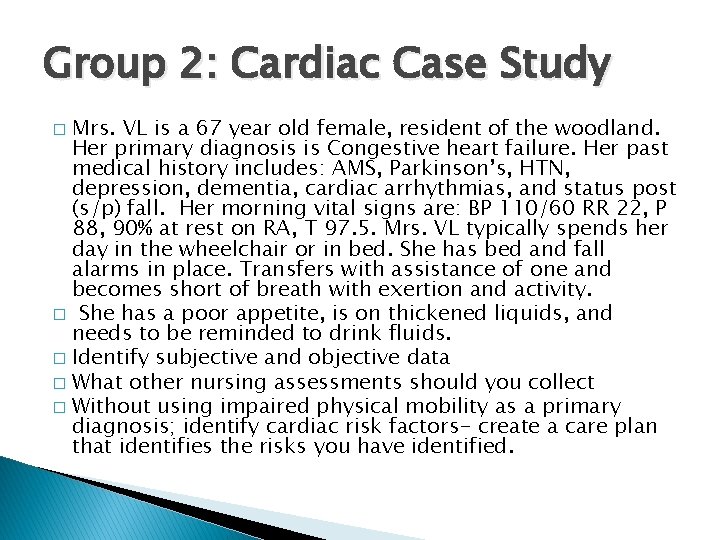
Group 2: Cardiac Case Study Mrs. VL is a 67 year old female, resident of the woodland. Her primary diagnosis is Congestive heart failure. Her past medical history includes: AMS, Parkinson’s, HTN, depression, dementia, cardiac arrhythmias, and status post (s/p) fall. Her morning vital signs are: BP 110/60 RR 22, P 88, 90% at rest on RA, T 97. 5. Mrs. VL typically spends her day in the wheelchair or in bed. She has bed and fall alarms in place. Transfers with assistance of one and becomes short of breath with exertion and activity. � She has a poor appetite, is on thickened liquids, and needs to be reminded to drink fluids. � Identify subjective and objective data � What other nursing assessments should you collect � Without using impaired physical mobility as a primary diagnosis; identify cardiac risk factors- create a care plan that identifies the risks you have identified. �
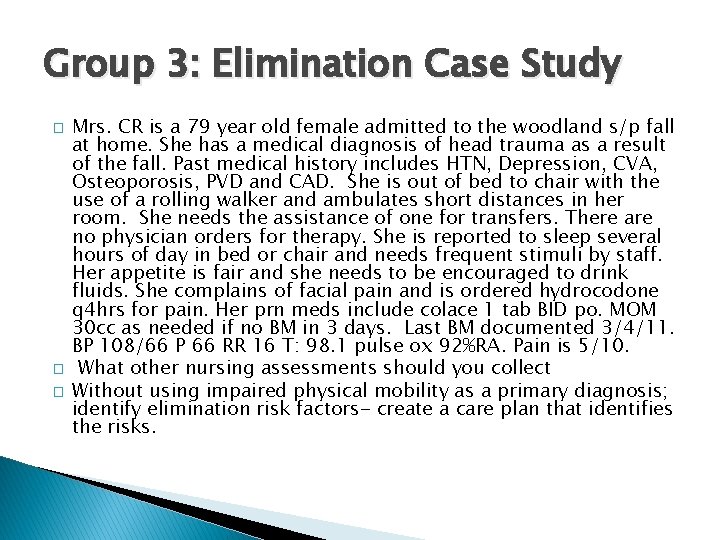
Group 3: Elimination Case Study � � � Mrs. CR is a 79 year old female admitted to the woodland s/p fall at home. She has a medical diagnosis of head trauma as a result of the fall. Past medical history includes HTN, Depression, CVA, Osteoporosis, PVD and CAD. She is out of bed to chair with the use of a rolling walker and ambulates short distances in her room. She needs the assistance of one for transfers. There are no physician orders for therapy. She is reported to sleep several hours of day in bed or chair and needs frequent stimuli by staff. Her appetite is fair and she needs to be encouraged to drink fluids. She complains of facial pain and is ordered hydrocodone q 4 hrs for pain. Her prn meds include colace 1 tab BID po. MOM 30 cc as needed if no BM in 3 days. Last BM documented 3/4/11. BP 108/66 P 66 RR 16 T: 98. 1 pulse ox 92%RA. Pain is 5/10. What other nursing assessments should you collect Without using impaired physical mobility as a primary diagnosis; identify elimination risk factors- create a care plan that identifies the risks.
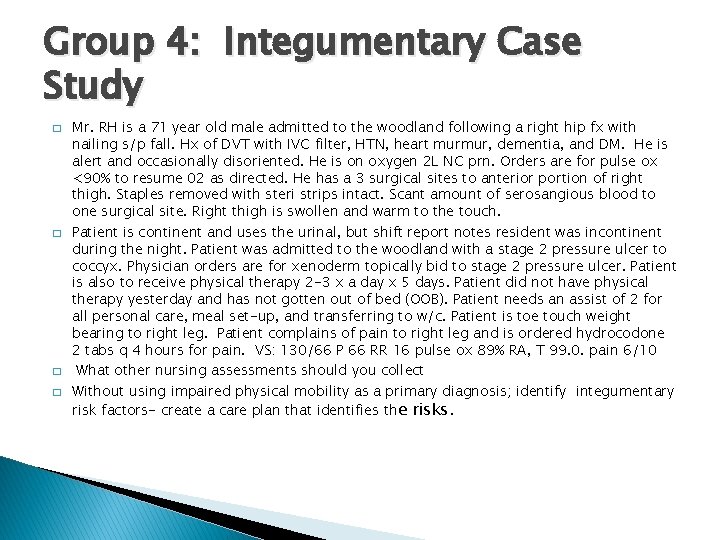
Group 4: Integumentary Case Study � � Mr. RH is a 71 year old male admitted to the woodland following a right hip fx with nailing s/p fall. Hx of DVT with IVC filter, HTN, heart murmur, dementia, and DM. He is alert and occasionally disoriented. He is on oxygen 2 L NC prn. Orders are for pulse ox <90% to resume 02 as directed. He has a 3 surgical sites to anterior portion of right thigh. Staples removed with steri strips intact. Scant amount of serosangious blood to one surgical site. Right thigh is swollen and warm to the touch. Patient is continent and uses the urinal, but shift report notes resident was incontinent during the night. Patient was admitted to the woodland with a stage 2 pressure ulcer to coccyx. Physician orders are for xenoderm topically bid to stage 2 pressure ulcer. Patient is also to receive physical therapy 2 -3 x a day x 5 days. Patient did not have physical therapy yesterday and has not gotten out of bed (OOB). Patient needs an assist of 2 for all personal care, meal set-up, and transferring to w/c. Patient is toe touch weight bearing to right leg. Patient complains of pain to right leg and is ordered hydrocodone 2 tabs q 4 hours for pain. VS: 130/66 P 66 RR 16 pulse ox 89% RA, T 99. 0. pain 6/10 What other nursing assessments should you collect Without using impaired physical mobility as a primary diagnosis; identify integumentary risk factors- create a care plan that identifies the risks.

NCLEX Questions � 1. A client who was in a car accident and broke his femur has been immobilized for 5 days. When the nurse gets this client out of bed for the first time, a nursing diagnosis related to the safety of this client will be: � A. Pain � B. Impaired skin integrity � C. Altered tissue perfusion � D. Risk for activity intolerance
Answer #1= D � Risk for activity intolerance � Rationale� Being on bed rest limit cardiac function, moving the client from a lying or supine position to an upright position will require an immediate cardiac workload, increase oxygen demand will cause your patient to be short of breath and exhibit an intolerance to activity. If you get your client up to fast, without allowing time for positional changes to their cardiac system- the risk of falls increases.
NCLEX-Questions � 2. The nurse is caring for a client who has right-sided weakness. The nurse needs to help the client walk. What should the nurse do while walking with the client? � A. Hold the client’s left hand while walking � B. Hold the client’s right hand while walking � C. Put a gait belt on the client and provide support on the left side � D. Put a gait belt on the client and provide support on the right side
Answer #2= D � Put a gait belt on the client and provide support on the right side � Rationale: � With right-sided weakness this is the side that needs support during ambulation, transfers, etc.
NCLEX-QUESTIONS � � � #3 A client is diagnosed with osteoarthritis (OA), tells a clinic nurse about the inability to ambulate and staying on bed rest because of hip stiffness. In addition to teaching the client measures to reduce joint stiffness, which referral for the client should the nurse plan to discuss with the health care provider? A. Social worker B. Occupational therapy C. Arthritis Foundation D. Physical Therapy
Answer= D Physical Therapist- rationale: � The P. T. can assist the client in adopting self -management strategies and teach isometric, postural, and other exercises that prevent joint overuse. �

NCLEX-Questions � � � #4. A client is admitted to the rehab unit following a Right total hip replacement (THR). The client is 3 days post-op. Doctor order states: activity is weight bearing as tolerated with assistance. Which nursing intervention should be implemented? A. Assisting the client to get out of bed on the left side so the client can stand to use the urinal B. Assisting the client using a gait belt to the commode C. Log rolling client on the right side to assist the client out of bed D. Assisting the client to the bathroom, which has grab bars , an elevated toilet seat, using a walker, and partial weight bearing of the right leg.
Answer: D � Assisting the client to the bathroom, which has grab bars , elevated toilet seat, using a walker, and partial weight bearing of the right leg. � Rationale: on the second day post-op your patient should be up and walking with a walker and have doctor orders that stipulating weight bearing restrictions. An elevated toilet seat is used to prevent hip flexion of >90 degrees when the client sits.
NCLEX-Questions � #5 � To prevent circulatory compromise after a right total knee replacement, a nurse should ensure that the client is: � A. flexing both feet and exercising uninvolved joints every hour while awake � B. using the CPM machine every 2 hours for 30 minutes � C. Assisted up to the chair as soon as the effects of anesthesia have worn off � D. Using the trapeze to life the buttocks off the bed and then rotating each leg intermittently
Answer: A � flexing both feet and exercising uninvolved joints every hour while awake- the flexing will promote muscle contraction and reduce the risk of DVT
NCLEX Questions � #6 � The nurse is assessing a resident who is 3 days post-op following a right total hip replacement. In assisting the resident up to the chair- which of the following findings require the nurse to intervene immediately? � A. Reddened area on the Sacrum � B. Voiding concentrated urine, 50 ml/hr � C. Capillary refill 3 seconds, dorsiflexon and sensation intact, pedal pulses palpable � D. Hip incision well approximated with 5 steristrips in place.
Answer=A � Reddened area on sacrum is indicative of a pressure ulcer, damage to underlying tissues has already occurred. � Urinary output is 30 ml/hr indicates adequate kidney function. � These assessments indicate good circulation and perfusion � Assessment of incision suggests good healing process
- Slides: 45