
Principles of Mendelism The contribution of mendel to
Principles of Mendelism • The contribution of mendel to genetics is called Mendelism. • Mendel is the father of genetics. • He was born in 1822 in Australia. He dies in 1884. He was a gardener & he performed series of experiments with pea plants in garden. • His work contains inheritance if characters in 22 varieties of garden peas. • He published papers in 1866 & 67. In the proceedings of natural history society of brunn.
• About 33 yrs his work remain unnoticed. When mendel’s work was recognized & appreciated. He was no more. Reaso’s for Medel’s success • He did his work by collecting several types of garden pea Pisum sativum. • He did hybridization experiments. • The following are the reason for medal sucsess. • Flowers of pea plants are normally self fertilized. • It shows number of contrasting characters.
Hybrids of pea plants are fertile. Cross pollination is not very difficult. Artificial fertilization is almost successful. The genes for 7 pairs of characters are located on seven separate homologous pairs of chromosomes. • Many pure breeding varieties are available for the experiment. • It is very easy to cultivate. • Growth period & life cycle is very short. • •
• He studied the inheritance of only one character at a time, he maintains statistical records of the results. Characters Selected by Mendel.
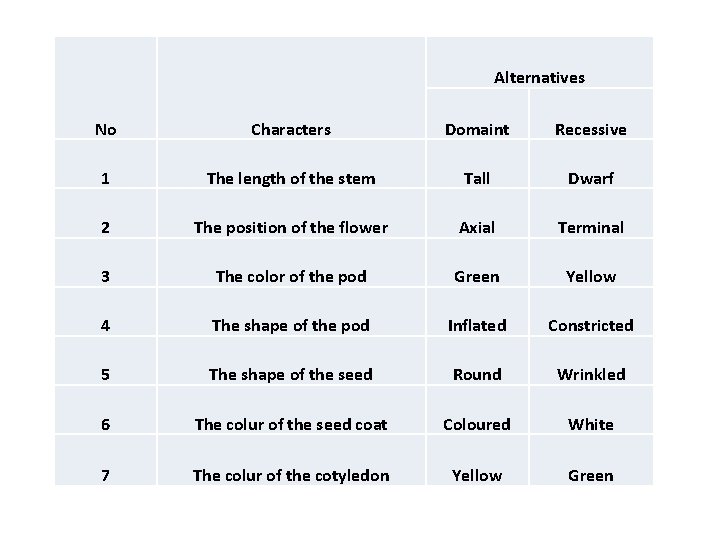
Alternatives No Characters Domaint Recessive 1 The length of the stem Tall Dwarf 2 The position of the flower Axial Terminal 3 The color of the pod Green Yellow 4 The shape of the pod Inflated Constricted 5 The shape of the seed Round Wrinkled 6 The colur of the seed coat Coloured White 7 The colur of the cotyledon Yellow Green
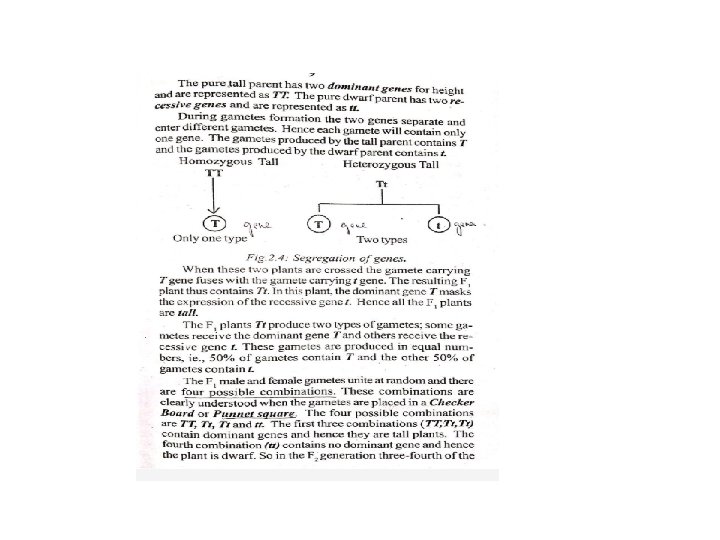
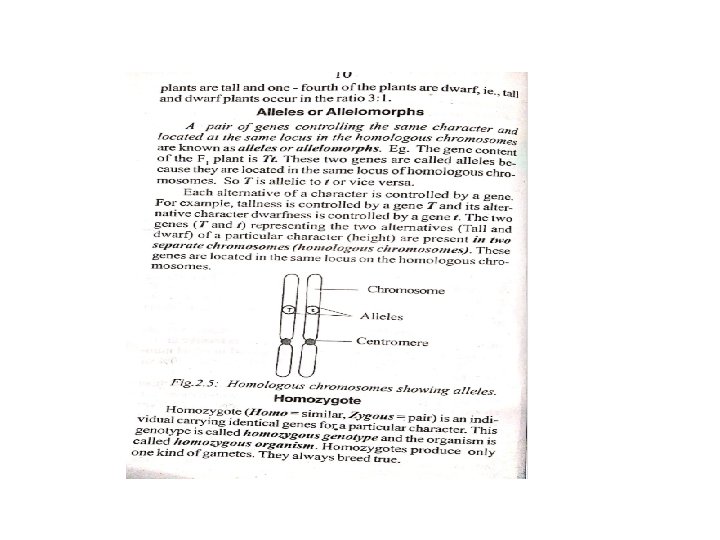
Law of Segregation Monohybrid & experiments • This was proposed by Mendel in 1866. • According to this law each organism is formed of bundle of characters. Each character is controlled by a pair of factors (genes). • During gamete formation, the 2 factors of a character separate & enter the different genes. This is called law of purity of gametes.
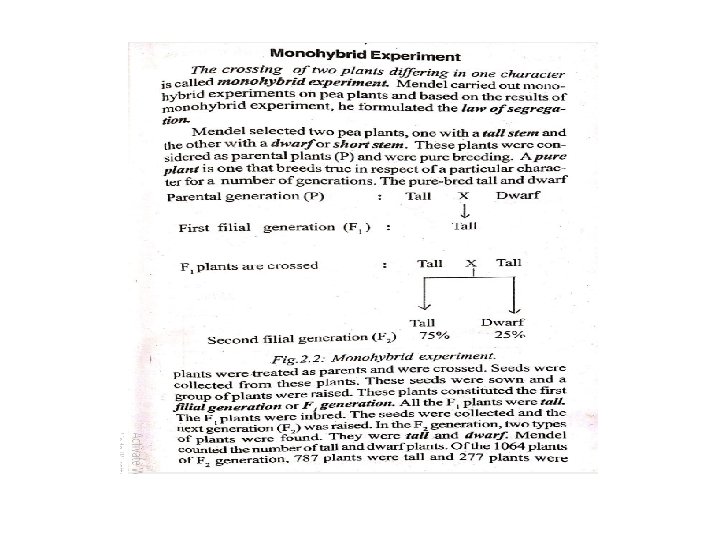
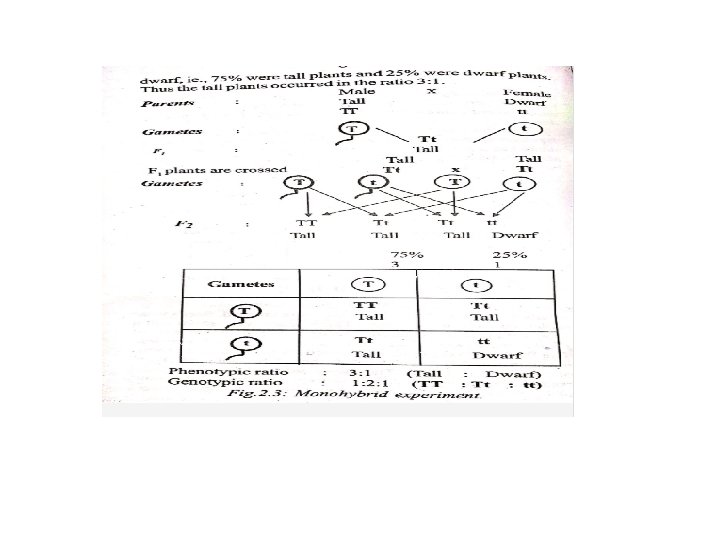
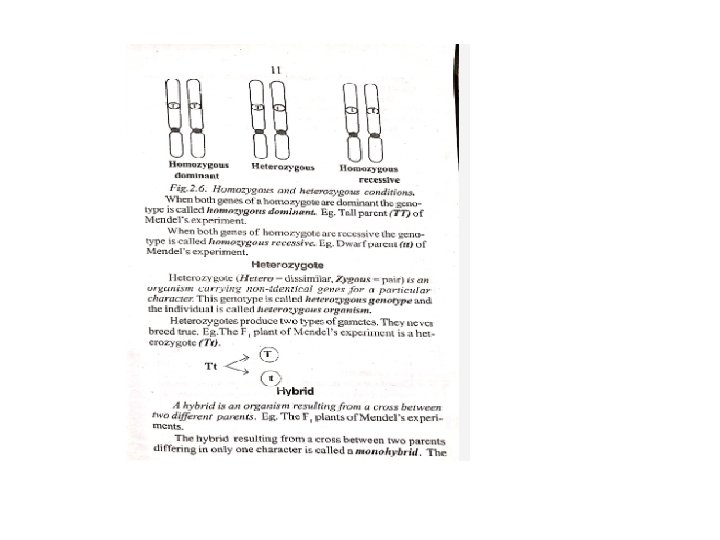
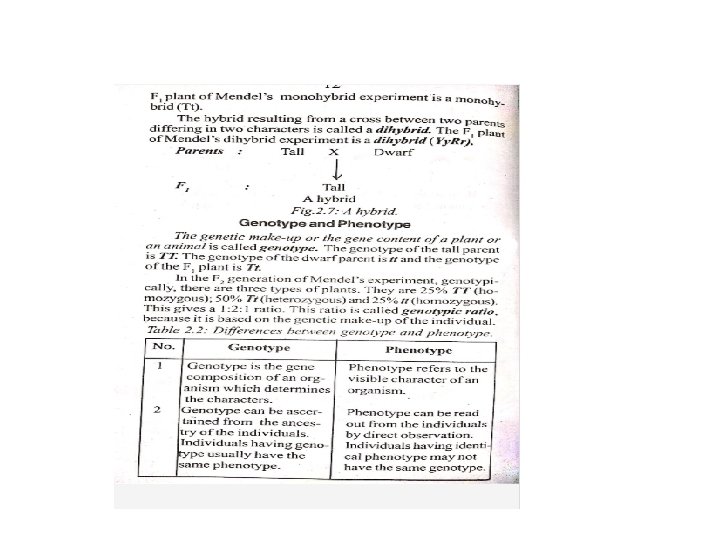
• The visible appearance of plant or animal is called phenotype • Back cross • It is a cross of F 1 hybrid with any one of its parents. • The back cross is of 2 types, they are the dominant back cross and the recessive back cross • When the F 1 hybrid is crossed with the dominant parent the cross is called dominant back cross. • If the F 1 hybrid is crossed with the recessive parent the cross is called recessive back cross • The recessive back cross helps to identify the hetrozygosity of hybrid hence this cross is called test cross
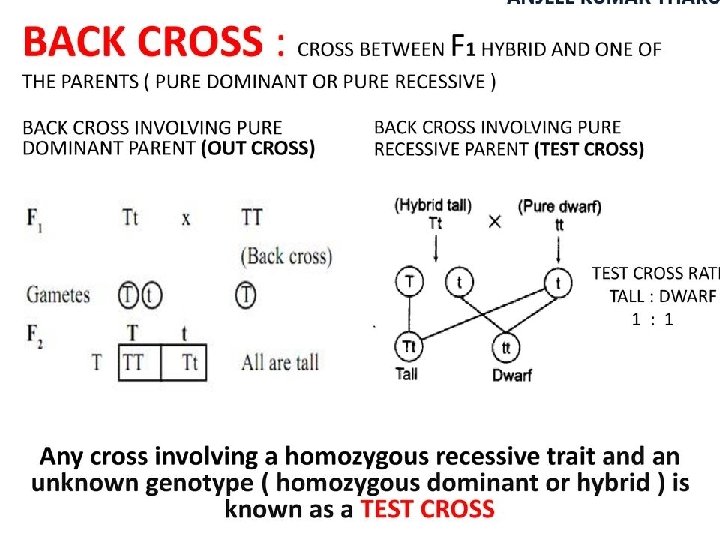
Test cross • Is a back cross where F 1 plant is crossed with recessive parent • This cross is used to test the hetrozygosity of the F 1 plant, hence it is called test cross or recessive back cross. Because the F 1 plant is crossed back with recessive parent. • Law of independent assortment & dihybrid experiment. • This law states that the genes for each character separate & enter the gametes independently of the genes f other characters.
Dihybrid Experiment • The crossing of 2 plants differing in 2 characters is called dihybrid experiment. • In this experiment 2 characters are considered at a time. • Mendel considered the cartyledon color yellow & green seed shape round & wrinkled. • He selected pure breeding yellow, round seed & pure breeding green wrinkled seed producing plant.
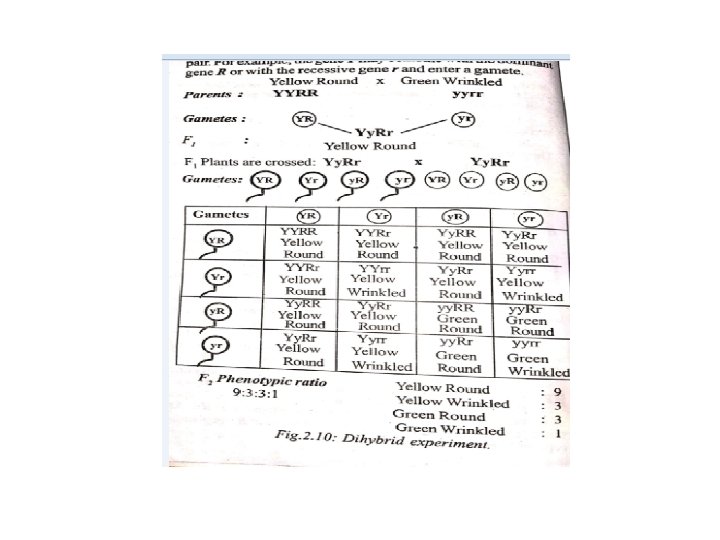
• These plant were treated as parents & crossed. • In F 1 generation, all plants are yellow round seeds. • The F 1 plants were self fertilized. • In F 2 generation 4 kinds of plants were produced they were (a) Plants producing yellow round seeds (b) Plants producing yellow wrinkled seeds (c) Plants producing green round seeds (d) Plants producing green wrinkled seeds The ratio is 9: 3: 3: 1.
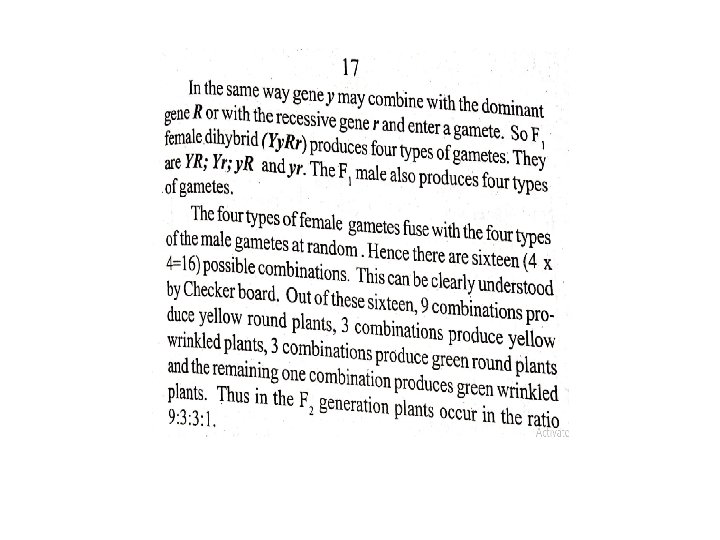
Explanation: • In cotyledon color yellow (Y ) is dominant over green (y). In seed shape round (R) is dominant over wrinkled (r). Hence the pure breeding yellow round parent is represented by genotype YYRR & pure breeding green wrinkled parent is having parent genotype yyrr. • During gamete formation the paired genes of a character assort independently of the other pair. Thus, dominant parent produce only one type of parent & each gamete carrying one gene for seed color (Y ) & another gene for seed shape (R). Hence, the gene content of the gametes is (YR).
• Similarly the recessive parent (yyrr) produces the gamete (yr). • F 1 plants are formed after crossing over above gametes & the genotype of F 1 plant is (Yy. Rr). • After self fertilization of F 1 hybrid 4 different types of plats are produced in the ratio of 9: 3: 3: 1.
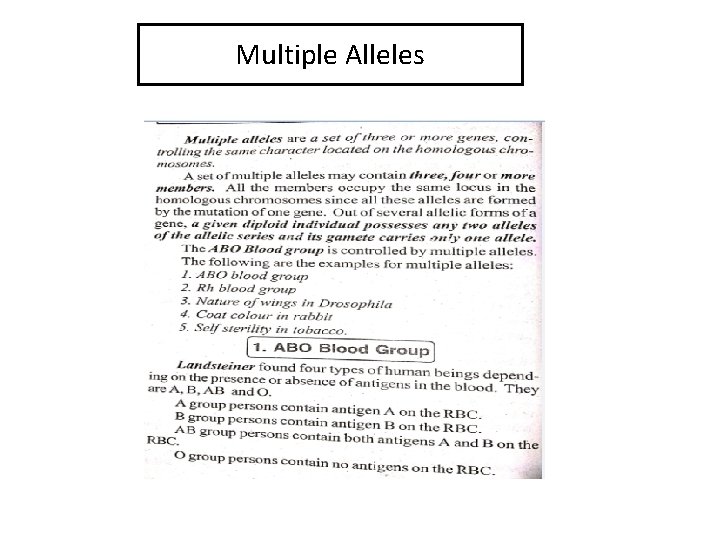
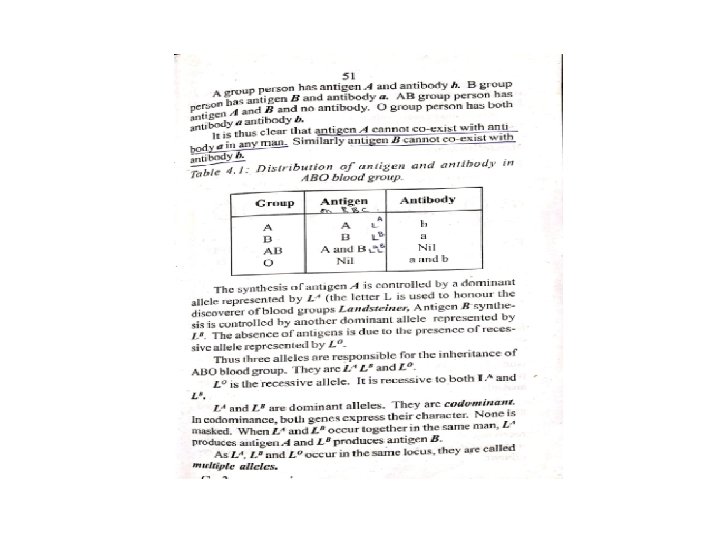
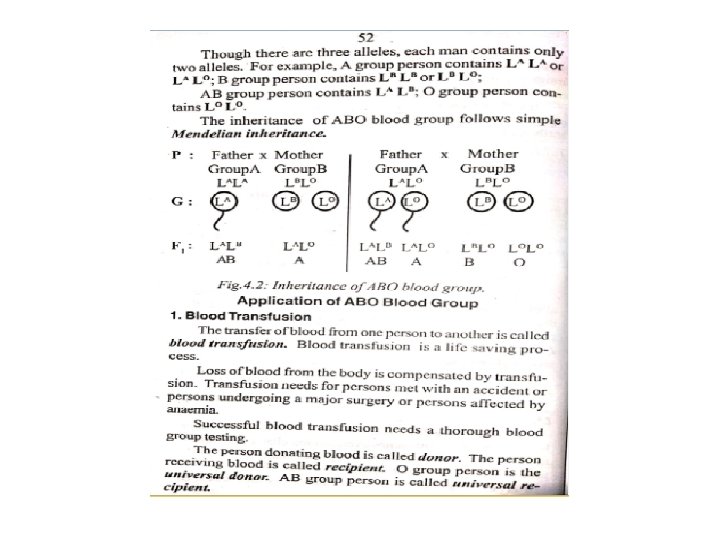
Multiple Alleles

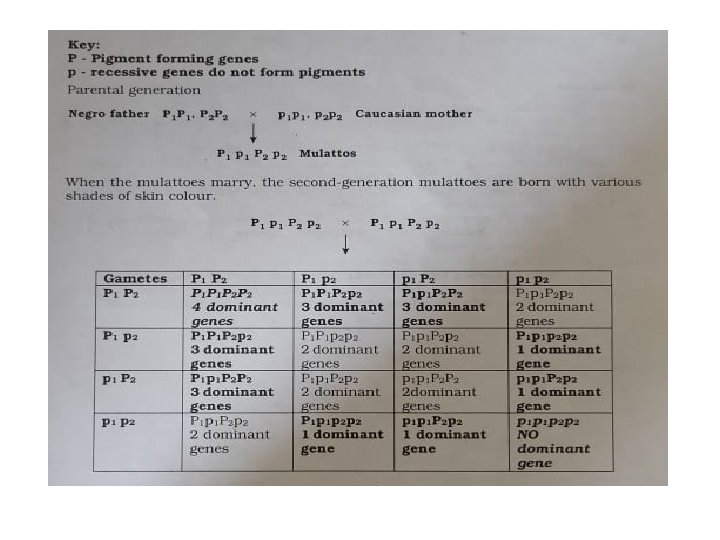
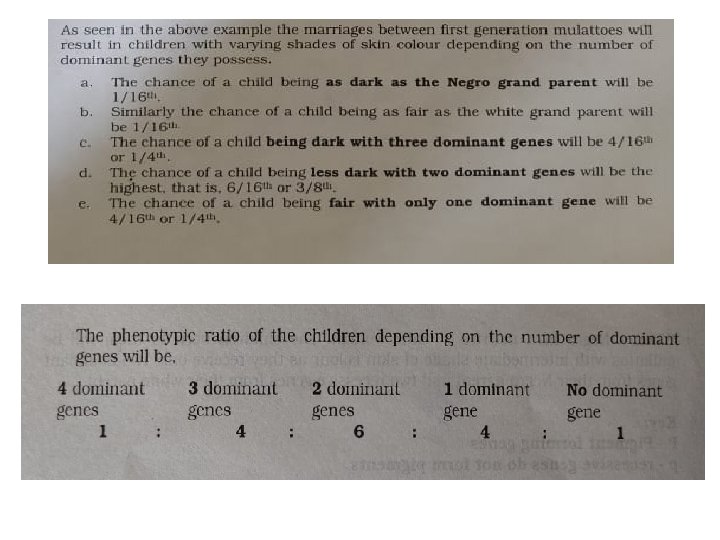
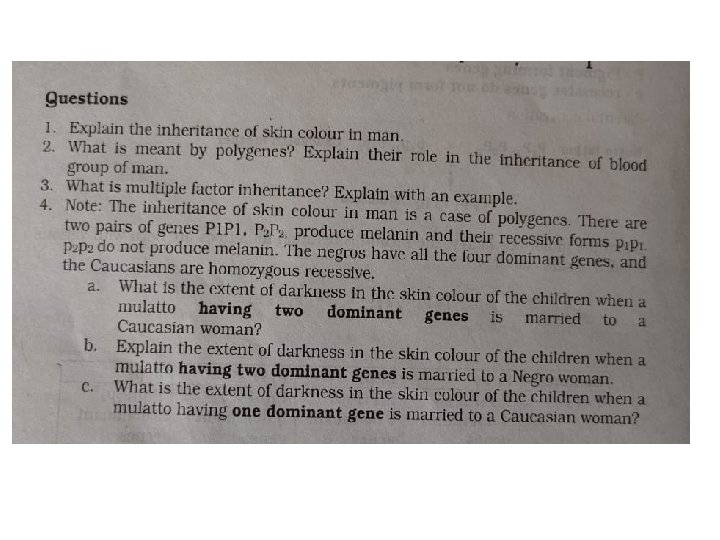
• • • Multiple Factor Inheritance, inheritance of skin color in man There are various shades of skin color This is due to deposition of melanin pigments In fair person – low melanin, In dark person(negroes) – high melanin marriages between negroes and white(Caucasians), the children born are mulattos (intermediate skin color) If the skin color dependent on only one pair of gene then people would be either dark/ fair with no intermediate shade of skin color When F 1 mulattos marry other mulattos, the children born F 2 born have various shades of skin color It is confirmed that many genes are involved in the inheritance of skin color According to Cart Stern and Davenport (1913) stated that skin color inheritance due to many genes/poly gene located on different loci on the chromosome. Since there are many genes are involved it is called multiple factor inheritance
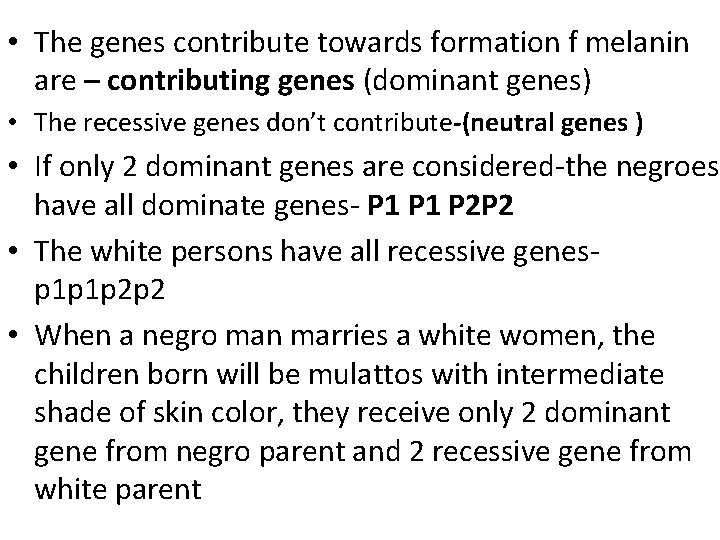
• The genes contribute towards formation f melanin are – contributing genes (dominant genes) • The recessive genes don’t contribute-(neutral genes ) • If only 2 dominant genes are considered-the negroes have all dominate genes- P 1 P 2 P 2 • The white persons have all recessive genesp 1 p 1 p 2 p 2 • When a negro man marries a white women, the children born will be mulattos with intermediate shade of skin color, they receive only 2 dominant gene from negro parent and 2 recessive gene from white parent
- Slides: 43