
Principles of Marketing Section 3 By Ms Eman

Principles of Marketing Section 3 By: Ms. Eman Elfar
Writing Job Descriptions A job description • A written statement of what the worker actually does, how he or she does it, and what the job’s working conditions are. Sections of a typical job description * Job identification * Job summary * Responsibilities and duties * Authority of incumbent * Standards of performance * Working conditions * Job specifications
The Job Description Job identification ⁂ Job title: name of job ⁂ FLSA (Fair Labor Standards Act ) status section: Exempt or nonexempt ⁂ Preparation date: when the description was written ⁂ Prepared by: who wrote the description Job summary ⁂ Describes the general nature of the job ⁂ Lists the major functions or activities
Relationships (chain of command) ¤ Reports to whom: employee’s immediate supervisor ¤ Supervises: employees that the job incumbent directly supervises ¤ Works with: others with whom the job holder will be expected to work and come into contact with internally and outside the company Responsibilities and duties ¤ A listing of the job’s major responsibilities and duties (essential functions) ¤ Defines limits of jobholder’s decision-making authority, direct supervision, and budgetary limitations
Standard Occupational Classification Classifies all workers into one of 23 major groups of jobs which are subdivided into 96 minor groups of jobs and detailed occupations. Standards of performance and working conditions Lists the standards the employee is expected to achieve under each of the job description’s main duties and responsibilities.
Is the Job Function Essential (how determine the job’s essential function v What three or four main activities actually constitute the job? Is each really necessary? v What is the relationship between each task? Is there a special sequence which the tasks must follow? v Do the tasks necessitate sitting, standing, crawling, walking, climbing, running, stooping, kneeling, lifting, carrying, digging, writing, operating, pushing, pulling, fingering, talking, listening, interpreting, analyzing, seeing, coordinating, etc. ? v How many employees are available to perform the job function? Can the job function be distributed among other employees? v How much time is spent on the job performing each particular function? Are infrequent tasks less important to success? v Would removing a function fundamentally alter the job?
Is the Job Function Essential (how determine the job’s essential function v What happens if a task is not completed on time? v Does the position exist to perform that function? v Are employees in the position actually required to perform the function? v Is there a limited number of other employees available to perform the function? v What is the degree of expertise or skill required to perform the function? v What is the actual work experience of present or past employees in the job? v What is the amount of time an individual actually spends performing the function? v What are the consequences of not requiring the performance of the function?
Writing Job Specifications There are four ways when writing job specification: Specifications for trained personnel Focus on traits like length of previous service, quality of relevant training, and previous job performance. Specifications for untrained personnel Focus on physical traits, personality, interests, or sensory skills that imply some potential for performing or for being trained to do the job.

Specifications Based on Judgment v. Self-created judgments (common sense) v. List of competencies in Web-based job descriptions (e. g. , www. jobdescription. com) v. O*NET online v. Standard Occupational Classification Specifications Based on Statistical Analysis v. Attempts to determine statistically the relationship between a predictor or human trait and an indicator or criterion of job effectiveness.
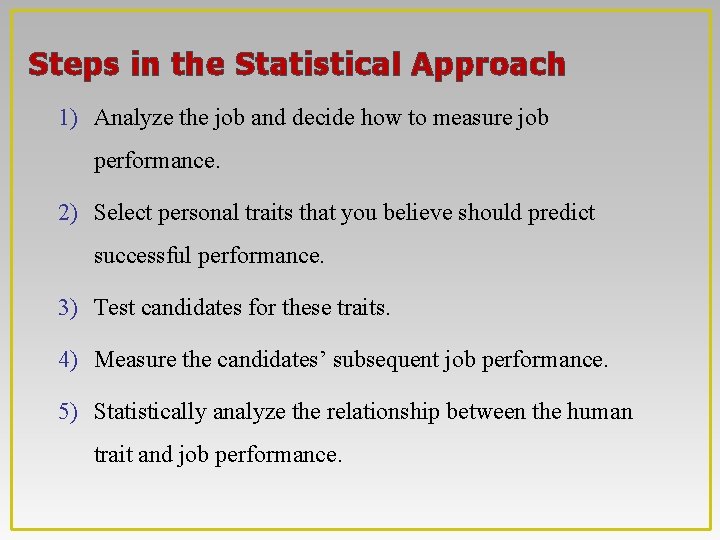
Steps in the Statistical Approach 1) Analyze the job and decide how to measure job performance. 2) Select personal traits that you believe should predict successful performance. 3) Test candidates for these traits. 4) Measure the candidates’ subsequent job performance. 5) Statistically analyze the relationship between the human trait and job performance.
Steps of Writing Job Descriptions v. Step 1. Decide on a Plan v. Step 2. Develop an Organization Chart v. Step 3. Use a Job Analysis/Description Questionnaire v. Step 4. Obtain Lists of Job Duties from O*NET v. Step 5. Compile the Job’s Human Requirements from O*NET v. Step 6. Complete Your Job Description
Job • Generally defined as “a set of closely related activities carried out for pay. ” Job enlargement • Assigning workers additional same level activities, thus increasing the number of activities they perform. Job enrichment • Redesigning jobs in a way that increases the opportunities for the worker to experience feelings of responsibility, achievement, growth, and recognition.
Job rotation ØMoving a trainee from department to broaden his or her experience and identify strong and weak points to prepare the person for an enhanced role with the company ØSystematically moving workers from one job to another to enhance work team performance.
De-jobbing • Broadening the responsibilities of the company’s jobs • Encouraging employee initiative. Why Managers Are De-jobbing Their Companies Internal factors leading to de-jobbing • Flatter organizations • Work teams External factors leading to de-jobbing. • Rapid product and technological change • Global competition • Deregulation, • Political instability, • Demographic changes • Rise of a service economy.
Competency-Based Job Analysis Competencies v. Demonstrable characteristics of a person that enable performance of a job. Competency-based job analysis v. Describing a job in terms of the measurable, observable, behavioral competencies (knowledge, skills, and/or behaviors) an employee must exhibit to do a job well.
Why Use Competency Analysis? Ø To support HPWS • Traditional job descriptions (with their lists of specific duties) may actually backfire if a high-performance work system is the goal. Ø Maintain a strategic focus • Describing the job in terms of the skills, knowledge, and competencies the worker needs is more strategic. Ø Measuring performance • Measurable skills, knowledge, and competencies are the heart of any company’s performance management process.
Performance Management Managing all elements of the organizational process that affect how well employees perform. • Types of competencies • General competencies • reading, writing, and mathematical reasoning. • Leadership competencies • leadership, strategic thinking, and teaching others. • Technical competencies • specific technical competencies required for specific types of jobs and/or occupations.
- Slides: 17