
PRINCIPLES OF MARKETING Chapter 4 BUYER BEHAVIOR ANALYSIS

PRINCIPLES OF MARKETING Chapter 4. BUYER BEHAVIOR ANALYSIS Dr. NGUYỄN MINH ĐỨC NONG LAM UNIVERSITY HCM CITY 1 Nguyễn Minh Đức 2009
The most important thing is to forecast where customers are moving, and be in front of them. 2 Nguyễn Minh Đức 2009
BUYER BEHAVIOR ANALYSIS § How do the buyers’ characteristics – cultural, social, personal, and psychological – influence buying behavior? § How does the buyer make purchasing decisions? § How individuals, groups, and organizations select, purchase, use, and dispose of goods, services, ideas, or experiences to satisfy their needs and desires. 3 Nguyễn Minh Đức 2009
Reason to analyze buyer behavior? v. Keys for product development v. Create characteristics of a new product v. Select marketing distribution v. Select message for communication v. Apply marketing mix 4 Nguyễn Minh Đức 2009
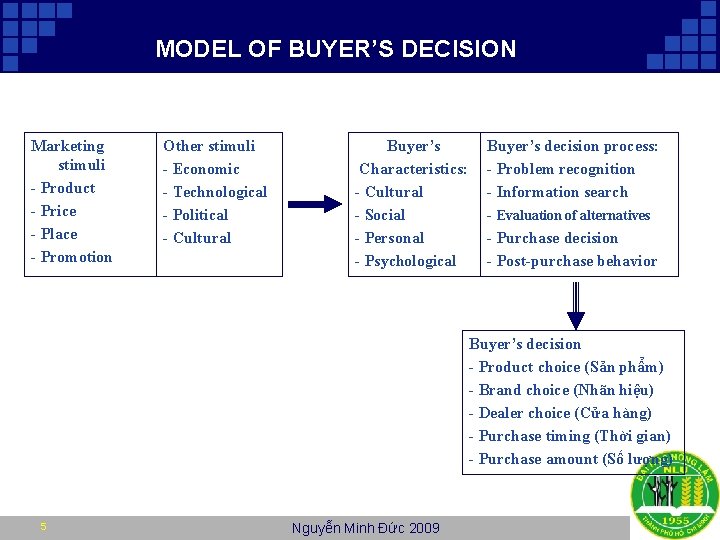
MODEL OF BUYER’S DECISION Marketing stimuli - Product - Price - Place - Promotion Other stimuli - Economic - Technological - Political - Cultural Buyer’s Characteristics: - Cultural - Social - Personal - Psychological Buyer’s decision process: - Problem recognition - Information search - Evaluation of alternatives - Purchase decision - Post-purchase behavior Buyer’s decision - Product choice (Sản phẩm) - Brand choice (Nhãn hiệu) - Dealer choice (Cửa hàng) - Purchase timing (Thời gian) - Purchase amount (Số lượng) 5 Nguyễn Minh Đức 2009

INFLUENCES OF BUYEER BEHAVIORS Cultural Psychological BUYER DECISION Personal 6 Nguyễn Minh Đức 2009 Social
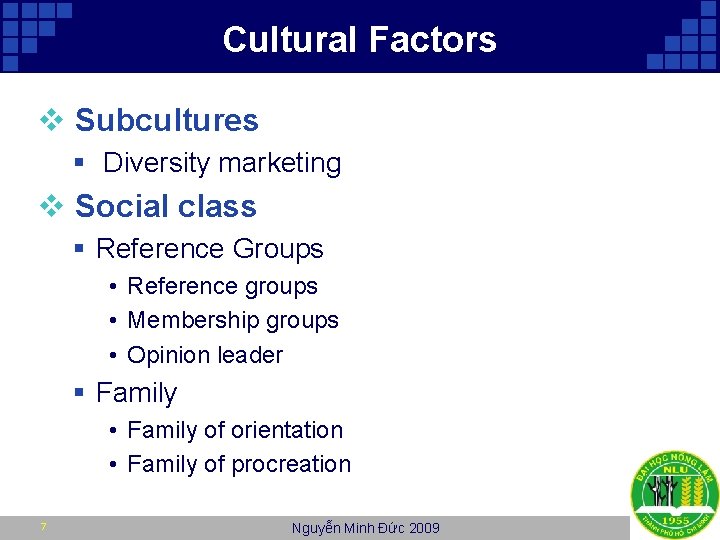
Cultural Factors v Subcultures § Diversity marketing v Social class § Reference Groups • Reference groups • Membership groups • Opinion leader § Family • Family of orientation • Family of procreation 7 Nguyễn Minh Đức 2009
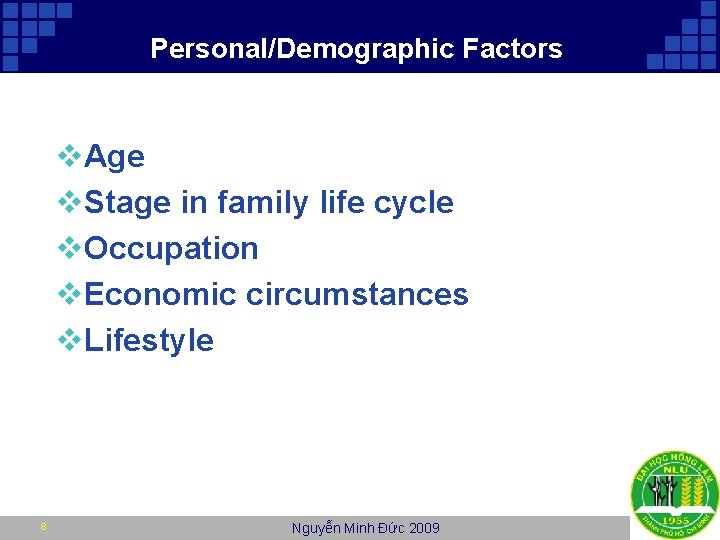
Personal/Demographic Factors v. Age v. Stage in family life cycle v. Occupation v. Economic circumstances v. Lifestyle 8 Nguyễn Minh Đức 2009
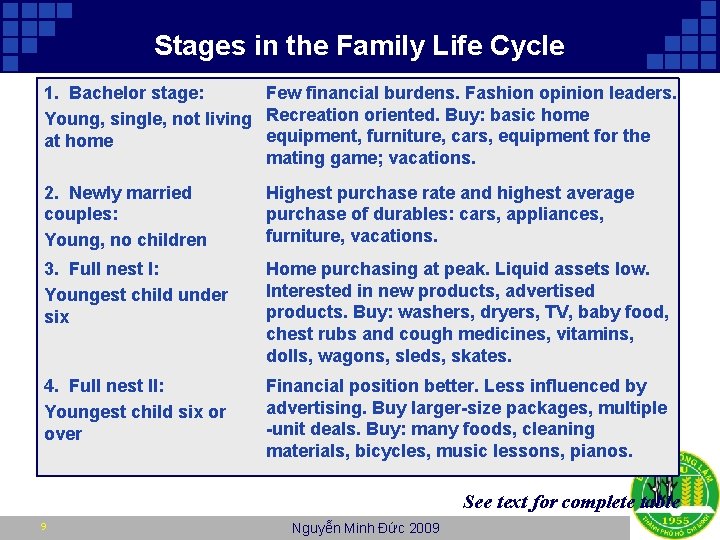
Stages in. Stages the Family Life Table 7. 2: in the Family Life Cycle 1. Bachelor stage: Few financial burdens. Fashion opinion leaders. Young, single, not living Recreation oriented. Buy: basic home equipment, furniture, cars, equipment for the at home mating game; vacations. 2. Newly married couples: Young, no children Highest purchase rate and highest average purchase of durables: cars, appliances, furniture, vacations. 3. Full nest I: Youngest child under six Home purchasing at peak. Liquid assets low. Interested in new products, advertised products. Buy: washers, dryers, TV, baby food, chest rubs and cough medicines, vitamins, dolls, wagons, sleds, skates. 4. Full nest II: Youngest child six or over Financial position better. Less influenced by advertising. Buy larger-size packages, multiple -unit deals. Buy: many foods, cleaning materials, bicycles, music lessons, pianos. See text for complete table 9 Nguyễn Minh Đức 2009
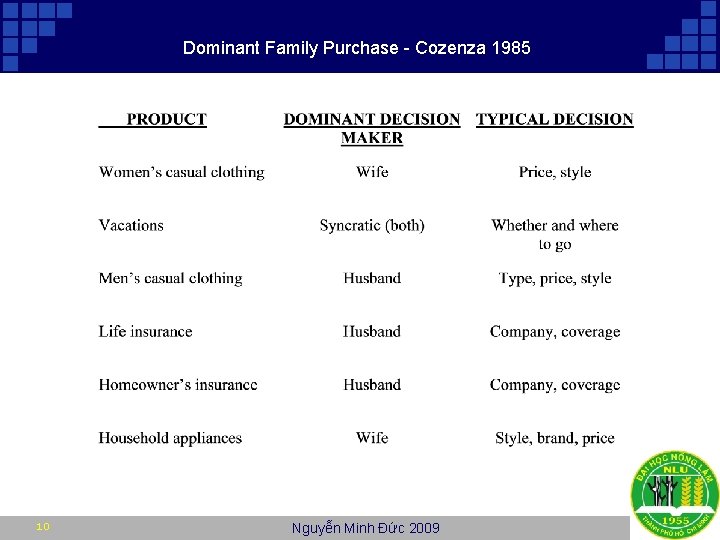
Dominant Family Purchase - Cozenza 1985 10 Nguyễn Minh Đức 2009
PSYCHOLOGICAL FACTORS § Motivation § Perception § Learning § Beliefs and attitudes 11 Nguyễn Minh Đức 2009
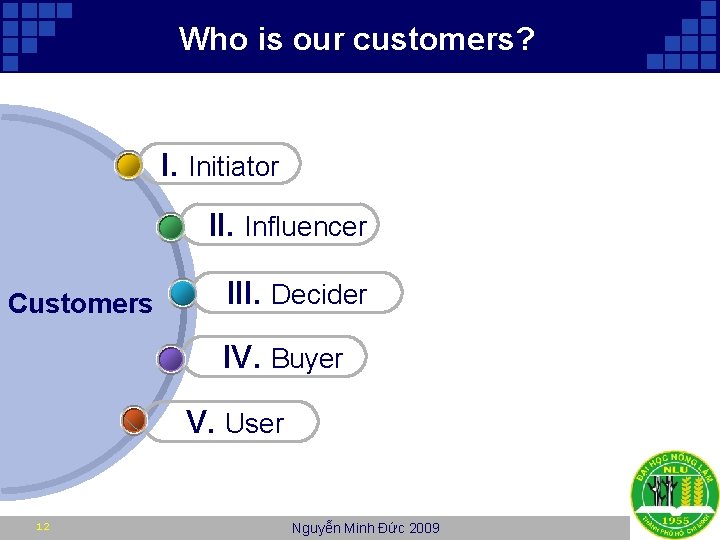
Who is our customers? I. Initiator II. Influencer Customers III. Decider IV. Buyer V. User 12 Nguyễn Minh Đức 2009
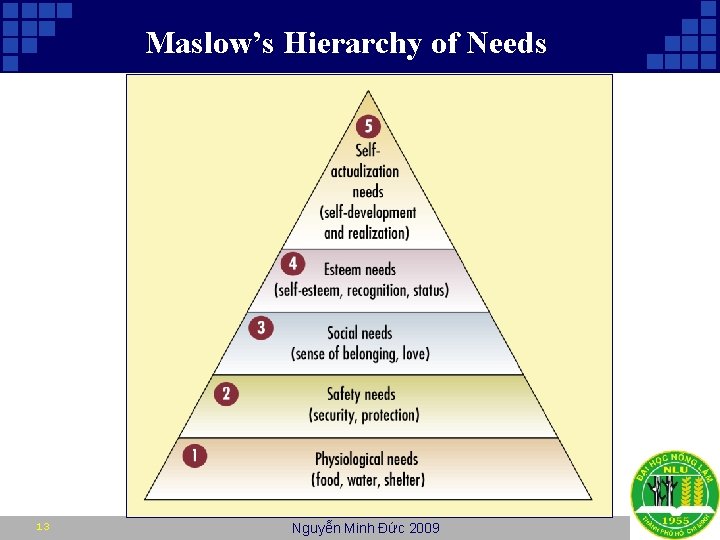
Maslow’s Hierarchy of Needs 13 Nguyễn Minh Đức 2009
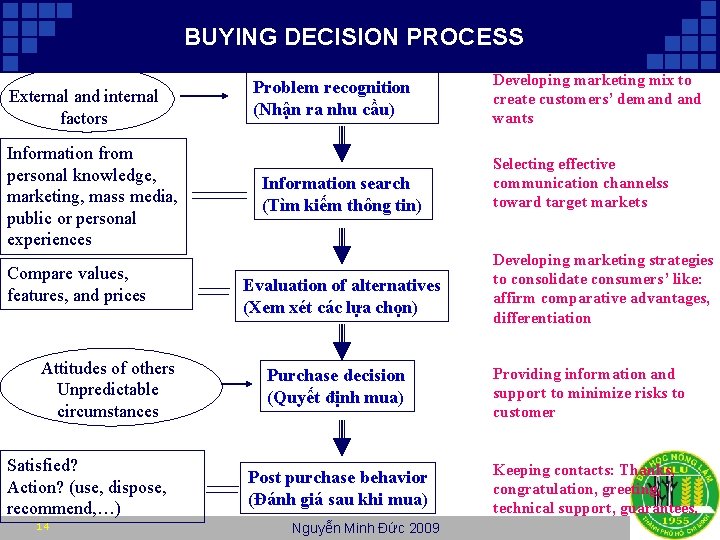
BUYING DECISION PROCESS External and internal factors Information from personal knowledge, marketing, mass media, public or personal experiences Compare values, features, and prices Attitudes of others Unpredictable circumstances Satisfied? Action? (use, dispose, recommend, …) 14 Problem recognition (Nhận ra nhu cầu) Information search (Tìm kiếm thông tin) Evaluation of alternatives (Xem xét các lựa chọn) Purchase decision (Quyết định mua) Post purchase behavior (Đánh giá sau khi mua) Nguyễn Minh Đức 2009 Developing marketing mix to create customers’ demand wants Selecting effective communication channelss toward target markets Developing marketing strategies to consolidate consumers’ like: affirm comparative advantages, differentiation Providing information and support to minimize risks to customer Keeping contacts: Thanks, congratulation, greeting, technical support, guarantees,

Example: Successive Sets Involved in Customer Decision Making 15 Nguyễn Minh Đức 2009
Successive Sets Involved in Customer Decision Making The Buying Decision Process § § § § 16 Consumer Reports Unanticipated situational factors Perceived risk Brand decision Vendor decision Quantity decision Timing decision Payment-method decision Nguyễn Minh Đức 2009
Types of buyer behaviour v Phức tạp (Complex buyer behaviour) VD: laptop, motobikes => Tư vấn, nêu bật điểm khác biệt, sự ưu việt của sản phẩm v Giảm rắc rối (Dissonance-reducing behaviour): brand reduces after-sales discomfort, mua trước tin sau VD: sản phẩm mỹ phẩm, thực phẩm => Cung cấp niềm tin (cho thử) v Theo thói quen (Habitual buying behaviour - little difference between products) e. g. nước chấm => khuyến mãi, quảng cáo v Thích thay đổi (variety seeking behaviour - significant brand differences) e. g soap powder => gia tăng sự có mặt của sản phẩm trên thị trường 17 Nguyễn Minh Đức 2009
Post-purchase Behavior § Postpurchase Satisfaction • Disappointed • Satisfied • Delighted § Postpurchase Use and Disposal 18 Nguyễn Minh Đức 2009
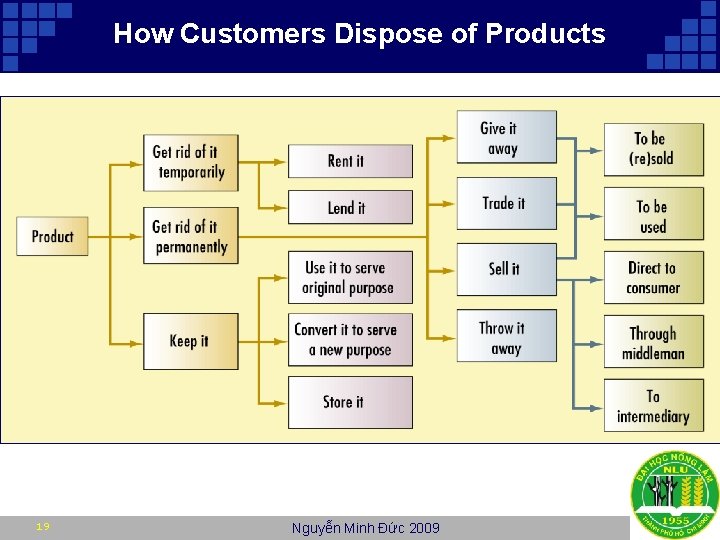
How Customers Dispose of Products 19 Nguyễn Minh Đức 2009
- Slides: 19