
Principles of Marketing An Asian Perspective Instructor Supplements


- Slides: 138
Principles of Marketing: An Asian Perspective Instructor Supplements • Created by Geoffrey da Silva
Communicating Customer Value: Integrated Marketing Communications 3 © 2012 Principles of Marketing: An Asian Perspective 14
Chapter 14 Outline 14. 1 The Promotion Mix 14. 2 Integrated Marketing Communications 14. 3 A View of the Communication Process 14. 4 Steps in Developing Effective Marketing Communication 14. 5 Setting the Total Promotion Budget and Mix 14. 6 Socially Responsible Marketing Communication 4 © 2012 Principles of Marketing: An Asian Perspective
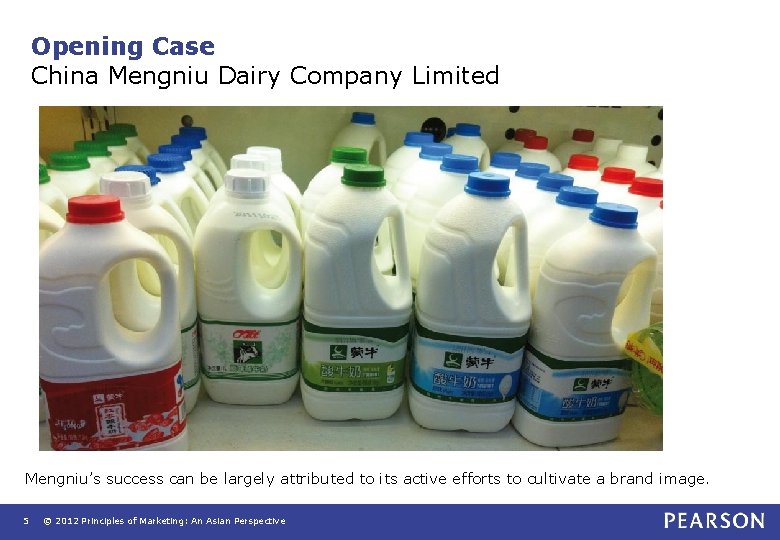
Opening Case China Mengniu Dairy Company Limited Mengniu’s success can be largely attributed to its active efforts to cultivate a brand image. 5 © 2012 Principles of Marketing: An Asian Perspective
14. 1 The Promotion Mix 6 14. 1 © 2012 Principles of Marketing: An Asian Perspective
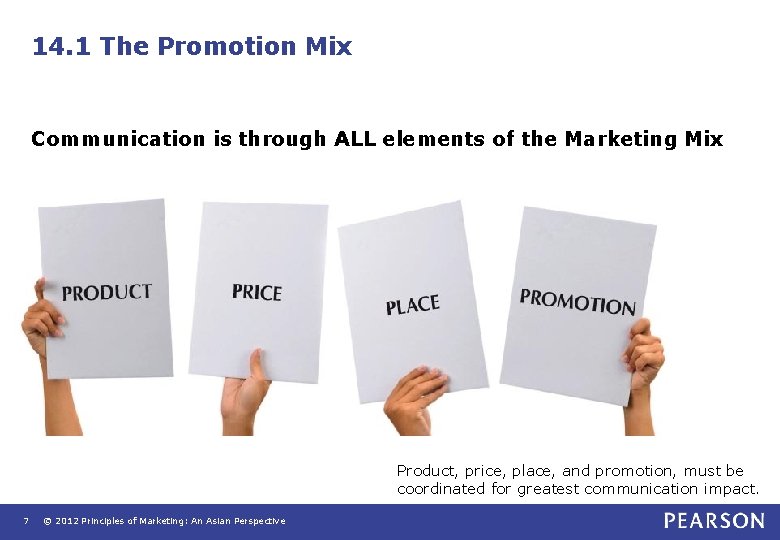
14. 1 The Promotion Mix Communication is through ALL elements of the Marketing Mix Product, price, place, and promotion, must be coordinated for greatest communication impact. 7 © 2012 Principles of Marketing: An Asian Perspective
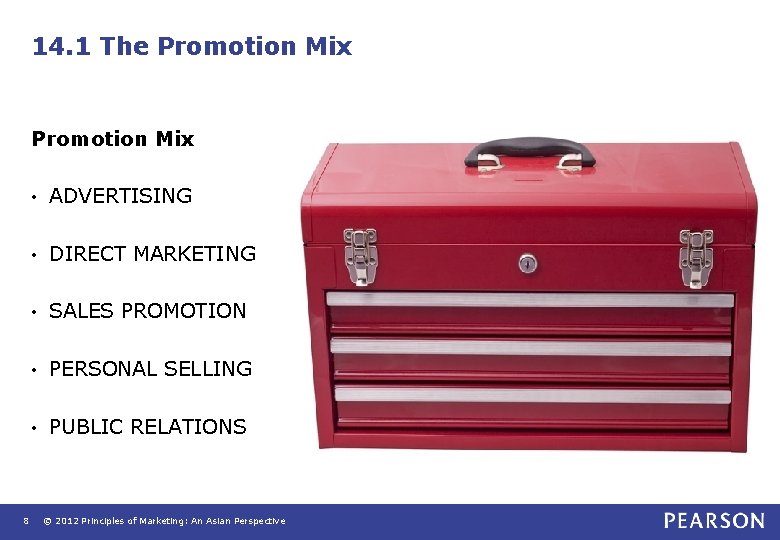
14. 1 The Promotion Mix • ADVERTISING • DIRECT MARKETING • SALES PROMOTION • PERSONAL SELLING • PUBLIC RELATIONS 8 © 2012 Principles of Marketing: An Asian Perspective
14. 1 The Promotion Mix The Promotions Mix • A company’s total promotion mix—also called its marketing communications mix—consists of the specific blend of advertising, sales promotion, public relations, personal selling, and direct marketing tools that the company uses to pursue its advertising and marketing objectives. 9 © 2012 Principles of Marketing: An Asian Perspective
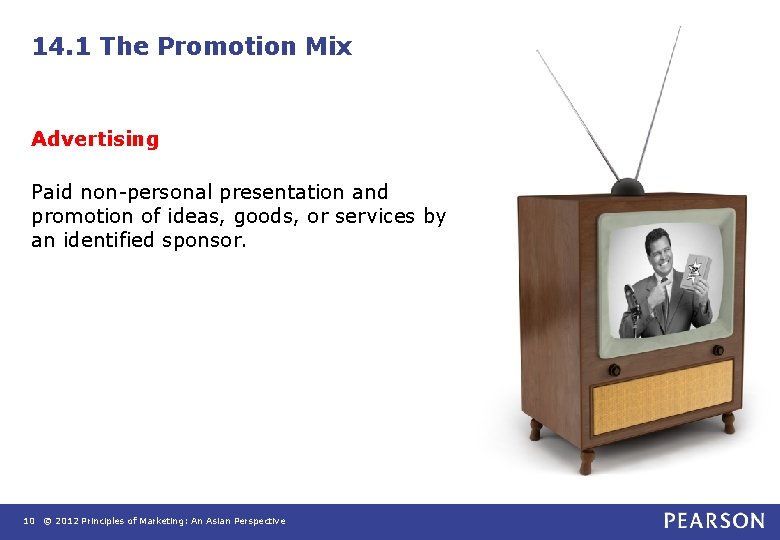
14. 1 The Promotion Mix Advertising Paid non personal presentation and promotion of ideas, goods, or services by an identified sponsor. 10 © 2012 Principles of Marketing: An Asian Perspective
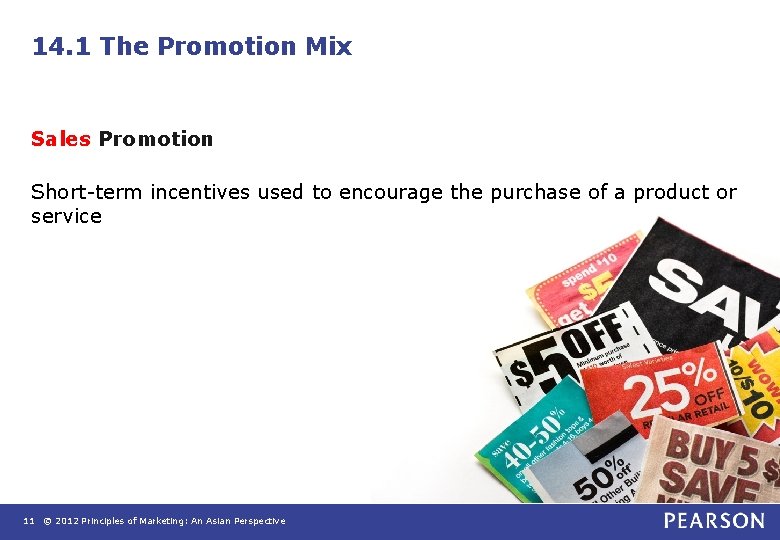
14. 1 The Promotion Mix Sales Promotion Short term incentives used to encourage the purchase of a product or service 11 © 2012 Principles of Marketing: An Asian Perspective
14. 1 The Promotion Mix Public Relations Building good relations with the company’s publics through favorable publicity, a good corporate image, and effective handling of unfavorable news. 12 © 2012 Principles of Marketing: An Asian Perspective
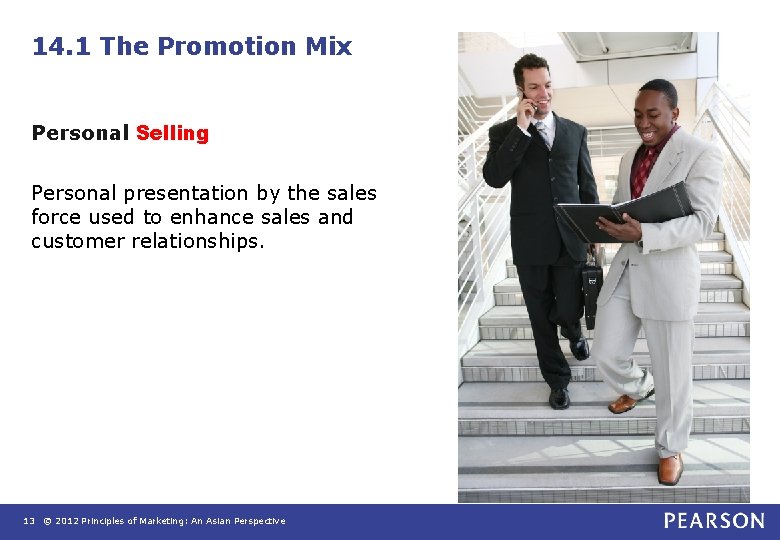
14. 1 The Promotion Mix Personal Selling Personal presentation by the sales force used to enhance sales and customer relationships. 13 © 2012 Principles of Marketing: An Asian Perspective
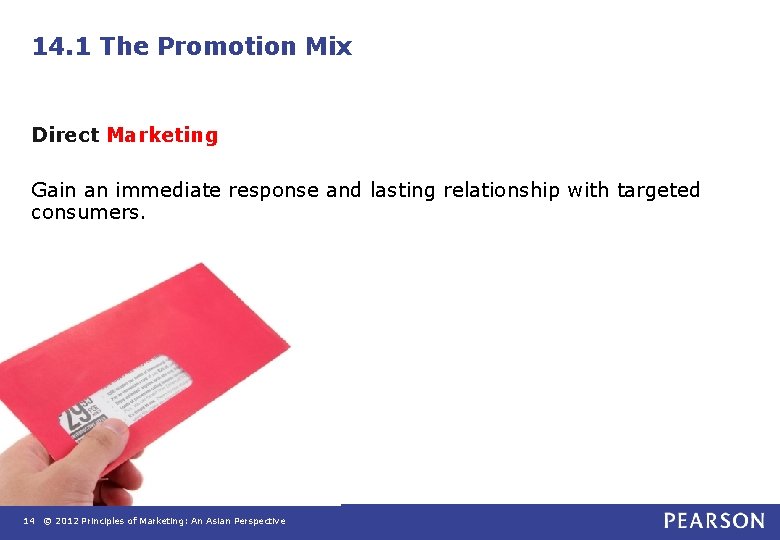
14. 1 The Promotion Mix Direct Marketing Gain an immediate response and lasting relationship with targeted consumers. 14 © 2012 Principles of Marketing: An Asian Perspective
14. 1 The Promotion Mix Reviewing the Key Concepts Define the five promotion mix tools for communicating customer value. 15 © 2012 Principles of Marketing: An Asian Perspective
14. 2 Integrated Marketing Communications 14. 2 16 © 2012 Principles of Marketing: An Asian Perspective
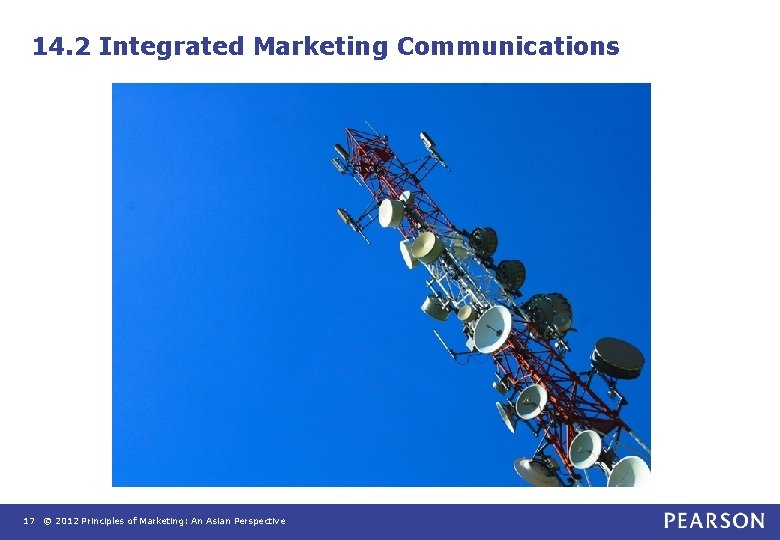
14. 2 Integrated Marketing Communications 17 © 2012 Principles of Marketing: An Asian Perspective
14. 2 Integrated Marketing Communications Importance of marketing communications • Building good customer relationships calls for more than just developing a good product, pricing it attractively, and making it available to target customers. • Companies must also communicate their value propositions to customers, and what they communicate should not be left to chance. 18 © 2012 Principles of Marketing: An Asian Perspective
14. 2 Integrated Marketing Communications Importance of marketing communications • All communications must be planned and blended into carefully integrated programs. • Just as good communication is important in building and maintaining any kind of relationship, it is a crucial element in a company’s efforts to build profitable customer relationships. 19 © 2012 Principles of Marketing: An Asian Perspective
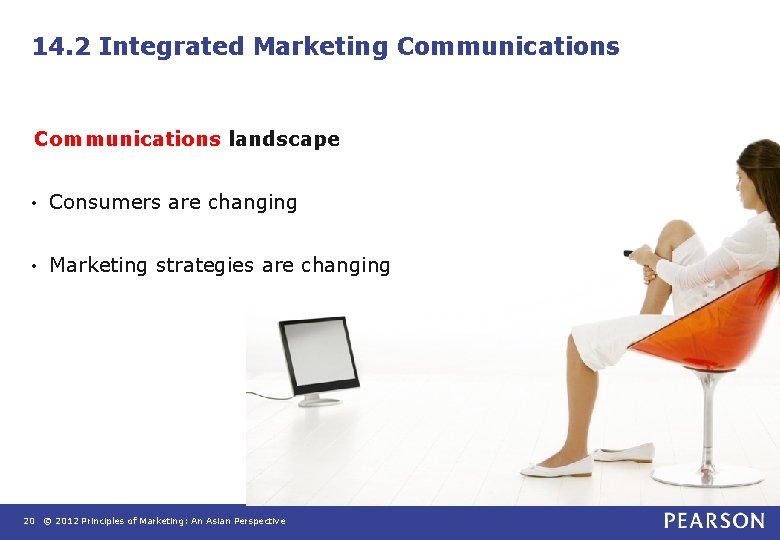
14. 2 Integrated Marketing Communications landscape • Consumers are changing • Marketing strategies are changing 20 © 2012 Principles of Marketing: An Asian Perspective
14. 2 Integrated Marketing Communications The New Marketing Communications Model • Consumers are changing. They are better informed and more communications empowered. • Marketing strategies are changing. As mass markets have fragmented, marketers are shifting away from mass marketing. More and more, they are developing focused marketing programs designed to build closer relationships with customers in more narrowly defined micro markets. 21 © 2012 Principles of Marketing: An Asian Perspective
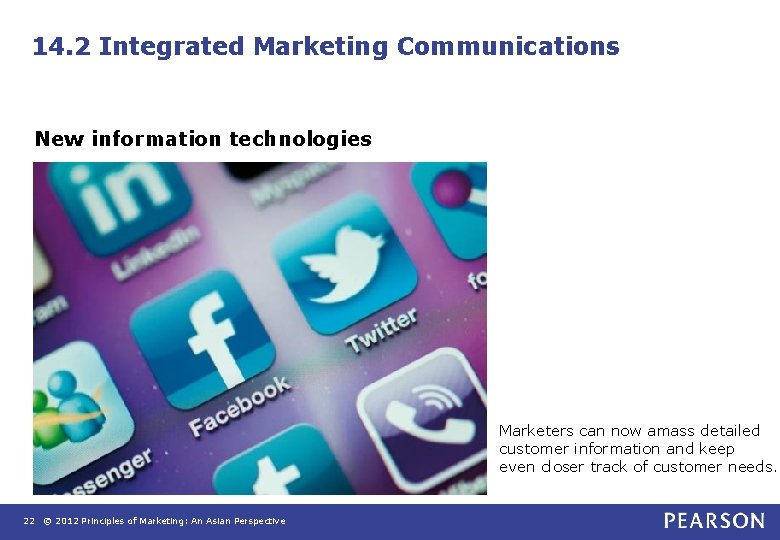
14. 2 Integrated Marketing Communications New information technologies Marketers can now amass detailed customer information and keep even closer track of customer needs. 22 © 2012 Principles of Marketing: An Asian Perspective
14. 2 Integrated Marketing Communications The New Marketing Communications Model • Although television, magazines, and other mass media remain very important, their dominance is declining. Advertisers are now adding a broad selection of more specialized and highly targeted media to reach smaller customer segments. • The new media range from specialty magazines, cable television channels, and video on demand (VOD) to Internet catalogs, e mail, podcasts, cell phones, and online social networks. 23 © 2012 Principles of Marketing: An Asian Perspective
14. 2 Integrated Marketing Communications The New Marketing Communications Model • Companies are doing less broadcasting and more narrowcasting. • Many large advertisers are shifting their advertising budgets away from network television in favor of more targeted, cost effective, interactive, and engaging media. • It seems likely that the new marketing communications model will consist of a shifting mix of both traditional mass media and a wide array of exciting new, more target, more personalized media 24 © 2012 Principles of Marketing: An Asian Perspective
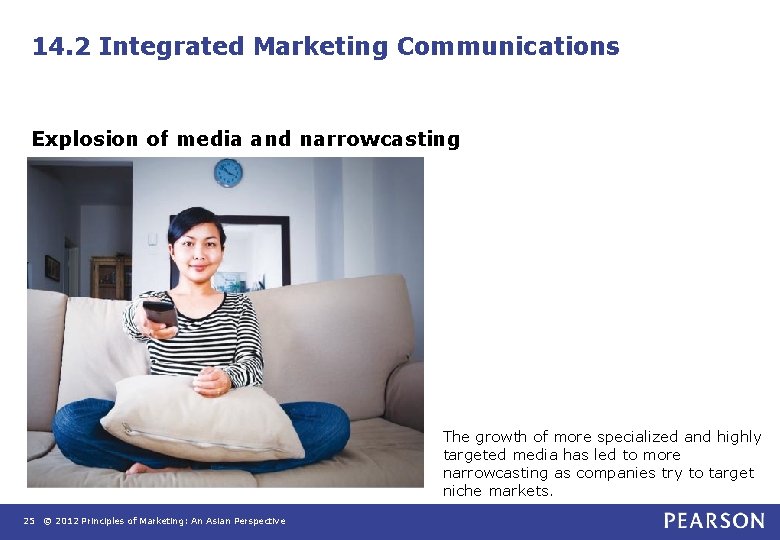
14. 2 Integrated Marketing Communications Explosion of media and narrowcasting The growth of more specialized and highly targeted media has led to more narrowcasting as companies try to target niche markets. 25 © 2012 Principles of Marketing: An Asian Perspective
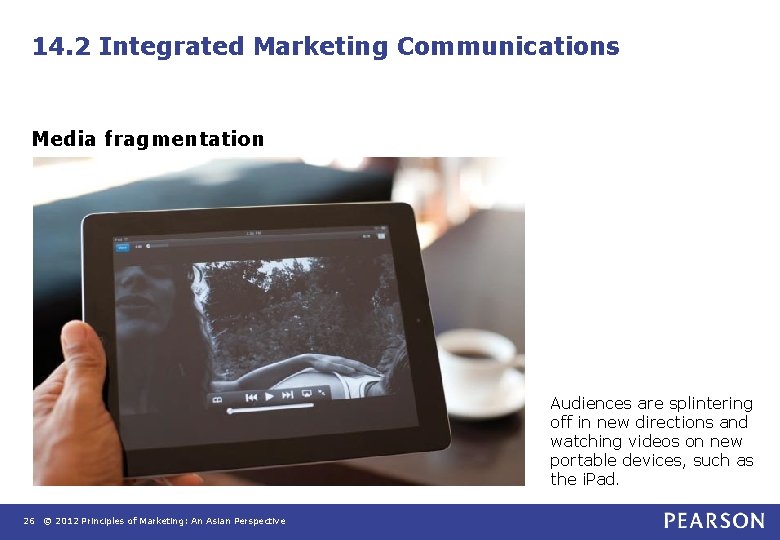
14. 2 Integrated Marketing Communications Media fragmentation Audiences are splintering off in new directions and watching videos on new portable devices, such as the i. Pad. 26 © 2012 Principles of Marketing: An Asian Perspective
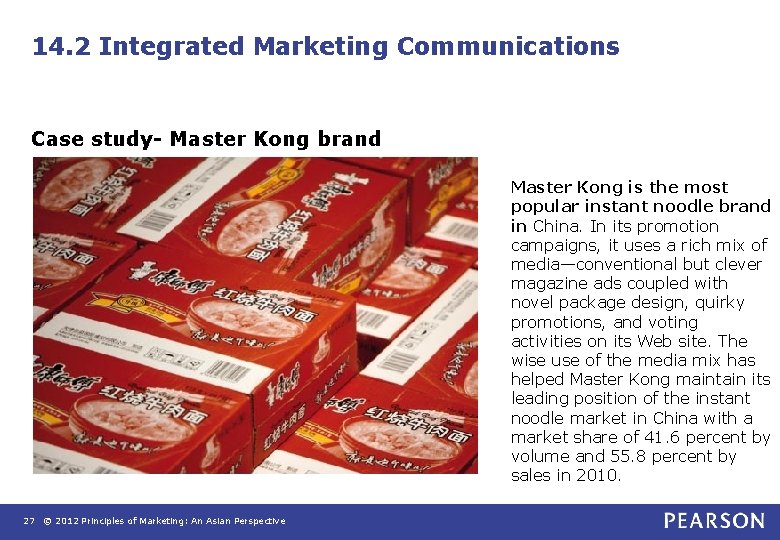
14. 2 Integrated Marketing Communications Case study- Master Kong brand Master Kong is the most popular instant noodle brand in China. In its promotion campaigns, it uses a rich mix of media—conventional but clever magazine ads coupled with novel package design, quirky promotions, and voting activities on its Web site. The wise use of the media mix has helped Master Kong maintain its leading position of the instant noodle market in China with a market share of 41. 6 percent by volume and 55. 8 percent by sales in 2010. 27 © 2012 Principles of Marketing: An Asian Perspective
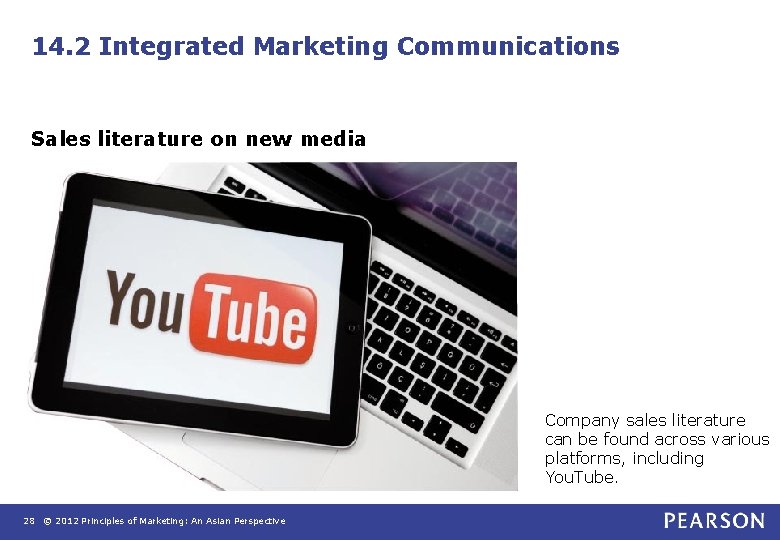
14. 2 Integrated Marketing Communications Sales literature on new media Company sales literature can be found across various platforms, including You. Tube. 28 © 2012 Principles of Marketing: An Asian Perspective
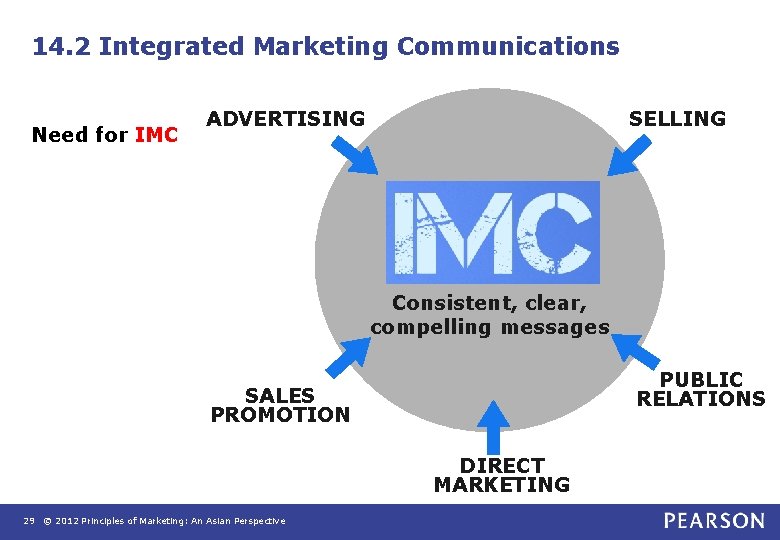
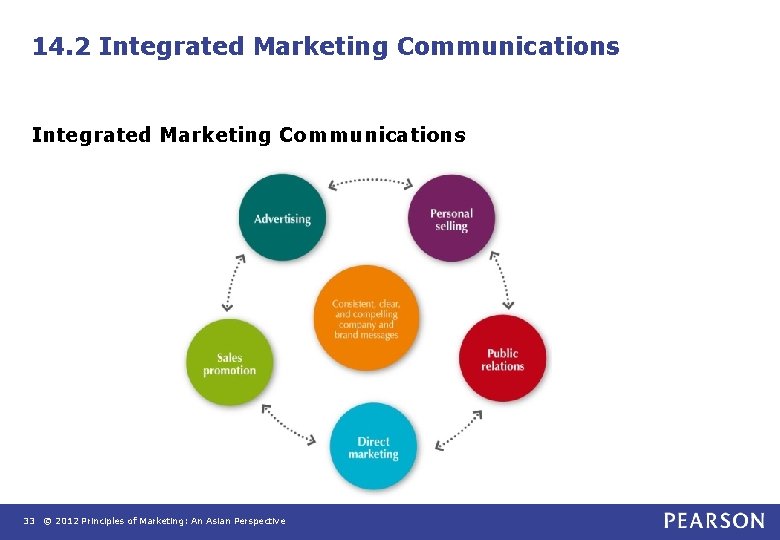
14. 2 Integrated Marketing Communications Need for IMC SELLING ADVERTISING Consistent, clear, compelling messages PUBLIC RELATIONS SALES PROMOTION DIRECT MARKETING 29 © 2012 Principles of Marketing: An Asian Perspective
14. 2 Integrated Marketing Communications Need for Integrated Marketing Communications • Customers don’t distinguish between message sources the way marketers do. • In the consumer’s mind, advertising messages from different media and different promotional approaches all become part of a single message about the company. Conflicting messages from these different sources can result in confused company images and brand positions. 30 © 2012 Principles of Marketing: An Asian Perspective
14. 2 Integrated Marketing Communications Need for Integrated Marketing Communications • Too often, companies fail to integrate their various communications channels. Mass media advertisements say one thing, while a price promotion sends a different signal and a product label creates still another message. Company sales literature says something altogether different and the company’s Web site seems out of sync with everything else. • The problem is that these communications often come from different company sources. 31 © 2012 Principles of Marketing: An Asian Perspective
14. 2 Integrated Marketing Communications • Today, more companies are adopting the concept of integrated marketing communications (IMC). • Under this concept, the company carefully integrates and coordinates its many communications channels to deliver a clear, consistent, and compelling message about the organization and its brands. 32 © 2012 Principles of Marketing: An Asian Perspective
14. 2 Integrated Marketing Communications 33 © 2012 Principles of Marketing: An Asian Perspective
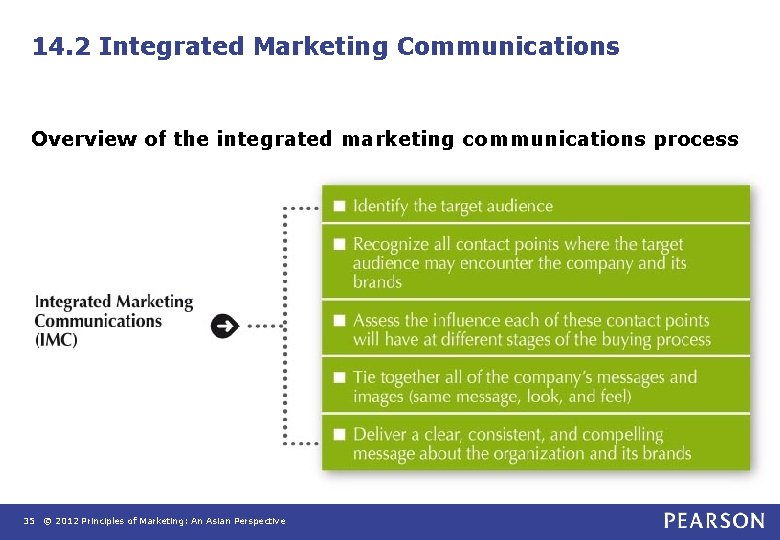
14. 2 Integrated Marketing Communications • IMC calls for recognizing all contact points where the customer may encounter the company, its products, and its brands. Each brand contact will deliver a message, whether good, bad, or indifferent. The company must strive to deliver a consistent and positive message with each contact. • IMC builds brand identity and strong customer relationships by tying together all of the company’s messages and images. Brand messages and positioning are coordinated across all communication activities and media. 34 © 2012 Principles of Marketing: An Asian Perspective
14. 2 Integrated Marketing Communications Overview of the integrated marketing communications process 35 © 2012 Principles of Marketing: An Asian Perspective
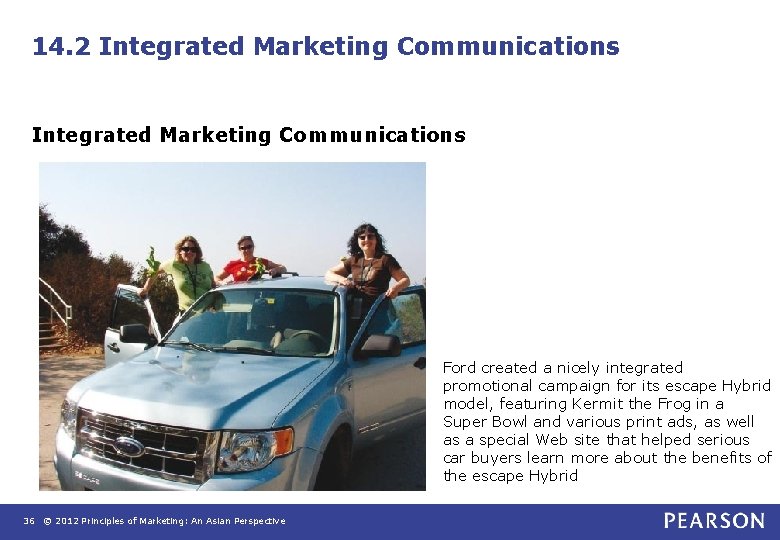
14. 2 Integrated Marketing Communications Ford created a nicely integrated promotional campaign for its escape Hybrid model, featuring Kermit the Frog in a Super Bowl and various print ads, as well as a special Web site that helped serious car buyers learn more about the benefits of the escape Hybrid 36 © 2012 Principles of Marketing: An Asian Perspective
14. 2 Integrated Marketing Communications Reviewing the Key Concepts Discuss the changing communications landscape and the need for integrated marketing communications. 37 © 2012 Principles of Marketing: An Asian Perspective
14. 3 A View of the Communication Process 14. 3 38 © 2012 Principles of Marketing: An Asian Perspective
14. 3 A View of the Communication Process The Communications Process • IMC involves identifying the target audience and shaping a well coordinated promotional program to obtain the desired audience response. • Today, marketers are moving toward viewing communications as managing the customer relationship over time. • Because customers differ, communications programs need to be developed for specific segments, niches, and even individuals. 39 © 2012 Principles of Marketing: An Asian Perspective
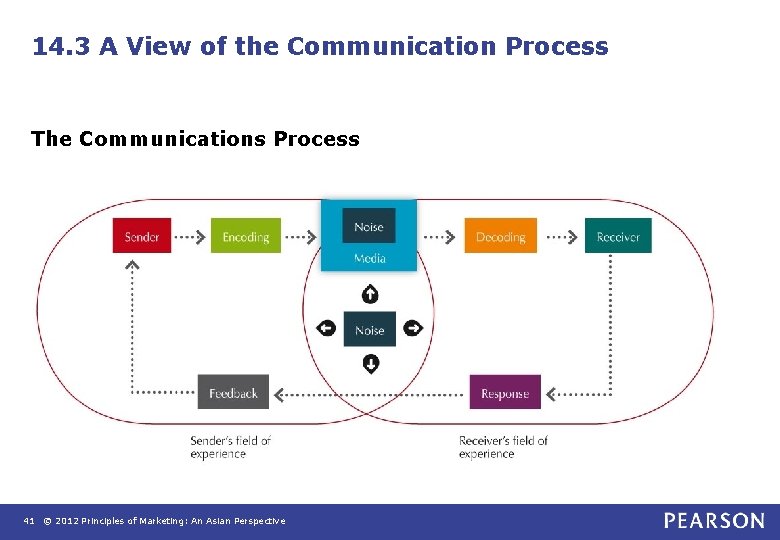
14. 3 A View of the Communication Process The Communications Process • The communications process should start with an audit of all the potential contacts target customers may have with the company and its brands. • To communicate effectively, marketers need to understand how communi cation works. Communication involves the nine elements as shown in Figure 14. 2 40 © 2012 Principles of Marketing: An Asian Perspective
14. 3 A View of the Communication Process The Communications Process 41 © 2012 Principles of Marketing: An Asian Perspective
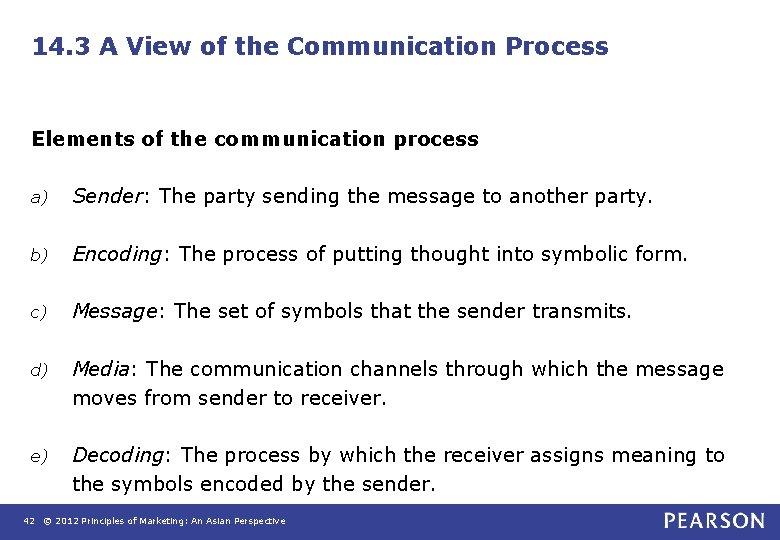
14. 3 A View of the Communication Process Elements of the communication process a) Sender: The party sending the message to another party. b) Encoding: The process of putting thought into symbolic form. c) Message: The set of symbols that the sender transmits. d) Media: The communication channels through which the message moves from sender to receiver. e) Decoding: The process by which the receiver assigns meaning to the symbols encoded by the sender. 42 © 2012 Principles of Marketing: An Asian Perspective
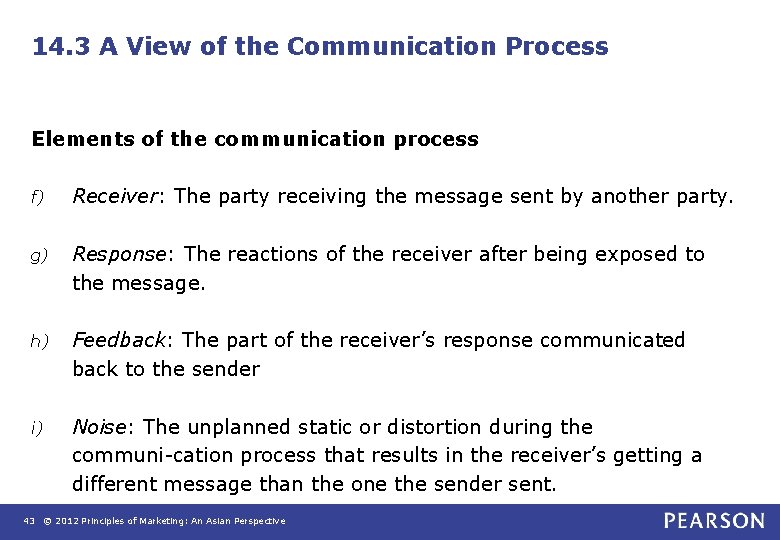
14. 3 A View of the Communication Process Elements of the communication process f) Receiver: The party receiving the message sent by another party. g) Response: The reactions of the receiver after being exposed to the message. h) Feedback: The part of the receiver’s response communicated back to the sender i) Noise: The unplanned static or distortion during the communi cation process that results in the receiver’s getting a different message than the one the sender sent. 43 © 2012 Principles of Marketing: An Asian Perspective
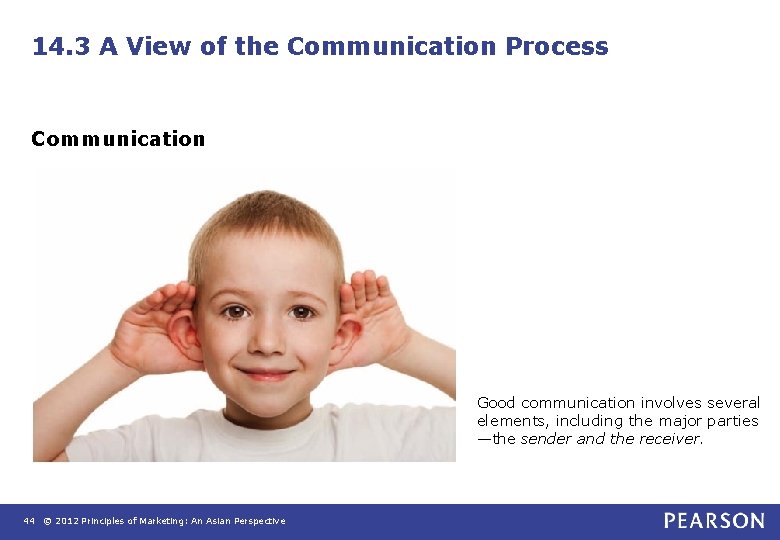
14. 3 A View of the Communication Process Communication Good communication involves several elements, including the major parties —the sender and the receiver. 44 © 2012 Principles of Marketing: An Asian Perspective
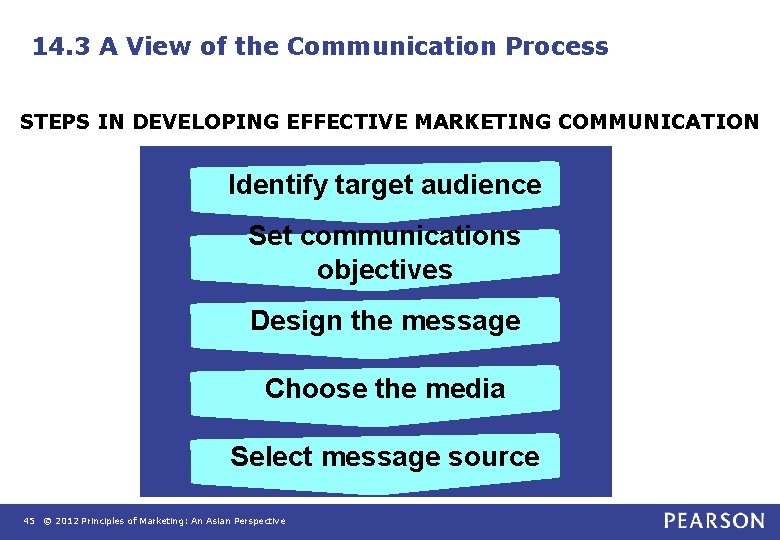
14. 3 A View of the Communication Process STEPS IN DEVELOPING EFFECTIVE MARKETING COMMUNICATION Identify target audience Set communications objectives Design the message Choose the media Select message source 45 © 2012 Principles of Marketing: An Asian Perspective
14. 4 Steps in Developing Effective Marketing Communication x 14. 4 46 © 2012 Principles of Marketing: An Asian Perspective
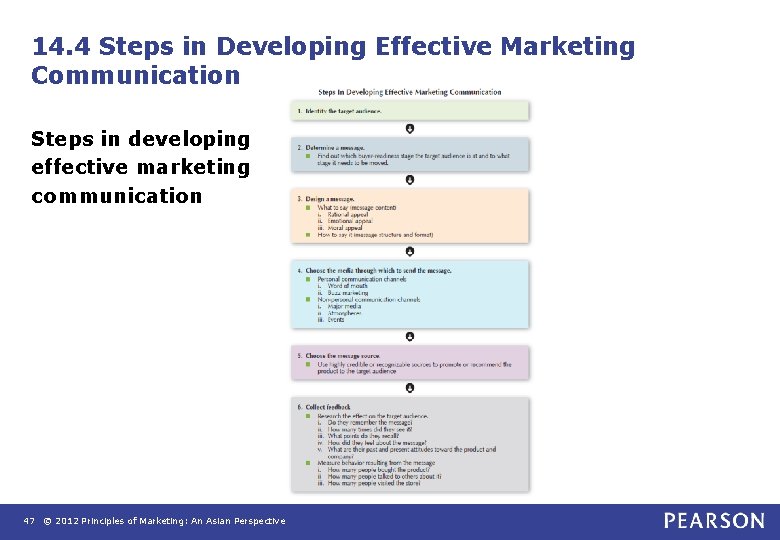
14. 4 Steps in Developing Effective Marketing Communication Steps in developing effective marketing communication 47 © 2012 Principles of Marketing: An Asian Perspective
14. 4 Steps in Developing Effective Marketing Communication Identifying the Target Audience COMMUNICATIONS DECISIONS 48 © 2012 Principles of Marketing: An Asian Perspective
14. 4 Steps in Developing Effective Marketing Communication Identifying the Target Audience • A marketing communicator starts with a clear target audience in mind. The audience may be potential buyers or current users, those who make the buying decision or those who influence it. The audience may be individuals, groups, special publics, or the general public. • The target audience will heavily affect the communicator’s decisions on what will be said, how it will be said, when it will be said, where it will be said, and who will say it. 49 © 2012 Principles of Marketing: An Asian Perspective
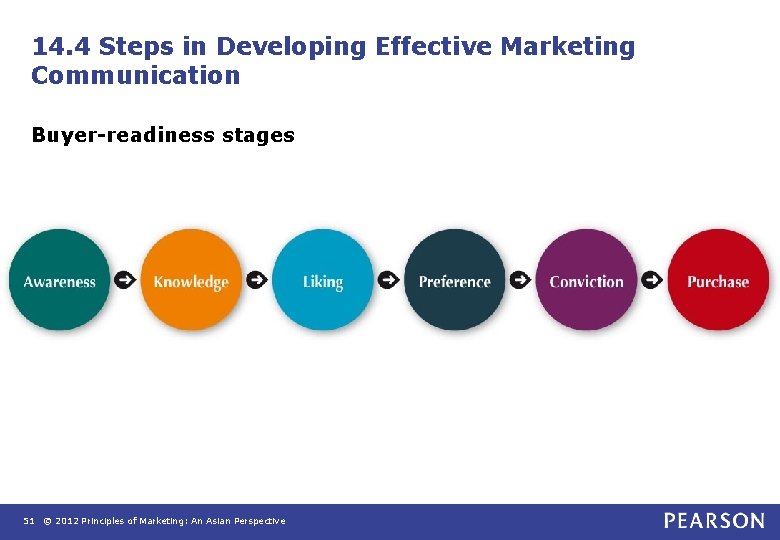
14. 4 Steps in Developing Effective Marketing Communication Determining the Communication Objectives • Once the target audience has been defined, the marketing communicator must decide what response is sought. The marketing communicator needs to know where the target audience now stands and to what stage it needs to be moved. • The target audience may be in any of six buyer-readiness stages, the stages consumers normally pass through on their way to making a purchase. 50 © 2012 Principles of Marketing: An Asian Perspective
14. 4 Steps in Developing Effective Marketing Communication Buyer-readiness stages 51 © 2012 Principles of Marketing: An Asian Perspective
14. 4 Steps in Developing Effective Marketing Communication objectives • The communicator must first build awareness and knowledge. • Assuming target consumers know about the product, how do they feel about it? • These stages include liking (feeling favorable about the product), preference, (preferring it to other brands), and conviction (believing that the product is best for them). 52 © 2012 Principles of Marketing: An Asian Perspective
14. 4 Steps in Developing Effective Marketing Communication objectives • Some members of the target market might be convinced about the product, but not quite get around to making the purchase. • The communicator must lead these consumers to take the final step. Actions might include offering special promotional prices, rebates, or premiums. 53 © 2012 Principles of Marketing: An Asian Perspective
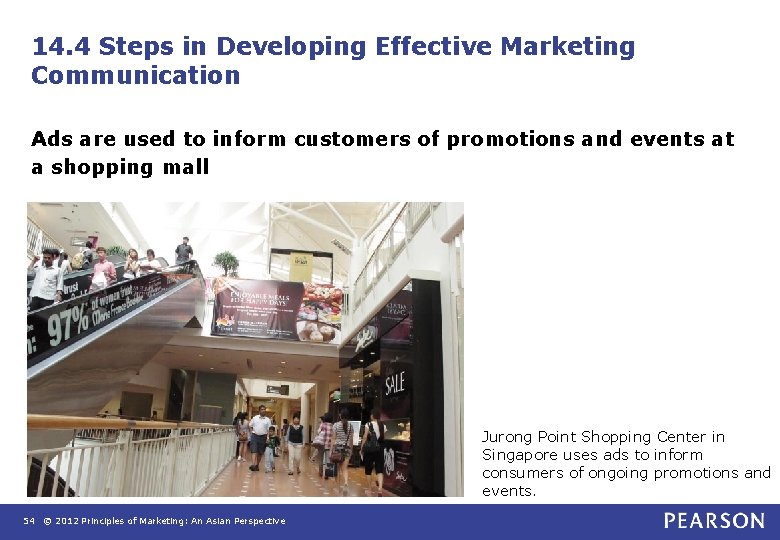
14. 4 Steps in Developing Effective Marketing Communication Ads are used to inform customers of promotions and events at a shopping mall Jurong Point Shopping Center in Singapore uses ads to inform consumers of ongoing promotions and events. 54 © 2012 Principles of Marketing: An Asian Perspective
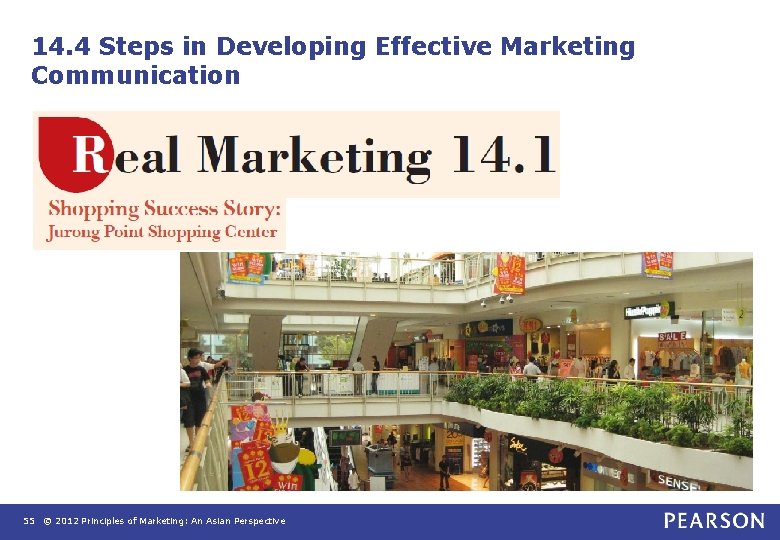
14. 4 Steps in Developing Effective Marketing Communication 55 © 2012 Principles of Marketing: An Asian Perspective
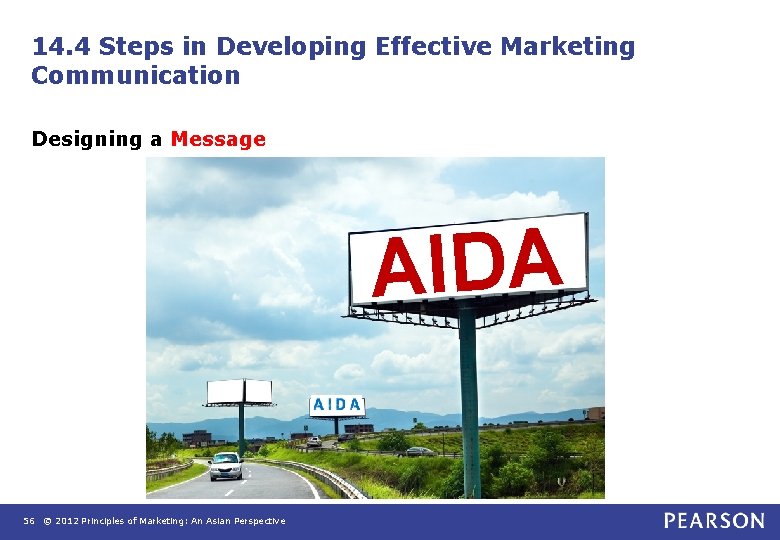
14. 4 Steps in Developing Effective Marketing Communication Designing a Message AIDA 56 © 2012 Principles of Marketing: An Asian Perspective
14. 4 Steps in Developing Effective Marketing Communication Designing a Message • Having defined the desired audience response, the communicator turns to developing an effective message. • The message should get Attention, hold Interest, arouse Desire, and obtain Action (a framework known as the AIDA model). • In putting the message together, the marketing communicator must decide what to say (message content) and how to say it (message structure and format). 57 © 2012 Principles of Marketing: An Asian Perspective
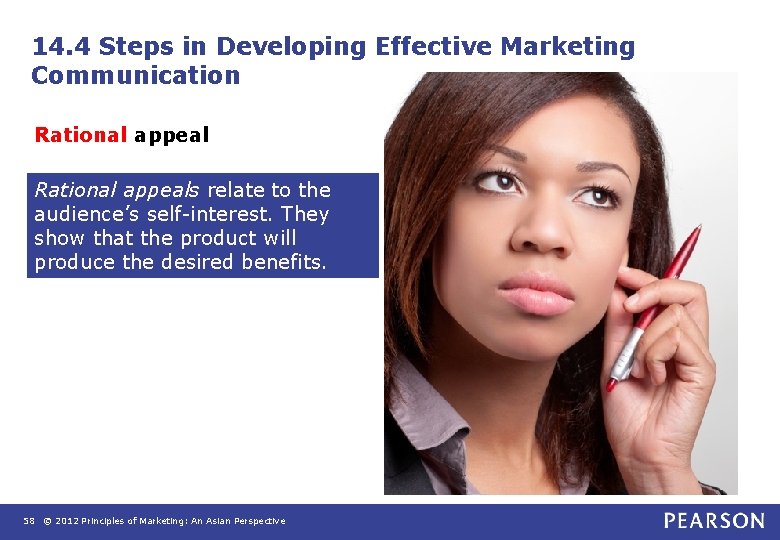
14. 4 Steps in Developing Effective Marketing Communication Rational appeals relate to the audience’s self interest. They show that the product will produce the desired benefits. 58 © 2012 Principles of Marketing: An Asian Perspective
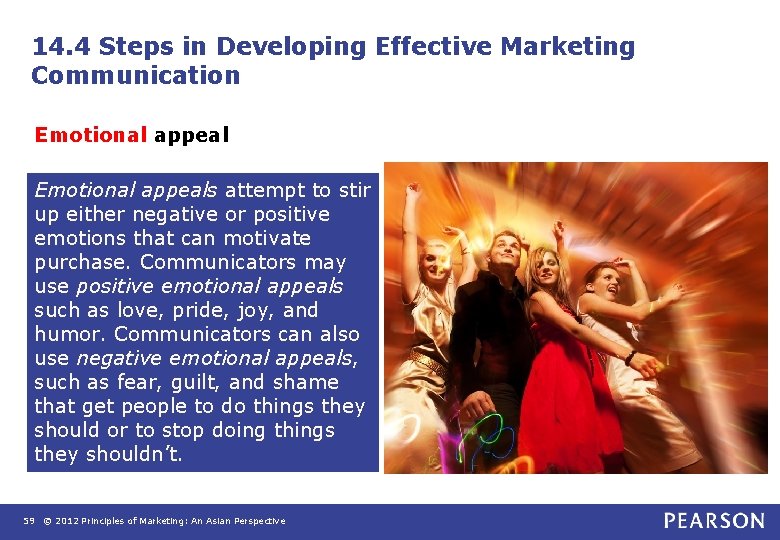
14. 4 Steps in Developing Effective Marketing Communication Emotional appeals attempt to stir up either negative or positive emotions that can motivate purchase. Communicators may use positive emotional appeals such as love, pride, joy, and humor. Communicators can also use negative emotional appeals, such as fear, guilt, and shame that get people to do things they should or to stop doing things they shouldn’t. 59 © 2012 Principles of Marketing: An Asian Perspective
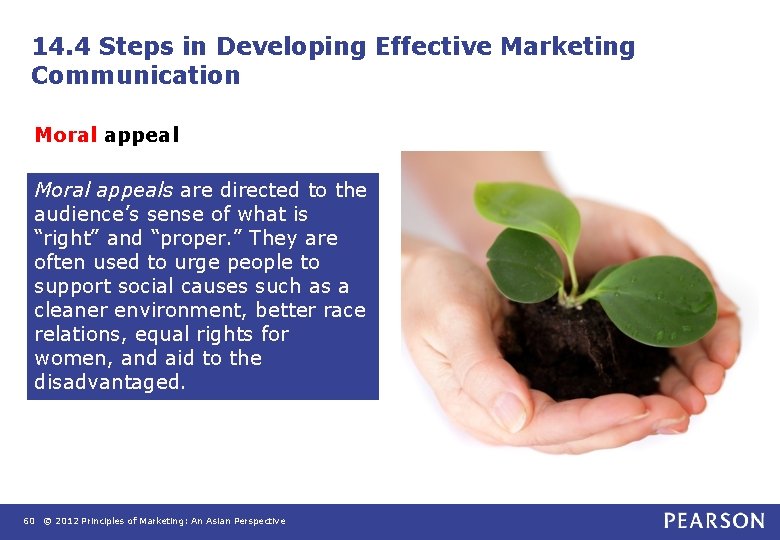
14. 4 Steps in Developing Effective Marketing Communication Moral appeals are directed to the audience’s sense of what is “right” and “proper. ” They are often used to urge people to support social causes such as a cleaner environment, better race relations, equal rights for women, and aid to the disadvantaged. 60 © 2012 Principles of Marketing: An Asian Perspective
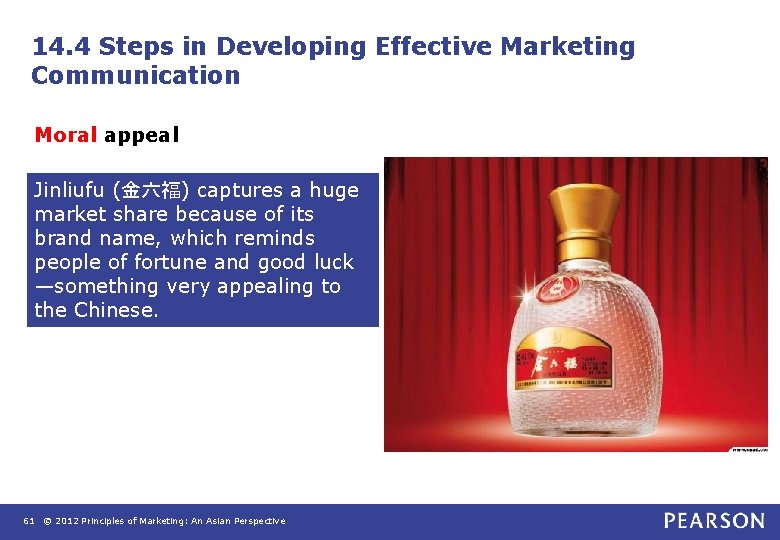
14. 4 Steps in Developing Effective Marketing Communication Moral appeal Jinliufu (金六福) captures a huge market share because of its brand name, which reminds people of fortune and good luck —something very appealing to the Chinese. 61 © 2012 Principles of Marketing: An Asian Perspective
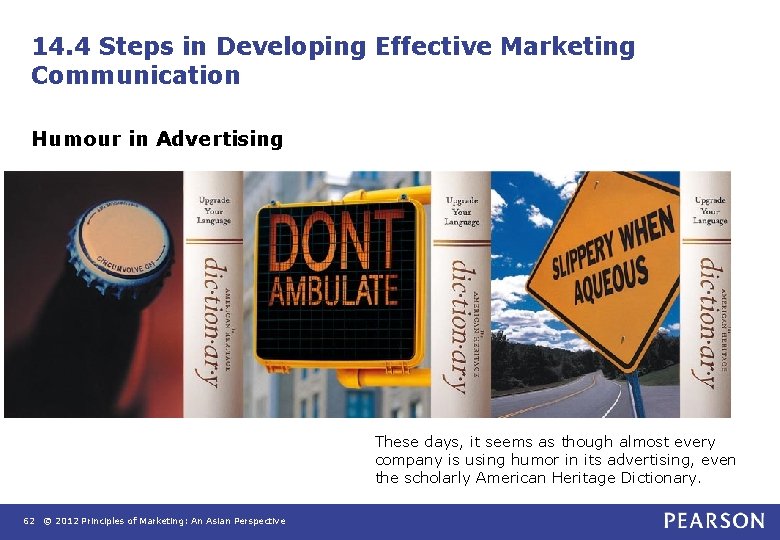
14. 4 Steps in Developing Effective Marketing Communication Humour in Advertising These days, it seems as though almost every company is using humor in its advertising, even the scholarly American Heritage Dictionary. 62 © 2012 Principles of Marketing: An Asian Perspective
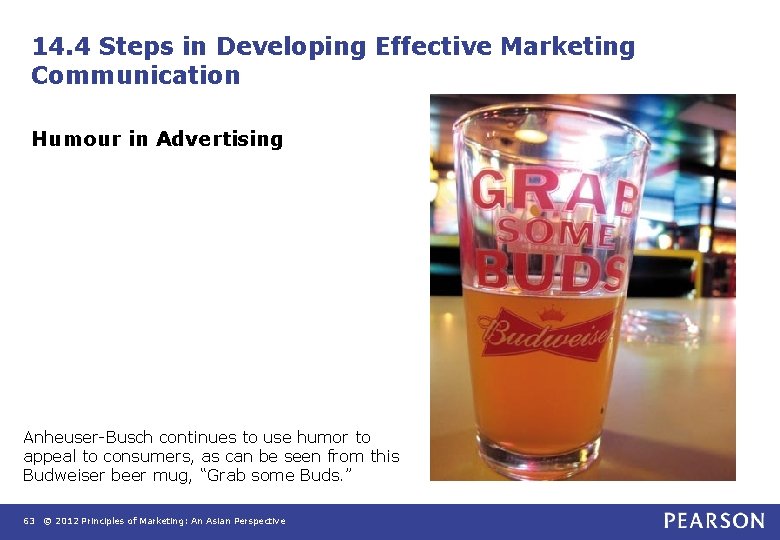
14. 4 Steps in Developing Effective Marketing Communication Humour in Advertising Anheuser Busch continues to use humor to appeal to consumers, as can be seen from this Budweiser beer mug, “Grab some Buds. ” 63 © 2012 Principles of Marketing: An Asian Perspective
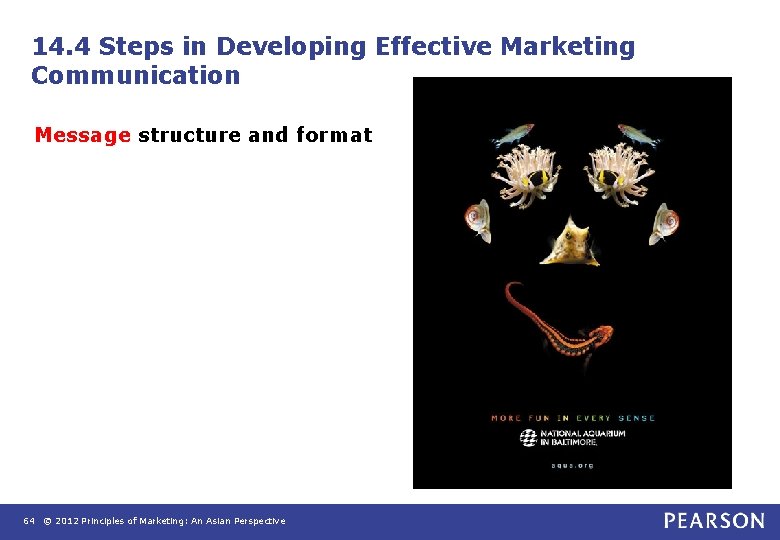
14. 4 Steps in Developing Effective Marketing Communication Message structure and format 64 © 2012 Principles of Marketing: An Asian Perspective
14. 4 Steps in Developing Effective Marketing Communication Message Structure The communicator must also decide how to handle three message structure issues. a) The first is whether to draw a conclusion or leave it to the audience. Recent research suggests that in many cases, rather than drawing a conclusion, the advertiser is better off asking questions and letting buyers come to their own conclusions. b) The second message structure issue is whether to present the strongest arguments first or last. Presenting them first gets strong attention but may lead to an anticlimactic ending. 65 © 2012 Principles of Marketing: An Asian Perspective
14. 4 Steps in Developing Effective Marketing Communication Message Structure c) The third message structure issue is whether to present a one sided argument (mentioning only the product’s strengths) or a two sided argument (touting the product’s strengths while also admitting its shortcomings). 66 © 2012 Principles of Marketing: An Asian Perspective
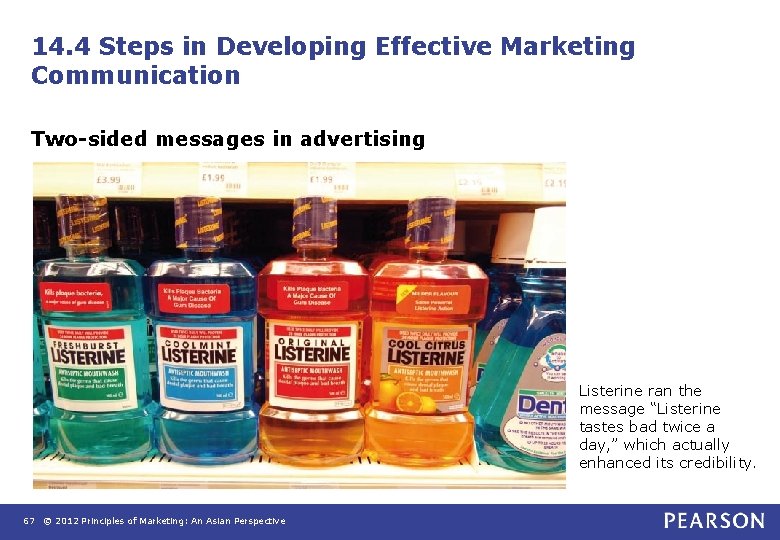
14. 4 Steps in Developing Effective Marketing Communication Two-sided messages in advertising Listerine ran the message “Listerine tastes bad twice a day, ” which actually enhanced its credibility. 67 © 2012 Principles of Marketing: An Asian Perspective
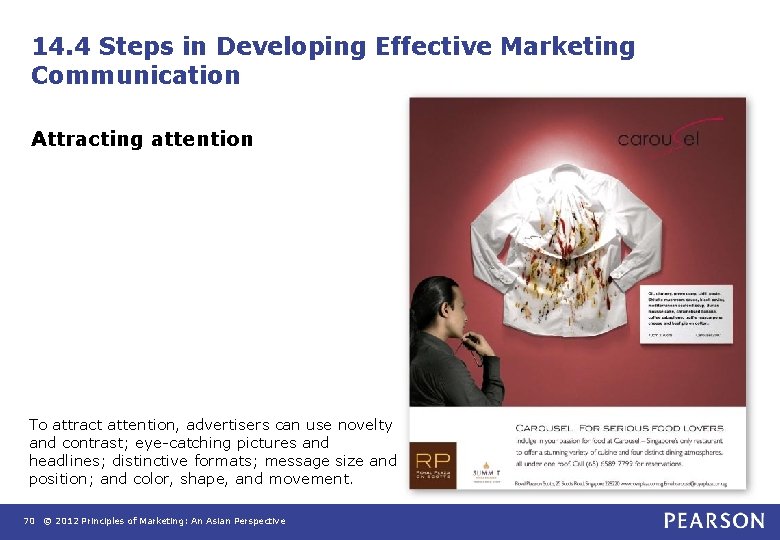
14. 4 Steps in Developing Effective Marketing Communication Message Format • The marketing communicator also needs a strong format for the message. • In a print ad, the communicator has to decide on the headline, copy, illustration, and color. To attract attention, advertisers use novelty and contrast; eye catching pictures and headlines; distinctive formats; message size and position; and color, shape, and movement. • If a message is to be carried over the radio, the communicator has to choose words, sounds, and voices. 68 © 2012 Principles of Marketing: An Asian Perspective
14. 4 Steps in Developing Effective Marketing Communication Message Format • If the message is to be carried on television or in person, then all these elements plus body language have to be planned. Presenters plan their facial expressions, gestures, dress, posture, and hairstyles. • If the message is carried on the product or its package, the communicator has to watch texture, scent, color, size, and shape. 69 © 2012 Principles of Marketing: An Asian Perspective
14. 4 Steps in Developing Effective Marketing Communication Attracting attention To attract attention, advertisers can use novelty and contrast; eye catching pictures and headlines; distinctive formats; message size and position; and color, shape, and movement. 70 © 2012 Principles of Marketing: An Asian Perspective
14. 4 Steps in Developing Effective Marketing Communication Choose the Media • PERSONAL • NONPERSONAL 71 © 2012 Principles of Marketing: An Asian Perspective
14. 4 Steps in Developing Effective Marketing Communication Personal channels • Word of mouth • Opinion leadership • Buzz 72 © 2012 Principles of Marketing: An Asian Perspective
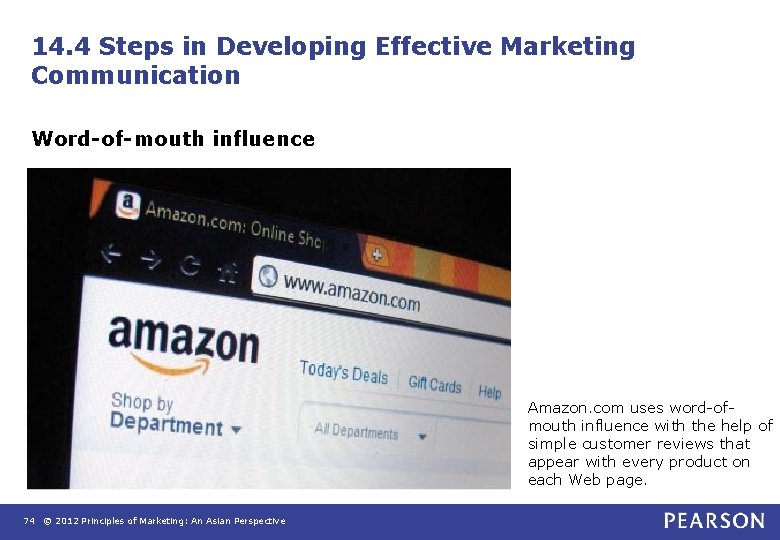
14. 4 Steps in Developing Effective Marketing Communication Personal communication channels • In personal communication channels, two or more people communicate directly with each other. • Some personal communication channels are controlled directly by the company. For example, company salespeople contact buyers in the target market. But other personal communications about the product may reach buyers through channels not directly controlled by the company. Word-of-mouth influence has considerable effect in many areas. 73 © 2012 Principles of Marketing: An Asian Perspective
14. 4 Steps in Developing Effective Marketing Communication Word-of-mouth influence Amazon. com uses word of mouth influence with the help of simple customer reviews that appear with every product on each Web page. 74 © 2012 Principles of Marketing: An Asian Perspective
14. 4 Steps in Developing Effective Marketing Communication Marketers can influence personal communication channels • Companies can take steps to put personal communication channels to work for them. • They can create marketing programs that will generate favorable word of mouth communications about their brands. • Companies can create opinion leaders—people whose opinions are sought by others—by supplying influencers with the product on attractive terms or by educating them so that they can inform others. 75 © 2012 Principles of Marketing: An Asian Perspective
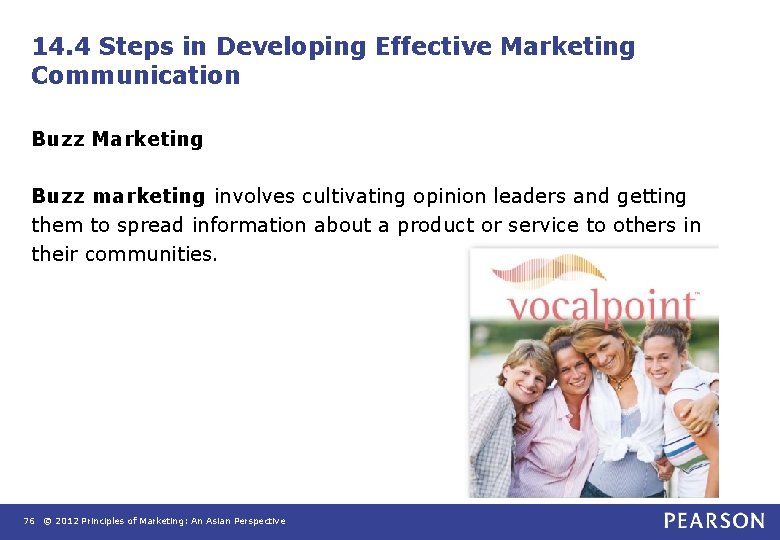
14. 4 Steps in Developing Effective Marketing Communication Buzz Marketing Buzz marketing involves cultivating opinion leaders and getting them to spread information about a product or service to others in their communities. 76 © 2012 Principles of Marketing: An Asian Perspective
14. 4 Steps in Developing Effective Marketing Communication 77 © 2012 Principles of Marketing: An Asian Perspective
14. 4 Steps in Developing Effective Marketing Communication Nonpersonal channels Nonpersonal communication channels are media that carry messages without personal contact or feedback. • Major media • Atmospheres • Events 78 © 2012 Principles of Marketing: An Asian Perspective
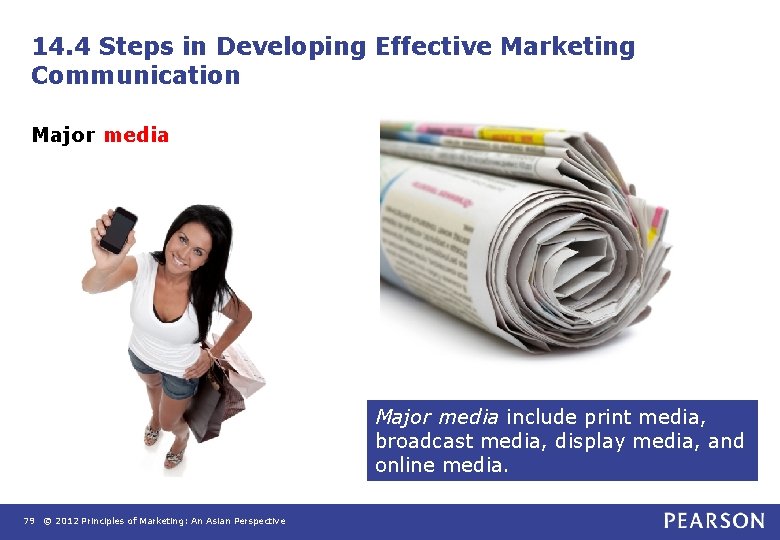
14. 4 Steps in Developing Effective Marketing Communication Major media include print media, broadcast media, display media, and online media. 79 © 2012 Principles of Marketing: An Asian Perspective
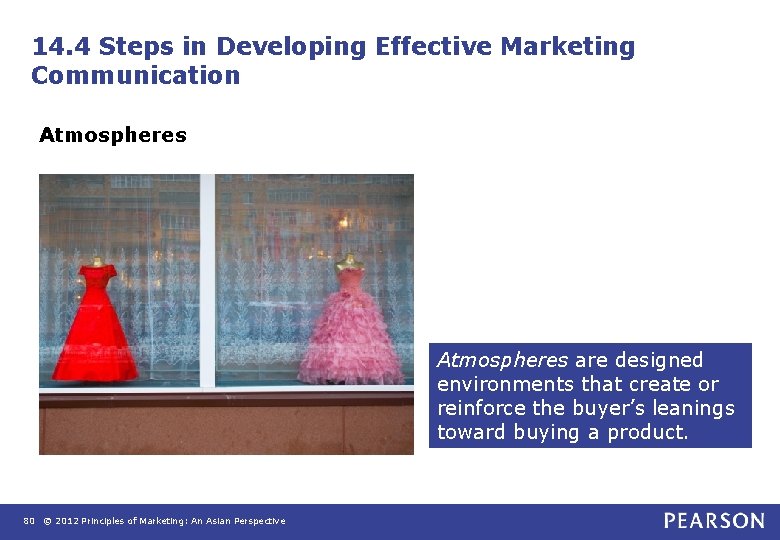
14. 4 Steps in Developing Effective Marketing Communication Atmospheres are designed environments that create or reinforce the buyer’s leanings toward buying a product. 80 © 2012 Principles of Marketing: An Asian Perspective
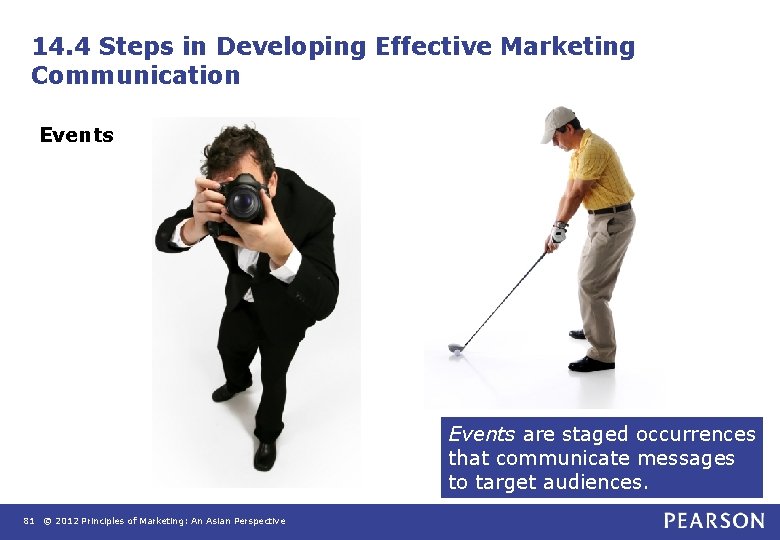
14. 4 Steps in Developing Effective Marketing Communication Events are staged occurrences that communicate messages to target audiences. 81 © 2012 Principles of Marketing: An Asian Perspective
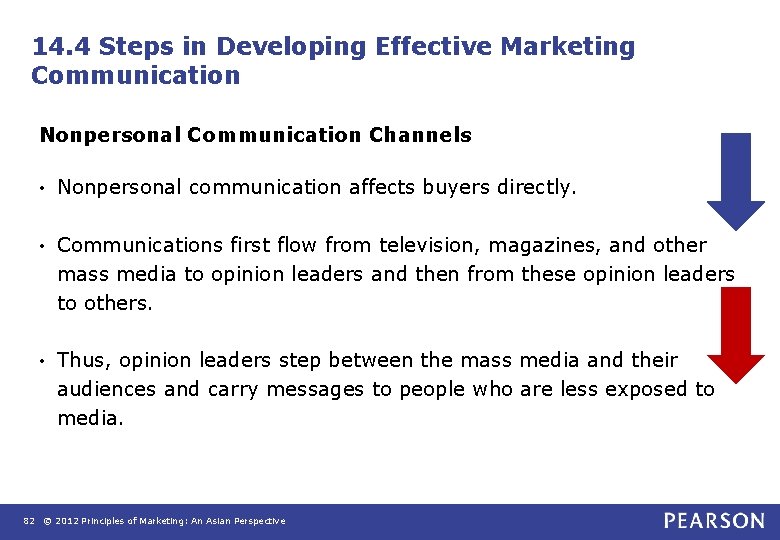
14. 4 Steps in Developing Effective Marketing Communication Nonpersonal Communication Channels • Nonpersonal communication affects buyers directly. • Communications first flow from television, magazines, and other mass media to opinion leaders and then from these opinion leaders to others. • Thus, opinion leaders step between the mass media and their audiences and carry messages to people who are less exposed to media. 82 © 2012 Principles of Marketing: An Asian Perspective
14. 4 Steps in Developing Effective Marketing Communication Selecting a Message Source • The message’s impact on the target audience is also affected by how the audience views the communicator. Messages delivered by highly credible sources are more persuasive. • Marketers often hire celebrity endorsers to deliver their message. But companies must be careful when selecting celebrities to represent their brands. 83 © 2012 Principles of Marketing: An Asian Perspective
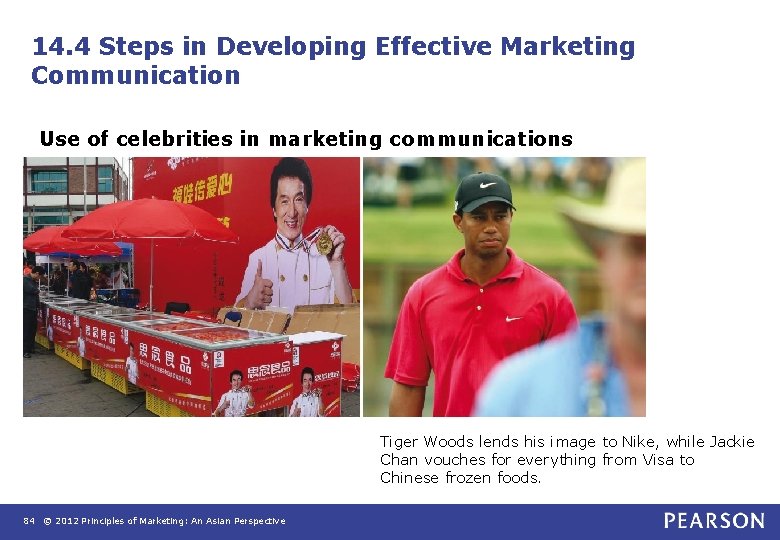
14. 4 Steps in Developing Effective Marketing Communication Use of celebrities in marketing communications Tiger Woods lends his image to Nike, while Jackie Chan vouches for everything from Visa to Chinese frozen foods. 84 © 2012 Principles of Marketing: An Asian Perspective
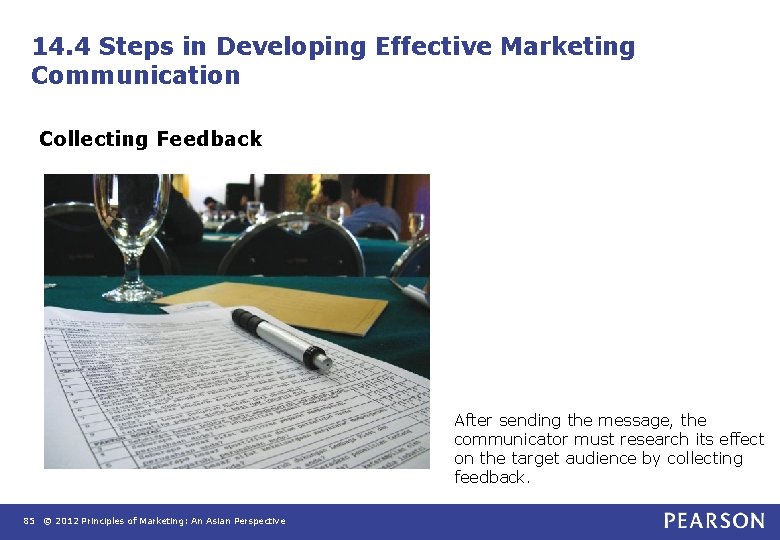
14. 4 Steps in Developing Effective Marketing Communication Collecting Feedback After sending the message, the communicator must research its effect on the target audience by collecting feedback. 85 © 2012 Principles of Marketing: An Asian Perspective
14. 4 Steps in Developing Effective Marketing Communication Collecting Feedback • After sending the message, the communicator must research its effect on the target audience. This involves asking the target audience members whether they remember the message, how many times they saw it, what points they recall, how they felt about the message, and their past and present attitudes toward the product and company. 86 © 2012 Principles of Marketing: An Asian Perspective
14. 4 Steps in Developing Effective Marketing Communication Collecting Feedback • The communicator would also like to measure behavior resulting from the message—how many people bought a product, talked to others about it, or visited the store. • Feedback on marketing communications may suggest changes in the promotion program or in the product offer itself. 87 © 2012 Principles of Marketing: An Asian Perspective
14. 4 Steps in Developing Effective Marketing Communication Reviewing the Key Concepts Outline the communication process and the steps in developing effective marketing communications. 88 © 2012 Principles of Marketing: An Asian Perspective
14. 5 Setting the Total Promotion Budget and Mix 14. 5 89 © 2012 Principles of Marketing: An Asian Perspective
14. 5 Setting the Total Promotion Budget and Mix How does the company decide on the total promotion budget and its division among the major promotional tools to create the promotion mix? 90 © 2012 Principles of Marketing: An Asian Perspective
14. 5 Setting the Total Promotion Budget and Mix Budgeting One of the hardest marketing decisions facing a company is how much to spend on promotion. We look at four common methods used to set the total budget for advertising. AFFORDABLE • % OF SALES • COMPETITIVE PARITY • OBJECTIVE-TASK • 91 © 2012 Principles of Marketing: An Asian Perspective
14. 5 Setting the Total Promotion Budget and Mix Affordable Method • Some companies use the affordable method—they set the promotion budget at the level they think the company can afford. • Small businesses often use this method, reasoning that the company cannot spend more on advertising than it has. 92 © 2012 Principles of Marketing: An Asian Perspective
14. 5 Setting the Total Promotion Budget and Mix Affordable Method • Unfortunately, this method of setting budgets completely ignores the effects of promotion on sales. It tends to place advertising last among spending priorities, even in situations in which advertising is critical to the firm’s success. • It leads to an uncertain annual promotion budget that makes long range market planning difficult. Although the affordable method can result in overspending on advertising, it more often results in under spending. 93 © 2012 Principles of Marketing: An Asian Perspective
14. 5 Setting the Total Promotion Budget and Mix Percentage-of-sales method • Other companies use the percentage-of-sales method, setting their promotion budget at a certain percentage of current or forecasted sales. Or they budget a percentage of the unit sales price. • The percentage of sales method has advantages. – It is simple to use – It helps management think about the relationship between promotion spending, selling price, and profit per unit. 94 © 2012 Principles of Marketing: An Asian Perspective
14. 5 Setting the Total Promotion Budget and Mix Percentage-of-sales method • There also many disadvantages to this method – It wrongly views sales as the cause of promotion rather than as the result. – The percentage of sales budget is based on availability of funds rather than on opportunities. It may prevent the increased spending sometimes needed to turn around falling sales. Because the budget varies with year to year sales, long range planning is difficult. – Finally, the method does not provide any basis for choosing a specific percentage, except what has been done in the past or what competitors are doing. 95 © 2012 Principles of Marketing: An Asian Perspective
14. 5 Setting the Total Promotion Budget and Mix Competitive-parity method • Other companies use the competitive-parity method, setting their promotion budgets to match competitors’ outlays. • They monitor competitors’ advertising or get industry promotion spending estimates from publications or trade associations, and then set their budgets based on the industry average. • Two arguments support this method: – Competitor’s budgets represent the collective wisdom of the industry. – Spending what competitors spend helps prevent promotion wars. 96 © 2012 Principles of Marketing: An Asian Perspective
14. 5 Setting the Total Promotion Budget and Mix Competitive-parity method • Unfortunately, neither argument is valid. There are no grounds for believing that the competition has a better idea of what the company should be spending on promotion than does the company itself. • Companies differ greatly, and each has its own special promotion needs. Finally, there is no evidence that budgets based on competitive parity prevent promotion wars. 97 © 2012 Principles of Marketing: An Asian Perspective
14. 5 Setting the Total Promotion Budget and Mix Objective-and-task method • The most logical budget setting method is the objective-and-task method, whereby the company sets its promotion budget based on what it wants to accomplish with promotion. • This budgeting method entails: – Defining specific promotion objectives – Determining the tasks needed to achieve these objectives – Estimating the costs of performing these tasks – The sum of these costs is the proposed promotion budget. 98 © 2012 Principles of Marketing: An Asian Perspective
14. 5 Setting the Total Promotion Budget and Mix Objective-and-task method • The advantage of the objective and task method is that it forces management to spell out its assumptions about the relationship between dollars spent and promotion results. • But it also is the most difficult method to use. Often, it is hard to figure out which specific tasks will achieve stated objectives. 99 © 2012 Principles of Marketing: An Asian Perspective
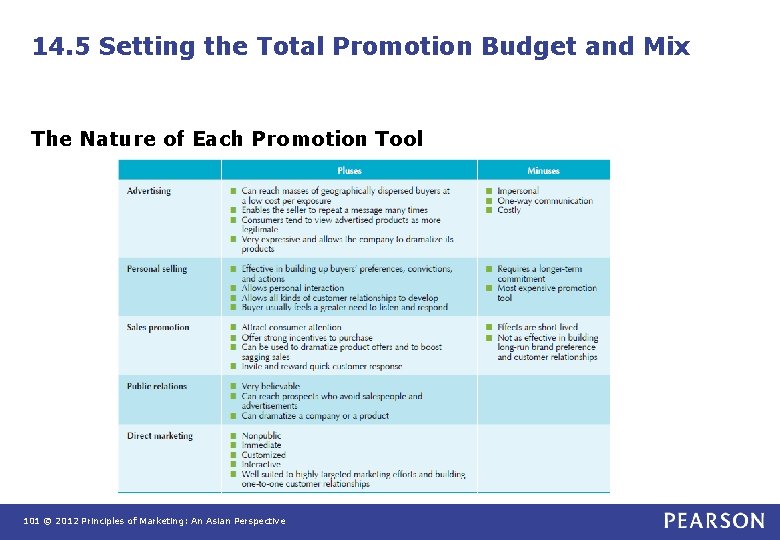
14. 5 Setting the Total Promotion Budget and Mix Shaping the Overall Promotion Mix • The IMC concept suggests that the company must blend the promotion tools carefully into a coordinated promotion mix. Companies within the same industry differ greatly in the design of their promotion mixes. The Nature of Each Promotion Tool • Each promotion tool has unique characteristics and costs. Marketers must understand these characteristics in selecting their mix of tools. 100 © 2012 Principles of Marketing: An Asian Perspective
14. 5 Setting the Total Promotion Budget and Mix The Nature of Each Promotion Tool 101 © 2012 Principles of Marketing: An Asian Perspective
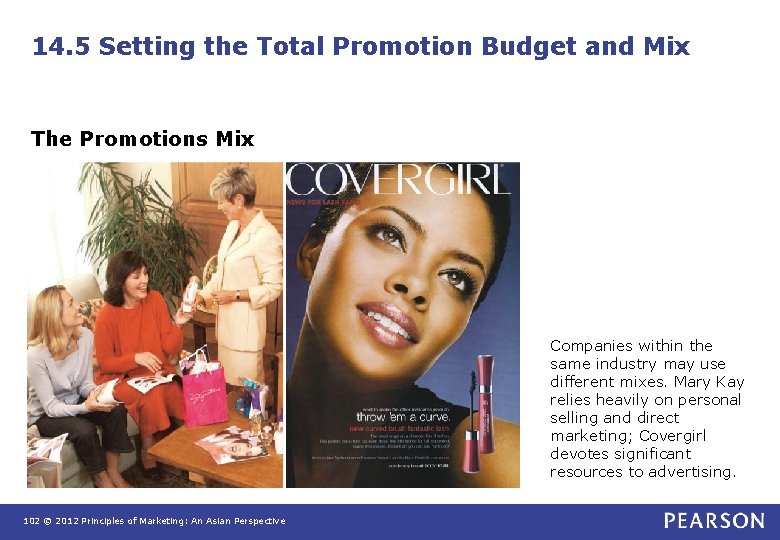
14. 5 Setting the Total Promotion Budget and Mix The Promotions Mix Companies within the same industry may use different mixes. Mary Kay relies heavily on personal selling and direct marketing; Covergirl devotes significant resources to advertising. 102 © 2012 Principles of Marketing: An Asian Perspective
14. 5 Setting the Total Promotion Budget and Mix Shaping the mix Advertising can reach masses of geographically dispersed buyers at a low cost per exposure, and it enables the seller to repeat the message many times. Beyond its reach, large scale advertising says something positive about the seller’s size, popularity, and success. Because of advertising’s public nature, consumers tend to view advertised products as more legitimate. 103 © 2012 Principles of Marketing: An Asian Perspective
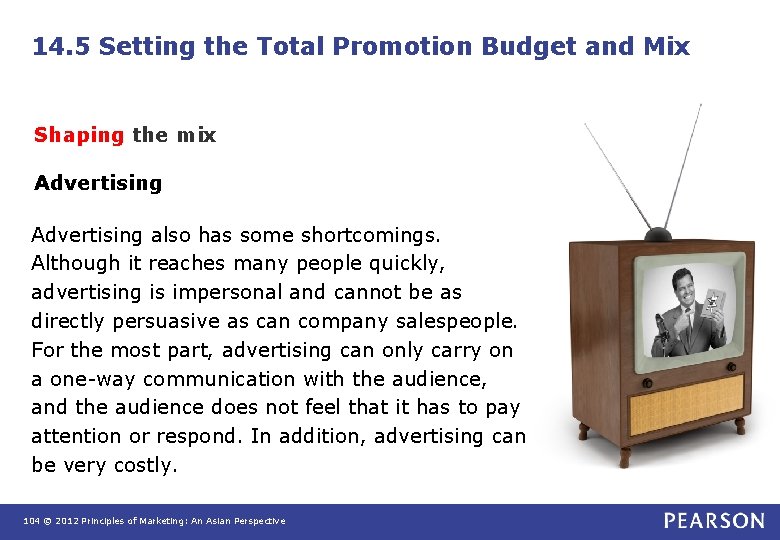
14. 5 Setting the Total Promotion Budget and Mix Shaping the mix Advertising also has some shortcomings. Although it reaches many people quickly, advertising is impersonal and cannot be as directly persuasive as can company salespeople. For the most part, advertising can only carry on a one way communication with the audience, and the audience does not feel that it has to pay attention or respond. In addition, advertising can be very costly. 104 © 2012 Principles of Marketing: An Asian Perspective
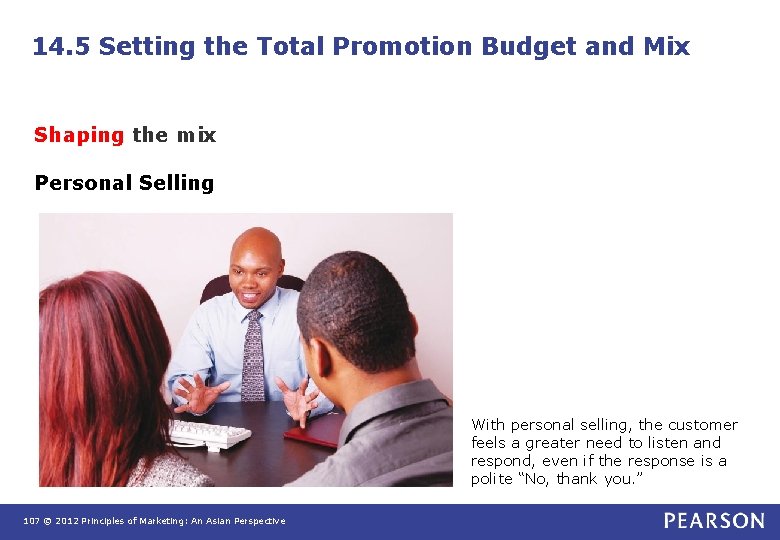
14. 5 Setting the Total Promotion Budget and Mix Shaping the mix Personal Selling Personal selling is the most effective tool at certain stages of the buying process, particularly in building up buyers’ preferences, convictions, and actions. The effective salesperson keeps the customer’s interests at heart in order to build a long term relationship. Finally, with personal selling, the buyer usually feels a greater need to listen and respond, even if the response is a polite “No thank you. ” 105 © 2012 Principles of Marketing: An Asian Perspective
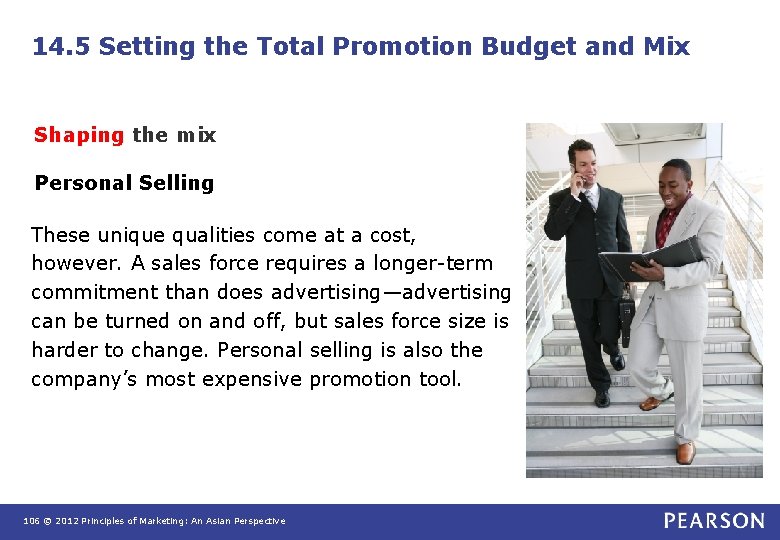
14. 5 Setting the Total Promotion Budget and Mix Shaping the mix Personal Selling These unique qualities come at a cost, however. A sales force requires a longer term commitment than does advertising—advertising can be turned on and off, but sales force size is harder to change. Personal selling is also the company’s most expensive promotion tool. 106 © 2012 Principles of Marketing: An Asian Perspective
14. 5 Setting the Total Promotion Budget and Mix Shaping the mix Personal Selling With personal selling, the customer feels a greater need to listen and respond, even if the response is a polite “No, thank you. ” 107 © 2012 Principles of Marketing: An Asian Perspective
14. 5 Setting the Total Promotion Budget and Mix Shaping the mix Sales Promotion Sales promotion includes a wide assortment of tools—coupons, contests, cents off deals, premiums, and others—all of which have many unique qualities. They attract consumer attention, offer strong incentives to purchase, and can be used to dramatize product offers and to boost sagging sales. 108 © 2012 Principles of Marketing: An Asian Perspective
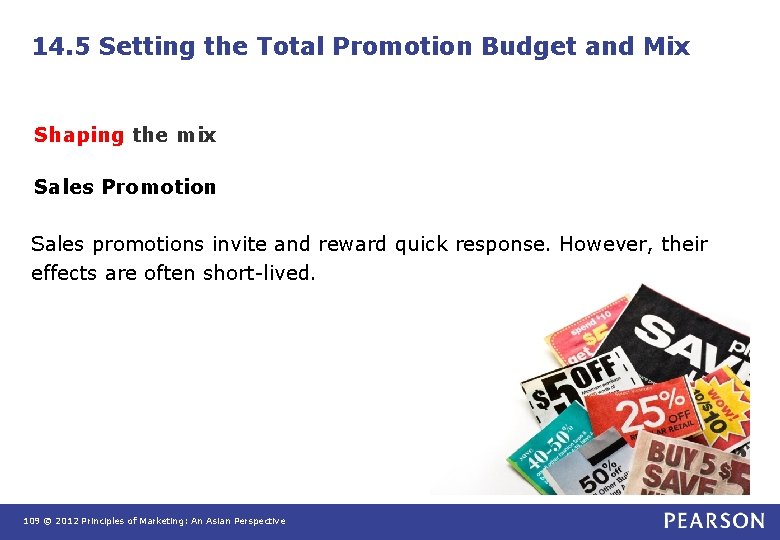
14. 5 Setting the Total Promotion Budget and Mix Shaping the mix Sales Promotion Sales promotions invite and reward quick response. However, their effects are often short lived. 109 © 2012 Principles of Marketing: An Asian Perspective
14. 5 Setting the Total Promotion Budget and Mix Shaping the mix Public Relations Public relations is very believable—news stories, features, sponsorships, and events seem more real and believable to readers than ads do. Public relations can reach many prospects that avoid salespeople and advertisements—the message gets to the buyers as “news” rather than as a sales directed communi cation. 110 © 2012 Principles of Marketing: An Asian Perspective
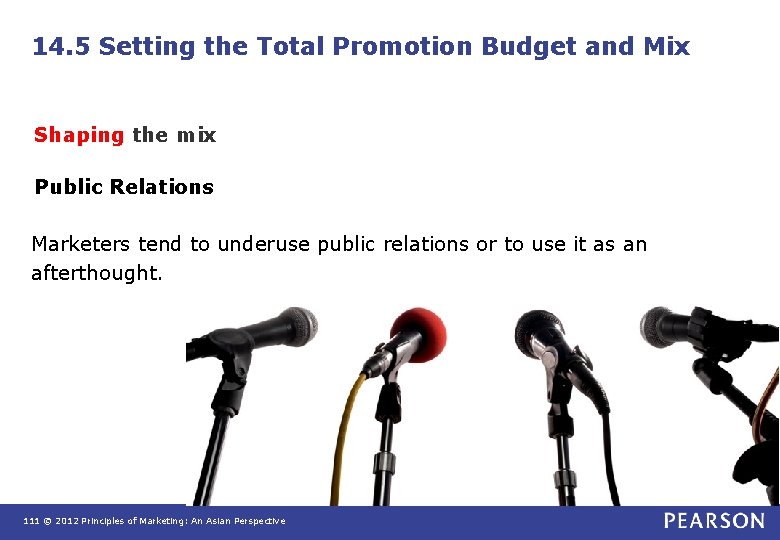
14. 5 Setting the Total Promotion Budget and Mix Shaping the mix Public Relations Marketers tend to underuse public relations or to use it as an afterthought. 111 © 2012 Principles of Marketing: An Asian Perspective
14. 5 Setting the Total Promotion Budget and Mix Shaping the mix Direct Marketing Direct marketing has four distinctive characteristics: a) Direct marketing is less public: b) The message is normally directed to a specific person. c) Direct marketing is immediate and customized: Messages can be prepared very quickly and can be tailored to appeal to specific consumers. d) Direct marketing is interactive: It allows a dialogue between the marketing team and the consumer, and messages can be altered depending on the consumer’s response. 112 © 2012 Principles of Marketing: An Asian Perspective
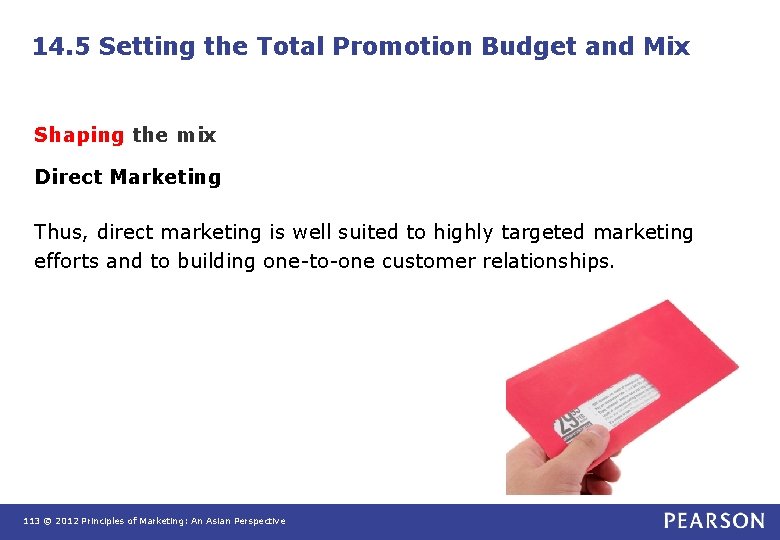
14. 5 Setting the Total Promotion Budget and Mix Shaping the mix Direct Marketing Thus, direct marketing is well suited to highly targeted marketing efforts and to building one to one customer relationships. 113 © 2012 Principles of Marketing: An Asian Perspective
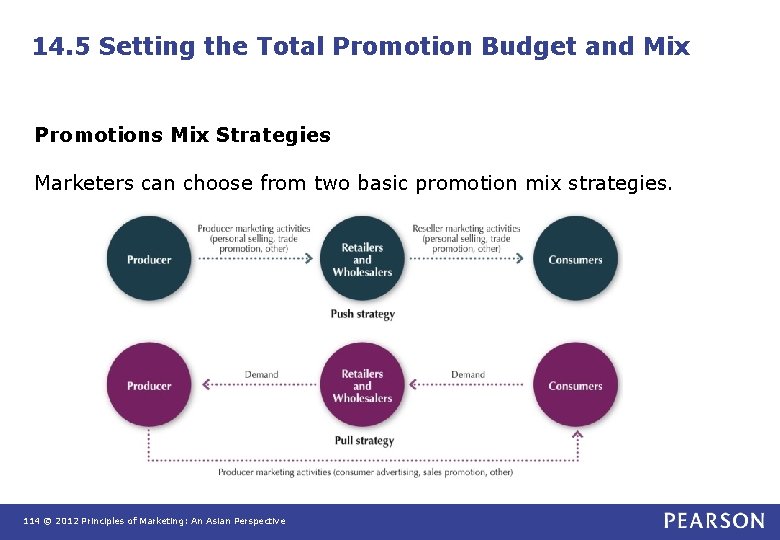
14. 5 Setting the Total Promotion Budget and Mix Promotions Mix Strategies Marketers can choose from two basic promotion mix strategies. 114 © 2012 Principles of Marketing: An Asian Perspective
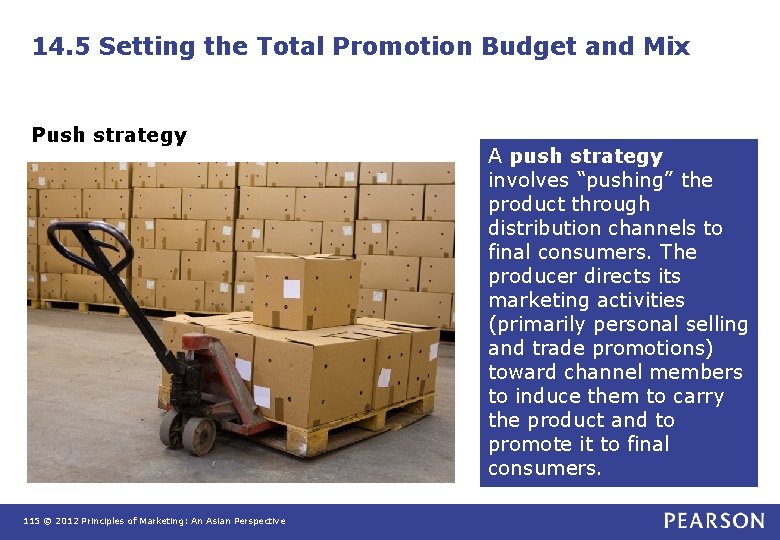
14. 5 Setting the Total Promotion Budget and Mix Push strategy 115 © 2012 Principles of Marketing: An Asian Perspective A push strategy involves “pushing” the product through distribution channels to final consumers. The producer directs its marketing activities (primarily personal selling and trade promotions) toward channel members to induce them to carry the product and to promote it to final consumers.
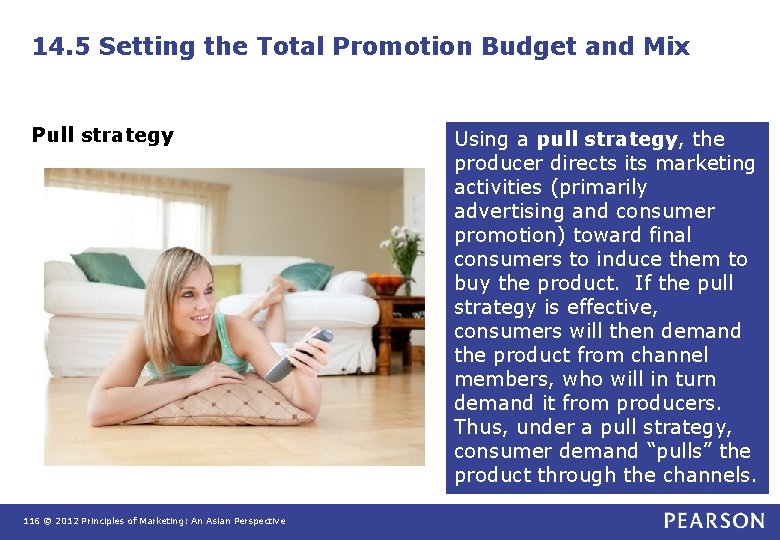
14. 5 Setting the Total Promotion Budget and Mix Pull strategy 116 © 2012 Principles of Marketing: An Asian Perspective Using a pull strategy, the producer directs its marketing activities (primarily advertising and consumer promotion) toward final consumers to induce them to buy the product. If the pull strategy is effective, consumers will then demand the product from channel members, who will in turn demand it from producers. Thus, under a pull strategy, consumer demand “pulls” the product through the channels.
14. 5 Setting the Total Promotion Budget and Mix Factors affecting the promotions mix • • • Companies consider many factors when designing their promotion mix strategies, including type of product/market and the PLC stage. For example, the importance of different promotion tools varies between consumer and business markets. Business to consumer (B to C) companies usually “pull” more, putting more of their funds into advertising, followed by sales promotion, personal selling, and then public relations. In contrast, business to business (B to B) marketers tend to “push” more, putting more of their funds into personal selling, followed by sales promotion, advertising, and public relations. 117 © 2012 Principles of Marketing: An Asian Perspective
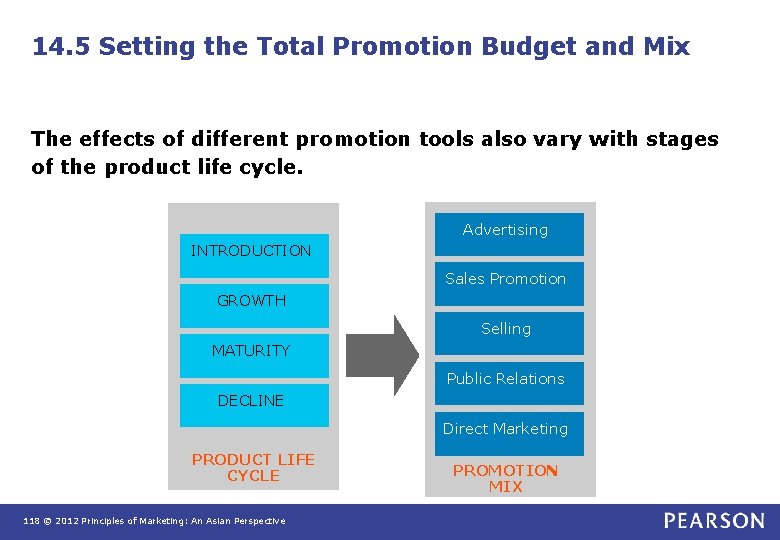
14. 5 Setting the Total Promotion Budget and Mix The effects of different promotion tools also vary with stages of the product life cycle. Advertising INTRODUCTION Sales Promotion GROWTH Selling MATURITY Public Relations DECLINE Direct Marketing PRODUCT LIFE CYCLE 118 © 2012 Principles of Marketing: An Asian Perspective PROMOTION MIX
14. 5 Setting the Total Promotion Budget and Mix Effect of the PLC on the Promotions Mix a) In the introduction stage, advertising and public relations are good for producing high awareness, and sales promotion is useful in promoting early trial. Personal selling must be used to get the trade to carry the product. b) In the growth stage, advertising and public relations continue to be powerful influences, whereas sales promotion can be reduced because fewer incentives are needed. 119 © 2012 Principles of Marketing: An Asian Perspective
14. 5 Setting the Total Promotion Budget and Mix Effect of the PLC on the Promotions Mix c) In the mature stage, sales promotion again becomes important relative to advertising. Buyers know the brands, and advertising is needed only to remind them of the product. d) In the decline stage, advertising is kept at a reminder level, public relations is dropped, and salespeople give the product only a little attention. Sales promotion, however, might continue strong. 120 © 2012 Principles of Marketing: An Asian Perspective
14. 5 Setting the Total Promotion Budget and Mix Reviewing the Key Concepts Explain the methods for setting the promotion budget and factors that affect the design of the promotion mix. 121 © 2012 Principles of Marketing: An Asian Perspective
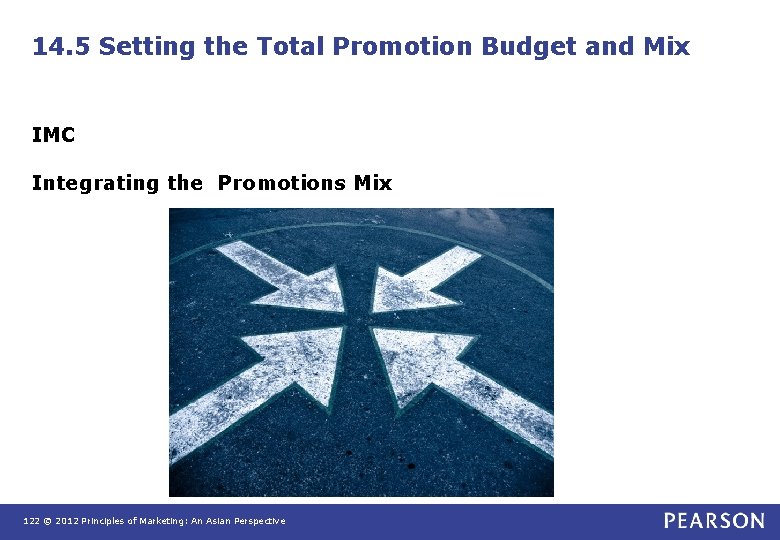
14. 5 Setting the Total Promotion Budget and Mix IMC Integrating the Promotions Mix 122 © 2012 Principles of Marketing: An Asian Perspective
14. 5 Setting the Total Promotion Budget and Mix Integrating the Promotions Mix • Having set the promotion budget and mix, the company must now take steps to see that all of the promotion mix elements are smoothly integrated. • Integrating the promotion mix starts with customers. Whether it’s advertising, personal selling, sales promotion, PR, or direct marketing, communications at each customer touchpoint must deliver consistent messages and positioning. 123 © 2012 Principles of Marketing: An Asian Perspective
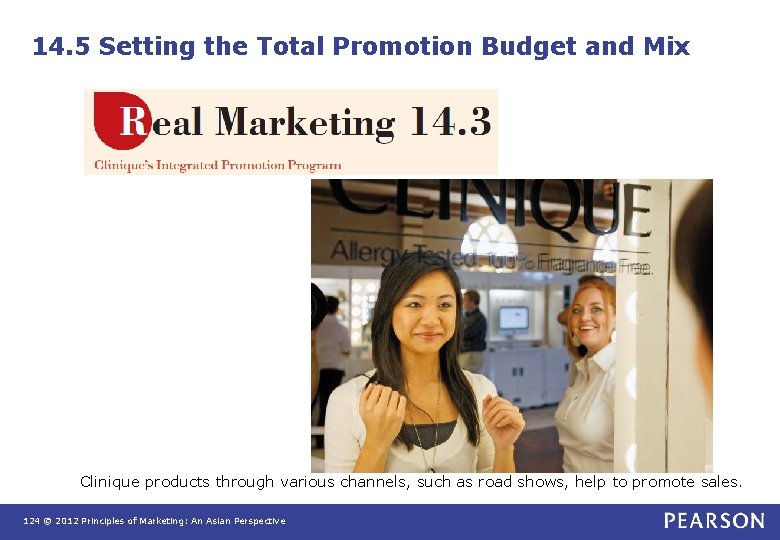
14. 5 Setting the Total Promotion Budget and Mix Clinique products through various channels, such as road shows, help to promote sales. 124 © 2012 Principles of Marketing: An Asian Perspective
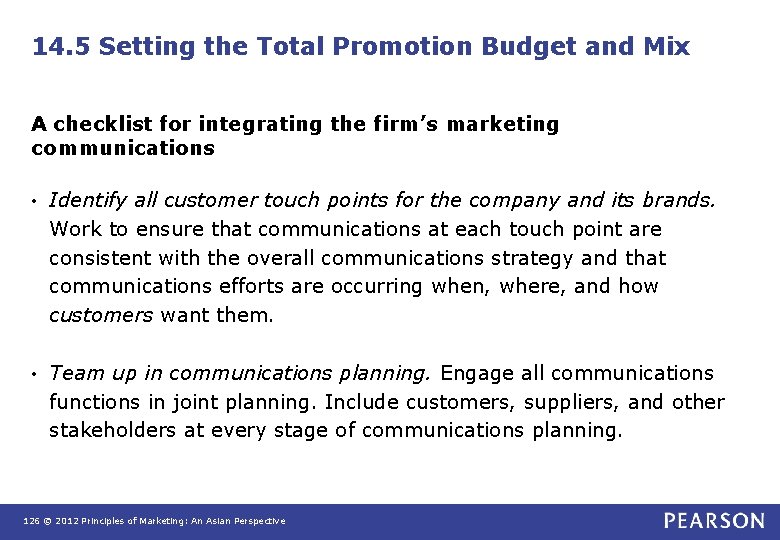
14. 5 Setting the Total Promotion Budget and Mix A checklist for integrating the firm’s marketing communications Analyze trends—internal and external—that can affect the company’s ability to do business. Look for areas where communications can help the most. Determine the strengths and weaknesses of each communications function. Develop a combination of promotional tactics based on these strengths and weaknesses. • Audit the pockets of communications spending throughout the organization. Itemize the communications budgets and tasks and consolidate these into a single budgeting process. Reassess all communications expenditures by product, promotional tool, stage of the life cycle, and observed effect. • 125 © 2012 Principles of Marketing: An Asian Perspective
14. 5 Setting the Total Promotion Budget and Mix A checklist for integrating the firm’s marketing communications • Identify all customer touch points for the company and its brands. Work to ensure that communications at each touch point are consistent with the overall communications strategy and that communications efforts are occurring when, where, and how customers want them. • Team up in communications planning. Engage all communications functions in joint planning. Include customers, suppliers, and other stakeholders at every stage of communications planning. 126 © 2012 Principles of Marketing: An Asian Perspective
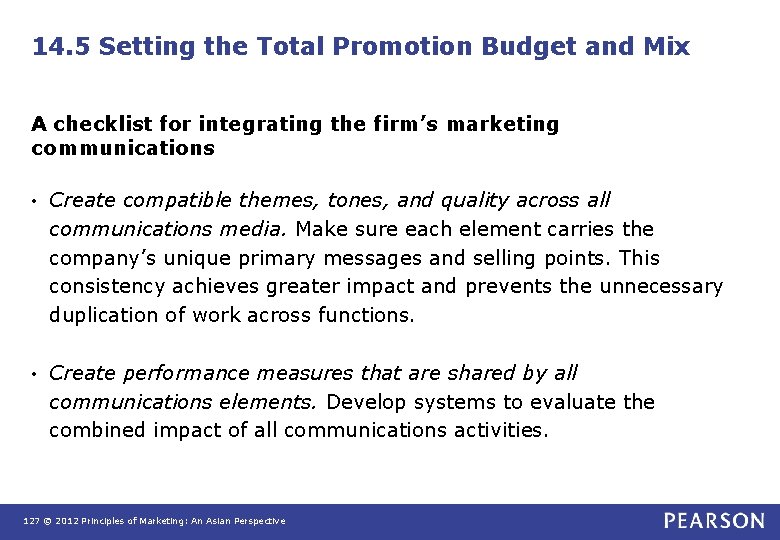
14. 5 Setting the Total Promotion Budget and Mix A checklist for integrating the firm’s marketing communications • Create compatible themes, tones, and quality across all communications media. Make sure each element carries the company’s unique primary messages and selling points. This consistency achieves greater impact and prevents the unnecessary duplication of work across functions. • Create performance measures that are shared by all communications elements. Develop systems to evaluate the combined impact of all communications activities. 127 © 2012 Principles of Marketing: An Asian Perspective
14. 5 Setting the Total Promotion Budget and Mix A checklist for integrating the firm’s marketing communications • Appoint a director responsible for the company’s persuasive communications efforts. This move encourages efficiency by centralizing planning and creating shared performance measures. 128 © 2012 Principles of Marketing: An Asian Perspective
14. 6 Socially Responsible Marketing Communication 14. 6 129 © 2012 Principles of Marketing: An Asian Perspective
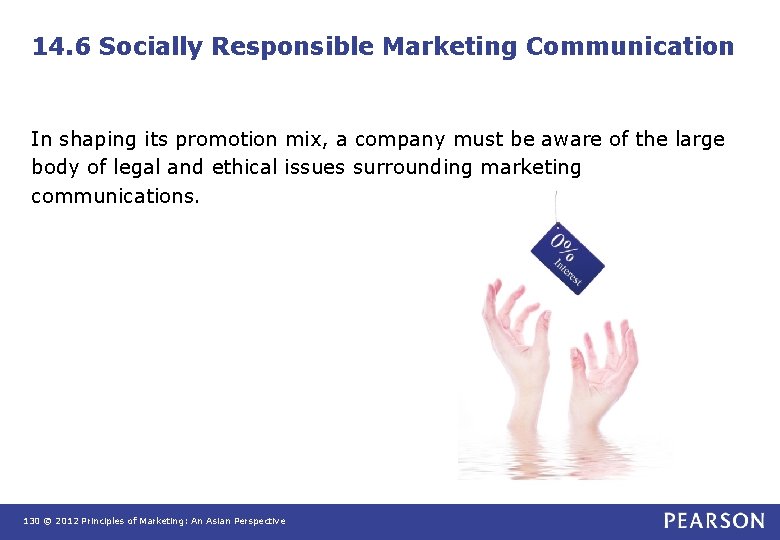
14. 6 Socially Responsible Marketing Communication In shaping its promotion mix, a company must be aware of the large body of legal and ethical issues surrounding marketing communications. 130 © 2012 Principles of Marketing: An Asian Perspective
14. 6 Socially Responsible Marketing Communication Advertising and Sales Promotion • By law, companies must avoid false or deceptive advertising. Advertisers must not make false claims, such as suggesting that a product cures something when it does not. They must avoid ads that have the capacity to deceive, even though no one actually may be deceived. • Sellers must avoid bait and switch advertising that attracts buyers under false pretenses. 131 © 2012 Principles of Marketing: An Asian Perspective
14. 6 Socially Responsible Marketing Communication Advertising and Sales Promotion • A company’s trade promotion activities are also closely regulated. For example, under some country’s legislations, sellers cannot favor certain customers through their use of trade promotions. They must make promotional allowances and services available to all resellers on proportionately equal terms. • Companies can use advertising and other forms of promotion to encourage and promote socially responsible programs and actions 132 © 2012 Principles of Marketing: An Asian Perspective
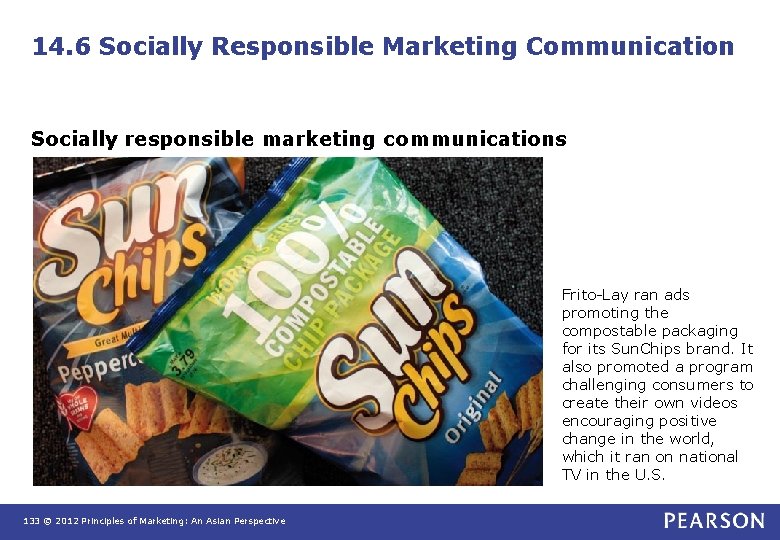
14. 6 Socially Responsible Marketing Communication Socially responsible marketing communications Frito Lay ran ads promoting the compostable packaging for its Sun. Chips brand. It also promoted a program challenging consumers to create their own videos encouraging positive change in the world, which it ran on national TV in the U. S. 133 © 2012 Principles of Marketing: An Asian Perspective
14. 6 Socially Responsible Marketing Communication Personal Selling • A company’s salespeople must follow the rules of “fair competition. ” Most states have enacted deceptive sales acts that spell out what is not allowed. • For example, salespeople may not lie to consumers or mislead them about the advantages of buying a product. To avoid bait and switch practices, salespeople’s statements must match advertising claims. • Different rules apply to consumers who are called on at home versus those who go to a store in search of a product. 134 © 2012 Principles of Marketing: An Asian Perspective
14. 6 Socially Responsible Marketing Communication Personal Selling • Because people called on at home may be taken by surprise and may be especially vulnerable to high pressure selling techniques. • Much personal selling involves business to business trade. In selling to businesses, salespeople may not offer bribes to purchasing agents or to others who can influence a sale. They may not obtain or use technical or trade secrets of competitors through bribery or industrial espionage. • Finally, salespeople must not disparage competitors or competing products by suggesting things that are not true. 135 © 2012 Principles of Marketing: An Asian Perspective
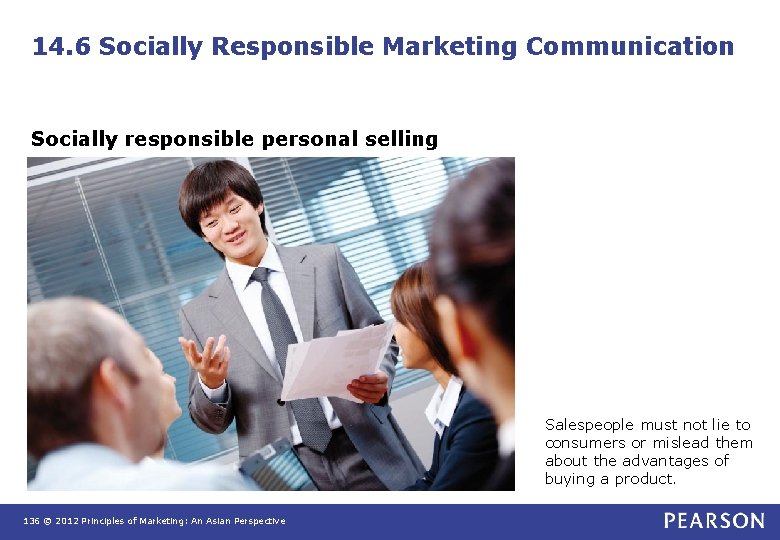
14. 6 Socially Responsible Marketing Communication Socially responsible personal selling Salespeople must not lie to consumers or mislead them about the advantages of buying a product. 136 © 2012 Principles of Marketing: An Asian Perspective
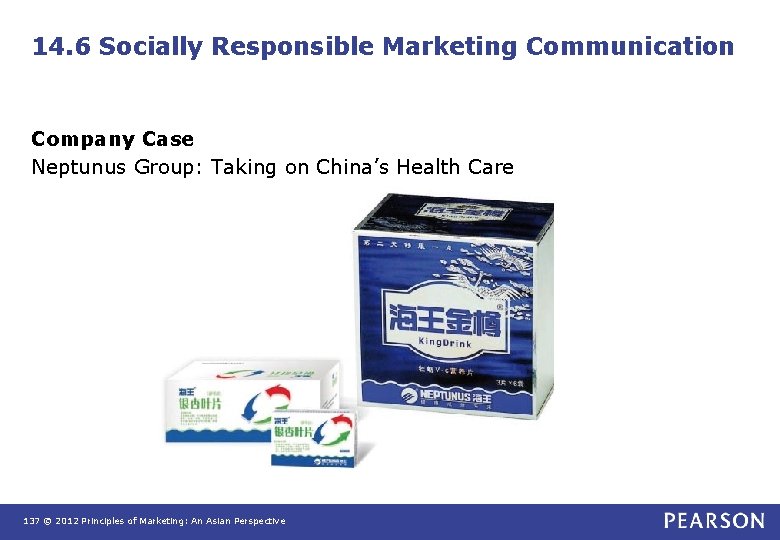
14. 6 Socially Responsible Marketing Communication Company Case Neptunus Group: Taking on China’s Health Care 137 © 2012 Principles of Marketing: An Asian Perspective
Thank you