
PRINCIPLES OF MANAGEMENT Dr R Prabhu Company Write
PRINCIPLES OF MANAGEMENT Dr. R. Prabhu
Company Write down the names of 10 Indian companies that you know Write down the names of 10 International companies that you know
Manager What does a Manager do at his office?
Definition of Management F. W. Taylor’s definition – “Management is knowing exctly what you want men to do and then seeing that they do it in the best and efficient way” Louis Allen’s definition – “Management is what a manager does” Koontz & O’Donnell’s definition – “Management is the creation and maintenance of an internal environment in an enterprise where individuals working together in groups, can perform efficiently and effectively towards the attainment of group goals”
Scope of Management Two aspects are there in Scope of Management 1. Subject matter of Management and 2. Functional areas of Management
Subject matter of Management This includes the various functions of Management like - Planning - Organising - Staffing - Directing and - Controlling
Functional areas of Management - This consists of the following areas Financial Management Personnel management Production management Office Management Marketing Management Maintenance Management
MANAGEMENT PROCESS - - This is a process of activities which can be divided into four distinct integrated activities Planning : Deciding what is to be done Organising : Deciding how it is to be done and who will do it Leading : Influencing Behaviour Controlling : To make sure that plans are carried out
Characteristics of Management 1. 2. 3. 4. 5. 6. 7. 8. Management is a process Management is purpose oriented Management is goal oriented Management is a dynamic process Management is multi-discilplinary Management as a disclipline Management is all pervasive Management is an influence process
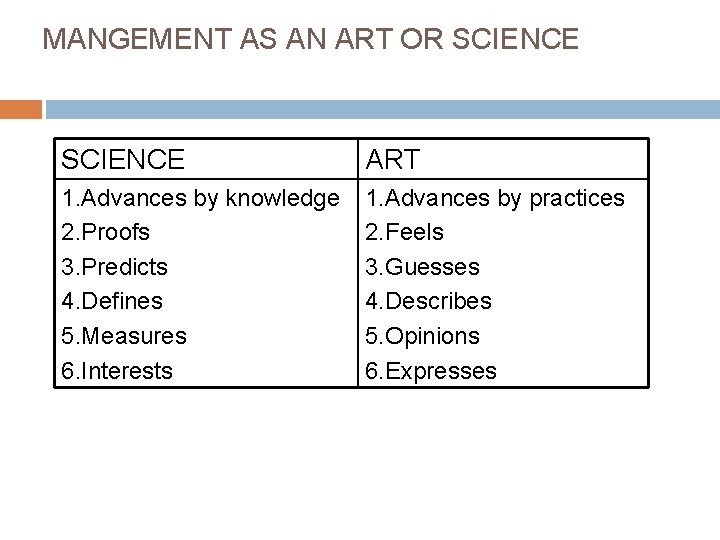
MANGEMENT AS AN ART OR SCIENCE ART 1. Advances by knowledge 2. Proofs 3. Predicts 4. Defines 5. Measures 6. Interests 1. Advances by practices 2. Feels 3. Guesses 4. Describes 5. Opinions 6. Expresses

Levels of Management Top level Middle level Lower level

LEVELS OF MANAGEMENT ADMINISTRTION TOP LEVEL MIDDLE LEVEL LOWER LEVEL MANAGEMENT
Roles of a Manager Henry Mintzberg three roles of managers 1. Interpersonal Role A. Figure head B. Leader C. liaison 2. Informational Role A. Monitor B. Disseminator C. Spokesperson 3. Decisional Role A. Entrepreneur Role B. Disturbance handler C. Resource Allocator D. Negotiator
Classical Management theories These theories emerged in the early years of the century (1900 -1930) Classical management consists of two distinct branches 1. Scientific management and 2. Administrative management theory
Features of classical management 1. 2. 3. 4. It is closely associated with the industrial revolution and development of large scale industries which demanded the development of new forms of organisation and management. It is based on scientific, administrative and bureaucratic model. Management thought focused on productivity, job content, structure, standardization, simplification and specialization. Scientific approach towards organization and management.
TAYLOR AND SCIENTIFIC MANAGEMENT Fredrick Taylor defined the basic problem of managing as the art of knowing exactly what you want one to do and see that they do it in the best and cheapest way. Taylor joined Midvale Steel company as a worker and later became supervisor. Here he completed ME and joineed Bethlehem Steel company. In both these places he carried on experiments on how to increase the efficiency of people. 1. 2. Taylors contributions can be described in two parts Main features of scientific management and Principles of scientific management
1. Main features of Scientific Management 1. 2. 3. 4. Separation – of planning and doing. Planning should be done by superiors and operational work by workers Functional Foremanship – This is against the unity of command as a lot of planning incharge people and production incharge people give orders to one worker Job Analysis – It was done to find out one best way of doing things. This is determined by a. Time Study and b. Motion Study. Standardisation – Should be maintained in respect of instruments and tools, period of work, amount of work, working conditions and cost of production.
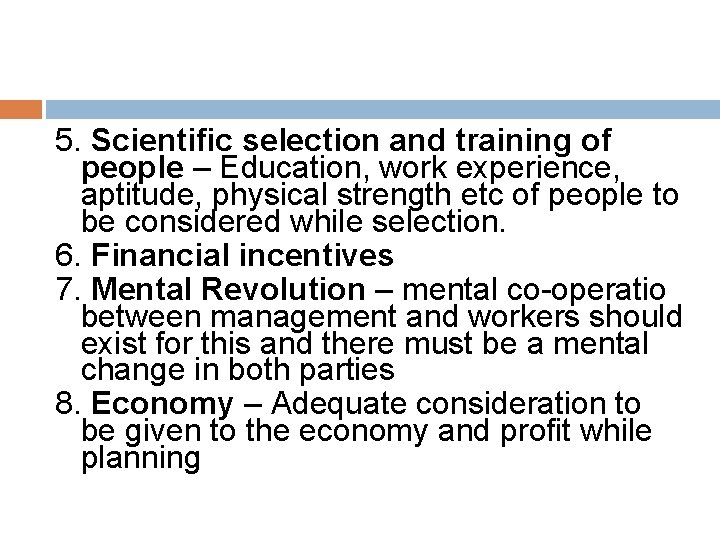
5. Scientific selection and training of people – Education, work experience, aptitude, physical strength etc of people to be considered while selection. 6. Financial incentives 7. Mental Revolution – mental co-operatio between management and workers should exist for this and there must be a mental change in both parties 8. Economy – Adequate consideration to be given to the economy and profit while planning
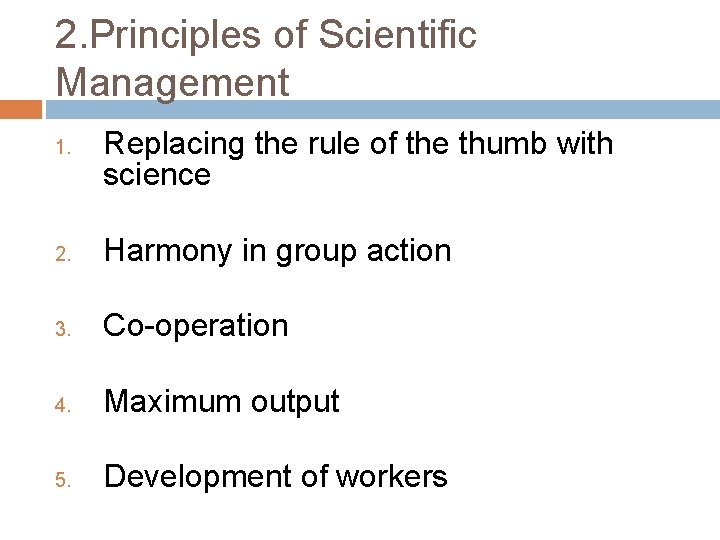
2. Principles of Scientific Management 1. Replacing the rule of the thumb with science 2. Harmony in group action 3. Co-operation 4. Maximum output 5. Development of workers
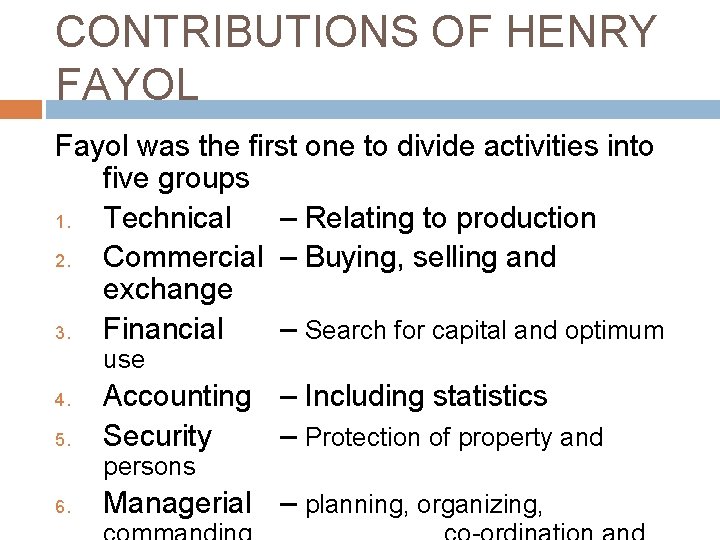
CONTRIBUTIONS OF HENRY FAYOL Fayol was the first one to divide activities into five groups 1. Technical – Relating to production 2. Commercial – Buying, selling and exchange 3. Financial – Search for capital and optimum use 4. 5. Accounting – Including statistics Security – Protection of property and persons 6. Managerial – planning, organizing,
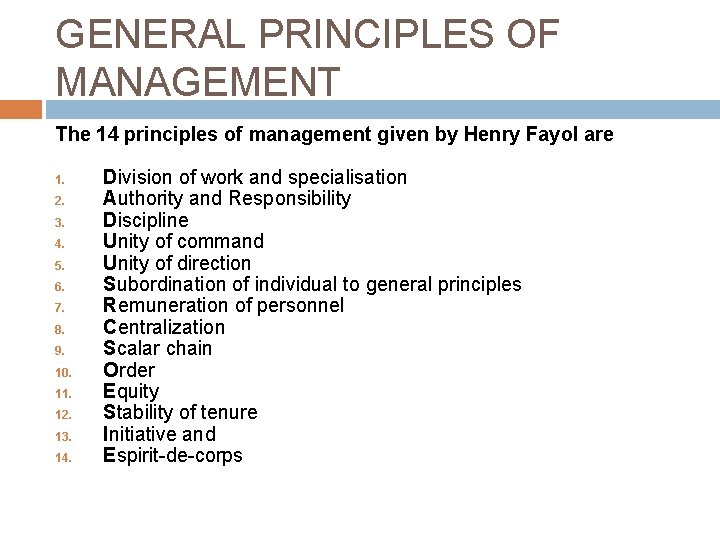
GENERAL PRINCIPLES OF MANAGEMENT The 14 principles of management given by Henry Fayol are 1. 2. 3. 4. 5. 6. 7. 8. 9. 10. 11. 12. 13. 14. Division of work and specialisation Authority and Responsibility Discipline Unity of command Unity of direction Subordination of individual to general principles Remuneration of personnel Centralization Scalar chain Order Equity Stability of tenure Initiative and Espirit-de-corps
UNIT – II PLANNING Definition Planning may be broadly defined as “A concept of executive action that embodies the skills of anticipating, influencing and controlling the nature and direction of change”.
Features of Planning 1. 2. 3. 4. 5. 6. Planning is a process rather than a behavior at a given point of time. Planning is primarily looking into the future Planning involves a selection of a stable course of action Planning is undertaken at all levels in the organization Planning is flexible as conditions are dynamic Planning is a pervasive and continuous management function
Importance of Planning 1. Primacy of planning – Planning precedes all other managerial functions
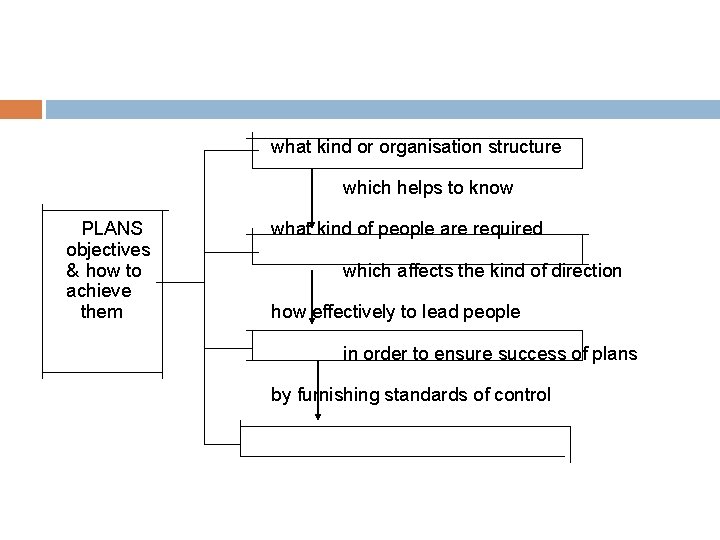
what kind or organisation structure which helps to know PLANS objectives & how to achieve them what kind of people are required which affects the kind of direction how effectively to lead people in order to ensure success of plans by furnishing standards of control
2. To offset uncertainty and change – There is a continuous change in the environment and the organization has to work in accelerating change 3. To focus attention on objectives – Planning focuses on organizational objectives and direction of action for achieving these objectives 4. To help in co-ordination – Co-ordination is the essence of management and planning is the basis for it 5. Help in control 6. To increase in organizational effectiveness
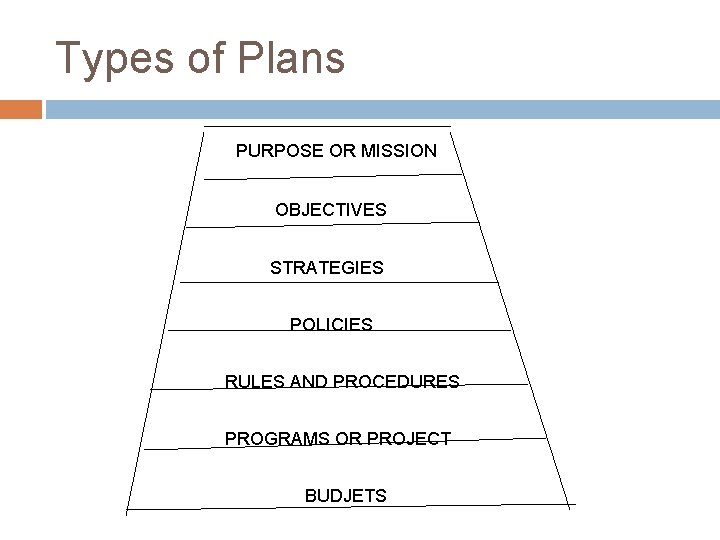
Types of Plans PURPOSE OR MISSION OBJECTIVES STRATEGIES POLICIES RULES AND PROCEDURES PROGRAMS OR PROJECT BUDJETS
Characteristics of Planning Ø Ø Ø It should be based on facts Stability Flexibility Updated procedures Minimum procedures Process as a system
Planning process 1. 2. 3. 4. 5. 6. 7. The following are the important steps in the planning process To identify the need of planning Analysis of existing internal profile of organisation To scan the environment To prepare statement of objectives To develop alternative course of action To evaluate alternative course Formulation of derivative plans
Advantages of planning 1. 2. 3. 4. 5. 6. 7. 8. Focuses attention on objectives Reduces uncertainty Ensures economical operations Facilitates control Improves motivation Improves competitive strength Encourages innovation & creativity Achieves better co-ordination
Limitations of planning 1. Difficulty of accurate premising 2. Problems of rapid change 3. Internal inflexibility a. Psychological inflexibility b. Policy and procedural inflexibility c. Capital investment 4. External inflexibility a. Political climate b. Trade unions c. Technological changes 5. Time and cost factors 6. Failure of people in planning
Business forecasting and essentials Forecasting is assumptions or forecast of the future and known conditions that will affect the operation of plans. Some sales forecasting methods are 1. 2. 3. 4. Jury of executive opinion method Sales forecast composite method Users expectation method Statistical methods a. Trend and cycles b. Correlation analysis c. Mathematical formulas or models
Decision Making Decision making is both managerial function and organizational process Discuss importance of decision making
Definition of Decision Making According to George. Terry “Decision Making is the selection based on some criteria from two or more alternatives”
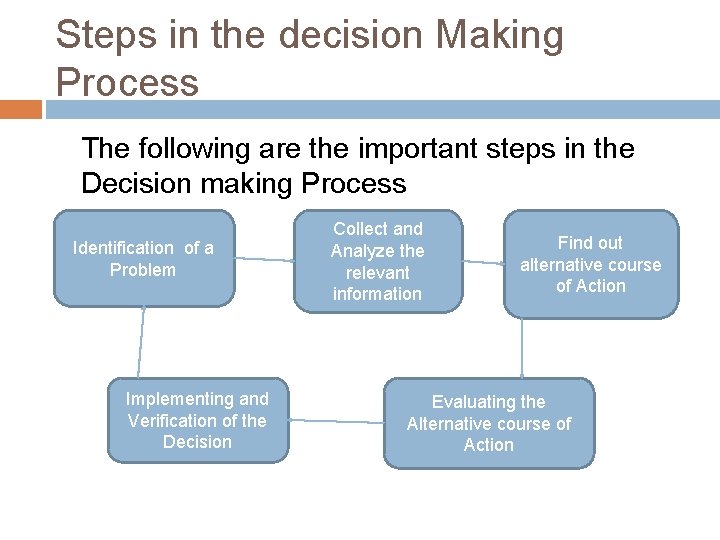
Steps in the decision Making Process The following are the important steps in the Decision making Process Identification of a Problem Implementing and Verification of the Decision Collect and Analyze the relevant information Find out alternative course of Action Evaluating the Alternative course of Action
Types of Decision Making The following are the major types of Decisions made by managers 1. Programmed and Non-programmed decisions 2. Major and minor decisions Routine and Strategic decisions Individual and Group decisions
Problems involved in Decision Making 1. 2. 3. 4. 5. 6. 7. 8. The common problems in making and implementing the decisions are as follows Incomplete information The accuracy and reliability of information Un-supporting management environment Non acceptance of subordinates Ineffective communication Incorrect timing Lack of organizational commitment Bias in decision making
- Slides: 38