
Principles of Management Definition Principles and Basics of
Principles of Management Definition, Principles and Basics of Management
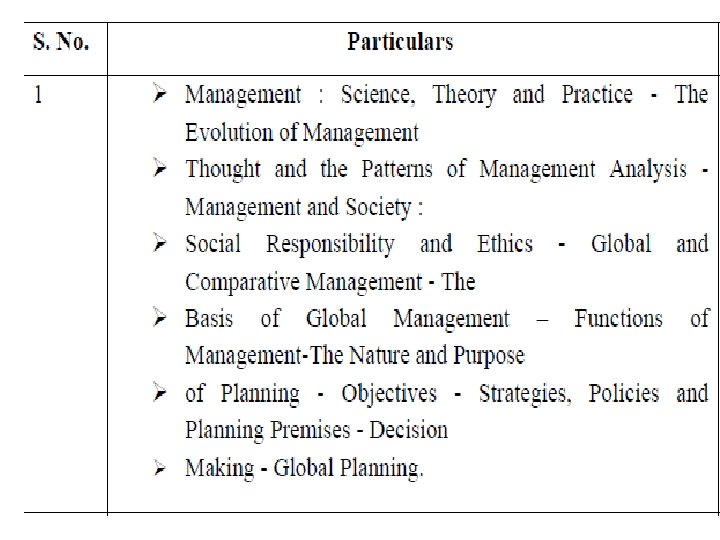
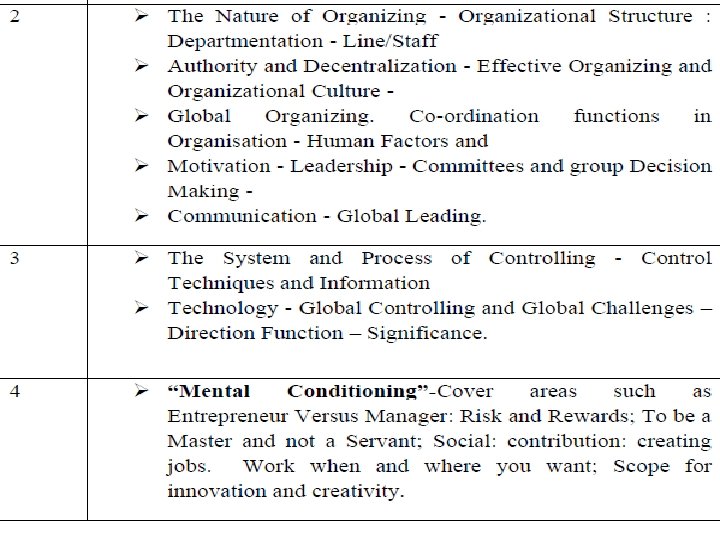
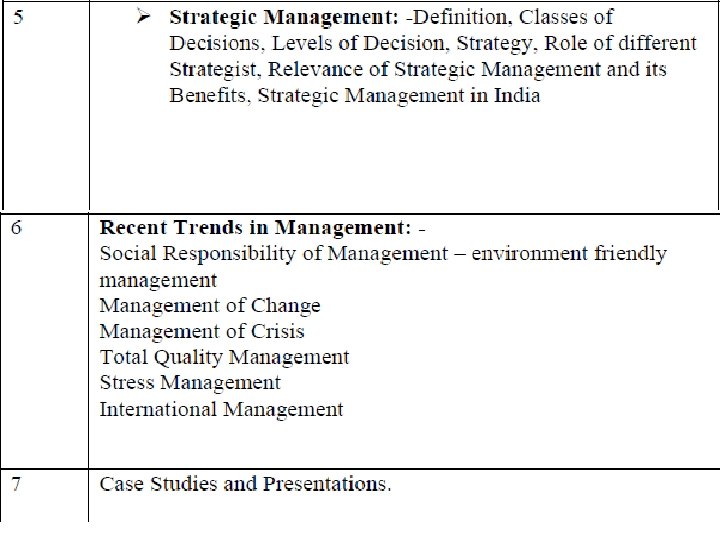
Course outline overview q Introduction to Management q. Evolution of Management q. System & Environment q. Decision Making & Planning q. Organizing q. HR Management & Staffing q. Leading q. Controlling 5
Methodology • • Lectures Videos Cases Presentations Discussions and debates Research reports Projects 6
Recommended Text & Reference Books: 1. FUNDAMENTALS OF MANAGEMENT Essential Concepts & Applications By: Robbins, Decenzo 2. MANAGEMENT The New Competitive Landscape By: Bateman, Snell 3. MANAGEMENT By: Robbins, Coulter 4. MANAGEMENT A global Perspective By: Weihrich, Koontz 7
Learning Objectives • Define Managers And Management. • Explain What Managers Do. • Describe The Competencies Used In Managerial Work And Assess Your Current Competency Levels. • Whether management is a Science or an Art? 8
Management in the New Millennium • A firm can be efficient by making the best use of people, money, physical plant, and technology. • It is ineffective if its goals do not provide a sustained competitive advantage. • A firm with excellent goals would fail if it hired the wrong people, lost key contributors, relied on outdated technology, and made poor investment decisions. 9
Basics of Management 10
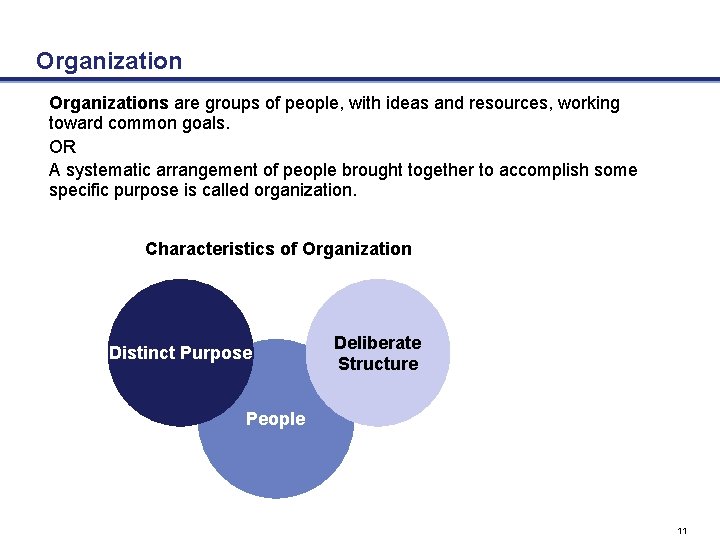
Organizations are groups of people, with ideas and resources, working toward common goals. OR A systematic arrangement of people brought together to accomplish some specific purpose is called organization. Characteristics of Organization Distinct Purpose Deliberate Structure People 11
Management Organization Two or more people who work together in a structured way to achieve a specific goal or set of goals. Goals Purpose that an organization strives to achieve; goals are fundamental elements of organization. The Role of Management To guide the organizations towards goal accomplishment 12
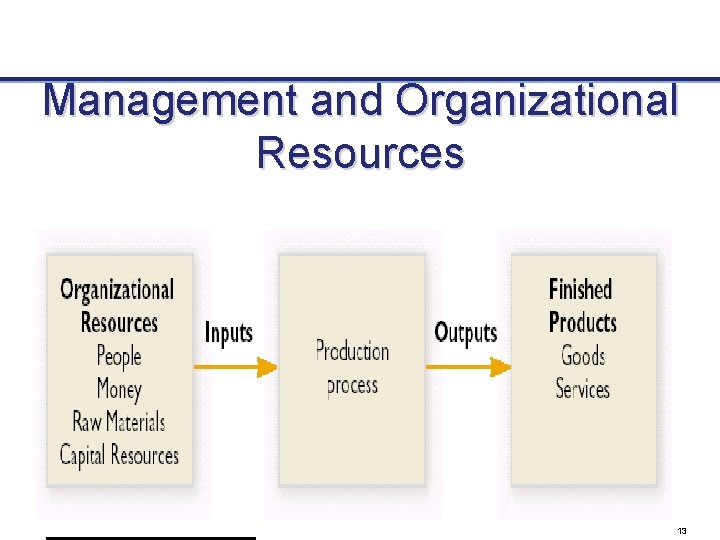
Management and Organizational Resources 13
Management Defined 1 Management is the process of achieving goals and objectives effectively and efficiently through and with the people. 2 "Management is a process of designing and maintaining an environment in which individuals work together in groups to effectively and efficiently accomplish selected aims". 14
Management Defined Cont’d 3 Management is the process of achieving organizational goals and objectives effectively and efficiently by using management functions i. e. – Planning – Organizing – Staffing – Controlling 4 Management is a set of activities directed at an organization's resources with the aim of achieving organizational goals in an efficient and effective manner. 15
These definitions when expanded have these implications: • Management is thus a continuous effort aimed at shaping an organization and contributing to its overall growth. • The functions of managers include planning, organizing, staffing, leading and controlling. • These functions are essential to any kind of organization. • It applies to managers at all hierarchical levels. • The aim of managers is to increase productivity, effectiveness and efficiency. 16
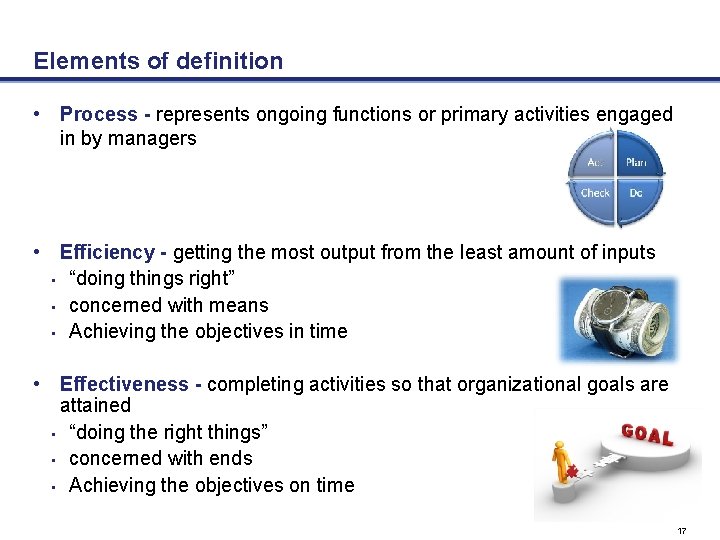
Elements of definition • Process - represents ongoing functions or primary activities engaged in by managers • Efficiency - getting the most output from the least amount of inputs • “doing things right” • concerned with means • Achieving the objectives in time • Effectiveness - completing activities so that organizational goals are attained • “doing the right things” • concerned with ends • Achieving the objectives on time 17
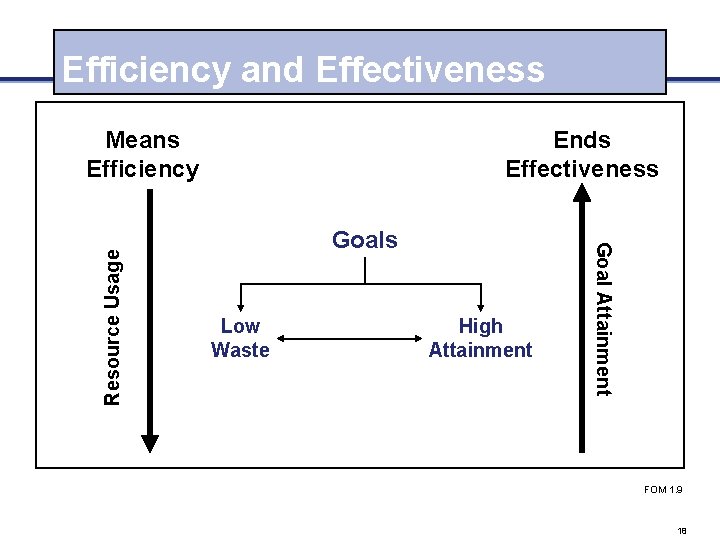
Efficiency and Effectiveness Ends Effectiveness Goals Low Waste High Attainment Goal Attainment Resource Usage Means Efficiency FOM 1. 9 18
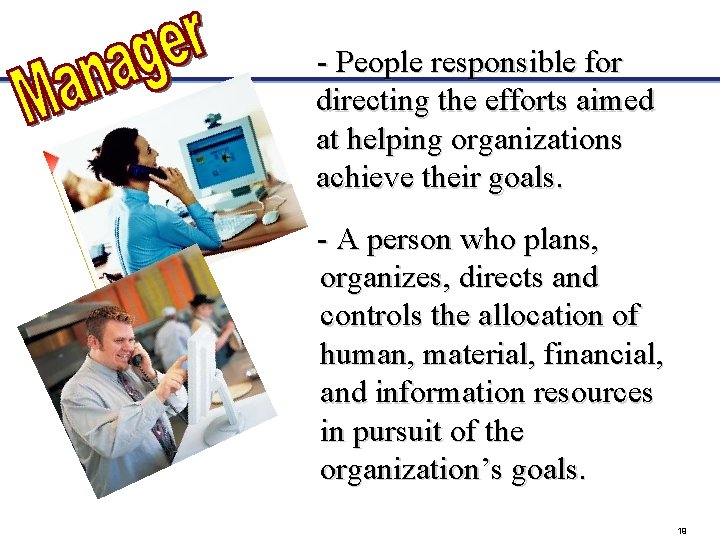
- People responsible for directing the efforts aimed at helping organizations achieve their goals. - A person who plans, organizes, directs and controls the allocation of human, material, financial, and information resources in pursuit of the organization’s goals. 19
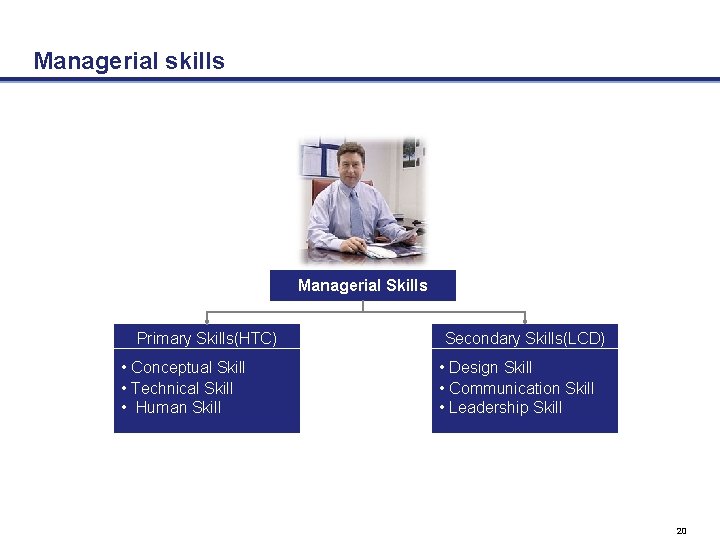
Managerial skills Managerial Skills Primary Skills(HTC) • Conceptual Skill • Technical Skill • Human Skill Secondary Skills(LCD) • Design Skill • Communication Skill • Leadership Skill 20
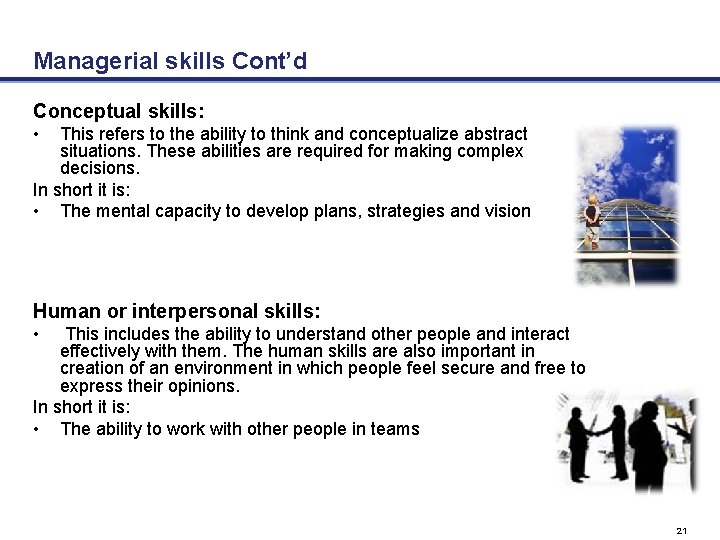
Managerial skills Cont’d Conceptual skills: • This refers to the ability to think and conceptualize abstract situations. These abilities are required for making complex decisions. In short it is: • The mental capacity to develop plans, strategies and vision Human or interpersonal skills: • This includes the ability to understand other people and interact effectively with them. The human skills are also important in creation of an environment in which people feel secure and free to express their opinions. In short it is: • The ability to work with other people in teams 21
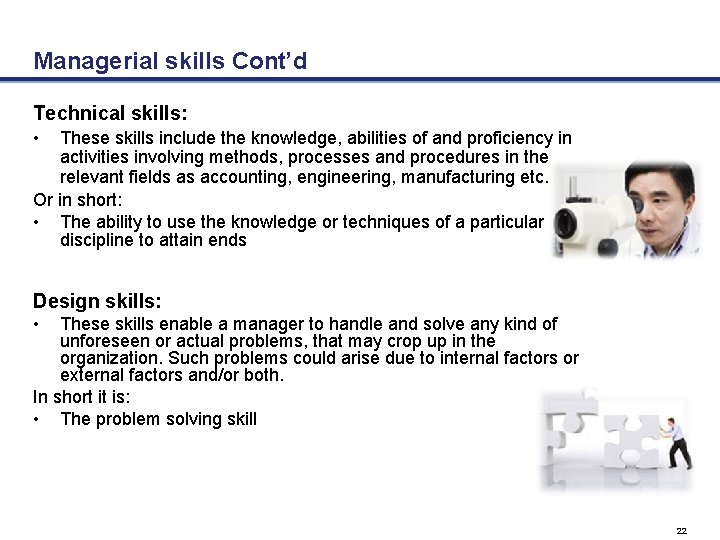
Managerial skills Cont’d Technical skills: • These skills include the knowledge, abilities of and proficiency in activities involving methods, processes and procedures in the relevant fields as accounting, engineering, manufacturing etc. Or in short: • The ability to use the knowledge or techniques of a particular discipline to attain ends Design skills: • These skills enable a manager to handle and solve any kind of unforeseen or actual problems, that may crop up in the organization. Such problems could arise due to internal factors or external factors and/or both. In short it is: • The problem solving skill 22
Managerial skills Cont’d Communication skills: • The abilities of exchanging ideas and information effectively. To understand others and let others understand comprehensively. Leadership skills • The abilities to influence other people to achieve the common goal. 23
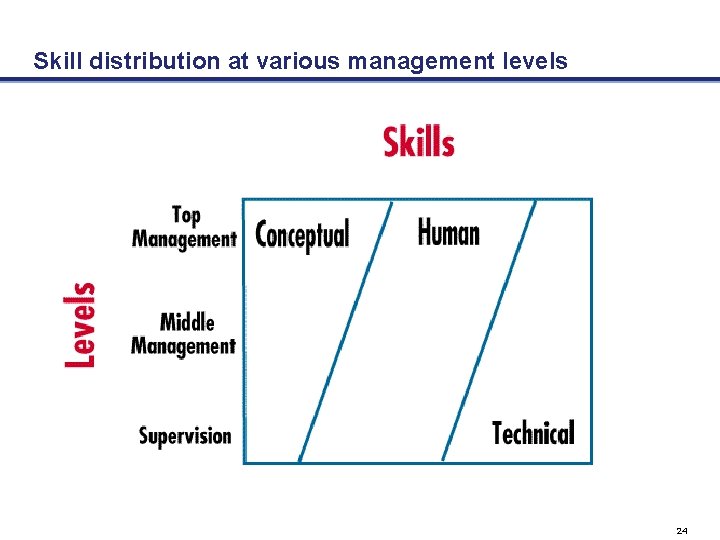
Skill distribution at various management levels 24
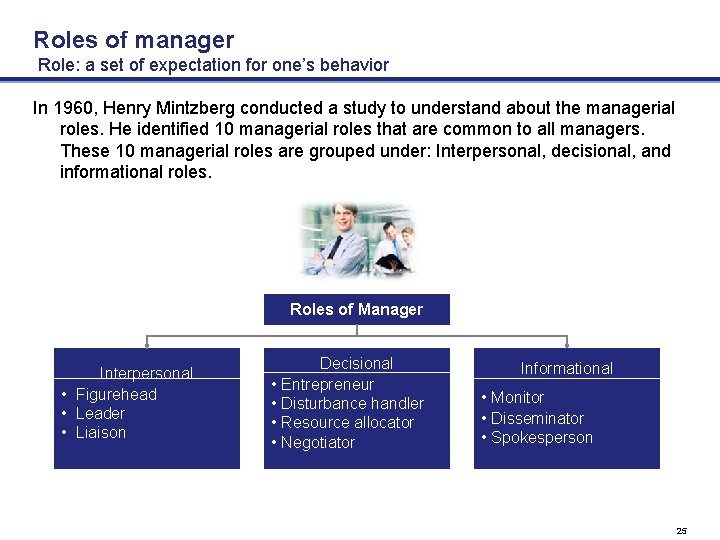
Roles of manager Role: a set of expectation for one’s behavior In 1960, Henry Mintzberg conducted a study to understand about the managerial roles. He identified 10 managerial roles that are common to all managers. These 10 managerial roles are grouped under: Interpersonal, decisional, and informational roles. Roles of Manager Interpersonal • Figurehead • Leader • Liaison Decisional • Entrepreneur • Disturbance handler • Resource allocator • Negotiator Informational • Monitor • Disseminator • Spokesperson 25
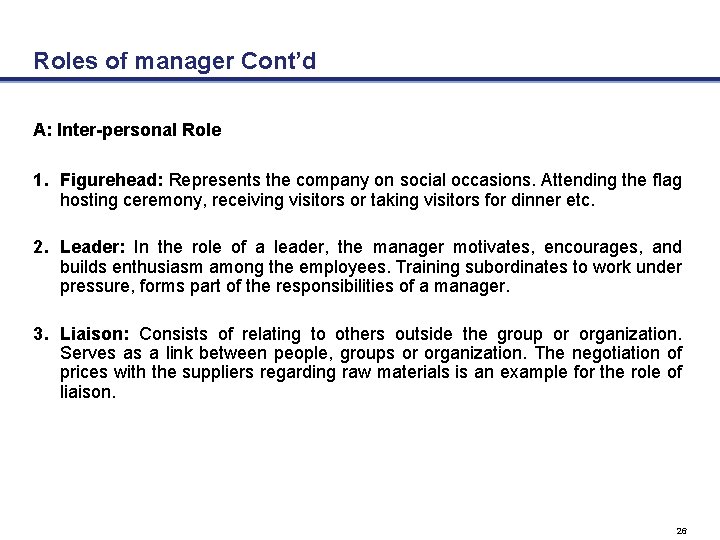
Roles of manager Cont’d A: Inter-personal Role 1. Figurehead: Represents the company on social occasions. Attending the flag hosting ceremony, receiving visitors or taking visitors for dinner etc. 2. Leader: In the role of a leader, the manager motivates, encourages, and builds enthusiasm among the employees. Training subordinates to work under pressure, forms part of the responsibilities of a manager. 3. Liaison: Consists of relating to others outside the group or organization. Serves as a link between people, groups or organization. The negotiation of prices with the suppliers regarding raw materials is an example for the role of liaison. 26
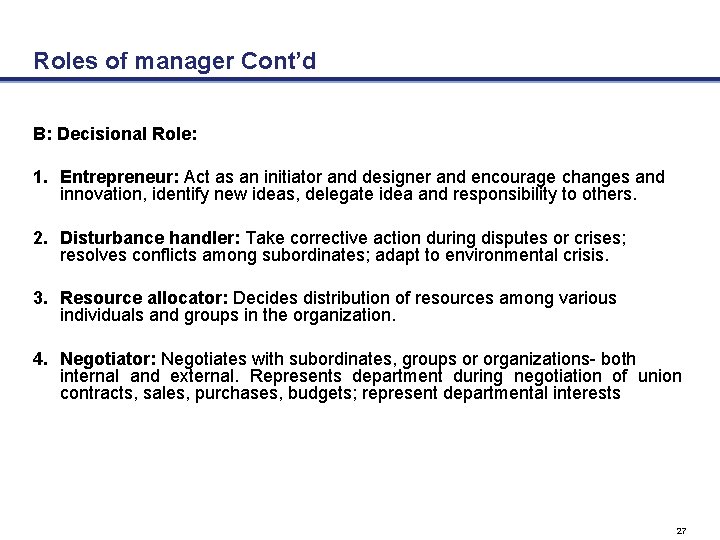
Roles of manager Cont’d B: Decisional Role: 1. Entrepreneur: Act as an initiator and designer and encourage changes and innovation, identify new ideas, delegate idea and responsibility to others. 2. Disturbance handler: Take corrective action during disputes or crises; resolves conflicts among subordinates; adapt to environmental crisis. 3. Resource allocator: Decides distribution of resources among various individuals and groups in the organization. 4. Negotiator: Negotiates with subordinates, groups or organizations- both internal and external. Represents department during negotiation of union contracts, sales, purchases, budgets; represent departmental interests 27
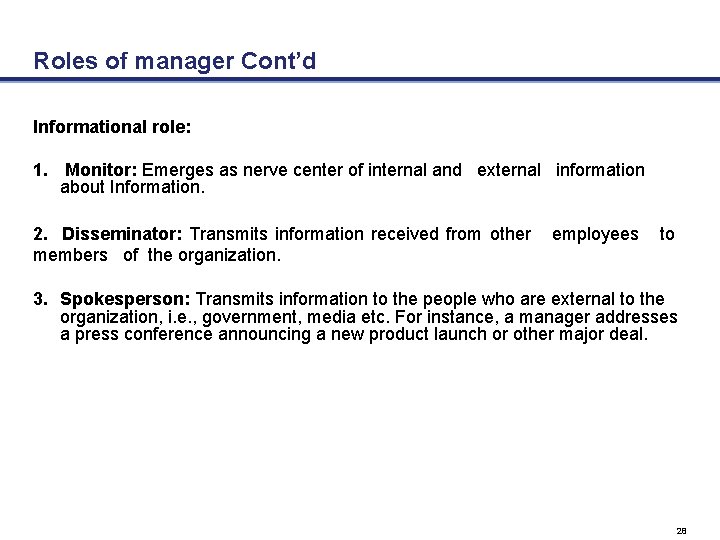
Roles of manager Cont’d Informational role: 1. Monitor: Emerges as nerve center of internal and external information about Information. 2. Disseminator: Transmits information received from other members of the organization. employees to 3. Spokesperson: Transmits information to the people who are external to the organization, i. e. , government, media etc. For instance, a manager addresses a press conference announcing a new product launch or other major deal. 28
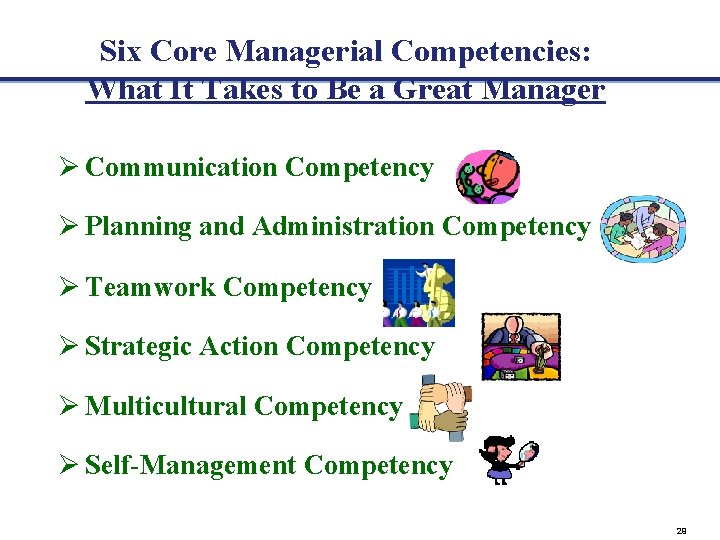
Six Core Managerial Competencies: What It Takes to Be a Great Manager Ø Communication Competency Ø Planning and Administration Competency Ø Teamwork Competency Ø Strategic Action Competency Ø Multicultural Competency Ø Self-Management Competency 29
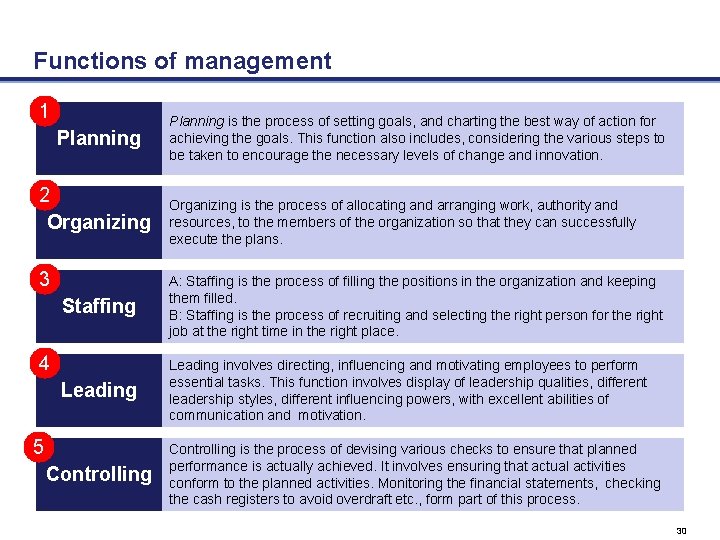
Functions of management 1 Planning 2 Organizing 3 Planning is the process of setting goals, and charting the best way of action for achieving the goals. This function also includes, considering the various steps to be taken to encourage the necessary levels of change and innovation. Organizing is the process of allocating and arranging work, authority and resources, to the members of the organization so that they can successfully execute the plans. Staffing A: Staffing is the process of filling the positions in the organization and keeping them filled. B: Staffing is the process of recruiting and selecting the right person for the right job at the right time in the right place. Leading involves directing, influencing and motivating employees to perform essential tasks. This function involves display of leadership qualities, different leadership styles, different influencing powers, with excellent abilities of communication and motivation. 4 5 Controlling is the process of devising various checks to ensure that planned performance is actually achieved. It involves ensuring that actual activities conform to the planned activities. Monitoring the financial statements, checking the cash registers to avoid overdraft etc. , form part of this process. 30
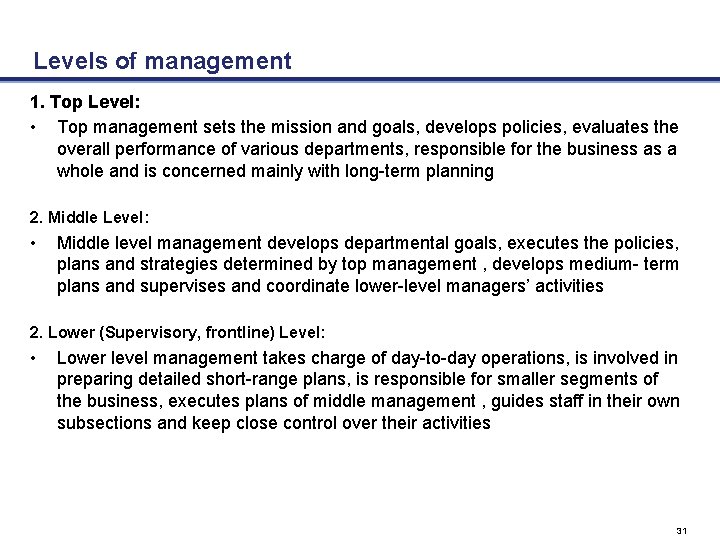
Levels of management 1. Top Level: • Top management sets the mission and goals, develops policies, evaluates the overall performance of various departments, responsible for the business as a whole and is concerned mainly with long-term planning 2. Middle Level: • Middle level management develops departmental goals, executes the policies, plans and strategies determined by top management , develops medium- term plans and supervises and coordinate lower-level managers’ activities 2. Lower (Supervisory, frontline) Level: • Lower level management takes charge of day-to-day operations, is involved in preparing detailed short-range plans, is responsible for smaller segments of the business, executes plans of middle management , guides staff in their own subsections and keep close control over their activities 31
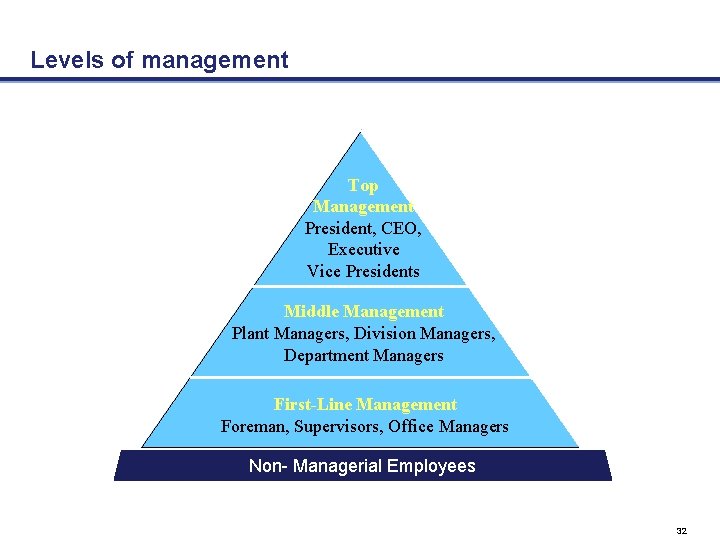
Levels of management Top Management President, CEO, Executive Vice Presidents Middle Management Plant Managers, Division Managers, Department Managers First-Line Management Foreman, Supervisors, Office Managers Non- Managerial Employees 32
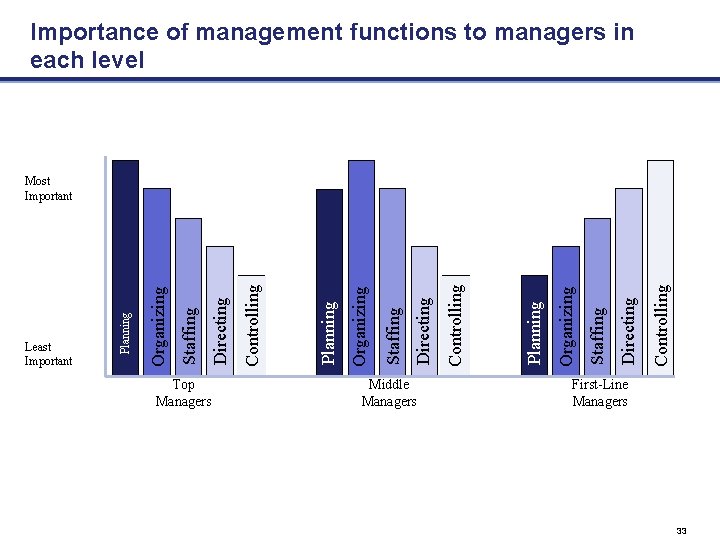
Least Important Top Managers Middle Managers Controlling Directing Staffing Organizing Planning Importance of management functions to managers in each level Most Important First-Line Managers 33
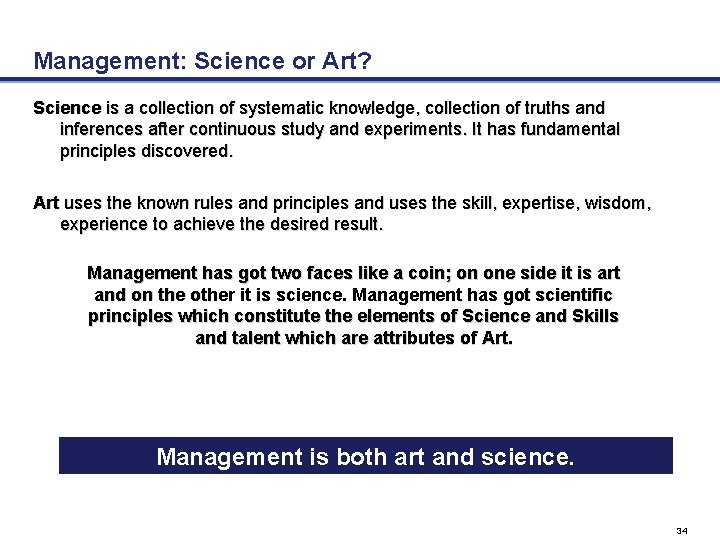
Management: Science or Art? Science is a collection of systematic knowledge, collection of truths and inferences after continuous study and experiments. It has fundamental principles discovered. Art uses the known rules and principles and uses the skill, expertise, wisdom, experience to achieve the desired result. Management has got two faces like a coin; on one side it is art and on the other it is science. Management has got scientific principles which constitute the elements of Science and Skills and talent which are attributes of Art. Management is both art and science. 34
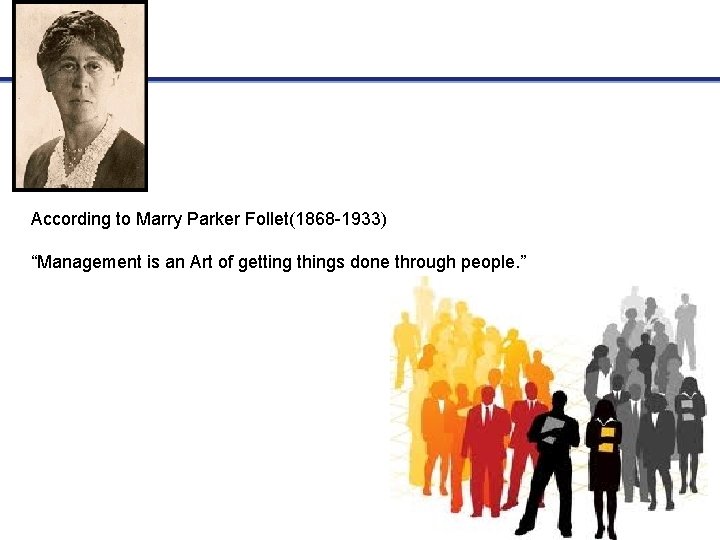
According to Marry Parker Follet(1868 -1933) “Management is an Art of getting things done through people. ” 35
MANAGEMENT AS A SCIENCE Science is a systematic body of knowledge pertaining to a specific field of study. It contains general principles and facts which explains a phenomenon. q These principles establish cause-and-effect relationships between two or more factors. q These principles and theories help to explain past events and may be used to predict the outcome of actions. q Scientific methods of observations, and experiments are used to develop principles of science. q The principles of science have universal application and validity. 36
Conditions which will explain Management as a Science q Systematic Body of Knowledge q Universal Principle q Scientific enquiry and experiment q Cause and effect relationship q Tests of validity and predictability 37
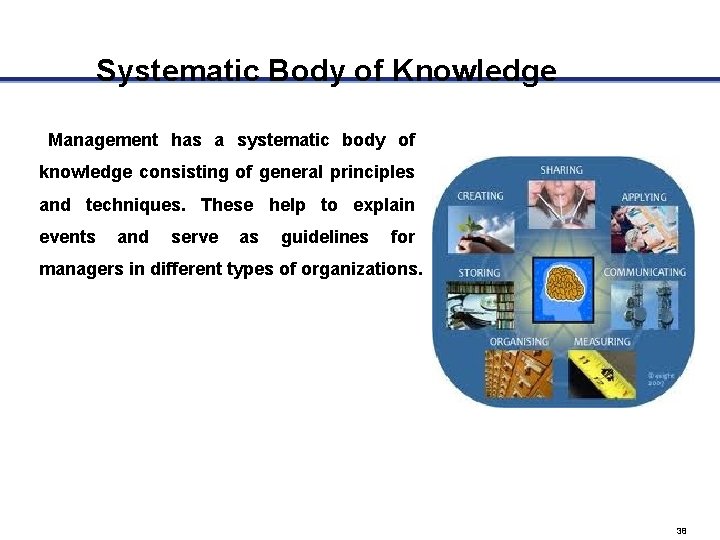
Systematic Body of Knowledge Management has a systematic body of knowledge consisting of general principles and techniques. These help to explain events and serve as guidelines for managers in different types of organizations. 38
Universal Principle Scientific principles represent basic facts about a particular field enquiry. These principles may be applied in all situations and at all times. Exceptions, if any, can be logically explained. For example, the Law of Gravitation states that if you throw an object in the air it will fall on the ground due to the gravitational force of the earth. This law can be applied in all countries and at all points of time. Management contains sound fundamental principles which can be universally applied. 39
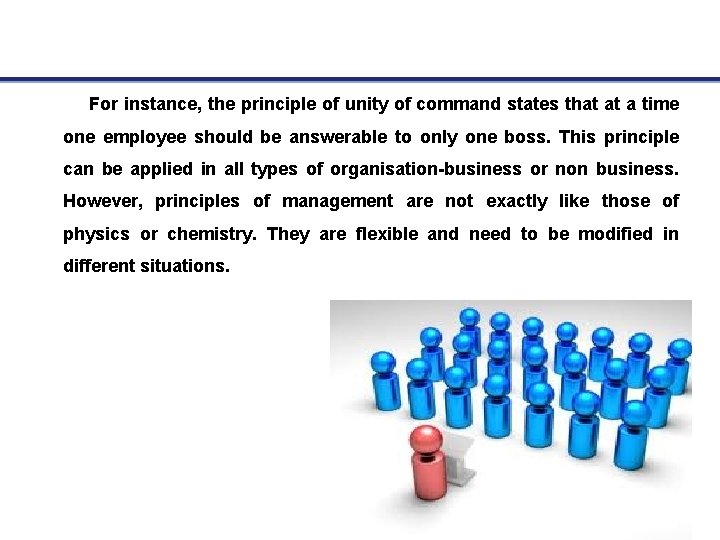
For instance, the principle of unity of command states that at a time one employee should be answerable to only one boss. This principle can be applied in all types of organisation-business or non business. However, principles of management are not exactly like those of physics or chemistry. They are flexible and need to be modified in different situations. 40
Scientific enquiry and experiments Scientific principles are derived through scientific investigation and reasoning. Scientific principles do not reflect the opinion of an individual or of a religious guru. Rather these can be scientifically proved at any time. They are critically tested. For example, the principle that the earth revolves around the sun has been scientifically proved. 41
Management principles are also based on scientific enquiry and investigation. These have been developed through experiments and practical experience of a large number of managers. For example, it has been observed that wherever one employee has two or more bosses simultaneously, confusion and indiscipline are likely to arise, with regard to following the instructions 42
Cause and effect relationship PRINCIPLES OF SCIENCE LAY DOWN A CAUSE AND EFFECT RELATIONSHIP BETWEEN RELATED FACTORS. FOR EXAMPLE, WHEN WATER IS HEATED UP TO 100ºC, IT STARTS BOILING AND TURNS INTO VAPOUR. SIMILARLY, THE PRINCIPLES OF MANAGEMENT ESTABLISH CAUSE AND EFFECT RELATIONSHIP BETWEEN DIFFERENT VARIABLES. FOR INSTANCE LACK OF BALANCE BETWEEN AUTHORITY AND RESPONSIBILITY WILL CAUSE MANAGEMENT TO BECOME INEFFECTIVE. 43
Tests of validity and predictability Validity of scientific principles can be tested at any time and any number of times. Every time the test will give the same result. Moreover, the future events can be predicted with reasonable accuracy by using scientific principles. For example, the Law of Gravitation can be tested by throwing various things in the air and every time the object will fall on the ground. For example, the principle of unity of command can be tested by comparing two persons, one having a single boss and other having two bosses. The performance of the first person will be higher than that of the second. 44
“Thus, management is undoubtedly a science. It contains a systematic body of knowledge in the form of general principles which enjoy universal applicability. “ 45
However, management is not as exact a science—Physics, Chemistry, Biology and other Physical sciences. This is because management deals with people and it is very difficult to predict accurately the behaviour of living human beings. Management principles are universal but they cannot be expected to give exactly the same results in every situation. That is why management is known as a soft science. Management is a social science. It is still growing, with the growing needs of human organisations. 46
MANAGEMENT AS AN ART Art implies the application of knowledge and skills to bring about the desired results. The essential elements of arts are: q Practical knowledge q Personal skill q Result oriented approach q Creativity q Improvement through continuous practice 47
Practical knowledge Every art signifies practical knowledge. An artist not only learn theory but also its application in practice. For example, a person may have adequate technical knowledge of painting but he cannot become a good painter unless he knows how to make use of the brush and colors. 48
Similarly, a person cannot become a successful manager simply by reading theory and getting a degree or diploma in management. He must also learn to apply his knowledge in solving managerial problems in practical life. A manager is judged not just by his technical knowledge but by his efficiency in applying this knowledge. 49
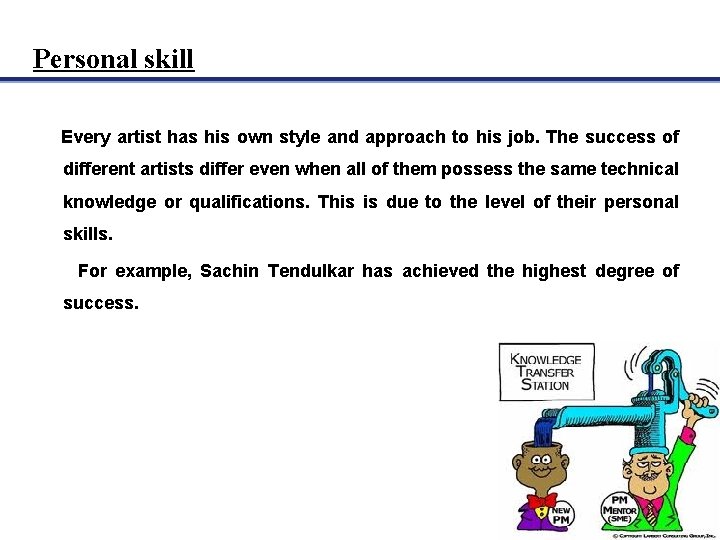
Personal skill Every artist has his own style and approach to his job. The success of different artists differ even when all of them possess the same technical knowledge or qualifications. This is due to the level of their personal skills. For example, Sachin Tendulkar has achieved the highest degree of success. 50
Similarly, management is personalised. Every manager has his individual approach and style in solving managerial problems. The success of a manager depends on his personality in addition to his technical knowledge. 51
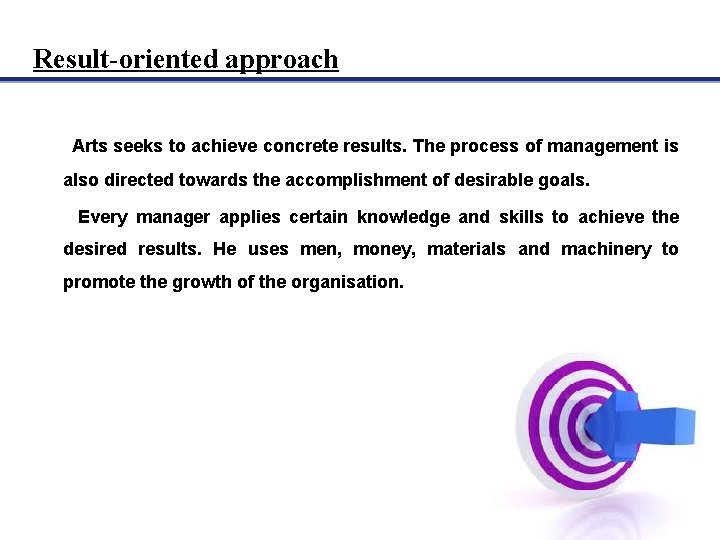
Result-oriented approach Arts seeks to achieve concrete results. The process of management is also directed towards the accomplishment of desirable goals. Every manager applies certain knowledge and skills to achieve the desired results. He uses men, money, materials and machinery to promote the growth of the organisation. 52
Creativity Art is basically creative and an artist aims at producing something that had not existed before. Therefore, every piece of art requires imagination and intelligence to create. Like any other art, management is creative. A manager effectively combines and coordinates the factors of production to create goods and services. Moulding the attitudes and behaviour of people at work, towards the achievement of the desired goals is an art of the highest order. 53
Improvement through continuous practice Practice makes one perfect. Every artist become more and more efficient through constant practice. A dancer, for example, learns to perform better by continuously practicing a dance. Similarly, manager gains experience through regular practice and becomes more effective. 54
For example, a person cannot be a good surgeon unless he has scientific knowledge of human anatomy and the practical skill of applying that knowledge in conducting an operation. 55
Similarly, a successful manager must know the principles of management and also acquire the skill of applying those principles for solving managerial problems in different situations. Knowledge of principles and theory is essential, but practical application is required to make this knowledge fruitful. One cannot become an effective manager simply by learning management principles by heart. Science (theory) and art (practice) are both essential for the success of management. 56
- Slides: 56