
Principles of Linear Pipelining Example Floating Point Adder
- Slides: 46
Principles of Linear Pipelining
Example : Floating Point Adder Unit
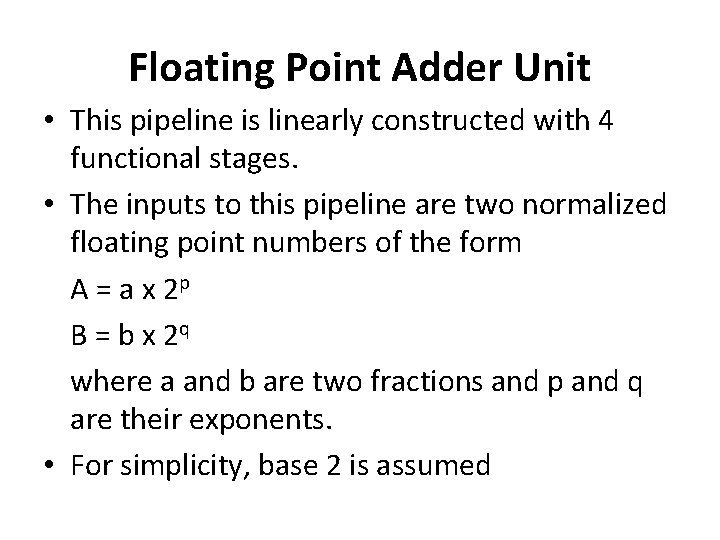
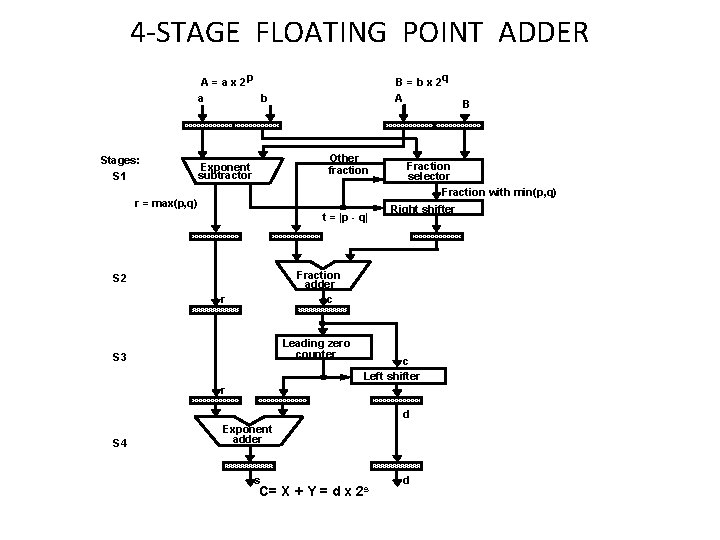
Floating Point Adder Unit • This pipeline is linearly constructed with 4 functional stages. • The inputs to this pipeline are two normalized floating point numbers of the form A = a x 2 p B = b x 2 q where a and b are two fractions and p and q are their exponents. • For simplicity, base 2 is assumed
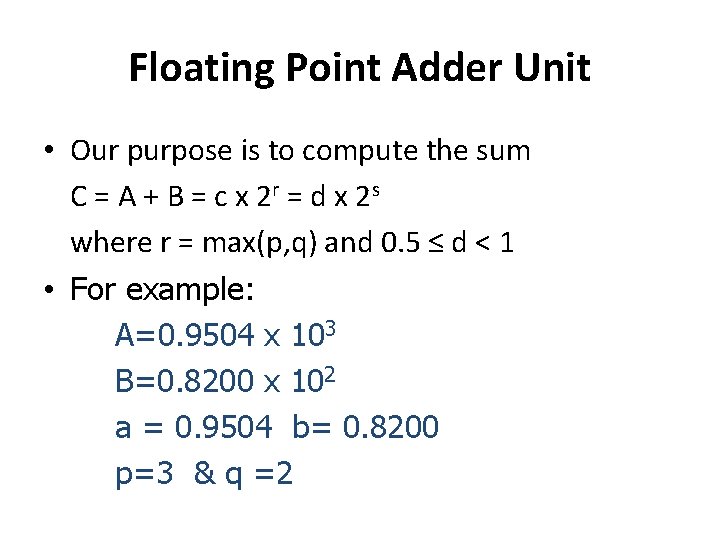
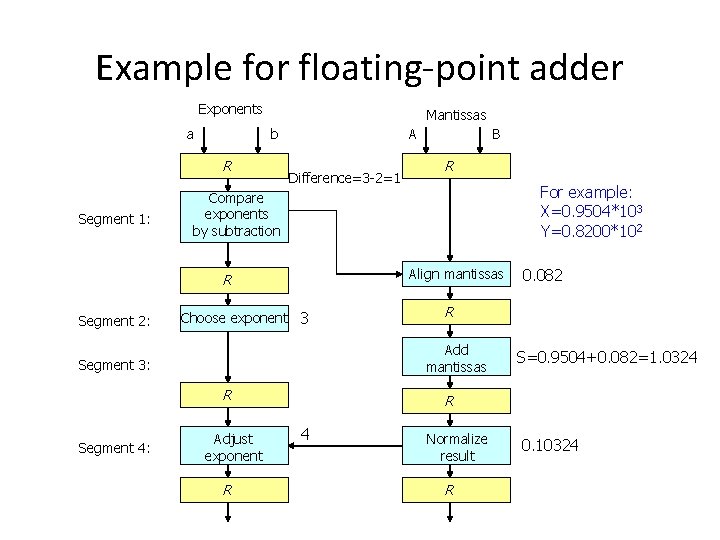
Floating Point Adder Unit • Our purpose is to compute the sum C = A + B = c x 2 r = d x 2 s where r = max(p, q) and 0. 5 ≤ d < 1 • For example: A=0. 9504 x 103 B=0. 8200 x 102 a = 0. 9504 b= 0. 8200 p=3 & q =2
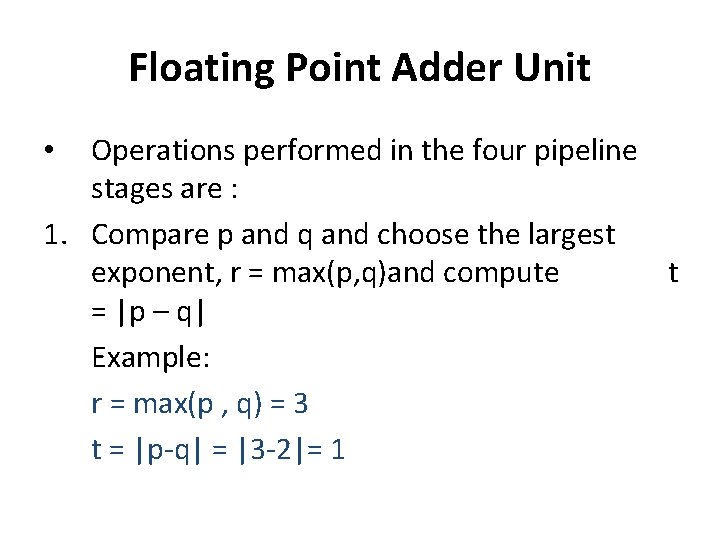
Floating Point Adder Unit Operations performed in the four pipeline stages are : 1. Compare p and q and choose the largest exponent, r = max(p, q)and compute t = |p – q| Example: r = max(p , q) = 3 t = |p-q| = |3 -2|= 1 •
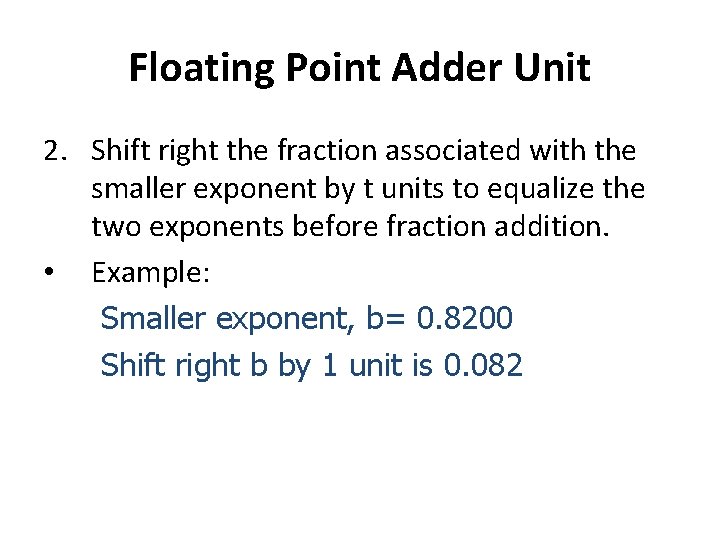
Floating Point Adder Unit 2. Shift right the fraction associated with the smaller exponent by t units to equalize the two exponents before fraction addition. • Example: Smaller exponent, b= 0. 8200 Shift right b by 1 unit is 0. 082
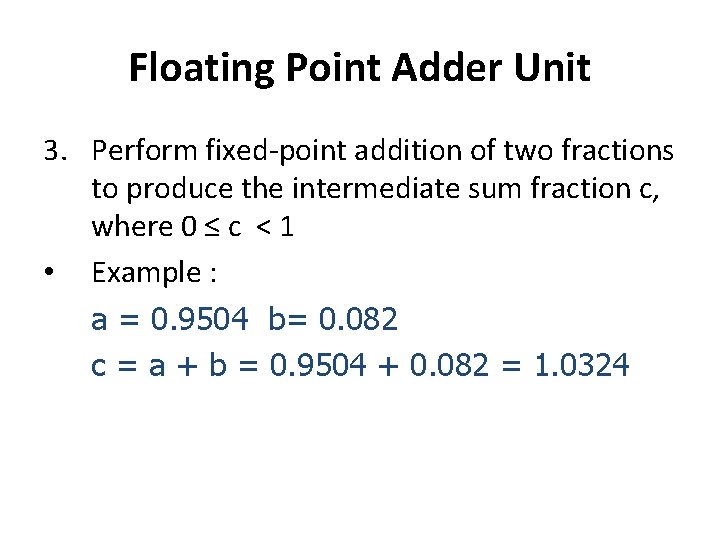
Floating Point Adder Unit 3. Perform fixed-point addition of two fractions to produce the intermediate sum fraction c, where 0 ≤ c < 1 • Example : a = 0. 9504 b= 0. 082 c = a + b = 0. 9504 + 0. 082 = 1. 0324
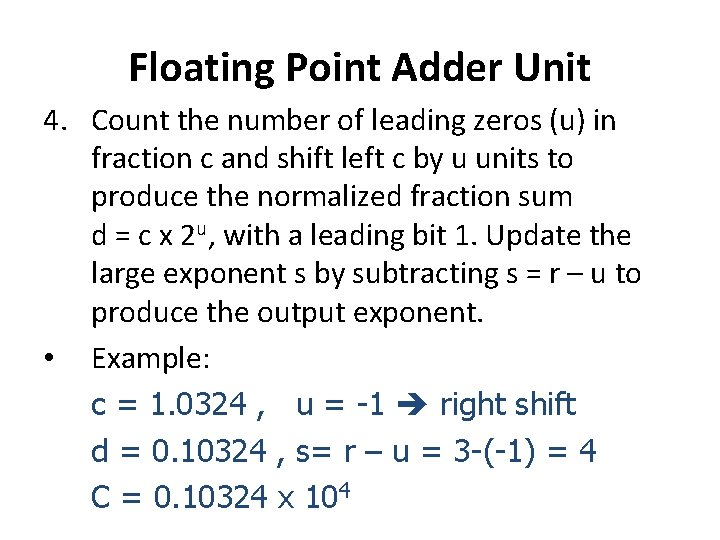
Floating Point Adder Unit 4. Count the number of leading zeros (u) in fraction c and shift left c by u units to produce the normalized fraction sum d = c x 2 u, with a leading bit 1. Update the large exponent s by subtracting s = r – u to produce the output exponent. • Example: c = 1. 0324 , u = -1 right shift d = 0. 10324 , s= r – u = 3 -(-1) = 4 C = 0. 10324 x 104
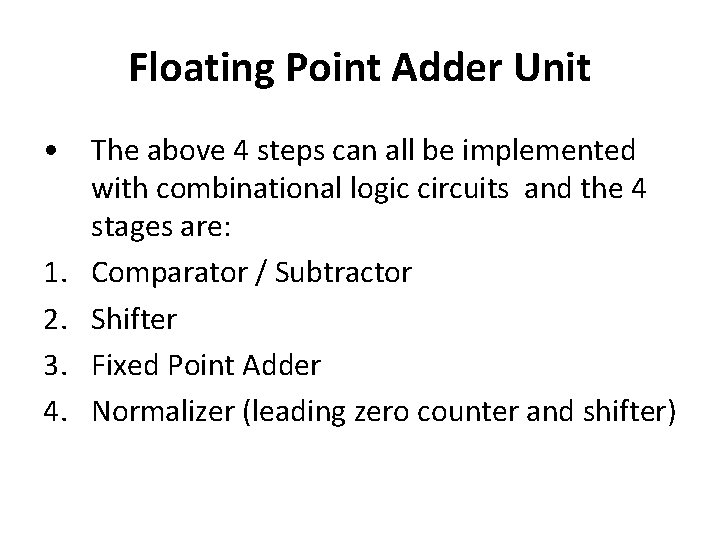
Floating Point Adder Unit • The above 4 steps can all be implemented with combinational logic circuits and the 4 stages are: 1. Comparator / Subtractor 2. Shifter 3. Fixed Point Adder 4. Normalizer (leading zero counter and shifter)
4 -STAGE FLOATING POINT ADDER A = a x 2 p a b Stages: S 1 B = b x 2 q A Other fraction Exponent subtractor Fraction selector Fraction with min(p, q) r = max(p, q) t = |p - q| Right shifter Fraction adder c S 2 r Leading zero counter S 3 c Left shifter r d S 4 B Exponent adder s C= X + Y = d x 2 s d
Example for floating-point adder Exponents a Mantissas b R Segment 1: A Difference=3 -2=1 For example: X=0. 9504*103 Y=0. 8200*102 Align mantissas Choose exponent 3 R Adjust exponent R 0. 082 R Add mantissas Segment 3: Segment 4: R Compare exponents by subtraction R Segment 2: B S=0. 9504+0. 082=1. 0324 R 4 Normalize result R 0. 10324
Classification of Pipeline Processors • There are various classification schemes for classifying pipeline processors. • Two important schemes are 1. Handler’s Classification 2. Li and Ramamurthy's Classification
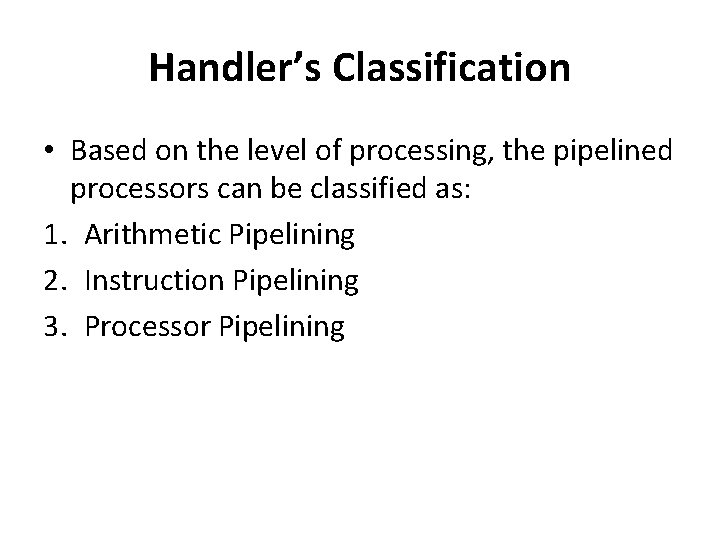
Handler’s Classification • Based on the level of processing, the pipelined processors can be classified as: 1. Arithmetic Pipelining 2. Instruction Pipelining 3. Processor Pipelining
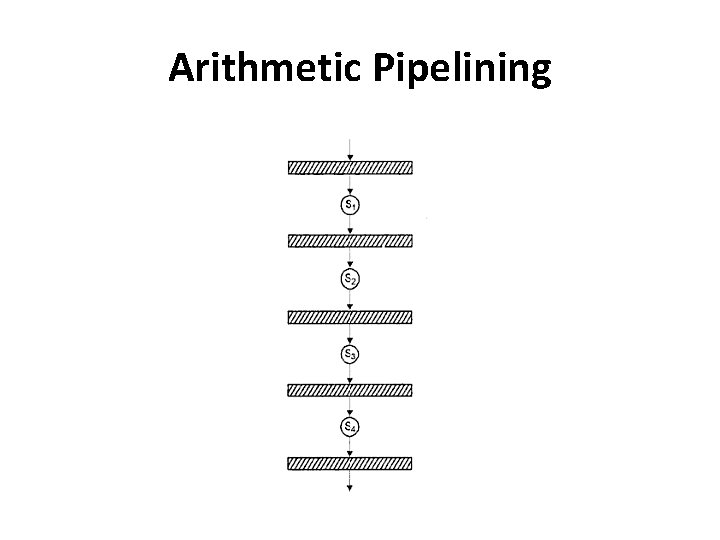
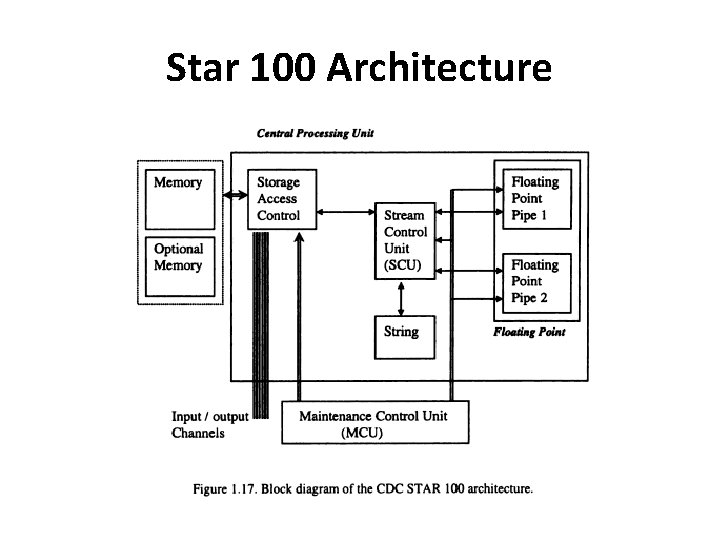
Arithmetic Pipelining • The arithmetic logic units of a computer can be segmented for pipelined operations in various data formats. • Example : Star 100
Arithmetic Pipelining
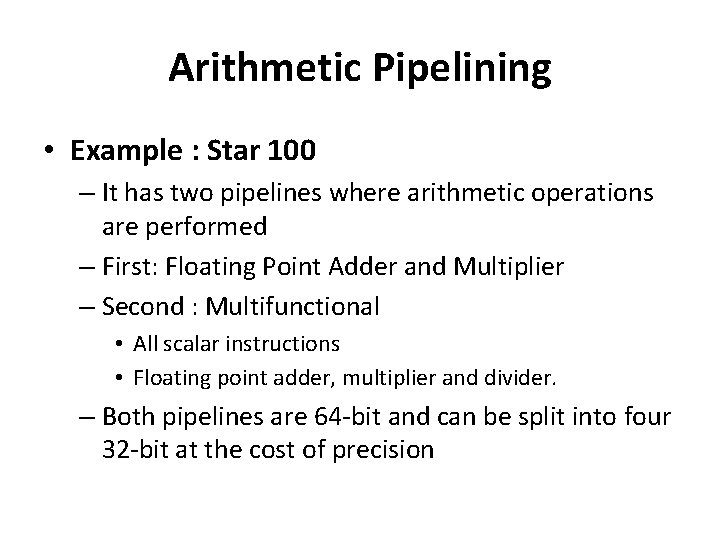
Arithmetic Pipelining • Example : Star 100 – It has two pipelines where arithmetic operations are performed – First: Floating Point Adder and Multiplier – Second : Multifunctional • All scalar instructions • Floating point adder, multiplier and divider. – Both pipelines are 64 -bit and can be split into four 32 -bit at the cost of precision
Star 100 Architecture
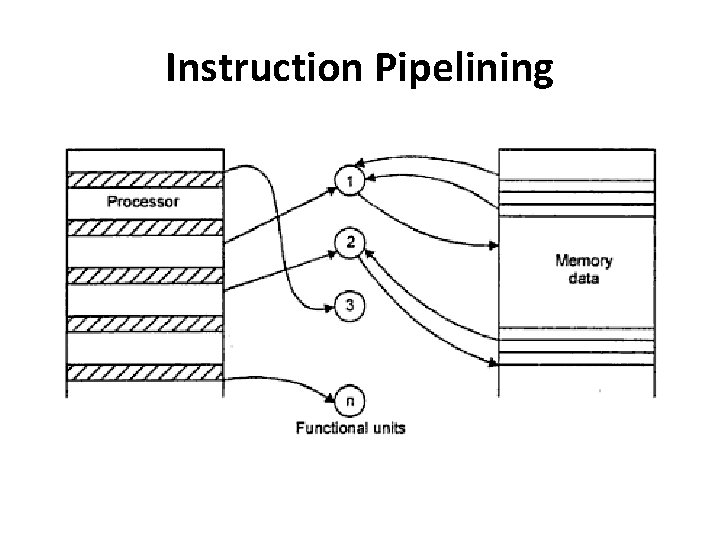
Instruction Pipelining • The execution of a stream of instructions can be pipelined by overlapping the execution of current instruction with the fetch, decode and operand fetch of the subsequent instructions • It is also called instruction look-ahead
Instruction Pipelining
Example : 8086 • The organization of 8086 into a separate BIU and EU allows the fetch and execute cycle to overlap. This is called pipelining.
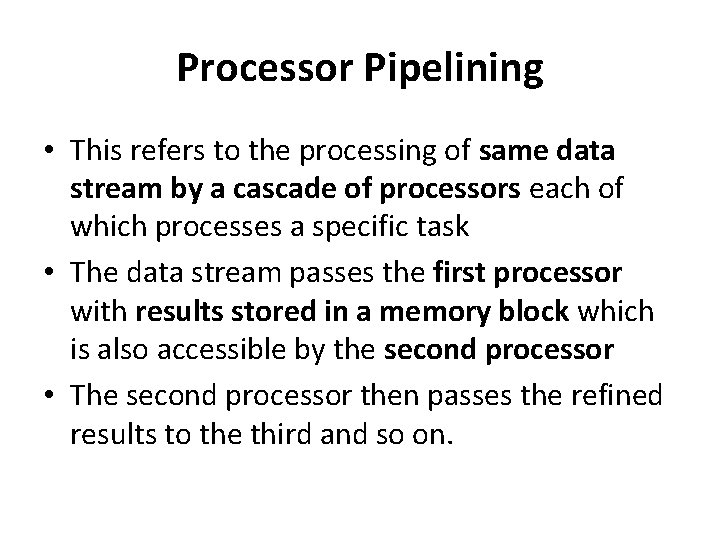
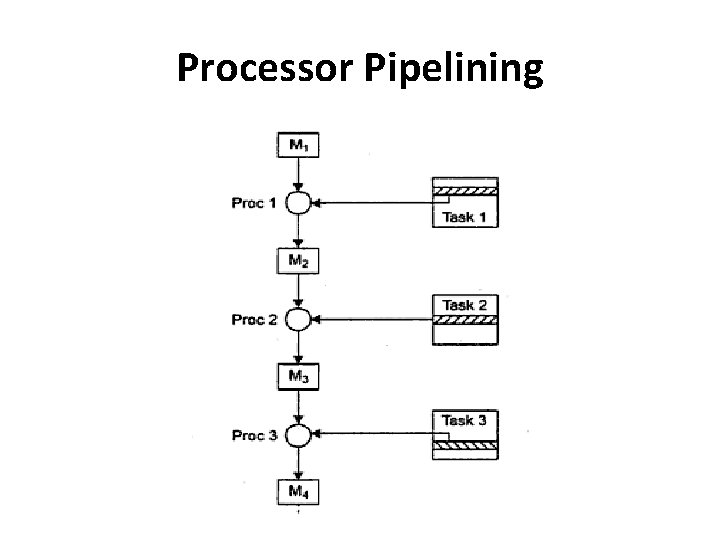
Processor Pipelining • This refers to the processing of same data stream by a cascade of processors each of which processes a specific task • The data stream passes the first processor with results stored in a memory block which is also accessible by the second processor • The second processor then passes the refined results to the third and so on.
Processor Pipelining
Li and Ramamurthy's Classification • According to pipeline configurations and control strategies, Li and Ramamurthy classify pipelines under three schemes – Unifunction v/s Multi-function Pipelines – Static v/s Dynamic Pipelines – Scalar v/s Vector Pipelines
Uni-function v/s Multi-function Pipelines
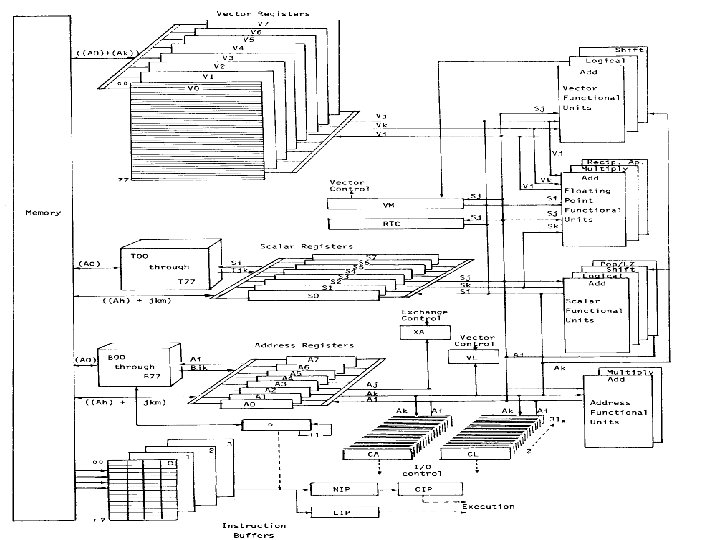
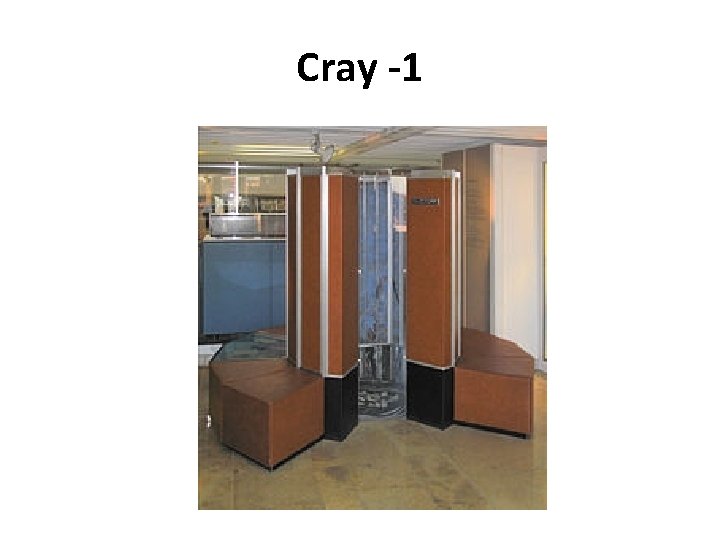
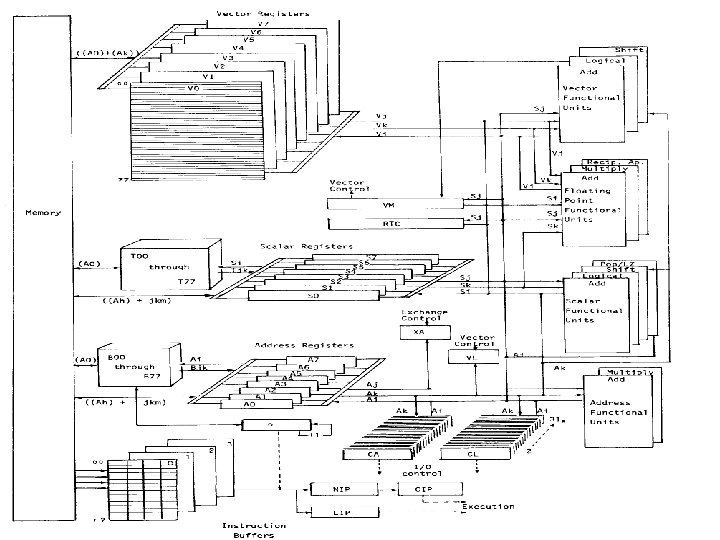
Unifunctional Pipelines • A pipeline unit with fixed and dedicated function is called unifunctional. • Example: CRAY 1 (Supercomputer - 1976) • It has 12 unifunctional pipelines described in four groups: – Address Functional Units: • Address Add Unit • Address Multiply Unit
Unifunctional Pipelines – Scalar Functional Units • • Scalar Add Unit Scalar Shift Unit Scalar Logical Unit Population/Leading Zero Count Unit – Vector Functional Units • Vector Add Unit • Vector Shift Unit • Vector Logical Unit
Unifunctional Pipelines – Floating Point Functional Units • Floating Point Add Unit • Floating Point Multiply Unit • Reciprocal Approximation Unit
Cray 1 : Architecture
Cray -1
Multifunctional • A multifunction pipe may perform different functions either at different times or same time, by interconnecting different subset of stages in pipeline. • Example 4 X-TI-ASC (Supercomputer - 1973)
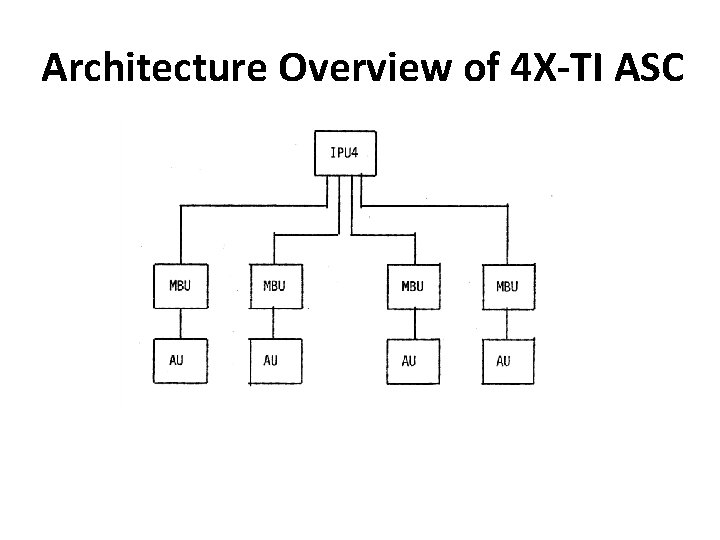
4 X-TI ASC • It has four multifunction pipeline processors, each of which is reconfigurable for a variety of arithmetic or logic operations at different times. • It is a four central processor comprised of nine units.
Multifunctional • It has – one instruction processing unit – four memory buffer units and – four arithmetic units. • Thus it provides four parallel execution pipelines below the IPU. • Any mixture of scalar and vector instructions can be executed simultaneously in four pipes.
Architecture Overview of 4 X-TI ASC
Static Vs Dynamic Pipeline
Static Pipeline • It may assume only one functional configuration at a time • It can be either unifunctional or multifunctional • Static pipelines are preferred when instructions of same type are to be executed continuously • A unifunction pipe must be static.
Dynamic pipeline • It permits several functional configurations to exist simultaneously • A dynamic pipeline must be multi-functional • The dynamic configuration requires more elaborate control and sequencing mechanisms than static pipelining
Scalar Vs Vector Pipeline
Scalar Pipeline • It processes a sequence of scalar operands under the control of a DO loop • Instructions in a small DO loop are often prefetched into the instruction buffer. • The required scalar operands are moved into a data cache to continuously supply the pipeline with operands • Example: IBM System/360 Model 91
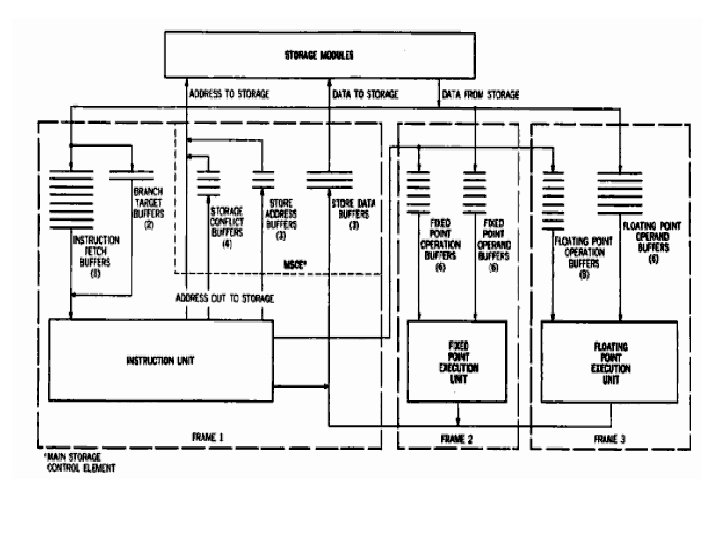
IBM System/360 Model 91 • In this computer, buffering plays a major role. • Instruction fetch buffering: – provide the capacity to hold program loops of meaningful size. – Upon encountering a loop which fits, the buffer locks onto the loop and subsequent branching requires less time. • Operand fetch buffering: – provide a queue into which storage can dump operands and execution units can fetch operands. – This improves operand fetching for storage-toregister and storage-to-storage instruction types.
Architecture overview of IBM 360/Model 91
Vector Pipelines • They are specially designed to handle vector instructions over vector operands. • Computers having vector instructions are called vector processors. • The design of a vector pipeline is expanded from that of a scalar pipeline. • The handling of vector operands in vector pipelines is under firmware and hardware control. • Example : Cray 1
Linear pipeline (Static & Unifunctional) • In a linear pipeline data flows from one stage to another and all stages are used once in a computation and it is for one functional evaluation.
Non-linear pipeline • In floating point adder, stage (2) and (4) needs a shift register. • We can use the same shift register and then there will be only 3 stages. • Then we should have a feedback from third stage to second stage. • Further the same pipeline can be used to perform fixed point addition. • A pipeline with feed-forward and/or feedback connections is called non-linear