
PRINCIPLES OF INHERITANCE AND VARIATION PRINCIPLES OF INHERITANCE
- Slides: 44
PRINCIPLES OF INHERITANCE AND VARIATION
PRINCIPLES OF INHERITANCE AND VARIATION �Genetics: deals with the inheritance, as well as the variation of characters from parents to offsprings. �Inheritance: is the process by which characters are passed on from parent to progeny. �Variation: is the degree by which progeny differ from their parents.
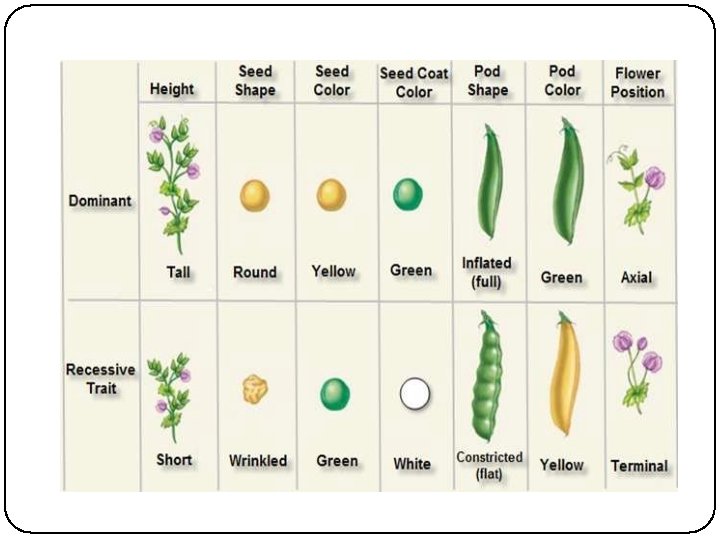
MENDEL’S LAWS OF INHERITANCE: �Gregor Mendel. Conducted hybridization experiments on garden peas for seven years (1856 – 1863) and proposed laws of inheritance. �Mendel conducted artificial pollination/cross pollination experiments using several truebreeding pea lines. �A true breeding line is one that, having undergone continuous self-pollination for several generations. �Mendel selected 14 true-breeding peas’ plant varieties, as pair’s which were similar except for one character with contrasting traits.
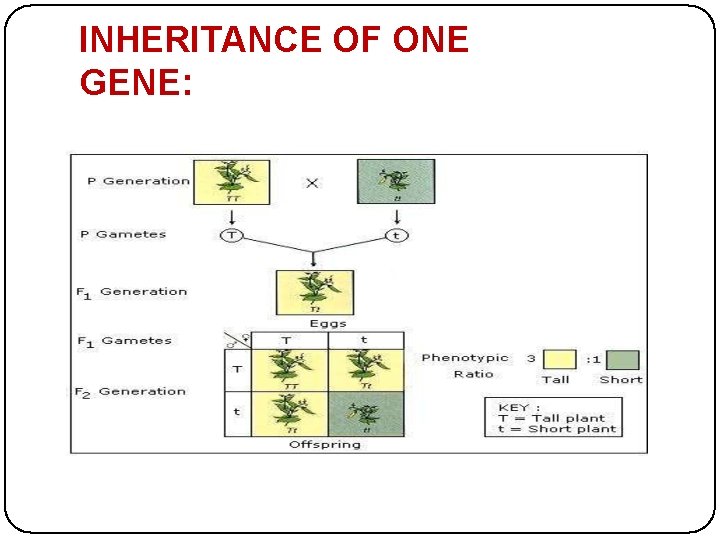
INHERITANCE OF ONE GENE:
Mendel’s � proposition: �Mendel proposed that something was being stably passed down, unchanged, from parent to offspring through the gametes, over successive generations. He called these things as ‘factors’. �Now a day we call them as genes. �Gene is therefore are the units of inheritance. �Genes which codes of a pair of contrasting traits are known as alleles, i. e. they are slightly different forms of the same gene.
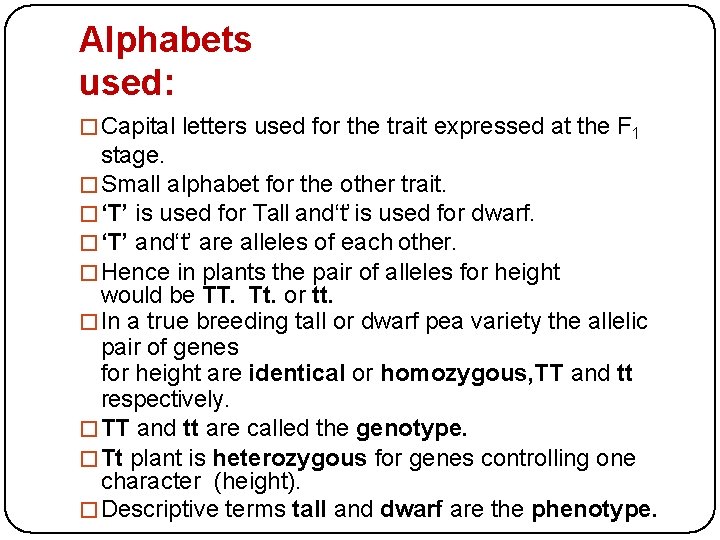
Alphabets used: �Capital letters used for the trait expressed at the F 1 stage. �Small alphabet for the other trait. �‘T’ is used for Tall and‘t’ is used for dwarf. �‘T’ and‘t’ are alleles of each other. �Hence in plants the pair of alleles for height would be TT. Tt. or tt. �In a true breeding tall or dwarf pea variety the allelic pair of genes for height are identical or homozygous, TT and tt respectively. �TT and tt are called the genotype. �Tt plant is heterozygous for genes controlling one character (height). �Descriptive terms tall and dwarf are the phenotype.
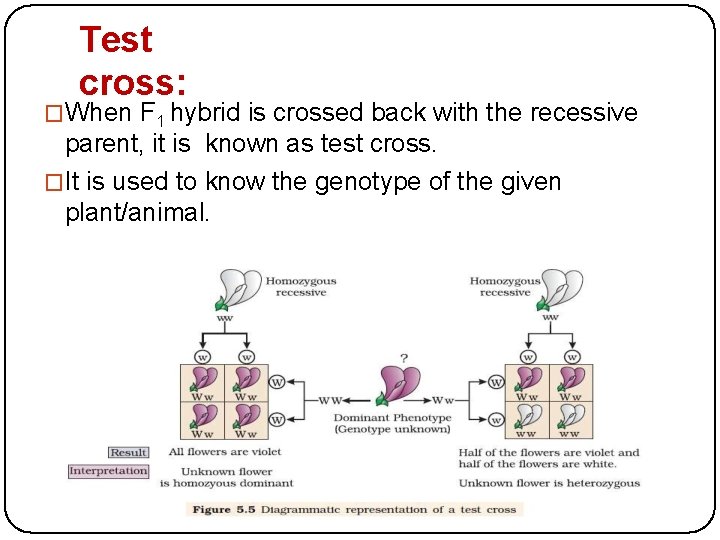
Test cross: �When F 1 hybrid is crossed back with the recessive parent, it is known as test cross. �It is used to know the genotype of the given plant/animal.
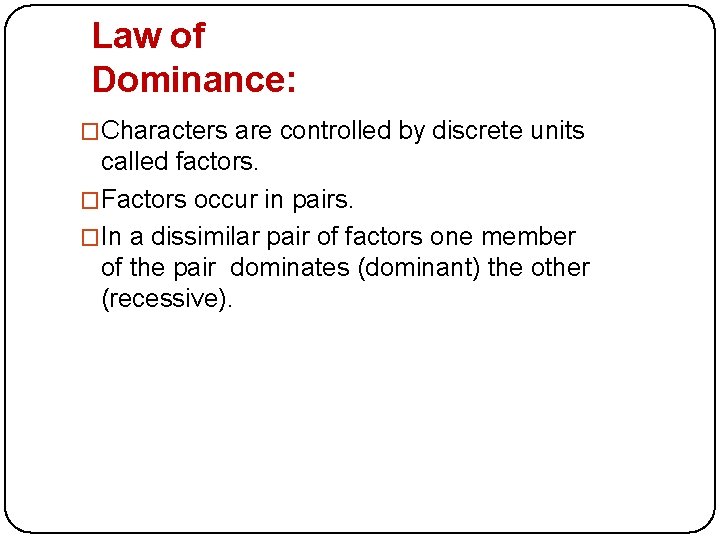
Law of Dominance: �Characters are controlled by discrete units called factors. �Factors occur in pairs. �In a dissimilar pair of factors one member of the pair dominates (dominant) the other (recessive).
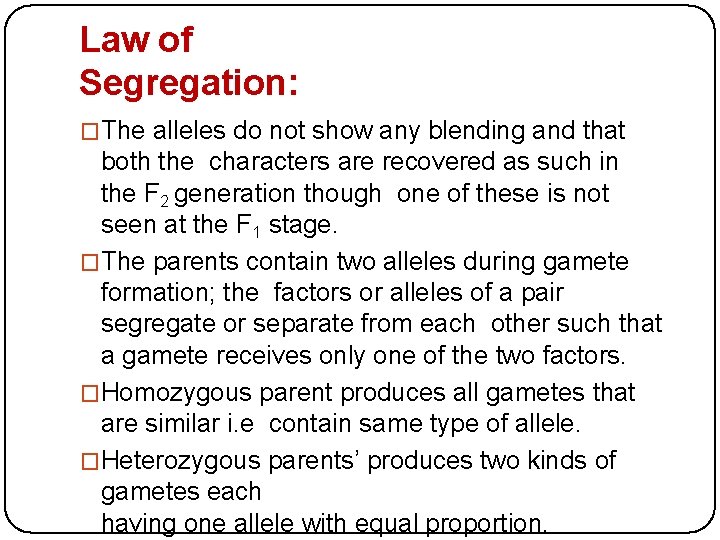
Law of Segregation: �The alleles do not show any blending and that both the characters are recovered as such in the F 2 generation though one of these is not seen at the F 1 stage. �The parents contain two alleles during gamete formation; the factors or alleles of a pair segregate or separate from each other such that a gamete receives only one of the two factors. �Homozygous parent produces all gametes that are similar i. e contain same type of allele. �Heterozygous parents’ produces two kinds of gametes each having one allele with equal proportion.
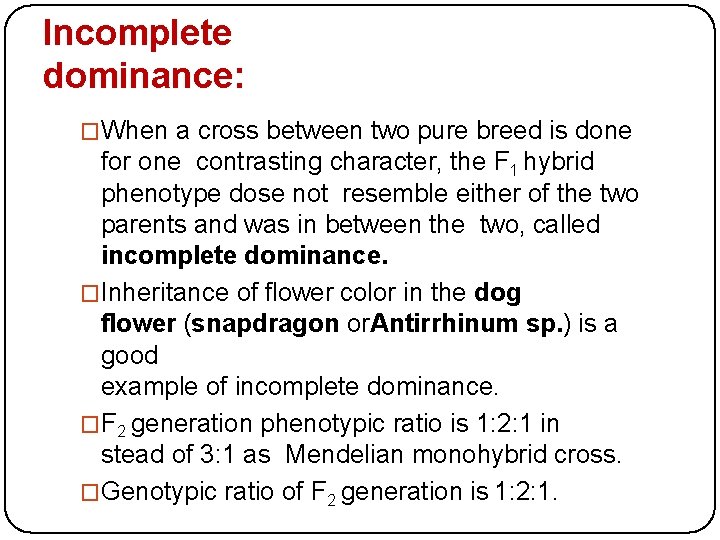
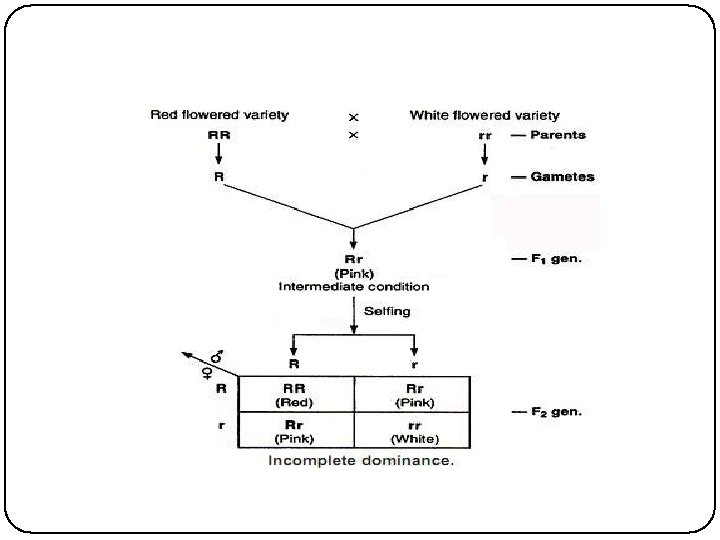
Incomplete dominance: �When a cross between two pure breed is done for one contrasting character, the F 1 hybrid phenotype dose not resemble either of the two parents and was in between the two, called incomplete dominance. �Inheritance of flower color in the dog flower (snapdragon or. Antirrhinum sp. ) is a good example of incomplete dominance. �F 2 generation phenotypic ratio is 1: 2: 1 in stead of 3: 1 as Mendelian monohybrid cross. �Genotypic ratio of F 2 generation is 1: 2: 1.
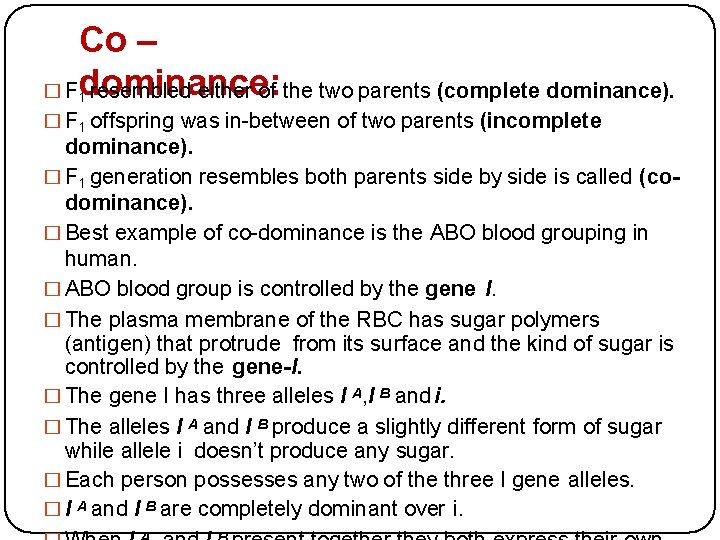
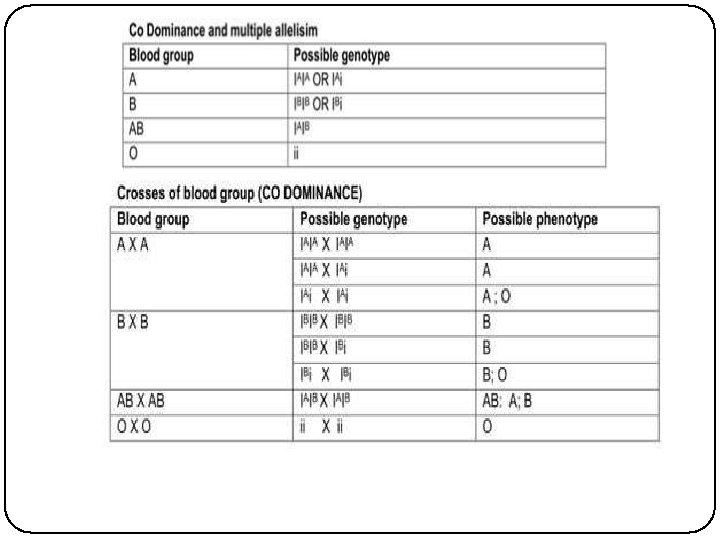
Co – � F dominance: resembled either of the two parents (complete dominance). 1 � F 1 offspring was in-between of two parents (incomplete dominance). � F 1 generation resembles both parents side by side is called (codominance). � Best example of co-dominance is the ABO blood grouping in human. � ABO blood group is controlled by the gene I. � The plasma membrane of the RBC has sugar polymers (antigen) that protrude from its surface and the kind of sugar is controlled by the gene-I. � The gene I has three alleles I A, I B and i. � The alleles I A and I B produce a slightly different form of sugar while allele i doesn’t produce any sugar. � Each person possesses any two of the three I gene alleles. � I A and I B are completely dominant over i.
Multiple Alleles: �Example of ABO blood grouping produces a good example of multiple alleles. �There are more than two i. e. three allele, governing the same character.
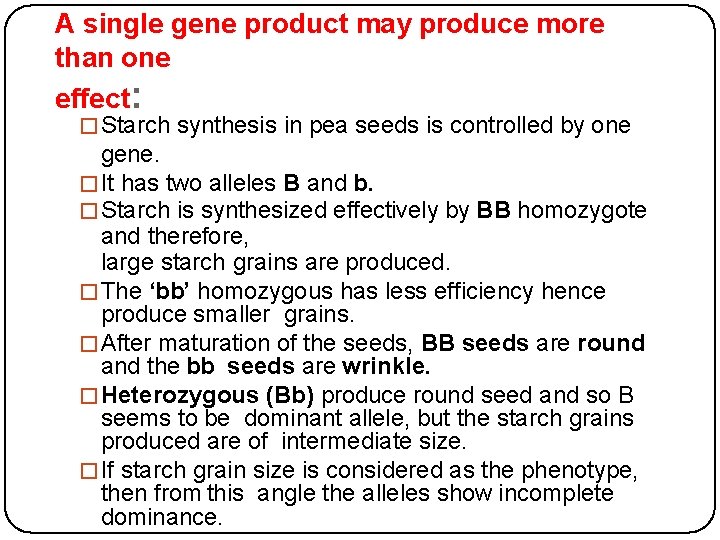
A single gene product may produce more than one effect: �Starch synthesis in pea seeds is controlled by one gene. �It has two alleles B and b. �Starch is synthesized effectively by BB homozygote and therefore, large starch grains are produced. �The ‘bb’ homozygous has less efficiency hence produce smaller grains. �After maturation of the seeds, BB seeds are round and the bb seeds are wrinkle. �Heterozygous (Bb) produce round seed and so B seems to be dominant allele, but the starch grains produced are of intermediate size. �If starch grain size is considered as the phenotype, then from this angle the alleles show incomplete dominance.
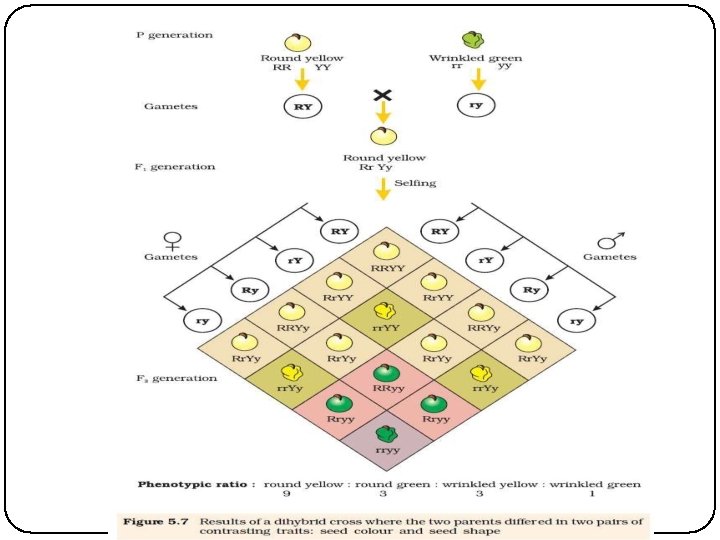
INHERITANCE OF TWO GENES: �Law of independent Assortment: �When two characters (dihybrid) are combined in a hybrid, segregation of one pair of traits is independent of the other pair of traits.
CHROMOSOMAL THEORY OF INHERITANCE: �Why Mendel’s theory was remained unrecognized? �Firstly communication was not easy in those days and his work could not be widely publicized. �Secondly his concept of genes (or factors, in Mendel’s word) as stable and discrete units that controlled the expression of traits and of the pair of alleles which did not’ blend’ with each other, was not accepted by his contemporaries as an explanation for the apparently continuous variation seen in nature. �Thirdly Mendel’s approach of using mathematics to explain biological phenomena was totally new and unacceptable to many of the biologists of his time. �Finally he could not provide any physical proof for the existence
Rediscovery of Mendel’s result: � 1990 three scientists (de. Vries, Correns and von Tschermak) independently rediscovered Mendel’s result on the inheritance of character
Chromosomal theory of inheritance: �Proposed by Walter Sutton and Theodore Bovery in 1902. �They work out the chromosome movement during meiosis. �The behavior of chromosomes was parallel to the behavior of genes and used chromosome movement to explain Mendel’s laws. �Sutton united the knowledge of chromosomal segregation with Mendelian principles and called it thechromosomal theory of inheritance. �Chromosome and genes are present in pairs in diploid cells. �Homologous chromosomes separate during gamete formation (meiosis) �Fertilization restores the chromosome number to diploid
Experimental verification of chromosomal theory: �Experimental verification of chromosomal theory of inheritance by Thomas Hunt Morgan and his colleagues. �Morgan worked with tiny fruit flies, Drosophila melanogaster. �Why Drosophila? �Suitable for genetic studies. �Grown on simple synthetic medium in the laboratory. �They complete their life cycle in about two weeks. �A single mating could produce a large number of progeny flies. �Clear differentiation of male and female flies �Have many types of hereditary variations that can be seen with low power microscopes.
Linkage and Recombination �Morgan hybridized yellow bodied, white eyed females to brown-bodied, red eyed male and intercrossed their F 1 progeny. �He observed that the two genes did not segregate independently of each other and the F 2 ratio deviated very significantly from 9: 3: 3: 1 ratio (expected when the two genes are independent). �When two genes in a dihybrid cross were situated on the same chromosome, the proportion of parental gene combinations was much higher than the non-parental type. �Morgan attributed this due to the physical association
�Linage: physical association of genes on a chromosome. �Recombination: the generation of non-parental gene combinations. �Morgan found that even when genes were grouped on the same chromosome, some genes were very tightly linked (showed very low recombination) while others were loosely linked (showed higher recombination). �The genes white and yellow were very tightly linked and showed 1. 3 percent recombination. �The genes white and miniature wing showed 37. 2 percent recombination, hence loosely linked.
POLYGENIC INHERITANCE: � Human have no distinct tall or short instead a whole range of possible heights. � Such traits are generally controlled by three or more genes and are thus called polygenic trait. � Besides the involvement of multiple genes polygenic inheritance also takes into account the influence of environment. � Human skin color is another classic example of polygenic inheritance. � In a polygenic trait the phenotype reflects the contribution of each allele i. e. the effect of each allele is additive. � Assume that three genes A, B, C control the skin colour in human. � Dominant forms A, B; AND C responsible for dark skin colour and the recessive forms a, b, c for light color of the skin. � Genotype with dominant alleles (AABBCC) will have darkest skin color. � Genotype with recessive alleles (aabbcc) will have lightest skin colour. � Other combinations always with intermediate colour.
PLEIOTRO PY: �A single gene can exhibit multiple phenotypic expression, such gene is called pleiotropic gene. �The mechanism of pleiotropy in most cases is the effect of a gene on metabolic pathways which contributes towards different phenotypes. �Phenylketonuria a disease in human is an example of pleiotropy. �This disease is caused due to mutation in the gene that code for the enzyme phenyl alanine hydroxylase. �Phenotypic expression characterized by: �Mental retardation �Reduction in hairs. �Reduction in skin pigmentation.
SEX DETERMINATION: �Henking (1891) traced specific nuclear structure during spermatogenesis of some insects. � 50 % of the sperm received these specific structures, whereas 50% sperm did not receive it. �Henking gave a name to this structure as the Xbody. �X-body of Henking was later on named as Xchromosome.
Sex-determination of grass hopper: �Sex-determination in grasshopper is XX-XO type. �All egg bears one ‘X’ chromosome along with autosomes. �Some sperms (50%) bear’s one ‘X’ chromosome and 50% do not. �Egg fertilized with sperm (with ‘X’ chromosome) became female (22+XX). �Egg fertilized with sperm (without ‘X’ chromosome) became male (22 + X 0)
Sex determination in insects and mammals (XX-XY type): �Bothe male and female has same number of chromosomes. �Female have autosomes and a pair of X chromosomes. (AA+ XX) �Male have autosomes and one large ‘X’ chromosome and one very small ‘Ychromosomes. (AA+XY) �This is called male heterogammety and female homogamety.
Sex determination in birds: �Female birds have two different sex chromosomes designated as. Z and W. �Male birds have two similar sex chromosomes and called ZZ. �Such type of sex determination is called female heterogammety and male homogamety.
Sex determination in Honey bee: �Sex determination in honey bee based on the number of sets of chromosomes an individual receives. �An offspring formed from the fertilization of a sperm and an egg developed into either queen (female) or worker (female). �An unfertilized egg develops as a male (drone), by means of parthenogenesis. �The male have half the number of chromosome than that of female. �The female are diploid having 32 chromosomes and males are haploid i. e. having 16 numbers of chromosomes. �This is called haplodiploid sex determination
MUTATIO N: � Mutation is a phenomenon which results in alteration of DNA sequences and consequently results in changes in the genotype and phenotype of an organism. � In addition to recombination, mutation is another phenomenon that leads to variation in DNA. � Loss (deletion) or gain (insertion/duplication) of a segment of DNA results in alteration in chromosomes. � Since genes are located on the chromosome, alteration in chromosomes results in abnormalities or aberration. � Chromosomal aberrations are commonly observed in cancerous cells. � Mutations also arise due to change in a single base pair of DNA. This is known as point mutation. E. g. sickle cell anemia. � Deletion and insertions of base pairs of DNA causes frame shift mutations.
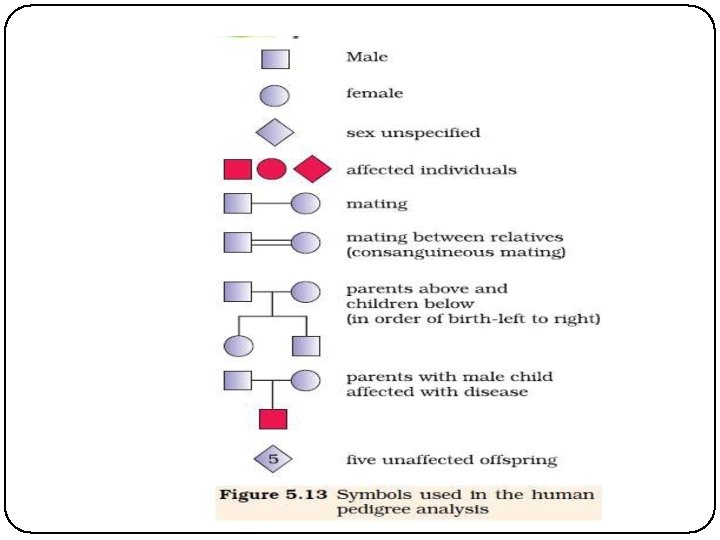
GENETIC DISORDERS: �Pedigree Analysis: �Analysis of traits in several of generations of a family is called the pedigree analysis. �In the pedigree analysis the inheritance of a particular trait is represented in the family tree over generations.
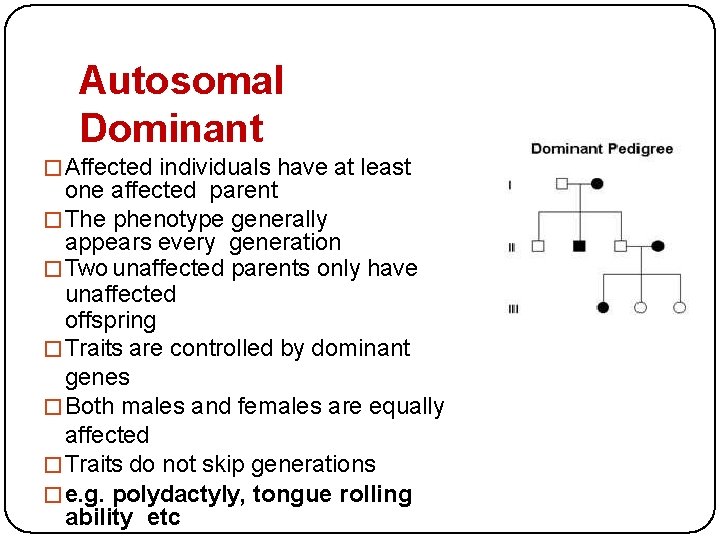
Autosomal Dominant �Affected individuals have at least one affected parent �The phenotype generally appears every generation �Two unaffected parents only have unaffected offspring �Traits are controlled by dominant genes �Both males and females are equally affected �Traits do not skip generations �e. g. polydactyly, tongue rolling ability etc
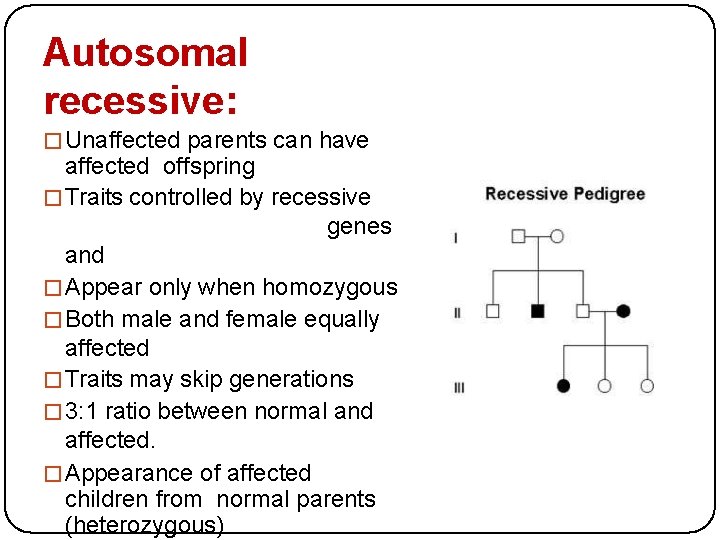
Autosomal recessive: �Unaffected parents can have affected offspring �Traits controlled by recessive genes and �Appear only when homozygous �Both male and female equally affected �Traits may skip generations � 3: 1 ratio between normal and affected. �Appearance of affected children from normal parents (heterozygous)
Mendelian Disorder: �Genetic disorders grouped into two categories – �Mendelian disorder �Chromosomal disorder �Mendelian disorders are mainly determined by alteration or mutation in the single gene. �Obey the principle of Mendelian inheritance during transmission from one generation to other. �Can be expressed in pedigree analysis. �E. g. Haemophilia, colorblindness, Cystic fibrosis, Sickle cell anemia, Phenylketonuria, Thalasemia etc.
Hemophili a: �In this disease a single protein that is a part of the cascade of proteins involved in the clotting of blood is affected. Due to this in an affected individual a simple cut will result in non-stop bleeding. �Sex linked recessive disease. �The diseases transmitted from unaffected carrier female to some of the male progeny. �Female becoming hemophilic is extremely rare because mother of such a female at least carrier and the father should be hemophilic. �Affected transmits the disease only to the son not to the daughter. �Daughter can receive the disease from both mother
Sickle cell anaemia: � The defect is caused due to substitution of Glutamic acid (Glu) by � � � � Valine (Val) at the sixth position of the beta globin chain of the haemoglobin molecule. Substitution of amino acid takes place due to the single base substitution at the sixth codon of the beta globin gene from GAG to GUG. The mutant haemoglobin molecule undergoes polymerization under low oxygen tension causing the change in the shape of the RBC from biconcave disc to elongated sickle like structure. This is an autosomes linked recessive trait. Transmitted from parents to the offspring when both the parents are carrier for the gene (heterozygous). This disease is controlled by single pair of allele, Hb. A, and Hb. S. There are three possible genotypes (Hb. A, Hb. A Hb. S, and Hb. S. Only homozygous individuals for Hb. S (Hb. S) show the diseased phenotype. Heterozygous (Hb. A Hb. S) individuals appear apparently unaffected but they are carrier of the disease as there is 50 percent probability of transmission of the mutant gene to the progeny.
Phenylketonur ia: �Autosomal recessive trait. �Inborn error of metabolism. �The affected individual lack one enzyme called phenyl alanine hydroxylase that converts the amino acid phenyl alanine to tyrosine. �In the absence of the enzyme phenyl alanine accumulated and converted into phenylpyruvic acid and other derivatives. �Accumulation of these results in mental retardation. �These derivatives excreted through kidney.
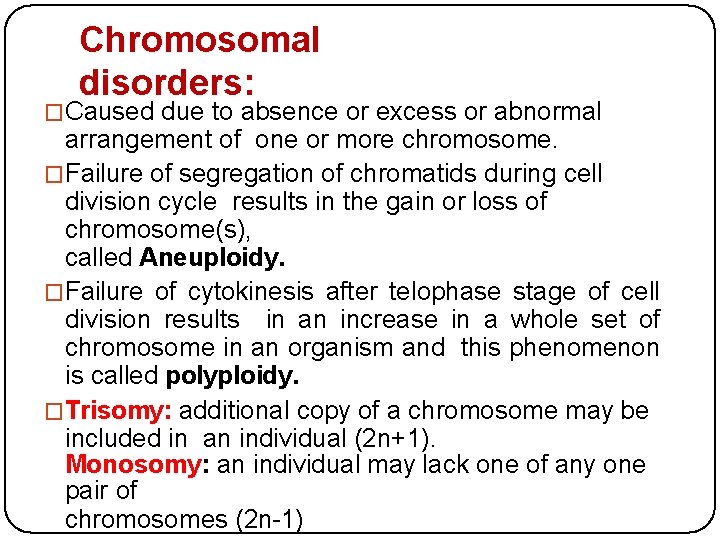
Chromosomal disorders: �Caused due to absence or excess or abnormal arrangement of one or more chromosome. �Failure of segregation of chromatids during cell division cycle results in the gain or loss of chromosome(s), called Aneuploidy. �Failure of cytokinesis after telophase stage of cell division results in an increase in a whole set of chromosome in an organism and this phenomenon is called polyploidy. �Trisomy: additional copy of a chromosome may be included in an individual (2 n+1). Monosomy: an individual may lack one of any one pair of chromosomes (2 n-1)
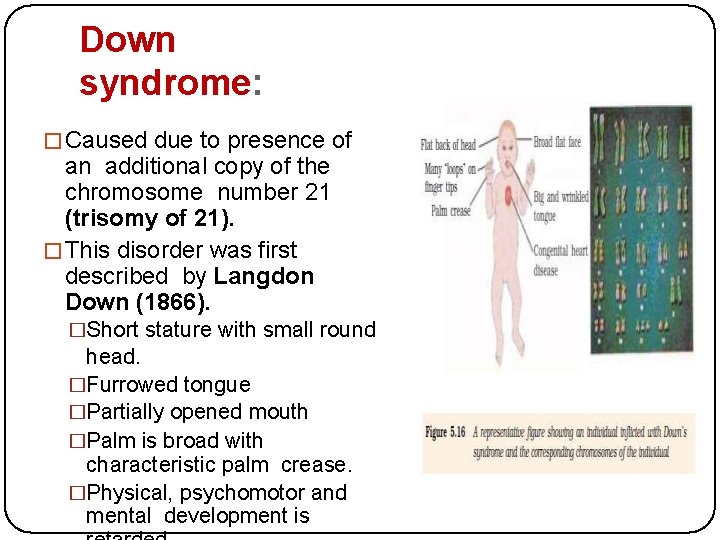
Down syndrome: �Caused due to presence of an additional copy of the chromosome number 21 (trisomy of 21). �This disorder was first described by Langdon Down (1866). �Short stature with small round head. �Furrowed tongue �Partially opened mouth �Palm is broad with characteristic palm crease. �Physical, psychomotor and mental development is
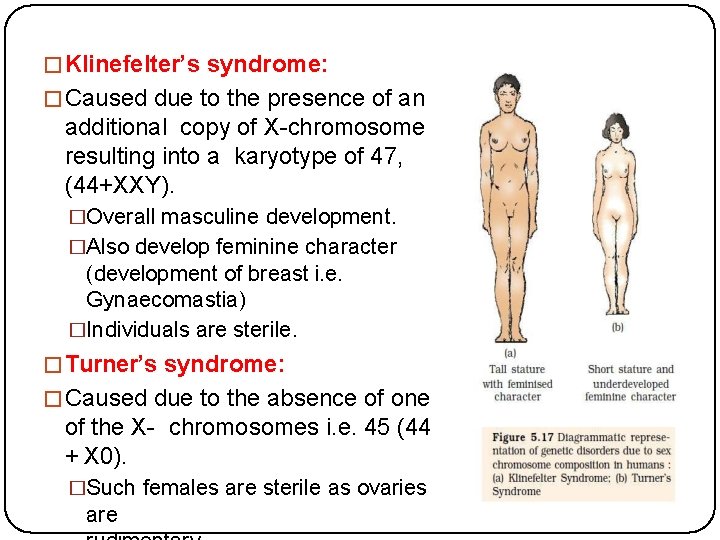
�Klinefelter’s syndrome: �Caused due to the presence of an additional copy of X-chromosome resulting into a karyotype of 47, (44+XXY). �Overall masculine development. �Also develop feminine character (development of breast i. e. Gynaecomastia) �Individuals are sterile. �Turner’s syndrome: �Caused due to the absence of one of the X- chromosomes i. e. 45 (44 + X 0). �Such females are sterile as ovaries are
Thanking you