
Principles of Information Systems Seventh Edition The use
- Slides: 43
Principles of Information Systems, Seventh Edition
• The use of information systems to add value to the organization is strongly influenced by organizational structure, culture, and change • Identify the value-added processes in the supply chain and describe the role of information systems within them • Provide a clear definition of the terms organizational structure, culture, and change and discuss how they affect the implementation of information systems Principles of Information Systems, Seventh Edition 2
• Because information systems are so important, businesses need to be sure that improvements or completely new systems help lower costs, increase profits, improve service, or achieve a competitive advantage • Identify some of the strategies employed to lower costs or improve service • Define the term competitive advantage and discuss how organizations are using information systems to gain such an advantage • Discuss how organizations justify the need for information systems Principles of Information Systems, Seventh Edition 3
• Information systems personnel are the key to unlocking the potential of any new or modified system • Define the types of roles, functions, and careers available in information systems Principles of Information Systems, Seventh Edition 4
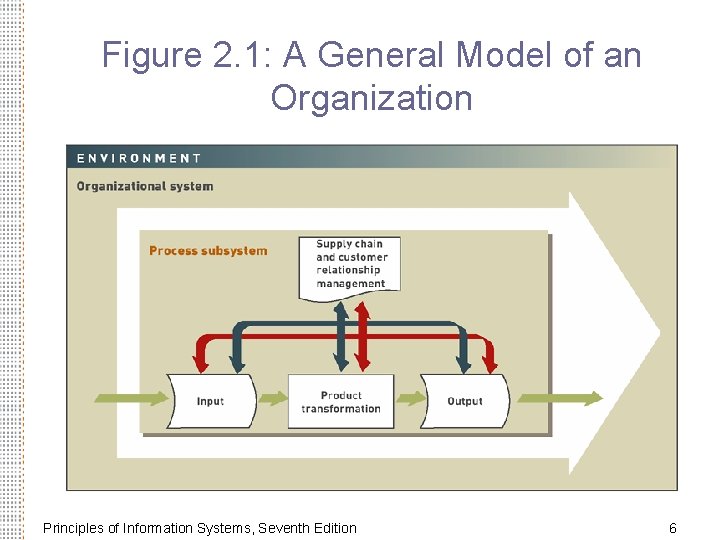
Organizations and Information Systems • Organization: a formal collection of people and other resources established to accomplish a set of goals • An organization is a system • Inputs to the system: resources such as materials, people, and money • Outputs to the environment: goods or services Principles of Information Systems, Seventh Edition 5
Figure 2. 1: A General Model of an Organization Principles of Information Systems, Seventh Edition 6
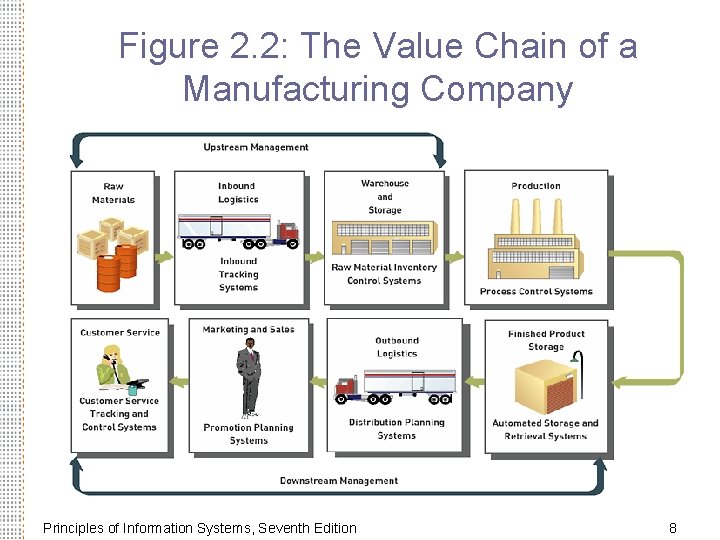
Organizations and Information Systems (continued) • Value chain: a series (chain) of activities that includes inbound logistics, warehouse and storage, production, finished product storage, outbound logistics, marketing and sales, and customer service • Upstream management: management of raw materials, inbound logistics, and warehouse and storage facilities • Downstream management: management of finished product storage, outbound logistics, marketing and sales, and customer service Principles of Information Systems, Seventh Edition 7
Figure 2. 2: The Value Chain of a Manufacturing Company Principles of Information Systems, Seventh Edition 8
Organizational Structure • Organizational structure: organizational subunits and their relationship with the overall organization • Categories of organizational structure: • Traditional • Project • Team • Multidimensional • Virtual Principles of Information Systems, Seventh Edition 9
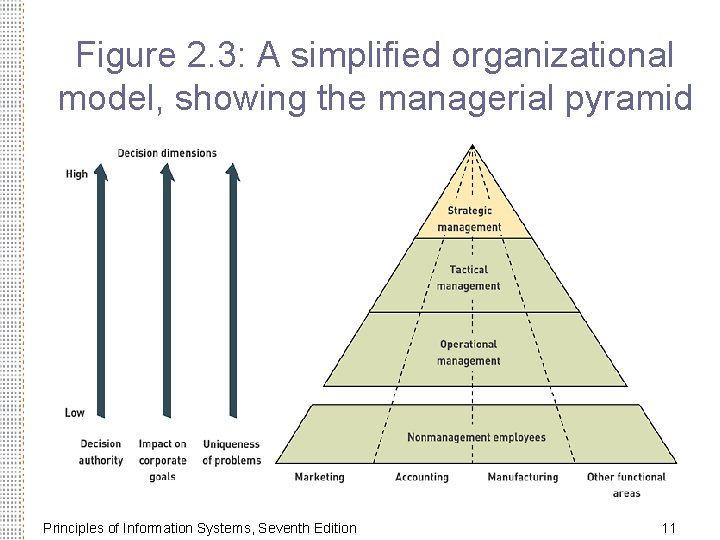
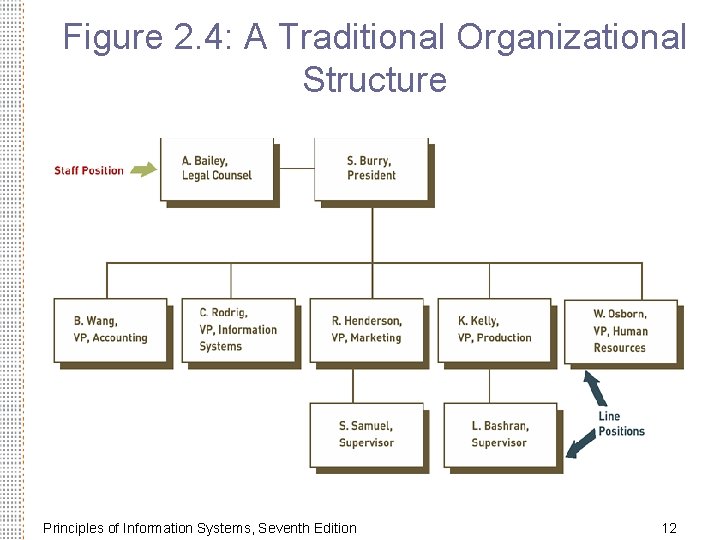
Traditional Organizational Structure • A hierarchical structure • Major department heads report to a president or top-level manager • A managerial pyramid shows the hierarchy of decision making and authority Principles of Information Systems, Seventh Edition 10
Figure 2. 3: A simplified organizational model, showing the managerial pyramid Principles of Information Systems, Seventh Edition 11
Figure 2. 4: A Traditional Organizational Structure Principles of Information Systems, Seventh Edition 12
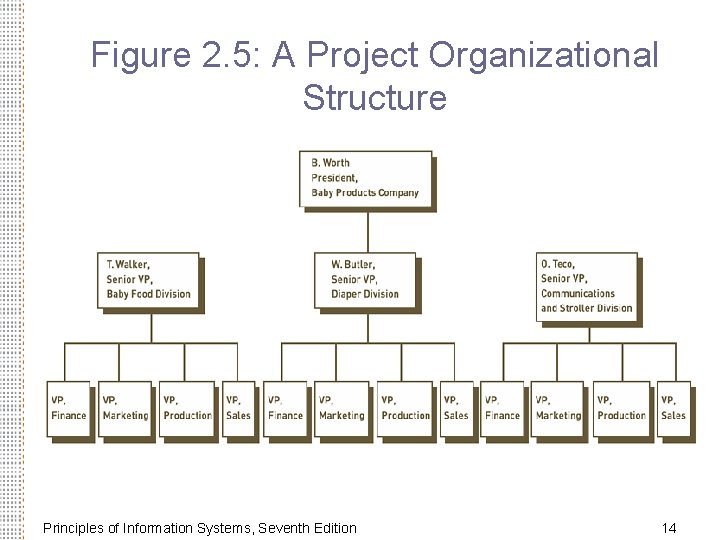
Project Organizational Structure • Centered around major products or services • Temporary project teams Principles of Information Systems, Seventh Edition 13
Figure 2. 5: A Project Organizational Structure Principles of Information Systems, Seventh Edition 14
Team Organizational Structure • Centered on work teams or groups • Temporary or permanent teams • Various sizes Principles of Information Systems, Seventh Edition 15
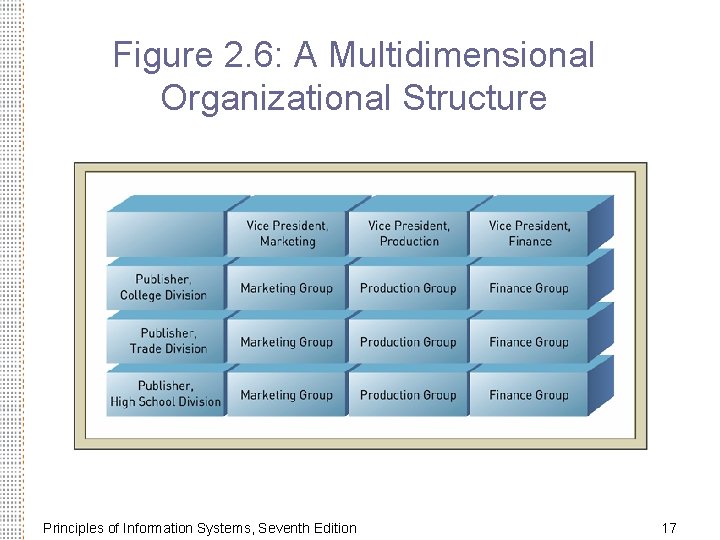
Multidimensional Organizational Structure • May incorporate several structures at the same time • Advantage: ability to simultaneously stress both traditional corporate areas and important product lines • Disadvantage: multiple lines of authority Principles of Information Systems, Seventh Edition 16
Figure 2. 6: A Multidimensional Organizational Structure Principles of Information Systems, Seventh Edition 17
Virtual Organizational Structure and Collaborative Work • Employs individuals, groups, or business units in geographically dispersed areas • People may never meet face to face • Can be permanent or temporary • Collaborative work: managers and employees can effectively work in groups around the world Principles of Information Systems, Seventh Edition 18
Organizational Culture and Change • Organizational culture: Major understandings and assumptions for a business, corporation, or organization • Organizational culture can significantly influence information systems • Organizational change: deals with how organizations plan for, implement, and handle change Principles of Information Systems, Seventh Edition 19
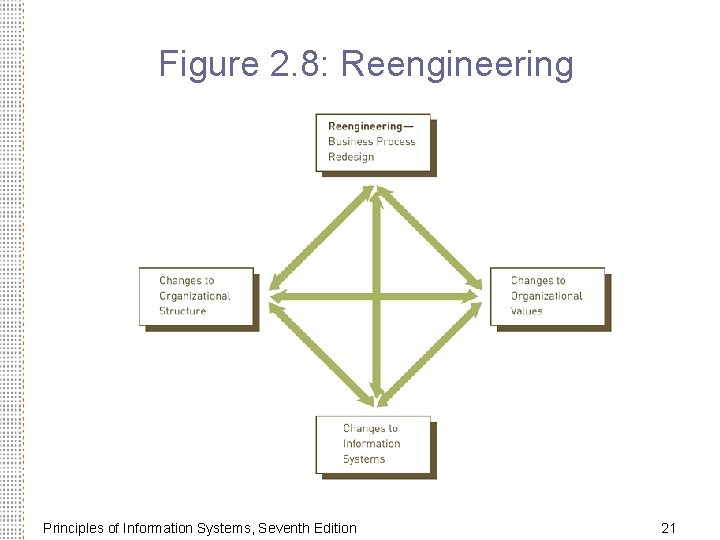
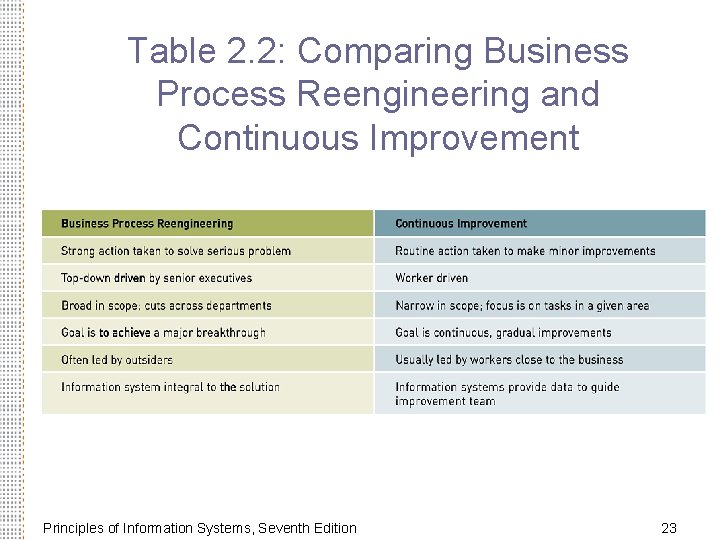
Reengineering • Process redesign • Radical redesign of business processes, organizational structures, information systems, and values of the organization to achieve a breakthrough in business results Principles of Information Systems, Seventh Edition 20
Figure 2. 8: Reengineering Principles of Information Systems, Seventh Edition 21
Continuous Improvement • Constantly seeking ways to improve business processes • Benefits: • Increased customer loyalty • Reduced customer dissatisfaction • Reduced opportunity for competitive inroads Principles of Information Systems, Seventh Edition 22
Table 2. 2: Comparing Business Process Reengineering and Continuous Improvement Principles of Information Systems, Seventh Edition 23
Technology Diffusion, Infusion, and Acceptance • Technology diffusion: measure of how widespread the use of technology is in an organization • Technology infusion: extent to which technology permeates a department • Technology Acceptance Model (TAM): specifies factors that can lead to higher usage of technology in an organization Principles of Information Systems, Seventh Edition 24
Total Quality Management • Quality: ability of a product or service to meet or exceed customer expectations • Total quality management (TQM): approaches, tools, and techniques that foster a commitment to quality throughout the organization Principles of Information Systems, Seventh Edition 25
Outsourcing, On-Demand Computing, and Downsizing • Outsourcing: contracting with outside professionals • On-demand computing: contracting for computer resources to rapidly respond to an organization’s varying workflow • Downsizing: reducing the number of employees in an organization to cut costs Principles of Information Systems, Seventh Edition 26
Organizations in a Global Society • As companies rely more heavily on virtual structures and outsourcing, businesses can operate around the world • Challenges to operating in a global society: • Every country has a set of customs, cultures, standards, politics, and laws • Language • Difficulty in managing and controlling operations in different countries Principles of Information Systems, Seventh Edition 27
Competitive Advantage • Competitive advantage: significant, long-term benefit to a company over its competition • Ability to establish and maintain a competitive advantage is vital to a company’s success Principles of Information Systems, Seventh Edition 28
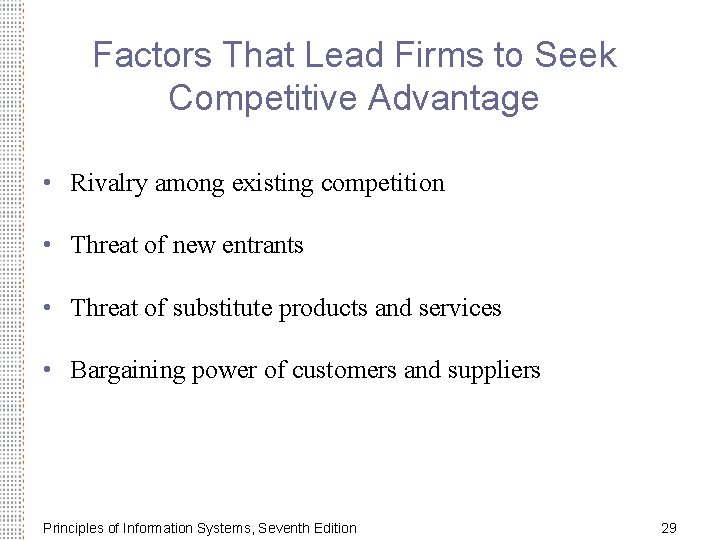
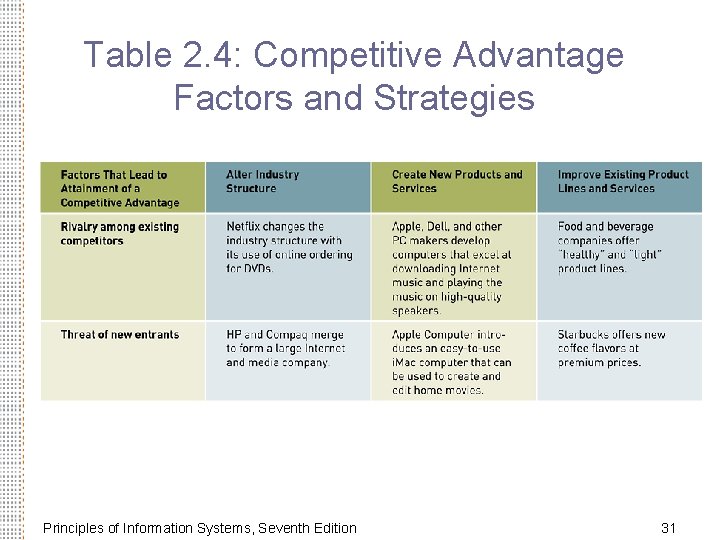
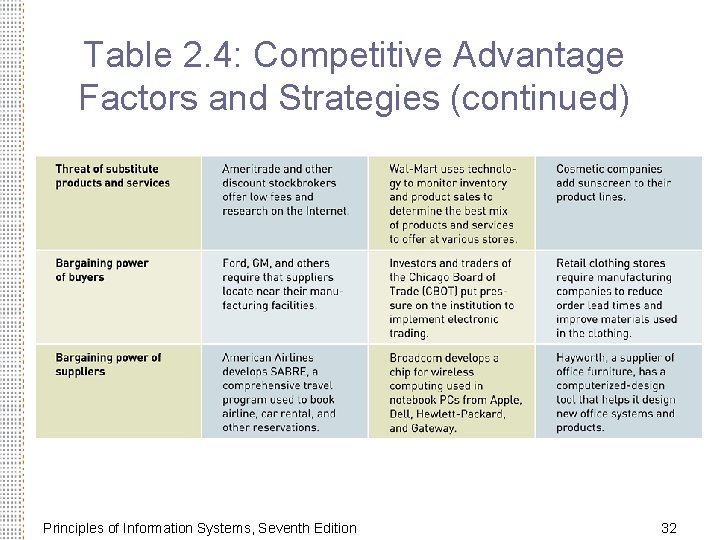
Factors That Lead Firms to Seek Competitive Advantage • Rivalry among existing competition • Threat of new entrants • Threat of substitute products and services • Bargaining power of customers and suppliers Principles of Information Systems, Seventh Edition 29
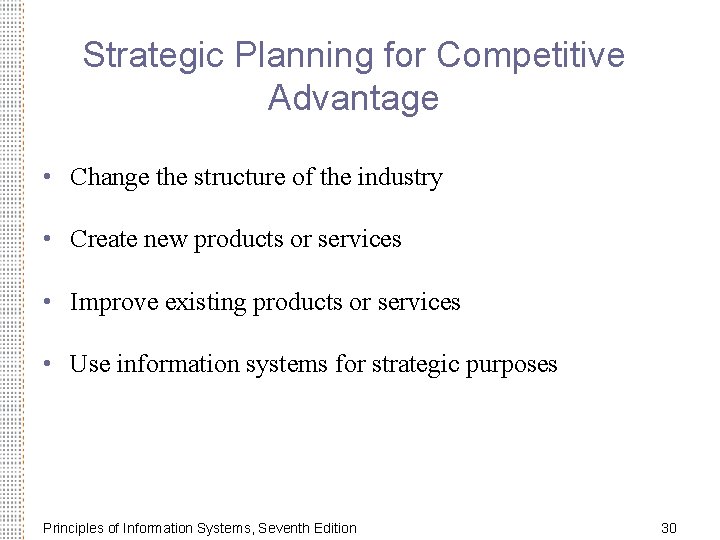
Strategic Planning for Competitive Advantage • Change the structure of the industry • Create new products or services • Improve existing products or services • Use information systems for strategic purposes Principles of Information Systems, Seventh Edition 30
Table 2. 4: Competitive Advantage Factors and Strategies Principles of Information Systems, Seventh Edition 31
Table 2. 4: Competitive Advantage Factors and Strategies (continued) Principles of Information Systems, Seventh Edition 32
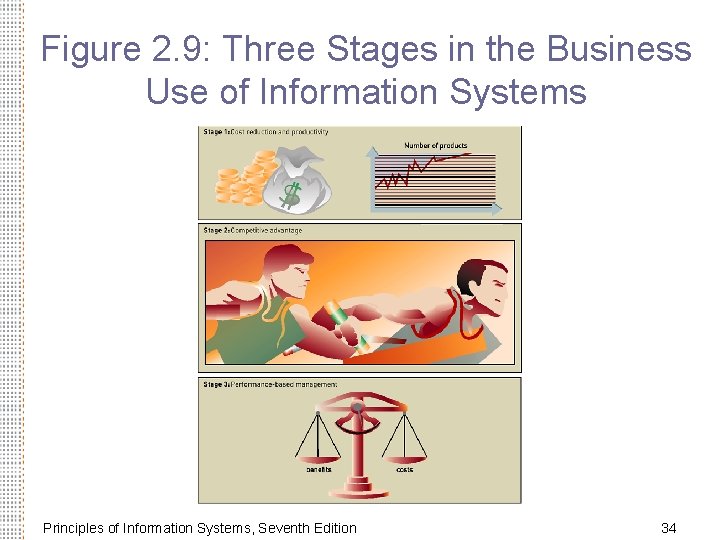
Performance-Based Information Systems • Considers both strategic advantage and costs • Uses productivity, return on investment (ROI), net present value, and other measures of performance Principles of Information Systems, Seventh Edition 33
Figure 2. 9: Three Stages in the Business Use of Information Systems Principles of Information Systems, Seventh Edition 34
Productivity • A measure of output achieved divided by input required • Higher level of output for a given level of input means greater productivity Principles of Information Systems, Seventh Edition 35
Return on Investment and the Value of Information Systems • Earnings growth • Market share • Customer awareness and satisfaction • Total cost of ownership Principles of Information Systems, Seventh Edition 36
Careers In Information Systems • Degree programs: • Degrees in information systems • Business degrees with a global or international orientation • Computer systems are making information systems professionals’ work easier • Opportunities in information systems are not confined to single countries Principles of Information Systems, Seventh Edition 37
Roles, Functions, and Careers in the Information Systems Department • Primary responsibilities in information systems • Operations: focuses on the efficiency of information systems functions • Systems development: focuses on specific development projects and ongoing maintenance and review • Support: provides user assistance Principles of Information Systems, Seventh Edition 38
Typical Information Systems Titles and Functions • Chief Information Officer (CIO): employs the IS department’s equipment and personnel to help the organization attain its goals • LAN administrators: set up and manage the network hardware, software, and security processes Principles of Information Systems, Seventh Edition 39
Typical IS Titles and Functions (continued) • Internet careers: • Strategists • Programmers • Web site operators • Chief Internet Officer Principles of Information Systems, Seventh Edition 40
Summary • An organization is a system • Categories of organizational structure: traditional, project, team, multidimensional, and virtual • Organizational culture: major understandings and assumptions of an organization • Reengineering: radical redesign of business processes, organizational structures, information systems, and values of the organization to achieve a breakthrough in business results Principles of Information Systems, Seventh Edition 41
Summary (continued) • Continuous improvement: constantly seeking ways to improve business processes • Outsourcing: contracting with outside professionals • Downsizing: reducing number of employees to cut costs • Competitive advantage: significant, long-term benefit to a company over its competition • Performance-based information systems considers both strategic advantage and costs Principles of Information Systems, Seventh Edition 42
Summary (continued) • Productivity: a measure of output achieved divided by input required • Primary responsibilities in information systems: operations, systems development, and support • Typical information systems titles: Chief Information Officer (CIO), LAN administrator Principles of Information Systems, Seventh Edition 43