
Principles of Immunology AntigenAntibody Interactions 42506 WordTerms List
Principles of Immunology Antigen-Antibody Interactions 4/25/06
Word/Terms List o o o o Agglutinin EIA Equivalence zone FIA Immunodiffusion Immunoelectrophoresis RIA Titer
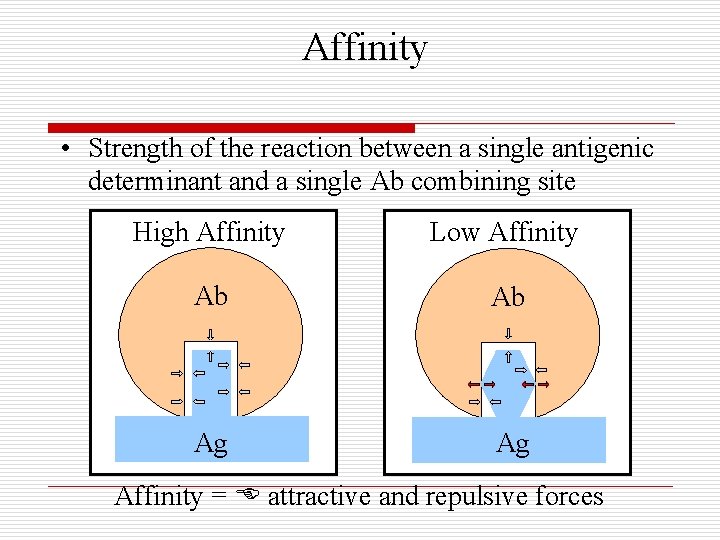
Affinity • Strength of the reaction between a single antigenic determinant and a single Ab combining site High Affinity Low Affinity Ab Ab Ag Ag Affinity = attractive and repulsive forces
Specificity o o The ability of an individual antibody combining site to react with only one antigenic determinant. The ability of a population of antibody molecules to react with only one antigen.

Cross Reactivity • The ability of an individual Ab combining site to react with more than one antigenic determinant. • The ability of a population of Ab molecules to react with more than one Ag Cross reactions Anti-A Ab Ag A Ag B Ag C Shared epitope Similar epitope
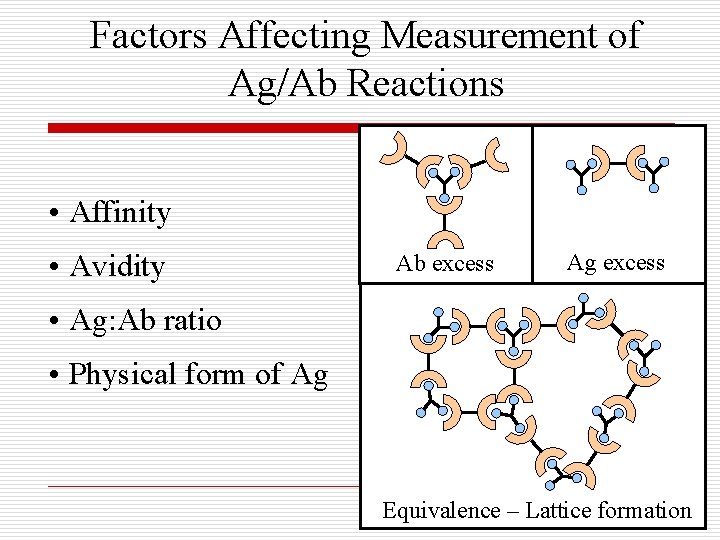
Factors Affecting Measurement of Ag/Ab Reactions • Affinity • Avidity Ab excess Ag excess • Ag: Ab ratio • Physical form of Ag Equivalence – Lattice formation
Tests Based on Ag/Ab Reactions o o All tests based on Ag/Ab reactions will have to depend on lattice formation or they will have to utilize ways to detect small immune complexes All tests based on Ag/Ab reactions can be used to detect either Ag or Ab
Agglutination Tests Lattice Formation
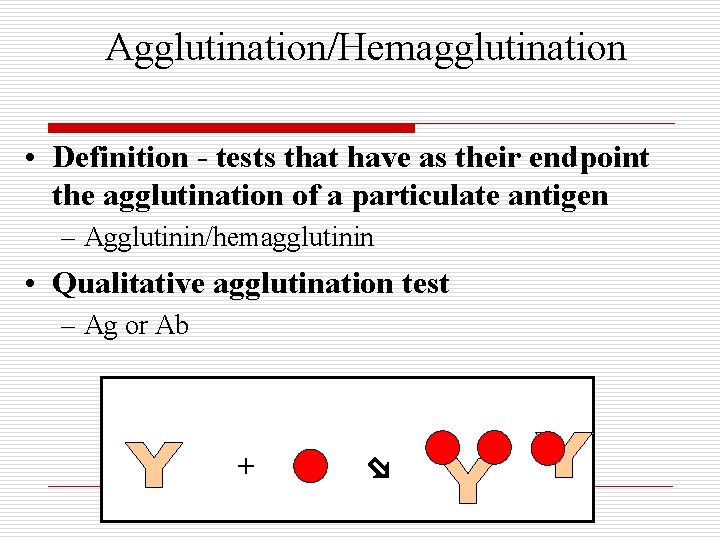
Agglutination/Hemagglutination • Definition - tests that have as their endpoint the agglutination of a particulate antigen – Agglutinin/hemagglutinin • Qualitative agglutination test – Ag or Ab +
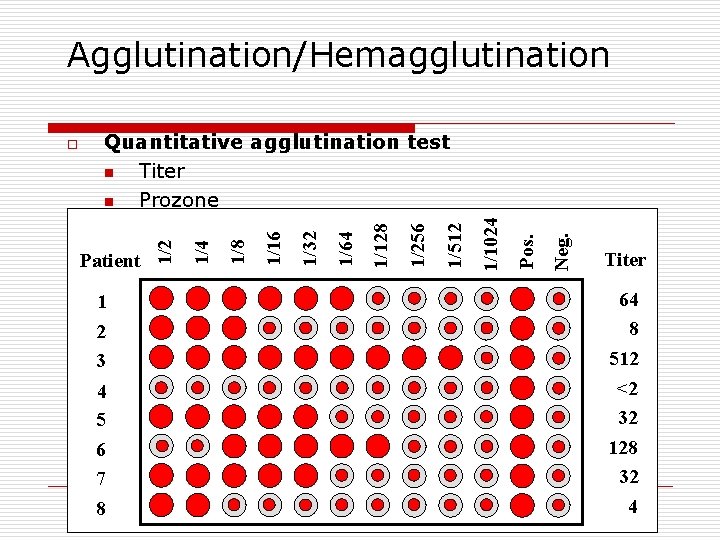
Agglutination/Hemagglutination Neg. Pos. 1/1024 1/512 1/256 1/128 1/64 1/32 1/16 1/8 Patient 1/4 Quantitative agglutination test n Titer n Prozone 1/2 o Titer 1 2 3 64 8 512 4 5 <2 32 6 7 8 128 32 4
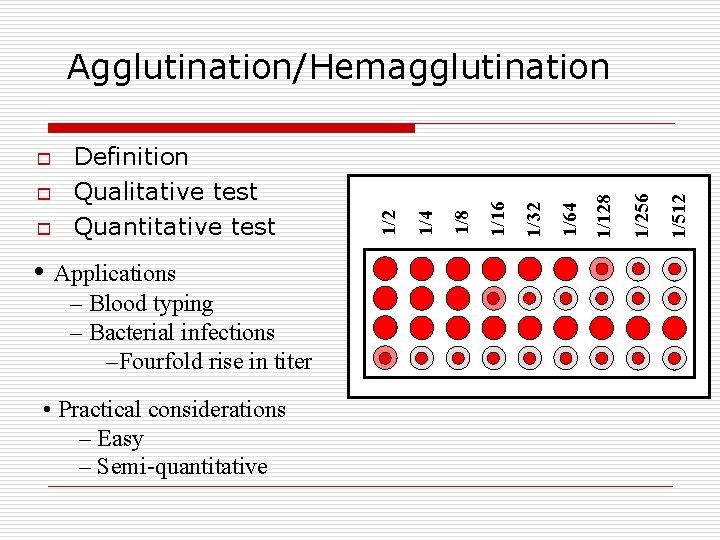
• Applications – Blood typing – Bacterial infections –Fourfold rise in titer • Practical considerations – Easy – Semi-quantitative 1/512 1/256 1/128 1/64 1/32 1/16 o 1/8 o Definition Qualitative test Quantitative test 1/4 o 1/2 Agglutination/Hemagglutination
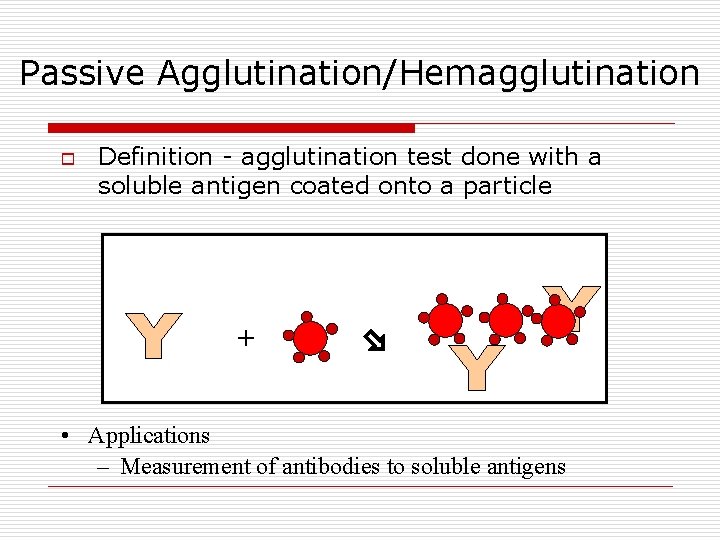
Passive Agglutination/Hemagglutination o Definition - agglutination test done with a soluble antigen coated onto a particle + • Applications – Measurement of antibodies to soluble antigens
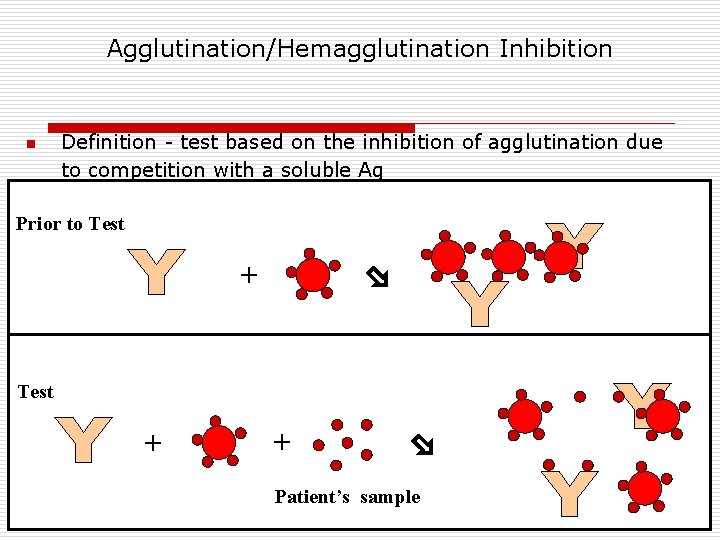
Agglutination/Hemagglutination Inhibition n Definition - test based on the inhibition of agglutination due to competition with a soluble Ag Prior to Test + + Patient’s sample
Agglutination/Hemagglutination Inhibition • Definition o Applications n o Measurement of soluble Ag Practical considerations n Same as agglutination test
Precipitation Tests Lattice Formation
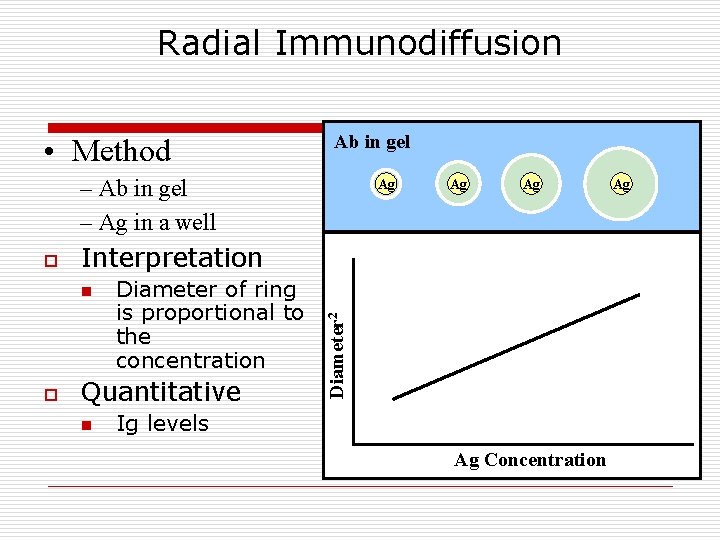
Radial Immunodiffusion • Method Ab in gel – Ag in a well Ag Interpretation n o Ag Diameter of ring is proportional to the concentration Quantitative n Diameter 2 o Ag Ig levels Ag Concentration Ag
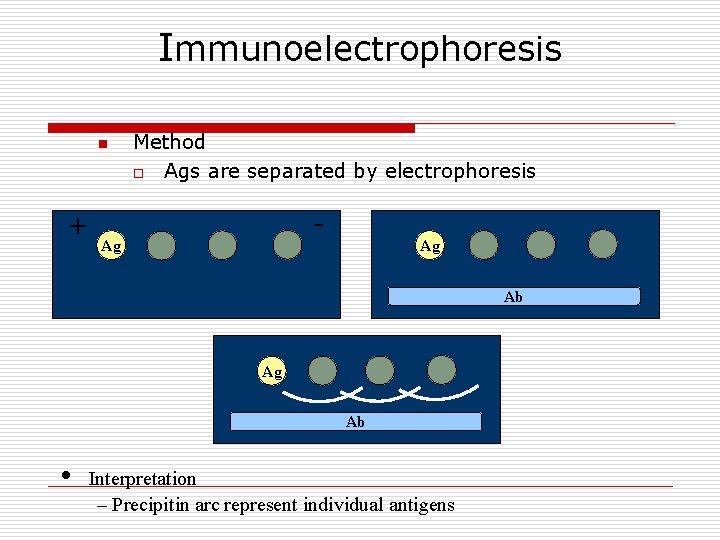
Immunoelectrophoresis n + Method o Ags are separated by electrophoresis - Ag Ag Ab • Interpretation – Precipitin arc represent individual antigens
Immunoelectrophoresis o o o Method Interpretation Qualitative n Relative concentration
Radioimmuoassays (RIA) Enzyme-Linked Immunosorbent Assays (EIA) Lattice formation not required
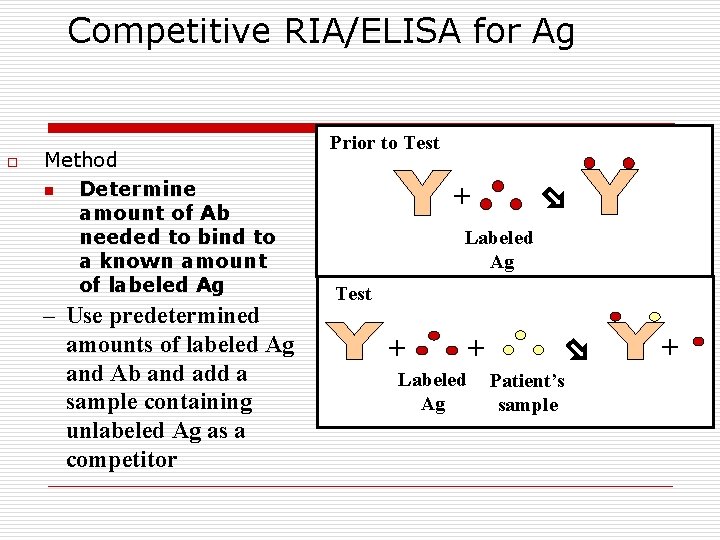
Competitive RIA/ELISA for Ag o Method n Determine amount of Ab needed to bind to a known amount of labeled Ag – Use predetermined amounts of labeled Ag and Ab and add a sample containing unlabeled Ag as a competitor Prior to Test + Labeled Ag + Patient’s sample +
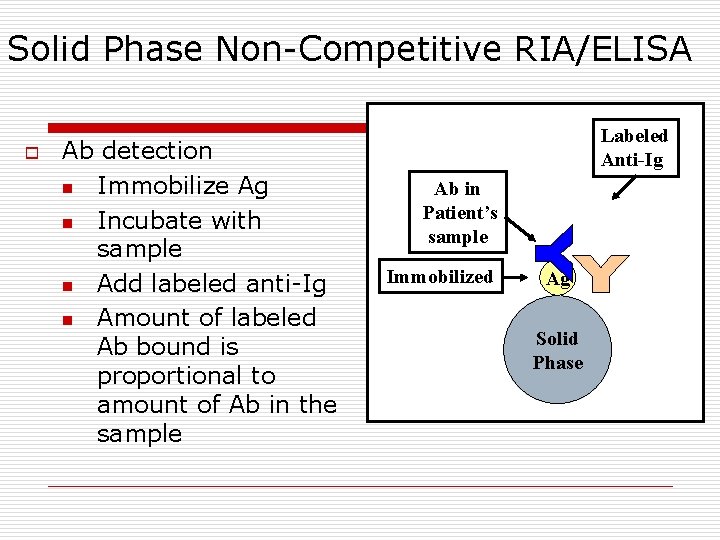
Solid Phase Non-Competitive RIA/ELISA o Ab detection n Immobilize Ag n Incubate with sample n Add labeled anti-Ig n Amount of labeled Ab bound is proportional to amount of Ab in the sample Labeled Anti-Ig Ab in Patient’s sample Immobilized Ag Solid Phase
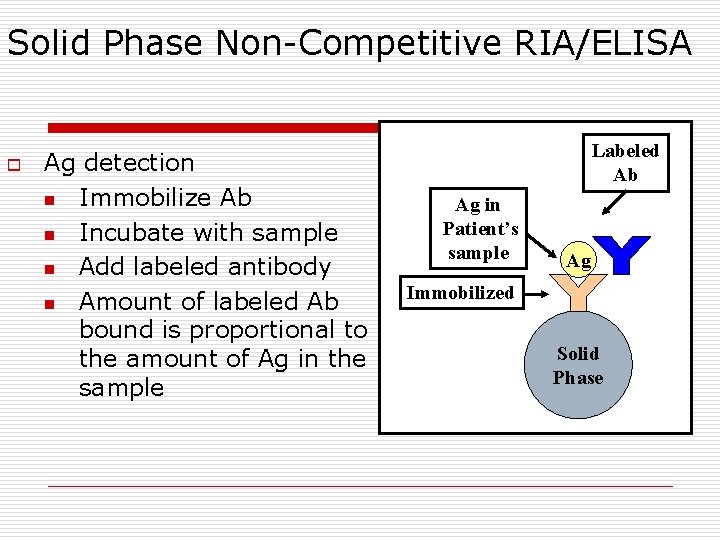
Solid Phase Non-Competitive RIA/ELISA o Ag detection n Immobilize Ab n Incubate with sample n Add labeled antibody n Amount of labeled Ab bound is proportional to the amount of Ag in the sample Labeled Ab Ag in Patient’s sample Ag Immobilized Solid Phase
Tests for Cell Associated Antigens Lattice formation not required
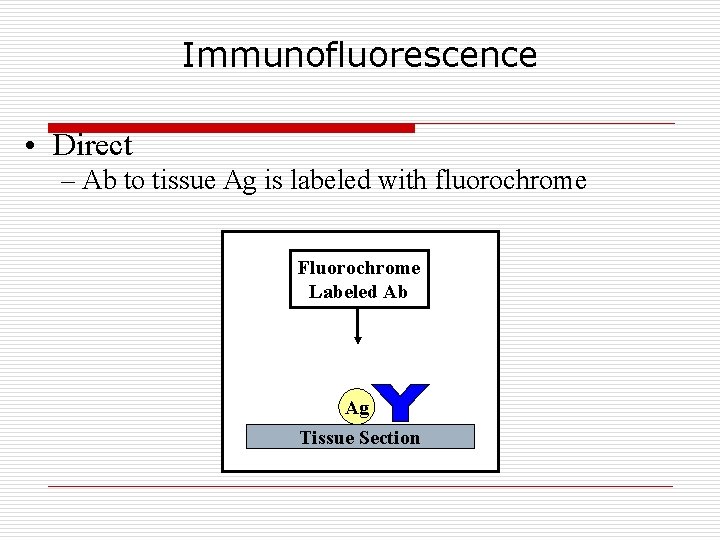
Immunofluorescence • Direct – Ab to tissue Ag is labeled with fluorochrome Fluorochrome Labeled Ab Ag Tissue Section
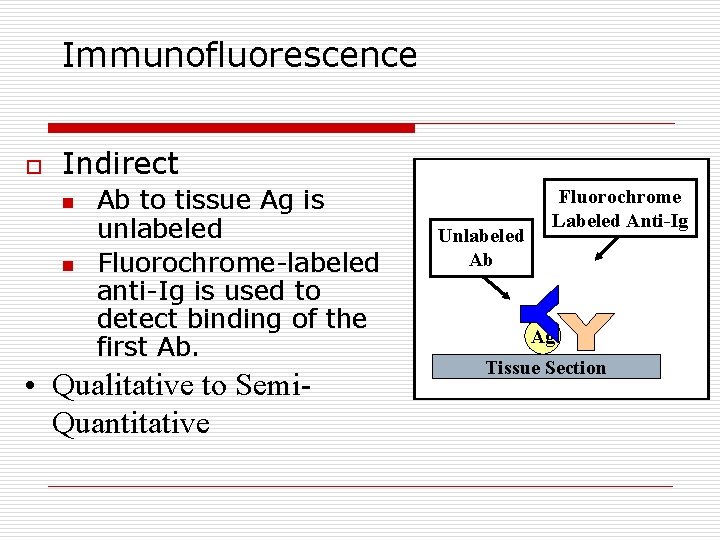
Immunofluorescence o Indirect n n Ab to tissue Ag is unlabeled Fluorochrome-labeled anti-Ig is used to detect binding of the first Ab. • Qualitative to Semi. Quantitative Unlabeled Ab Fluorochrome Labeled Anti-Ig Ag Tissue Section
Assays Based on Complement Lattice formation not required
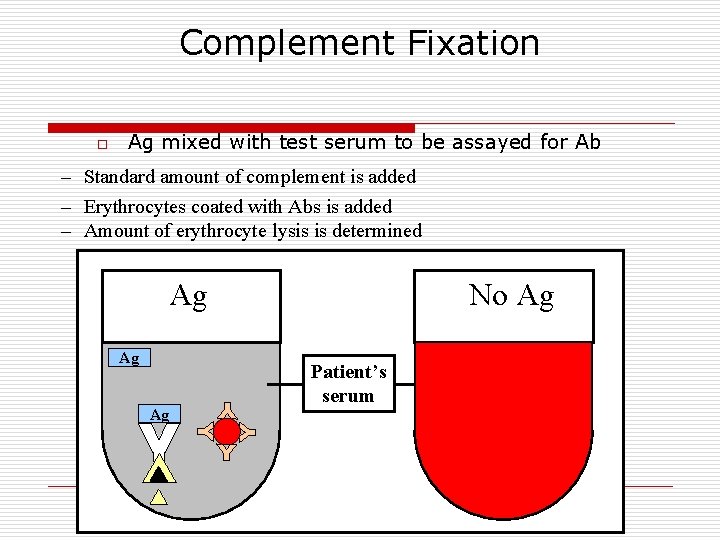
Complement Fixation o Ag mixed with test serum to be assayed for Ab – Standard amount of complement is added – Erythrocytes coated with Abs is added – Amount of erythrocyte lysis is determined No Ag Ag Patient’s serum
- Slides: 27