
Principles of Government Warm UP What is the




- Slides: 69
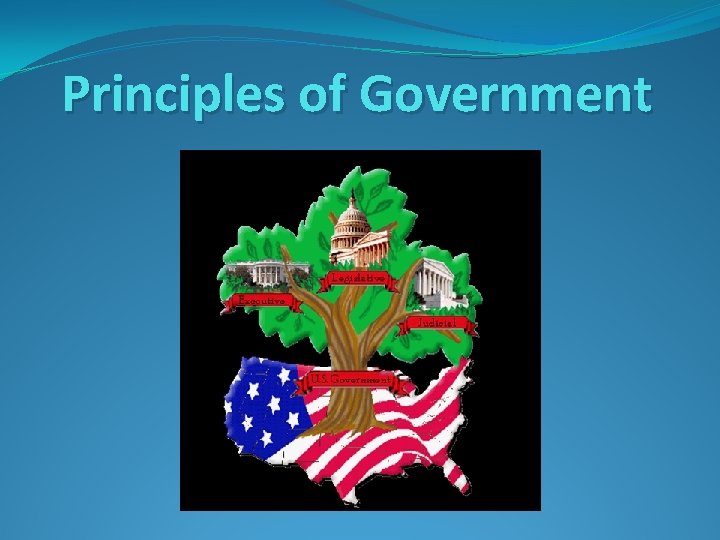
Principles of Government
Warm UP! • What is the difference between a government and a state? • Who holds power in a Dictatorship? • What is the purpose of a constitution? • Give an example of a use of judicial power.
What is the difference between a government and a state? �A state is a body of people living in a defined territory with a government and the power to make laws without the consent of a higher authority.
�A government is the institution through which states make and enforce their policies
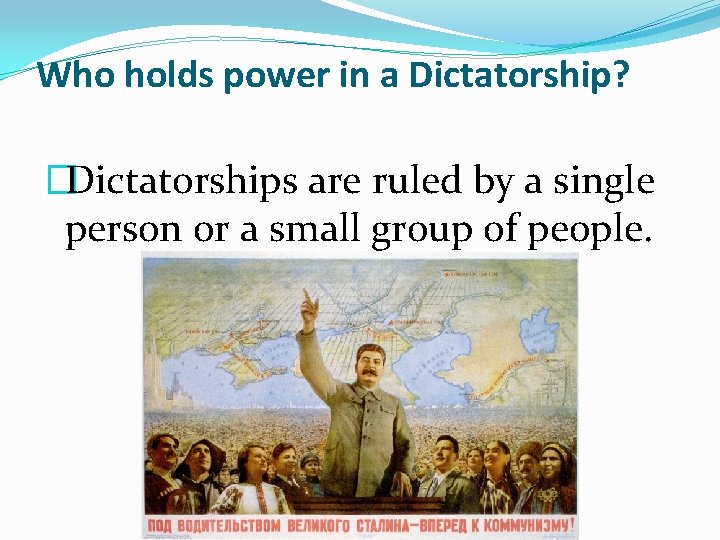
Who holds power in a Dictatorship? �Dictatorships are ruled by a single person or a small group of people.
Dictatorship V. S. Oligarchy Dictatorship � A type of government where political authority is controlled by an individual or a political entity � A form of government controlled by a ruler with total power over a country, typically one who has obtained control � A type of government which is ruled by a dictator. by force. � a government organization or group in which absolute power is so concentrated. Oligarchy � System governed by a few powerful people � Oligarchy is a type of government controlled by a small group of people � A type of government by powerful people in a small group is called oligarchy � A small group exercises control especially for corrupt and selfish purposes in a type of government, this government is called as Oligarchy.
What is the purpose of a constitution? �Constitutions include the fundamental laws that set out the principles, structures, and processes of government.
Give an example of a use of judicial power. Examples include: �Interpreting laws. �Determining the meanings of laws. �Settling social disputes.
Notes
Purpose of government �Form a more perfect union �Establish justice �Insure domestic tranquility �Provide for common defense �Promote general welfare �Secure blessings of liberty
1. Form a more perfect union �The Articles of Confederation; the nations first constitution, created a “firm league of friendship” between the 13 states, that proved eventually not to be very firm or friendly.
� The government it created was powerless to overcome the intense rivalries and jealousies among the states.
� The Constitution written in 1787 linked the American people and states closer together in the belief that in union there is strength.
2. Establish justice �Justice is a concept, idea, an invention of the human mind. �Over time it has developed to mean that the law, in both its content and its administration, must be reasonable, fair, and impartial.
�Thomas Jefferson said that to provide justice is “the most sacred of the duties of government. ” No purpose, no goal of public policy, can be of greater importance in a democracy.
3. Insure Domestic Tranquility �Order is essential to the wellbeing of any society, and keeping the peace at home has always been a prime function of government.
�James Madison observed in The Federalist No. 51, : ~“If all men were angels no government would be necessary. ”
4. Provide For The Common Defense �Defending the nation against foreign enemies is another major function of the government.
�Defense and foreign policy are two sides of the same coin and are paramount in protecting its citizens from foreign threats.
5. Secure the Blessings Of Liberty �“The god who gave us life gave us liberty at the same time. ” ~Thomas Jefferson �This nation was founded by people who loved liberty and prized it above all earthly possessions.
�American dedication to freedom for the individual recognizes that liberty cannot be absolute. �No one can be free to do whatever he or she pleases. �That behavior would interfere with the freedoms of others.
�The federal and state constitutions created many guarantees for the rights and liberties for the individual. �That doesn’t mean that they will last forever, it is up to each generation to preserve, protect, and be willing to stand up for them whenever necessary.
�“You can only be free if I am free. ” ~Clarence Darrow �“Eternal Vigilance is the price of liberty” ~Thomas Jefferson
Morning Wake Up �Choose one of the purposes of the American system of government and give one real life example of this. �Which two theories might be used to explain the origins of japan, which has an emperor typically chosen from the same familial lines? 1. The force theory and the divine right theory 2. The evolutionary theory and the force theory 3. The social contract theory and the divine right theory 4. The evolutionary theory and the divine right theory
Grab a book from the back � Starting on page three � Look up here and answer the section 1 review in your notes.
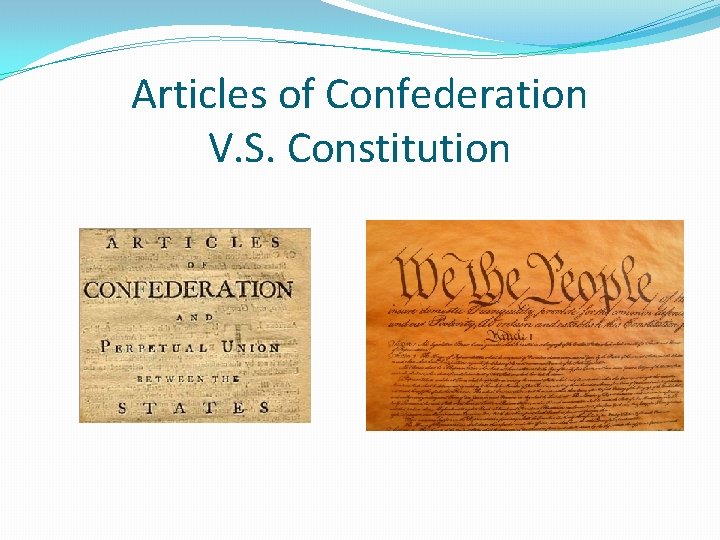
Articles of Confederation V. S. Constitution
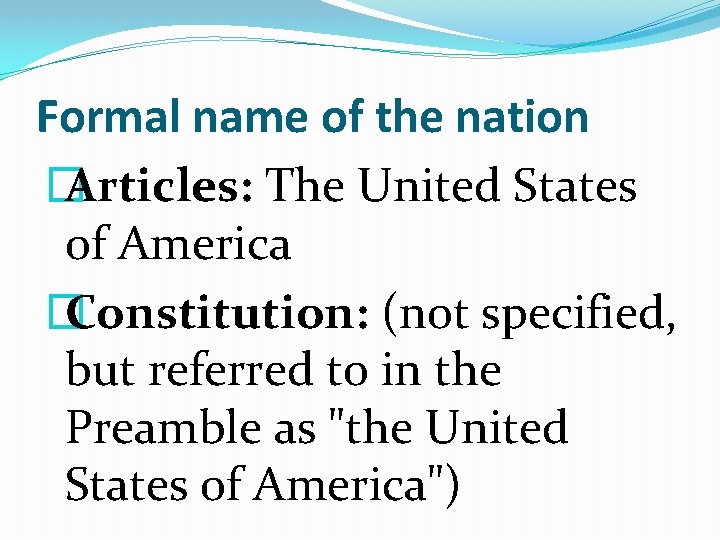
Formal name of the nation � Articles: The United States of America � Constitution: (not specified, but referred to in the Preamble as "the United States of America")
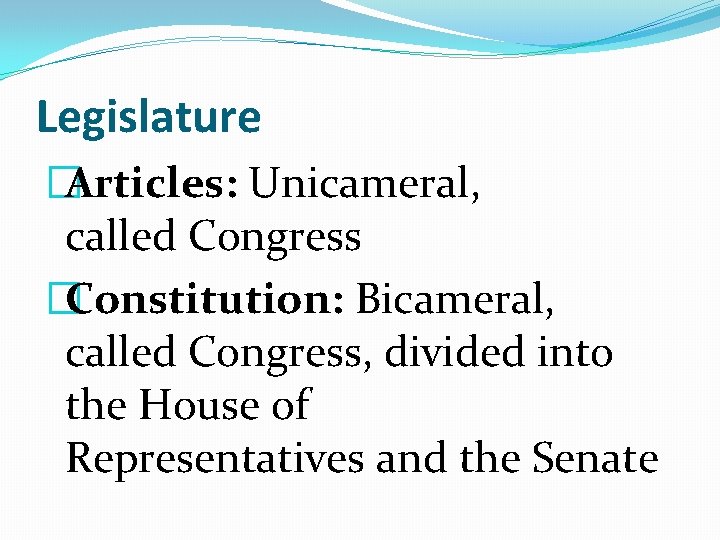
Legislature �Articles: Unicameral, called Congress �Constitution: Bicameral, called Congress, divided into the House of Representatives and the Senate
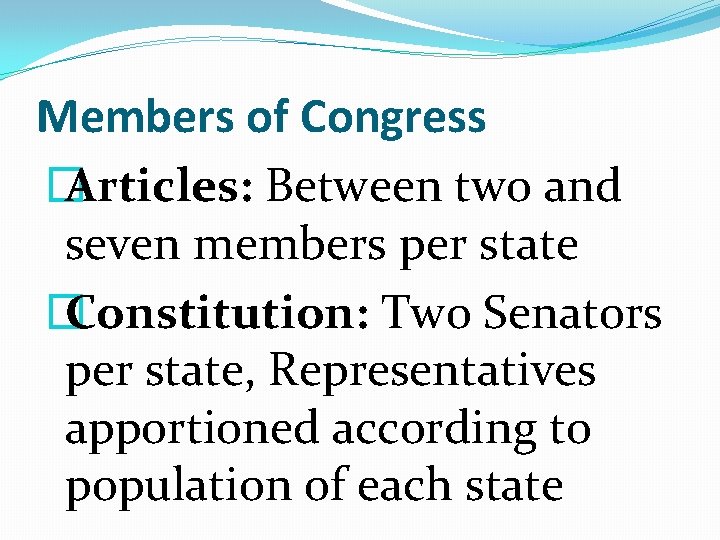
Members of Congress � Articles: Between two and seven members per state � Constitution: Two Senators per state, Representatives apportioned according to population of each state
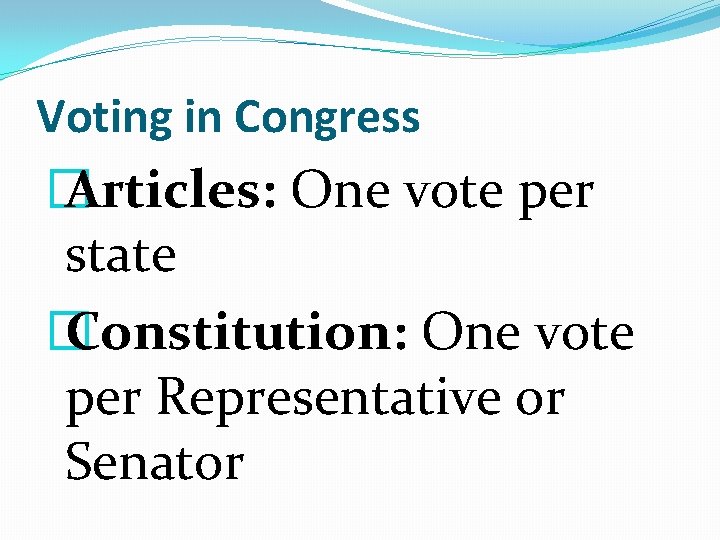
Voting in Congress � Articles: One vote per state � Constitution: One vote per Representative or Senator
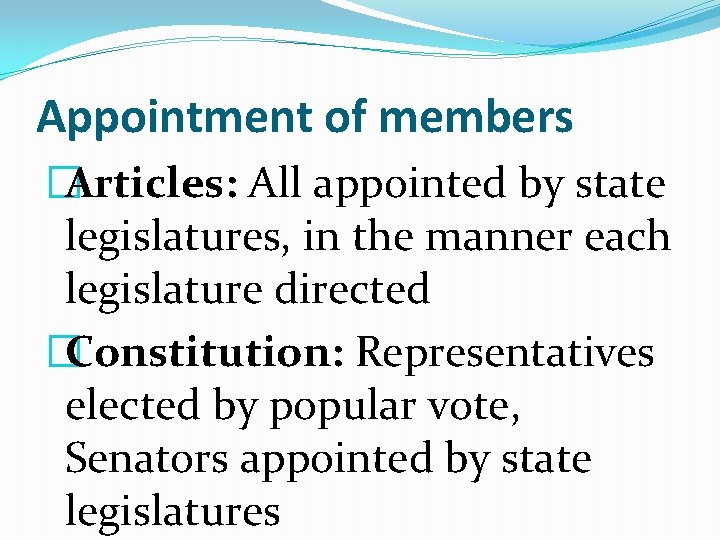
Appointment of members �Articles: All appointed by state legislatures, in the manner each legislature directed �Constitution: Representatives elected by popular vote, Senators appointed by state legislatures
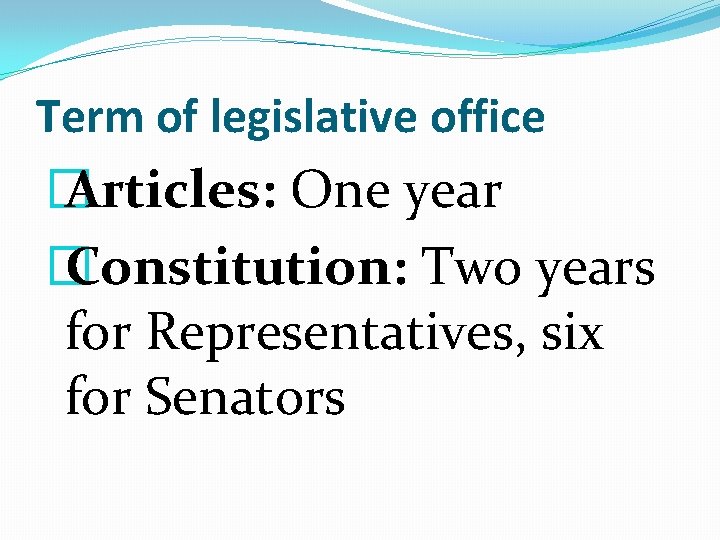
Term of legislative office � Articles: One year � Constitution: Two years for Representatives, six for Senators
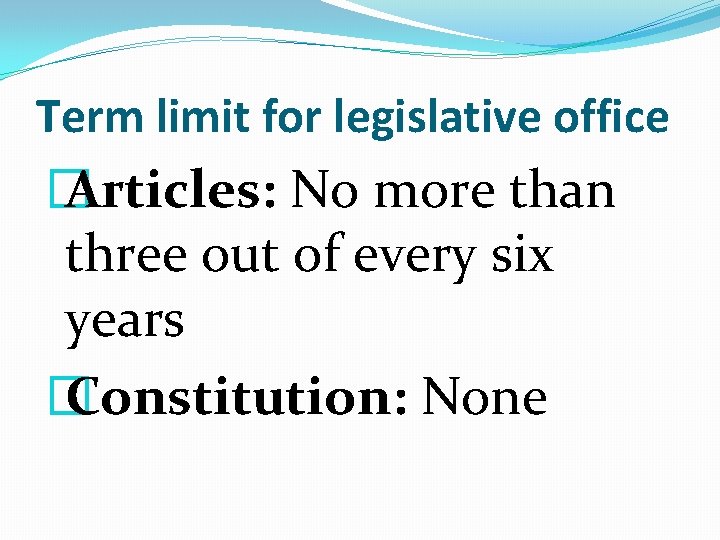
Term limit for legislative office � Articles: No more than three out of every six years � Constitution: None
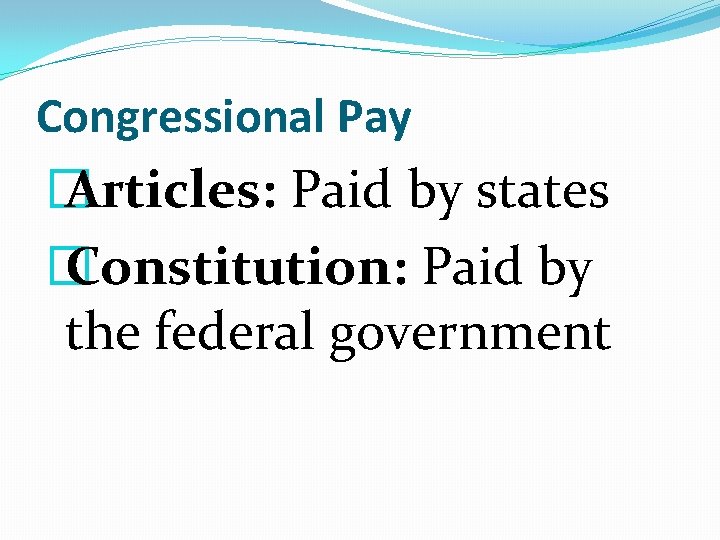
Congressional Pay � Articles: Paid by states � Constitution: Paid by the federal government
�What is the age limit for senators? �How many years can a senator serve in one term? �What is the age limit for House of Representatives? �How many years can a member of the house serve? �What is Unicameral V. S. Bicameral?
When Congress is not in session � Articles: A Committee of States stood in � Constitution: The President can call for Congress to assemble
Chair of legislature � Articles: President of Congress � Constitution: Speaker of the House of Representatives, Vice
Executive � Articles: None � Constitution: President
National Judiciary � Articles: Maritime judiciary established � Constitution: Federal judiciary established, including Supreme Court
Adjudicator of disputes between states � Articles: Congress � Constitution: Supreme Court
New States � Articles: Admitted upon agreement of nine states (special exemption provided for Canada) � Constitution: Admitted upon agreement of Congress
Amendment � Articles: When agreed upon by all states � Constitution: When agreed upon by threefourths of all states
�Navy Articles: Congress authorized to build a navy; states authorized to equip warships to counter piracy Constitution: Congress authorized to build a navy; states not allowed to keep ships of war �Army Articles: Congress to decide on size of force and to requisition troops from each state according to population Constitution: Congress authorized to raise and support armies
Power to coin money � Articles: United States and the states � Constitution: United States only
Ex post facto laws � Articles: Not forbidden � Constitution: Forbidden of both the states and the Congress
Bills of attainder � Articles: Not forbidden � Constitution: Forbidden of both the states and the Congress
Taxes � Articles: Apportioned by Congress, collected by the states � Constitution: Laid and collected by Congress
Ratification � Articles: Unanimous consent required � Constitution: Consent of nine states required
Warm UP �What defines a unitary Government? �How is power distributed in a Federal government? �Who holds power in an Oligarchy? �What specific trait gives the united states a presidential System of government?
What defines a unitary Government? � Concentration of power in a central government which creates local units of government for its convenience and delegates their power
How is power distributed in a federal government? � Power is divided between a central government and several local governments.
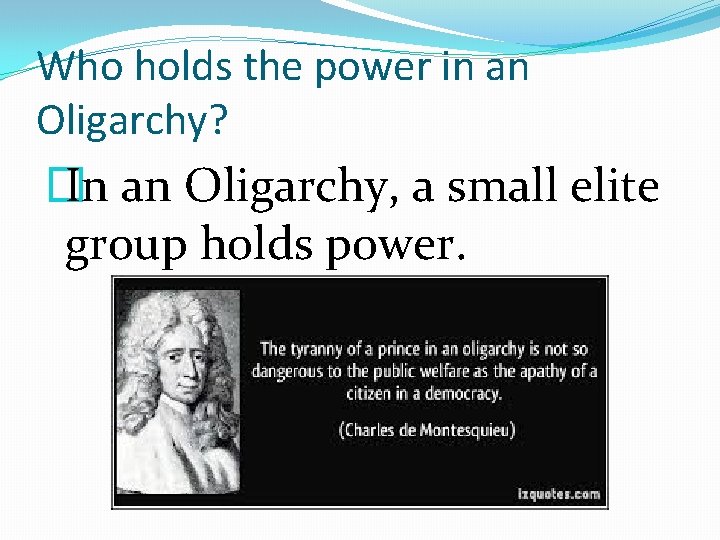
Who holds the power in an Oligarchy? � In an Oligarchy, a small elite group holds power.
What specific trait gives the united states a presidential System of government? � The U. S. Constitution establishes a separation of powers with a president heading the executive branch.
Foundations �Worth of the Individual �Equality of all persons �Majority rule, Minority Rights �Necessity of compromise �Individual freedom
1. Worth of the Individual �Democracy is firmly based on the belief in the fundamental importance of the individual. �This concept of the dignity and worth of the individual is of overriding importance in democratic thought.
�Sometimes the welfare of a few individuals is subordinated to the interests of the many. �However it is not simply serving the interests of a mass of people who happen to outnumber the few. �Rather, it is serving the many who, as individuals, together make up that society.
2. Equality of All Persons �Democracy does not insist on an equality of condition for all people. �It does not claim that all are born with the same mental or physical abilities. �It does not argue that all people have the right to an equal share of worldly goods.
All are entitled to � 1. Equality of opportunity � 2. Equality before the law � 3. Not be held back because of race, color, gender, or religion � 4. Develop themselves as fully as they can.
3. Majority Rule, Minority Rights �Democracy argues that a majority of the people will be right more often they will be wrong � And that the majority will be right more often then will any one person or small group.
�Democracy cannot work without the principle of majority rule. �However, a majority could destroy its opposition and in the process destroy democracy.
� Democracy insists on majority rule restrained by minority rights. � The majority must always listen to the minority’s argument.
4. Necessity of Compromise �In a democracy, public decision making must be a matter of give and take. �Compromise is the process of blending and adjusting competing views and interests.
Compromise is important in a democracy for two main reasons. � 1. Democracy puts the individual first, and is the equal to all other individuals. so in a society of many different individuals and groups how can the people make public decisions without compromise?
� 2. Few public questions have only two sides. Most can be answered in several ways. �Remember compromise is a process, a way to achieving majority agreement. It is never an end in itself. Not all compromises are good, and not all are necessary.
5. Individual Freedom � Democracy can only thrive in an atmosphere of individual freedom. � Not to be confused with total and complete freedom.
�Absolute freedom can only exist in total absence of government. Also known as anarchy. �Anarchy can only lead, inevitably and quickly, to rule by the strong and ruthless.
�Democracy insists that each individual must be free as far as the freedom of all will allow �Finding that line is a vitally and continuously important component of democracy. �Striking the balance between individual freedom and the rights of a society as a whole is as difficult as it is important.
�“The right to swing my fists ends where the other man’s nose begins. ” ~Oliver Wendell Holmes �“The rights of every man are diminished when the rights of one man are threatened. ” ~John F. Kennedy �“Must a government of necessity be too strong for the liberties of its own people , or too weak to maintain its own existence? ” ~Abraham Lincoln
Democracy and the free Enterprise system.