
Principles of Government The Basics Principles of the
Principles of Government The Basics
Principles of the U. S. Constitution • Basic law and government of the United States • Based on 7 principles: – – – – Republicanism Popular sovereignty Federalism Limited government Separation of power Checks and balances Individual rights

Republicanism • The idea that government is controlled by the people who hold power and elect representatives, giving those representatives power to make and enforce laws.
Popular Sovereignty • All political power rests with the people who can create, alter, and abolish government.
Limited Government • Limits are placed on the powers of government • Everyone, including all authority figures, must obey the laws
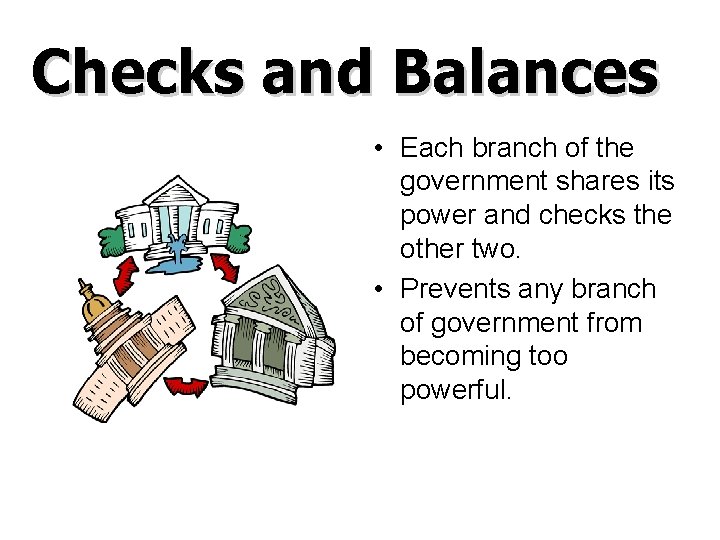
Checks and Balances • Each branch of the government shares its power and checks the other two. • Prevents any branch of government from becoming too powerful.
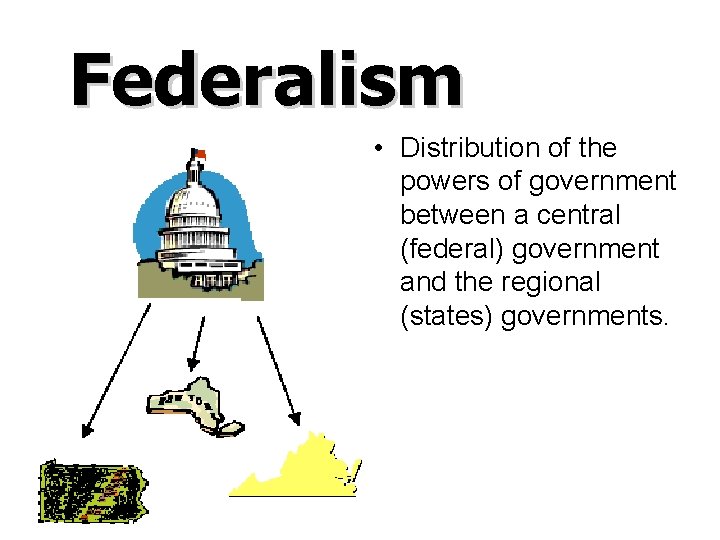
Federalism • Distribution of the powers of government between a central (federal) government and the regional (states) governments.
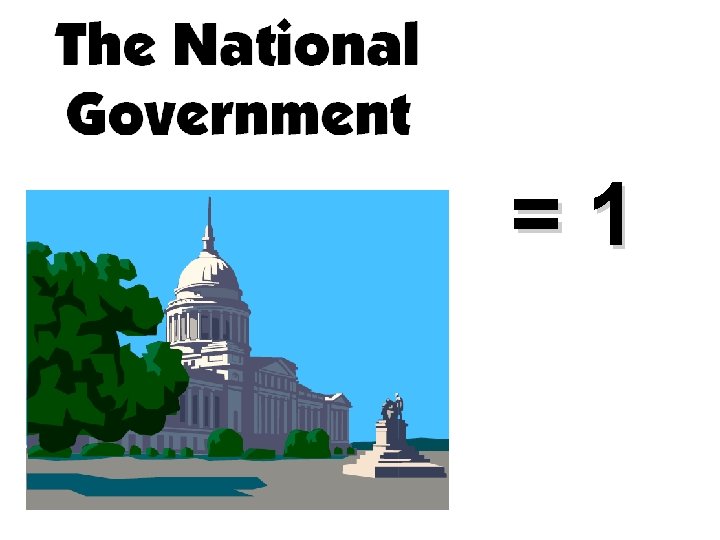
=1
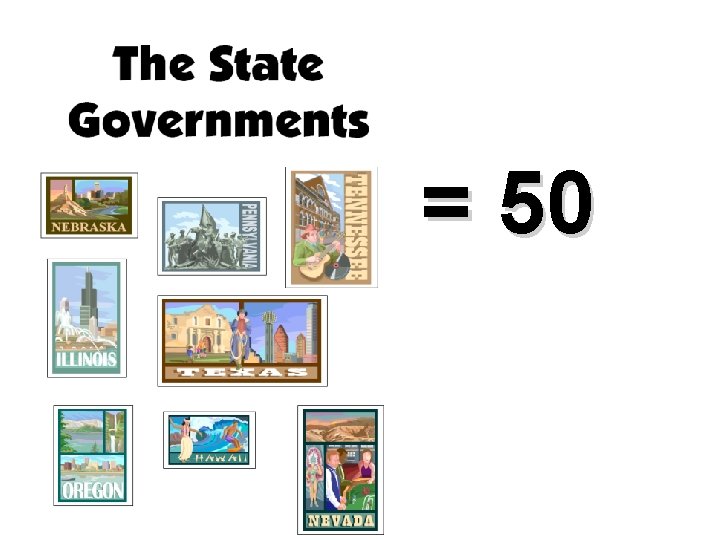
= 50
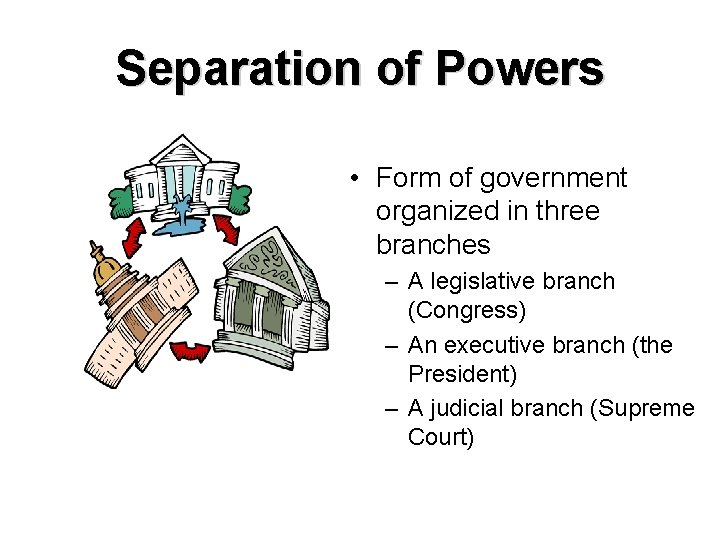
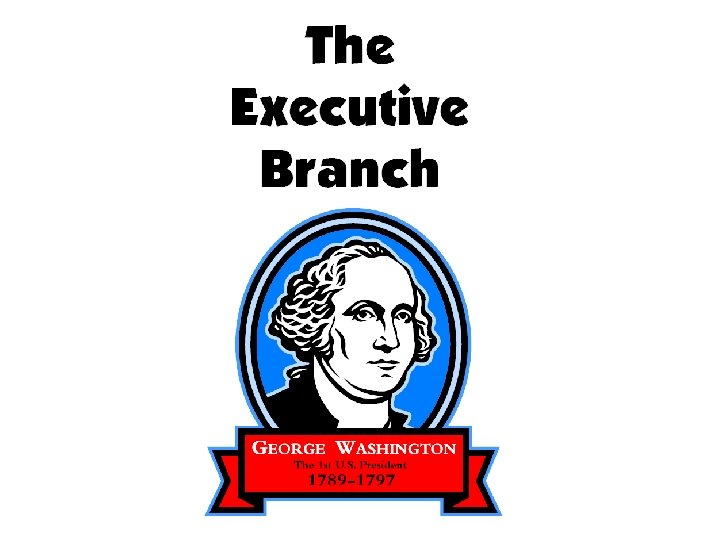
Separation of Powers • Form of government organized in three branches – A legislative branch (Congress) – An executive branch (the President) – A judicial branch (Supreme Court)
Individual Rights • The rights of the people protected in the Bill of Rights including: – Economic rights related to property – Political rights related to freedom of speech and press – personal rights related to bearing arms and maintaining private residences
Amendments • The way of making changes to the U. S. Constitution
Bill of Rights • First ten amendments to the Constitution • (ratified in 1791)

First Amendment: Religious and Political Freedom • States that “Congress shall make no law” restricting freedom of: – – – Speech Press Religion Assembly Petition
Second Amendment: Right to Bear Arms • Guarantees the right of states to organize militias, or armies, and the right of individuals to bear arms.
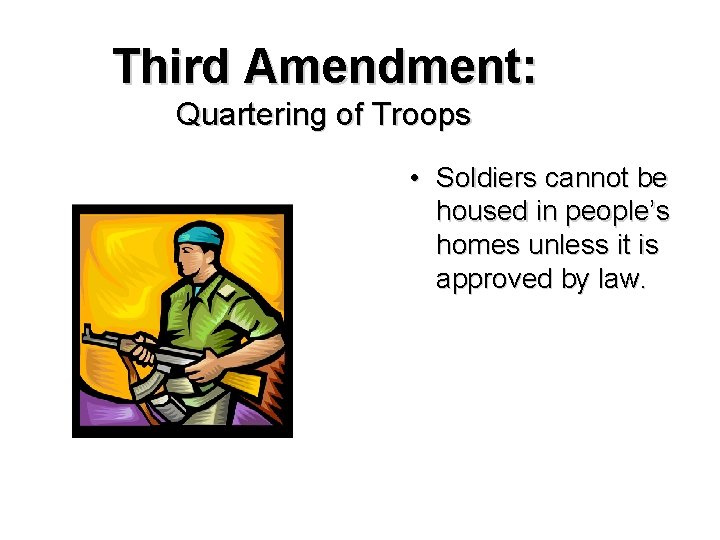
Third Amendment: Quartering of Troops • Soldiers cannot be housed in people’s homes unless it is approved by law.
Fourth Amendment: Search and Seizure • Protects citizens from unreasonable searches and seizures. • If a judge believes the search is reasonable, a search warrant will be granted.

Fifth Amendment: Rights of the Accused • This amendment protects an accused person from having to testify against him or herself (selfincrimination). • It bans double jeopardy (tried twice for the same crime) • It guarantees that no citizen may be deprived of life, liberty, or property without due process of law – certain legal procedures that must be carried out before a person can be punished.
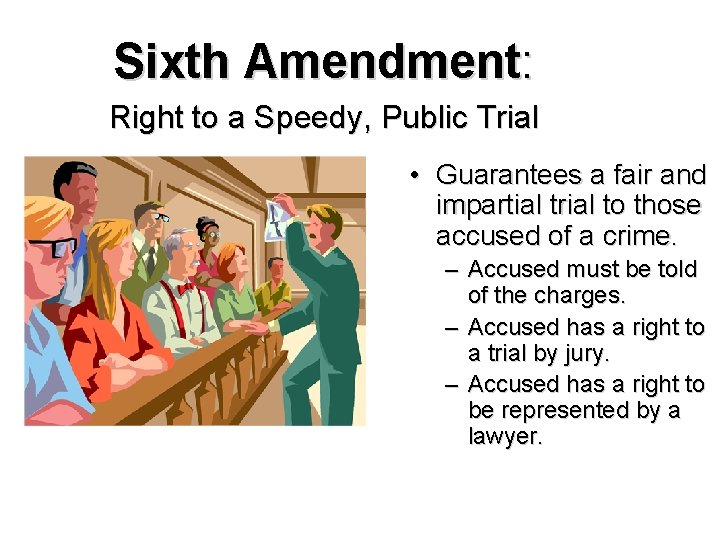
Sixth Amendment: Right to a Speedy, Public Trial • Guarantees a fair and impartial trial to those accused of a crime. – Accused must be told of the charges. – Accused has a right to a trial by jury. – Accused has a right to be represented by a lawyer.
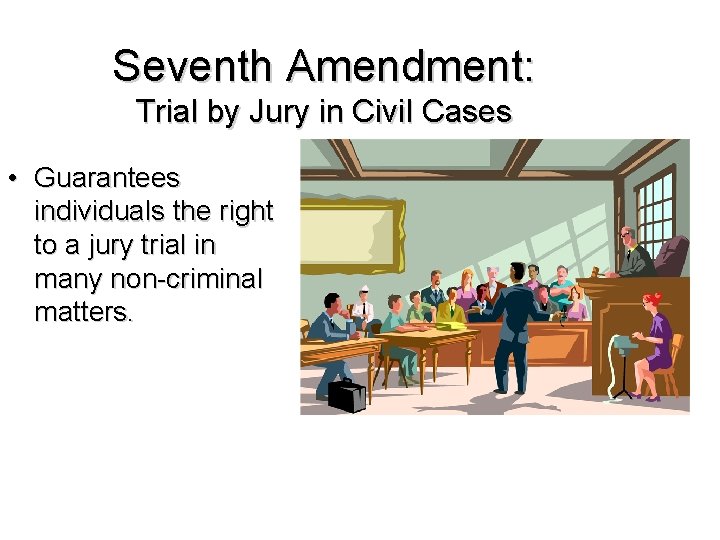
Seventh Amendment: Trial by Jury in Civil Cases • Guarantees individuals the right to a jury trial in many non-criminal matters.
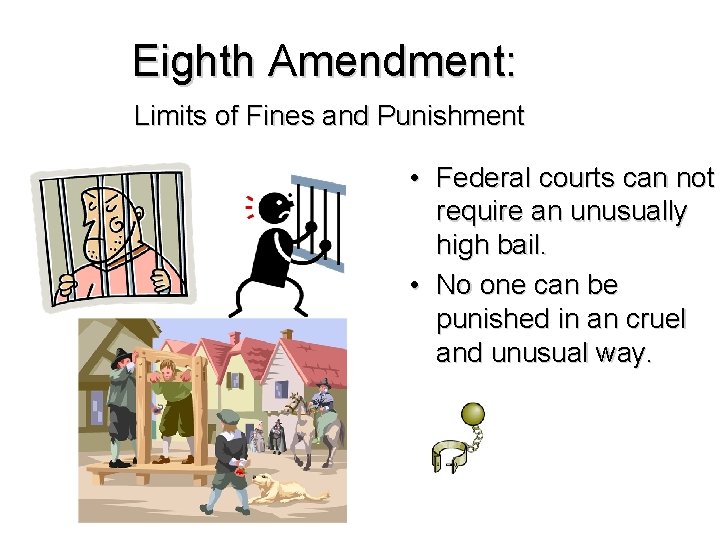
Eighth Amendment: Limits of Fines and Punishment • Federal courts can not require an unusually high bail. • No one can be punished in an cruel and unusual way.

9 th Amendment: Rights Kept By The People • “The enumeration in the Constitution, of certain rights, shall not be construed to deny or disparage others retained by the people. ” • The Ninth Amendment never lists exactly what rights are "retained by the people. " That's sort of the whole point of the amendment. Different people have different ideas as to what these rights may be. Can you think of some "rights" you think are still held by the people? Here a few examples: • The right to eat junk food • The right to dye your hair green • The right to refuse medical treatment 25
10 th Amendment: Rights Kept By the States or the People The powers not delegated to the United States by the Constitution, nor prohibited by it to the states, are reserved to the states respectively, or to the people. • The Supreme Court has declared that the 10 th Amendment is a truism. This means that the amendment doesn't really add anything new to the Constitution. It was just put in place to emphasize that the Federal Government has jurisdiction over some things and state governments have jurisdiction over other things. • Examples: The states determine the rules for marriages, divorces, driving licenses, voting, state taxes, job and school requirements, rules for police and fire departments, and many more. 26
- Slides: 26