
Principles of good assessment theory and practice David
- Slides: 20
Principles of good assessment: theory and practice David Nicol, Project Director, Re-Engineering Assessment Practices, University of Strathclyde, Scotland www. reap. ac. uk Assessment Design for International Online Conference, Assessment for. Learner Responsbility 29 -31 st May 2007 29 -31 May 2007 Responsibility
Plan • • The purposes of assessment Who is involved in assessment and how Why are assessment principles important? What makes a good principle? Ten assessment and feedback principles Dimensions and dynamics of implementation Application of principles to first year courses Issues and reflections on principles 29 -31 May 2007 Assessment Design for Learner Responsibility 2
The purpose of assessment • Assessment for and of learning (Black and Wiliam, 1998) • Student-centred assessment • My definition: assessment should support the development of learner self-regulation (or autonomy in learning). • Students should learn to monitor, manage, self-assess their own learning. • In practice, professionals formulate their own criteria and assess their performance against them 29 -31 May 2007 Assessment Design for Learner Responsibility 3
Some research findings • Students are always engaged in self-assessment/selfregulation of their own learning (Winne, 2005; Black & Wiliam, 2005). Logically entailed by constructivist thinking. • The act of using teacher feedback implies that selfassessment must be present (Sadler, 1983, Nicol and Macfarlane-Dick, 2006) • The question is: how can we scaffold students’ learning so they become better at self-regulation? (Lajoie, 2005) 29 -31 May 2007 Assessment Design for Learner Responsibility 4
Why are principles important? • Guide and inform teaching practice. Original seven linked to research + included tips and strategies for implementation (see Nicol and Macfarlane-Dick, 2006) • Inform institutional assessment strategies for assessment (e. g. Universities of Melbourne and Strathclyde) • Used to inform application of technology to support assessment (e. g. Nicol and Milligan, 2006: Nicol, 2007, JISC Guide, 2007) 29 -31 May 2007 Assessment Design for Learner Responsibility 5
What makes a good principle? 1. Capture a core idea from published research 2. Broad relevance – many ways of implementing 3. Minimal overlap with each other 4. Effectiveness higher the when more principles are operationalised in same learning design 5. Support design and evaluation of or implemention 29 -31 May 2007 Assessment Design for Learner Responsibility 6
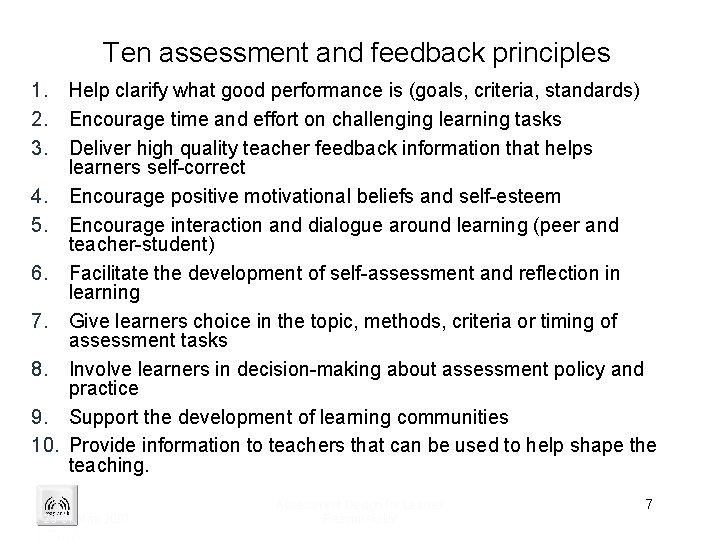
Ten assessment and feedback principles 1. 2. 3. Help clarify what good performance is (goals, criteria, standards) Encourage time and effort on challenging learning tasks Deliver high quality teacher feedback information that helps learners self-correct 4. Encourage positive motivational beliefs and self-esteem 5. Encourage interaction and dialogue around learning (peer and teacher-student) 6. Facilitate the development of self-assessment and reflection in learning 7. Give learners choice in the topic, methods, criteria or timing of assessment tasks 8. Involve learners in decision-making about assessment policy and practice 9. Support the development of learning communities 10. Provide information to teachers that can be used to help shape the teaching. 29 -31 May 2007 Assessment Design for Learner Responsibility 7
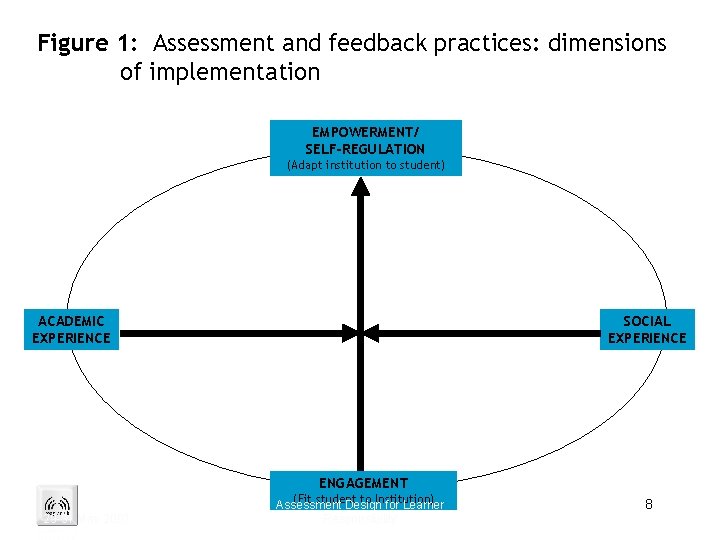
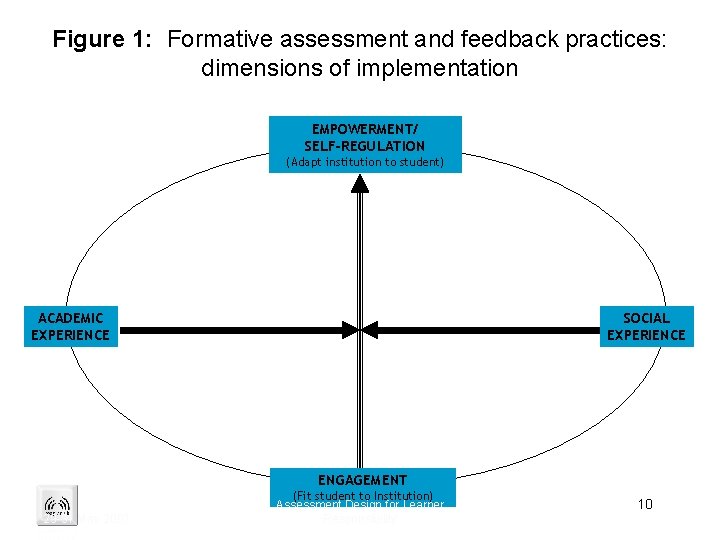
Figure 1: Assessment and feedback practices: dimensions of implementation EMPOWERMENT/ SELF-REGULATION (Adapt institution to student) ACADEMIC EXPERIENCE SOCIAL EXPERIENCE ENGAGEMENT 29 -31 May 2007 (Fit student to Institution) Assessment Design for Learner Responsibility 8
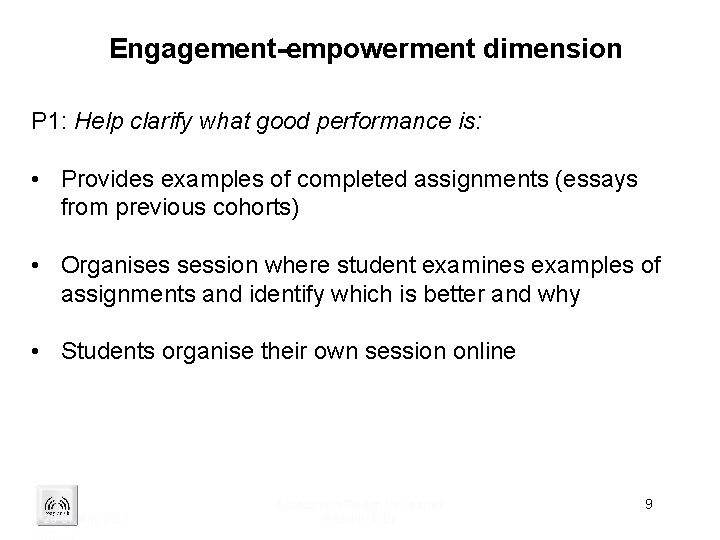
Engagement-empowerment dimension P 1: Help clarify what good performance is: • Provides examples of completed assignments (essays from previous cohorts) • Organises session where student examines examples of assignments and identify which is better and why • Students organise their own session online 29 -31 May 2007 Assessment Design for Learner Responsibility 9
Figure 1: Formative assessment and feedback practices: dimensions of implementation EMPOWERMENT/ SELF-REGULATION (Adapt institution to student) ACADEMIC EXPERIENCE SOCIAL EXPERIENCE ENGAGEMENT 29 -31 May 2007 (Fit student to Institution) Assessment Design for Learner Responsibility 10
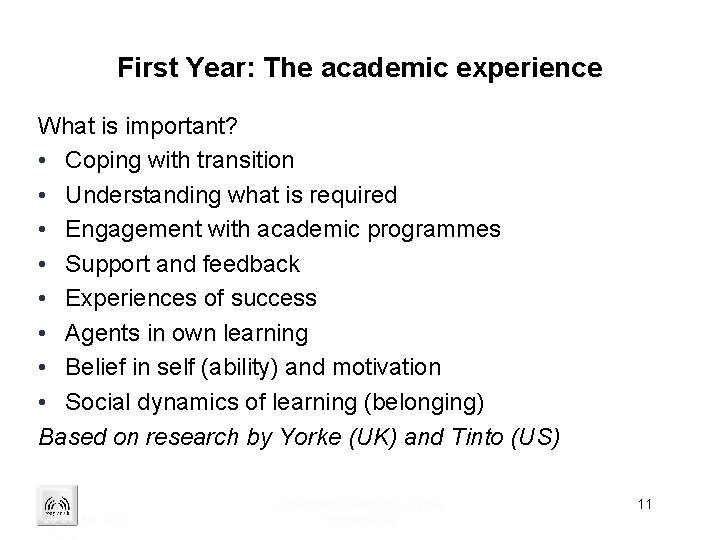
First Year: The academic experience What is important? • Coping with transition • Understanding what is required • Engagement with academic programmes • Support and feedback • Experiences of success • Agents in own learning • Belief in self (ability) and motivation • Social dynamics of learning (belonging) Based on research by Yorke (UK) and Tinto (US) 29 -31 May 2007 Assessment Design for Learner Responsibility 11
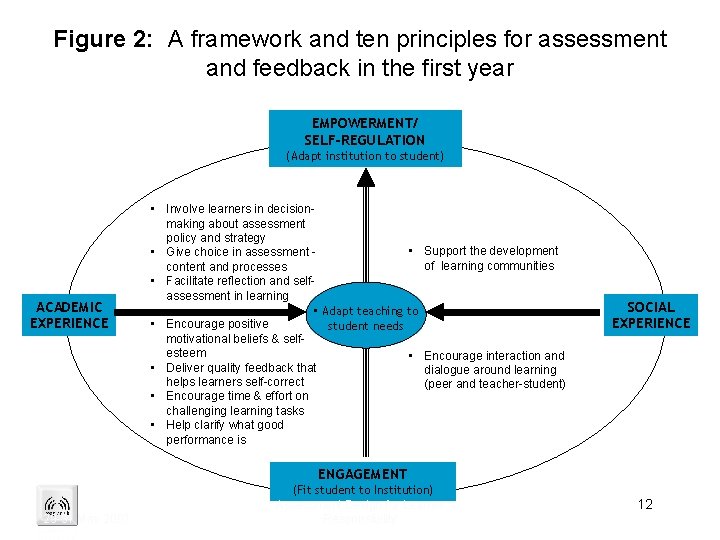
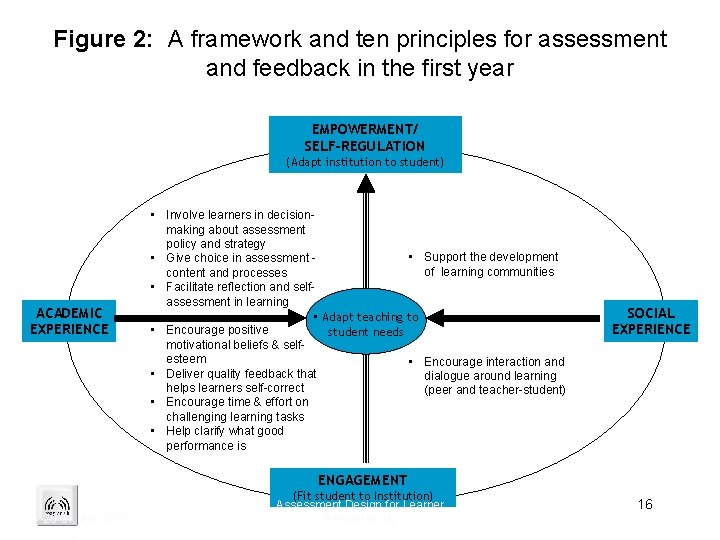
Figure 2: A framework and ten principles for assessment and feedback in the first year EMPOWERMENT/ SELF-REGULATION (Adapt institution to student) ACADEMIC EXPERIENCE • Involve learners in decisionmaking about assessment policy and strategy • • Give choice in assessment content and processes • Facilitate reflection and selfassessment in learning • Adapt teaching to • Encourage positive student needs motivational beliefs & selfesteem • • Deliver quality feedback that helps learners self-correct • Encourage time & effort on challenging learning tasks • Help clarify what good performance is Support the development of learning communities SOCIAL EXPERIENCE Encourage interaction and dialogue around learning (peer and teacher-student) ENGAGEMENT 29 -31 May 2007 (Fit student to Institution) Assessment Design for Learner Responsibility 12
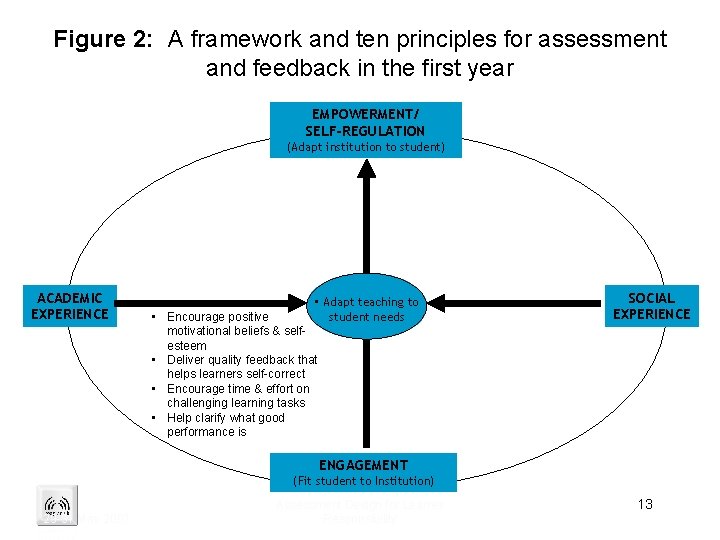
Figure 2: A framework and ten principles for assessment and feedback in the first year EMPOWERMENT/ SELF-REGULATION (Adapt institution to student) ACADEMIC EXPERIENCE • Adapt teaching to student needs • Encourage positive motivational beliefs & selfesteem • Deliver quality feedback that helps learners self-correct • Encourage time & effort on challenging learning tasks • Help clarify what good performance is SOCIAL EXPERIENCE ENGAGEMENT (Fit student to Institution) 29 -31 May 2007 Assessment Design for Learner Responsibility 13
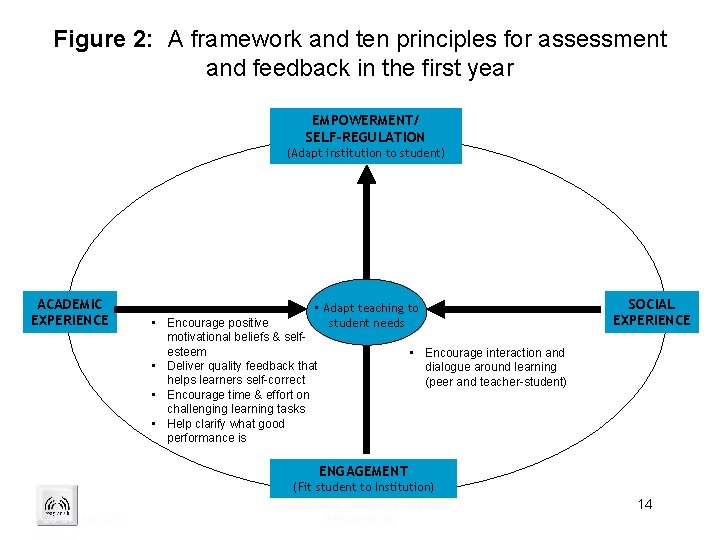
Figure 2: A framework and ten principles for assessment and feedback in the first year EMPOWERMENT/ SELF-REGULATION (Adapt institution to student) ACADEMIC EXPERIENCE • Adapt teaching to student needs • Encourage positive motivational beliefs & selfesteem • Deliver quality feedback that helps learners self-correct • Encourage time & effort on challenging learning tasks • Help clarify what good performance is SOCIAL EXPERIENCE • Encourage interaction and dialogue around learning (peer and teacher-student) ENGAGEMENT 29 -31 May 2007 (Fit student to Institution) Assessment Design for Learner Responsibility 14
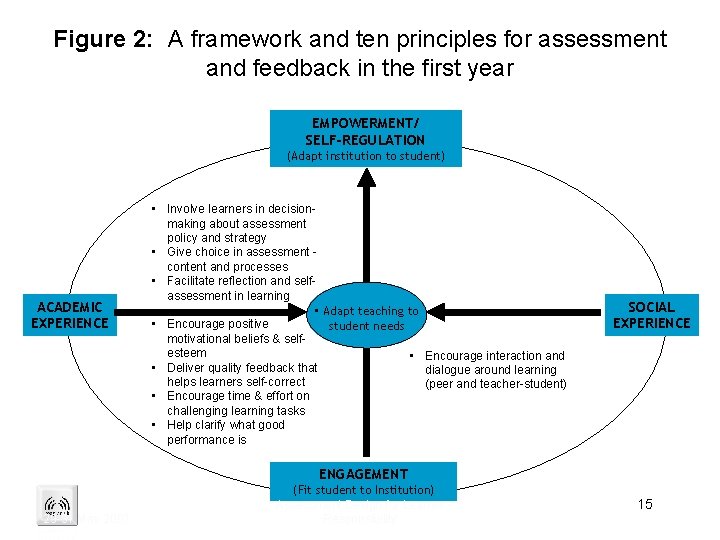
Figure 2: A framework and ten principles for assessment and feedback in the first year EMPOWERMENT/ SELF-REGULATION (Adapt institution to student) ACADEMIC EXPERIENCE • Involve learners in decisionmaking about assessment policy and strategy • Give choice in assessment content and processes • Facilitate reflection and selfassessment in learning • Adapt teaching to • Encourage positive student needs motivational beliefs & selfesteem • Encourage interaction and • Deliver quality feedback that dialogue around learning helps learners self-correct (peer and teacher-student) • Encourage time & effort on challenging learning tasks • Help clarify what good performance is SOCIAL EXPERIENCE ENGAGEMENT 29 -31 May 2007 (Fit student to Institution) Assessment Design for Learner Responsibility 15
Figure 2: A framework and ten principles for assessment and feedback in the first year EMPOWERMENT/ SELF-REGULATION (Adapt institution to student) ACADEMIC EXPERIENCE • Involve learners in decisionmaking about assessment policy and strategy • • Give choice in assessment content and processes • Facilitate reflection and selfassessment in learning • Adapt teaching to • Encourage positive student needs motivational beliefs & selfesteem • • Deliver quality feedback that helps learners self-correct • Encourage time & effort on challenging learning tasks • Help clarify what good performance is Support the development of learning communities SOCIAL EXPERIENCE Encourage interaction and dialogue around learning (peer and teacher-student) ENGAGEMENT 29 -31 May 2007 (Fit student to Institution) Assessment Design for Learner Responsibility 16
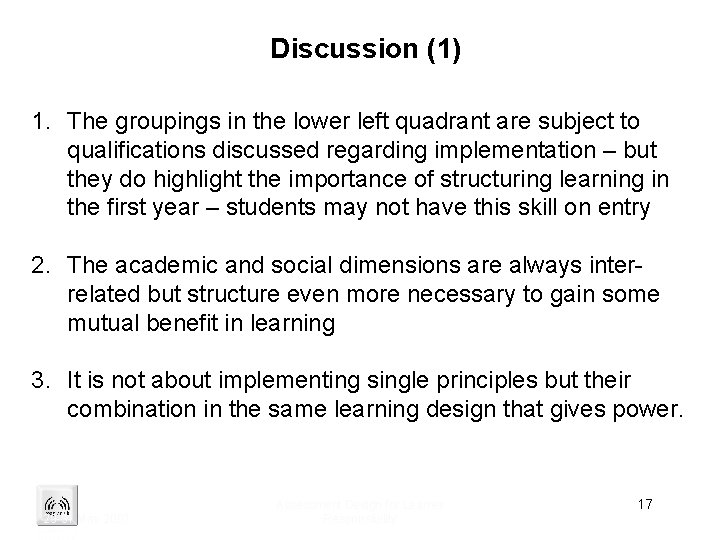
Discussion (1) 1. The groupings in the lower left quadrant are subject to qualifications discussed regarding implementation – but they do highlight the importance of structuring learning in the first year – students may not have this skill on entry 2. The academic and social dimensions are always interrelated but structure even more necessary to gain some mutual benefit in learning 3. It is not about implementing single principles but their combination in the same learning design that gives power. 29 -31 May 2007 Assessment Design for Learner Responsibility 17
Discussion (2) 4. Conflict across the principles in implementation eg creating structure (principle 2) and giving choice and flexibility in study (principle 7 5. And in giving freedom and encouraging group working 29 -31 May 2007 Assessment Design for Learner Responsibility 18
Conclusion 1. Are the principles described here useful in thinking about assessment and feedback practices? 2. What are the gaps or omissions? 3. How could they be improved? 29 -31 May 2007 Assessment Design for Learner Responsibility 19
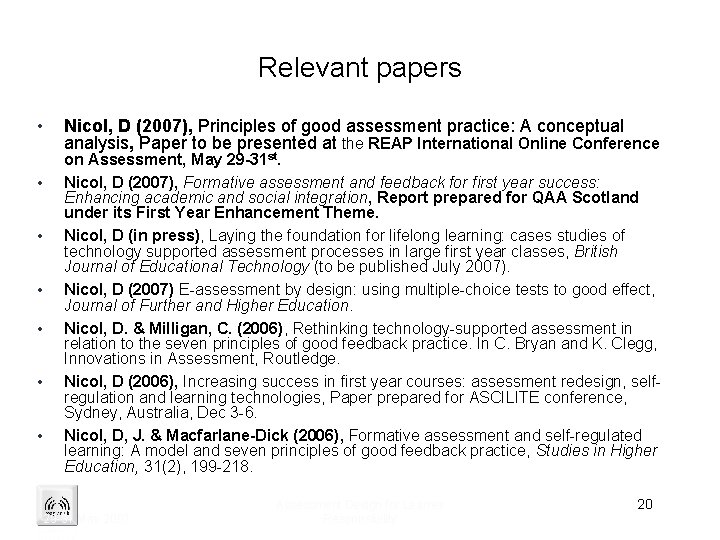
Relevant papers • • Nicol, D (2007), Principles of good assessment practice: A conceptual analysis, Paper to be presented at the REAP International Online Conference on Assessment, May 29 -31 st. Nicol, D (2007), Formative assessment and feedback for first year success: Enhancing academic and social integration, Report prepared for QAA Scotland under its First Year Enhancement Theme. Nicol, D (in press), Laying the foundation for lifelong learning: cases studies of technology supported assessment processes in large first year classes, British Journal of Educational Technology (to be published July 2007). Nicol, D (2007) E-assessment by design: using multiple-choice tests to good effect, Journal of Further and Higher Education. Nicol, D. & Milligan, C. (2006), Rethinking technology-supported assessment in relation to the seven principles of good feedback practice. In C. Bryan and K. Clegg, Innovations in Assessment, Routledge. Nicol, D (2006), Increasing success in first year courses: assessment redesign, selfregulation and learning technologies, Paper prepared for ASCILITE conference, Sydney, Australia, Dec 3 -6. Nicol, D, J. & Macfarlane-Dick (2006), Formative assessment and self-regulated learning: A model and seven principles of good feedback practice, Studies in Higher Education, 31(2), 199 -218. 29 -31 May 2007 Assessment Design for Learner Responsibility 20