
Principles of Furniture Joinery Design Semester 1 2

- Slides: 14
Principles of Furniture & Joinery Design Semester 1 & 2 Jennifer Byrne 2016 1
Principles of Furniture & Joinery Design n n n n 10 ECT module Semester 1 = 50% 5 ECT aprox 100 learning hours Semester 1 Class contact 36 hrs Independent Learning aprox. 64 hrs Blended learning consisting of class contact and online learning and research. No Final exam. Portfolio of coursework Jennifer Byrne 2016 2
Principles of Furniture & Joinery Design Linked module : n Principles of Furniture & Joinery Design 10 Ects n Bespoke Machining Techniques & Furniture 2 10 Ects n 3 D CAD 5 Ects n Wood Finishing 10 Ects n n One project is common to all of the above modules with many learning outcomes from each module being assessed using this project. Jennifer Byrne 2016 3
Module Descriptor n n n This module introduces the student to the concepts of design with regard to creating bespoke items of Furniture / Joinery. It enables them to explore and understand the process from conception through to tender, from designing from a brief to sourcing materials, to evaluating production costs, to presentation. The module is also designed to provide the student with theoretical knowledge of the history and development of Furniture / Joinery. Jennifer Byrne 2016 4
Module Aim n n n The aim of this module is to provide the student with the tools and knowledge to design and create items to the description in a given brief. By completing the design process from start to finish the student will be provided with the confidence to go out into the work force with a better understanding of the whole designing process in relation to real life business. It also aims to supply students with theoretical information to manufacture furniture and joinery. Jennifer Byrne 2016 5
Module Aim (Cont. ) n n To familiarise students with the process of laminating, bending and shaping timber as required for furniture and joinery construction. To ensure students recognise details of historical furniture and joinery and to understand the development of period furniture and joinery styles. Jennifer Byrne 2016 6
Learning Outcomes: n n Appreciate the various stages of the design process. Apply techniques, processes and methodologies for creating designs. Recognise and sketch the features and characteristics of historical furniture and joinery. Demonstrate an understanding of theoretical elements and their application as required in the construction of furniture and joinery Jennifer Byrne 2016 7
Learning Outcomes: (Cont) n n n Display theoretical knowledge of the lamination, bending and shaping of component parts. Display theoretical knowledge of constructing veneered patterns. Measure, design and draw out plans for a kitchen& produce a materials list and costing for same. Carry out research on a designer and or artefact. Given a brief, produce a detailed report from designing through to the completion of the end product including a 10 min oral presentation. Jennifer Byrne 2016 8
Module Content: n n n Design Process: various methods used for design process Creation: using creative thinking to create 3 D designs, showcase them by freehand or CAD drawings Material selection: Understanding the limits of different materials and knowing the jointing used in various situations. Application of problem solving techniques, methods and processes. Furniture / Joinery manufacturing theory. Timber laminations, bending and shaping. Jennifer Byrne 2016 9
Module Content: (Cont. ) n n n Pattern veneering. Furniture and joinery sizes. History of furniture / Joinery Communication : Expand on previous communication skills and include them in the over all process of dealing with a customer’s brief. Carry out research on a designer and or artefact. Kitchen design and planning. Jennifer Byrne 2016 10
Module Delivery n n Contact time 3 hours per week for two semesters. Students are expected to practice, complete, or expand on class work outside class hours. Independent learning is further encouraged through course-work projects. Group learning and peer learning is encouraged in classroom activities and coursework. Jennifer Byrne 2016 11
Course-work: Assignment n n n Completed Portfolio of Coursework: Numerous course-work projects covering all of the learning out comes. Design an item of furniture or joinery given a brief/specification demonstrating an understanding of the module content. Assignments will be issued to cover the areas outlined in the Module Content. Complete a detailed project from a given brief Evidence of a depth of understanding of areas of theory relevant to the development of the projects Oral Presentations 10 minute Jennifer Byrne 2016 12
Course-work: Assignment n n n Course-work: Assignments Design the artefact. Supply evidence of a depth of understanding of areas of theory relevant to the development of the project. Supply materials list, cutting list, work schedule, sequence of events sketches and working drawings of table. Oral Presentation 10 minute Jennifer Byrne 2016 13
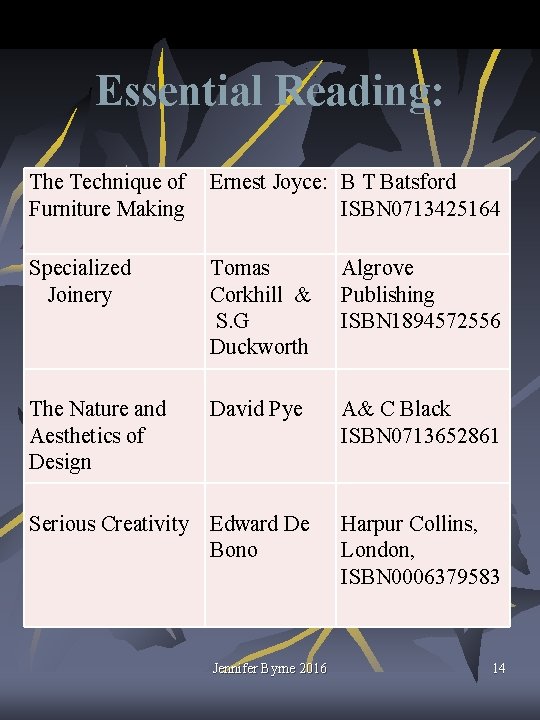
Essential Reading: The Technique of Ernest Joyce: B T Batsford Furniture Making ISBN 0713425164 Specialized Joinery Tomas Corkhill & S. G Duckworth Algrove Publishing ISBN 1894572556 The Nature and Aesthetics of Design David Pye A& C Black ISBN 0713652861 Serious Creativity Edward De Bono Jennifer Byrne 2016 Harpur Collins, London, ISBN 0006379583 14