
Principles of Freedom American Government 1 st Principle

- Slides: 50
Principles of Freedom American Government
1 st Principle “Natural Law” • • Natural law is eternal and universal. Be obedient to authority. Love thy neighbor as thyself. Is necessary to build a moral and virtuous society. • All mankind can be taught virtue.
2 nd Principle People Can’t Survive Unless They Remain Virtuous & Morally Strong • As nations become corrupted and vicious, they have more need of masters. • People need to be industrious, frugal & honest. • The way to pacify and change a culture is to have people only desire “luxury, indolence, amusement & pleasure”. • Other ways for a society to see its downfall are to become obsessed with self-interest, neglect public affairs and a general disdain for the needs of the community as a whole. • Virtue has to be earned and it has to be learned. . • The American founders looked to the home, the school and the churches to fuel the fires of virtue from generation to generation.
3 rd Principle “Elect Virtuous Leaders” • Public officials should not be chosen if they are lacking in experience, training, proven virtue and demonstrated wisdom. James Madison once said: “if men were angels, no government would be necessary. If angels were to govern men, neither external nor internal controls on government would be necessary” • Every leader should have to rise to his office on personal merit, not the wealth and reputation of his ancestors. • Founders believed the best citizens should accept major roles in public life.
Making Public Office an Honor Rather than a Position of Profit • Violent struggles for appointments to public office because they paid so well in 17 th &18 th century Europe • Benjamin Franklin warned that high salaries for government officials are the best way to attract scoundrels and drive from the halls of public office those men who possess true merit and virtue. • Current Presidential Salary= $400, 000 • Current Congressional Salary= $174, 000 • Governor Salary=Maine @$70, 000 to California @ $206, 500. • Average Salary in America: under 50 K
4 th Principle “Without Religion the Government of a Free People Cannot be Maintained” • In the days of the American founders, a formal education was to include the concepts of religion, morality and knowledge, but not any one formal religion (such as what had happened in England) • The only religious tenets to be taught in schools (Founders view) were to be those which were universally accepted by all religious faiths and completely fundamental in their premise.
American Founders Campaign for Equality of All Religions • Wanted to provide legal equality for all religions, both Christian and non-Christian; no other nation had ever successfully achieved this ideal. • Thomas Jefferson sought to dis-establish the official church of Virginia; this was accomplished in 1786. • James Madison was adamant: “state government should not prefer one religion over another” • 1 st Amendment—”Congress shall make NO law respecting an establishment of religion, OR prohibiting the free exercise thereof”
5 th Principle All Men are Created Equal • Everyone knows that no two human beings are exactly alike in any respect. They are different when they are born, exhibiting different natural skills and acquiring different tastes. • Humans vary in physical strength, mental capacity, emotional stability, inherited social status, in their opportunities and a host of other areas of life.
How Can Men Be Equal? 1. Be treated as equals in the sight of God 2. Be treated as equals in the sight of Law 3. Be treated as equals in the protection of their rights. It is the task of society to accept people in all their vast array of individual differences, but treat them as equals when it comes to their role as human beings.
What it Means to have “Equal Rights” 1. 2. 3. 4. 5. 6. The Goal of society is to provide “equal justice”, which means protecting the rights of the people equally: To vote for a candidate of your choice. To obtain an education. To compete for a job. To purchase a home. To enjoy freedom of religion. To enjoy freedom of speech.
What it Means to have “Equal Rights” 7. At the microphone or before the TV cameras, to present views on the issues of the day. 8. At the meeting hall, to peaceably assemble. 9. At the print shop, to enjoy the freedom of the press. 10. At the store, to buy the essentials or desirable things of life. 11. At the bank, to save and prosper. 12. At the tax collectors office, to pay no more than their fare share. 13. At the probate court, to pass on to theirs the fruits of life’s labors. 14. At the bar of justice, to secure their rights.
6 th Principle Proper Role of Government is to Protect Equal Rights, Not Provide Equal Things • In Europe, during the days of the American Revolution, it was popular to proclaim that the role of government was to take from the “haves” and give to the have nots” so that all might be truly equal. • The American Founders perceived this proposition to contain a major fallacy---people cannot delegate to their government the power to do anything except that which they have the lawful right to do themselves. • Every person is entitled to protection of his life and property—therefore perfectly legitimate to delegate to the government the task of setting up a police force to protect the lives and property of all people.
Making America Prosperous What is the Formula?
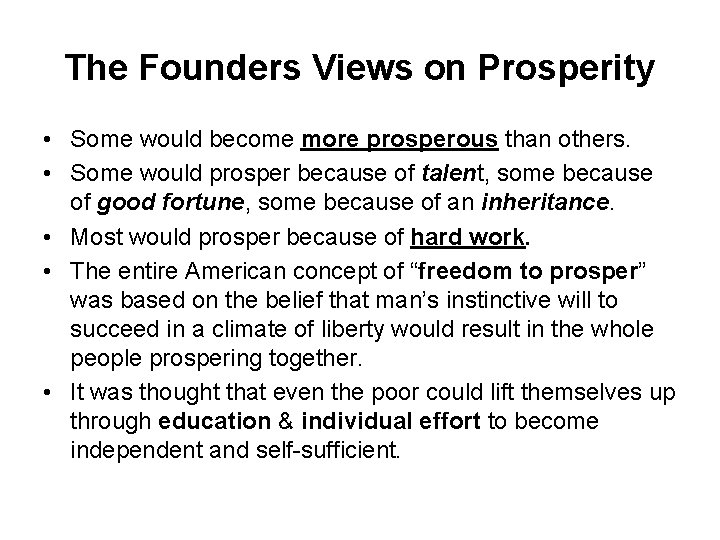
The Founders Views on Prosperity • Some would become more prosperous than others. • Some would prosper because of talent, some because of good fortune, some because of an inheritance. • Most would prosper because of hard work. • The entire American concept of “freedom to prosper” was based on the belief that man’s instinctive will to succeed in a climate of liberty would result in the whole people prospering together. • It was thought that even the poor could lift themselves up through education & individual effort to become independent and self-sufficient.
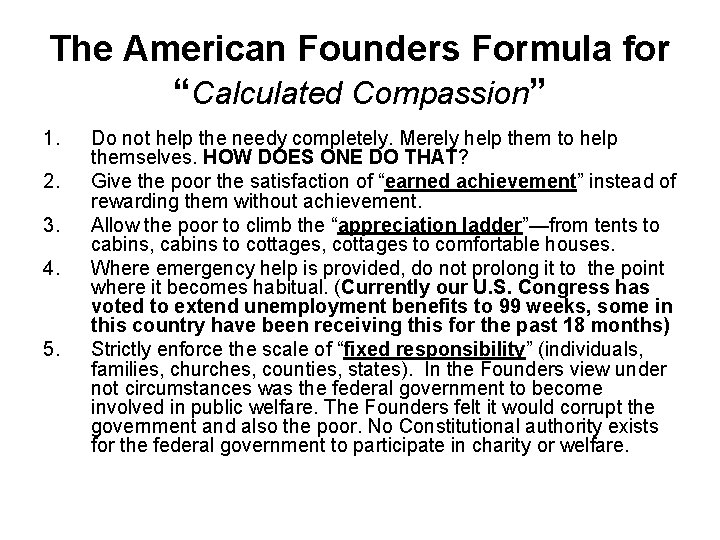
The American Founders Formula for “Calculated Compassion” 1. 2. 3. 4. 5. Do not help the needy completely. Merely help them to help themselves. HOW DOES ONE DO THAT? Give the poor the satisfaction of “earned achievement” instead of rewarding them without achievement. Allow the poor to climb the “appreciation ladder”—from tents to cabins, cabins to cottages, cottages to comfortable houses. Where emergency help is provided, do not prolong it to the point where it becomes habitual. (Currently our U. S. Congress has voted to extend unemployment benefits to 99 weeks, some in this country have been receiving this for the past 18 months) Strictly enforce the scale of “fixed responsibility” (individuals, families, churches, counties, states). In the Founders view under not circumstances was the federal government to become involved in public welfare. The Founders felt it would corrupt the government and also the poor. No Constitutional authority exists for the federal government to participate in charity or welfare.
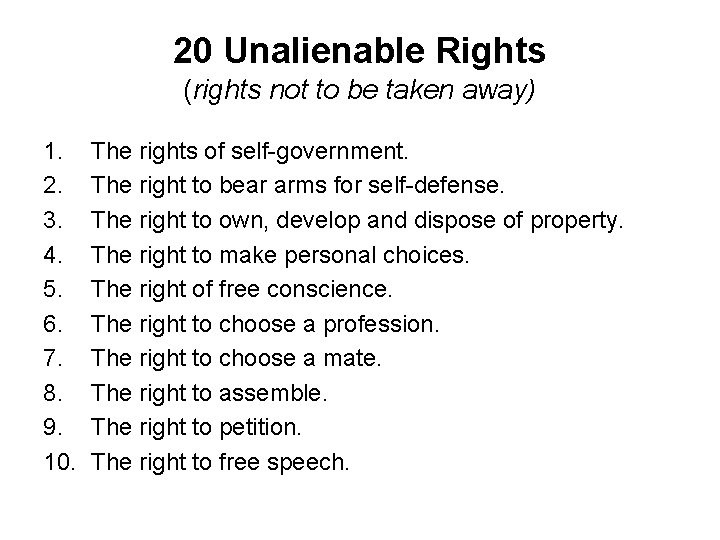
20 Unalienable Rights (rights not to be taken away) 1. 2. 3. 4. 5. 6. 7. 8. 9. 10. The rights of self-government. The right to bear arms for self-defense. The right to own, develop and dispose of property. The right to make personal choices. The right of free conscience. The right to choose a profession. The right to choose a mate. The right to assemble. The right to petition. The right to free speech.
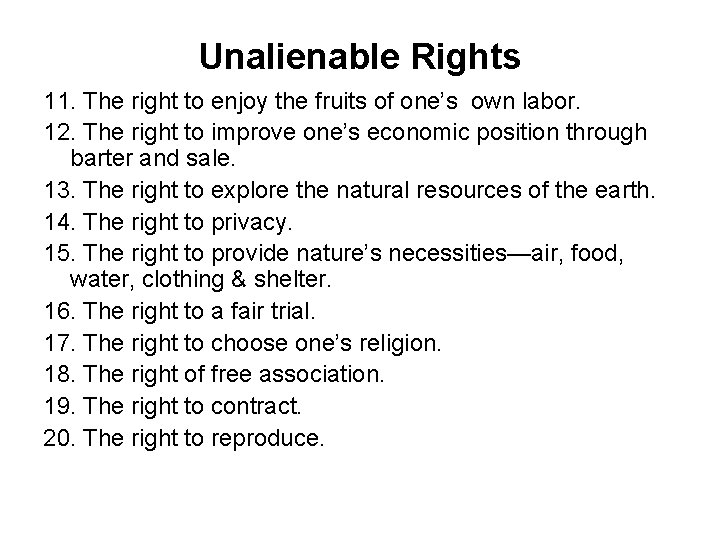
Unalienable Rights 11. The right to enjoy the fruits of one’s own labor. 12. The right to improve one’s economic position through barter and sale. 13. The right to explore the natural resources of the earth. 14. The right to privacy. 15. The right to provide nature’s necessities—air, food, water, clothing & shelter. 16. The right to a fair trial. 17. The right to choose one’s religion. 18. The right of free association. 19. The right to contract. 20. The right to reproduce.
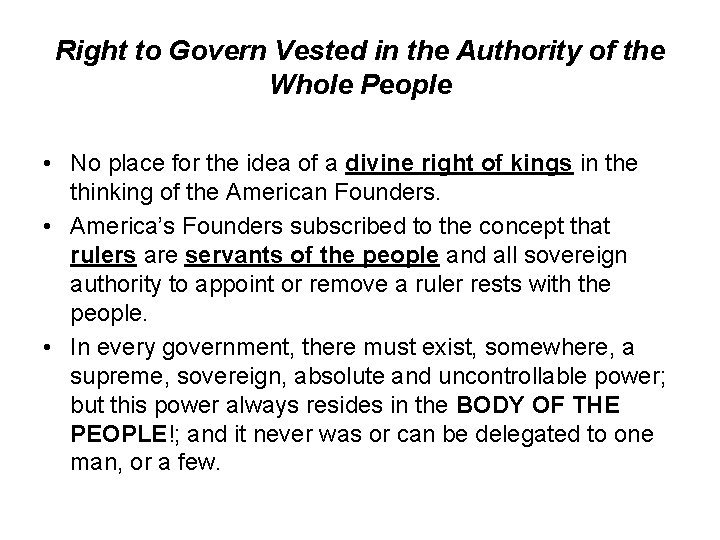
Right to Govern Vested in the Authority of the Whole People • No place for the idea of a divine right of kings in the thinking of the American Founders. • America’s Founders subscribed to the concept that rulers are servants of the people and all sovereign authority to appoint or remove a ruler rests with the people. • In every government, there must exist, somewhere, a supreme, sovereign, absolute and uncontrollable power; but this power always resides in the BODY OF THE PEOPLE!; and it never was or can be delegated to one man, or a few.
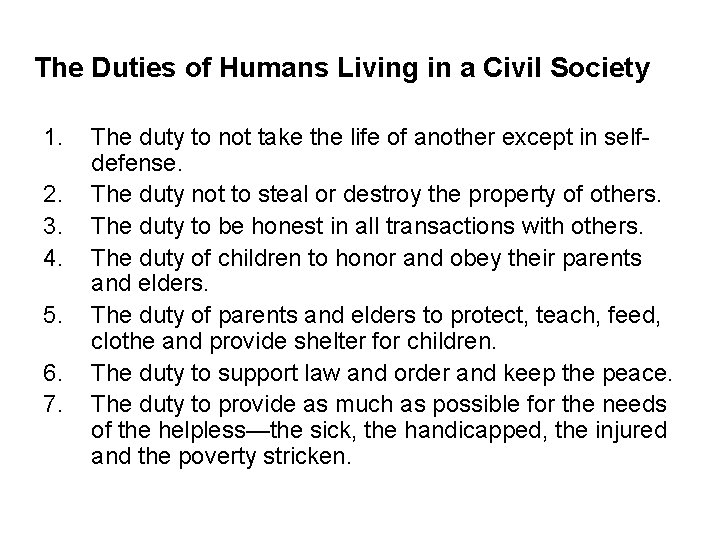
The Duties of Humans Living in a Civil Society 1. 2. 3. 4. 5. 6. 7. The duty to not take the life of another except in selfdefense. The duty not to steal or destroy the property of others. The duty to be honest in all transactions with others. The duty of children to honor and obey their parents and elders. The duty of parents and elders to protect, teach, feed, clothe and provide shelter for children. The duty to support law and order and keep the peace. The duty to provide as much as possible for the needs of the helpless—the sick, the handicapped, the injured and the poverty stricken.
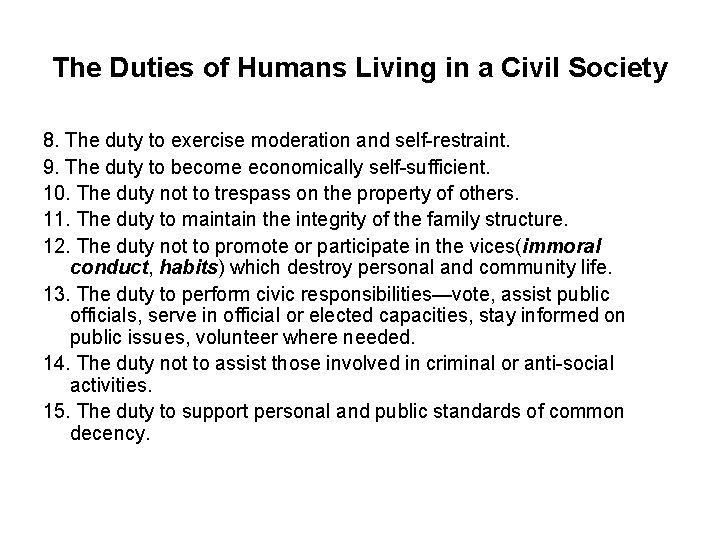
The Duties of Humans Living in a Civil Society 8. The duty to exercise moderation and self-restraint. 9. The duty to become economically self-sufficient. 10. The duty not to trespass on the property of others. 11. The duty to maintain the integrity of the family structure. 12. The duty not to promote or participate in the vices(immoral conduct, habits) which destroy personal and community life. 13. The duty to perform civic responsibilities—vote, assist public officials, serve in official or elected capacities, stay informed on public issues, volunteer where needed. 14. The duty not to assist those involved in criminal or anti-social activities. 15. The duty to support personal and public standards of common decency.
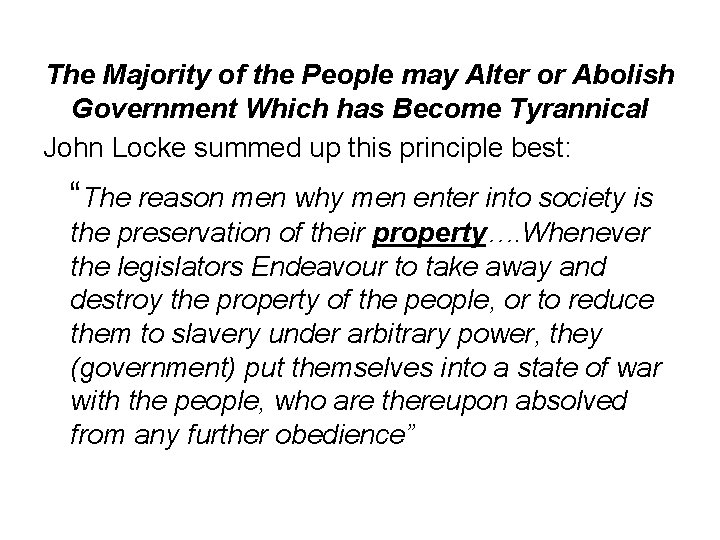
The Majority of the People may Alter or Abolish Government Which has Become Tyrannical John Locke summed up this principle best: “The reason men why men enter into society is the preservation of their property…. Whenever the legislators Endeavour to take away and destroy the property of the people, or to reduce them to slavery under arbitrary power, they (government) put themselves into a state of war with the people, who are thereupon absolved from any further obedience”
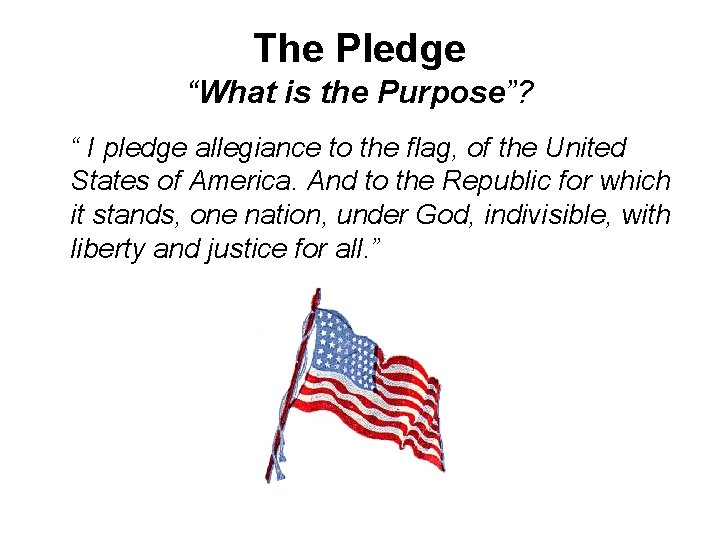
The Pledge “What is the Purpose”? “ I pledge allegiance to the flag, of the United States of America. And to the Republic for which it stands, one nation, under God, indivisible, with liberty and justice for all. ”
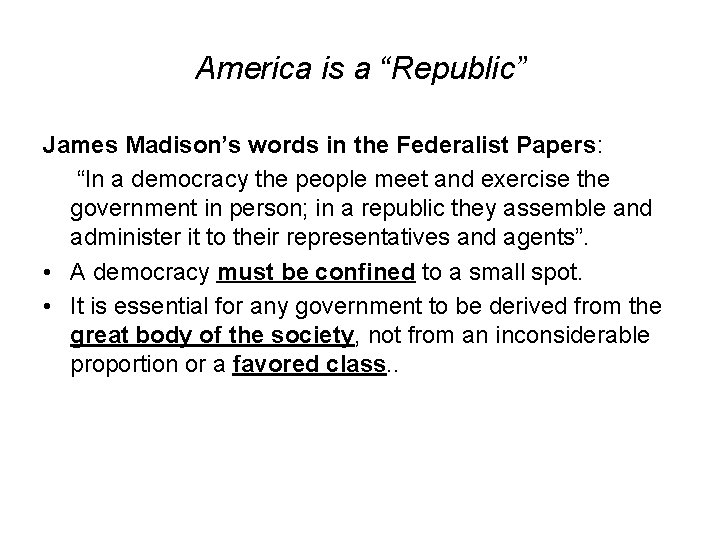
America is a “Republic” James Madison’s words in the Federalist Papers: “In a democracy the people meet and exercise the government in person; in a republic they assemble and administer it to their representatives and agents”. • A democracy must be confined to a small spot. • It is essential for any government to be derived from the great body of the society, not from an inconsiderable proportion or a favored class. .
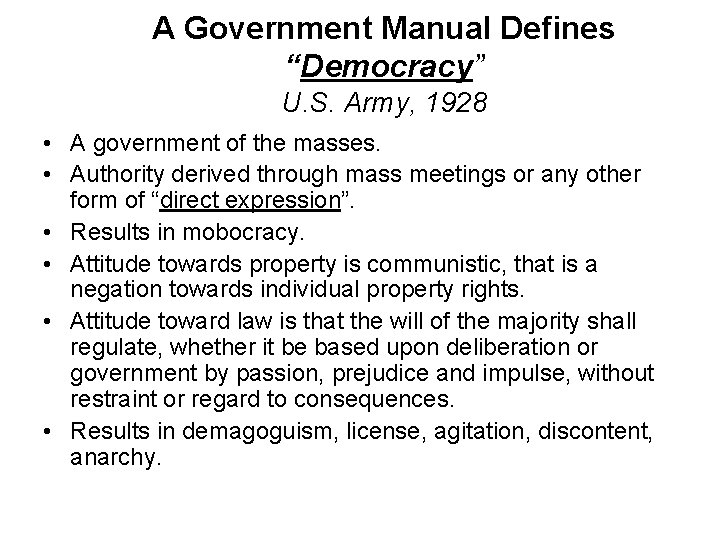
A Government Manual Defines “Democracy” U. S. Army, 1928 • A government of the masses. • Authority derived through mass meetings or any other form of “direct expression”. • Results in mobocracy. • Attitude towards property is communistic, that is a negation towards individual property rights. • Attitude toward law is that the will of the majority shall regulate, whether it be based upon deliberation or government by passion, prejudice and impulse, without restraint or regard to consequences. • Results in demagoguism, license, agitation, discontent, anarchy.
11 th Principle A Constitution Should be Structured to Permanently Protect the People from the Human Frailties of their Rulers • America’s Founders believed the greatest danger arises when a leader is so completely trusted that the people feel no anxiety to watch him. • People are commonly most in danger when the means of injuring their rights are in the possession of those whom they entertain the least suspicion. • The purpose of a constitution is to define the area in which a public official can serve to his utmost ability, but at the same time provide strict limitations to chain him down from mischief. • The founders knew from experience that the loss of freedom through the gradual erosion of Constitutional principles is not always so obvious that the people can readily detect it.
Life and Liberty are Secure Only so Long as the Right to Property is Secure 1. 2. 3. 4. Four Things Would Occur Without Property Rights: The incentive of an industrious person to develop and improve more property would be destroyed. The industrious individual would also be deprived of the fruits of his labor. Marauding bands of individuals would be tempted to go about the country confiscating by force and violence the good things which others had provided for themselves. Mankind would be impelled to remain on a bare subsistence level of hand to mouth survival because the accumulation of anything would invite attack.
A Person’s Property is a Protection of Life Itself • All property is an extension of a person’s life, energy and ingenuity. • To destroy or confiscate property is, in reality, an attack on the essence of life itself. • A person who has worked to cultivate a farm, obtain food by hunting, carved a beautiful statue, or secured a wage for his labor has projected his very being, the very essence of his life, into that labor. • According to Former President Abraham Lincoln, “Property is desirable, is a positive good in the world. That some should be rich shows that others may become rich and is encouragement to industry and enterprise. Let not him who is houseless pull down the house of another, but let him work diligently to build one for himself, thus by example assuring this own shall be safe from violence”
Property Rights Essential to Liberty • Founder John Adams saw private property as the most important single foundation under girding our human liberty and human happiness: “The moment the idea is admitted into society that property is not as sacred as the laws of God, and that there is not a force of law and public justice to protect it, anarchy and tyranny commences”
Should Government Take from the “Have’s” & Give to the “Have Nots”? • According to our nation’s founders, one of the worst sins of government was the exercise of its coercive taxing powers to take property from one group and give it to another. • Founders believed property rights were the foundation of all civilizations. • Only nations committed to the principles of private property have risen above poverty and produced great works of science, art & literature.
Caring for the Poor Question: if it corrupts a society for the government to take care of the poor by violating the principle of property rights the question that has to be asked is who will look out for those who are “supposedly” taking care of the poor? Answer: Anybody but the federal government. Until the dawn of the 1930 s, help was given almost exclusively by the private sector (businesses), community or state.
People may Support the Government. . The Government should not support the people • The obligation of government is to protect people, not take care of them. • In the words of former President Grover Cleveland: “The friendliness and charity of our countrymen can always be relied upon to relieve their fellow citizens in misfortune”
The Highest Level of Prosperity Occurs when there is a Free-Market Economy & a Minimum of Government Regulations 1. 2. 3. 4. 5. 6. Specialized Production: allow each person or corporation of persons to do what they do best. Exchange of goods takes place in a free market environment without governmental interference in production, prices or wages. Supply and demand—no government imposed monopolies. Prices regulated by competition on the basis of supply and demand. Profits—the means why which production of goods and services is worthwhile. Competition is seen as the means by which quality is improved, quantity increased and prices reduced.
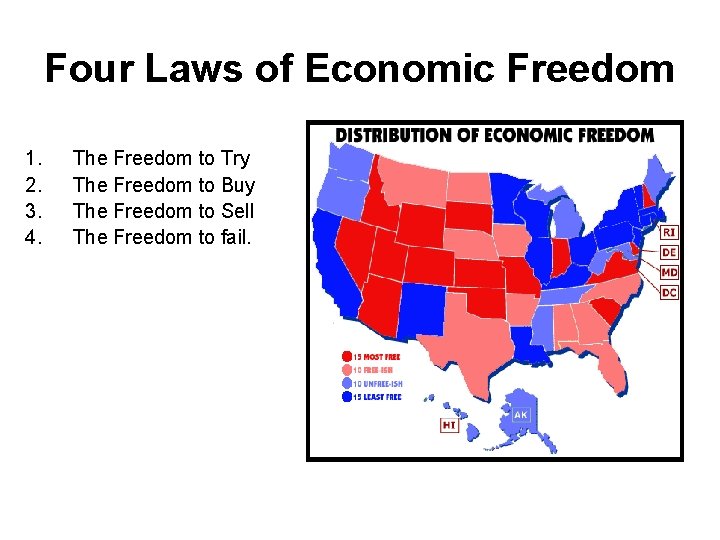
Four Laws of Economic Freedom 1. 2. 3. 4. The Freedom to Try The Freedom to Buy The Freedom to Sell The Freedom to fail.
Early 20 th Century America “What Happened? ” • 1905—American the richest industrial nation in the world, yet only had 5% of the world’s continental land area and 6% of the world’s population. • American’s back then were producing over 50% of almost everything---food, clothes, houses, transpiration, communications, etc. .
Role of Government in Economics Policing responsibilities to prevent: 1. ILLEGAL FORCE in the market place to compel purchase or the sale of products. 2. FRAUD in misrepresenting the quality, location or ownership of the item being sold or bought. 3. MONOPOLY which eliminates competition and results in restraint of trade. 4. DEBACUHERY of the cultural standards and moral fiber of society by commercial exploitation of vice (obscenity, drugs, liquor, prostitution, commercial gambling.
Human Equality • Humans are equal in the sense that neither God nor nature has appointed some at birth to rule over others. • Humans are politically equal. • To be legitimate (a government), the right to rule must be based on agreement, or a compact among equal civic members.
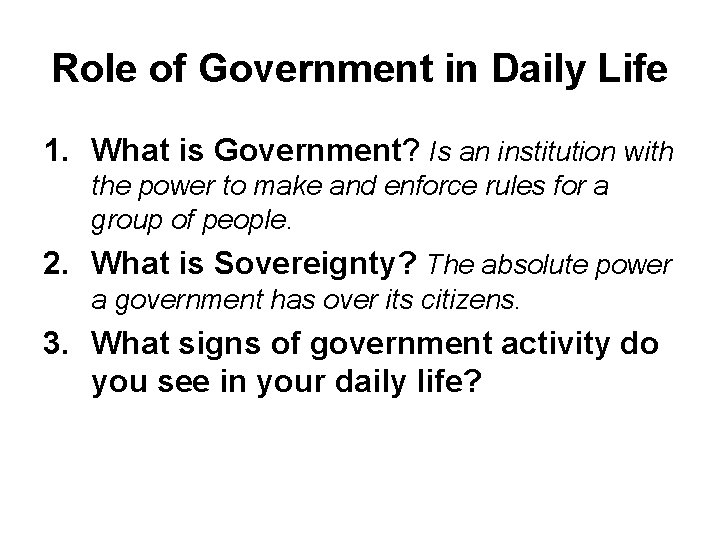
Role of Government in Daily Life 1. What is Government? Is an institution with the power to make and enforce rules for a group of people. 2. What is Sovereignty? The absolute power a government has over its citizens. 3. What signs of government activity do you see in your daily life?
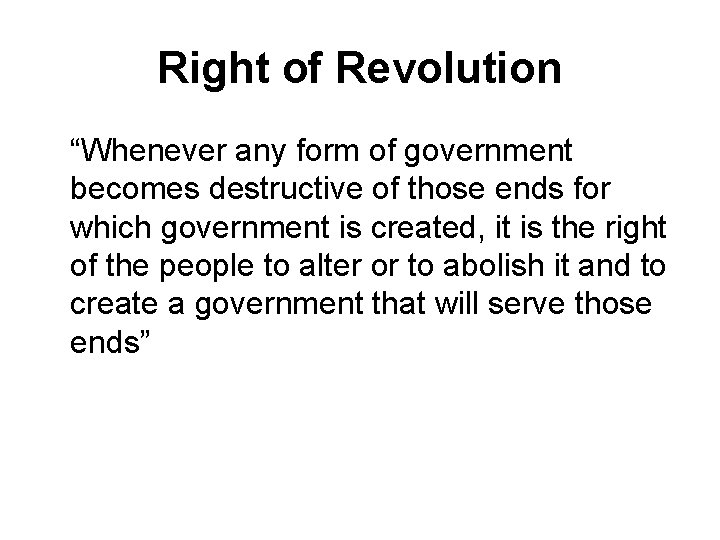
Right of Revolution “Whenever any form of government becomes destructive of those ends for which government is created, it is the right of the people to alter or to abolish it and to create a government that will serve those ends”
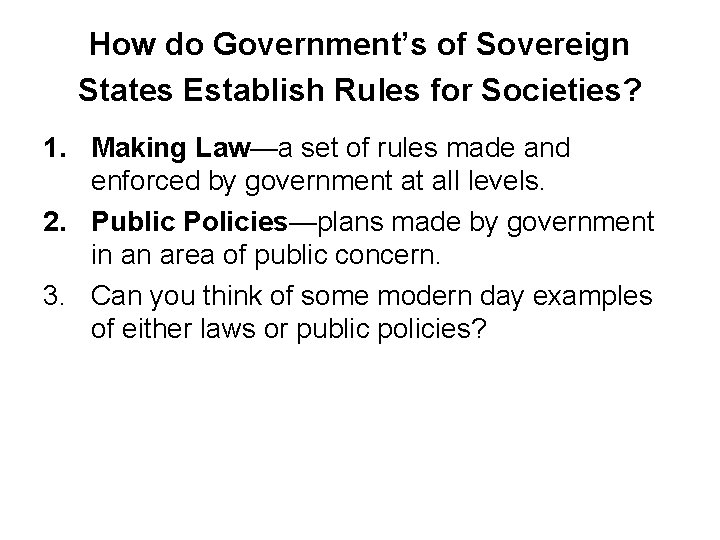
How do Government’s of Sovereign States Establish Rules for Societies? 1. Making Law—a set of rules made and enforced by government at all levels. 2. Public Policies—plans made by government in an area of public concern. 3. Can you think of some modern day examples of either laws or public policies?
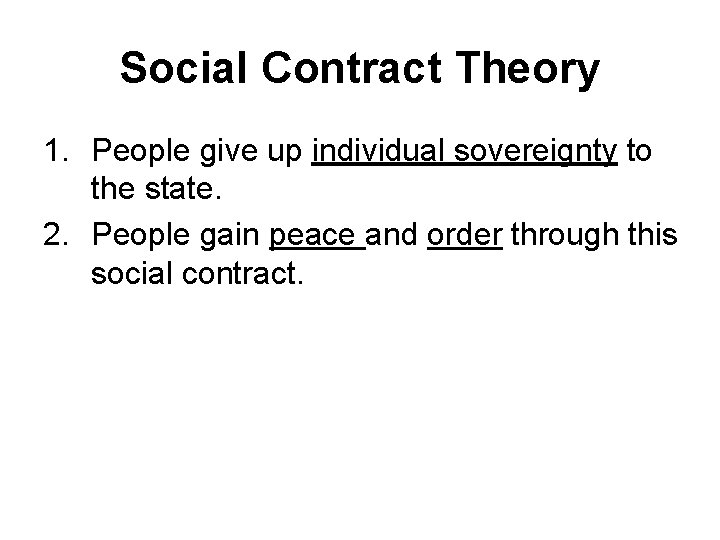
Social Contract Theory 1. People give up individual sovereignty to the state. 2. People gain peace and order through this social contract.
Beliefs of John Locke “Natural Rights Philosophy” • The mind was a blank slate at birth. • Locke believed all persons are born good, independent and equal. • Locke believed we had “natural rights”— those that we simply have as human beings. This includes the right to life, liberty and the pursuit of happiness (in some circles thought of as property as well)
Functions of Government “The Ability to Maintain Order” • Enforcing laws to protect the safety of citizens. • Protecting people from unfair business practices. • Establishing laws and policies to protect individual rights. • Regulating businesses and their practices (some believe this can go too far) • Protecting the country from foreign invasion
Functions of Government “To Provide Services” • Build roads. • Provide access to medical care—not necessarily provide “outright” care. • Inspect the foods and medications used by people. • Build schools and provide educational opportunities. • Regulate the transportation systems.
What are the Benefits of a Democratic Society? • Choice—we get to choose what we want out of life, the ability to make our own decisions, to succeed or fail on our own. • Personal dignity and self-worth are valued. • A healthy respect for the law. • Protection of individual rights. • Laws and policies which should promote the best interests of the general public.
Choice • We want to be able to pick our governmental leaders. • We want to choose how to raise our family, educate our children, earn a living. • Having “choice” allows us in America the ability to take responsibility for our own lives.
I believe there are more instances of the abridgement of freedom of the people by gradual and silent encroachments by those in power than by violent and sudden usurpations. ” – James Madison
“Nothing in the world is more dangerous than sincere ignorance and consciencious stupidity. ” -Martin Luther King, Jr
“What country can preserve its freedom if its rulers are not warned from time to time that its people preserve the spirit of resistance. Let the people take arms for the liberty tree of freedom must be refreshed from time to time with the blood of patriots and tyrants. ” -Thomas Jefferson
America 2011 • The more that a government intrudes into private business and the personal lives of it’s people, the less motivation private business and the individual has to succeed. • At some point will the productive members of society get sick of doing all the work for those that refuse to work and leave the country to collapse on itself?