
Principles of Flight Thrust and Drag Principles of
- Slides: 21
Principles of Flight – Thrust and Drag Principles of Flight Thrust and Drag
Principles of Flight – Thrust and Drag Principles of Flight So Far You already know that: • Every action has an equal and opposite reaction • Every object has weight • To generate lift, you need airflow over the wings. • Lift varies with airspeed, angle of attack, wing shape and air density • For straight and level flight, lift and weight must be equal
Principles of Flight – Thrust and Drag Aim of the Lesson By the end of the lesson, you should have learnt: • What thrust and drag are, and how they are produced • How to minimise drag • How drag varies with the airspeed • How the levels of thrust and drag affect an aircraft’s flight • What is necessary for an aircraft to be in balance
Principles of Flight – Thrust and Drag An Aircraft In Flight • Besides lift and weight, there are two other forces that act on an aircraft in flight • These are thrust and drag
Principles of Flight – Thrust and Drag Thrust • The airflow over the wings that is needed to generate lift is caused by thrusting the aircraft forwards through the air. • Thrust is therefore the forward force acting on an aircraft • It is produced by the engines by throwing air backwards • Either a propeller can do this, or air can be expelled from the rear (in the case of a jet engine)
Principles of Flight – Thrust and Drag Thrust • In both cases, throwing air backwards thrusts the aircraft forces • This is because every action has an equal and opposite reaction • The size of the thrust depends on the amount of engine power selected by the pilot
Principles of Flight – Thrust and Drag • When you’re on a bicycle, the faster you go the more resistance you encounter • The force which hinders your progress is called drag • The same can be said for aircraft. • Every part of the aircraft over which air flows produces drag which resists forward motion • Thus the more drag there is, the more thrust is needed to over come it
Principles of Flight – Thrust and Drag • However to get more thrust you need a bigger engine, more fuel and more weight, and therefore more expense • The aircraft’s designer wants to make the aircraft fly at the best possible speed for the available thrust • Therefore he will try and reduce drag • This makes the aircraft more efficient and economical
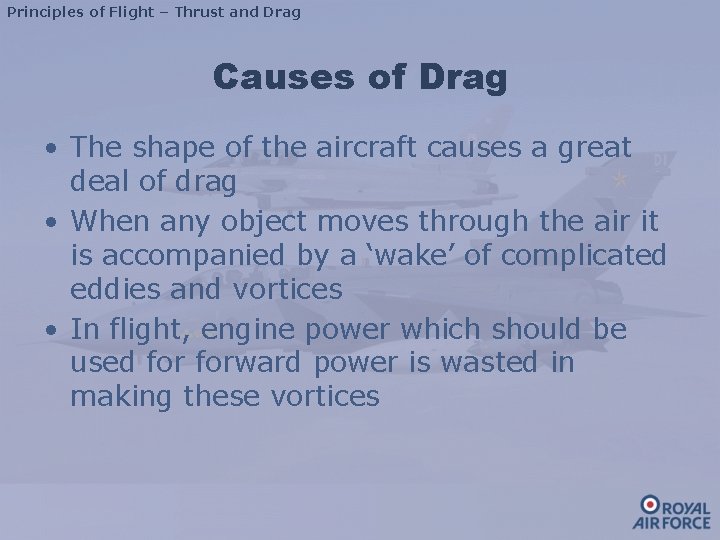
Principles of Flight – Thrust and Drag Causes of Drag • The shape of the aircraft causes a great deal of drag • When any object moves through the air it is accompanied by a ‘wake’ of complicated eddies and vortices • In flight, engine power which should be used forward power is wasted in making these vortices
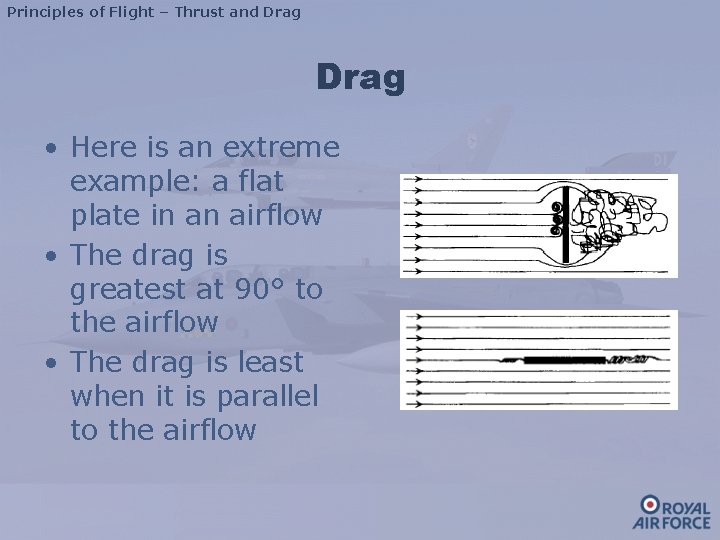
Principles of Flight – Thrust and Drag • Here is an extreme example: a flat plate in an airflow • The drag is greatest at 90° to the airflow • The drag is least when it is parallel to the airflow
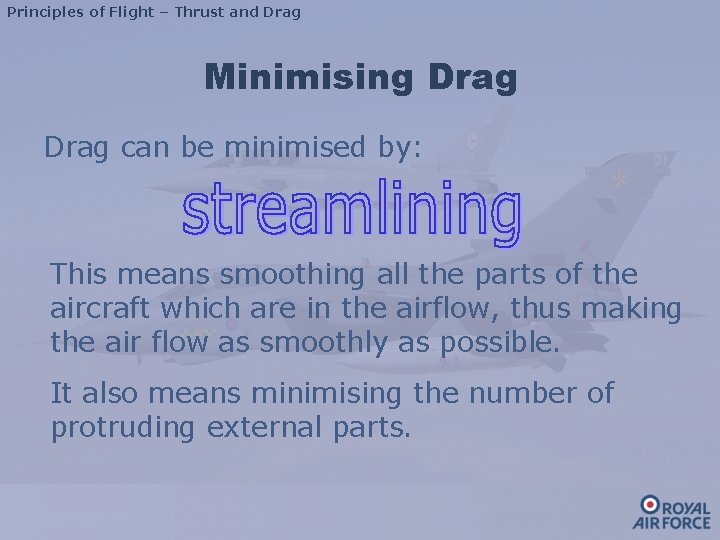
Principles of Flight – Thrust and Drag Minimising Drag can be minimised by: This means smoothing all the parts of the aircraft which are in the airflow, thus making the air flow as smoothly as possible. It also means minimising the number of protruding external parts.
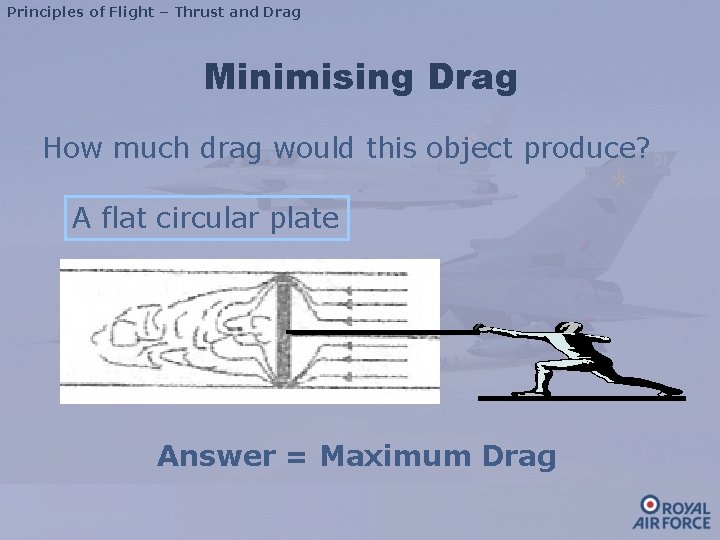
Principles of Flight – Thrust and Drag Minimising Drag How much drag would this object produce? A flat circular plate Answer = Maximum Drag
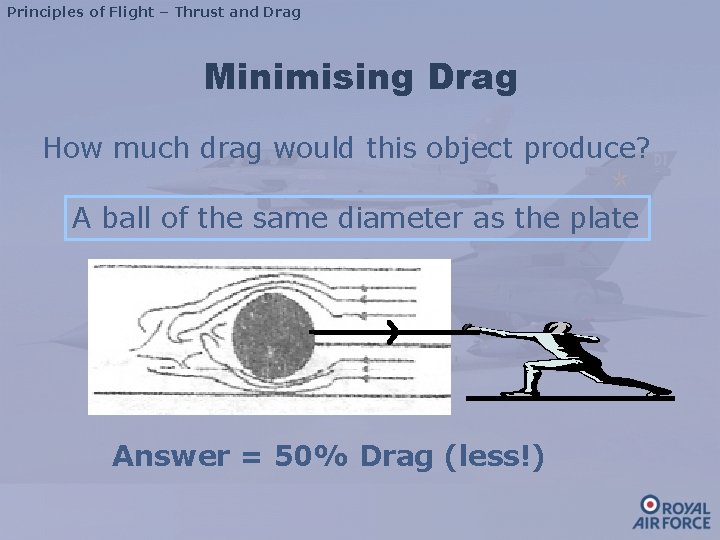
Principles of Flight – Thrust and Drag Minimising Drag How much drag would this object produce? A ball of the same diameter as the plate Answer = 50% Drag (less!)
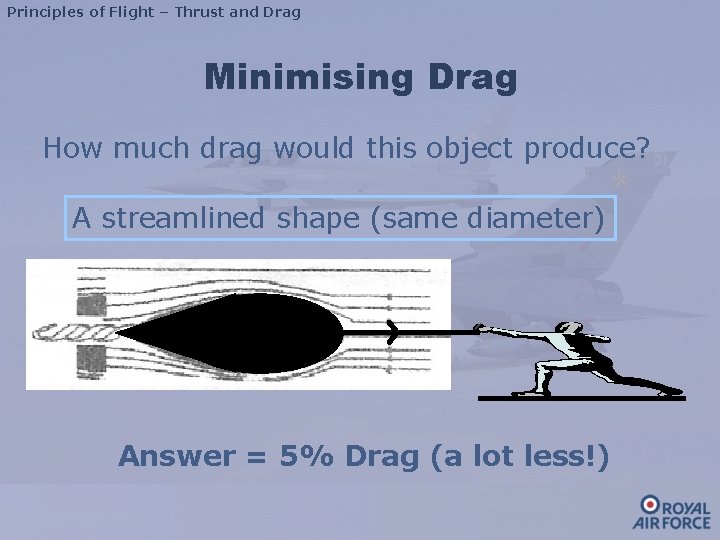
Principles of Flight – Thrust and Drag Minimising Drag How much drag would this object produce? A streamlined shape (same diameter) Answer = 5% Drag (a lot less!)
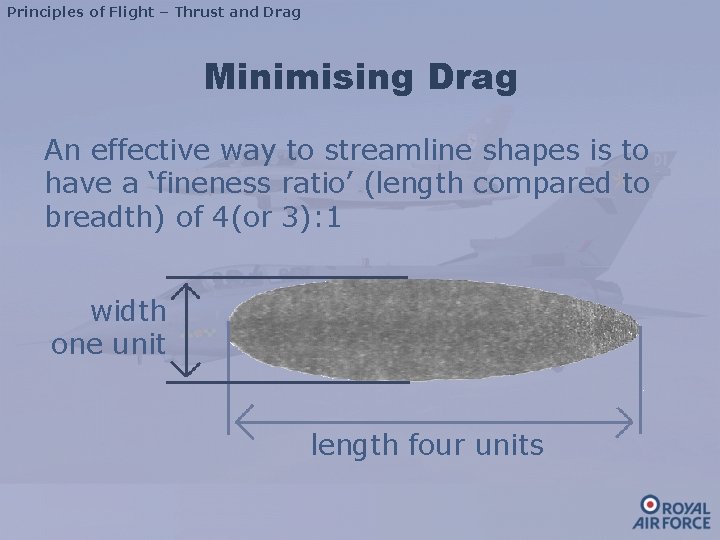
Principles of Flight – Thrust and Drag Minimising Drag An effective way to streamline shapes is to have a ‘fineness ratio’ (length compared to breadth) of 4(or 3): 1 width one unit length four units
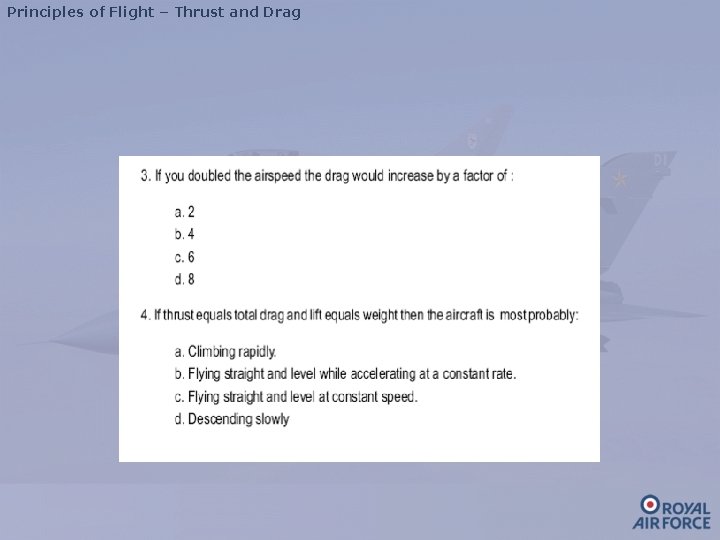
Principles of Flight – Thrust and Drag Variation of Drag with Airspeed The amount of drag is proportional to the square of the airspeed That is, when an aircraft is going at twice the airspeed there is four times as much drag. So, when an aircraft is going at three times the airspeed, how many times more drag will there be? Answer = 9 times as much drag
Principles of Flight – Thrust and Drag in Straight and Level Flight You have already learnt that for straight and level flight, lift must equal weight. Now we must learn that for the aircraft to travel at a constant speed, the thrust must be equal to the drag.
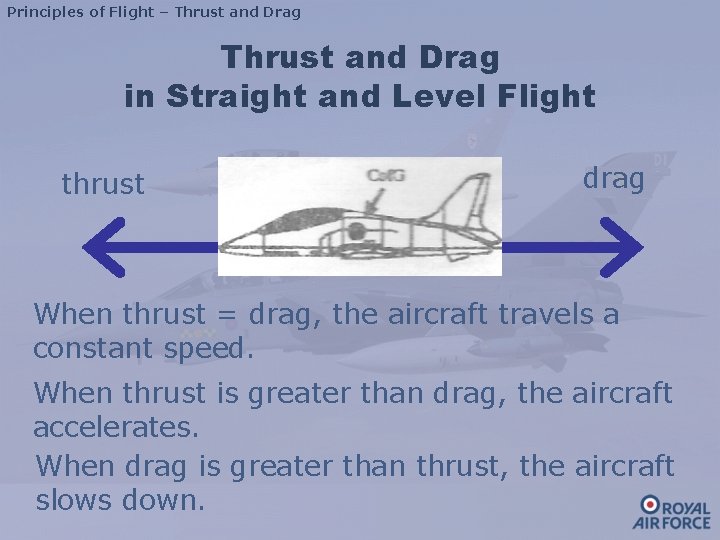
Principles of Flight – Thrust and Drag in Straight and Level Flight thrust drag When thrust = drag, the aircraft travels a constant speed. When thrust is greater than drag, the aircraft accelerates. When drag is greater than thrust, the aircraft slows down.
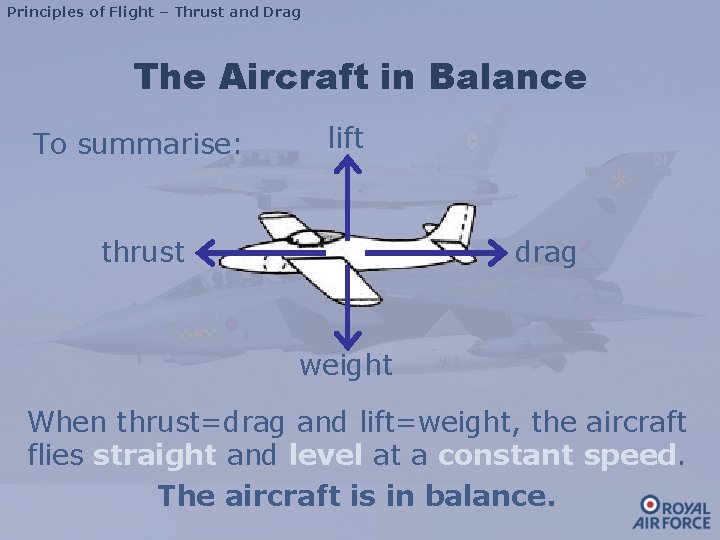
Principles of Flight – Thrust and Drag The Aircraft in Balance To summarise: lift thrust drag weight When thrust=drag and lift=weight, the aircraft flies straight and level at a constant speed. The aircraft is in balance.
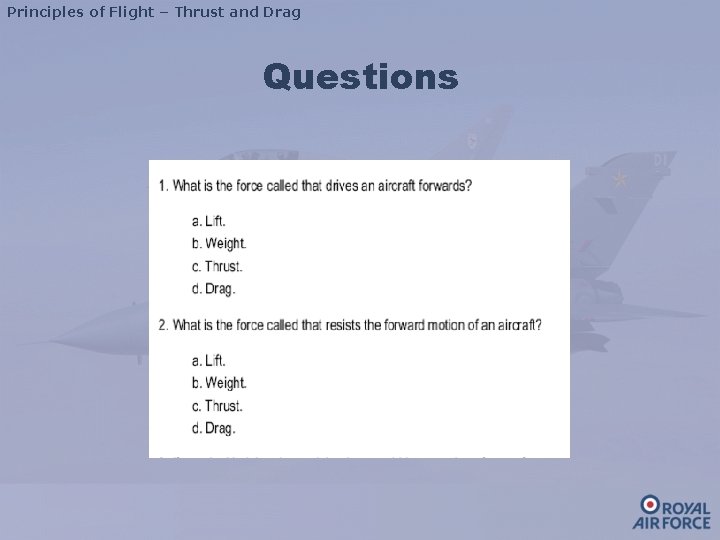
Principles of Flight – Thrust and Drag Questions
Principles of Flight – Thrust and Drag