
Principles of Exercise Why is it important to

- Slides: 12
Principles of Exercise
Why is it important to know the principles of exercise? � The Principles of Exercise are like a quickreference “How to” manual to reach your fitness goals � Knowing these principles will allow you SAFELY and systematically improve in any of the fitness components discussed previously. �Strength, endurance, flexibility, agility, ect. �
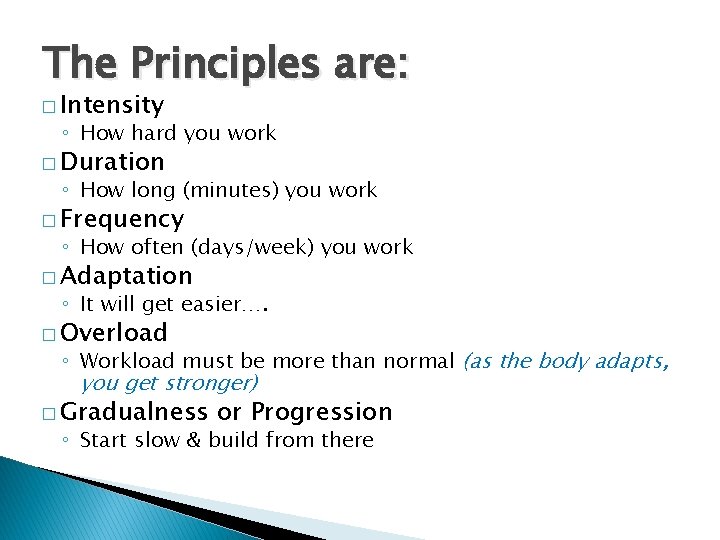
The Principles are: � Intensity ◦ How hard you work � Duration ◦ How long (minutes) you work � Frequency ◦ How often (days/week) you work � Adaptation ◦ It will get easier…. � Overload ◦ Workload must be more than normal (as the body adapts, you get stronger) � Gradualness or Progression ◦ Start slow & build from there
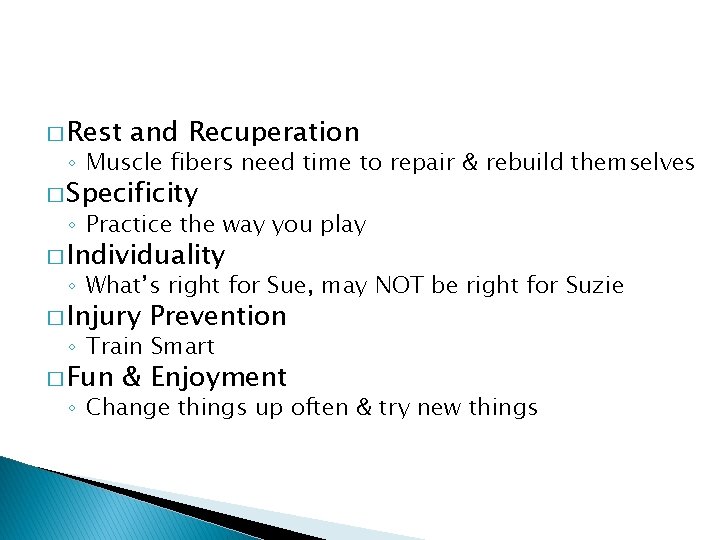
� Rest and Recuperation ◦ Muscle fibers need time to repair & rebuild themselves � Specificity ◦ Practice the way you play � Individuality ◦ What’s right for Sue, may NOT be right for Suzie � Injury Prevention ◦ Train Smart � Fun & Enjoyment ◦ Change things up often & try new things
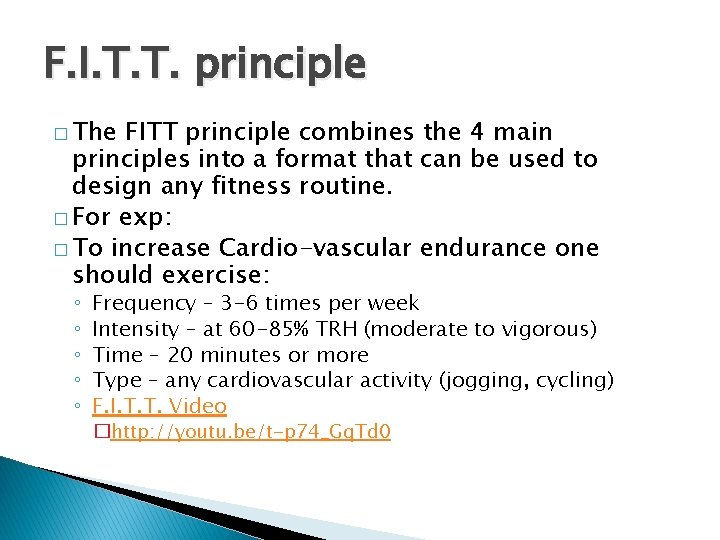
F. I. T. T. principle � The FITT principle combines the 4 main principles into a format that can be used to design any fitness routine. � For exp: � To increase Cardio-vascular endurance one should exercise: ◦ ◦ ◦ Frequency – 3 -6 times per week Intensity – at 60 -85% TRH (moderate to vigorous) Time – 20 minutes or more Type – any cardiovascular activity (jogging, cycling) F. I. T. T. Video �http: //youtu. be/t-p 74_Gq. Td 0
F= FREQUENCY �How often, or how many days a week you will perform any given activity �In general, you should exercise 36 times per week
I= Intensity �How hard or strenuous the work out is. �EXP. A cardio workout can be measured as moderate (~50 -60% THR) or moderate to vigorous (~75 -85% THR)
T=Time �Time stands for how long each workout lasts �A generally, a cardiovascular workout should last 20 – 30 minutes or up to 60 minutes for advanced individuals.
T=Type �Type stands for the type of activity you are doing, whether aerobic or anaerobic �Aerobic= Cardio �Anaerobic = strength work or stretching
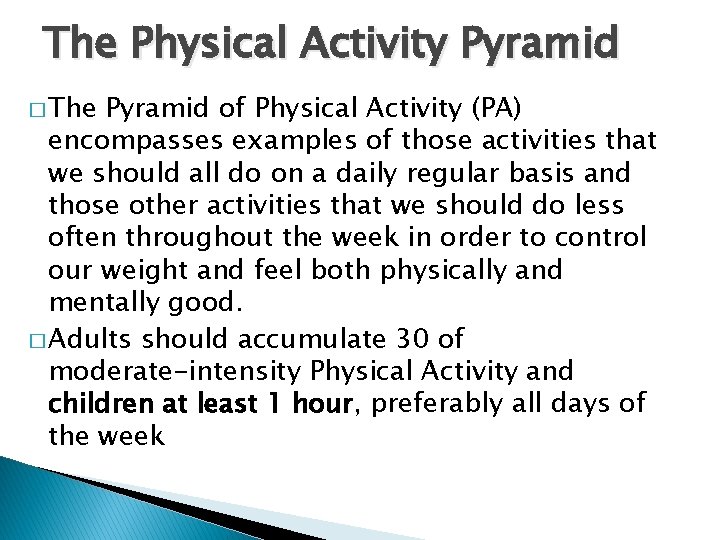
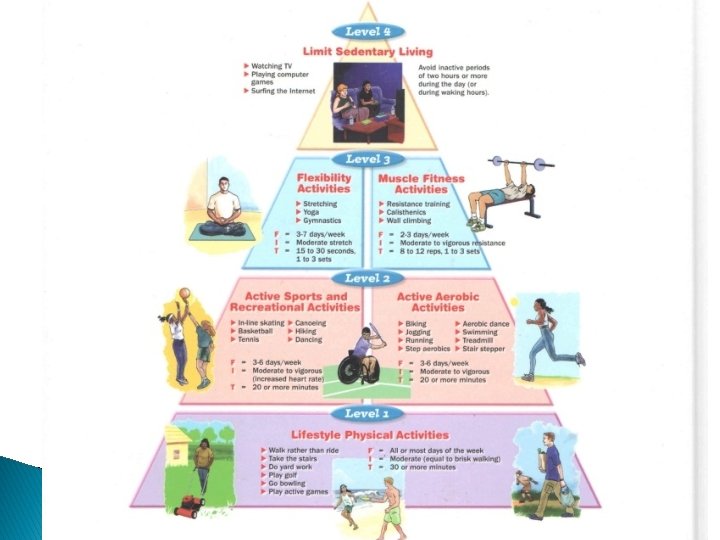
The Physical Activity Pyramid � The Pyramid of Physical Activity (PA) encompasses examples of those activities that we should all do on a daily regular basis and those other activities that we should do less often throughout the week in order to control our weight and feel both physically and mentally good. � Adults should accumulate 30 of moderate-intensity Physical Activity and children at least 1 hour, preferably all days of the week
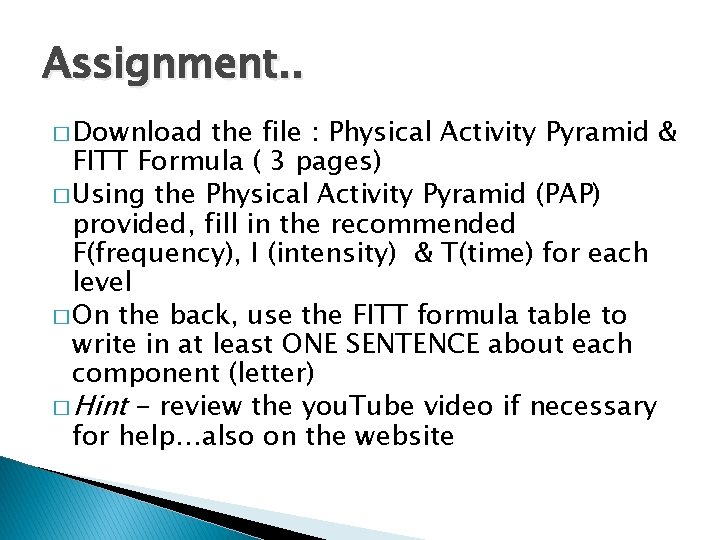
Assignment. . � Download the file : Physical Activity Pyramid & FITT Formula ( 3 pages) � Using the Physical Activity Pyramid (PAP) provided, fill in the recommended F(frequency), I (intensity) & T(time) for each level � On the back, use the FITT formula table to write in at least ONE SENTENCE about each component (letter) � Hint - review the you. Tube video if necessary for help…also on the website