
Principles of Epidemiology for Public Health EPID 600

Principles of Epidemiology for Public Health (EPID 600) Module appendix - Attributable risk Victor J. Schoenbach, Ph. D home page Department of Epidemiology Gillings School of Global Public Health University of North Carolina at Chapel Hill www. unc. edu/epid 600/ 6/24/2013 Attributable risk 1

Attributable risk - conceptual Assume that we know that a factor causes a disease. How can we answer the “so what? ” questions: • “How much risk is attributable to that factor? ” • “How many cases are attributable to that factor? ” The answers depend on: (1) by how much the factor increases risk and (2) how common the risk factor is. A strong risk factor that is common has a large impact. 6/24/2013 Attributable risk 2
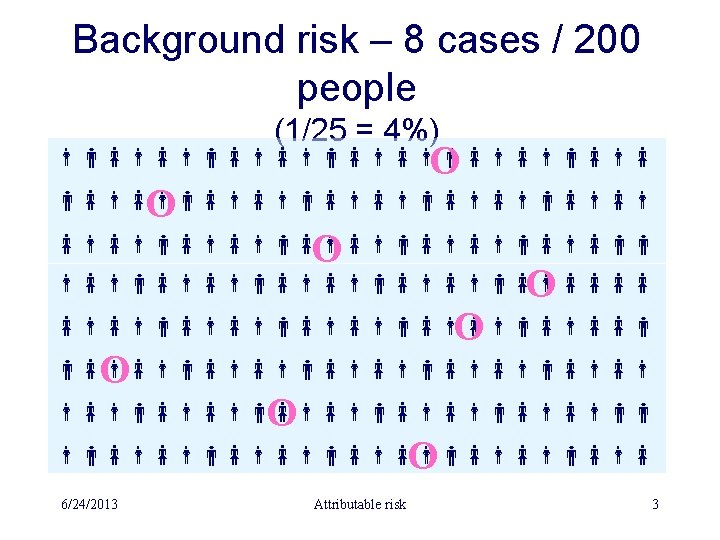
Background risk – 8 cases / 200 people (1/25 = 4%) O O 6/24/2013 Attributable risk 3
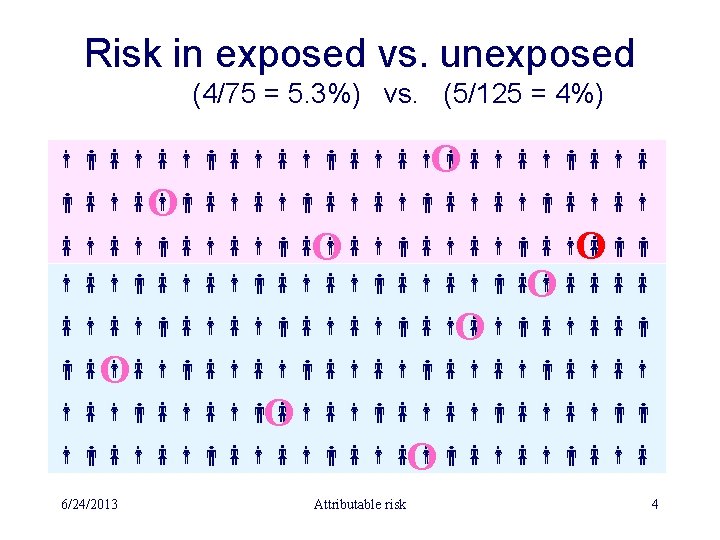
Risk in exposed vs. unexposed (4/75 = 5. 3%) vs. (5/125 = 4%) O O O 6/24/2013 Attributable risk 4

Attributable risk – proportion of risk in exposed population (PAR) O O O O 6/24/2013 Attributable risk 5

Attributable risk – proportion of risk in the entire population (PARP) O O O O 6/24/2013 Attributable risk 6
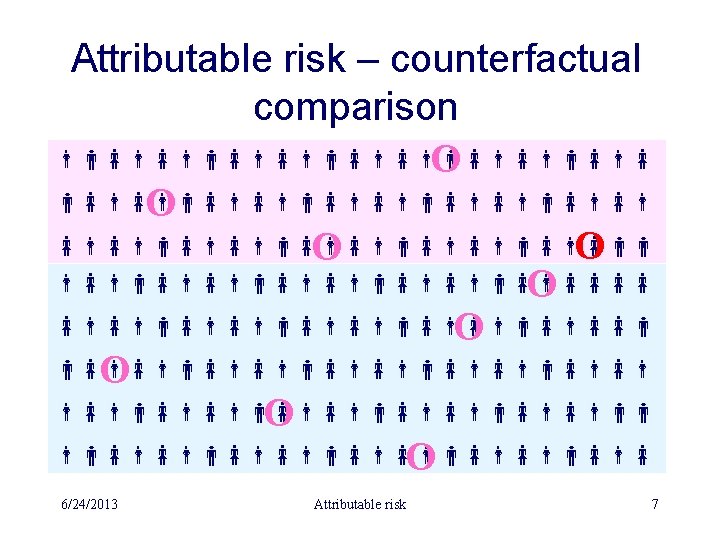
Attributable risk – counterfactual comparison O O O O 6/24/2013 Attributable risk 7
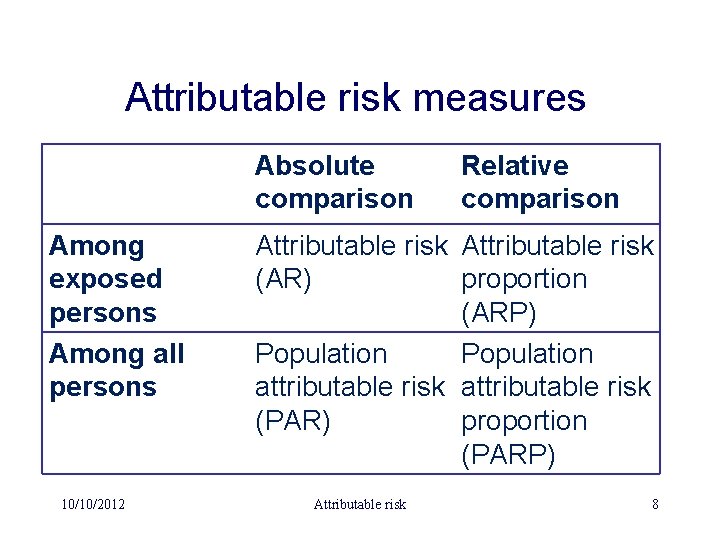
Attributable risk measures Absolute comparison Among exposed persons Among all persons 10/10/2012 Relative comparison Attributable risk (AR) proportion (ARP) Population attributable risk (PAR) proportion (PARP) Attributable risk 8
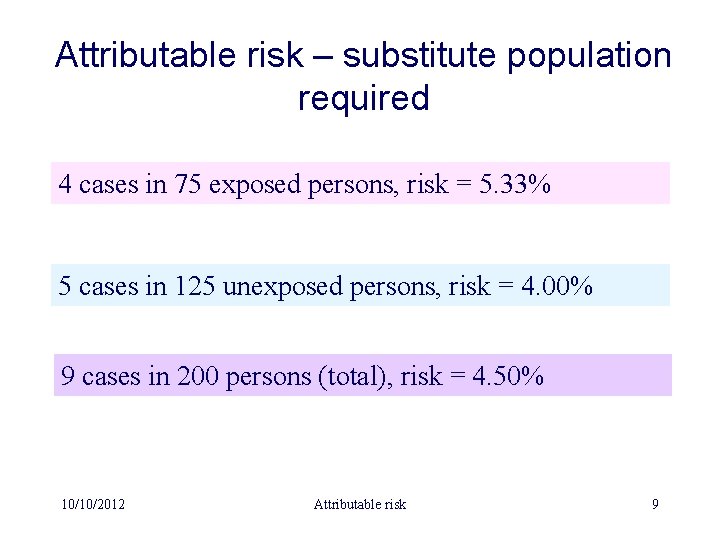
Attributable risk – substitute population required 4 cases in 75 exposed persons, risk = 5. 33% 5 cases in 125 unexposed persons, risk = 4. 00% 9 cases in 200 persons (total), risk = 4. 50% 10/10/2012 Attributable risk 9
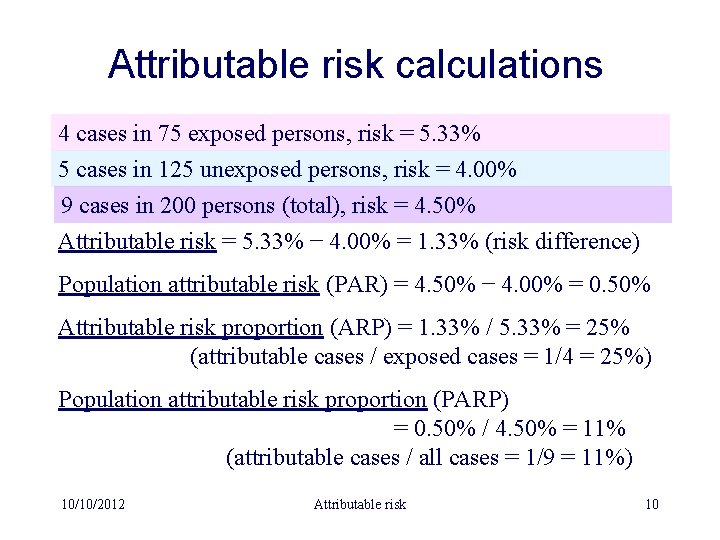
Attributable risk calculations 4 cases in 75 exposed persons, risk = 5. 33% 5 cases in 125 unexposed persons, risk = 4. 00% 9 cases in 200 persons (total), risk = 4. 50% Attributable risk = 5. 33% − 4. 00% = 1. 33% (risk difference) Population attributable risk (PAR) = 4. 50% − 4. 00% = 0. 50% Attributable risk proportion (ARP) = 1. 33% / 5. 33% = 25% (attributable cases / exposed cases = 1/4 = 25%) Population attributable risk proportion (PARP) = 0. 50% / 4. 50% = 11% (attributable cases / all cases = 1/9 = 11%) 10/10/2012 Attributable risk 10
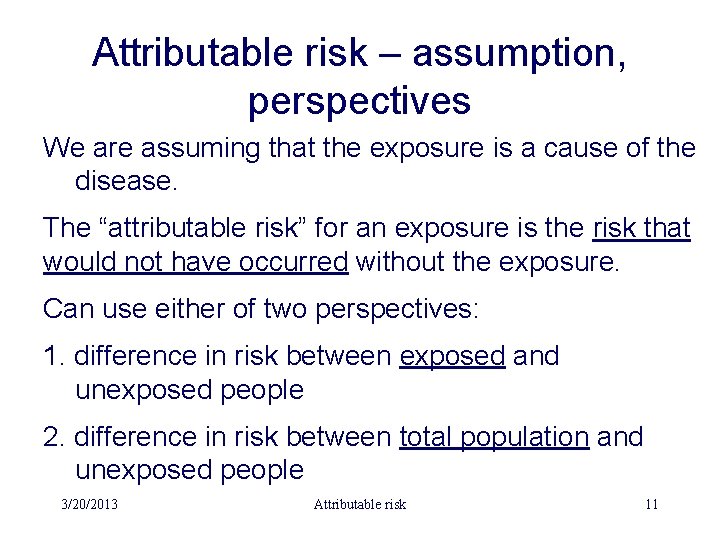
Attributable risk – assumption, perspectives We are assuming that the exposure is a cause of the disease. The “attributable risk” for an exposure is the risk that would not have occurred without the exposure. Can use either of two perspectives: 1. difference in risk between exposed and unexposed people 2. difference in risk between total population and unexposed people 3/20/2013 Attributable risk 11
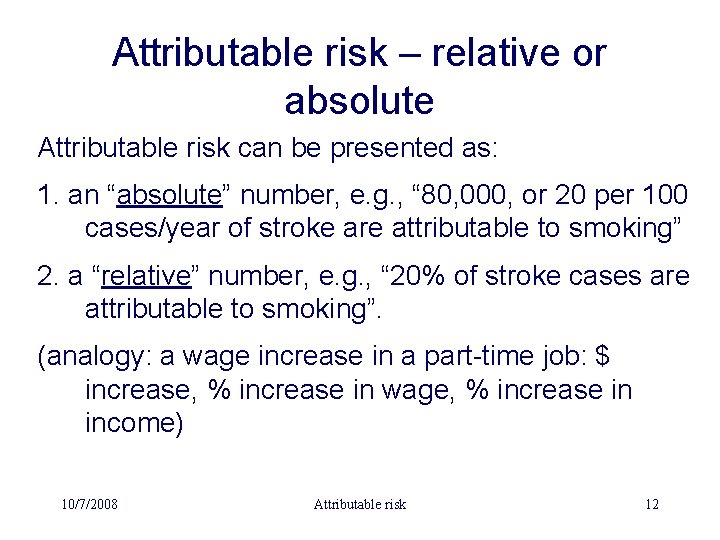
Attributable risk – relative or absolute Attributable risk can be presented as: 1. an “absolute” number, e. g. , “ 80, 000, or 20 per 100 cases/year of stroke are attributable to smoking” 2. a “relative” number, e. g. , “ 20% of stroke cases are attributable to smoking”. (analogy: a wage increase in a part-time job: $ increase, % increase in wage, % increase in income) 10/7/2008 Attributable risk 12
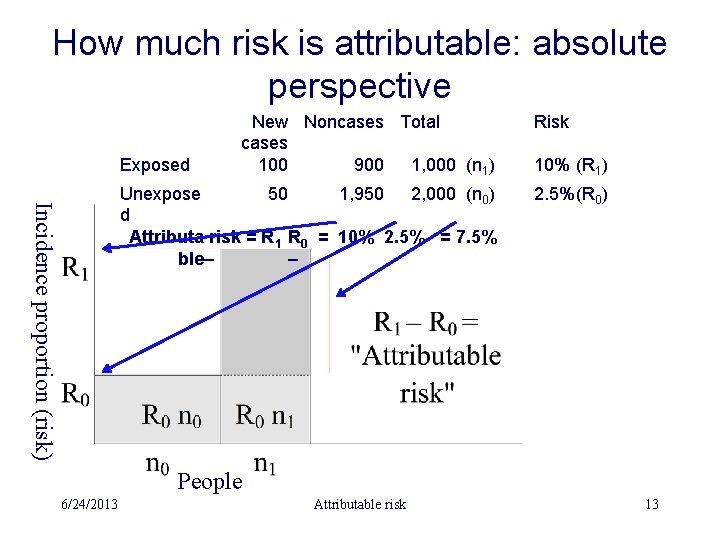
How much risk is attributable: absolute perspective Exposed New Noncases Total cases 100 900 1, 000 (n 1) Incidence proportion (risk) Unexpose 50 1, 950 2, 000 (n 0) d Attributa risk = R 1 R 0 = 10% 2. 5% = 7. 5% ble– – Risk 10% (R 1) 2. 5%(R 0) People 6/24/2013 Attributable risk 13
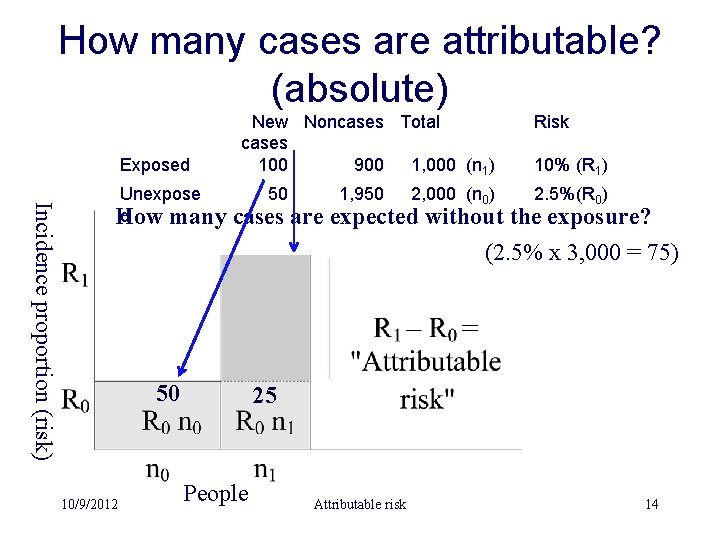
How many cases are attributable? (absolute) Exposed Incidence proportion (risk) Unexpose d How many New Noncases Total cases 100 900 1, 000 (n 1) 1, 950 2, 000 (n 0) 10% (R 1) 2. 5%(R 0) cases are expected without the exposure? (2. 5% x 3, 000 = 75) 50 10/9/2012 50 Risk 25 People Attributable risk 14
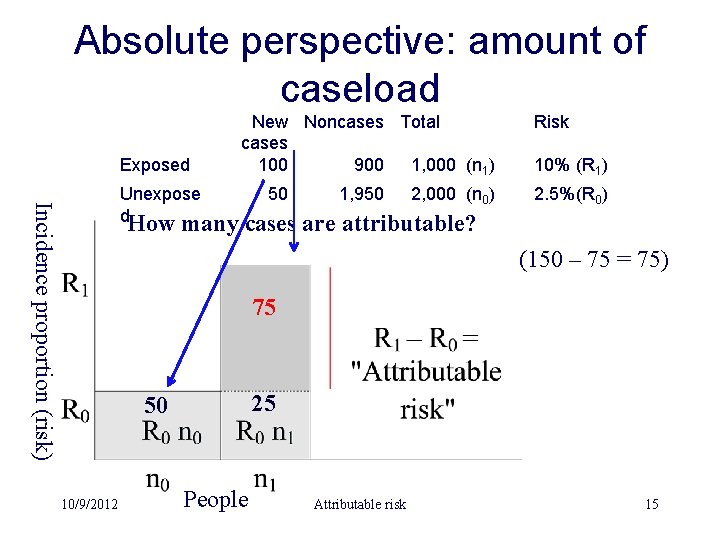
Absolute perspective: amount of caseload Exposed New Noncases Total cases 100 900 1, 000 (n 1) Incidence proportion (risk) Unexpose d 50 1, 950 2, 000 (n 0) Risk 10% (R 1) 2. 5%(R 0) How many cases are attributable? (150 – 75 = 75) 75 25 50 10/9/2012 People Attributable risk 15
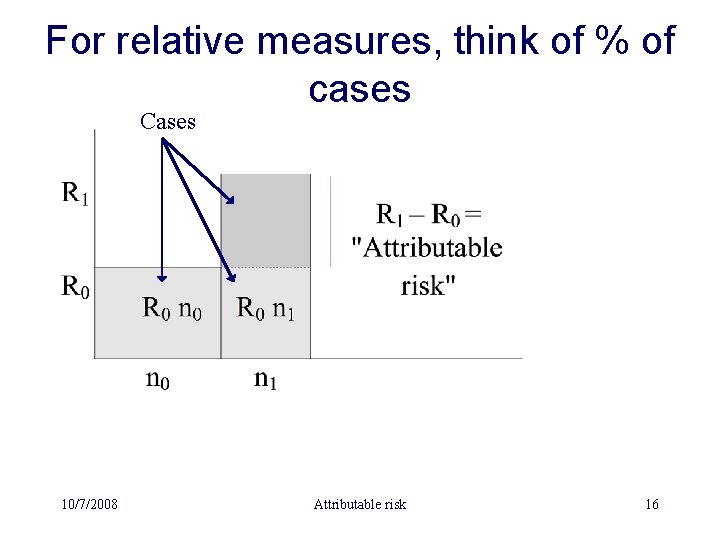
For relative measures, think of % of cases Cases 10/7/2008 Attributable risk 16
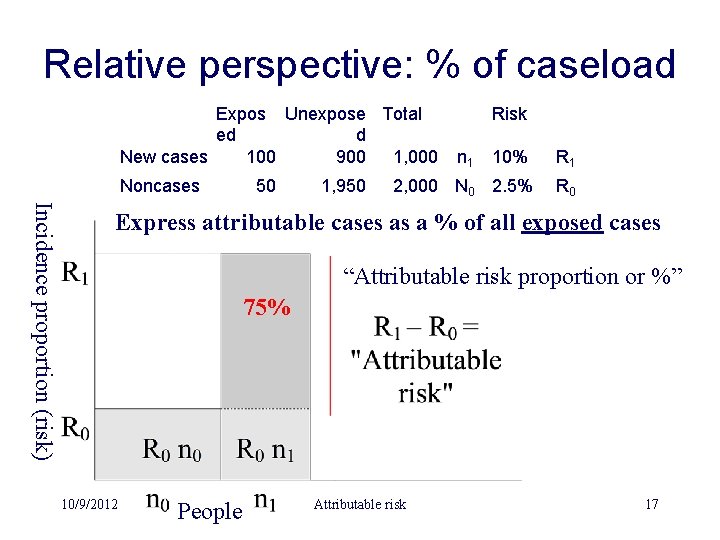
Relative perspective: % of caseload Expos Unexpose Total ed d New cases 100 900 1, 000 Noncases 50 1, 950 Risk n 1 10% R 1 2, 000 N 0 2. 5% R 0 Incidence proportion (risk) Express attributable cases as a % of all exposed cases “Attributable risk proportion or %” 75% 10/9/2012 People Attributable risk 17
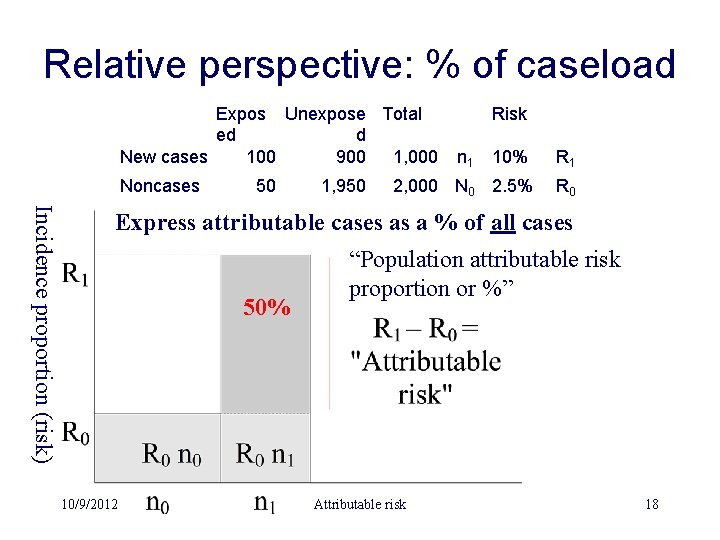
Relative perspective: % of caseload Expos Unexpose Total ed d New cases 100 900 1, 000 Noncases 50 1, 950 Risk n 1 10% R 1 2, 000 N 0 2. 5% R 0 Incidence proportion (risk) Express attributable cases as a % of all cases 50% 10/9/2012 “Population attributable risk proportion or %” Attributable risk 18
- Slides: 18