
Principles of Effective Communication Guidelines for the choice
- Slides: 49
Principles of Effective Communication Guidelines for the choice of content and style of presentation, adapted to the purpose and receiver of your message
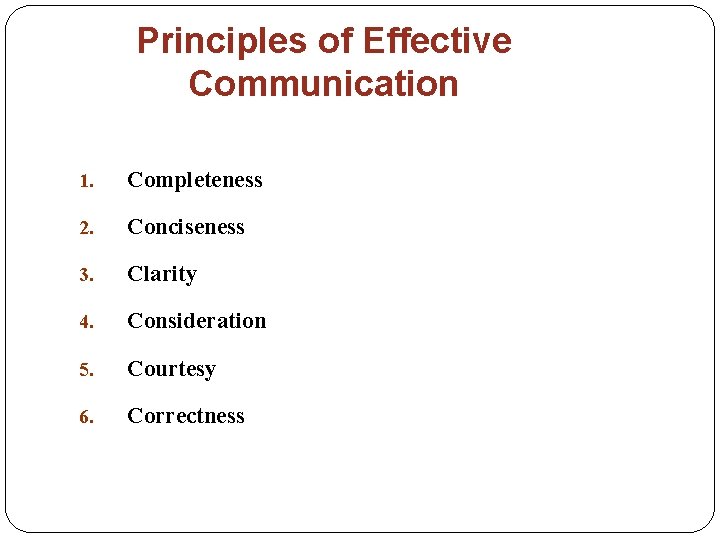
Principles of Effective Communication 1. Completeness 2. Conciseness 3. Clarity 4. Consideration 5. Courtesy 6. Correctness
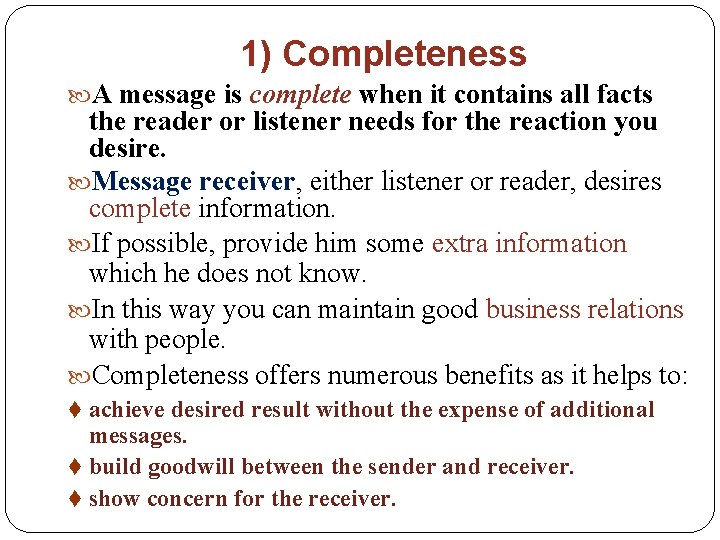
1) Completeness A message is complete when it contains all facts the reader or listener needs for the reaction you desire. Message receiver, either listener or reader, desires complete information. If possible, provide him some extra information which he does not know. In this way you can maintain good business relations with people. Completeness offers numerous benefits as it helps to: t achieve desired result without the expense of additional messages. t build goodwill between the sender and receiver. t show concern for the receiver.
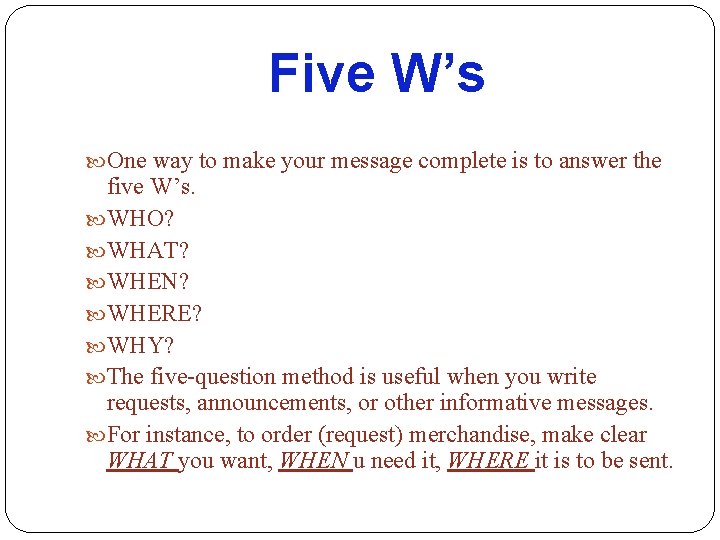
Five W’s One way to make your message complete is to answer the five W’s. WHO? WHAT? WHEN? WHERE? WHY? The five-question method is useful when you write requests, announcements, or other informative messages. For instance, to order (request) merchandise, make clear WHAT you want, WHEN u need it, WHERE it is to be sent.
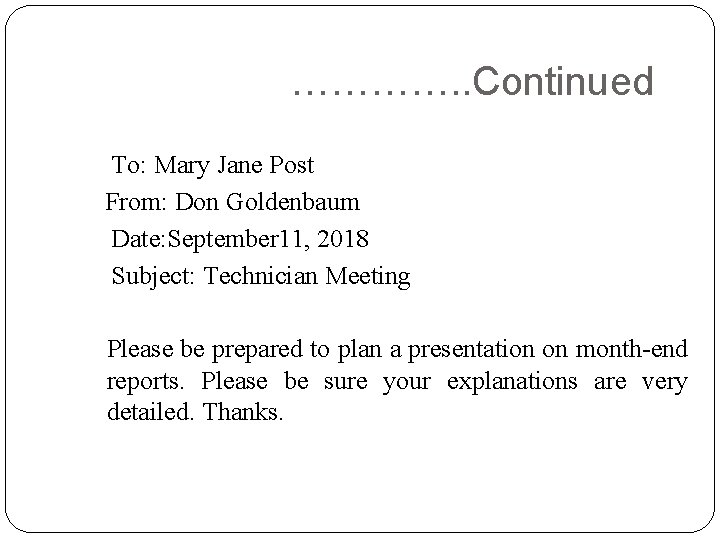
…………. . Continued To: Mary Jane Post From: Don Goldenbaum Date: September 11, 2018 Subject: Technician Meeting Please be prepared to plan a presentation on month-end reports. Please be sure your explanations are very detailed. Thanks.
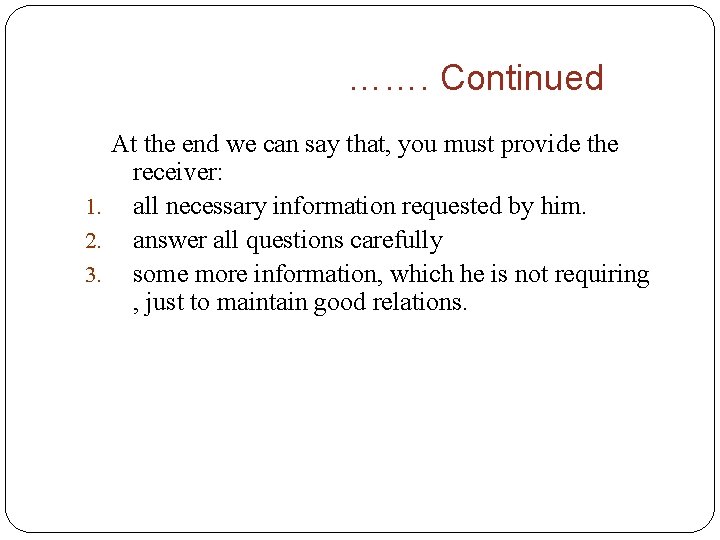
……. Continued At the end we can say that, you must provide the receiver: 1. all necessary information requested by him. 2. answer all questions carefully 3. some more information, which he is not requiring , just to maintain good relations.
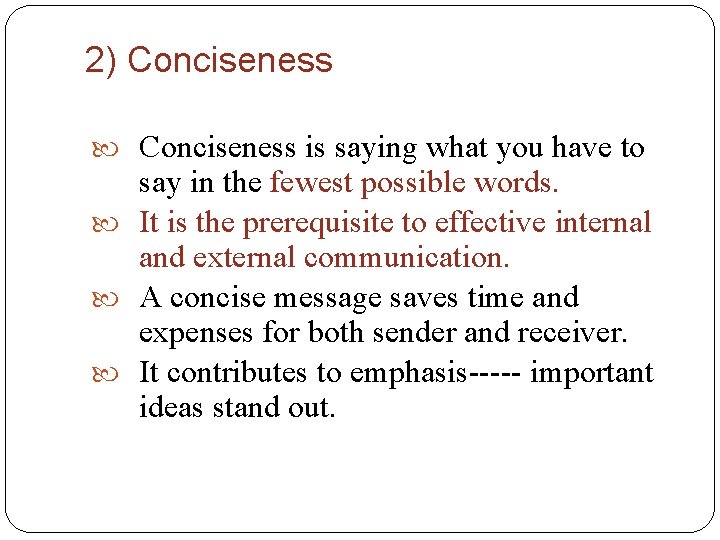
2) Conciseness is saying what you have to say in the fewest possible words. It is the prerequisite to effective internal and external communication. A concise message saves time and expenses for both sender and receiver. It contributes to emphasis----- important ideas stand out.
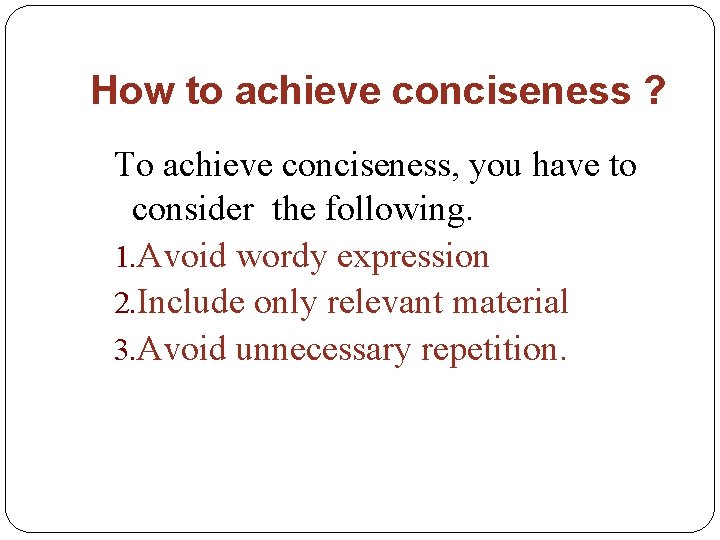
How to achieve conciseness ? To achieve conciseness, you have to consider the following. 1. Avoid wordy expression 2. Include only relevant material 3. Avoid unnecessary repetition.
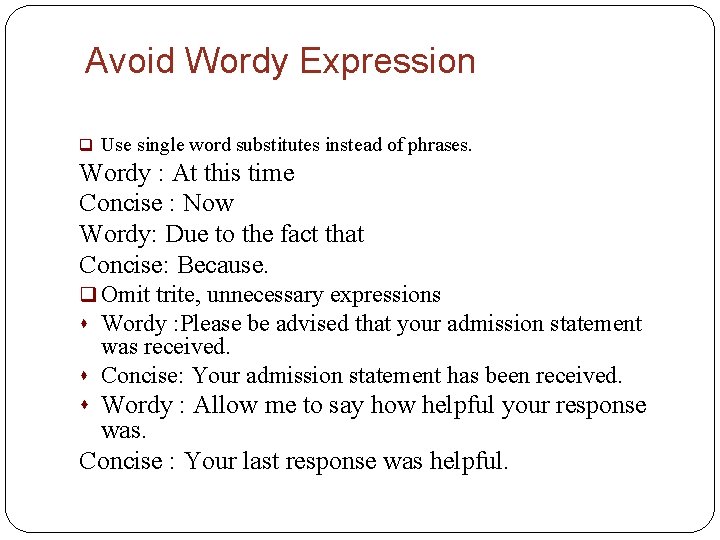
Avoid Wordy Expression q Use single word substitutes instead of phrases. Wordy : At this time Concise : Now Wordy: Due to the fact that Concise: Because. q Omit trite, unnecessary expressions s Wordy : Please be advised that your admission statement was received. s Concise: Your admission statement has been received. s Wordy : Allow me to say how helpful your response was. Concise : Your last response was helpful.
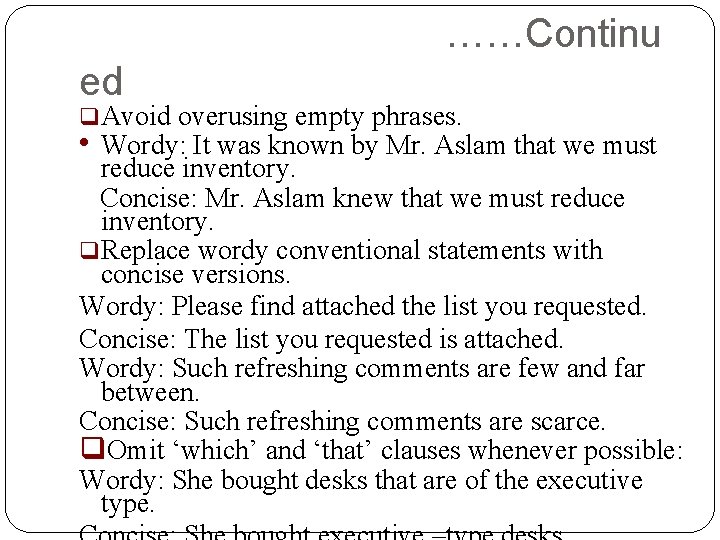
……Continu ed q. Avoid overusing empty phrases. • Wordy: It was known by Mr. Aslam that we must reduce inventory. Concise: Mr. Aslam knew that we must reduce inventory. q. Replace wordy conventional statements with concise versions. Wordy: Please find attached the list you requested. Concise: The list you requested is attached. Wordy: Such refreshing comments are few and far between. Concise: Such refreshing comments are scarce. q. Omit ‘which’ and ‘that’ clauses whenever possible: Wordy: She bought desks that are of the executive type.
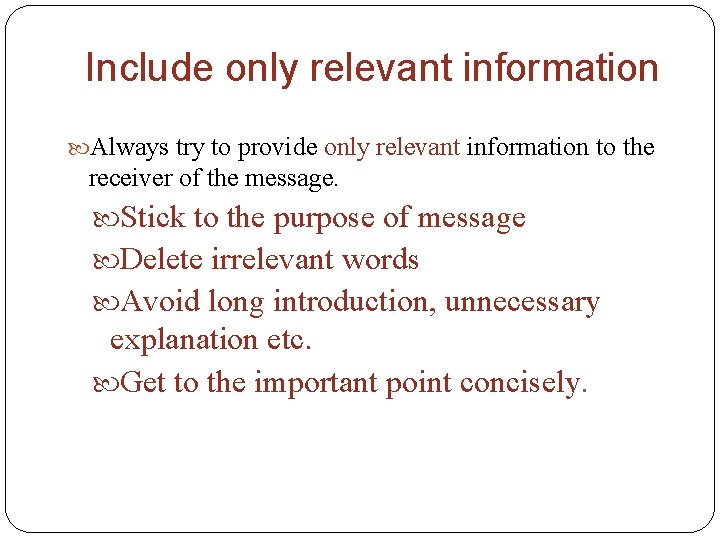
Include only relevant information Always try to provide only relevant information to the receiver of the message. Stick to the purpose of message Delete irrelevant words Avoid long introduction, unnecessary explanation etc. Get to the important point concisely.
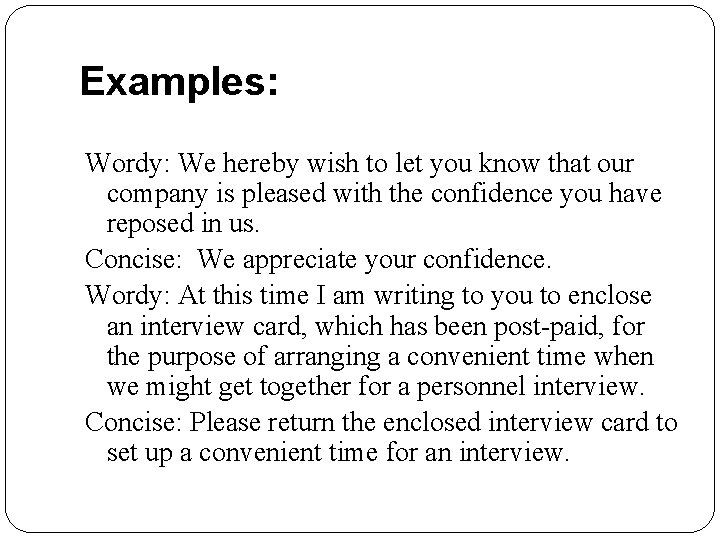
Examples: Wordy: We hereby wish to let you know that our company is pleased with the confidence you have reposed in us. Concise: We appreciate your confidence. Wordy: At this time I am writing to you to enclose an interview card, which has been post-paid, for the purpose of arranging a convenient time when we might get together for a personnel interview. Concise: Please return the enclosed interview card to set up a convenient time for an interview.
Avoid unnecessary Repetition Sometimes repetition is necessary for emphasis. But when the same thing is said two or three times without any reasons, the message becomes wordy and boring. Therefore, try to avoid unnecessary repetition.
Some ways to eliminate unnecessary words Use shorter name after you have mentioned the long one once. Instead of North Central Company use North Central. Use pronouns or initials E. g. Instead of world trade organization use WTO or You can use IT for Information Technology. (Keeping in view the fact that receiver knows about these terms)
Exercise Q. 1. Reduce the length of the following sentences: In the period between April and June, we detected the problem. Reference is made to your May 10 report in which you concluded that the warranty is worthless. We have not received your payment covering invoices that cover June and July purchases. In my opinion, I think the plan is sound. Our new model is longer in length than the old one. Our Web site has made available many of the things you can use for making a decision on the best dentist.
Home Task In my own personal opinion, I believe that all amusement-park roller coasters should be required to undergo thorough and complete inspections once they have reached the old age of fifteen years old. From what I have seen and read, most roller coaster accidents that tend to occur on older steel roller coasters can be traced to poor, inadequate, bad maintenance. The engineering technology of old should be considered obsolete and out of date, and amusement parks should be forced to comply with strict safety rules and regulations that revolve around the idea that once a coaster has reached
…………. Continued fifteen years of age, it should be taken apart and put back together with newer, better, more technologically sound, and safer roller coaster mechanical parts. I think and strongly feel that changing the current standards of roller coaster safety urgently needs to be made a federal law. It is the Constitutional responsibility of the federal government to keep citizens safe.
3) Consideration Preparing every message with the message receiver in mind. Specific ways to indicate consideration are as follows: t Focus on “You” instead of “I” and “We”. t Show audience benefit or interest in the receiver. t Emphasize positive , pleasant facts. Focus on “You” instead of “I” and “We”. v. Using “You” does help project a you –attitude, but overuse can lead to a negative reaction.
……… Continued Creating you-attitude may require avoiding telling others how they feel, assuming you know their needs. We- attitude: I am delighted to announce that we will be extending our hours to make shopping more convenient. You- attitude: You will be able to shop evenings with the extended hours. I -attitude: I live less than 15 minutes from your office, which is convenient for me. You-attitude: Your location is so convenient , I would have no trouble arriving on time , even in bad weather.
………Continued “You” can be insensitive in negative situations. The use of you in negative situations can be avoided by employing the passive voice, making the receiver part of a group , or depersonalizing the situation. Insensitive: You failed to enclose your check in the envelop. Considerate: The check was not enclosed. (passive voice) Considerate: The envelope we received did not have a check in it. (depersonalized)
Exercise Following sentences lack You-Attitude; rewrite the sentences and make them more audience-oriented: So that we may complete our file records on you, we ask that you submit to us your January report. We have shipped the two dozen Cross desk sets you ordered.
Explain Reader’s Benefit Show audience benefit or interest in the receiver. Readers may react positively when benefits are shown them. E. g. “ You will be glad to know that we now have a walk-up window open 7 -9 a. m. and 3 -8 p. m. every weekday”. Revised: You can now take care of your banking needs at our new walk-up window. It is open with a capable teller to serve you 7 -9 a. m. and 3 -8 p. m. Monday through Friday.
Emphasize positive, pleasant facts. Accent the positive things i. e. stress on what can be done instead of what cannot be done. Negative –Unpleasant: It is impossible to open an account for you today. Positive-pleasant: As soon as your signature card reaches us, we will gladly open an account for you.
Exercise Change the negative tone of the following messages into positive ones: You failed to give us the fabric specifications of the chair you ordered. We cannot deliver until Friday. We regret to inform you that we must deny your request for credit. We have been quite tolerant of your past-due account and must now demand payment.
5) Clarity Getting the meaning in the head of receiver accurately.
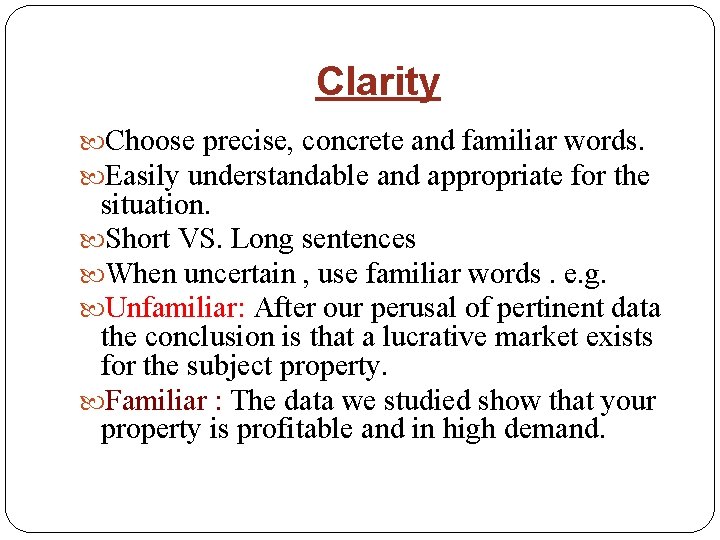
Clarity Choose precise, concrete and familiar words. Easily understandable and appropriate for the situation. Short VS. Long sentences When uncertain , use familiar words. e. g. Unfamiliar: After our perusal of pertinent data the conclusion is that a lucrative market exists for the subject property. Familiar : The data we studied show that your property is profitable and in high demand.
Technical terms should be avoided or must be explained during the document rather than later. Understanding the receiver helps in choosing appropriate and familiar words.
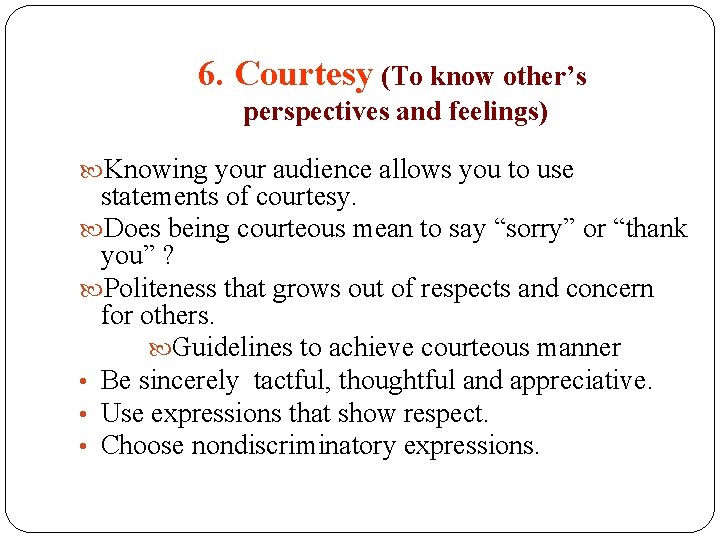
6. Courtesy (To know other’s perspectives and feelings) Knowing your audience allows you to use statements of courtesy. Does being courteous mean to say “sorry” or “thank you” ? Politeness that grows out of respects and concern for others. Guidelines to achieve courteous manner • Be sincerely tactful, thoughtful and appreciative. • Use expressions that show respect. • Choose nondiscriminatory expressions.
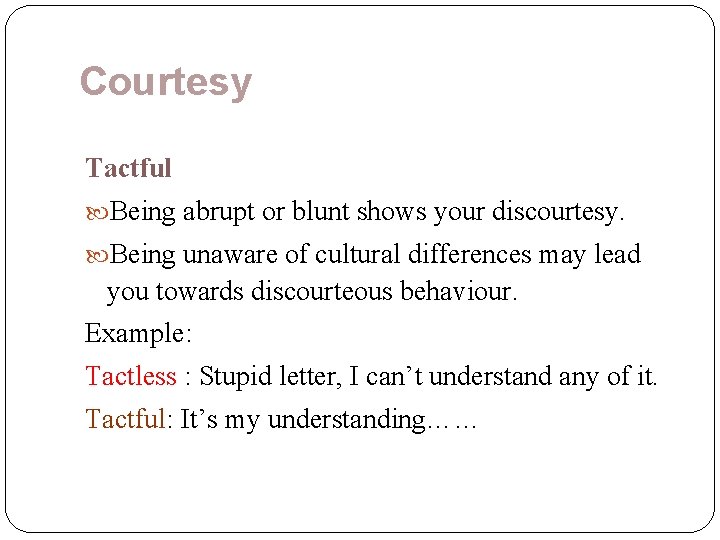
Courtesy Tactful Being abrupt or blunt shows your discourtesy. Being unaware of cultural differences may lead you towards discourteous behaviour. Example: Tactless : Stupid letter, I can’t understand any of it. Tactful: It’s my understanding……
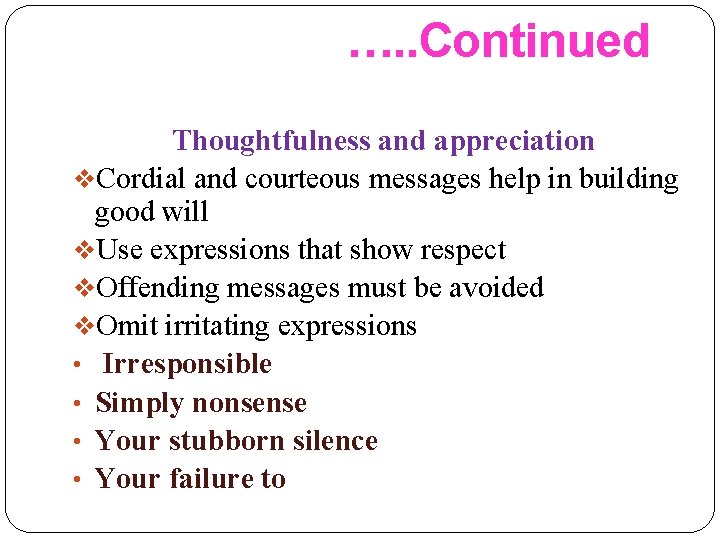
…. . Continued Thoughtfulness and appreciation v. Cordial and courteous messages help in building good will v. Use expressions that show respect v. Offending messages must be avoided v. Omit irritating expressions • Irresponsible • Simply nonsense • Your stubborn silence • Your failure to
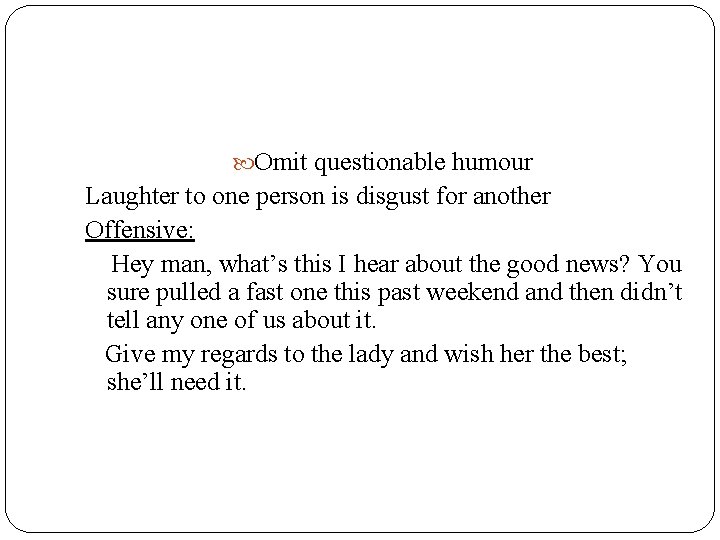
Omit questionable humour Laughter to one person is disgust for another Offensive: Hey man, what’s this I hear about the good news? You sure pulled a fast one this past weekend and then didn’t tell any one of us about it. Give my regards to the lady and wish her the best; she’ll need it.
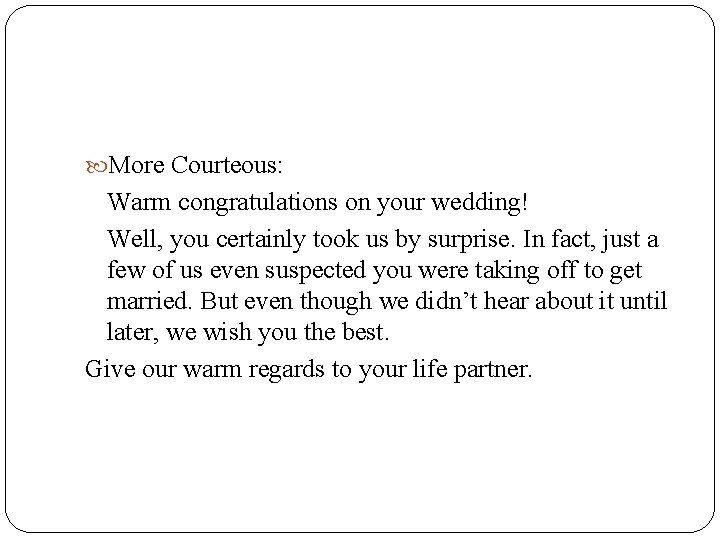
More Courteous: Warm congratulations on your wedding! Well, you certainly took us by surprise. In fact, just a few of us even suspected you were taking off to get married. But even though we didn’t hear about it until later, we wish you the best. Give our warm regards to your life partner.
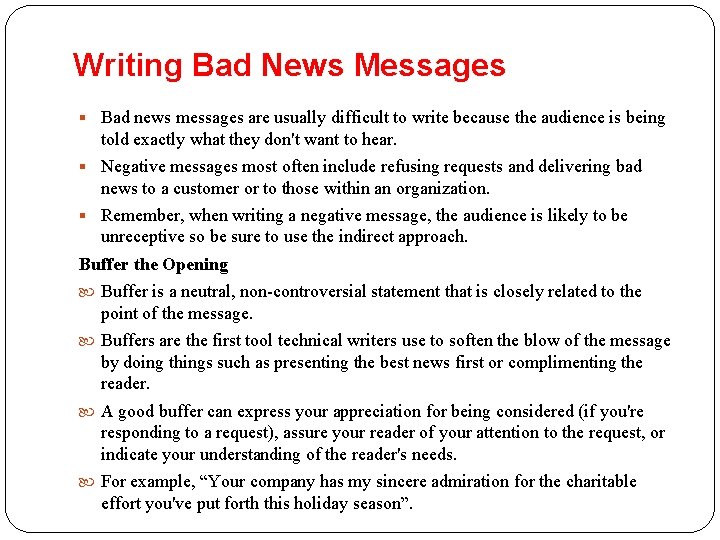
Writing Bad News Messages § Bad news messages are usually difficult to write because the audience is being told exactly what they don't want to hear. § Negative messages most often include refusing requests and delivering bad news to a customer or to those within an organization. § Remember, when writing a negative message, the audience is likely to be unreceptive so be sure to use the indirect approach. Buffer the Opening Buffer is a neutral, non-controversial statement that is closely related to the point of the message. Buffers are the first tool technical writers use to soften the blow of the message by doing things such as presenting the best news first or complimenting the reader. A good buffer can express your appreciation for being considered (if you're responding to a request), assure your reader of your attention to the request, or indicate your understanding of the reader's needs. For example, “Your company has my sincere admiration for the charitable effort you've put forth this holiday season”.
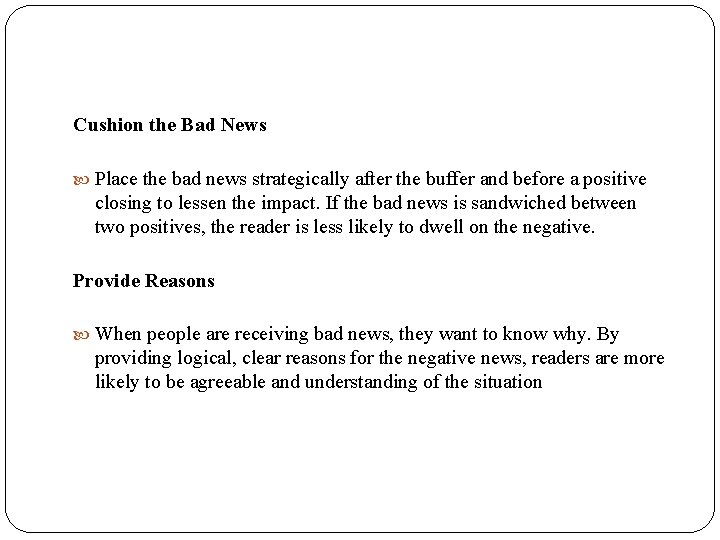
Cushion the Bad News Place the bad news strategically after the buffer and before a positive closing to lessen the impact. If the bad news is sandwiched between two positives, the reader is less likely to dwell on the negative. Provide Reasons When people are receiving bad news, they want to know why. By providing logical, clear reasons for the negative news, readers are more likely to be agreeable and understanding of the situation
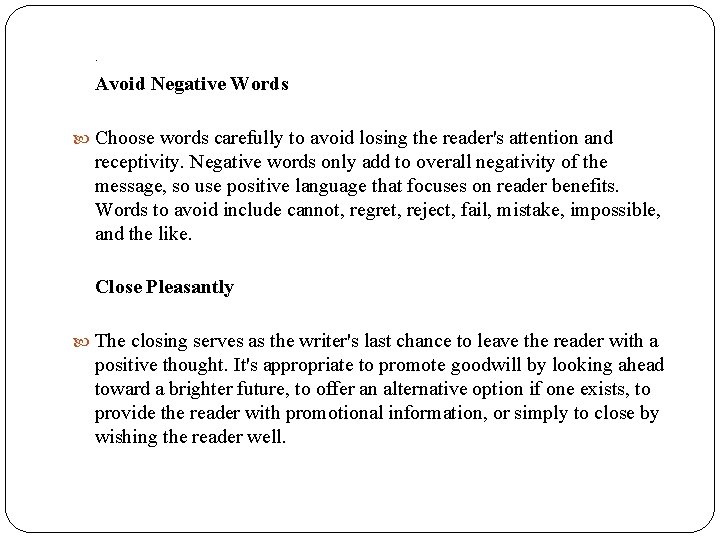
. Avoid Negative Words Choose words carefully to avoid losing the reader's attention and receptivity. Negative words only add to overall negativity of the message, so use positive language that focuses on reader benefits. Words to avoid include cannot, regret, reject, fail, mistake, impossible, and the like. Close Pleasantly The closing serves as the writer's last chance to leave the reader with a positive thought. It's appropriate to promote goodwill by looking ahead toward a brighter future, to offer an alternative option if one exists, to provide the reader with promotional information, or simply to close by wishing the reader well.
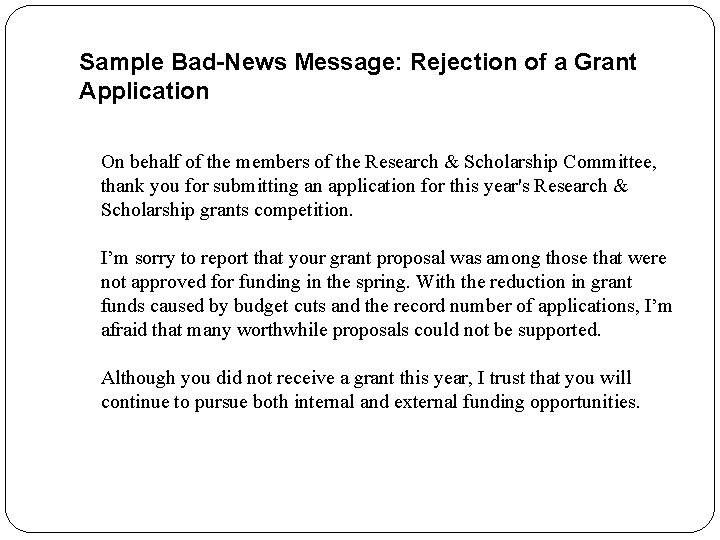
Sample Bad-News Message: Rejection of a Grant Application On behalf of the members of the Research & Scholarship Committee, thank you for submitting an application for this year's Research & Scholarship grants competition. I’m sorry to report that your grant proposal was among those that were not approved for funding in the spring. With the reduction in grant funds caused by budget cuts and the record number of applications, I’m afraid that many worthwhile proposals could not be supported. Although you did not receive a grant this year, I trust that you will continue to pursue both internal and external funding opportunities.
Exercise Following is a short bad news message. Rewrite the message using indirect approach: Your request for leave has been denied. Please contact your supervisor if you need more information.
Exercise I have received a message in which you offered me the position as General Manager at Simon's Inc. Unfortunately, I am unable to accept the position. I did not think that the position you offered me would utilize my communication and customerservice skills to the degree that I wanted. Therefore, I have accepted a position as Assistant Director at a different company
Use nondiscriminatory expressions Equal treatment of people regardless of gender, race, ethnic origin and physical features. v. Avoid sexist terms: “Man” Words Manpower Chairman Man-made Freshman Foreman
Singular pronouns He, She…… he/she, he or she q Anyone who comes to class late will get his grade reduced. Ø Anyone who comes to class late will get his/her grade reduced. Ø Those/Students who come to class late will get their grades reduced. Biased terms of address Mrs. Sarwar Miss. Anila Ali
Exercise Change the sexist words or terms into neutral ones: If a customer pays promptly, he is placed on our preferred list. When an unauthorized employee enters the security area, he is subject to dismissal. When a customer needs service, it is his right to ask for it.
7) Correctness
7) Correctness At the core of correctness is correct grammar, punctuation and spelling. Message must be perfect grammatically and textually. The term correctness, as applied to business messages also mean the following characteristics: o Use the right level of language o Check the accuracy of figures, facts and words
Use the right Level of Language There are three levels of language: 1. Formal 2. Informal 3. Substandard. Make a quick guess: What kind of writing is associated with each level? What is the style of each?
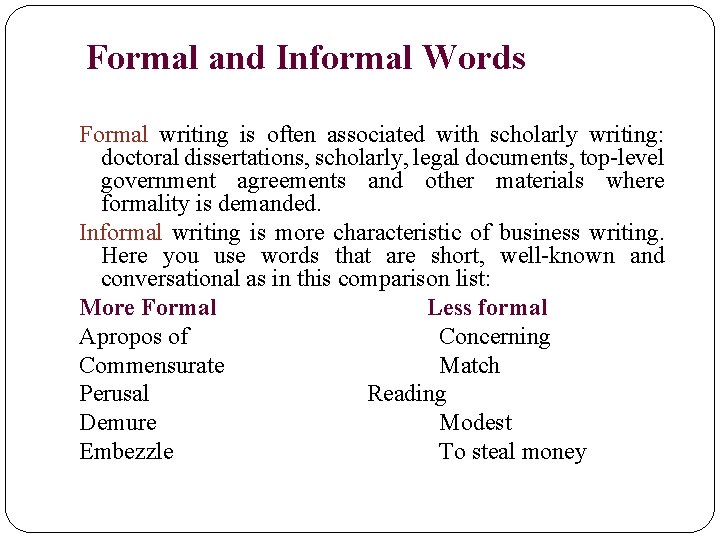
Formal and Informal Words Formal writing is often associated with scholarly writing: doctoral dissertations, scholarly, legal documents, top-level government agreements and other materials where formality is demanded. Informal writing is more characteristic of business writing. Here you use words that are short, well-known and conversational as in this comparison list: More Formal Less formal Apropos of Concerning Commensurate Match Perusal Reading Demure Modest Embezzle To steal money
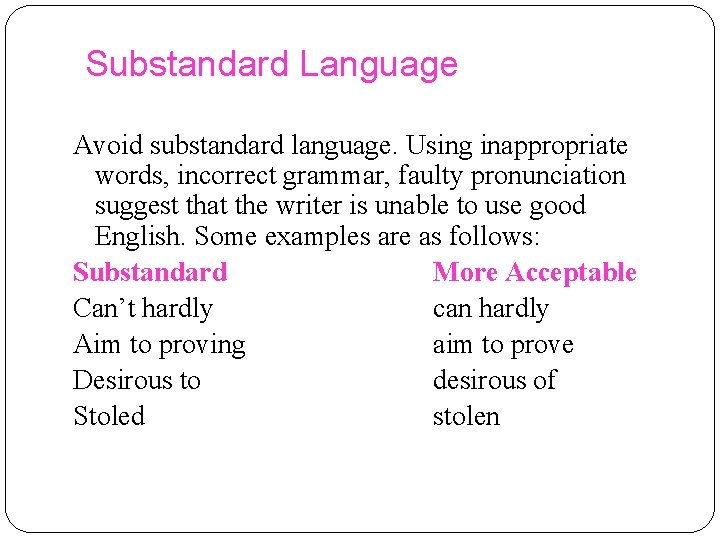
Substandard Language Avoid substandard language. Using inappropriate words, incorrect grammar, faulty pronunciation suggest that the writer is unable to use good English. Some examples are as follows: Substandard More Acceptable Can’t hardly can hardly Aim to proving aim to prove Desirous to desirous of Stoled stolen
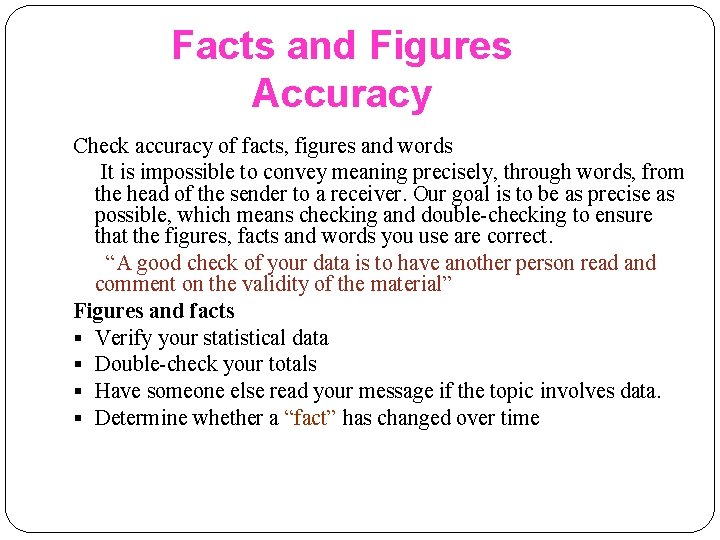
Facts and Figures Accuracy Check accuracy of facts, figures and words It is impossible to convey meaning precisely, through words, from the head of the sender to a receiver. Our goal is to be as precise as possible, which means checking and double-checking to ensure that the figures, facts and words you use are correct. “A good check of your data is to have another person read and comment on the validity of the material” Figures and facts § Verify your statistical data § Double-check your totals § Have someone else read your message if the topic involves data. § Determine whether a “fact” has changed over time
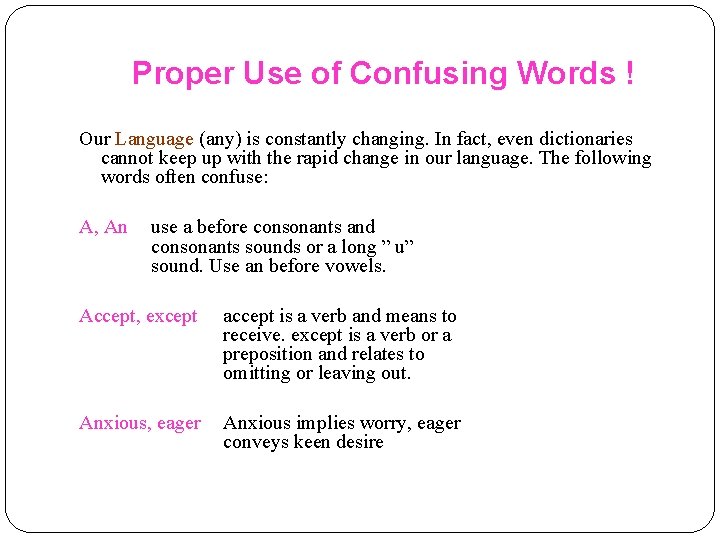
Proper Use of Confusing Words ! Our Language (any) is constantly changing. In fact, even dictionaries cannot keep up with the rapid change in our language. The following words often confuse: A, An use a before consonants and consonants sounds or a long ” u” sound. Use an before vowels. Accept, except accept is a verb and means to receive. except is a verb or a preposition and relates to omitting or leaving out. Anxious, eager Anxious implies worry, eager conveys keen desire
Thank You