
Principles of Economics Test 9 What is economics
- Slides: 113
Principles of Economics Test #9
What is economics? • Study of how people choose to use their limited resources to satisfy their unlimited wants
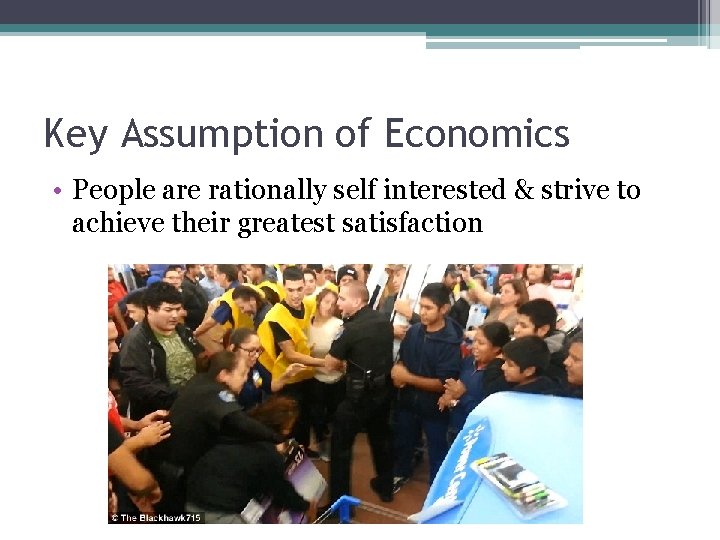
Key Assumption of Economics • People are rationally self interested & strive to achieve their greatest satisfaction
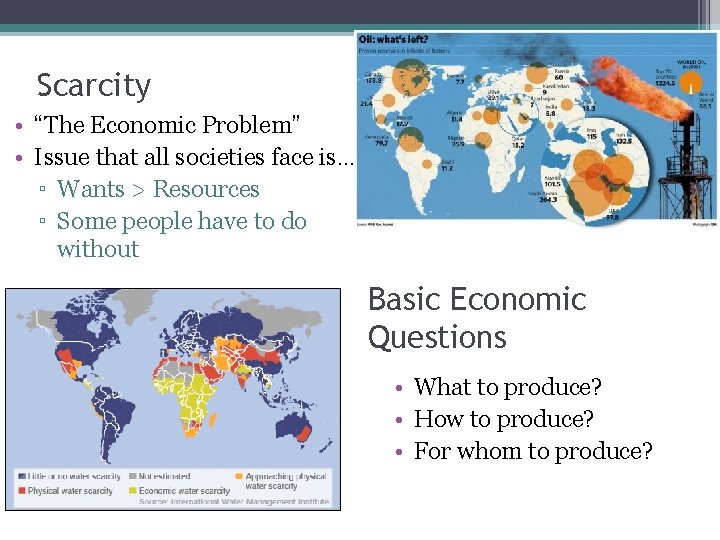
Scarcity • “The Economic Problem” • Issue that all societies face is… ▫ Wants > Resources ▫ Some people have to do without Basic Economic Questions • What to produce? • How to produce? • For whom to produce?
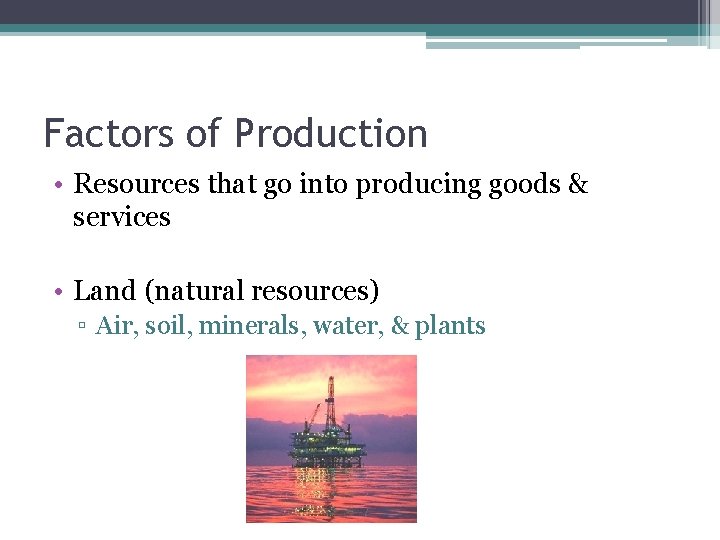
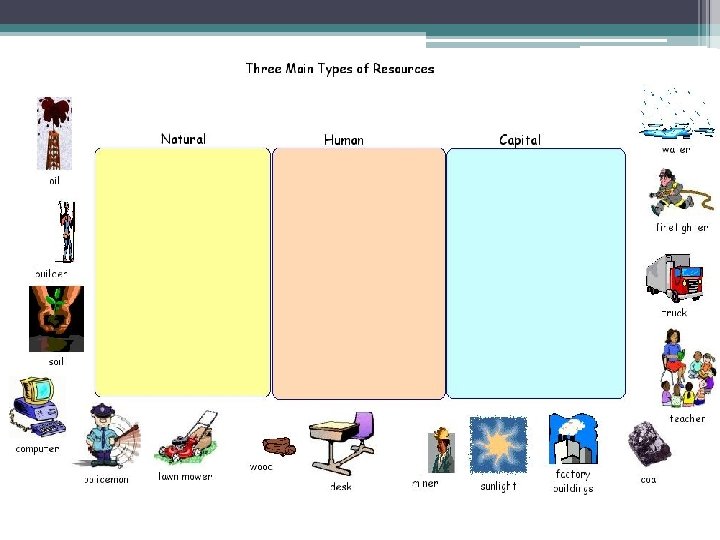
Factors of Production • Resources that go into producing goods & services • Land (natural resources) ▫ Air, soil, minerals, water, & plants
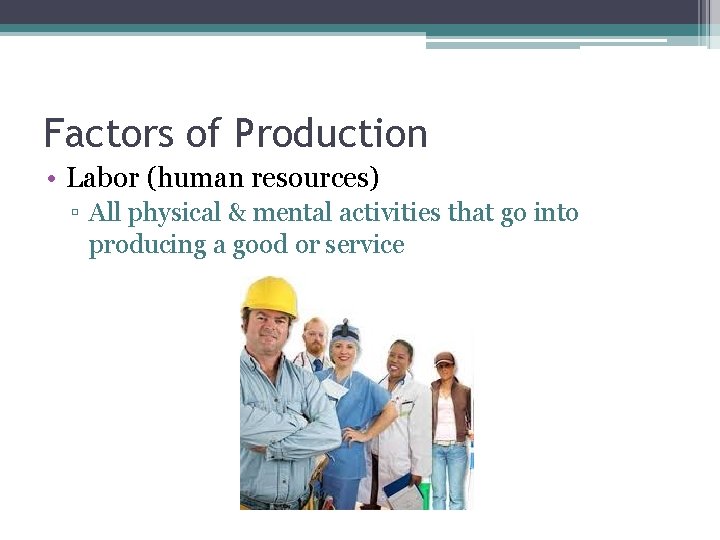
Factors of Production • Labor (human resources) ▫ All physical & mental activities that go into producing a good or service
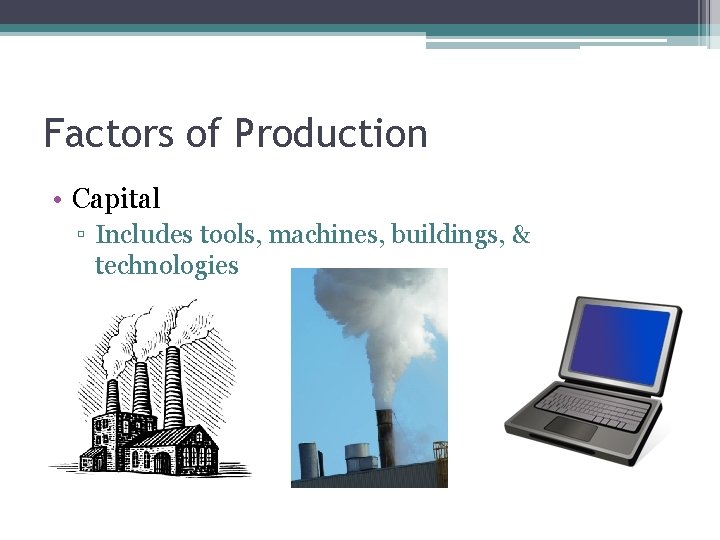
Factors of Production • Capital ▫ Includes tools, machines, buildings, & technologies
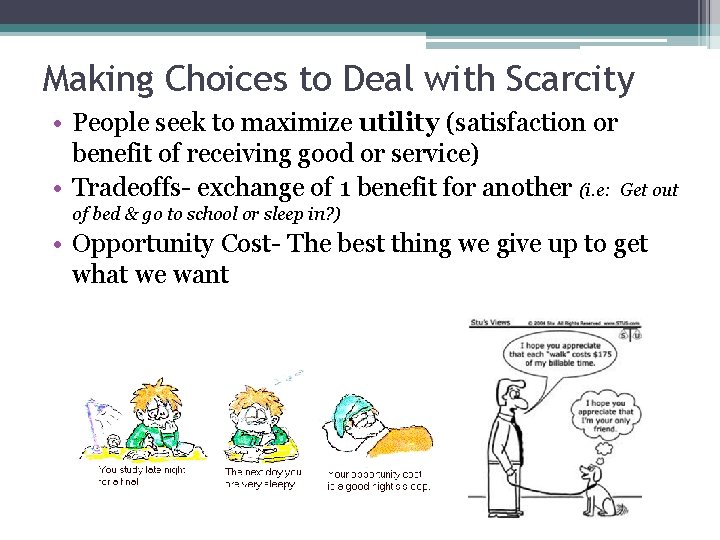
Making Choices to Deal with Scarcity • People seek to maximize utility (satisfaction or benefit of receiving good or service) • Tradeoffs- exchange of 1 benefit for another (i. e: Get out of bed & go to school or sleep in? ) • Opportunity Cost- The best thing we give up to get what we want
The Lorax Questions: 1. List an example for each factor of production. 2. What tradeoffs were illustrated? 3. What can this teach us about economics and scarcity?
After reading about California’s drought, reflect on the issue of scarcity and how it relates to government. California Drought Questions: 1. What sort of scarcity problems does the government have to deal with? 2. How do you think they should address these problems? 3. How much power do you think is necessary for government to address these problems?
After reading one economist’s view on scarcity, answer the following questions. The Scarcity Shortage Questions: 1. According to the author, what was the number one problem economics attempted to solve in the past? 2. Summarize what has happened to this economic issue, presently. 3. Describe an example, other than those used in the article, that displays this change.
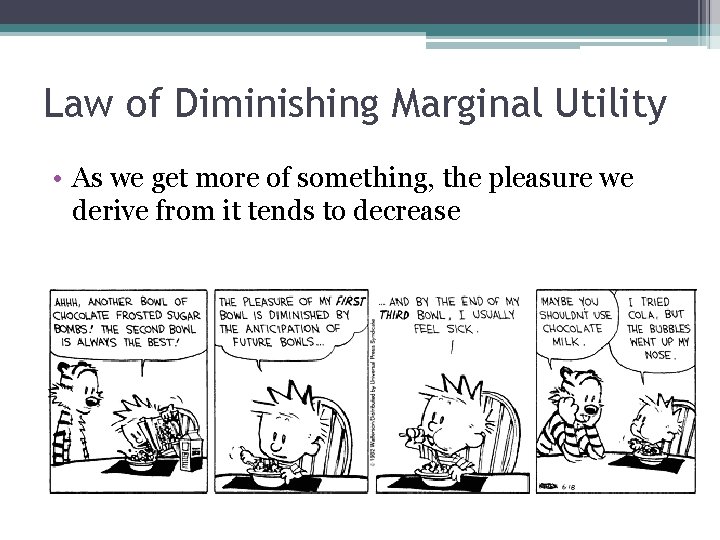
Law of Diminishing Marginal Utility • As we get more of something, the pleasure we derive from it tends to decrease
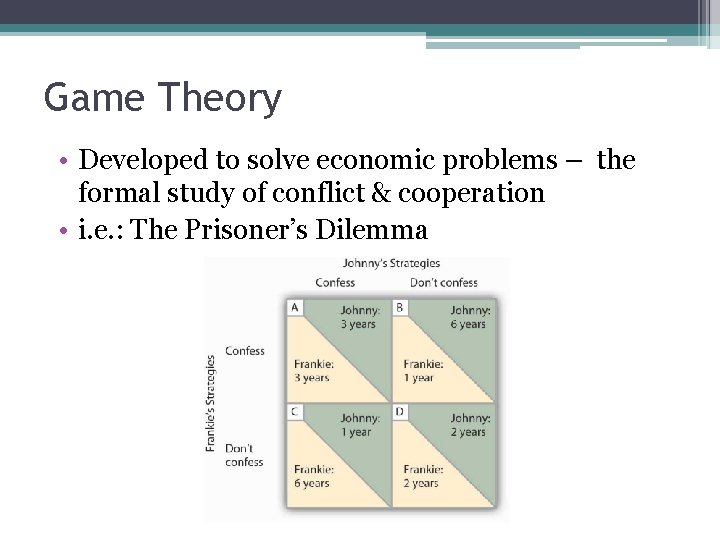
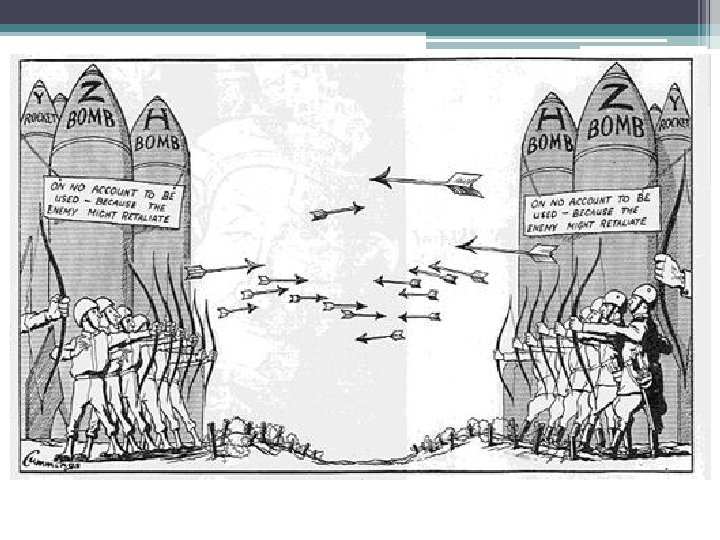
Game Theory • Developed to solve economic problems – the formal study of conflict & cooperation • i. e. : The Prisoner’s Dilemma
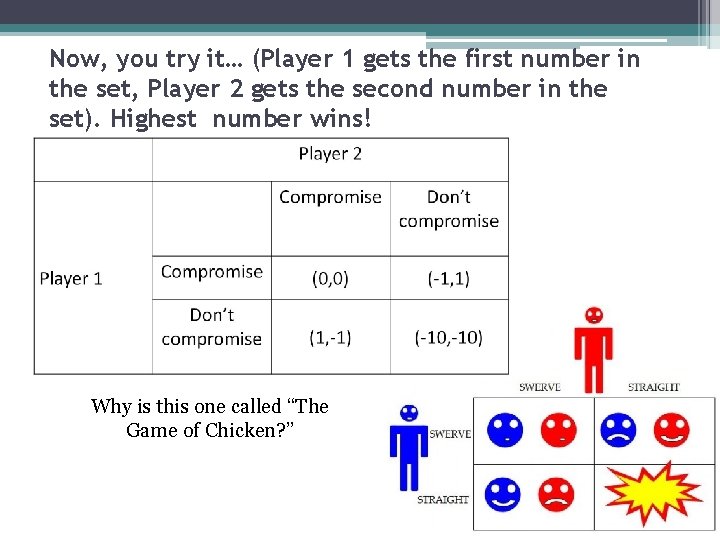
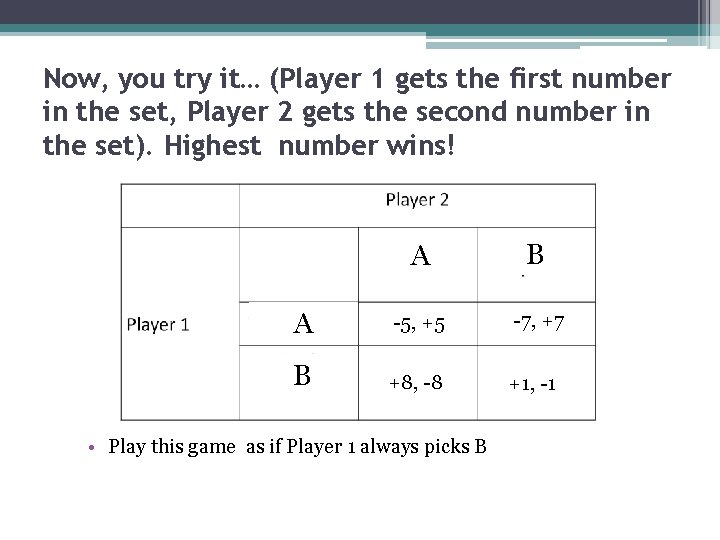
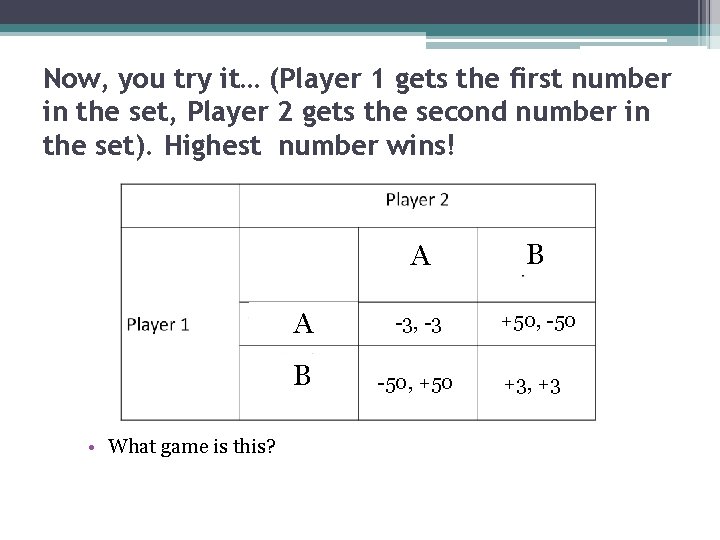
Now, you try it… (Player 1 gets the first number in the set, Player 2 gets the second number in the set). Highest number wins! Why is this one called “The Game of Chicken? ”
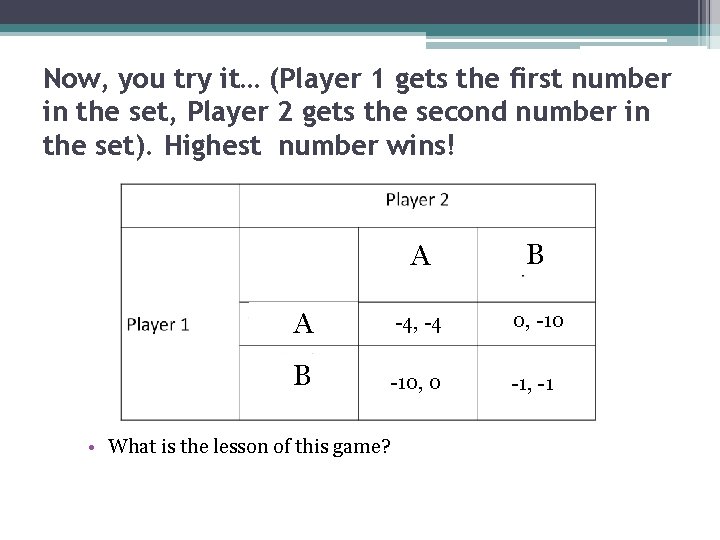
Now, you try it… (Player 1 gets the first number in the set, Player 2 gets the second number in the set). Highest number wins! A B A -4, -4 0, -10 B -10, 0 -1, -1 • What is the lesson of this game?
Now, you try it… (Player 1 gets the first number in the set, Player 2 gets the second number in the set). Highest number wins! A B A -4, -4 -5, +5 -7, +7 B +8, -8 +1, -1 • Play this game as if Player 1 always picks B
Now, you try it… (Player 1 gets the first number in the set, Player 2 gets the second number in the set). Highest number wins! • What game is this? A B A -4, -4 -3, -3 +50, -50 B -50, +50 +3, +3
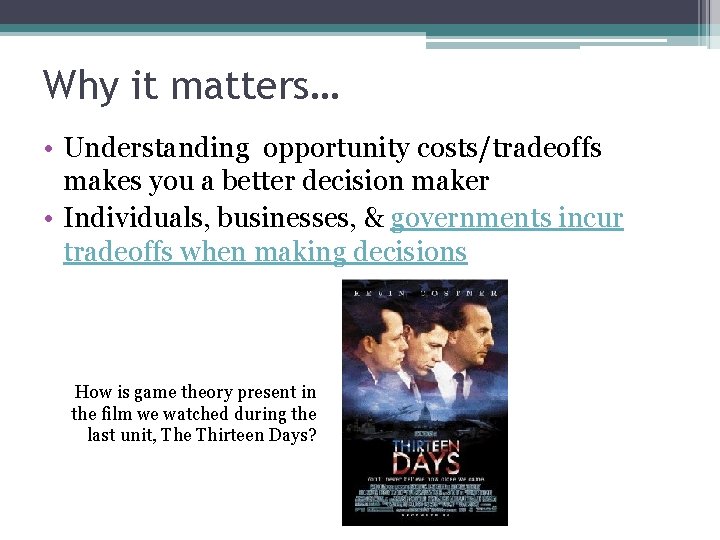
Why it matters… • Understanding opportunity costs/tradeoffs makes you a better decision maker • Individuals, businesses, & governments incur tradeoffs when making decisions How is game theory present in the film we watched during the last unit, The Thirteen Days?
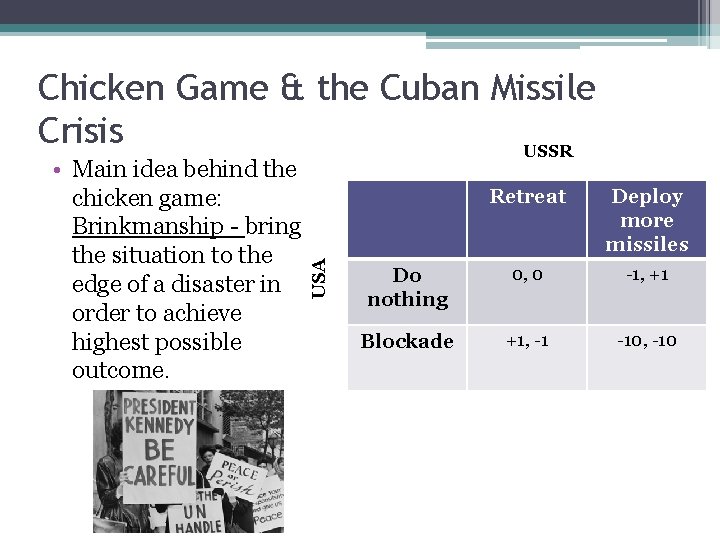
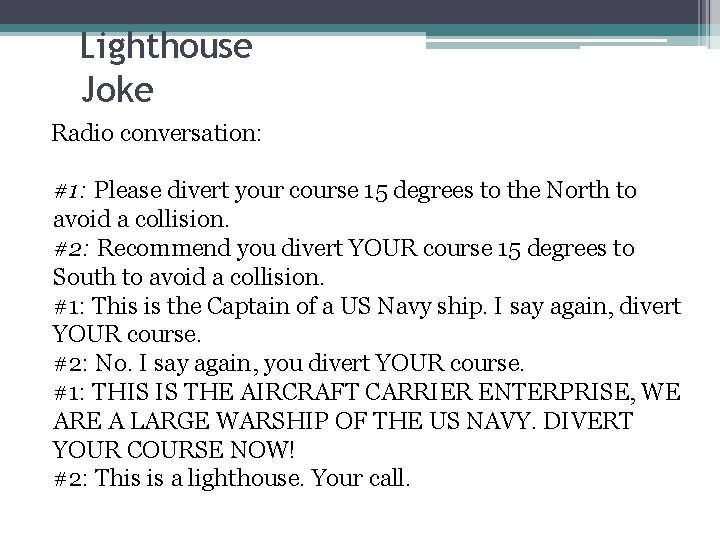
• Main idea behind the chicken game: Brinkmanship - bring the situation to the edge of a disaster in order to achieve highest possible outcome. USA Chicken Game & the Cuban Missile Crisis USSR Retreat Deploy more missiles Do nothing 0, 0 -1, +1 Blockade +1, -1 -10, -10
Lighthouse Joke Radio conversation: #1: Please divert your course 15 degrees to the North to avoid a collision. #2: Recommend you divert YOUR course 15 degrees to South to avoid a collision. #1: This is the Captain of a US Navy ship. I say again, divert YOUR course. #2: No. I say again, you divert YOUR course. #1: THIS IS THE AIRCRAFT CARRIER ENTERPRISE, WE ARE A LARGE WARSHIP OF THE US NAVY. DIVERT YOUR COURSE NOW! #2: This is a lighthouse. Your call.
• Can Game Theory Help a Presidential Candidate Win? • Could Game Theory Have Helped United Airlines?
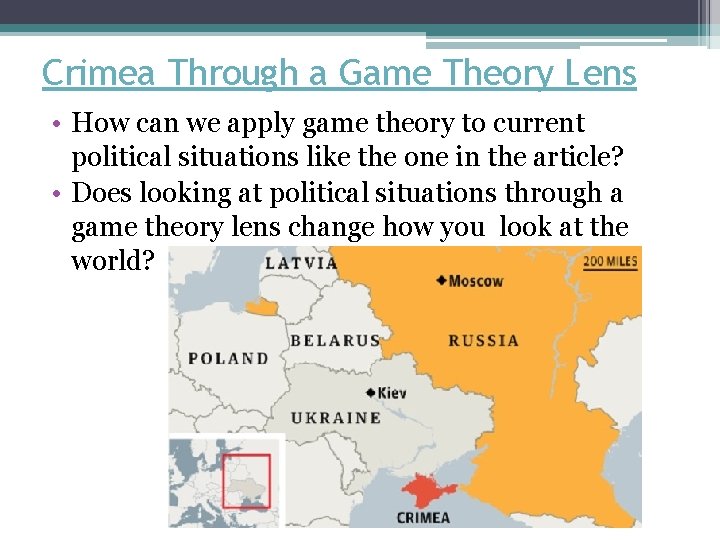
Crimea Through a Game Theory Lens • How can we apply game theory to current political situations like the one in the article? • Does looking at political situations through a game theory lens change how you look at the world?
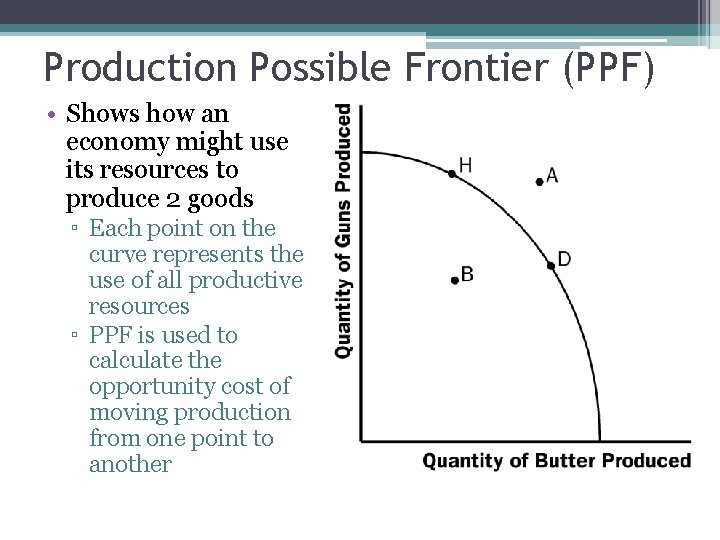
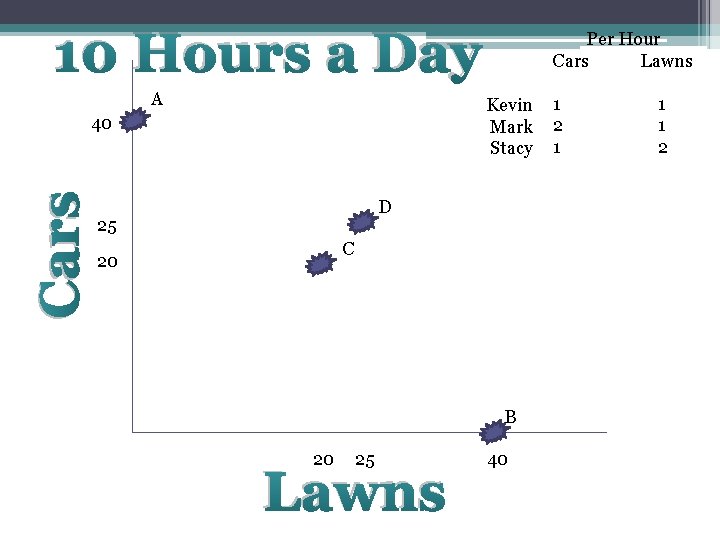
Production Possible Frontier (PPF) • Shows how an economy might use its resources to produce 2 goods ▫ Each point on the curve represents the use of all productive resources ▫ PPF is used to calculate the opportunity cost of moving production from one point to another
10 Hours a Day A Kevin Mark Stacy 40 Cars Per Hour Cars Lawns D 25 C 20 B 20 25 Lawns 40 1 2 1 1 2
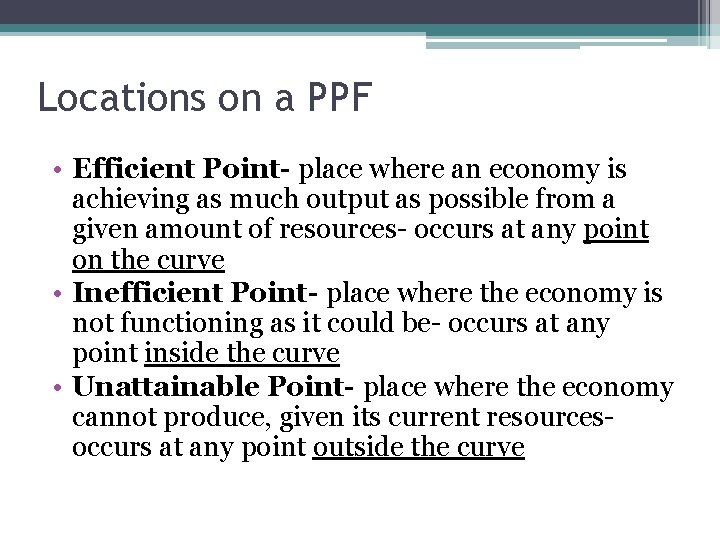
Locations on a PPF • Efficient Point- place where an economy is achieving as much output as possible from a given amount of resources- occurs at any point on the curve • Inefficient Point- place where the economy is not functioning as it could be- occurs at any point inside the curve • Unattainable Point- place where the economy cannot produce, given its current resources- occurs at any point outside the curve
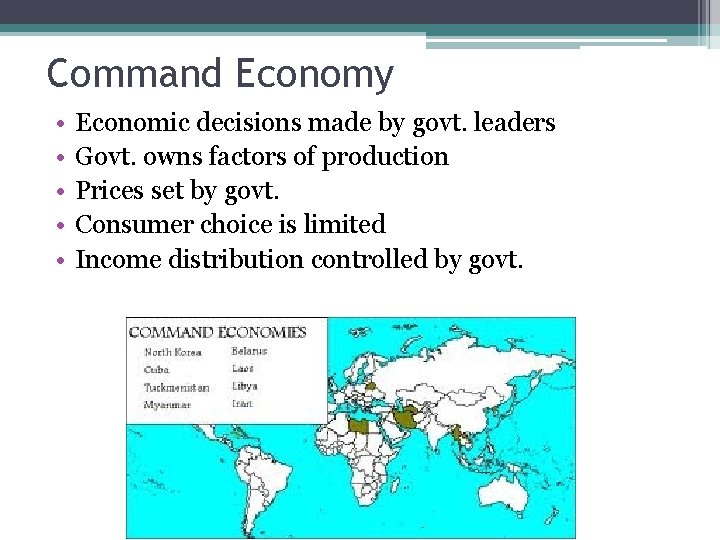
Command Economy • • • Economic decisions made by govt. leaders Govt. owns factors of production Prices set by govt. Consumer choice is limited Income distribution controlled by govt.
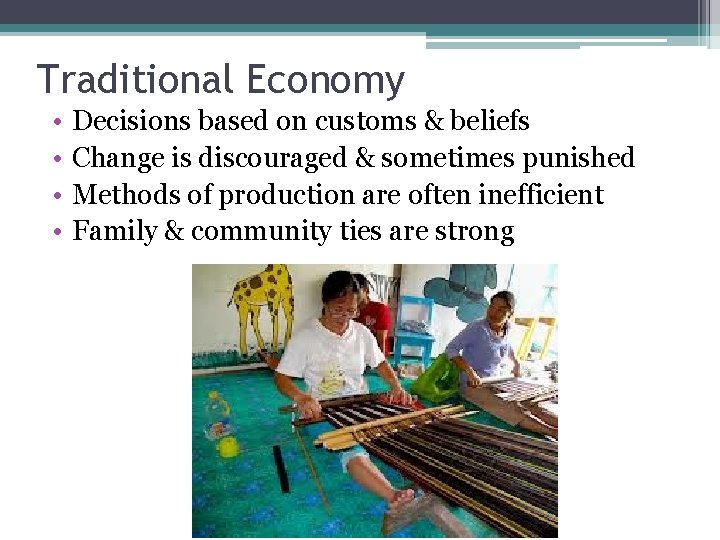
Traditional Economy • • Decisions based on customs & beliefs Change is discouraged & sometimes punished Methods of production are often inefficient Family & community ties are strong
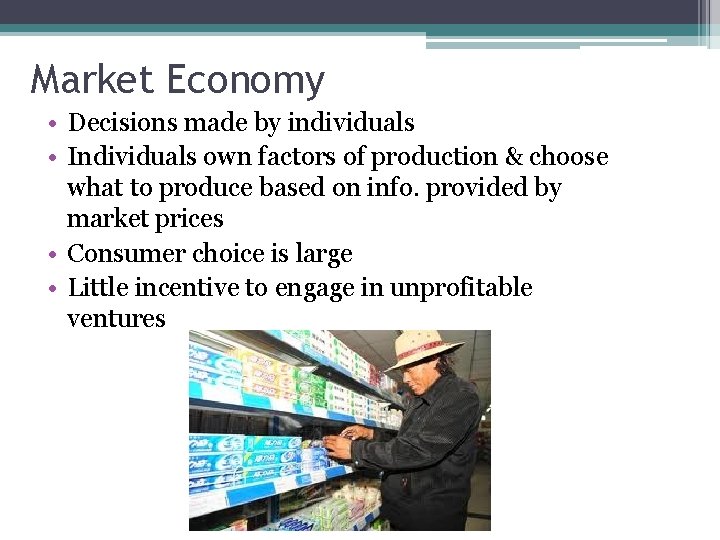
Market Economy • Decisions made by individuals • Individuals own factors of production & choose what to produce based on info. provided by market prices • Consumer choice is large • Little incentive to engage in unprofitable ventures
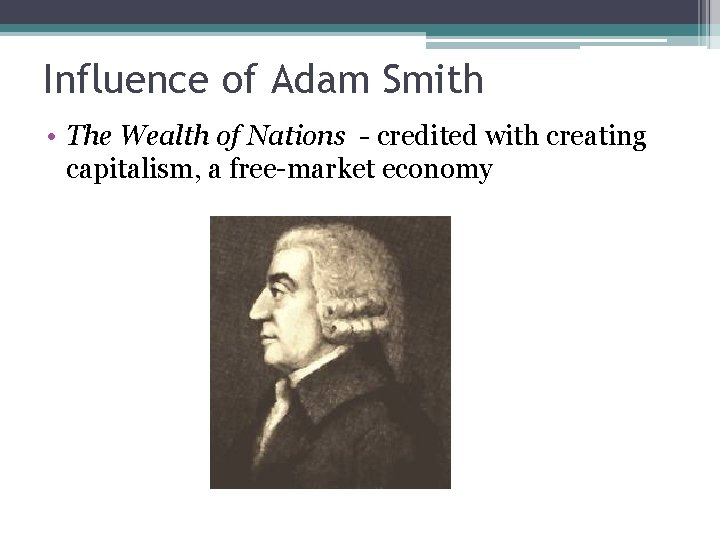
Influence of Adam Smith • The Wealth of Nations - credited with creating capitalism, a free-market economy
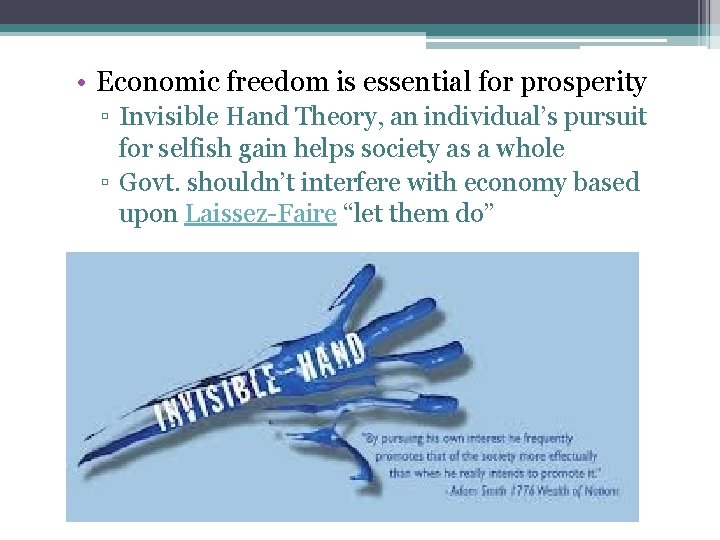
• Economic freedom is essential for prosperity ▫ Invisible Hand Theory, an individual’s pursuit for selfish gain helps society as a whole ▫ Govt. shouldn’t interfere with economy based upon Laissez-Faire “let them do”
• In the 1700 s & 1800 s Smith’s ideas were put into action: ▫ Capitalists grew wealthy by accumulating capital & devoting them to industrial production -> Industrial Revolution ▫ Positives- more jobs, urban growth, goods & services, & technology ▫ Negatives- harsh work conditions, long hours, low wages, unsanitary conditions
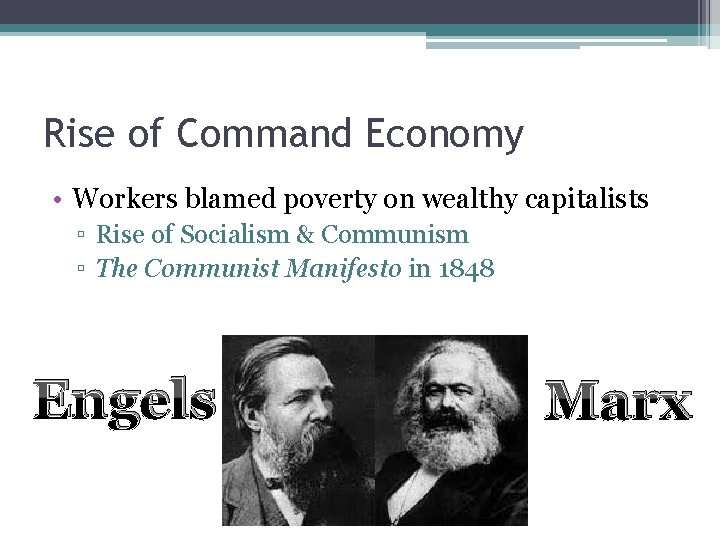
Rise of Command Economy • Workers blamed poverty on wealthy capitalists ▫ Rise of Socialism & Communism ▫ The Communist Manifesto in 1848 Engels Marx
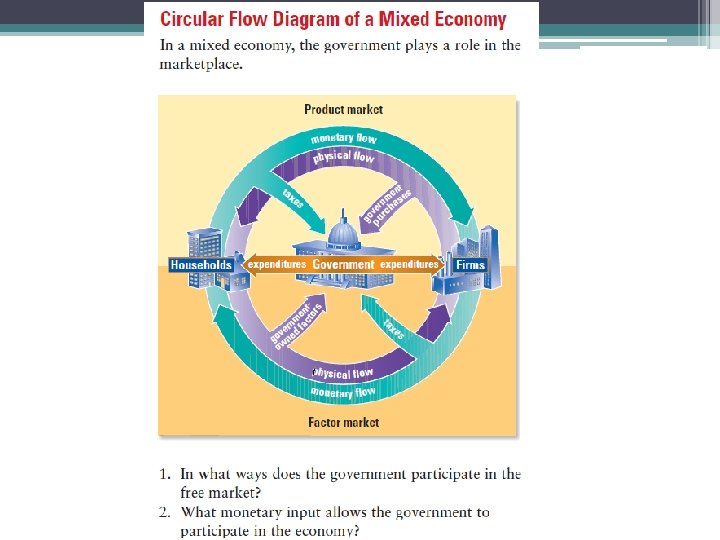
U. S. Mixed Economy • In a mixed economy… ▫ Individuals: �Own the factors of production �Freedom to produce or consume �Must operate under confines of the law ▫ Government: �Protects workers & consumers �Regulates business & preserves competitions �Provide public goods/benefits
Micro & Macroeconomics Test #10
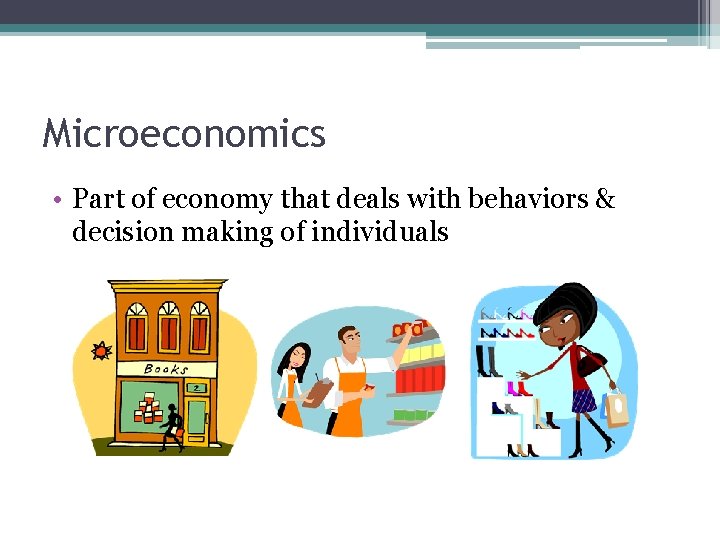
Microeconomics • Part of economy that deals with behaviors & decision making of individuals
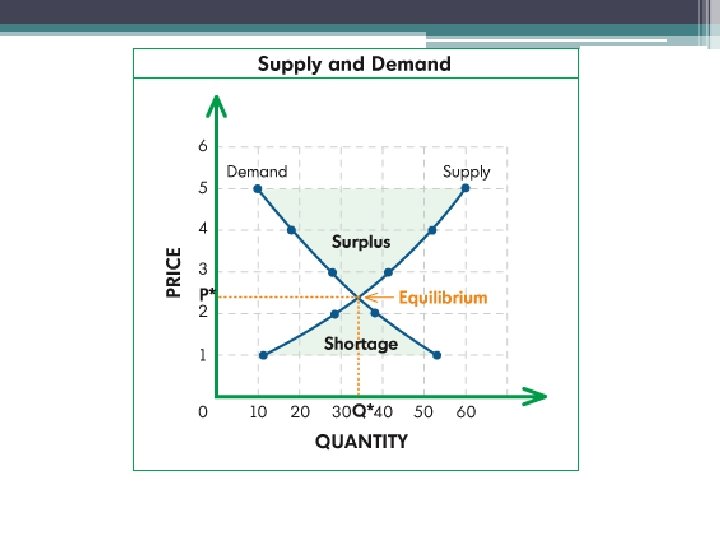
Law of Supply • If prices are high, suppliers offer greater quantities for sale • If prices are low, suppliers offer smaller quantities for sale
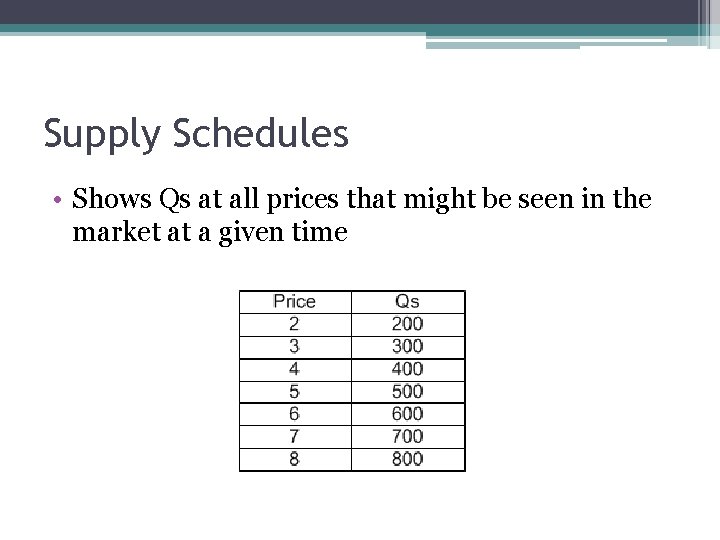
Supply Schedules • Shows Qs at all prices that might be seen in the market at a given time
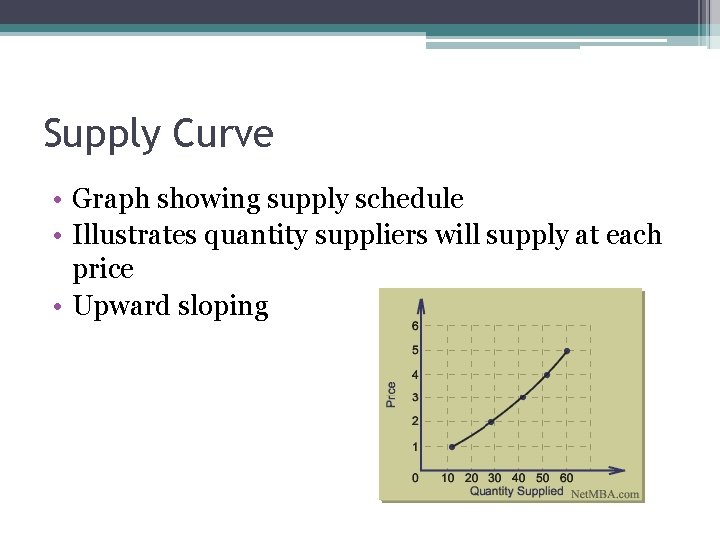
Supply Curve • Graph showing supply schedule • Illustrates quantity suppliers will supply at each price • Upward sloping
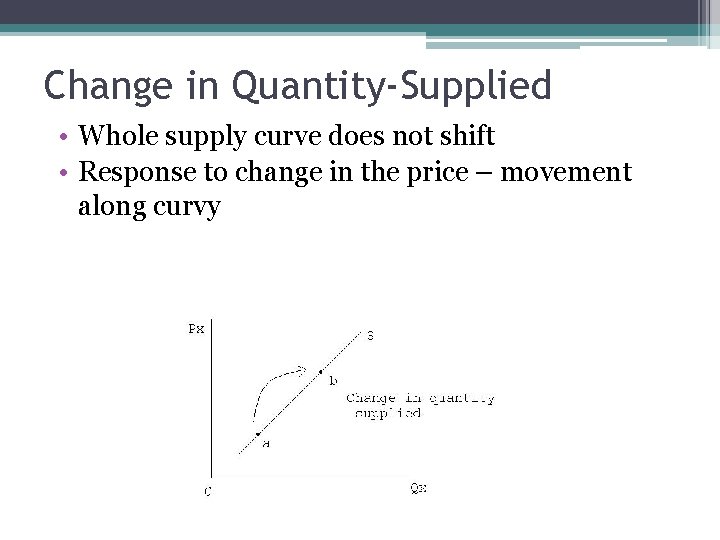
Change in Quantity-Supplied • Whole supply curve does not shift • Response to change in the price – movement along curvy
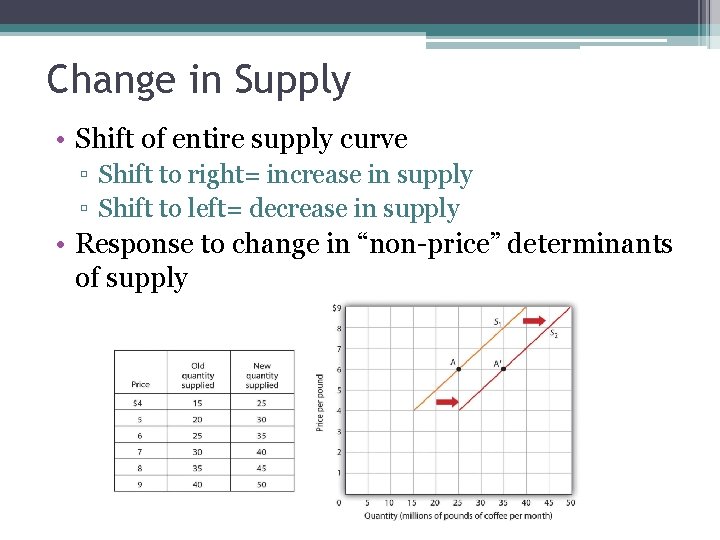
Change in Supply • Shift of entire supply curve ▫ Shift to right= increase in supply ▫ Shift to left= decrease in supply • Response to change in “non-price” determinants of supply
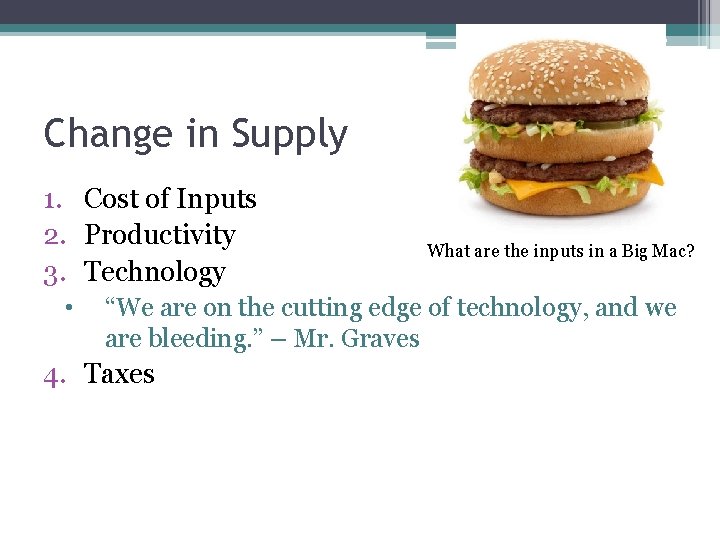
Change in Supply 1. Cost of Inputs 2. Productivity 3. Technology • What are the inputs in a Big Mac? “We are on the cutting edge of technology, and we are bleeding. ” – Mr. Graves 4. Taxes
5. Subsidies 6. Future Expectations 7. Government Regulations 8. Number of Sellers
Farm Subsidies On a sheet of notebook paper, answer the following questions. Keep this sheet because we may use it for one other activity in class today. 1) What is supposed to be the purpose of farm subsidies? 2) Do they work? Why or why not? 3) What is your opinion on this government subsidy?
Train Derailments in VA 1. What non-price determinant of supply is proposed in the situation above? 2. What consequences (seen and unseen) could this cause?
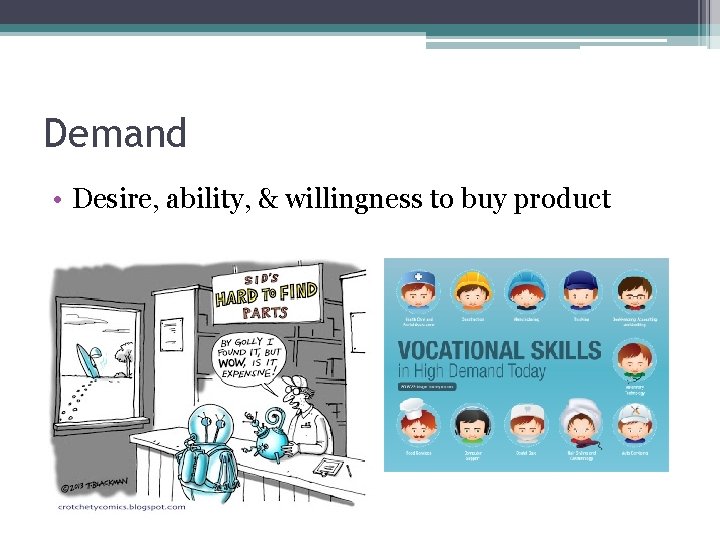
Demand • Desire, ability, & willingness to buy product
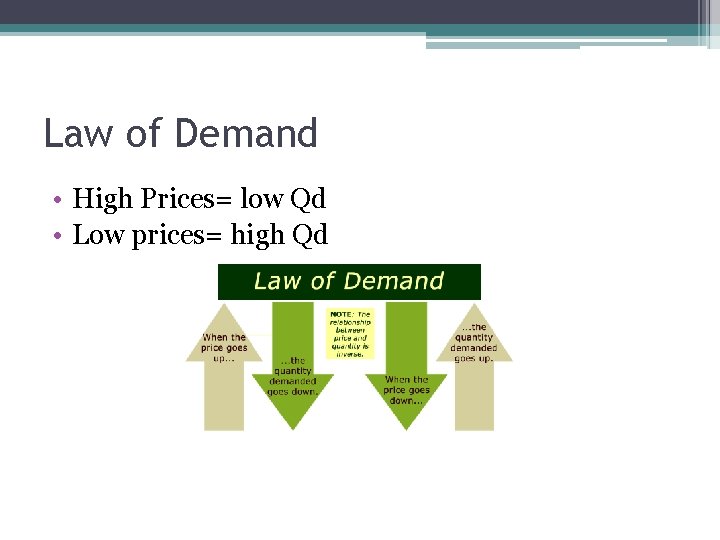
Law of Demand • High Prices= low Qd • Low prices= high Qd
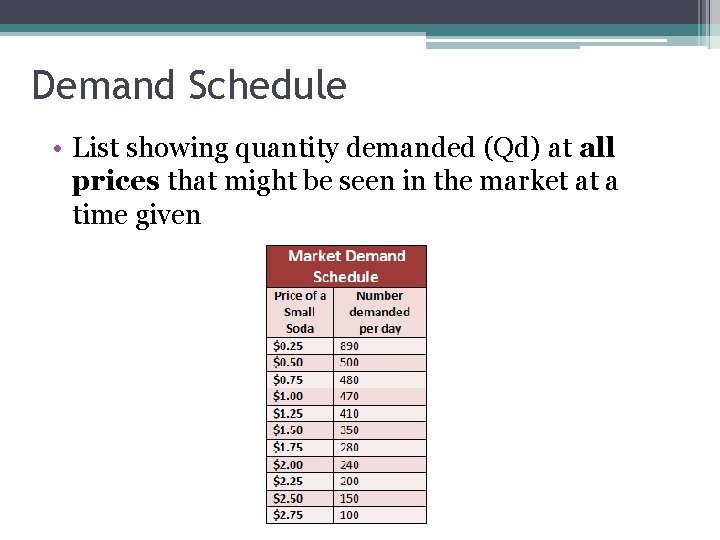
Demand Schedule • List showing quantity demanded (Qd) at all prices that might be seen in the market at a time given
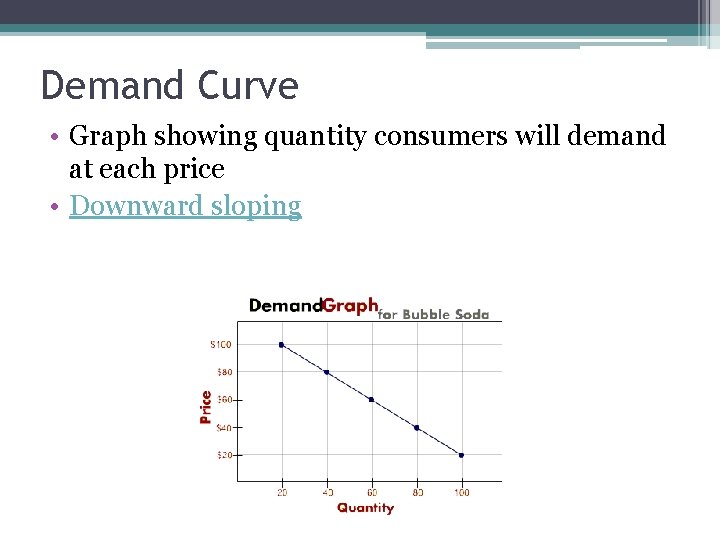
Demand Curve • Graph showing quantity consumers will demand at each price • Downward sloping
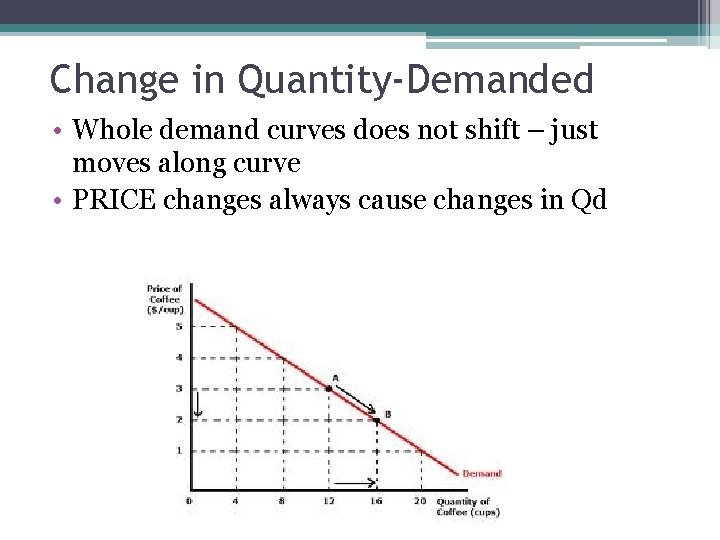
Change in Quantity-Demanded • Whole demand curves does not shift – just moves along curve • PRICE changes always cause changes in Qd
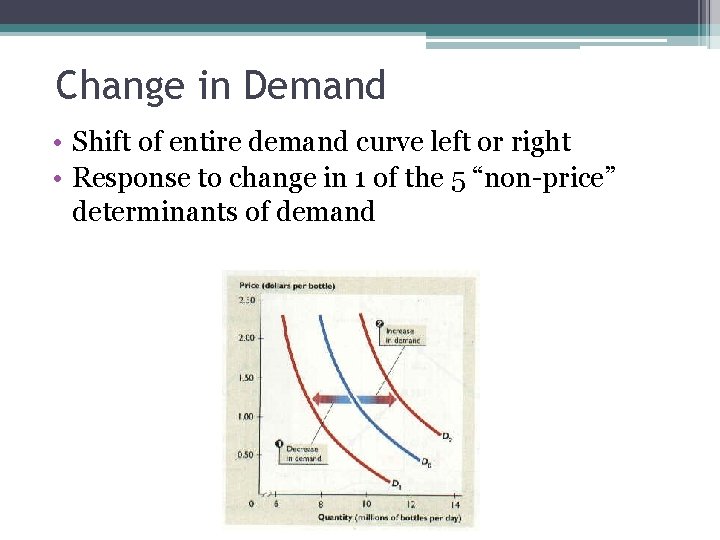
Change in Demand • Shift of entire demand curve left or right • Response to change in 1 of the 5 “non-price” determinants of demand
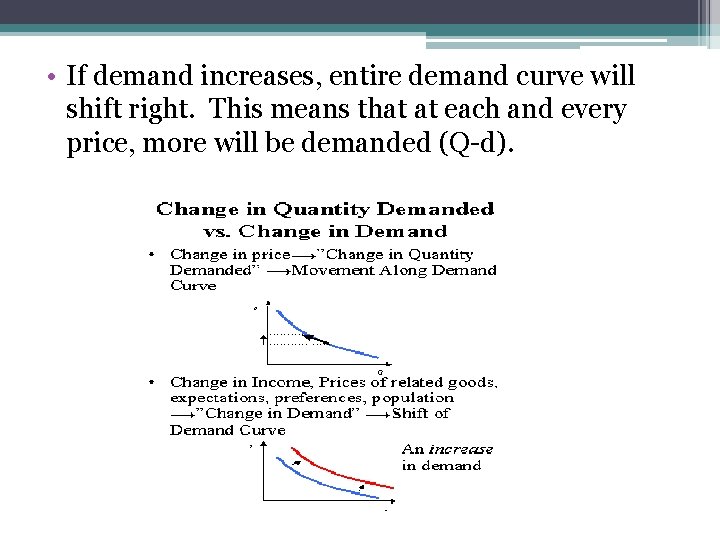
• If demand increases, entire demand curve will shift right. This means that at each and every price, more will be demanded (Q-d).
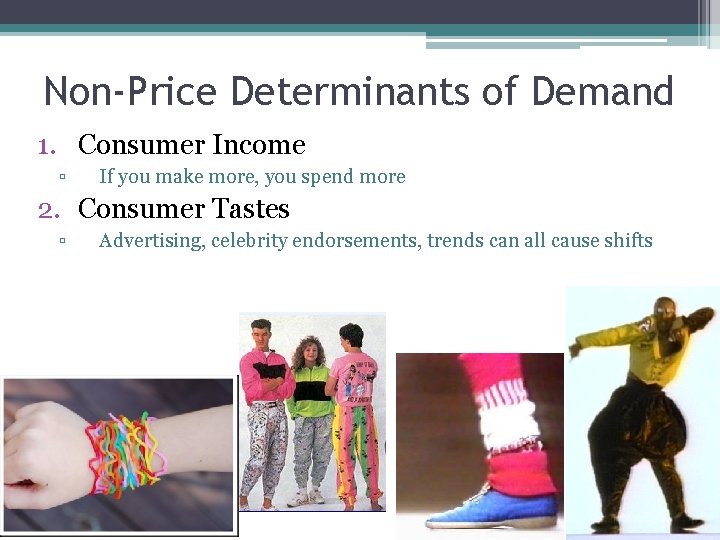
Non-Price Determinants of Demand 1. Consumer Income ▫ If you make more, you spend more 2. Consumer Tastes ▫ Advertising, celebrity endorsements, trends can all cause shifts
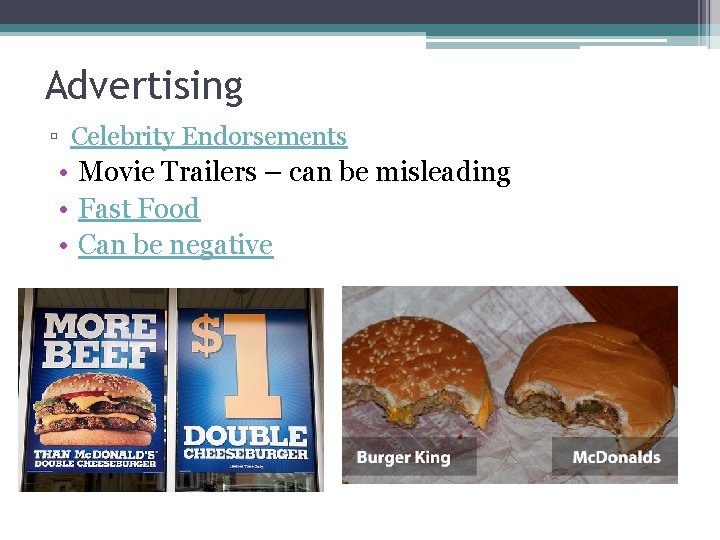
Advertising ▫ Celebrity Endorsements • Movie Trailers – can be misleading • Fast Food • Can be negative
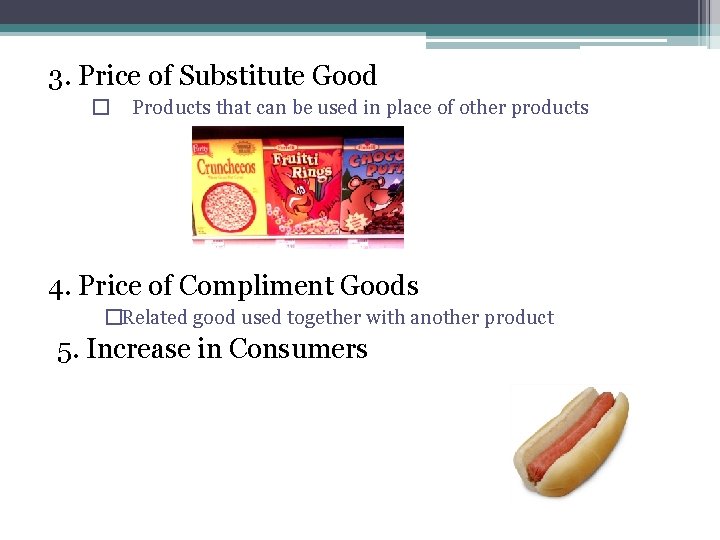
3. Price of Substitute Good � Products that can be used in place of other products 4. Price of Compliment Goods �Related good used together with another product 5. Increase in Consumers
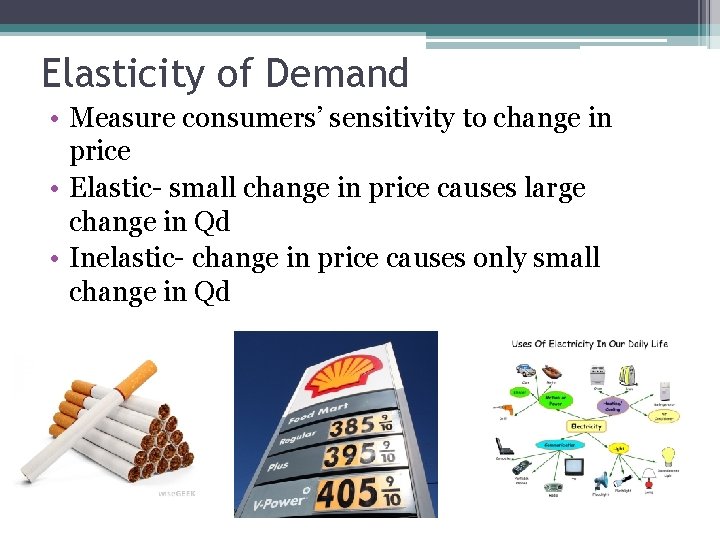
Elasticity of Demand • Measure consumers’ sensitivity to change in price • Elastic- small change in price causes large change in Qd • Inelastic- change in price causes only small change in Qd
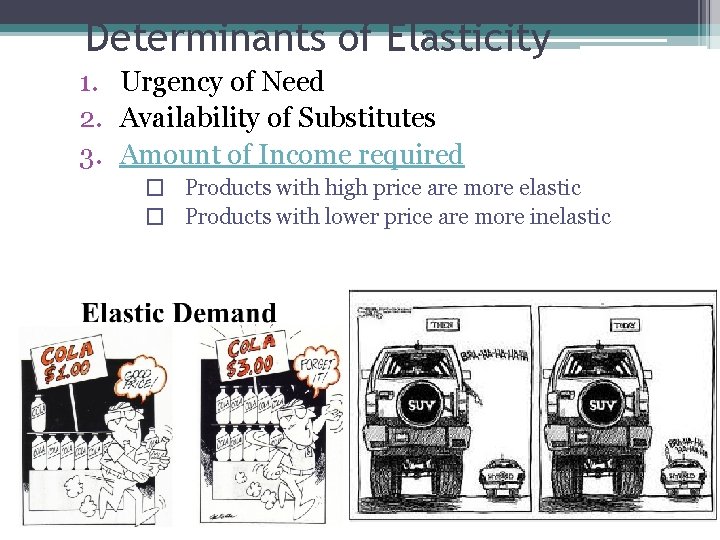
Determinants of Elasticity 1. Urgency of Need 2. Availability of Substitutes 3. Amount of Income required � Products with high price are more elastic � Products with lower price are more inelastic
Headliners Activity: Supply & Demand • Pretend you are a writer for the local newspaper. • Your task is to create a ‘catchy’ headline & write a brief news article detailing a scenario that would cause a change in supply or demand. Be sure to describe which determinant of supply or demand your article is discussing. Include a S&D graph to illustrate how the change in supply or demand would impact local consumers. Examples of “catchy” headlines from recent news… ▫ “J. Crew benefits as Mrs. Obama wears the brand” ▫ “Tickets! Whose Got Tickets? ” ▫ “Consumer demand for small cars is here to stay”
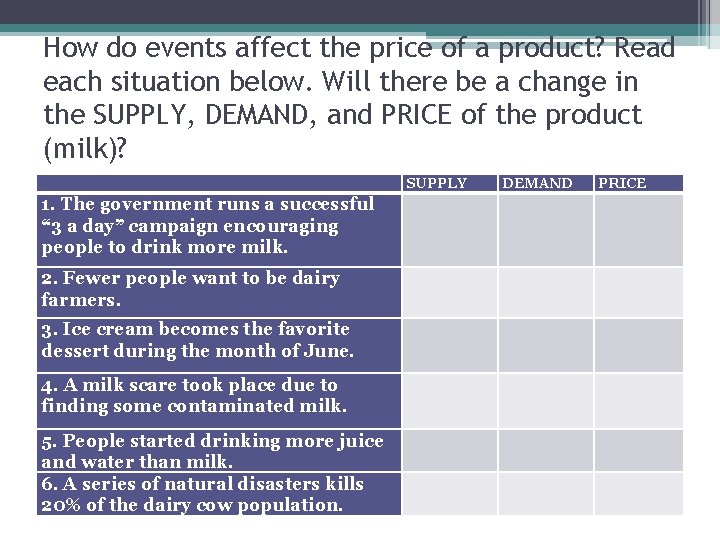
How do events affect the price of a product? Read each situation below. Will there be a change in the SUPPLY, DEMAND, and PRICE of the product (milk)? SUPPLY DEMAND PRICE 2. Fewer people want to be dairy farmers. 3. Ice cream becomes the favorite dessert during the month of June. 4. A milk scare took place due to finding some contaminated milk. 5. People started drinking more juice and water than milk. 6. A series of natural disasters kills 20% of the dairy cow population. 1. The government runs a successful “ 3 a day” campaign encouraging people to drink more milk.
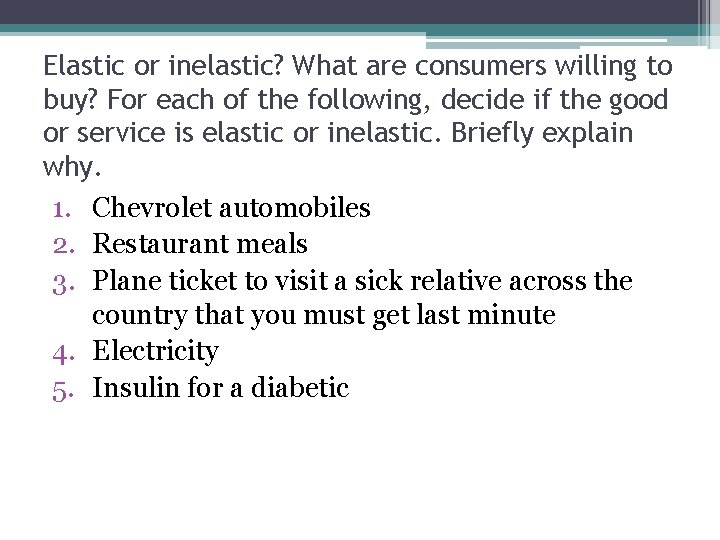
Elastic or inelastic? What are consumers willing to buy? For each of the following, decide if the good or service is elastic or inelastic. Briefly explain why. 1. Chevrolet automobiles 2. Restaurant meals 3. Plane ticket to visit a sick relative across the country that you must get last minute 4. Electricity 5. Insulin for a diabetic
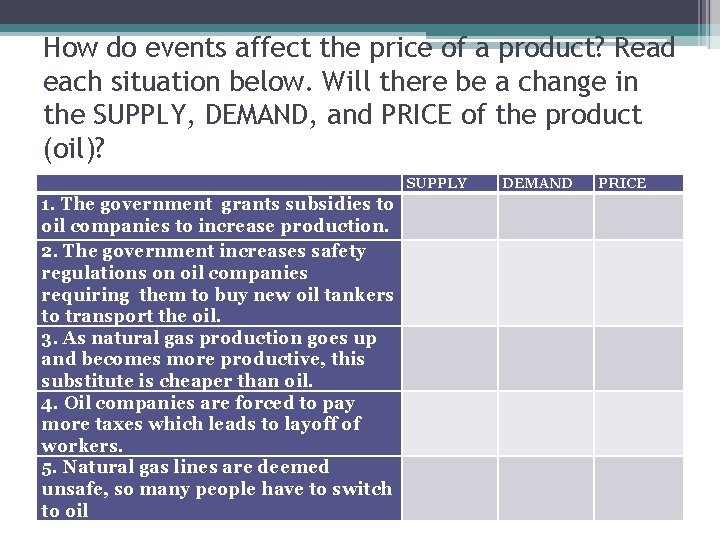
How do events affect the price of a product? Read each situation below. Will there be a change in the SUPPLY, DEMAND, and PRICE of the product (oil)? 1. The government grants subsidies to oil companies to increase production. 2. The government increases safety regulations on oil companies requiring them to buy new oil tankers to transport the oil. 3. As natural gas production goes up and becomes more productive, this substitute is cheaper than oil. 4. Oil companies are forced to pay more taxes which leads to layoff of workers. 5. Natural gas lines are deemed unsafe, so many people have to switch to oil SUPPLY DEMAND PRICE
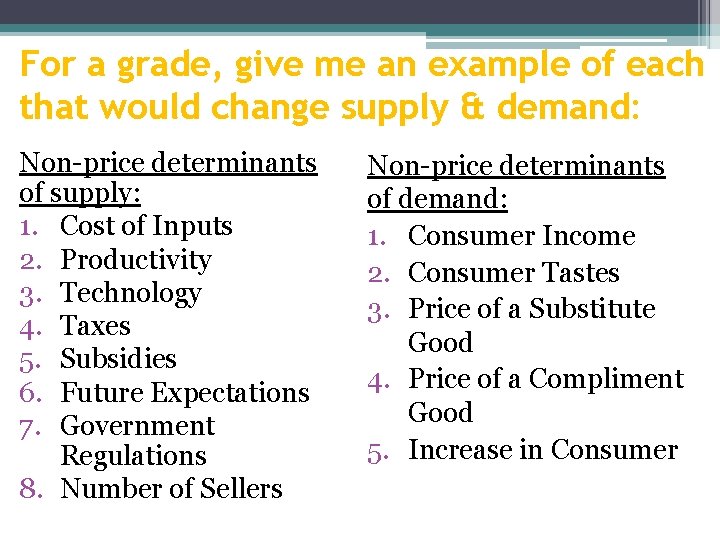
For a grade, give me an example of each that would change supply & demand: Non-price determinants of supply: 1. Cost of Inputs 2. Productivity 3. Technology 4. Taxes 5. Subsidies 6. Future Expectations 7. Government Regulations 8. Number of Sellers Non-price determinants of demand: 1. Consumer Income 2. Consumer Tastes 3. Price of a Substitute Good 4. Price of a Compliment Good 5. Increase in Consumer
Understanding Market Equilibrium • During the 1920 s & into the 1930 s, the U. S. government experimented with Prohibition. The 18 th Amendment, ratified in 1919, made the manufacture, sale, and transportation of alcoholic beverages illegal. For various social, political, and legal reasons, the experiment failed. Prohibition ended in 1933 with the ratification of the 21 st Amendment.
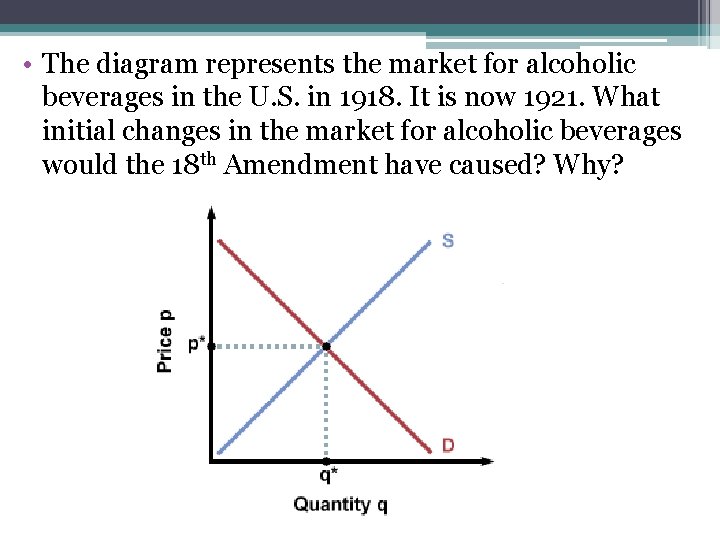
• The diagram represents the market for alcoholic beverages in the U. S. in 1918. It is now 1921. What initial changes in the market for alcoholic beverages would the 18 th Amendment have caused? Why?
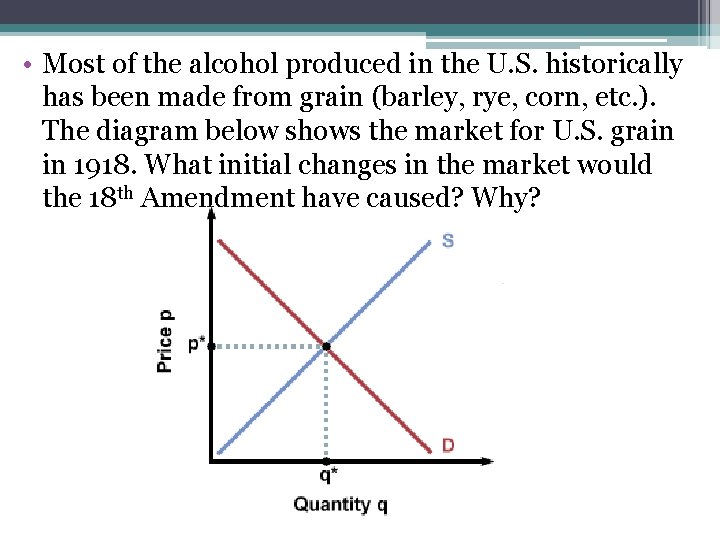
• Most of the alcohol produced in the U. S. historically has been made from grain (barley, rye, corn, etc. ). The diagram below shows the market for U. S. grain in 1918. What initial changes in the market would the 18 th Amendment have caused? Why?
Macroeconomics • Macroeconomics considers the performance of a country as a whole ▫ ▫ Rate of economic growth Inflation Unemployment Trade performance with other countries • Evaluate success or failure of govt economic policies
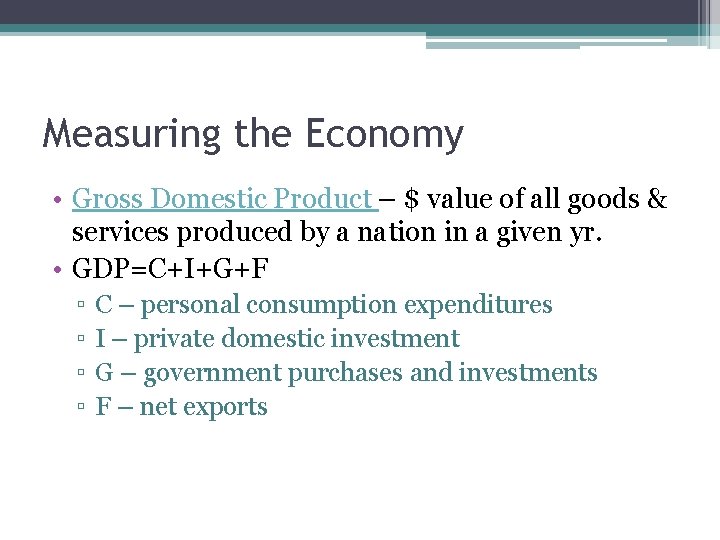
Measuring the Economy • Gross Domestic Product – $ value of all goods & services produced by a nation in a given yr. • GDP=C+I+G+F ▫ ▫ C – personal consumption expenditures I – private domestic investment G – government purchases and investments F – net exports
Consumption Expenditure • Factors affecting consumption: ▫ ▫ ▫ Tax Rates Income Credit Interest Rates Wealth (property, shares, savings, bonds)
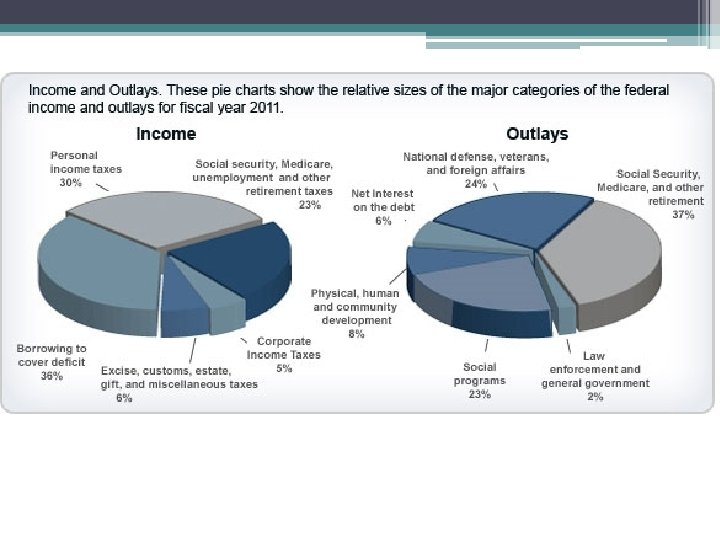
Government Spending • • Defense Health Social Welfare Education Foreign Aid Industry Law & Order
The People’s Pie Online Simulation 1. What are the 3 types of taxation? 2. What can be done to reduce Medicare & Social Security costs? What are the effects of this? 3. Explain budgeting. 4. What sort of things did you focus your spending on? 5. Is it easy to win re-election?
Import Spending • Goods & services bought from abroad- outflow of funds Export Earnings • Goods and services sold abroad- influx of funds
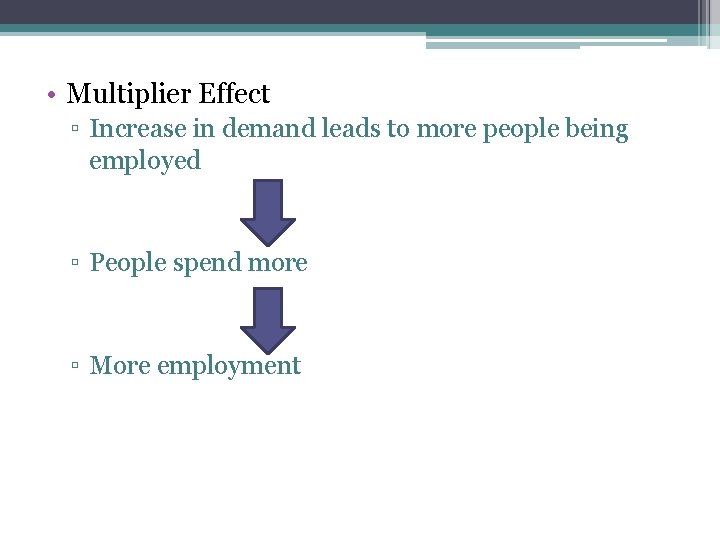
• Multiplier Effect ▫ Increase in demand leads to more people being employed ▫ People spend more ▫ More employment
Keynesian View on Inflation • Full employment leads to inflation • Rise in wages cause costs to increase
CONSUMER PRICE INDEX • Compares prices from different years • Indicators of the economy – rapid growth will cause inflation ▫ Leading – activities that tend to rise or fall before a change in economy– ex. New business, employment & construction ▫ Coincident – activities that change at the same time –industrial production, industrial sales, & payrolls ▫ Lagging – activities that change after the initial changes in economy ex. – interest rates
EMPLOYMENT • Underemployment –those who have a job for which they are over qualified • Unemployment –Unemployment rate -% of the labor force unemployed that are actively seeking employment
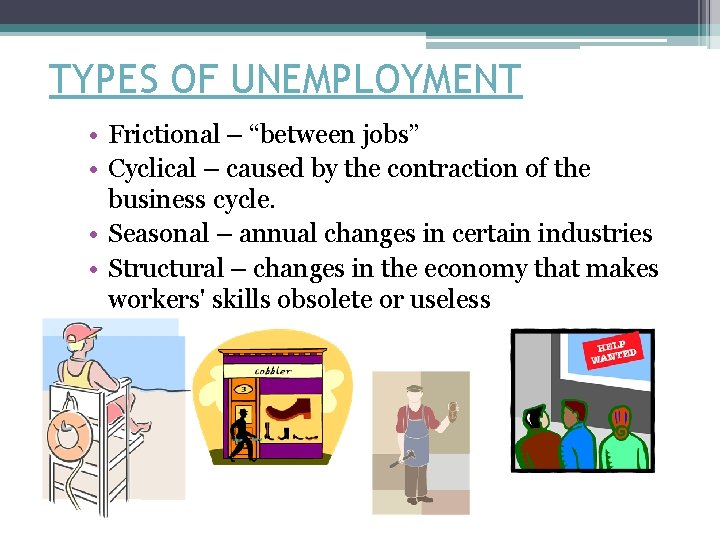
TYPES OF UNEMPLOYMENT • Frictional – “between jobs” • Cyclical – caused by the contraction of the business cycle. • Seasonal – annual changes in certain industries • Structural – changes in the economy that makes workers' skills obsolete or useless
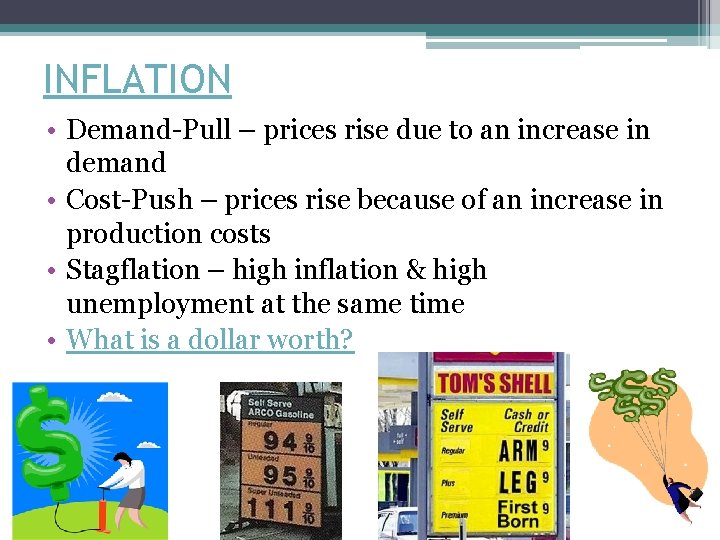
INFLATION • Demand-Pull – prices rise due to an increase in demand • Cost-Push – prices rise because of an increase in production costs • Stagflation – high inflation & high unemployment at the same time • What is a dollar worth?
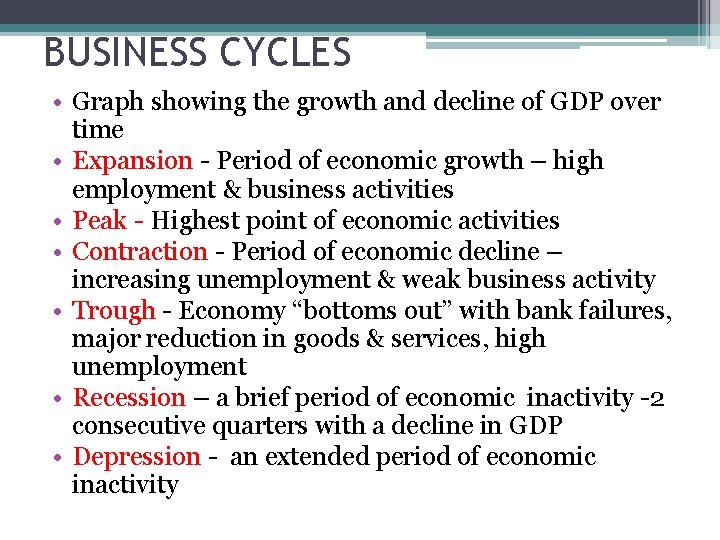
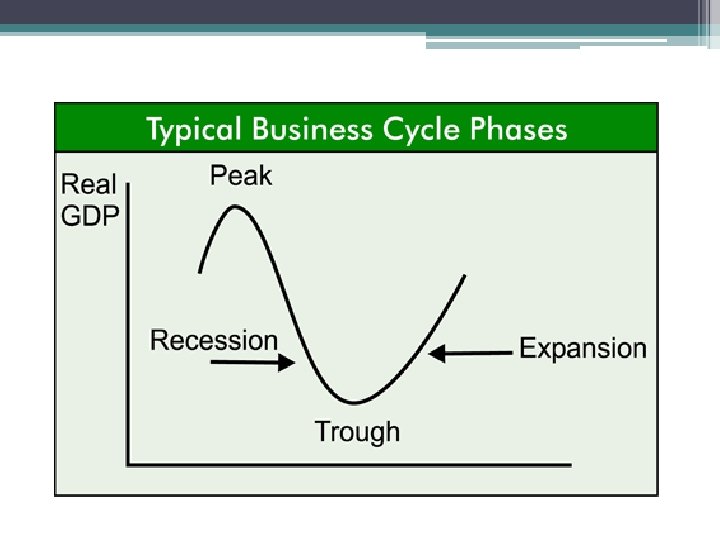
BUSINESS CYCLES • Graph showing the growth and decline of GDP over time • Expansion - Period of economic growth – high employment & business activities • Peak - Highest point of economic activities • Contraction - Period of economic decline – increasing unemployment & weak business activity • Trough - Economy “bottoms out” with bank failures, major reduction in goods & services, high unemployment • Recession – a brief period of economic inactivity -2 consecutive quarters with a decline in GDP • Depression - an extended period of economic inactivity
ROLE OF THE GOVERNMENT • • Spends Invests Employs Settles disputes – National Labor Relations Board • Regulates businesses to preserve competition • Protects the consumer
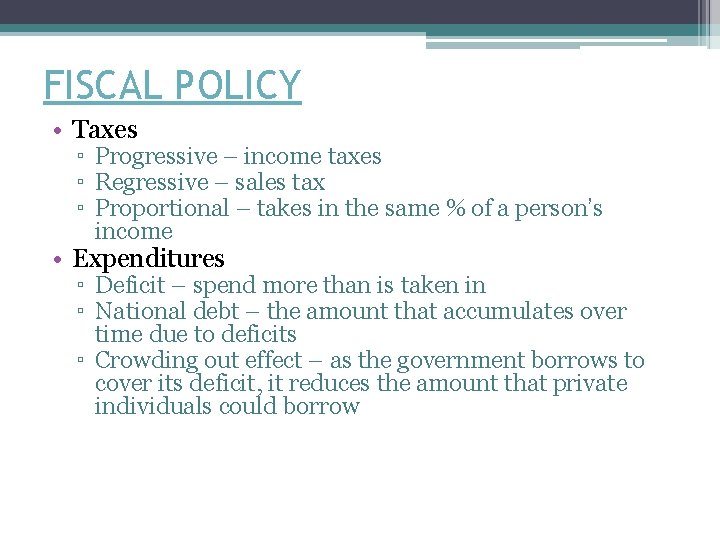
FISCAL POLICY • Taxes ▫ Progressive – income taxes ▫ Regressive – sales tax ▫ Proportional – takes in the same % of a person’s income • Expenditures ▫ Deficit – spend more than is taken in ▫ National debt – the amount that accumulates over time due to deficits ▫ Crowding out effect – as the government borrows to cover its deficit, it reduces the amount that private individuals could borrow
Open & Operating: The Federal Reserve Responds to 9/11 1. What is the purpose of a central bank? 2. How did an extraordinary event challenge the infrastructure of the financial system? 3. What role does the central bank play in responding to a crisis situation?
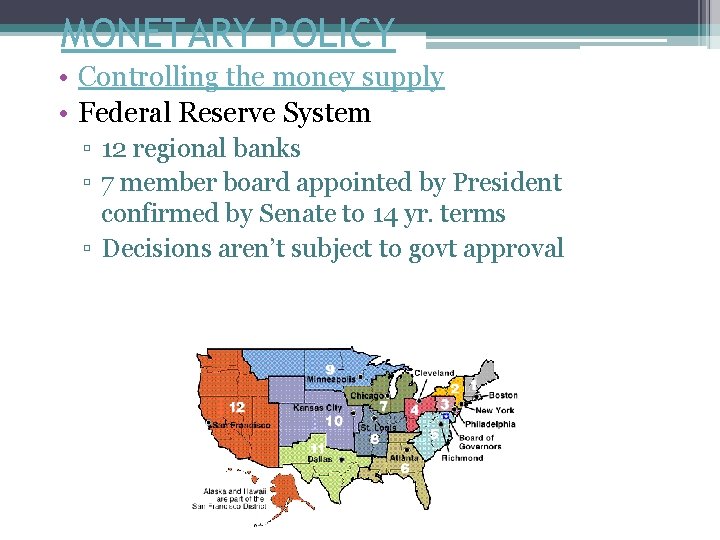
MONETARY POLICY • Controlling the money supply • Federal Reserve System ▫ 12 regional banks ▫ 7 member board appointed by President confirmed by Senate to 14 yr. terms ▫ Decisions aren’t subject to govt approval
TOOLS OF THE FEDERAL RESERVE • Reserve Requirement -% banks must keep in reserve & not loan out • Discount rate – interest rate banks must pay to borrow money from FED • Buying & selling govt bonds • Too rapid growth causes inflation • Slow growth causes unemployment
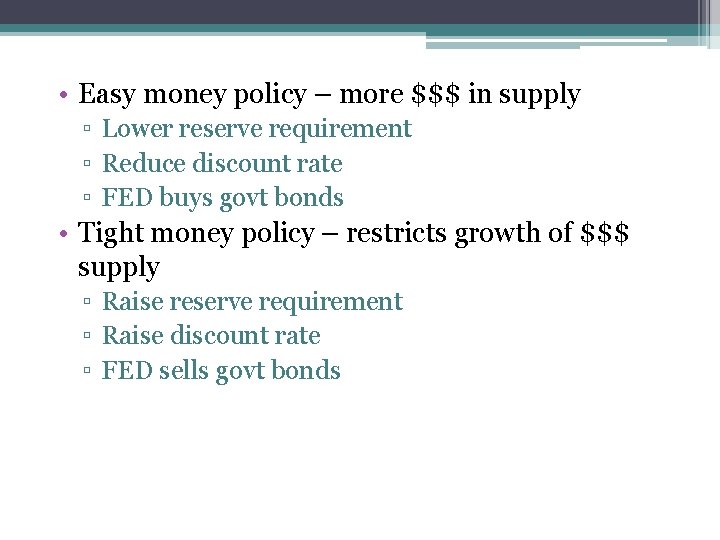
• Easy money policy – more $$$ in supply ▫ Lower reserve requirement ▫ Reduce discount rate ▫ FED buys govt bonds • Tight money policy – restricts growth of $$$ supply ▫ Raise reserve requirement ▫ Raise discount rate ▫ FED sells govt bonds
Reality (pay)Check Interpreting Your Pay Stub
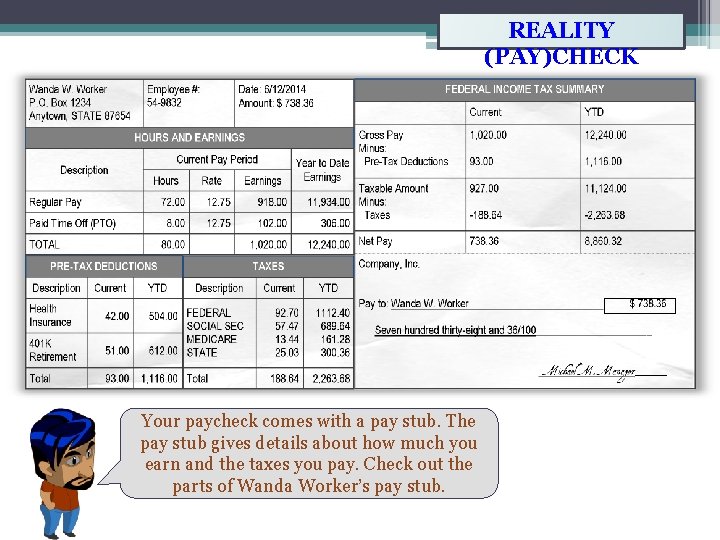
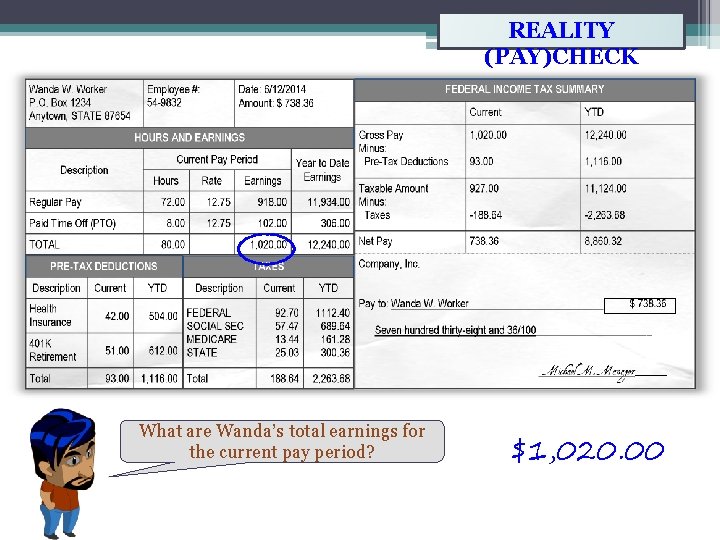
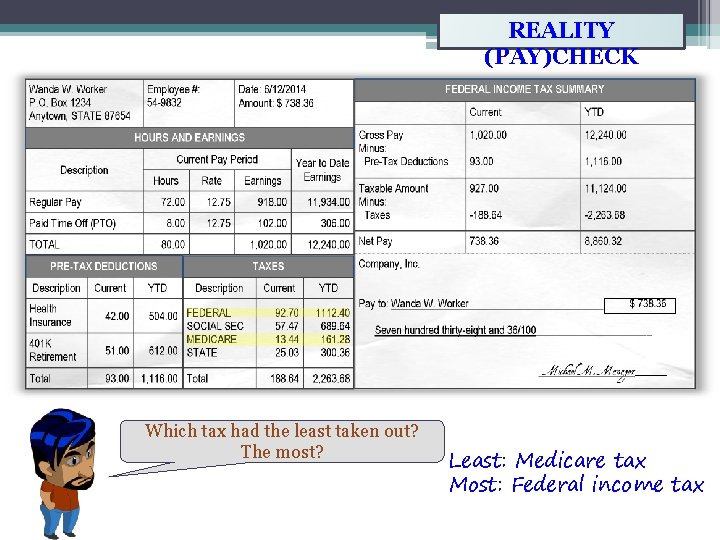
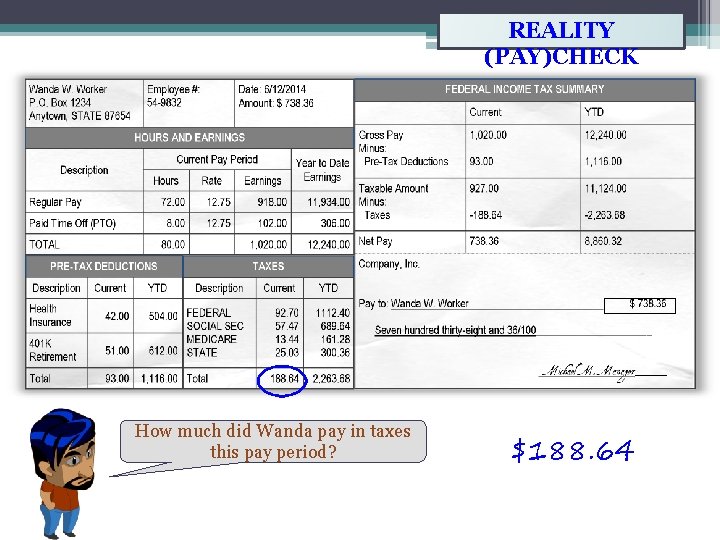
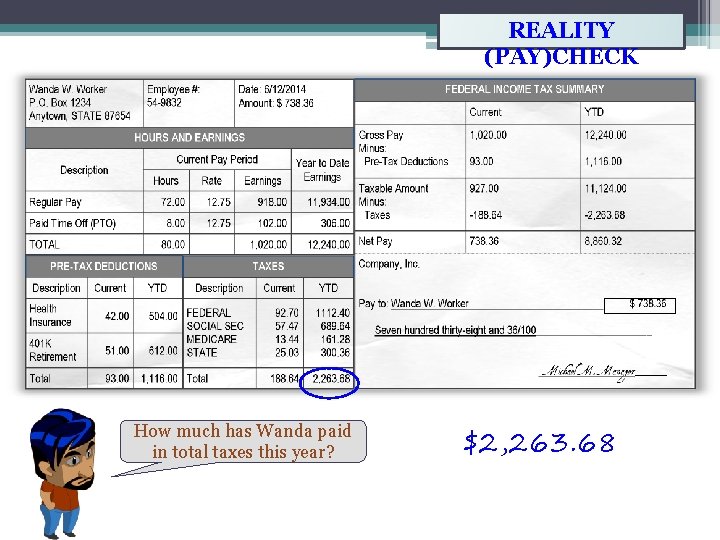
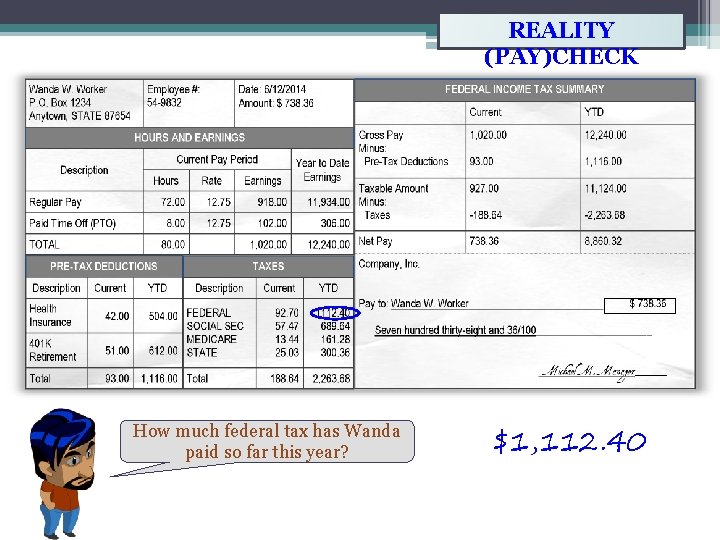
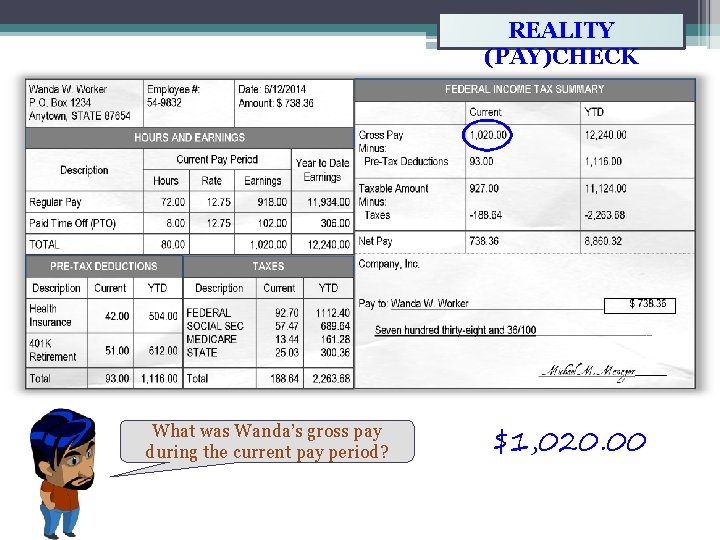
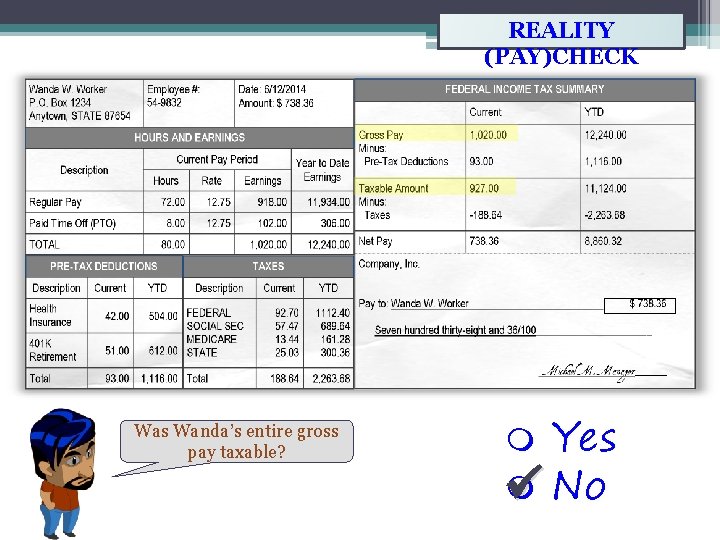
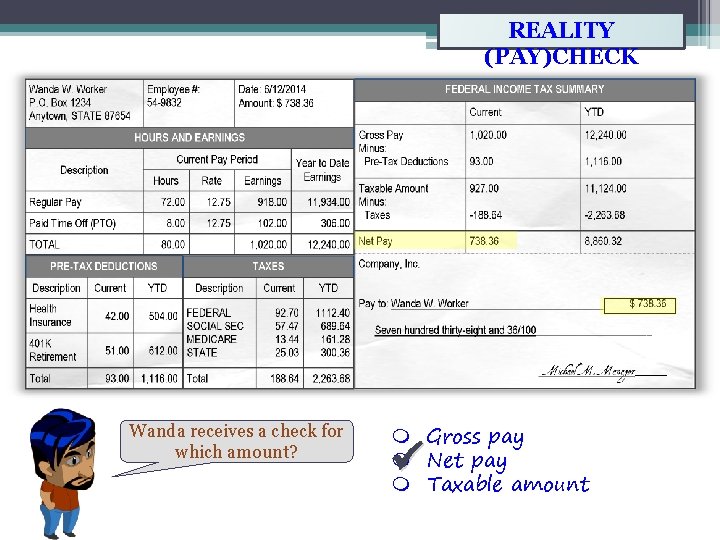
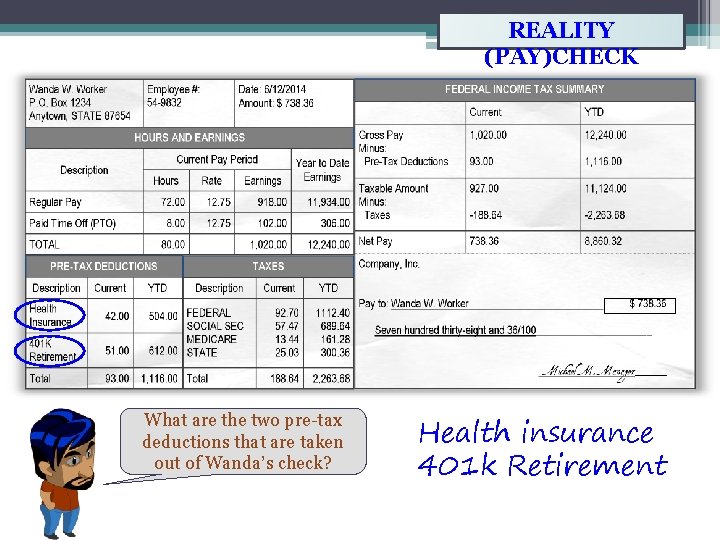
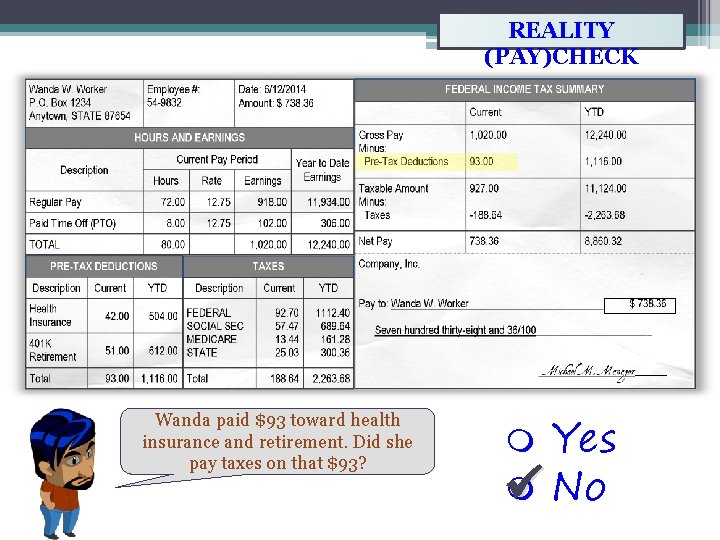
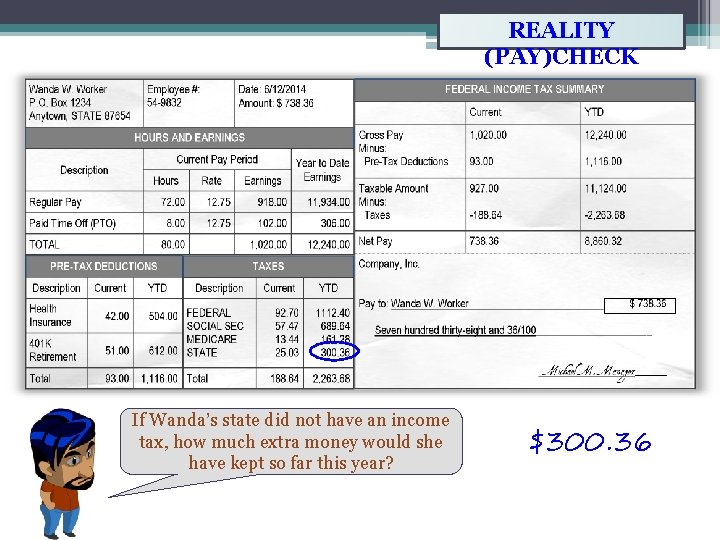
REALITY (PAY)CHECK Your paycheck comes with a pay stub. The pay stub gives details about how much you earn and the taxes you pay. Check out the parts of Wanda Worker’s pay stub.
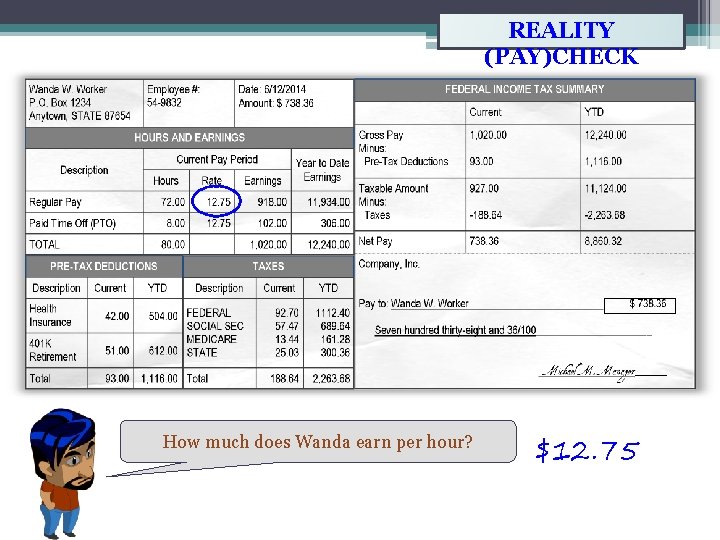
REALITY (PAY)CHECK How much does Wanda earn per hour? $12. 75
REALITY (PAY)CHECK What are Wanda’s total earnings for the current pay period? $1, 020. 00
REALITY (PAY)CHECK Which tax had the least taken out? The most? Least: Medicare tax Most: Federal income tax
REALITY (PAY)CHECK How much did Wanda pay in taxes this pay period? $188. 64
REALITY (PAY)CHECK How much has Wanda paid in total taxes this year? $2, 263. 68
REALITY (PAY)CHECK How much federal tax has Wanda paid so far this year? $1, 112. 40
REALITY (PAY)CHECK What was Wanda’s gross pay during the current pay period? $1, 020. 00
REALITY (PAY)CHECK Was Wanda’s entire gross pay taxable? Yes No
REALITY (PAY)CHECK Wanda receives a check for which amount? Gross pay Net pay Taxable amount
REALITY (PAY)CHECK What are the two pre-tax deductions that are taken out of Wanda’s check? Health insurance 401 k Retirement
REALITY (PAY)CHECK Wanda paid $93 toward health insurance and retirement. Did she pay taxes on that $93? Yes No
REALITY (PAY)CHECK If Wanda’s state did not have an income tax, how much extra money would she have kept so far this year? $300. 36
HOW MUCH WILL IT COST? A Look at Sales Tax
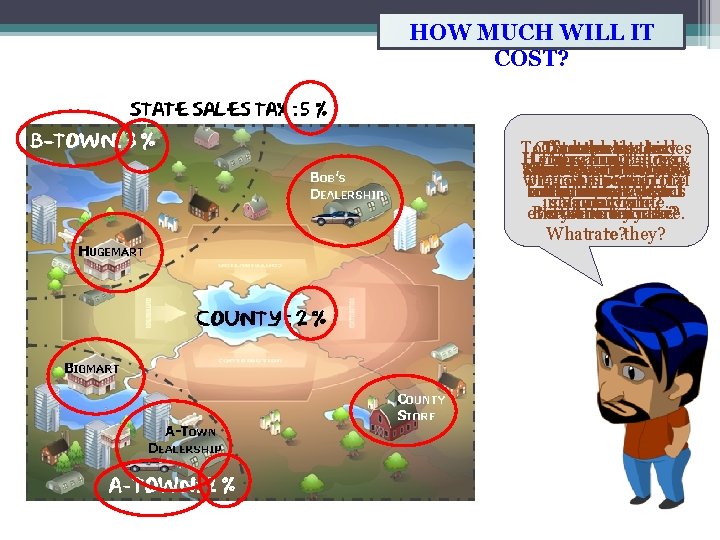
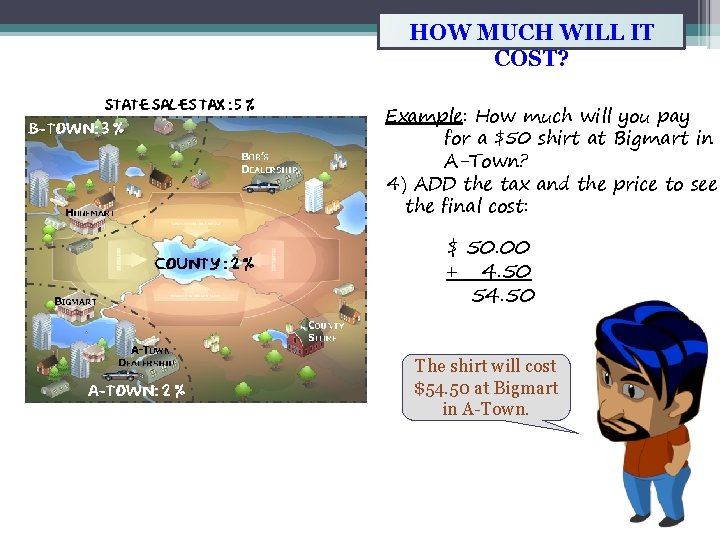
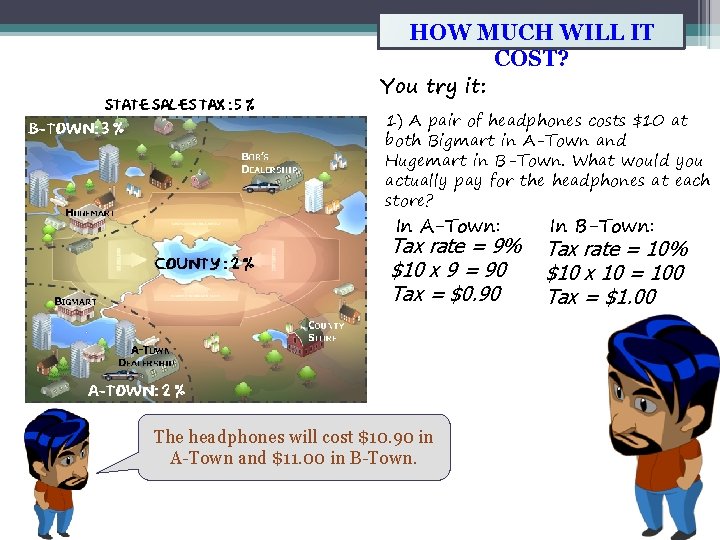
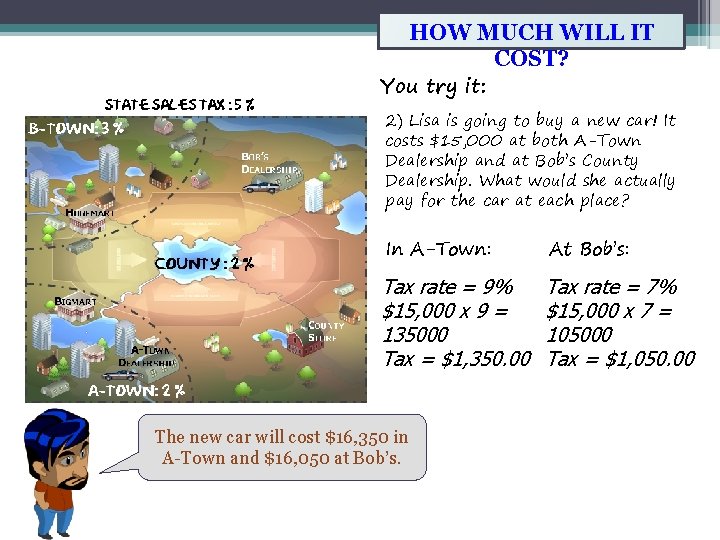
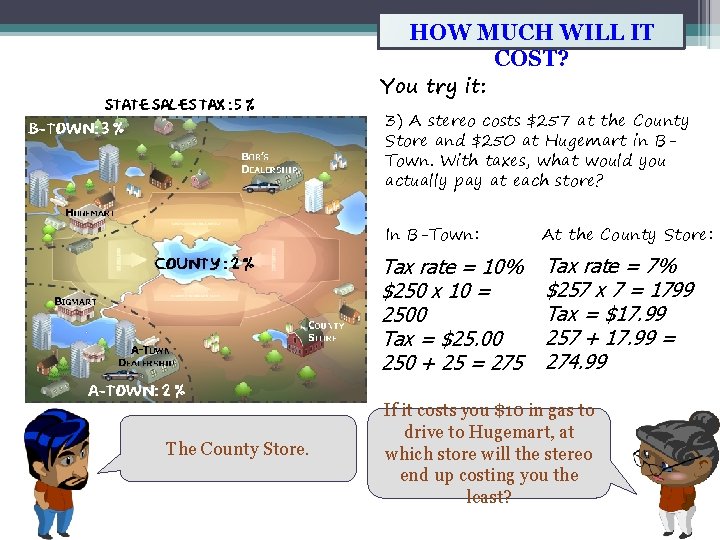
HOW MUCH WILL IT COST? To find the total sales City sales tax only County sales tax If people in this State sales tax If you are in B-Town, Here is an imaginary There are 2 cities Now find the 3 applies inside a city’s county want to buy a tax rate you will pay, applies everywhere 5% + 2% + 3% = 10% Let’s learn how to What is A-Town’s tax what will be the total biggest stores in the in this county in an boundaries. What is in the state. What is in the county. What add the tax rates of car, they have 2 calculate sales tax. rate? imaginary state. sales tax rate? Name them. county. everywhere you are. B-Town’s tax rate? the state tax rate? is the county tax choices. What are they? rate?
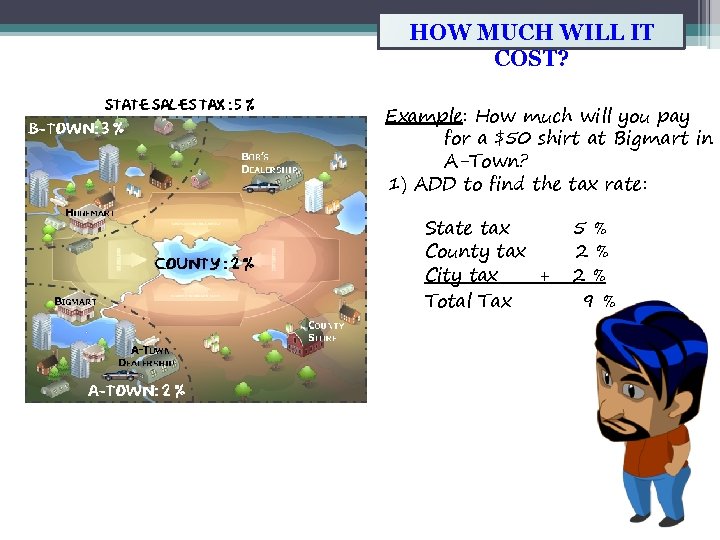
HOW MUCH WILL IT COST? Example: How much will you pay for a $50 shirt at Bigmart in A-Town? 1) ADD to find the tax rate: State tax County tax City tax + Total Tax 5 % 2 % 9 %
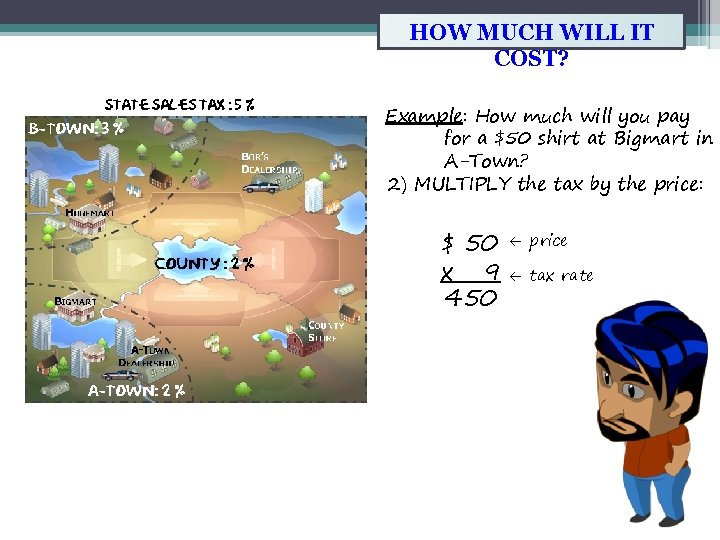
HOW MUCH WILL IT COST? Example: How much will you pay for a $50 shirt at Bigmart in A-Town? 2) MULTIPLY the tax by the price: $ 50 x 9 450 price tax rate
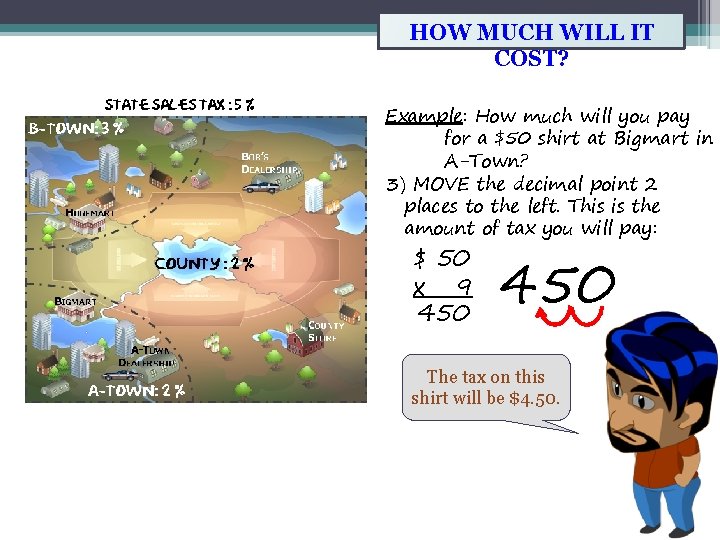
HOW MUCH WILL IT COST? Example: How much will you pay for a $50 shirt at Bigmart in A-Town? 3) MOVE the decimal point 2 places to the left. This is the amount of tax you will pay: $ 50 x 9 450 The tax on this shirt will be $4. 50.
HOW MUCH WILL IT COST? Example: How much will you pay for a $50 shirt at Bigmart in A-Town? 4) ADD the tax and the price to see the final cost: $ 50. 00 + 4. 50 54. 50 The shirt will cost $54. 50 at Bigmart in A-Town.
HOW MUCH WILL IT COST? You try it: 1) A pair of headphones costs $10 at both Bigmart in A-Town and Hugemart in B-Town. What would you actually pay for the headphones at each store? In A-Town: Tax rate = 9% $10 x 9 = 90 Tax = $0. 90 The headphones will cost $10. 90 in A-Town and $11. 00 in B-Town. In B-Town: Tax rate = 10% $10 x 10 = 100 Tax = $1. 00
HOW MUCH WILL IT COST? You try it: 2) Lisa is going to buy a new car! It costs $15, 000 at both A-Town Dealership and at Bob’s County Dealership. What would she actually pay for the car at each place? In A-Town: At Bob’s: Tax rate = 9% $15, 000 x 9 = 135000 Tax = $1, 350. 00 Tax rate = 7% $15, 000 x 7 = 105000 Tax = $1, 050. 00 The new car will cost $16, 350 in A-Town and $16, 050 at Bob’s.
HOW MUCH WILL IT COST? You try it: 3) A stereo costs $257 at the County Store and $250 at Hugemart in BTown. With taxes, what would you actually pay at each store? The stereo will cost $275 in B-Town and $274. 99 at The County Store. the County Store. In B-Town: At the County Store: Tax rate = 10% $250 x 10 = 2500 Tax = $25. 00 250 + 25 = 275 Tax rate = 7% $257 x 7 = 1799 Tax = $17. 99 257 + 17. 99 = 274. 99 If it costs you $10 in gas to drive to Hugemart, at which store will the stereo end up costing you the least?
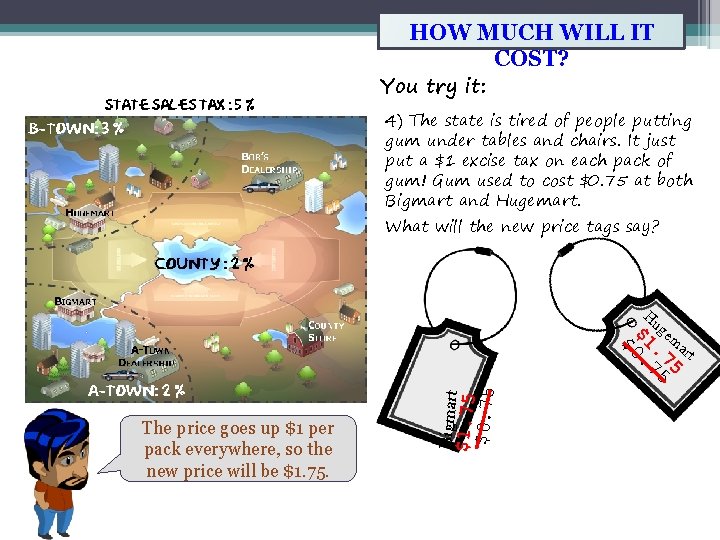
HOW MUCH WILL IT COST? You try it: 4) The state is tired of people putting gum under tables and chairs. It just put a $1 excise tax on each pack of gum! Gum used to cost $0. 75 at both Bigmart and Hugemart. What will the new price tags say? Hu $ ge Bigmart The price goes up $1 per pack everywhere, so the new price will be $1. 75 $0 1. mar. 7 75 t 5