
Principles of Economics Chapter 4 The Private Property




- Slides: 69
Principles of Economics Chapter 4 The Private Property System, Trade and Specialization J. Patrick Gunning January 27, 2007
Purpose of the Chapter • The purpose is to show private property rights encourage people to specialize and to produce goods at the lowest costs that they know.
Introduction (1) • Specialization: distinctly different tasks that yield satisfaction to members of a community are performed by people who are relatively superior to others in performing those tasks. Recall the benefits of specialization. • Specialization makes higher standards of living possible and it enables larger populations to be supported with the same amount of other resources. • Opposite of specialization: everyone becomes a jack of all trades.
Introduction (2) • A mental experiment: suppose that a specialized shoemaker had to share his income with others or that he was continually threatened with theft and extortion. • He would shift to producing goods that he could personally use and that he could protect from being taken by others.
Topics of This Chapter • 1. Adam Smith on the diversity of human capital. • 2. Specialization according to the principle of lowest opportunity cost. • 3. Ownership, specialization and legal rights: onestage production. • 4. Lowest opportunity cost in two-stage production. • 5. Issues: introduction to theory of international trade, intellectual property rights.
First Topic: Adam Smith and the Diversity of Human Capital • • Adam Smith (1776) wrote about the division of labor and specialization. In modern terms we would say that he was writing about the production of diverse human capital. Two ways in which a division of labor occurs. 1. Caused by an employer. 2. Caused by a self-employed person.
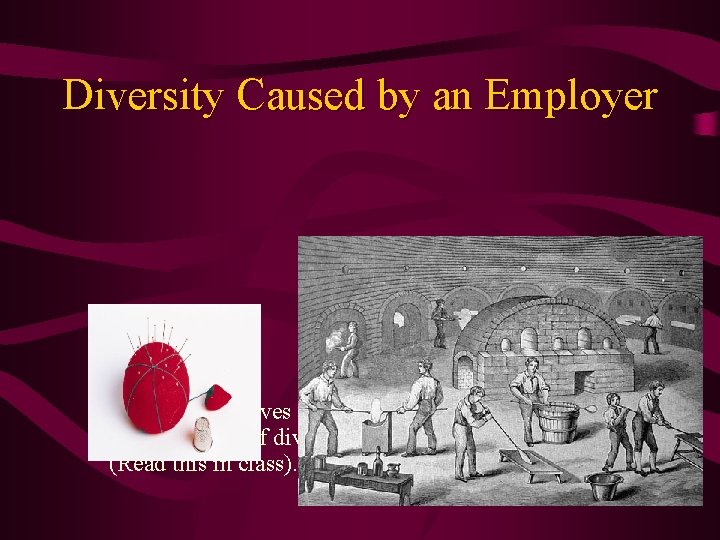
Diversity Caused by an Employer An employer gives orders to his employees. The pin-maker is an example of division of labor caused by an employer. (Read this in class).
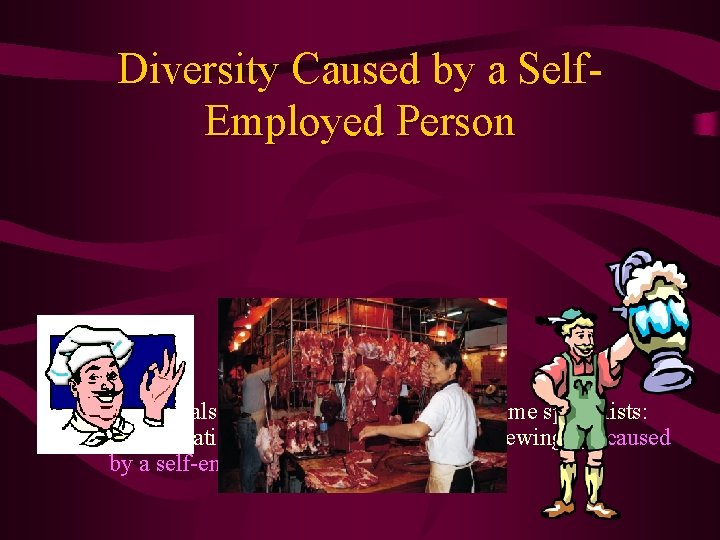
Diversity Caused by a Self. Employed Person Individuals choose by themselves to become specialists: specialization in baking, butchery, and brewing are caused by a self-employed person seeking gain.
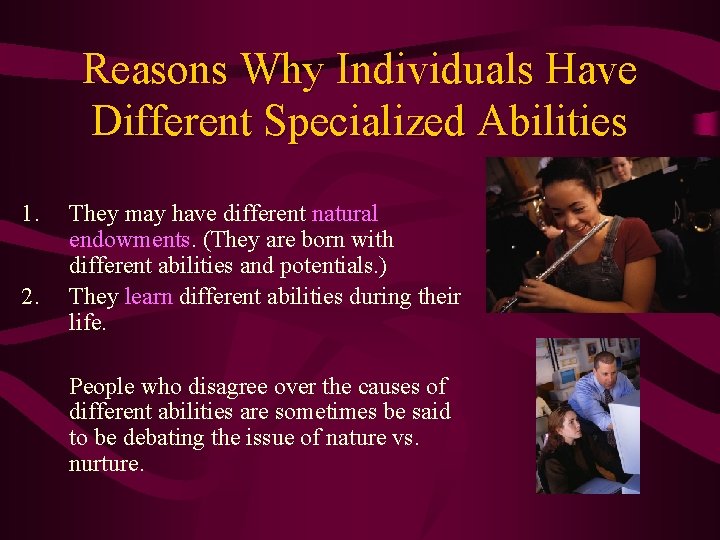
Reasons Why Individuals Have Different Specialized Abilities 1. 2. They may have different natural endowments. (They are born with different abilities and potentials. ) They learn different abilities during their life. People who disagree over the causes of different abilities are sometimes be said to be debating the issue of nature vs. nurture.
Smith’s Views About Learning • Learning is more important than natural endowments. • Such learning – the division of labor or diversity of human capital – makes a nation wealthy.
How a Nation Becomes Wealthy 1. Individuals have a natural propensity to act in their own interests. 2. Under the private property system, they recognize that it is in their interests to learn to specialize and trade instead of producing goods only for themselves. 3. People choose to trade and specialize. 4. The small natural differences among people become larger as a result of learning. 5. The division of labor and specialization causes a nation to become wealthy.
New Topic Specialization According to the Principle of Lowest Opportunity Cost
The Potential Benefit From Exchanging Legal Rights to Use Resources (1) • We assume that all resources are owned by someone. • The identity of the owner is important. – Whether an item is used as a resource depends on who owns it. – Whether a resource is used at the lowest cost to produce a product also depends on who owns it.
The Potential Benefit From Exchanging Legal Rights to Use Resources (2) • The example of a farmer who owns a machine shop and an machinist who owns a farm. • Both could benefit if they exchanged the legal rights to control the non-human-capital resources.
The Principle of Lowest Opportunity Cost • In market interaction, individuals have an incentive to redistribute legal rights to control resources so that in the resulting distribution, each resource is used in the production activity in which it is judged to have the lowest opportunity cost.
Specialization Due To The Intervention Of An Investor • Suppose that neither of two specialists recognizes the benefits of switching places. • Investors have an incentive to finance an exchange of legal rights to use resources if they can manage to share in the gain that results from the exchange.
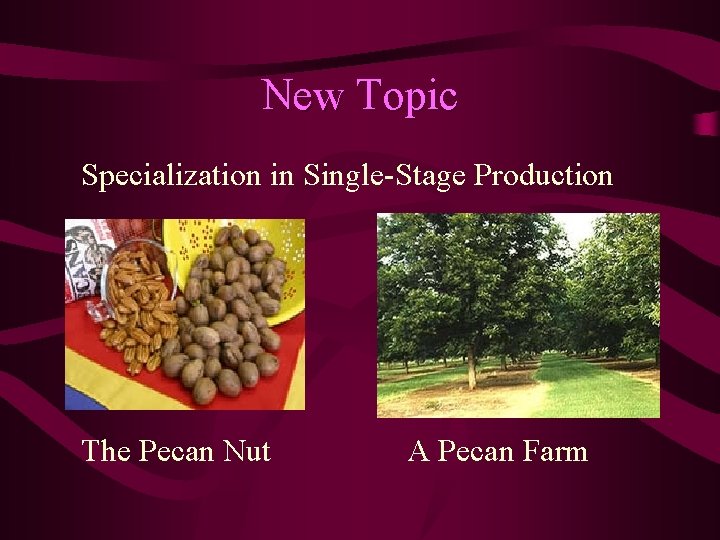
New Topic Specialization in Single-Stage Production The Pecan Nut A Pecan Farm
A Simple Two-person Case of Gathering Pecans • The setting: a grove of pecan trees and two prospective pecan gatherers: A and B. • There is scarcity: fewer pecans are available at a zero price than consumers want.
Discussion Of Three Initial Ownership Situations 1. A (with the lowest opportunity cost) owns the right to gather and sell the pecans. 2. B owns the right to gather and sell the pecans. 3. No one owns the right to gather and sell the pecans; each produces half of the pecans.
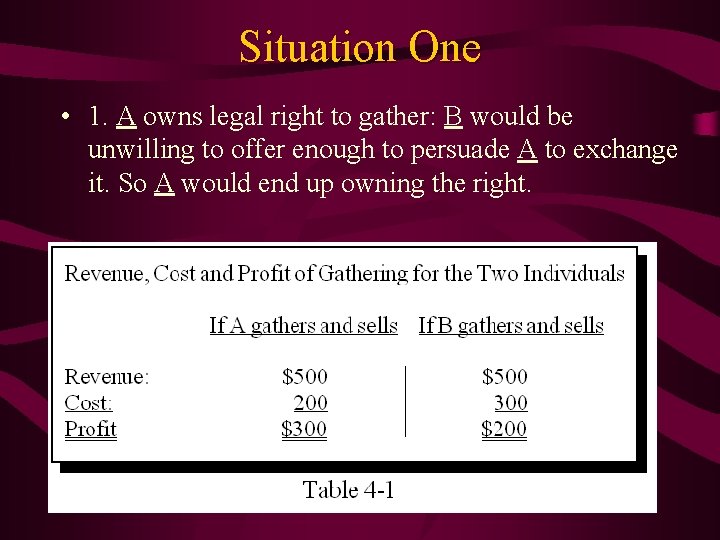
Situation One • 1. A owns legal right to gather: B would be unwilling to offer enough to persuade A to exchange it. So A would end up owning the right.
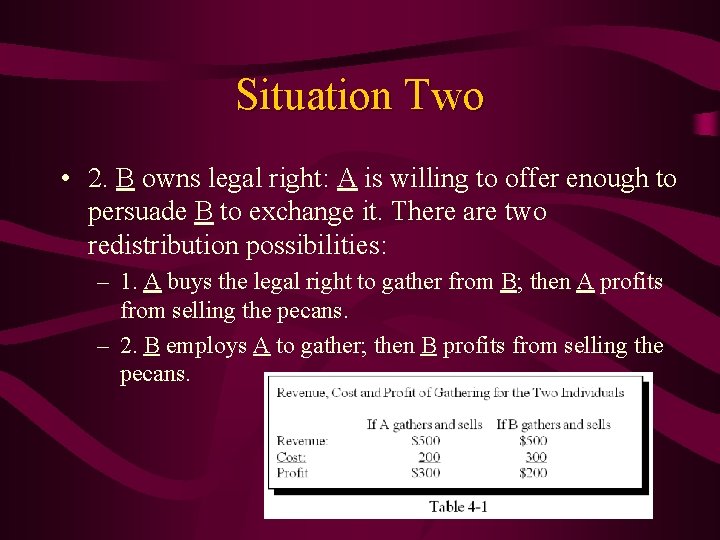
Situation Two • 2. B owns legal right: A is willing to offer enough to persuade B to exchange it. There are two redistribution possibilities: – 1. A buys the legal right to gather from B; then A profits from selling the pecans. – 2. B employs A to gather; then B profits from selling the pecans.
Conclusion • In each case, the right to control the work used in gathering pecans comes to be owned by the person who has the lowest opportunity cost of gathering.
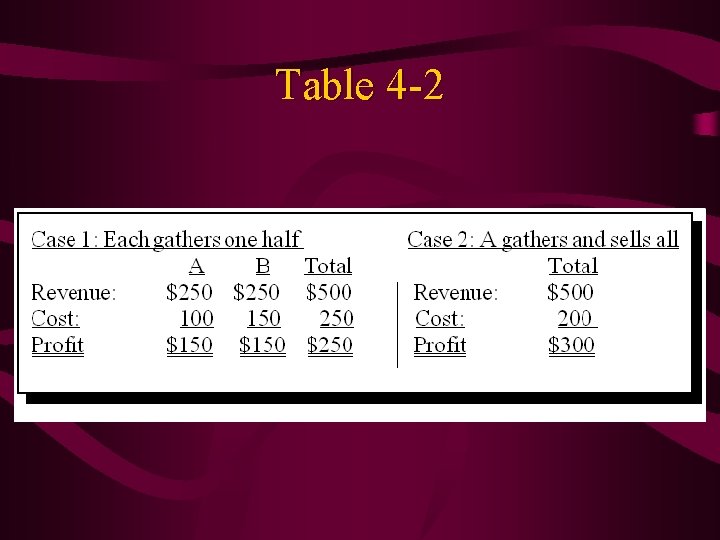
Situation 3: No Initial Legal Rights to Gather Exist • If there is no initial legal right to gather, individuals have an incentive to establish an exclusive right to control all of the gathering so that the person with the lowest opportunity cost did all of the gathering. • An example from the text. • Assume that both gather ½ of the total.
Table 4 -2
Principle • If the exclusive right to control a resource is more valuable than the combination of rights to share in its control, individuals have incentives to transform the shared right into an exclusive right.
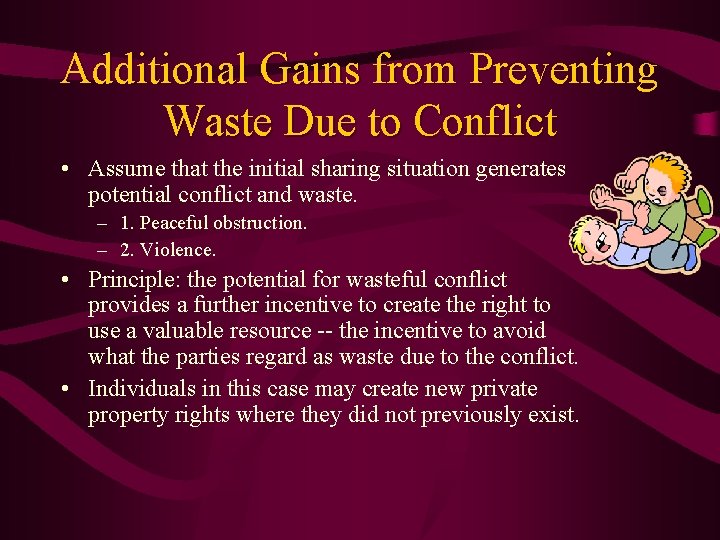
Additional Gains from Preventing Waste Due to Conflict • Assume that the initial sharing situation generates potential conflict and waste. – 1. Peaceful obstruction. – 2. Violence. • Principle: the potential for wasteful conflict provides a further incentive to create the right to use a valuable resource -- the incentive to avoid what the parties regard as waste due to the conflict. • Individuals in this case may create new private property rights where they did not previously exist.
Apparent Exceptions to the Principle (1) • Begrudging: – Definition: feeling satisfaction because someone else is worse off. – If B initially has the right to gather, he may not be willing to allow A to gain by exchanging the right with her. – Note that he must forego his own gain in order to prevent A from gaining. This illustrates that begrudging (and also discrimination) is costly to the person who begrudges.
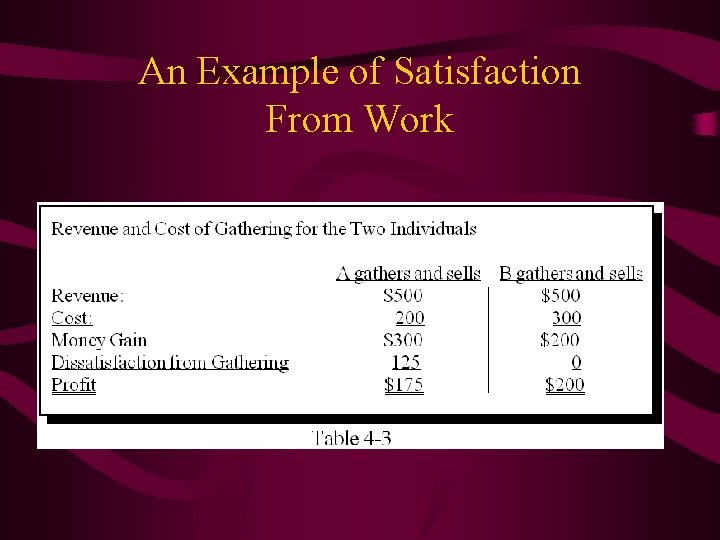
Apparent Exceptions to the Principle (2) • Satisfaction from the work. If B initially has the right to gather, he may be willing to forego the gain from trading away his right to gather because he enjoys gathering.
An Example of Satisfaction From Work
Shared Specialization • It is possible that costs would be minimized if both gatherers did part of the work. • This would be the case if the marginal cost of gathering rose sharply. • Marginal cost: the cost of producing one more unit of a good. • If the marginal cost to B of gathering rose sharply, at some quantity, the marginal cost of gathering to A would become lower than it is to B. • The individuals would have an incentive to share the gathering task – i. e. , to engage in shared specialization.
Definition • Shared specialization: a production situation in which more than one person specializes in producing a good because sharply rising marginal cost makes sharing more efficient.
Lowest Opportunity Cost Vs. Highest Benefit • Principle of highest benefit: in market interaction, individuals have an incentive to redistribute legal rights to the product due to employing resources so that, in the resulting distribution, the person who can cause the highest benefit becomes the owner.
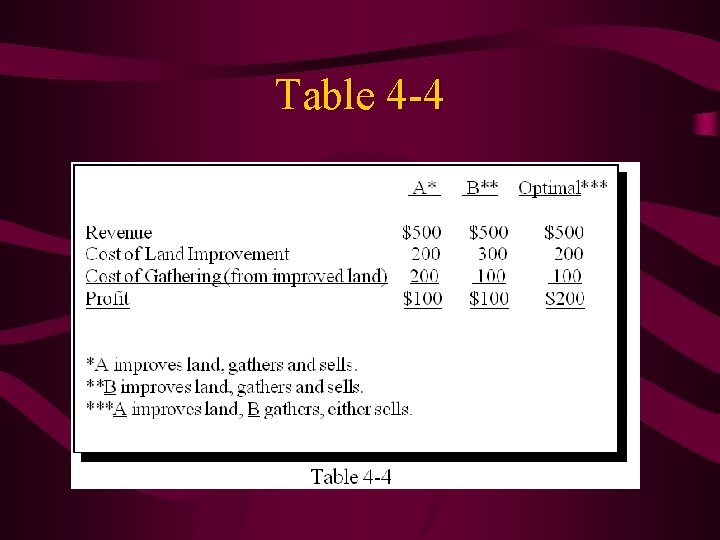
New Topic: Lowest Opportunity Cost in Two-Stage Production • The setting: the same as before except that production requires a second stage – land improvement. • Before pecans can be gathered for a profit, pecan growing land must be improved. • The numbers are given in table 4 -3.
Table 4 -4
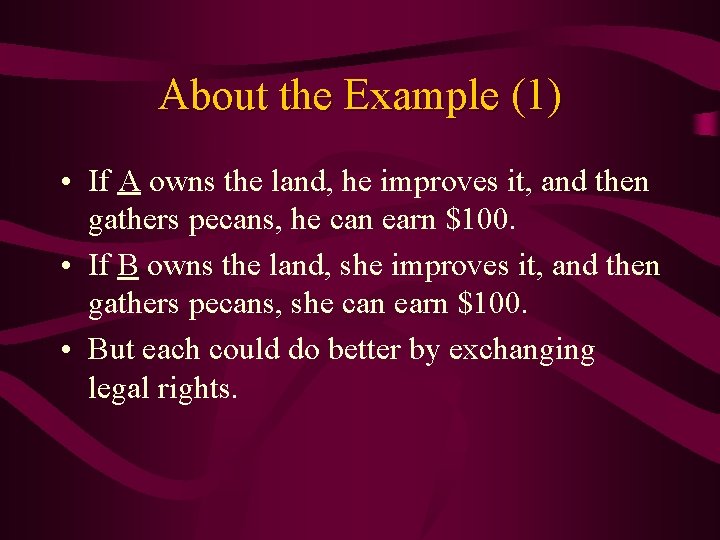
About the Example (1) • If A owns the land, he improves it, and then gathers pecans, he can earn $100. • If B owns the land, she improves it, and then gathers pecans, she can earn $100. • But each could do better by exchanging legal rights.
About the Example (2) • To minimize the total cost, B must improve the land A must use the land to gather pecans. • How can this be accomplished? • Here are two possible ways:
First Case: A Owns The Land • A may improve the land then sell (or rent) it to B for $300 or more. • A may improve the land then hire B to gather the pecans. Then she would sell the pecans herself.
Second Case: B Owns The Land • B may offer the sell the land to A for a price greater than $100. A would buy if she expected to either resell (re-rent) the land to B at a price that is greater than $300 or if she expected to hire B to gather the pecans for a price that is less than $200. • B would be willing to offer A up to $300 for the job of improving the land.
Importance of the Right to Exchange Rights • Three rights are important: • 1. The right to exchange the product of one’s work (the right to gain from its use). • 2. The right of an owner to rent out the property and to charge rent. • 3. The right to contract with another person for work.
New Topic: Three Issues Related To Specialization: 1. Trade, comparative advantage and the production of human capital. 2. Intellectual property rights. 3. Harm due to specialization.
First Issue: Trade, Comparative Advantage and the Production of Human Capital • Absolute advantage: a situation in which one person can produce more goods with a given set of resources than another person. • Example: in one hour, A can produce more corn than B.
Absolute Advantage • Absolute advantage in two goods. A can produce more corn and milk in one hour than B. • If one person possesses an absolute advantage in one good while another possesses and absolute advantage in the other good, the two people can ordinarily gain by specializing and then trading.
Limitation of Absolute Advantage in Explaining Trade • The concept does not apply if a person has an absolute advantage in producing all goods. • To explain trade in this case, we need the concept of comparative advantage.
Physical Opportunity Cost • Definition: the amount of a product that must be given up to produce another product. It differs from opportunity cost because it refers to the amount of a product and not to satisfaction.
Comparative Advantage • Comparative advantage: a situation in which one person can produce a unit of output at a lower physical opportunity cost than another person. • Comparative advantage is used to compare two peoples’ abilities to produce one good in relation to their abilities to produce other goods – even if one has an absolute advantage in producing nearly all goods. • Example of comparative advantage in table 4 -5.
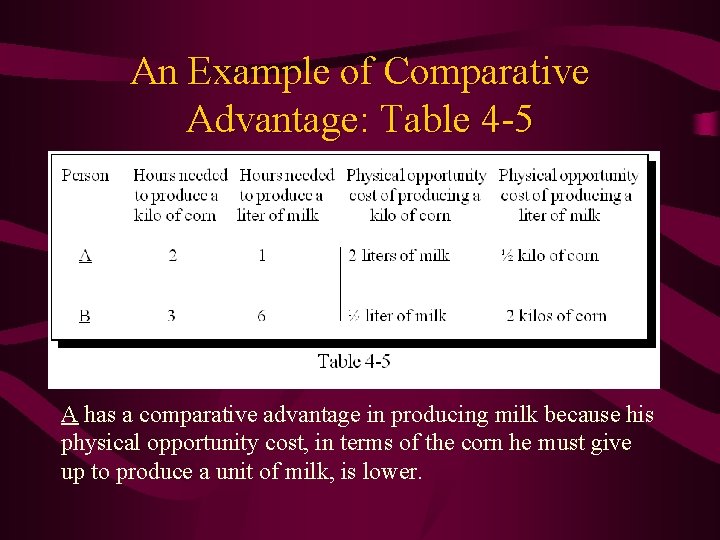
An Example of Comparative Advantage: Table 4 -5 A has a comparative advantage in producing milk because his physical opportunity cost, in terms of the corn he must give up to produce a unit of milk, is lower.
Further Explanation of Table 4 -5 B has a comparative advantage in producing corn because his physical opportunity cost, in terms of milk given up to produce a unit of corn, is lower. A has a comparative disadvantage in producing corn because his physical opportunity cost, in terms of milk given up to produce a unit of corn, is higher. B has a comparative disadvantage in producing milk because his physical opportunity cost, in terms of corn given up to produce a unit of milk, is higher.
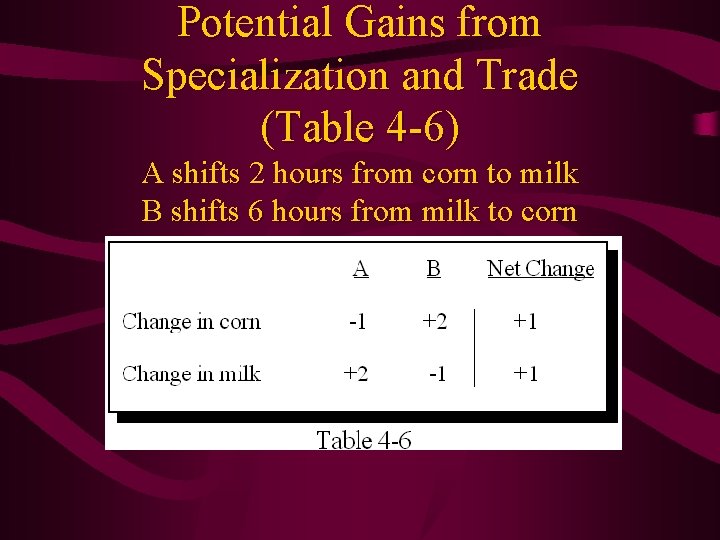
Potential Gains from Specialization and Trade (Table 4 -6) A shifts 2 hours from corn to milk B shifts 6 hours from milk to corn
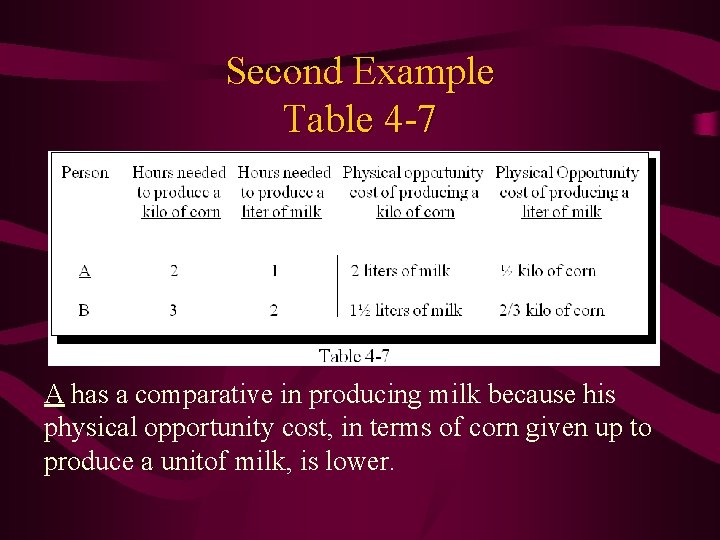
Second Example Table 4 -7 A has a comparative in producing milk because his physical opportunity cost, in terms of corn given up to produce a unitof milk, is lower.
Further Explanation of Table 4 -7 (same as Table 4 -5) B has a comparative advantage in producing corn because his physical opportunity cost, in terms of milk given up to produce a unit of corn, is lower. A has a comparative disadvantage in producing corn because his physical opportunity cost, in terms of milk given up to produce a unit of corn, is higher. B has a comparative disadvantage in producing milk because his physical opportunity cost, in terms of corn given up to produce a unit of milk, is higher.
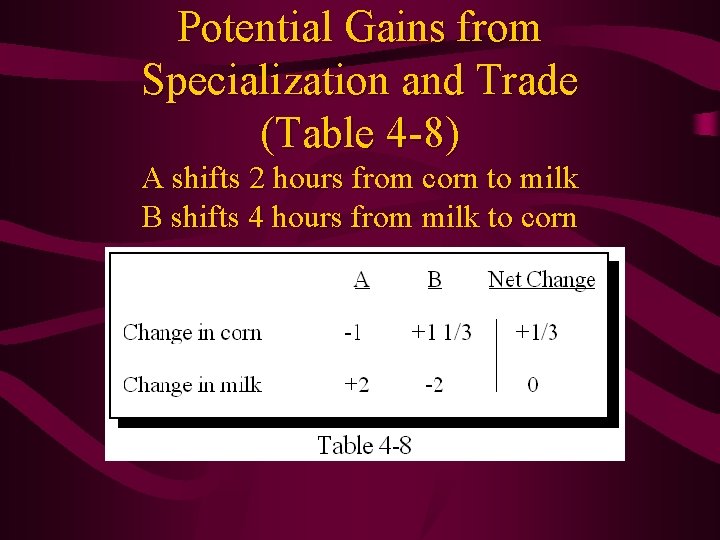
Potential Gains from Specialization and Trade (Table 4 -8) A shifts 2 hours from corn to milk B shifts 4 hours from milk to corn
Who Gains The Most From Trade And Specialization (1) • Although two parties in a transaction gain from trade, some observers care about which party gains the most. • Terms of trade: the price of one good in terms of the amount of another good that must be given up in exchange for it.
Showing The Potential Gains From Trade (1) • 1. Identify the comparative advantage. • 2. Assume that one of the parties shifts a fixed amount of resources away from producing the good for which he has a comparative disadvantage toward the good for which he has a comparative advantage.
Showing The Potential Gains From Trade (2) • 3. Assume that the other party shifts just enough resources away from the production of the good for which she has a disadvantage to compensate for the loss that resulted from the first party's shift. • 4. Subtract the lesser amount produced by the second party from the greater amount produced by the first party.
Who Gains The Most From Trade And Specialization (2) • Which party gains the most from trade depends on the terms of trade. • This, in turn, often depends on bargaining, or negotiating ability. • Economists, as such, are not interested in this issue. • Their task is to show the benefits of trade, not how to capture benefits that would otherwise go to the other trading party.
Can One Of The Parties Lose From Exchange? • The answer is “yes” if a person makes an error in judgment. • A person may be induced to make an error by deception and lying.
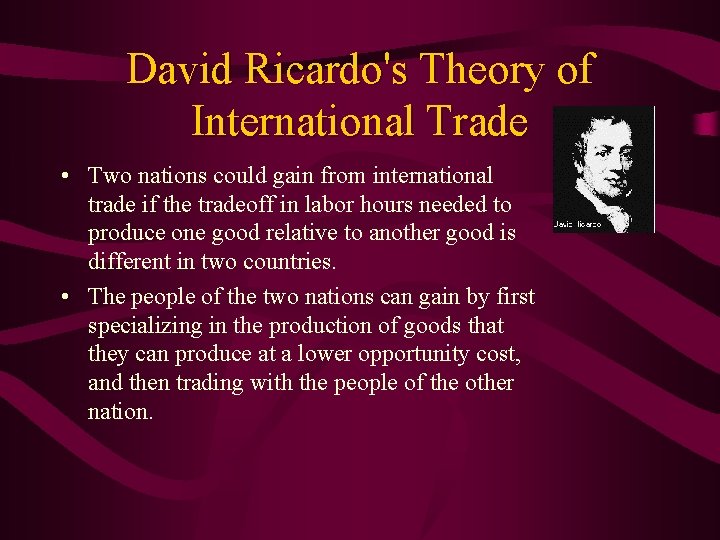
David Ricardo's Theory of International Trade • Two nations could gain from international trade if the tradeoff in labor hours needed to produce one good relative to another good is different in two countries. • The people of the two nations can gain by first specializing in the production of goods that they can produce at a lower opportunity cost, and then trading with the people of the other nation.
The Production of Comparative Advantage • Ricardo assumes that comparative advantage already exists. • Adam Smith wrote about how people have an incentive to produce human capital and, therefore, to become specialists: – The pin factory. – The baker, butcher, and brewer.
Adam Smith's Theory • The potential for gaining from trade gives people an incentive to specialize. In a large market the potential is greater than in a smaller market. Therefore, the diversity of human capital is limited by the extent of the market.
An Example Of Two Identical Farmers (1): Three Cases • Case 1: Both improve their farming abilities; there would be no comparative advantage and no reason for trade. • Case 2: One specializes in fence-building; the other in carpentry. There is comparative advantage; trade follows; both gain. • Case 3: One specializes in fence-building; the other does not specialize. There is comparative advantage; trade follows; both gain.
An Example Of Two Identical Farmers (2) • A person who decides to specialize also causes others to become specialists in the sense that they choose to produce more of the good that they decide to trade away.
Two General Principles • 1. Comparative differences in production ability give individuals incentives to trade. This is true even if a person has an absolute disadvantage in producing all goods. • 2. By specializing, a person can reduce her opportunity cost or increase her comparative productivity. By doing so and then offering a trade, she can lead those who do not deliberately specialize to become specialists also.
Second Issue: Intellectual Property Rights (1) • Discoverer: a person who produces entirely new human capital. • Copier: a person who produces knowledge that is new to himself but which he knows someone else has already produced. • Copying reduces or eliminates the prospective gains from exchange to a discoverer. As a result, the incentive to produce a discovery is lower than it would be if the technique could not be copied or if a copier had to pay compensation to the discoverer.
Intellectual Property Rights (2) • Patent: an exclusive, monopoly right to produce a particular product or to use a particular method of production for a certain number of years. • Copyright: an exclusive, monopoly right to receive the benefits from a writing or artistic work.
Intellectual Property Rights (3) • Patent system: a bureaucracy that accepts applications for patents. • Copyright system: a set of government agents who enforce a law that punishes copiers of a writing or artistic work. • Intellectual property rights: legal rights that are articulated in patent and copyright laws and judicial decisions.
Harm Due to Specialization • Not everyone gains from each act of specialization. • Every specialization faces competition. • The example of competing restaurant chefs. When a new person completes his training to be a chef, – Restaurant patrons gain. – Other chefs lose. • New inventions may make old methods of production – and the specialists who employ them – obsolete.
Should We Be Concerned About The Harm Due To Specialization? : Some Things To Consider • 1. When the specialization is due to invention, it brings great gains, as compared with the harm. • 2. Individuals have an incentive to try to predict harm and prepare for it. Many people can take care of themselves and do not need us to be concerned. Some cannot. • 3. Many people would like to maintain the status quo, regardless of the benefits they block others from receiving. Thus there is often substantial opposition to new inventions. These people ordinarily favor free enterprise. But they want exceptions for themselves.
Conclusion • A solitary actor must be a jack-of-all-trades, or a generalist. • There are gains due to specialization. • Private property rights are a catalyst for specialization, that is, for the production of human capital and skills.