
PRINCIPLES OF ECONOMICS 2 e Chapter 21 Unemployment
- Slides: 26
PRINCIPLES OF ECONOMICS 2 e Chapter 21 Unemployment Power. Point Image Slideshow
CH. 8 OUTLINE 8. 1: How the Unemployment Rate is Defined and Computed 8. 2: Patterns of Unemployment 8. 3: What Causes Changes in Unemployment Over the Short Run 8. 4: What Causes Changes in Unemployment Over the Long Run
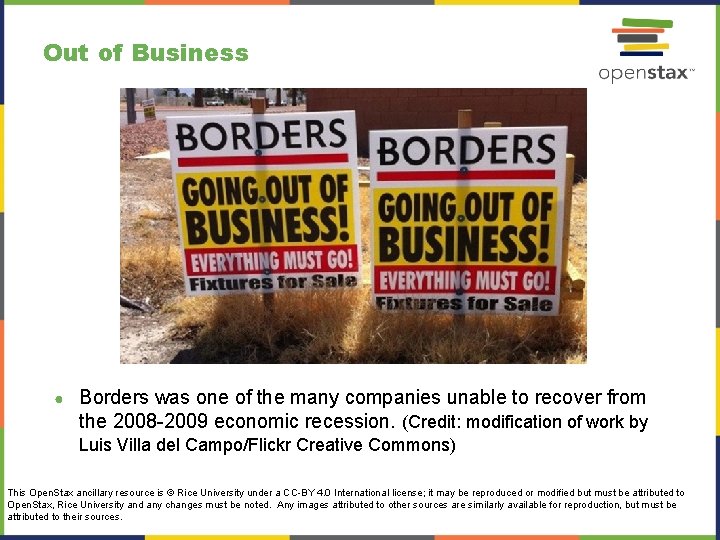
Out of Business ● Borders was one of the many companies unable to recover from the 2008 -2009 economic recession. (Credit: modification of work by Luis Villa del Campo/Flickr Creative Commons) This Open. Stax ancillary resource is © Rice University under a CC-BY 4. 0 International license; it may be reproduced or modified but must be attributed to Open. Stax, Rice University and any changes must be noted. Any images attributed to other sources are similarly available for reproduction, but must be attributed to their sources.
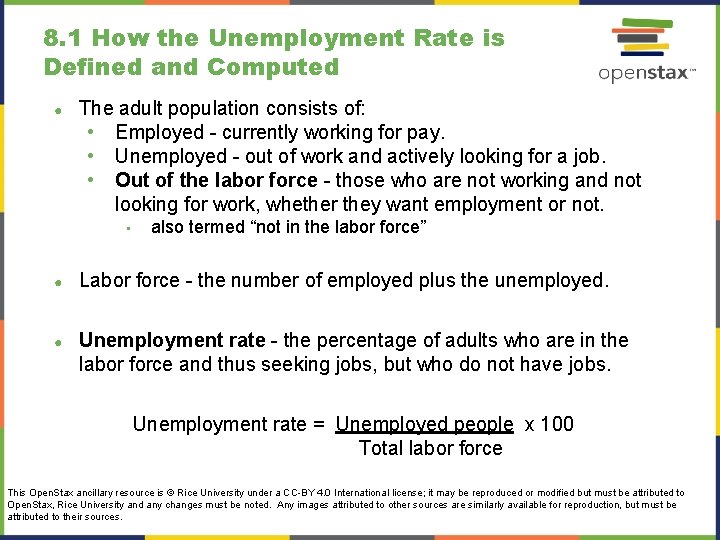
8. 1 How the Unemployment Rate is Defined and Computed ● The adult population consists of: • Employed - currently working for pay. • Unemployed - out of work and actively looking for a job. • Out of the labor force - those who are not working and not looking for work, whether they want employment or not. • also termed “not in the labor force” ● Labor force - the number of employed plus the unemployed. ● Unemployment rate - the percentage of adults who are in the labor force and thus seeking jobs, but who do not have jobs. Unemployment rate = Unemployed people x 100 Total labor force This Open. Stax ancillary resource is © Rice University under a CC-BY 4. 0 International license; it may be reproduced or modified but must be attributed to Open. Stax, Rice University and any changes must be noted. Any images attributed to other sources are similarly available for reproduction, but must be attributed to their sources.
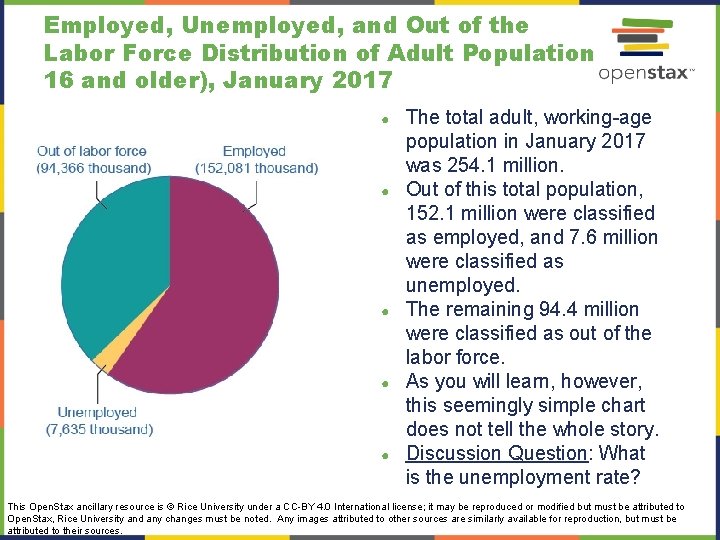
Employed, Unemployed, and Out of the Labor Force Distribution of Adult Population (age 16 and older), January 2017 ● ● ● The total adult, working-age population in January 2017 was 254. 1 million. Out of this total population, 152. 1 million were classified as employed, and 7. 6 million were classified as unemployed. The remaining 94. 4 million were classified as out of the labor force. As you will learn, however, this seemingly simple chart does not tell the whole story. Discussion Question: What is the unemployment rate? This Open. Stax ancillary resource is © Rice University under a CC-BY 4. 0 International license; it may be reproduced or modified but must be attributed to Open. Stax, Rice University and any changes must be noted. Any images attributed to other sources are similarly available for reproduction, but must be attributed to their sources.
Hidden Unemployment ● “Hidden unemployment” - people who are mislabeled in the categorization of employed, unemployed, or out of the labor force. • Part-time or temporary workers looking for full-time or permanent work. • Underemployed - individuals who are employed in a job that is below their skills. • Discouraged workers - those who have stopped looking for employment due to the lack of suitable positions available. This Open. Stax ancillary resource is © Rice University under a CC-BY 4. 0 International license; it may be reproduced or modified but must be attributed to Open. Stax, Rice University and any changes must be noted. Any images attributed to other sources are similarly available for reproduction, but must be attributed to their sources.
Labor Force Participation Rate ● Labor force participation rate - the percentage of adults in an economy who are either employed or who are unemployed and looking for a job. Labor force participation rate = ● Total labor force x 100 Total adult population Discussion Question: Using the January 2017 statistics, what is the labor force participation rate? This Open. Stax ancillary resource is © Rice University under a CC-BY 4. 0 International license; it may be reproduced or modified but must be attributed to Open. Stax, Rice University and any changes must be noted. Any images attributed to other sources are similarly available for reproduction, but must be attributed to their sources.
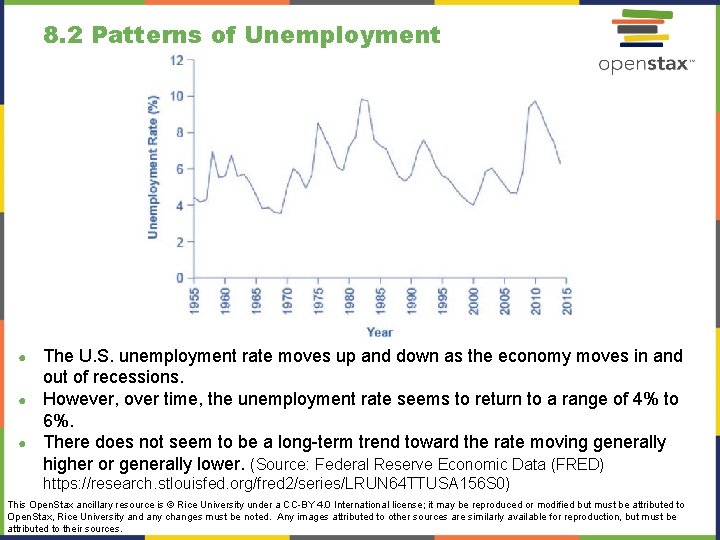
8. 2 Patterns of Unemployment The U. S. unemployment rate moves up and down as the economy moves in and out of recessions. ● However, over time, the unemployment rate seems to return to a range of 4% to 6%. ● There does not seem to be a long-term trend toward the rate moving generally higher or generally lower. (Source: Federal Reserve Economic Data (FRED) ● https: //research. stlouisfed. org/fred 2/series/LRUN 64 TTUSA 156 S 0) This Open. Stax ancillary resource is © Rice University under a CC-BY 4. 0 International license; it may be reproduced or modified but must be attributed to Open. Stax, Rice University and any changes must be noted. Any images attributed to other sources are similarly available for reproduction, but must be attributed to their sources.
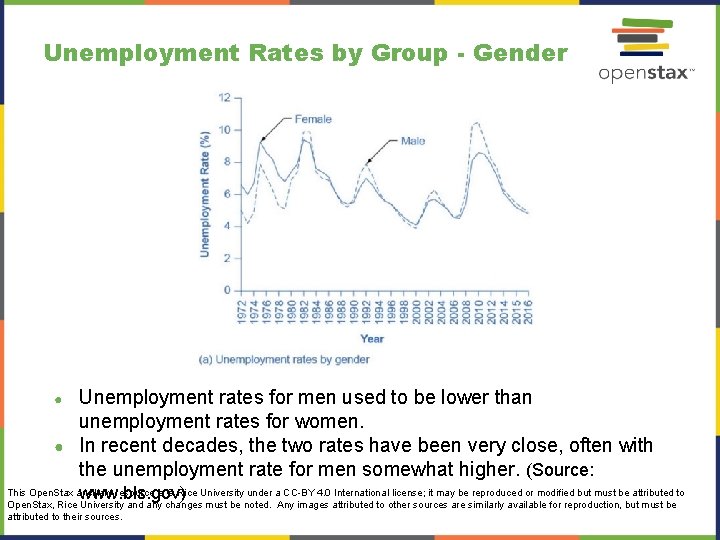
Unemployment Rates by Group - Gender ● ● Unemployment rates for men used to be lower than unemployment rates for women. In recent decades, the two rates have been very close, often with the unemployment rate for men somewhat higher. (Source: www. bls. gov) This Open. Stax ancillary resource is © Rice University under a CC-BY 4. 0 International license; it may be reproduced or modified but must be attributed to Open. Stax, Rice University and any changes must be noted. Any images attributed to other sources are similarly available for reproduction, but must be attributed to their sources.
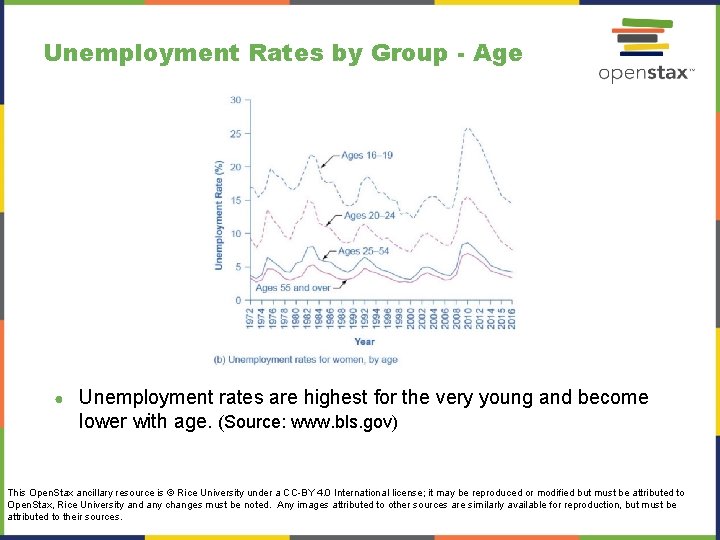
Unemployment Rates by Group - Age ● Unemployment rates are highest for the very young and become lower with age. (Source: www. bls. gov) This Open. Stax ancillary resource is © Rice University under a CC-BY 4. 0 International license; it may be reproduced or modified but must be attributed to Open. Stax, Rice University and any changes must be noted. Any images attributed to other sources are similarly available for reproduction, but must be attributed to their sources.
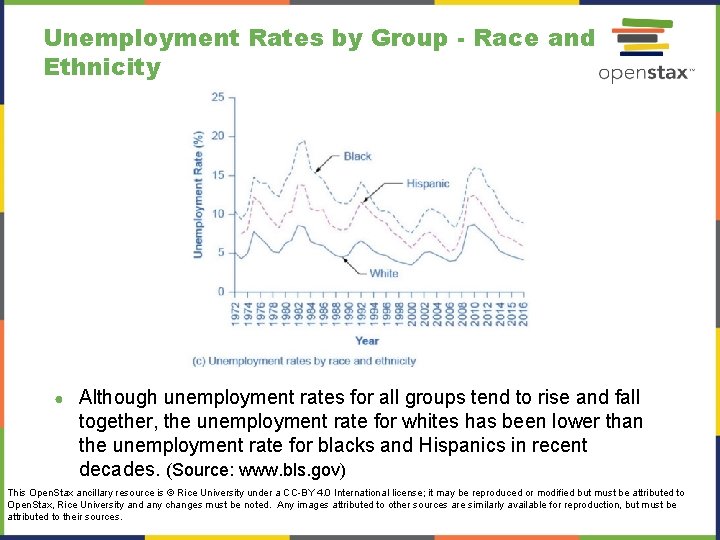
Unemployment Rates by Group - Race and Ethnicity ● Although unemployment rates for all groups tend to rise and fall together, the unemployment rate for whites has been lower than the unemployment rate for blacks and Hispanics in recent decades. (Source: www. bls. gov) This Open. Stax ancillary resource is © Rice University under a CC-BY 4. 0 International license; it may be reproduced or modified but must be attributed to Open. Stax, Rice University and any changes must be noted. Any images attributed to other sources are similarly available for reproduction, but must be attributed to their sources.
International Unemployment Comparisons ● From an international perspective, the U. S. unemployment rate typically has looked a little better than average. ● Caution when comparing cross-country unemployment rates due to: • Different definitions of unemployment • Survey tools for measuring unemployment • • Poorer countries lack resources and technical capabilities in their statistical agencies. Different labor markets • In low-income countries, workers are not involved in the labor market through an employer who pays them regularly, but in short-term work, subsistence activities, and barter. This Open. Stax ancillary resource is © Rice University under a CC-BY 4. 0 International license; it may be reproduced or modified but must be attributed to Open. Stax, Rice University and any changes must be noted. Any images attributed to other sources are similarly available for reproduction, but must be attributed to their sources.
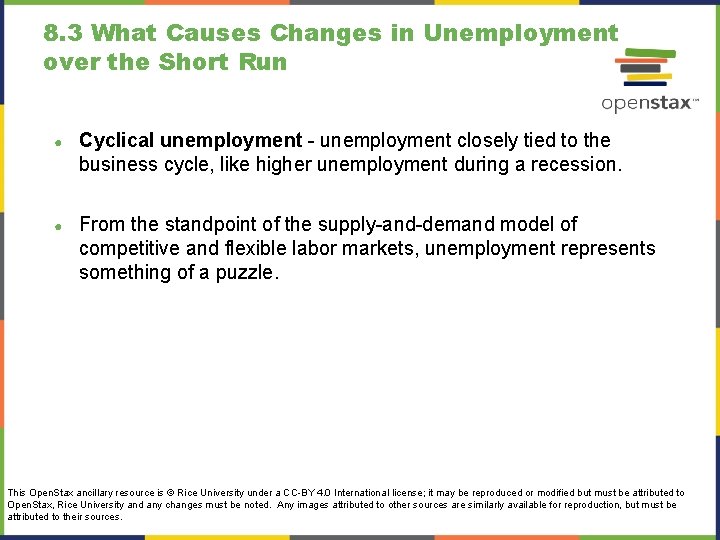
8. 3 What Causes Changes in Unemployment over the Short Run ● Cyclical unemployment - unemployment closely tied to the business cycle, like higher unemployment during a recession. ● From the standpoint of the supply-and-demand model of competitive and flexible labor markets, unemployment represents something of a puzzle. This Open. Stax ancillary resource is © Rice University under a CC-BY 4. 0 International license; it may be reproduced or modified but must be attributed to Open. Stax, Rice University and any changes must be noted. Any images attributed to other sources are similarly available for reproduction, but must be attributed to their sources.
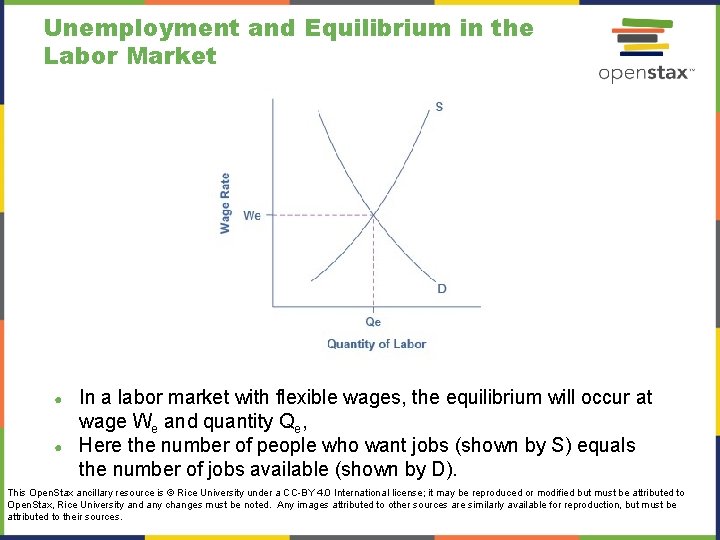
Unemployment and Equilibrium in the Labor Market ● ● In a labor market with flexible wages, the equilibrium will occur at wage We and quantity Qe, Here the number of people who want jobs (shown by S) equals the number of jobs available (shown by D). This Open. Stax ancillary resource is © Rice University under a CC-BY 4. 0 International license; it may be reproduced or modified but must be attributed to Open. Stax, Rice University and any changes must be noted. Any images attributed to other sources are similarly available for reproduction, but must be attributed to their sources.
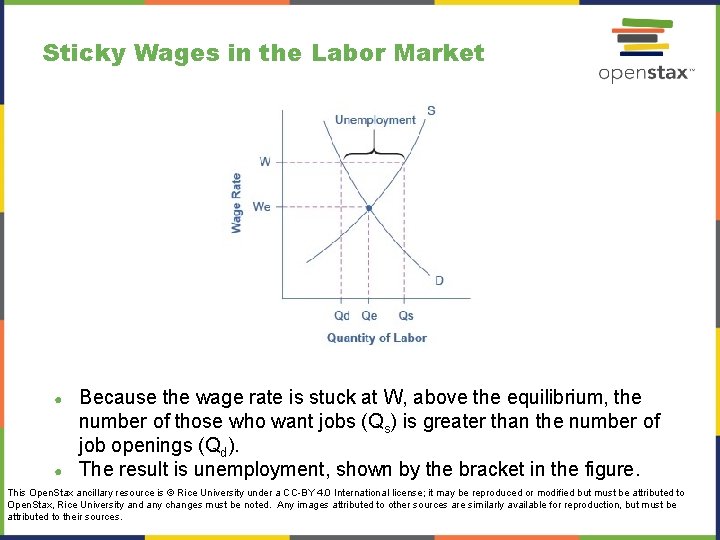
Sticky Wages in the Labor Market ● ● Because the wage rate is stuck at W, above the equilibrium, the number of those who want jobs (Qs) is greater than the number of job openings (Qd). The result is unemployment, shown by the bracket in the figure. This Open. Stax ancillary resource is © Rice University under a CC-BY 4. 0 International license; it may be reproduced or modified but must be attributed to Open. Stax, Rice University and any changes must be noted. Any images attributed to other sources are similarly available for reproduction, but must be attributed to their sources.
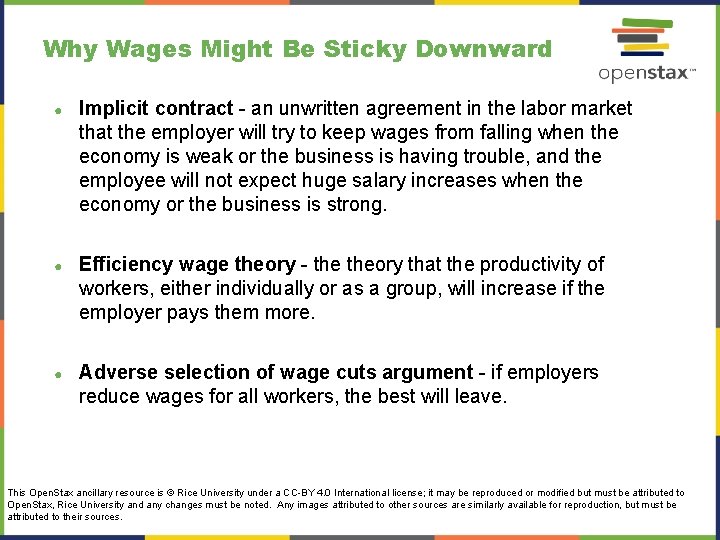
Why Wages Might Be Sticky Downward ● Implicit contract - an unwritten agreement in the labor market that the employer will try to keep wages from falling when the economy is weak or the business is having trouble, and the employee will not expect huge salary increases when the economy or the business is strong. ● Efficiency wage theory - theory that the productivity of workers, either individually or as a group, will increase if the employer pays them more. ● Adverse selection of wage cuts argument - if employers reduce wages for all workers, the best will leave. This Open. Stax ancillary resource is © Rice University under a CC-BY 4. 0 International license; it may be reproduced or modified but must be attributed to Open. Stax, Rice University and any changes must be noted. Any images attributed to other sources are similarly available for reproduction, but must be attributed to their sources.
Why Wages Might Be Sticky Downward, Continued ● Insider-outsider model - those already working for the firm are “insiders” who know the procedures; the other workers are “outsiders” who are recent or prospective hires. ● Relative wage coordination argument - across-the-board wage cuts are hard for an economy to implement, and workers fight against them. This Open. Stax ancillary resource is © Rice University under a CC-BY 4. 0 International license; it may be reproduced or modified but must be attributed to Open. Stax, Rice University and any changes must be noted. Any images attributed to other sources are similarly available for reproduction, but must be attributed to their sources.
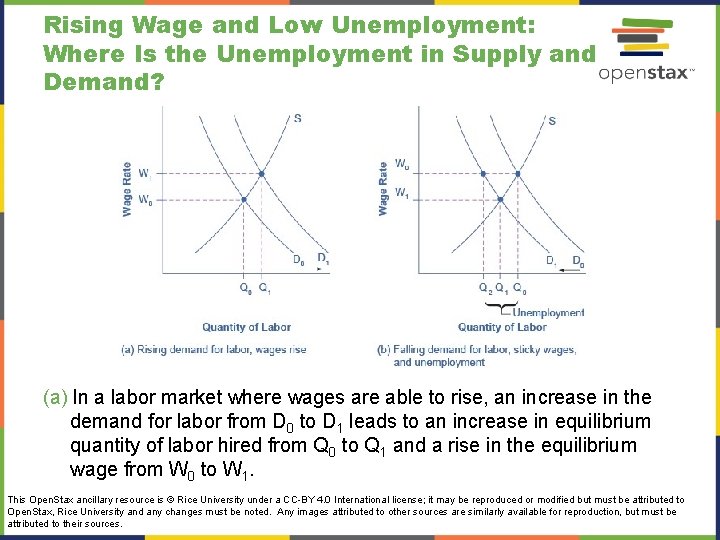
Rising Wage and Low Unemployment: Where Is the Unemployment in Supply and Demand? (a) In a labor market where wages are able to rise, an increase in the demand for labor from D 0 to D 1 leads to an increase in equilibrium quantity of labor hired from Q 0 to Q 1 and a rise in the equilibrium wage from W 0 to W 1. This Open. Stax ancillary resource is © Rice University under a CC-BY 4. 0 International license; it may be reproduced or modified but must be attributed to Open. Stax, Rice University and any changes must be noted. Any images attributed to other sources are similarly available for reproduction, but must be attributed to their sources.
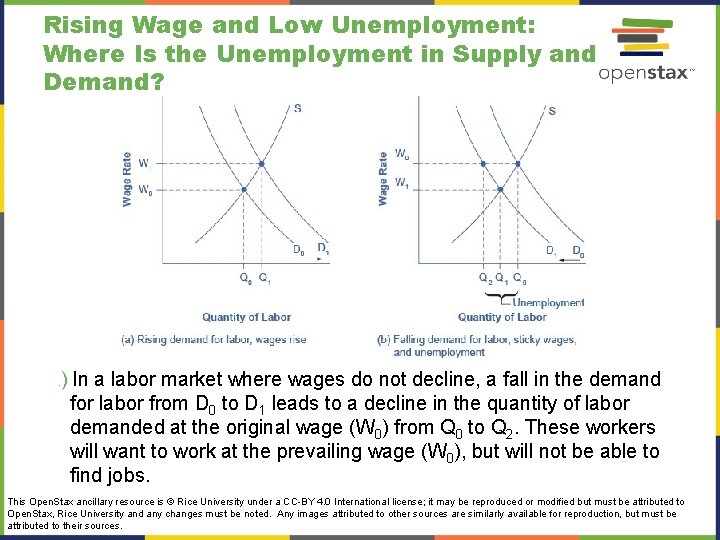
Rising Wage and Low Unemployment: Where Is the Unemployment in Supply and Demand? (a) In a labor market where wages do not decline, a fall in the demand for labor from D 0 to D 1 leads to a decline in the quantity of labor demanded at the original wage (W 0) from Q 0 to Q 2. These workers will want to work at the prevailing wage (W 0), but will not be able to find jobs. This Open. Stax ancillary resource is © Rice University under a CC-BY 4. 0 International license; it may be reproduced or modified but must be attributed to Open. Stax, Rice University and any changes must be noted. Any images attributed to other sources are similarly available for reproduction, but must be attributed to their sources.
8. 4 What Causes Changes in Unemployment over the Long Run ● Natural rate of unemployment - the unemployment rate that would exist in a growing and healthy economy from the combination of economic, social, and political factors that exist at a given time. • • ● Frictional unemployment - unemployment that occurs as workers move between jobs. Structural Unemployment - unemployment that occurs because individuals lack skills valued by employers. Economists consider the economy to be at full employment when the actual unemployment rate is equal to the natural unemployment rate. This Open. Stax ancillary resource is © Rice University under a CC-BY 4. 0 International license; it may be reproduced or modified but must be attributed to Open. Stax, Rice University and any changes must be noted. Any images attributed to other sources are similarly available for reproduction, but must be attributed to their sources.
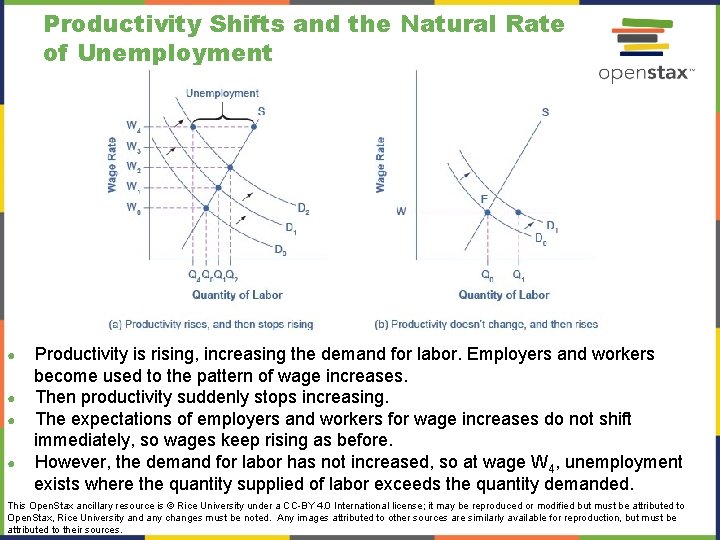
Productivity Shifts and the Natural Rate of Unemployment ● ● Productivity is rising, increasing the demand for labor. Employers and workers become used to the pattern of wage increases. Then productivity suddenly stops increasing. The expectations of employers and workers for wage increases do not shift immediately, so wages keep rising as before. However, the demand for labor has not increased, so at wage W 4, unemployment exists where the quantity supplied of labor exceeds the quantity demanded. This Open. Stax ancillary resource is © Rice University under a CC-BY 4. 0 International license; it may be reproduced or modified but must be attributed to Open. Stax, Rice University and any changes must be noted. Any images attributed to other sources are similarly available for reproduction, but must be attributed to their sources.
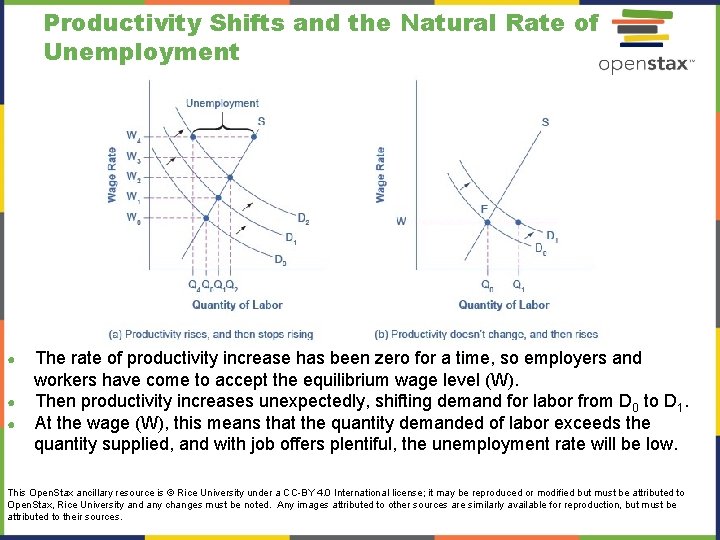
Productivity Shifts and the Natural Rate of Unemployment ● ● ● The rate of productivity increase has been zero for a time, so employers and workers have come to accept the equilibrium wage level (W). Then productivity increases unexpectedly, shifting demand for labor from D 0 to D 1. At the wage (W), this means that the quantity demanded of labor exceeds the quantity supplied, and with job offers plentiful, the unemployment rate will be low. This Open. Stax ancillary resource is © Rice University under a CC-BY 4. 0 International license; it may be reproduced or modified but must be attributed to Open. Stax, Rice University and any changes must be noted. Any images attributed to other sources are similarly available for reproduction, but must be attributed to their sources.
Public Policy and the Natural Rate of Unemployment ● On the supply side of the labor market, public policies to assist the unemployed can affect how eager people are to find work. • Example: unemployment insurance, welfare benefits, food stamps, and government medical benefits may make the opportunity cost of unemployment lower -> a worker may be less eager to seek a new job. ● What seems to matter most is how long the assistance lasts. • Short term benefits (weeks/months) vs. long term benefits (years) ● Government assistance for job search or retraining can sometimes encourage people back to work sooner. This Open. Stax ancillary resource is © Rice University under a CC-BY 4. 0 International license; it may be reproduced or modified but must be attributed to Open. Stax, Rice University and any changes must be noted. Any images attributed to other sources are similarly available for reproduction, but must be attributed to their sources.
Public Policy and the Natural Rate of Unemployment, Continued ● On the demand side of the labor market some public policies can affect the willingness of firms to hire: • Government rules • Social institutions • Presence of unions This Open. Stax ancillary resource is © Rice University under a CC-BY 4. 0 International license; it may be reproduced or modified but must be attributed to Open. Stax, Rice University and any changes must be noted. Any images attributed to other sources are similarly available for reproduction, but must be attributed to their sources.
The Natural Rate of Unemployment in Recent Years ● Underlying economic, social, and political factors that determine the natural rate of unemployment can change over time, which means that the natural rate of unemployment can change over time too. ● Estimates by economists of the natural rate of unemployment in the U. S. economy is about 4. 5 to 5. 5%, which is a lower estimate than previously. ● Reasons for this lower rate: • Internet as a job seeking tool • Growth of the temporary worker industry • Aging of the “baby boom generation” This Open. Stax ancillary resource is © Rice University under a CC-BY 4. 0 International license; it may be reproduced or modified but must be attributed to Open. Stax, Rice University and any changes must be noted. Any images attributed to other sources are similarly available for reproduction, but must be attributed to their sources.
This Open. Stax ancillary resource is © Rice University under a CC-BY 4. 0 International license; it may be reproduced or modified but must be attributed to Open. Stax, Rice University and any changes must be noted. Any images attributed to other sources are similarly available for reproduction, but must be attributed to their sources.