
Principles of Drying Because of the wide variety
Principles of Drying - Because of the wide variety of materials that are dried in commercial equipment and the many types of equipment that are used, there is no single theory of drying that covers all materials and dryer types. - Variations in shape and size of stock, in moisture equilibria, in the mechanism of flow of moisture through the solid, and in the method of providing the heat required for the vaporization all prevent a unified treatment. - General principles used in a semiquantitative way are relied upon. Dryers are seldom designed by the user but are bought from companies that specialize in the engineering and fabrication of drying equipment.
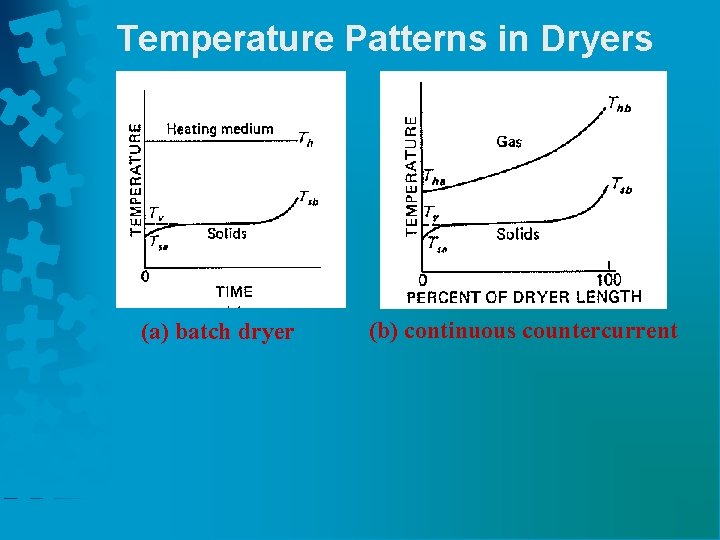
Temperature Patterns in Dryers (a) batch dryer (b) continuous countercurrent
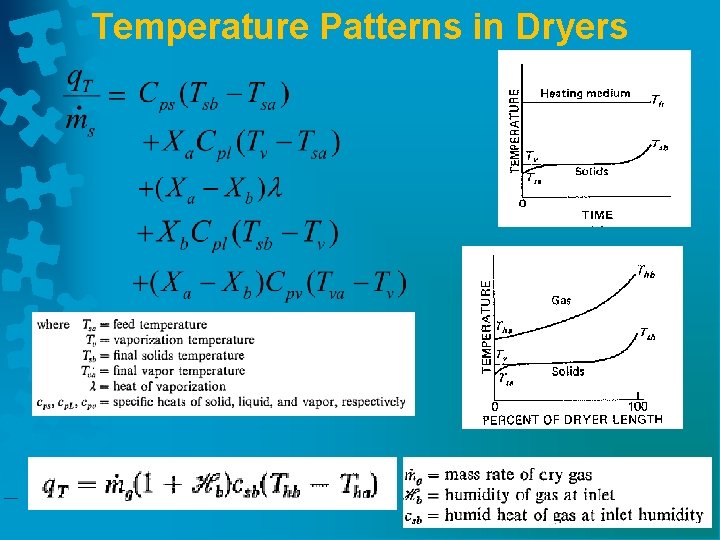
Temperature Patterns in Dryers
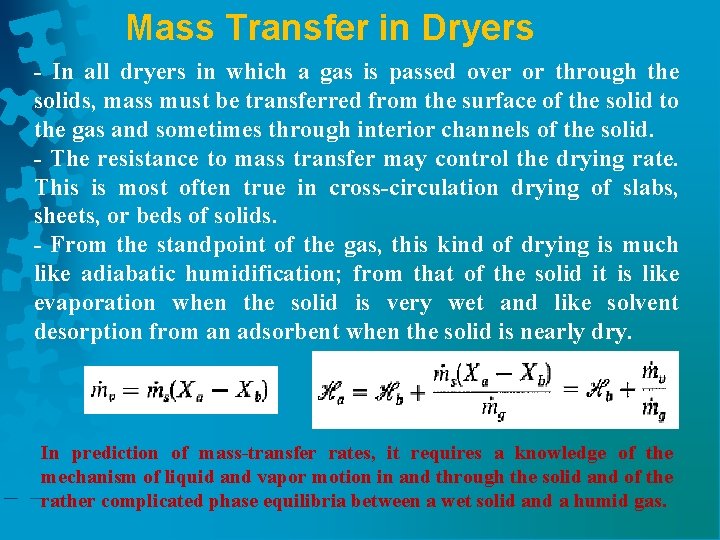
Mass Transfer in Dryers - In all dryers in which a gas is passed over or through the solids, mass must be transferred from the surface of the solid to the gas and sometimes through interior channels of the solid. - The resistance to mass transfer may control the drying rate. This is most often true in cross-circulation drying of slabs, sheets, or beds of solids. - From the standpoint of the gas, this kind of drying is much like adiabatic humidification; from that of the solid it is like evaporation when the solid is very wet and like solvent desorption from an adsorbent when the solid is nearly dry. In prediction of mass-transfer rates, it requires a knowledge of the mechanism of liquid and vapor motion in and through the solid and of the rather complicated phase equilibria between a wet solid and a humid gas.
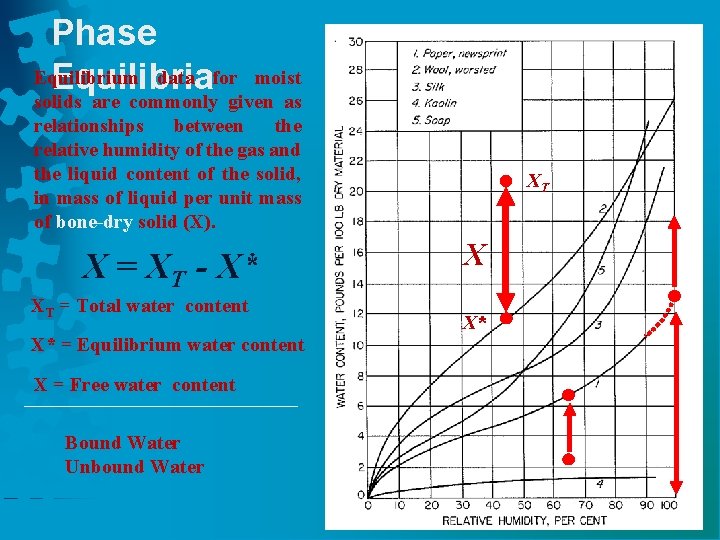
Phase Equilibrium data for Equilibria moist solids are commonly given as relationships between the relative humidity of the gas and the liquid content of the solid, in mass of liquid per unit mass of bone-dry solid (X). X = XT - X* XT = Total water content X* = Equilibrium water content X = Free water content Bound Water Unbound Water XT X X*
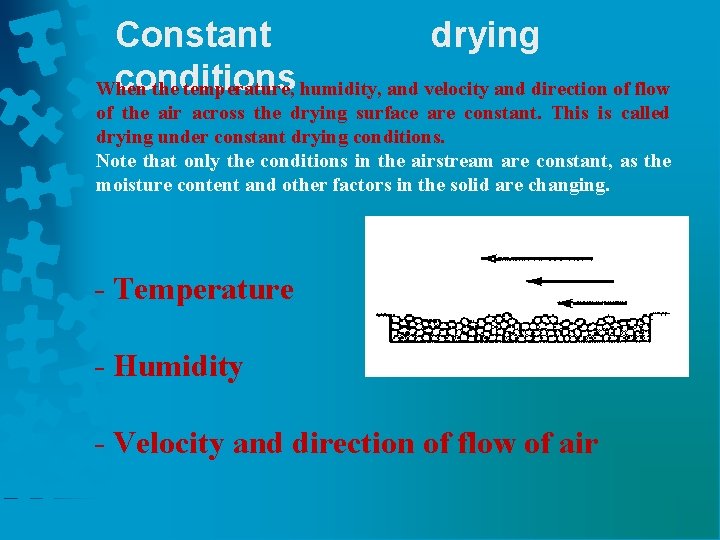
Constant drying conditions When the temperature, humidity, and velocity and direction of flow of the air across the drying surface are constant. This is called drying under constant drying conditions. Note that only the conditions in the airstream are constant, as the moisture content and other factors in the solid are changing. - Temperature - Humidity - Velocity and direction of flow of air
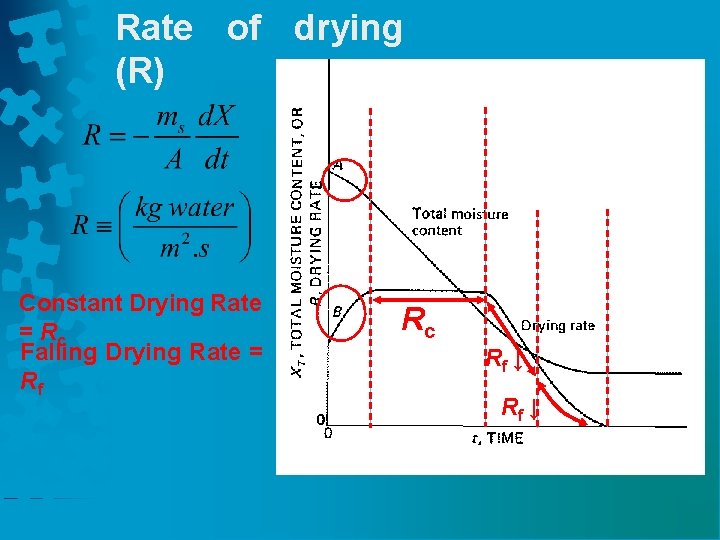
Rate of drying (R) Constant Drying Rate = Rc Falling Drying Rate = Rf Rc Rf ↓
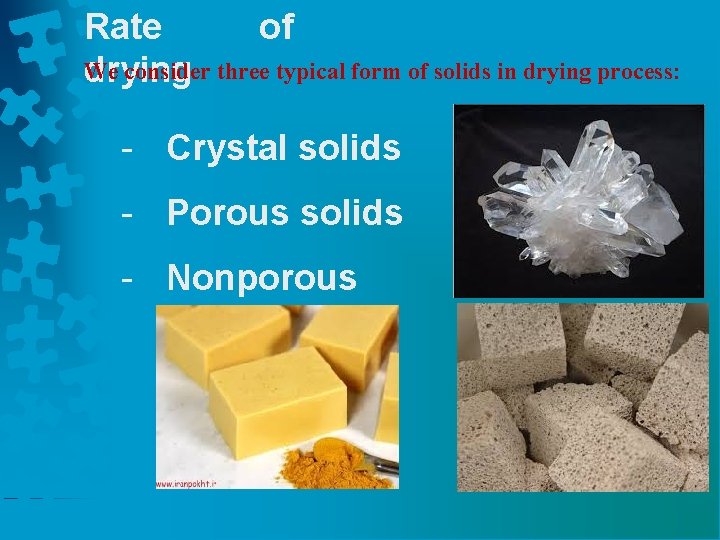
Rate of We consider three typical form of solids in drying process: drying - Crystal solids - Porous solids - Nonporous solids
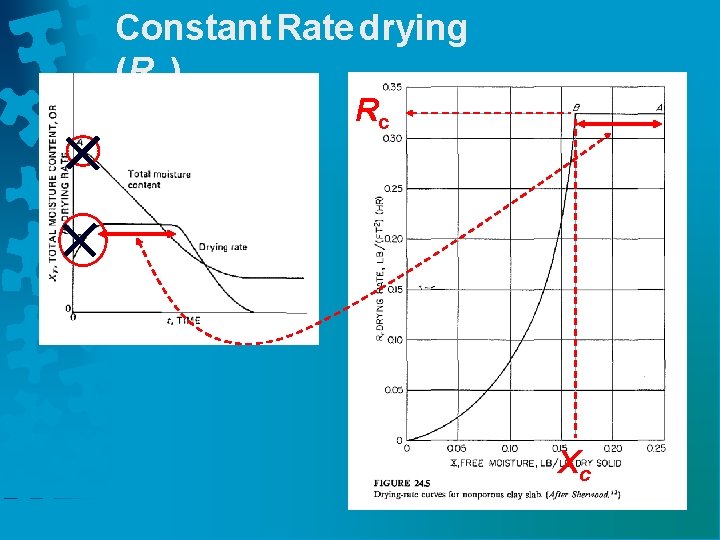
Constant Rate drying (RC) Rc Xc
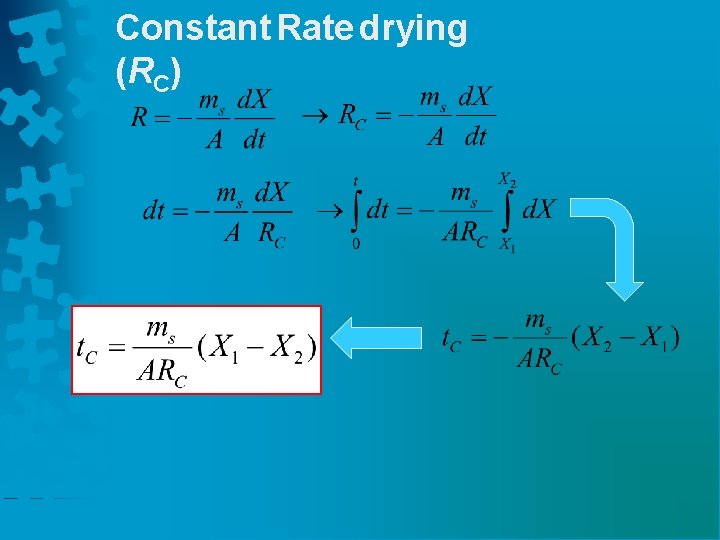
Constant Rate drying (RC)
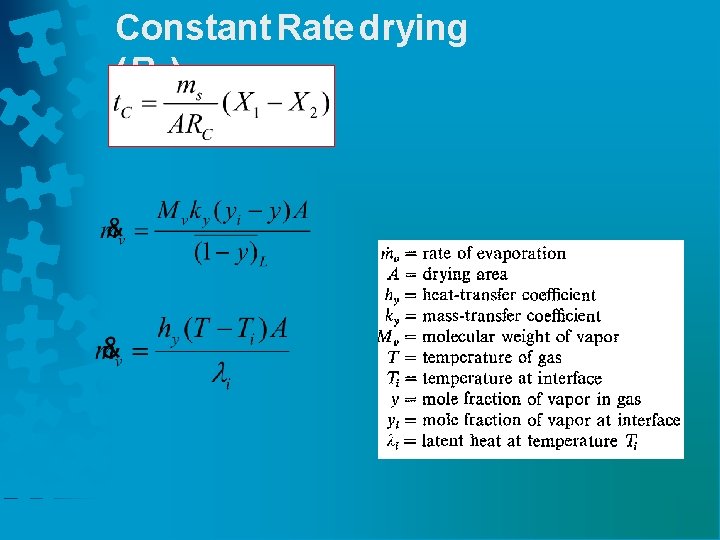
Constant Rate drying (RC)
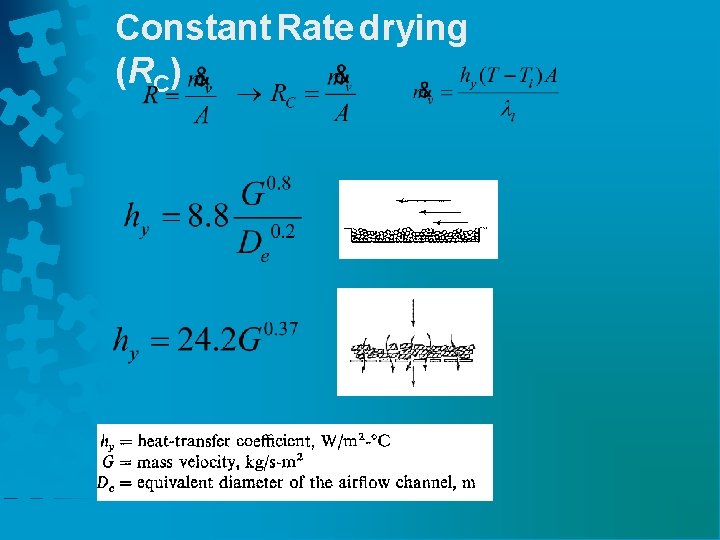
Constant Rate drying (RC)
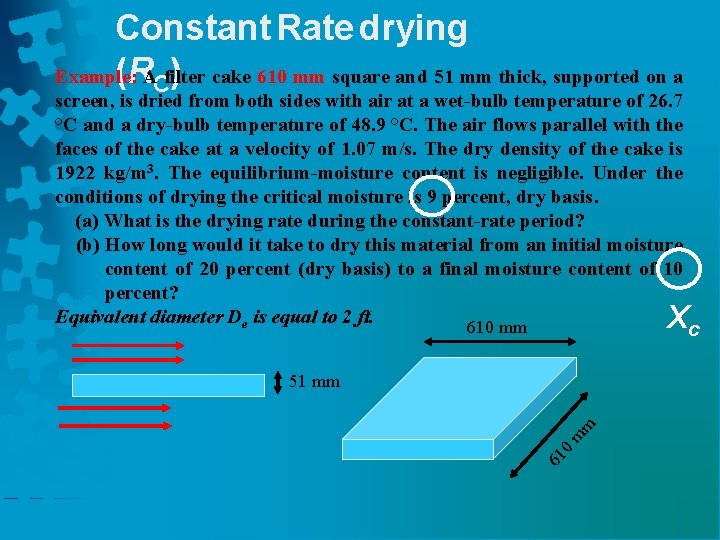
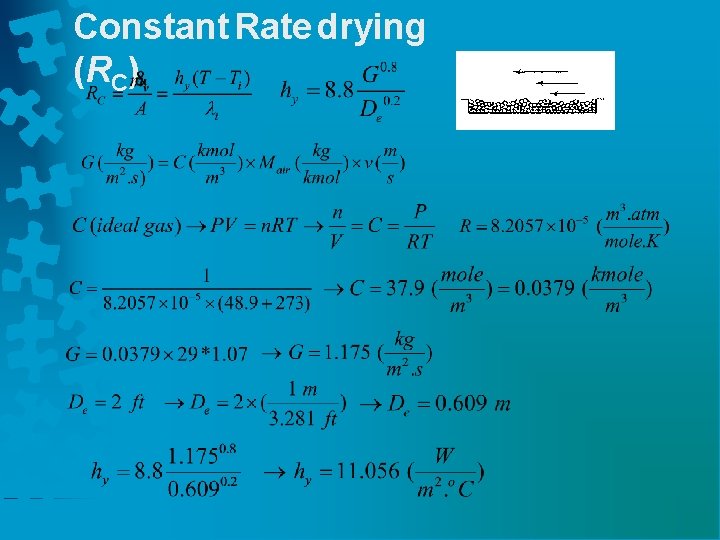
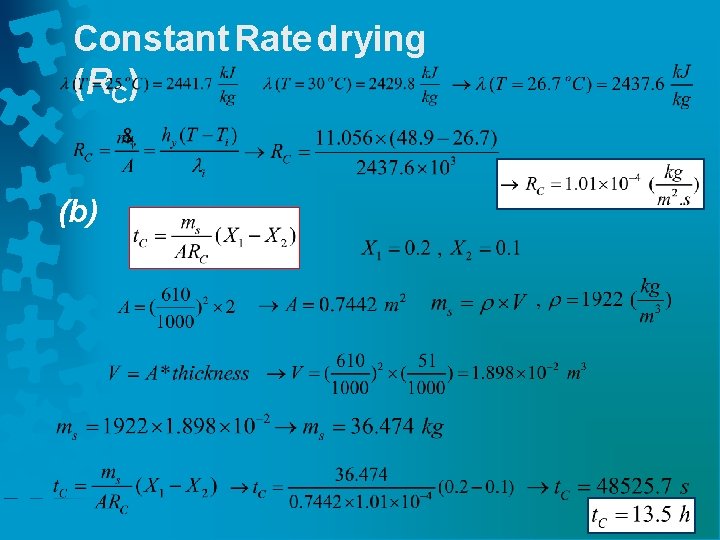
Constant Rate drying Example: (RACfilter ) cake 610 mm square and 51 mm thick, supported on a screen, is dried from both sides with air at a wet-bulb temperature of 26. 7 °C and a dry-bulb temperature of 48. 9 °C. The air flows parallel with the faces of the cake at a velocity of 1. 07 m/s. The dry density of the cake is 1922 kg/m 3. The equilibrium-moisture content is negligible. Under the conditions of drying the critical moisture is 9 percent, dry basis. (a) What is the drying rate during the constant-rate period? (b) How long would it take to dry this material from an initial moisture content of 20 percent (dry basis) to a final moisture content of 10 percent? Equivalent diameter De is equal to 2 ft. Xc 610 mm 61 0 m m 51 mm
Constant Rate drying (RC)
Constant Rate drying (RC) (b)

Home work (4)
- Slides: 16