
Principles of Drug Use Prescribing for the Elderly
Principles of Drug Use: Prescribing for the Elderly Thomas R. Clark, RPh, MHS ASCP Director of Policy & Advocacy American Society of Consultant Pharmacists America’s Senior Care Pharmacists®
“Medications are probably the single most important health care technology in preventing illness, disability, and death in the geriatric population” Avorn, J. Medication use and the elderly: current status and opportunities. Health Affairs. 1995(Spring): 278 -86. American Society of Consultant Pharmacists America’s Senior Care Pharmacists®

Importance of geriatric drug therapy Aging of population High use of drugs in elderly Prevalence of medication therapy problems Shift from nursing facility to home and community-based services American Society of Consultant Pharmacists America’s Senior Care Pharmacists®
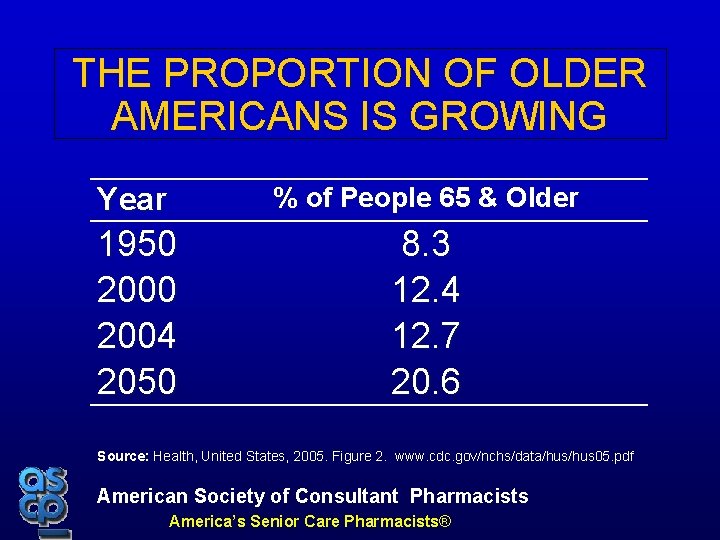
THE PROPORTION OF OLDER AMERICANS IS GROWING Year % of People 65 & Older 1950 2004 2050 8. 3 12. 4 12. 7 20. 6 Source: Health, United States, 2005. Figure 2. www. cdc. gov/nchs/data/hus 05. pdf American Society of Consultant Pharmacists America’s Senior Care Pharmacists®
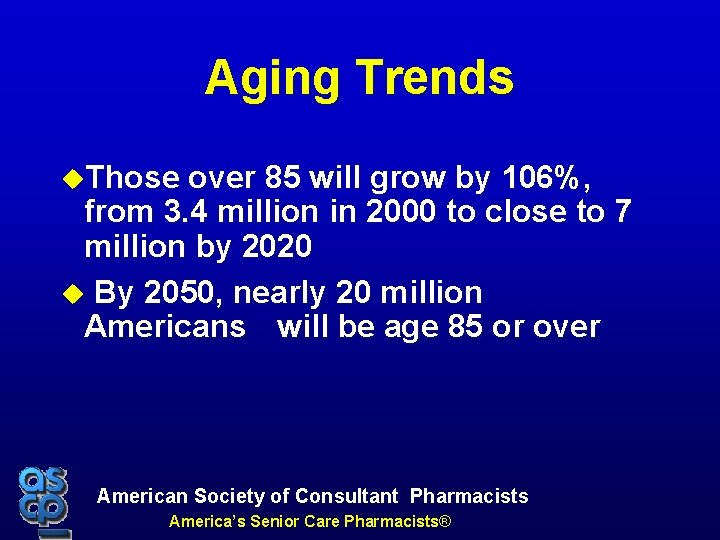
Aging Trends u. Those over 85 will grow by 106%, from 3. 4 million in 2000 to close to 7 million by 2020 u By 2050, nearly 20 million Americans will be age 85 or over American Society of Consultant Pharmacists America’s Senior Care Pharmacists®
Aging Trends About half those age 85 and over need assistance with daily living u About half those age 85 and over have some degree of cognitive impairment u About one out of five live in NF u American Society of Consultant Pharmacists America’s Senior Care Pharmacists®
Persons Surviving to Age 90 1940: Seven percent u 2050: Forty two percent u American Society of Consultant Pharmacists America’s Senior Care Pharmacists®

Rx Use in the US Source: Center on an Aging Society, Georgetown University, 2000 American Society of Consultant Pharmacists America’s Senior Care Pharmacists®

Rx Use and Seniors 1998 - 34. 4% of 2. 733 billion Rxs US Population – 933 million Rxs for seniors Seniors Rxs for non-seniors Source: IMS 1998 American Society of Consultant Pharmacists America’s Senior Care Pharmacists®
Rx Use and Seniors In 2005, seniors comprised 12. 5% of the population and consumed 37% of prescriptions By 2020, seniors will comprise 16% of the population and will consume 49% of prescriptions Source: US Census, IMS National Prescription Audit, July 2005 American Society of Consultant Pharmacists America’s Senior Care Pharmacists®
Rx Use and Seniors Typical NF Resident 75 -85+ years of age Average number of routine prescription medications: 8. 1 Average number of PRN prescription medications: 3. 2 Percent of residents receiving 9+ routine medications per day: 41. 1 American Society of Consultant Pharmacists America’s Senior Care Pharmacists®
Rx Use and Seniors Assisted Living 13 medications/resident American Society of Consultant Pharmacists America’s Senior Care Pharmacists®

Medication Therapy Problems Polypharmacy: drug use without indication Undertreatment: indication without drug use Dose too low Dose too high Adverse drug reaction American Society of Consultant Pharmacists America’s Senior Care Pharmacists®

Medication Therapy Problems Drug interaction Inappropriate drug Lack of adherence or compliance Medication error American Society of Consultant Pharmacists America’s Senior Care Pharmacists®
Polypharmacy “As older patients move through time, often from physician to physician, they are at increasing risk of accumulating layer upon layer of drug therapy, as a reef accumulates layer upon layer of coral” Jerry Avorn, quoted in Arch Intern Med 164: 1957– 59 American Society of Consultant Pharmacists America’s Senior Care Pharmacists®
Polypharmacy “The desire to take medicine is perhaps the greatest feature which distinguishes man from animals. ” Sir William Osler, in H. Cushing, Life of Sir William Osler (1925) American Society of Consultant Pharmacists America’s Senior Care Pharmacists®
Polypharmacy “One of the first duties of the physician is to educate the masses not to take medicine. ” Sir William Osler, Aphorisms from his Bedside Teachings (1961) p. 105. American Society of Consultant Pharmacists America’s Senior Care Pharmacists®
Polypharmacy “I firmly believe that if the whole materia medica as now used could be sunk to the bottom of the sea, it would be all the better for mankind— and all the worse for the fishes. ” Oliver Wendell Holmes, 1860 American Society of Consultant Pharmacists America’s Senior Care Pharmacists®
Undertreatment “Over the past few years, the pendulum has swung from concern about the risks of excessive prescribing of inappropriate or unnecessary drug therapy to concerns about the consequences of underprescribing of potentially beneficial therapies to seniors (65 years and older). ” Rochon PA, Gurwitz JH. Prescribing for seniors: neither too much nor too little. JAMA, 1999; 282: 113 -5 American Society of Consultant Pharmacists America’s Senior Care Pharmacists®
Examples of Undertreatment Pain management Pneumococcal and flu vaccine Depression Secondary heart attack prevention American Society of Consultant Pharmacists America’s Senior Care Pharmacists®
Quality of Health Care for Older Adults Vulnerable elders receive about half of recommended care Preventive care suffers the most Physicians often fail to prescribe recommended medications Care for geriatric conditions (e. g. falls, incontinence) is poorer than care for medical conditions such as hypertension Source: Rand Research http: //rand. org/pubs/research_briefs/2005/RB 9051. pdf American Society of Consultant Pharmacists America’s Senior Care Pharmacists®
Adverse Effects “Any symptom in an elderly patient should be considered a drug side effect until proved otherwise. ” Gurwitz J, Monane M, Monane S, Avorn J. Polypharmacy. In: Morris JN, Lipsitz LA, Murphy K, et al. Quality Care in the Nursing Home. St. Louis, MO: Mosby Year Book; 1997: 13 -25. American Society of Consultant Pharmacists America’s Senior Care Pharmacists®
Adverse Drug Events (ADE) Rate of ADEs requiring an ER visit for persons 65 and over is more than twice the rate for persons under age 65 Rate of ADEs requiring hospitalization is nearly seven times greater for persons age 65 or over versus persons under age 65. Source: JAMA 2006; 296(15): 1858– 66 American Society of Consultant Pharmacists America’s Senior Care Pharmacists®
Inappropriate Drugs Antibacterial to treat a viral infection “Beers medications” - medications considered potentially inappropriate for older adults based on risk versus benefit (expert consensus) Ref: Arch Intern Med 2003; 163: 2716– 24 American Society of Consultant Pharmacists America’s Senior Care Pharmacists®
Inappropriate Drugs 21% of older adults take one or more medications categorized by Beers as generally inappropriate Source: Arch Intern Med 2004; 164: 1621– 25. American Society of Consultant Pharmacists America’s Senior Care Pharmacists®
Medication Adherence Social and economic factors Health care system-related factors Condition-related factors Therapy-related factors Patient-related factors American Society of Consultant Pharmacists America’s Senior Care Pharmacists®

Medication Adherence More than 10% of hospital admissions for older adults may be due to nonadherence Nonadherence costs the U. S. health care system $100 billion per year Source: Vermiere E. et al. Patient adherence to treatment: three decades of research, a comprehensive review. J Clin Pharm Ther 2001; 26: 331– 42. American Society of Consultant Pharmacists America’s Senior Care Pharmacists®
Principles of Drug Use Ask: Is treatment warranted? Are nonpharmacologic alternatives available? Consider risk vs. benefit of drug therapy Establish goals of therapy – Quality of care – Quality of life – Functional status American Society of Consultant Pharmacists America’s Senior Care Pharmacists®
Goals of Therapy “Is it quality of life or quantity of life? Truthfully, if my destiny is to feel great now and maybe shorten my future, I’d rather feel well now. ” Source: Nancy Richardson, 60, of Wayland, Mass. , referring to risk versus benefit of estrogen therapy. Quoted in New York Times, December 18, 2006 article by Gina Kolata, “Breast Cancer News Brings a Range of Reactions” American Society of Consultant Pharmacists America’s Senior Care Pharmacists®
Principles of Drug Use Consider the whole person, not just one disease or one drug Be aware of assumptions behind clinical practice guidelines Disease management may not be adequate or appropriate if multiple chronic diseases are present American Society of Consultant Pharmacists America’s Senior Care Pharmacists®
Questions? American Society of Consultant Pharmacists America’s Senior Care Pharmacists®
- Slides: 31