
Principles of Design n Balance n Rhythm n
Principles of Design n Balance n Rhythm n Proportion n Dominance n Unity Source: Joshua David Mc. Clurg-Genevese, “Principles and Elements of Design: ” http: //www. digital-web. com/
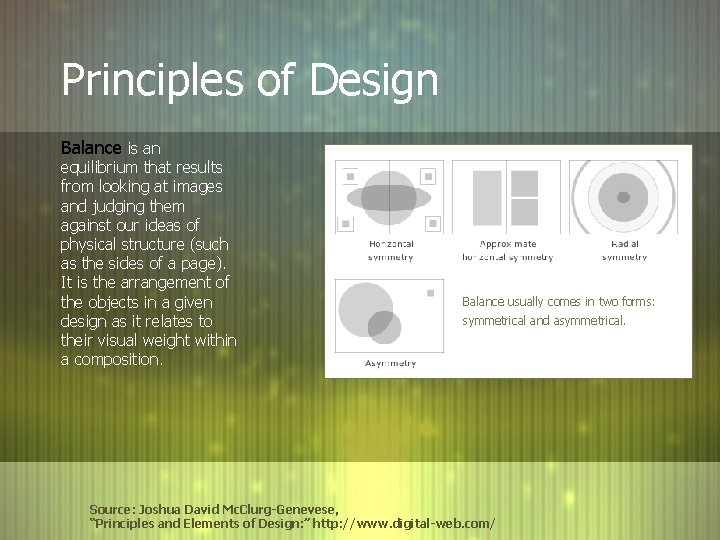
Principles of Design Balance is an equilibrium that results from looking at images and judging them against our ideas of physical structure (such as the sides of a page). It is the arrangement of the objects in a given design as it relates to their visual weight within a composition. Balance usually comes in two forms: symmetrical and asymmetrical. Source: Joshua David Mc. Clurg-Genevese, “Principles and Elements of Design: ” http: //www. digital-web. com/
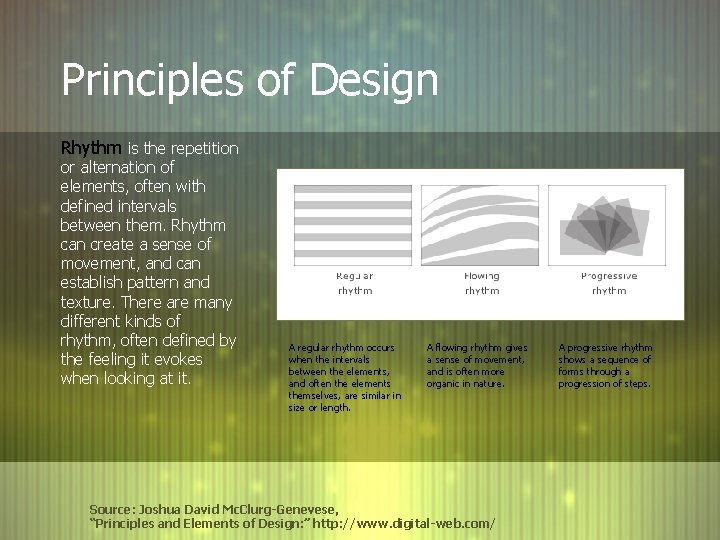
Principles of Design Rhythm is the repetition or alternation of elements, often with defined intervals between them. Rhythm can create a sense of movement, and can establish pattern and texture. There are many different kinds of rhythm, often defined by the feeling it evokes when looking at it. A regular rhythm occurs when the intervals between the elements, and often the elements themselves, are similar in size or length. A flowing rhythm gives a sense of movement, and is often more organic in nature. Source: Joshua David Mc. Clurg-Genevese, “Principles and Elements of Design: ” http: //www. digital-web. com/ A progressive rhythm shows a sequence of forms through a progression of steps.
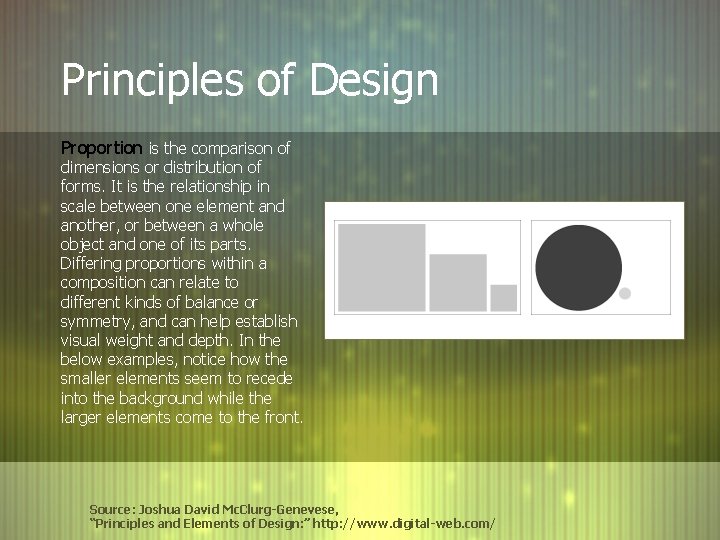
Principles of Design Proportion is the comparison of dimensions or distribution of forms. It is the relationship in scale between one element and another, or between a whole object and one of its parts. Differing proportions within a composition can relate to different kinds of balance or symmetry, and can help establish visual weight and depth. In the below examples, notice how the smaller elements seem to recede into the background while the larger elements come to the front. Source: Joshua David Mc. Clurg-Genevese, “Principles and Elements of Design: ” http: //www. digital-web. com/

Principles of Design Dominance relates to varying degrees of emphasis in design. It determines the visual weight of a composition, establishes space and perspective, and often resolves where the eye goes first when looking at a design. There are three stages of dominance, each relating to the weight of a particular object within a composition. Subordinate: The object given the least visual weight, the element of tertiary emphasis that recedes to the background of the composition. Sub-dominant: The element of secondary emphasis, the elements in the middle ground of the composition. Dominant: The object given the most visual weight, the element of primary emphasis that advances to the foreground in the composition. Source: Joshua David Mc. Clurg-Genevese, “Principles and Elements of Design: ” http: //www. digital-web. com/
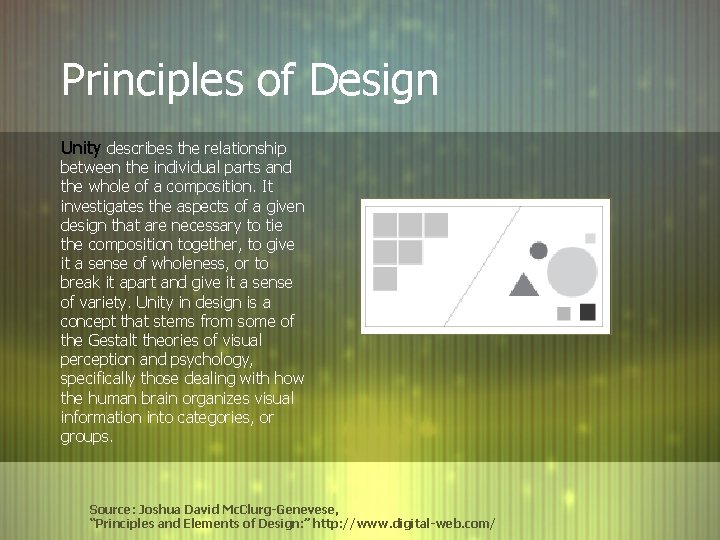
Principles of Design Unity describes the relationship between the individual parts and the whole of a composition. It investigates the aspects of a given design that are necessary to tie the composition together, to give it a sense of wholeness, or to break it apart and give it a sense of variety. Unity in design is a concept that stems from some of the Gestalt theories of visual perception and psychology, specifically those dealing with how the human brain organizes visual information into categories, or groups. Source: Joshua David Mc. Clurg-Genevese, “Principles and Elements of Design: ” http: //www. digital-web. com/
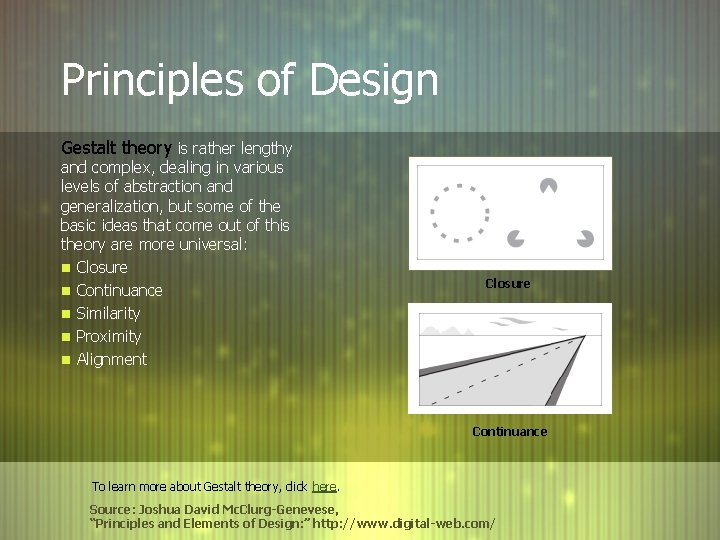
Principles of Design Gestalt theory is rather lengthy and complex, dealing in various levels of abstraction and generalization, but some of the basic ideas that come out of this theory are more universal: n Closure n Continuance n Similarity n Proximity n Alignment Closure Continuance To learn more about Gestalt theory, click here. Source: Joshua David Mc. Clurg-Genevese, “Principles and Elements of Design: ” http: //www. digital-web. com/
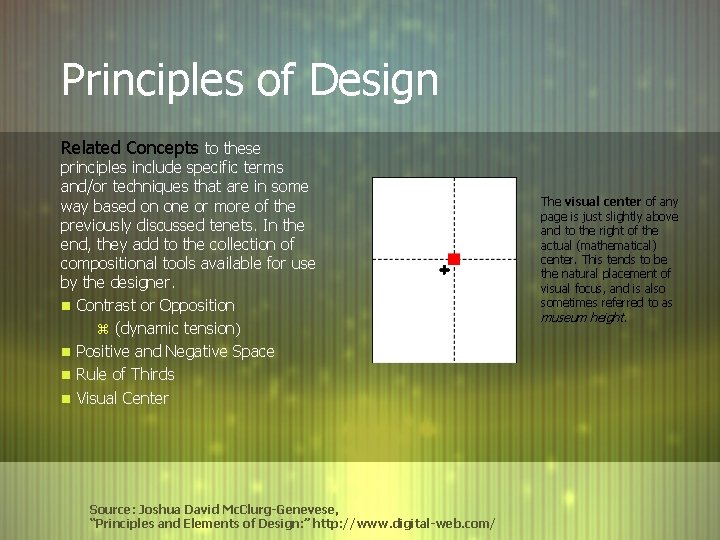
Principles of Design Related Concepts to these principles include specific terms and/or techniques that are in some way based on one or more of the previously discussed tenets. In the end, they add to the collection of compositional tools available for use by the designer. n Contrast or Opposition z (dynamic tension) n Positive and Negative Space n Rule of Thirds n Visual Center Source: Joshua David Mc. Clurg-Genevese, “Principles and Elements of Design: ” http: //www. digital-web. com/ The visual center of any page is just slightly above and to the right of the actual (mathematical) center. This tends to be the natural placement of visual focus, and is also sometimes referred to as museum height.
Elements of Design Line z The Graphic Unifier. Curved, Straight, Directional Thrust: Horizontal, Vertical, Diagonal Shape z Natural, Geometric. Positive and Negative. (The Golden Mean) Space / Size z Large, Medium, Small. Proportion or Scale. (The Golden Mean) Value z Light, Dark. (Value Patterns) Color z Hue, Chorma, and Value. Texture z Rough, Smooth, Soft, Hard. Typograpghy z Principle or element? Source: Joshua David Mc. Clurg-Genevese, “Principles and Elements of Design: ” http: //www. digital-web. com/
Elements of Design Composition is an arrangement of all the elements, which achieves a unified whole. But alas, it is merely a tool to create form and content. Content relates to human emotion and the intellect and is the end result of the reasons for painting. Design is a means to that end. Attributes are defined as the qualities that the art or design conveys to the observer. n Emotional: Active, Passive n Esthetic: Realistic, Impressionistic, Abstract, Decorative, Grunge n Spatial: Depth, Flat Source: Joshua David Mc. Clurg-Genevese, “Principles and Elements of Design: ” http: //www. digital-web. com/
- Slides: 10