
Principles of Design Cornell notes You will be
Principles of Design Cornell notes
You will be using your “Principles of Design” worksheet to take notes from this presentation. YOU MUST USE COLOR PENCILS or color gel pens for these notes.
3 With each Principle of Design you will change the color pencil, gel pens, or font (if typing) being used for the notes! You do not have to use the same color in this presentation. DO USE YELLOW, but what ever color use for each Principle all notes for that Principle must be done in the color you chose. Mind. Map map notes are taken in the same way with colors and images. What you are doing today connects Mind. Map with Cornell notes.
BALANCE Select a color pencil or gel pen to take your notes. May be any color except yellow. If typing on a computer select a color for your font.
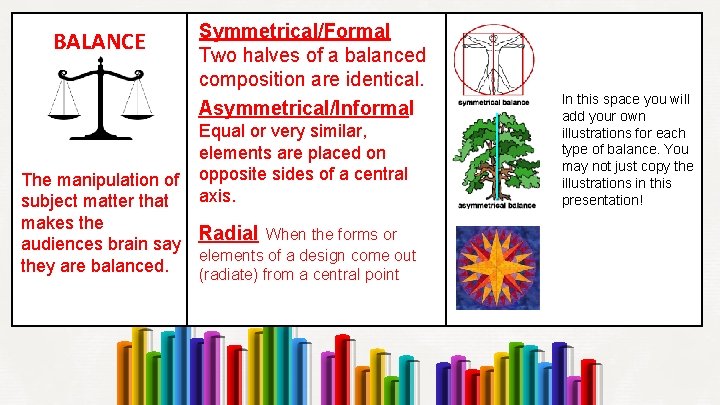
BALANCE Symmetrical/Formal Two halves of a balanced composition are identical. Asymmetrical/Informal Equal or very similar, elements are placed on opposite sides of a central axis. The manipulation of subject matter that makes the Radial When the forms or audiences brain say elements of a design come out they are balanced. (radiate) from a central point In this space you will add your own illustrations for each type of balance. You may not just copy the illustrations in this presentation!
EMPHASIS Select a new color to take your notes. May be any color except yellow or a color already used for this worksheet.
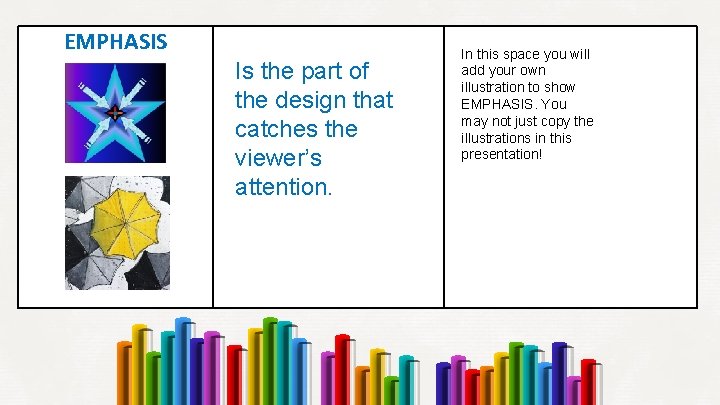
EMPHASIS Is the part of the design that catches the viewer’s attention. In this space you will add your own illustration to show EMPHASIS. You may not just copy the illustrations in this presentation!
MOVEMENT Select a new color to take your notes. May be any color except yellow or a color already used for this worksheet.
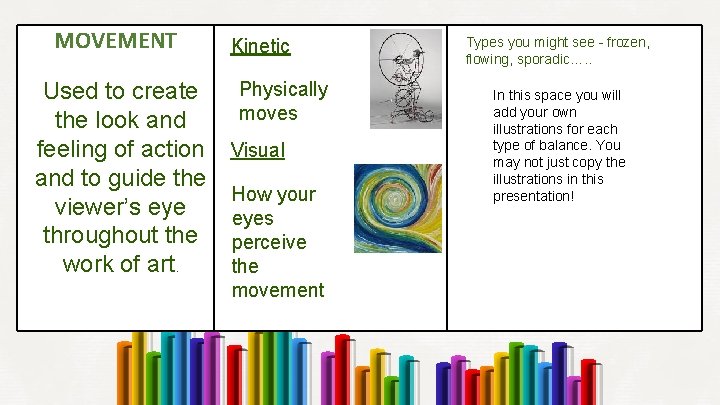
MOVEMENT Kinetic Physically Used to create moves the look and feeling of action Visual and to guide the How your viewer’s eyes throughout the perceive work of art. the movement Types you might see - frozen, flowing, sporadic…. . In this space you will add your own illustrations for each type of balance. You may not just copy the illustrations in this presentation!
PATTERN Select a new color to take your notes. May be any color except yellow or a color already used for this worksheet.
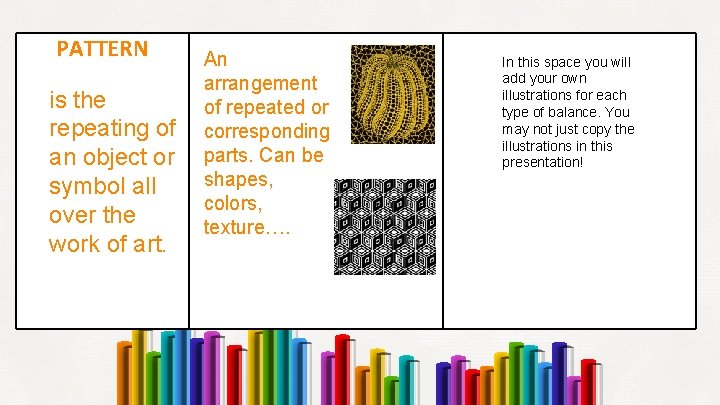
PATTERN is the repeating of an object or symbol all over the work of art. An arrangement of repeated or corresponding parts. Can be shapes, colors, texture…. In this space you will add your own illustrations for each type of balance. You may not just copy the illustrations in this presentation!
REPETITION Select a new color to take your notes. May be any color except yellow or a color already used for this worksheet.
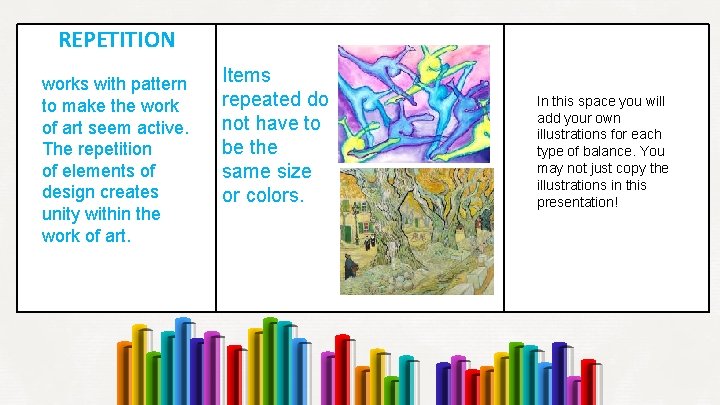
REPETITION works with pattern to make the work of art seem active. The repetition of elements of design creates unity within the work of art. Items repeated do not have to be the same size or colors. In this space you will add your own illustrations for each type of balance. You may not just copy the illustrations in this presentation!
PROPORTION Select a new color to take your notes. May be any color except yellow or a color already used for this worksheet.
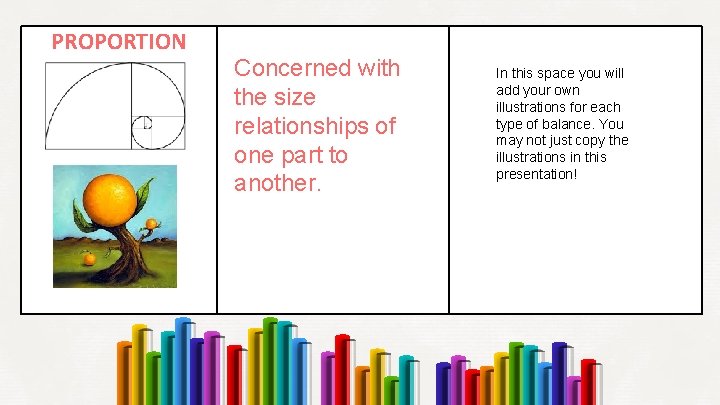
PROPORTION Concerned with the size relationships of one part to another. In this space you will add your own illustrations for each type of balance. You may not just copy the illustrations in this presentation!
RHYTHM Select a new color to take your notes. May be any color except yellow or a color already used for this worksheet.
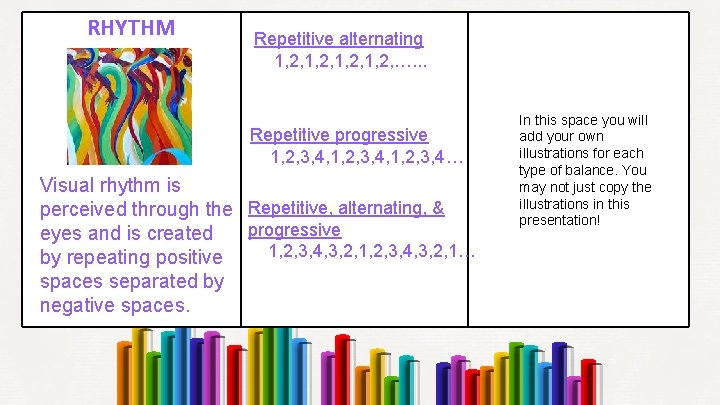
RHYTHM Repetitive alternating 1, 2, …. . . Repetitive progressive 1, 2, 3, 4, 1, 2, 3, 4… Visual rhythm is perceived through the Repetitive, alternating, & progressive eyes and is created 1, 2, 3, 4, 3, 2, 1… by repeating positive spaces separated by negative spaces. In this space you will add your own illustrations for each type of balance. You may not just copy the illustrations in this presentation!
VARIETY Select a new color to take your notes. May be any color except yellow or a color already used for this worksheet.
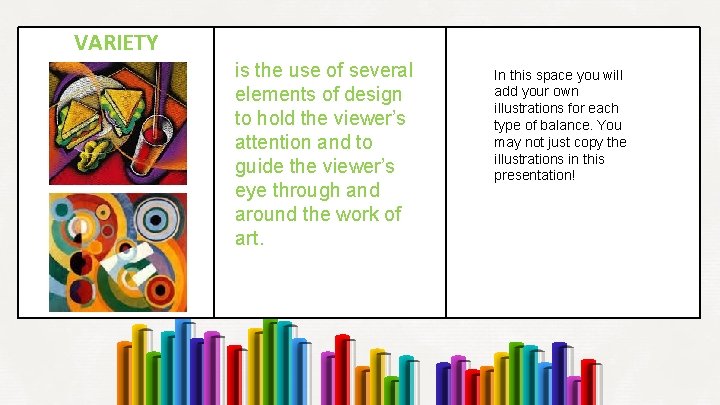
VARIETY is the use of several elements of design to hold the viewer’s attention and to guide the viewer’s eye through and around the work of art. In this space you will add your own illustrations for each type of balance. You may not just copy the illustrations in this presentation!
UNITY Select a new color to take your notes. May be any color except yellow or a color already used for this worksheet.
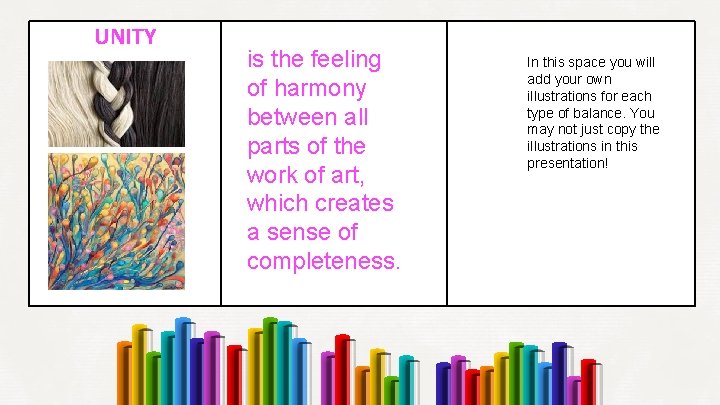
UNITY is the feeling of harmony between all parts of the work of art, which creates a sense of completeness. In this space you will add your own illustrations for each type of balance. You may not just copy the illustrations in this presentation!
22 You have now finished your written part of the Cornell notes. Now you need to add your own illustrations to help you remember the notes. When finished, turn in your paper or upload your work into Focus for grading!
- Slides: 22