
Principles of Democracy ESSENTIAL QUESTION WHAT INSTITUTIONS HELP
- Slides: 13
Principles of Democracy ESSENTIAL QUESTION: WHAT INSTITUTIONS HELP MEET THE PRINCIPLES OF DEMOCRACY?
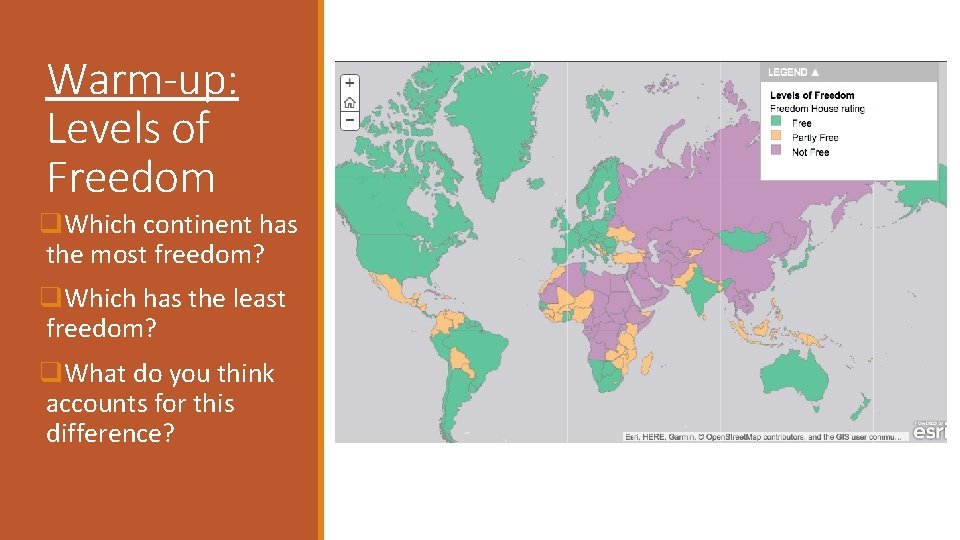
Warm-up: Levels of Freedom q. Which continent has the most freedom? q. Which has the least freedom? q. What do you think accounts for this difference?
What is a Principle? § A principle is a fundamental truth that serves as a foundation for a system of belief, behavior, or reasoning. § An institution is a practice or organization that is put in place to act on an idea. §Many countries claim to be democrativ but have government institutions that do not meet the principles of democracy. §There are 14 in total and no democracy is truly perfect.
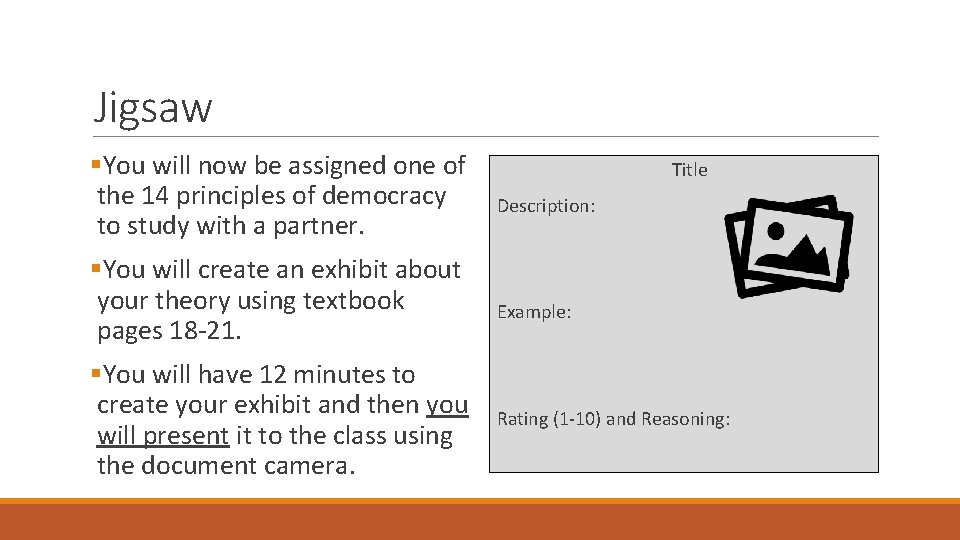
Jigsaw §You will now be assigned one of the 14 principles of democracy to study with a partner. §You will create an exhibit about your theory using textbook pages 18 -21. §You will have 12 minutes to create your exhibit and then you will present it to the class using the document camera. Title Description: Example: Rating (1 -10) and Reasoning:
Principles of Democracy 1. CITIZEN PARTICIPATION 2. FREE AND FAIR ELECTIONS §Participation can take many forms including ldebating issues, voting, attending community meetings, serving in the military, or serving on a jury. §One of the most well-known ways citizens express their will is electing representatives. §Being a citizen is a duty of all people because it helps democracy stay true its intentions. §Elections must be held regularly. §Elections must be fair by allowing all people to vote and all votes to count equily.
Principles of Democracy 3. ACCEPTING ELECTION RESULTS 4. RULE OF LAW §There are winners and loser in §In a democracy no one can be an election and both must accept above the law not even an elected leader or a king. the results with grace. §The losing party must hand over §Everyone must obey the law and power peafully or democracy will be punished consistently for violations. fail.
Principles of Democracy 5. MAJORITY RULE WITH MINORITY RIGHTS 6. TRANSPARENCY §Decisions are made according to §This means keeping the public what the majority wants, but informed of all actions. must be tolerant of others. §Often this means holding public meetings and publishing minutes §Those in a racial, ethnic, religious, or other minority group for those who can't be there. must still be allowed to influence §The press also must be allowed government. to investigate and speak freely.
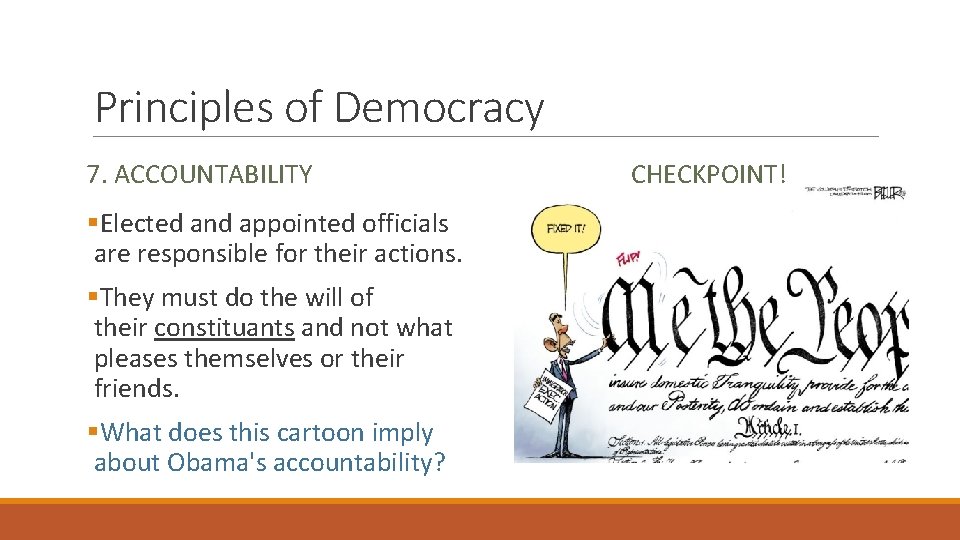
Principles of Democracy 7. ACCOUNTABILITY §Elected and appointed officials are responsible for their actions. §They must do the will of their constituants and not what pleases themselves or their friends. §What does this cartoon imply about Obama's accountability? CHECKPOINT!
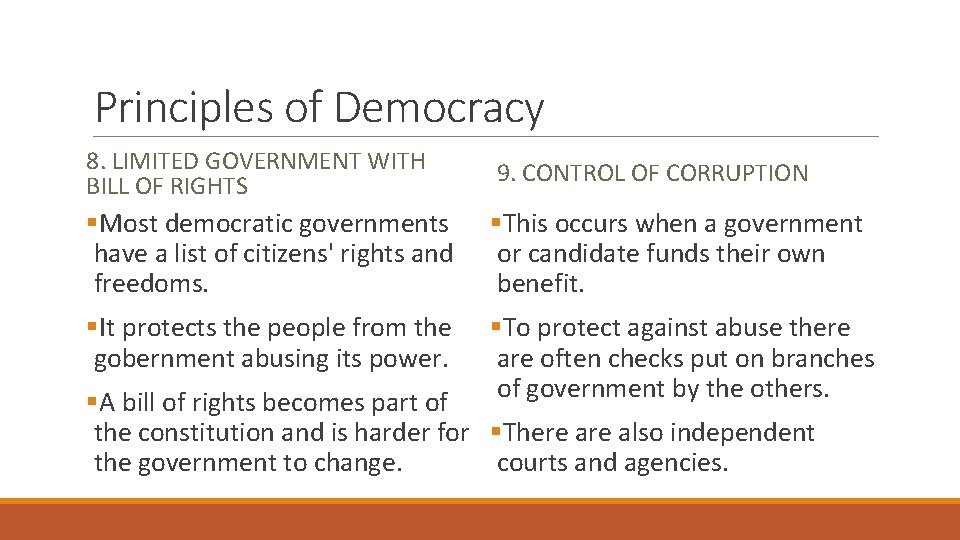
Principles of Democracy 8. LIMITED GOVERNMENT WITH BILL OF RIGHTS 9. CONTROL OF CORRUPTION §Most democratic governments have a list of citizens' rights and freedoms. §This occurs when a government or candidate funds their own benefit. §It protects the people from the gobernment abusing its power. §To protect against abuse there are often checks put on branches of government by the others. §A bill of rights becomes part of the constitution and is harder for §There also independent the government to change. courts and agencies.
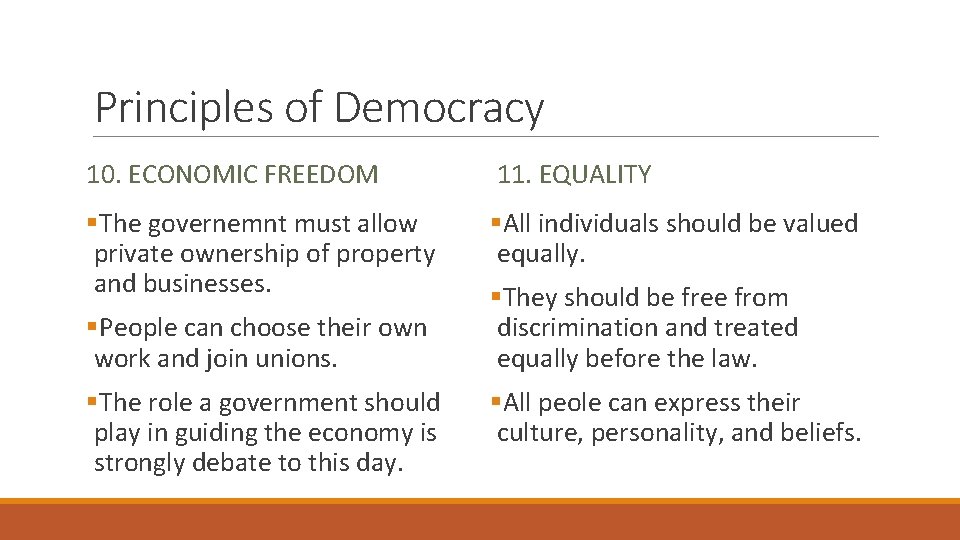
Principles of Democracy 10. ECONOMIC FREEDOM 11. EQUALITY §The governemnt must allow private ownership of property and businesses. §All individuals should be valued equally. §People can choose their own work and join unions. §The role a government should play in guiding the economy is strongly debate to this day. §They should be free from discrimination and treated equally before the law. §All peole can express their culture, personality, and beliefs.
Principles of Democracy 8. LIMITED GOVERNMENT WITH BILL OF RIGHTS 9. CONTROL OF CORRUPTION §Most democratic governments have a list of citizens' rights and freedoms. §This occurs when a government or candidate funds their own benefit. §It protects the people from the gobernment abusing its power. §To protect against abuse there are often checks put on branches of government by the others. §A bill of rights becomes part of the constitution and is harder for §There also independent the government to change. courts and agencies.
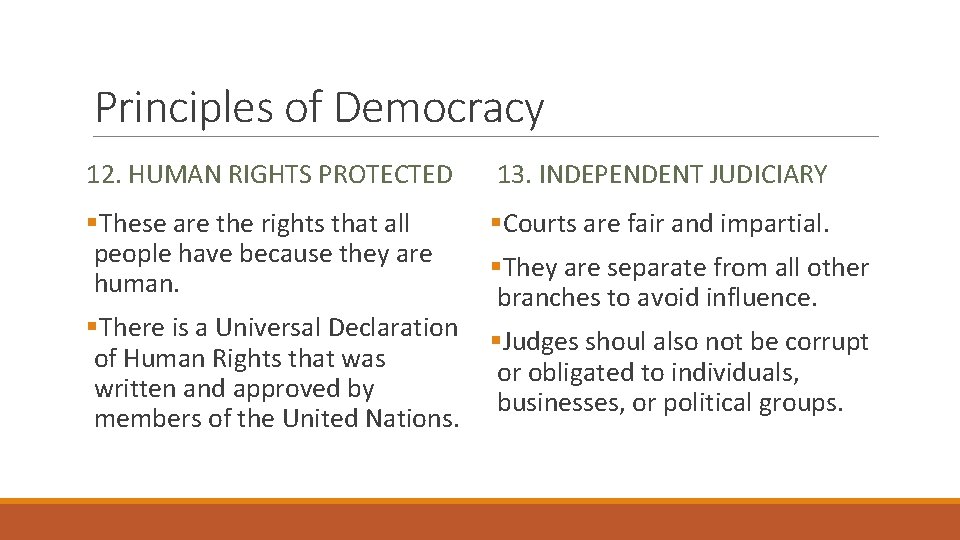
Principles of Democracy 12. HUMAN RIGHTS PROTECTED 13. INDEPENDENT JUDICIARY §These are the rights that all people have because they are human. §Courts are fair and impartial. §They are separate from all other branches to avoid influence. §There is a Universal Declaration §Judges shoul also not be corrupt of Human Rights that was or obligated to individuals, written and approved by businesses, or political groups. members of the United Nations.
Principles of Democracy 14. COMPETING POLITICAL PARTIES §Most democratic governments have a list of citizens' rights and freedoms. §It protects the people from the gobernment abusing its power. LEARNING CHECK! §Choose one principle of Democracy that you think is the least important and explain why. §Create questions to accompany §A bill of rights becomes part of your Cornell notes for this section. the constitution and is harder for the government to change.