
Principles of Containment 1 2008 University of Wollongong

- Slides: 69
Principles of Containment 封闭原则 1. © 2008 University of Wollongong and BP International Limited W 505 – Control of Hazardous Substances
Definition 定义 The terms “containment”, “isolation” and “segregation” are often used interchangeably to describe the equipment, systems or procedures which are employed to prevent or reduce exposure to hazardous substances 术语“封闭”、“隔绝”和“隔离”常被交叉使用,描述用 于预防或减少暴露于有害物质的设备、系统或 序。 2. © 2008 University of Wollongong and BP International Limited W 505 – Control of Hazardous Substances
Containment 封闭 Describes any control measure which reduces exposure by using a barrier to prevent the escape of materials hazardous to health into the surrounding workplace 用来描述任何可减少暴露的控制措施。该措施通过使用一 个屏障来防止有害物质扩散到周围的 作场所。 3. © 2008 University of Wollongong and BP International Limited W 505 – Control of Hazardous Substances
Containment as a Process Control 用作 序控制的封闭 Containment may also be used as a process control 封闭也可用作 序控制 Containment can be used to prevent contamination or degradation of compounds by the environment: 封闭可用于防止环境污染或化合物降解。 eg: during electronic components or pharmaceuticals manufacture where a controlled manufacturing environment is required 例如:电子元件厂或制药厂就要求一个可控的生产环境。 4. © 2008 University of Wollongong and BP International Limited W 505 – Control of Hazardous Substances
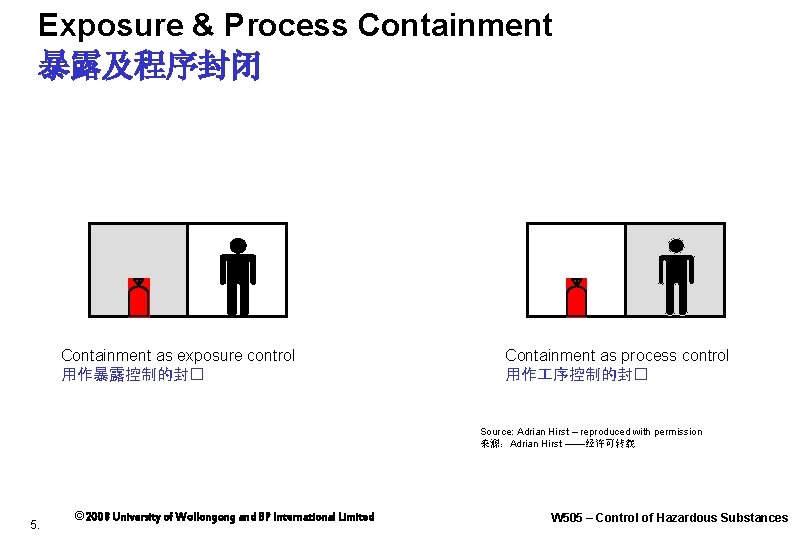
Exposure & Process Containment 暴露及程序封闭 Containment as exposure control 用作暴露控制的封� Containment as process control 用作 序控制的封� Source: Adrian Hirst – reproduced with permission 来源:Adrian Hirst ——经许可转载 5. © 2008 University of Wollongong and BP International Limited W 505 – Control of Hazardous Substances
Design Considerations 设计应考虑的事项 When designing or assessing containment it is important to take into account the process control as well as the exposure control as in some instances the two aims may contradict each other 在设计或评估封闭时,应同时考虑到 序控制和暴露控制。这是因为在有些情况 下两者可能互相冲突。 For example where clean room technology is used, containment is augmented by ventilation to achieve pressure differentials. These pressure differentials may be used to contain either the substance or the environment but not both 例如,使用清洁空间技术时,利用通风增加封闭,从而实现压力差。该压力差可 以用来要么控制物质,要么控制环境,而不是同时作用于两者。 6. © 2008 University of Wollongong and BP International Limited W 505 – Control of Hazardous Substances
Use Of Containment 封闭的使用 Containment is used in manufacturing industries, particularly those handling and producing chemicals 制造业通常要采用封闭,特别当处理和生产化学品时。 Examples include chemical manufacture, agrochemicals, pharmaceuticals, petrochemical industry 这方面的例子包括化学品制造业、农用化学品制造业、药 品制造业和石化业。 7. © 2008 University of Wollongong and BP International Limited W 505 – Control of Hazardous Substances
Use Of Containment (cont) 封闭的使用(续) Containment tends to be used as a control measure to reduce the level of risk from the following hazards: 封闭一般作为一种控制措施,用于降低下列危害发生的风险等级: • Flammability 易燃性 • Explosivity 爆炸性 • Toxicity 毒性 8. © 2008 University of Wollongong and BP International Limited W 505 – Control of Hazardous Substances
Primary and Secondary Containment 一级和二级封闭 • Primary containment may be defined as the first level of containment, that is, the inside portion of the container that comes into immediate contact on its inner surface with the material being contained 一级封闭可定义为一层封闭,即,直接与所装物质接触的内部表面。 • Secondary containment is a control measure to prevent unplanned releases of toxic or hazardous compounds into uncontrolled work areas. As such this is a level of containment that is external to and separate from primary containment 二级封闭是指一个控制措施。用来防止有毒或危险化合物意外释放到没有控制的 作区。与一级封闭相比,它是在一级封闭外部采取的独立于一级封闭的封闭措 施。 9. © 2008 University of Wollongong and BP International Limited W 505 – Control of Hazardous Substances
Examples of Primary & Secondary Containment 一级和二级封闭范例 • At a simple level an example of primary containment is the use of an intermediate bulk container (IBC) or sealed drum to contain a liquid, whilst secondary containment is use of a bund or drip tray to capture any releases from the drums or IBC 一个简单的一级封闭例子是,采用一个中型散装容器(IBC )或封闭的鼓形圆桶来盛装一种液体。而二级封闭则是采 用一个底盘或防漏盆来收集任何可能从圆桶或集装箱中溢 出的液体。 10. © 2008 University of Wollongong and BP International Limited W 505 – Control of Hazardous Substances
Integration of Containment with other Control Measures 封闭和其它控制措施的整合 • All control measures need to integrate with each other so they work in an additive or synergistic way rather than an antagonistic one 所有控制措施都需要相互整合,以便他们能以一个互补或 增效的、而非冲突的方式 作。 • This is particularly important with regards to containment solutions 这对于封闭解决方案来说尤其重要。 11. © 2008 University of Wollongong and BP International Limited W 505 – Control of Hazardous Substances
Integration of Containment with other Control Measures (cont) 封闭和其它控制措施的整合(续) • Containment is often designed to incorporate ventilation as a control measure 通常,封闭设计与通风相结合,作为一种控制措施。 • It is essential that the containment designers have a good working knowledge of general and local exhaust ventilation in order to combine the two 对封闭设计者来说,应掌握全面和局部排气通风的应用知识,以便有效地将两者 结合起来,这是非常重要的。 • Similarly, operation of containment controls will require a significant amount of administrative control in terms of working practices, information, instruction & training 相应的,封闭控制操作对管理控制提出了非常高的要求,主要包括 作经验、信 息、指导和培训几方面。 12. © 2008 University of Wollongong and BP International Limited W 505 – Control of Hazardous Substances
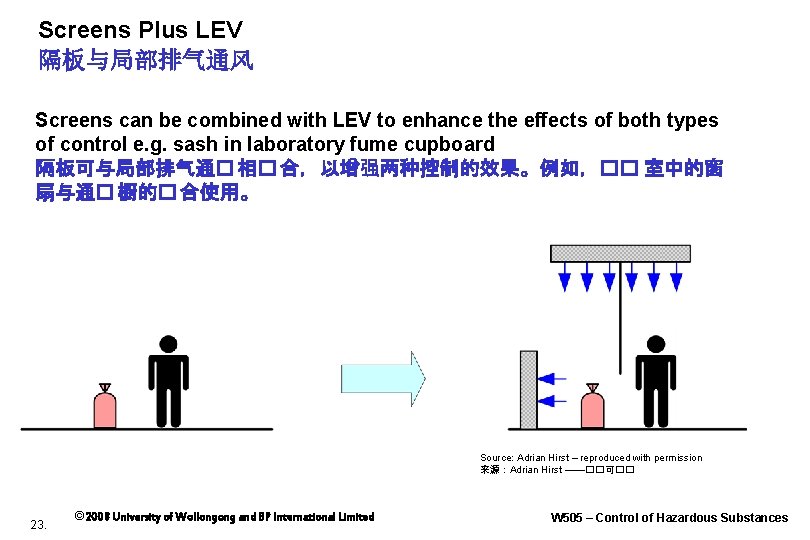
Types of Containment Devices 封闭装置的类型 • Barrier devices: This is where one or more barriers are placed between operator and exposure source 屏障设备:置于操作员和暴露源之间的一个或几个屏障 – mixing of chemicals is carried out within a sealed vessel 化学品的混合是在一个封闭的容器中进行的。 • Combined barrier-LEV devices: This is where the use of barriers/enclosures is combined with LEV controls 组合屏障-局部排气通风装置:交叉使用屏障/闭合罩与局部排气通风 控制装置 – a laboratory fume cupboard with an adjustable sash height 实验室通风橱和可调节高度的窗扇的组合。 13. © 2008 University of Wollongong and BP International Limited W 505 – Control of Hazardous Substances
Integration of Containment with Process Design 封闭与 艺流程设计相结合 • In many instances it is appropriate to integrate the design of containment with that of the process and as such the containment will influence the design of the process 由于封闭可能影响 艺流程的设计,因此许多情况下综合考虑封闭设计和 艺流 程设计是比较合适的。 • Containment is much more difficult to apply as an add‑on control measure than it is when considered at the start up stage 与事后用作补充的控制措施相比,初始阶段进行封闭更容易。 14. © 2008 University of Wollongong and BP International Limited W 505 – Control of Hazardous Substances
Typical Industrial Processes Requiring Containment 要求封闭的典型 业程序 Example: Manufacture of chemicals 例如:化学品制造 • Weighing/dispensing of solid raw materials 称重/分发固体原材料 • The addition of solid/liquid and /or gaseous reagents to reaction vessels 添加固体/液体和/或气体试剂到反应容器 • The controlled reaction of chemicals with subsequent product and by product generation 化学品的受控反应生成的产物和副产物 15. © 2008 University of Wollongong and BP International Limited W 505 – Control of Hazardous Substances
Example: Manufacture of chemicals (cont) 范例:化学品制造(续) • Purification steps which may involve the addition and removal of material 净化过程中可能涉及物品的添加和去除 • Crystallisation of a solid product 固体产品的结晶 • Separation of products from liquors 产品从溶液中分离 • Drying 干燥 • Removal of the product to containers 去除的产品放入容器中 • Milling and Blending 研磨和混合 16. © 2008 University of Wollongong and BP International Limited W 505 – Control of Hazardous Substances
Transfer Operations Involving Solids 固体转运 • Dispensing operations 分发操作 • Charging of vessels and equipment 给容器或设备装料 • Unloading solid-liquid separation equipment 卸载固-液分开的设备 • Unloading dryers 卸载干燥剂 • Milling and Blending 研磨和混合 • Removal of solid impurities 固体杂质的去除 17. © 2008 University of Wollongong and BP International Limited W 505 – Control of Hazardous Substances
Transfer Operations Involving Liquids 液体转运 • Loading and unloading of road/rail tankers 公路/铁路油槽车装卸 • Drum and semi bulk container transfers 筒式集装箱和半散装集装箱的转运 • Small container transfers 小型集装箱的转运 • Pressurised liquid transfers from cylinders 圆筒中增压液体的转运 • Container filling 容器充注 18. © 2008 University of Wollongong and BP International Limited W 505 – Control of Hazardous Substances
Other Operations 其它操作 • Gaseous transfers 气态物质的转运 • Quality control sampling 质量控制取样 • Process containment 艺流程封闭 • Plant cleaning 厂房清洁 19. © 2008 University of Wollongong and BP International Limited W 505 – Control of Hazardous Substances
Types of Containment Equipment 封闭设备类型 • Simple enclosures & screens 简单的围栅和隔板 • Isolators 隔离物 • Over-bagging 多袋包装 Transfer devices 转运装置 • Coupling devices 联结装置 • Remote handling 遥控 20. © 2008 University of Wollongong and BP International Limited W 505 – Control of Hazardous Substances
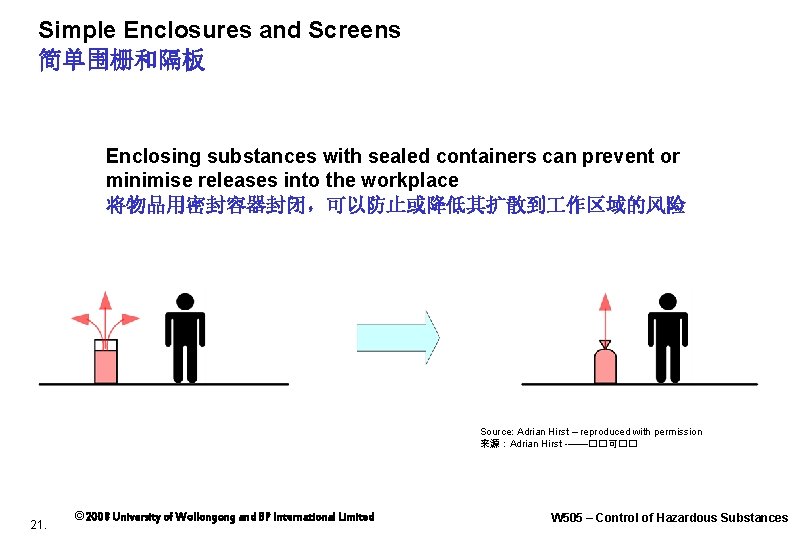
Simple Enclosures and Screens 简单围栅和隔板 Enclosing substances with sealed containers can prevent or minimise releases into the workplace 将物品用密封容器封闭,可以防止或降低其扩散到 作区域的风险 Source: Adrian Hirst – reproduced with permission 来源:Adrian Hirst -——��可�� 21. © 2008 University of Wollongong and BP International Limited W 505 – Control of Hazardous Substances
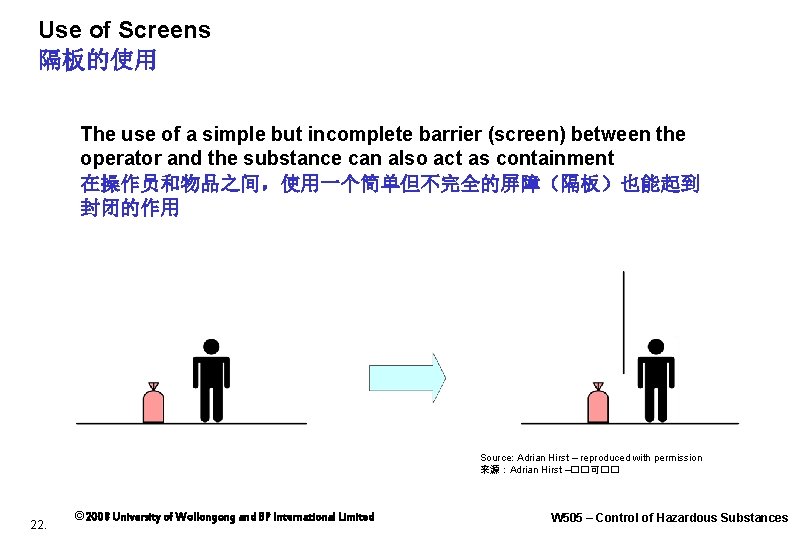
Use of Screens 隔板的使用 The use of a simple but incomplete barrier (screen) between the operator and the substance can also act as containment 在操作员和物品之间,使用一个简单但不完全的屏障(隔板)也能起到 封闭的作用 Source: Adrian Hirst – reproduced with permission 来源:Adrian Hirst –��可�� 22. © 2008 University of Wollongong and BP International Limited W 505 – Control of Hazardous Substances
Screens Plus LEV 隔板与局部排气通风 Screens can be combined with LEV to enhance the effects of both types of control e. g. sash in laboratory fume cupboard 隔板可与局部排气通� 相� 合,以增强两种控制的效果。例如,�� 室中的窗 扇与通� 橱的� 合使用。 Source: Adrian Hirst – reproduced with permission 来源:Adrian Hirst ——��可�� 23. © 2008 University of Wollongong and BP International Limited W 505 – Control of Hazardous Substances
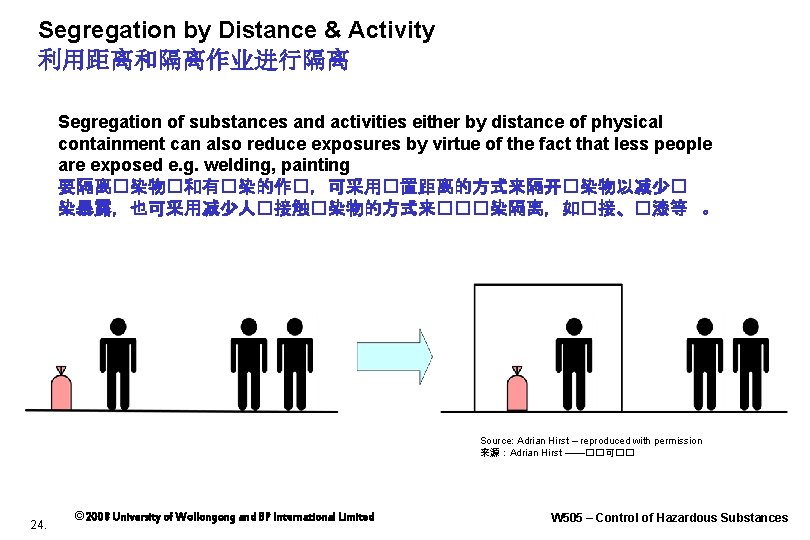
Segregation by Distance & Activity 利用距离和隔离作业进行隔离 Segregation of substances and activities either by distance of physical containment can also reduce exposures by virtue of the fact that less people are exposed e. g. welding, painting 要隔离�染物�和有�染的作�,可采用�置距离的方式来隔开�染物以减少� 染暴露,也可采用减少人�接触�染物的方式来���染隔离,如�接、�漆等 。 Source: Adrian Hirst – reproduced with permission 来源:Adrian Hirst ——��可�� 24. © 2008 University of Wollongong and BP International Limited W 505 – Control of Hazardous Substances
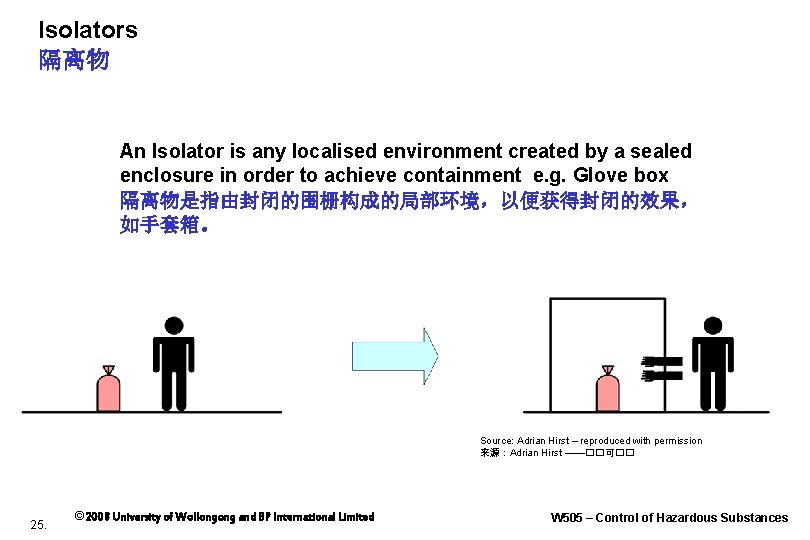
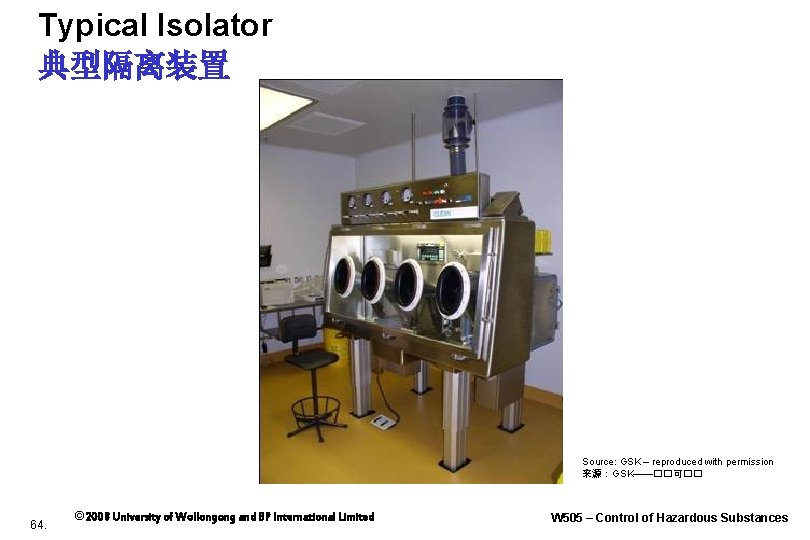
Isolators 隔离物 An Isolator is any localised environment created by a sealed enclosure in order to achieve containment e. g. Glove box 隔离物是指由封闭的围栅构成的局部环境,以便获得封闭的效果, 如手套箱。 Source: Adrian Hirst – reproduced with permission 来源:Adrian Hirst ——��可�� 25. © 2008 University of Wollongong and BP International Limited W 505 – Control of Hazardous Substances
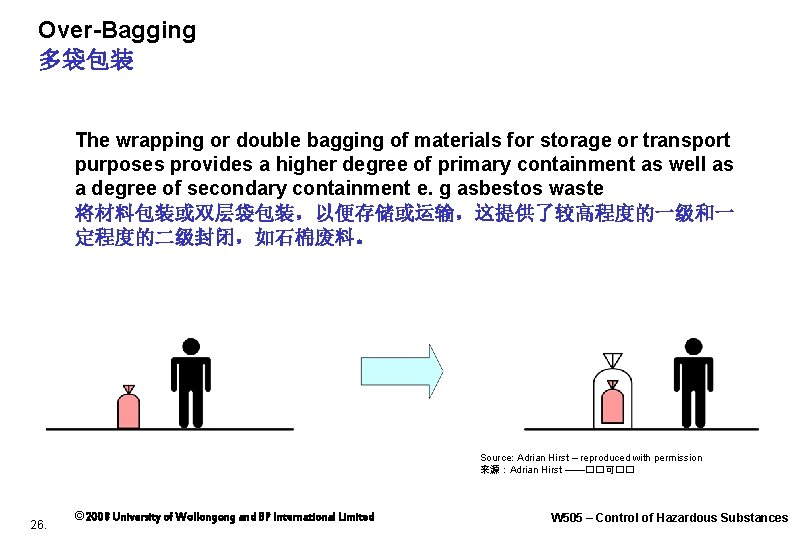
Over-Bagging 多袋包装 The wrapping or double bagging of materials for storage or transport purposes provides a higher degree of primary containment as well as a degree of secondary containment e. g asbestos waste 将材料包装或双层袋包装,以便存储或运输,这提供了较高程度的一级和一 定程度的二级封闭,如石棉废料。 Source: Adrian Hirst – reproduced with permission 来源:Adrian Hirst ——��可�� 26. © 2008 University of Wollongong and BP International Limited W 505 – Control of Hazardous Substances
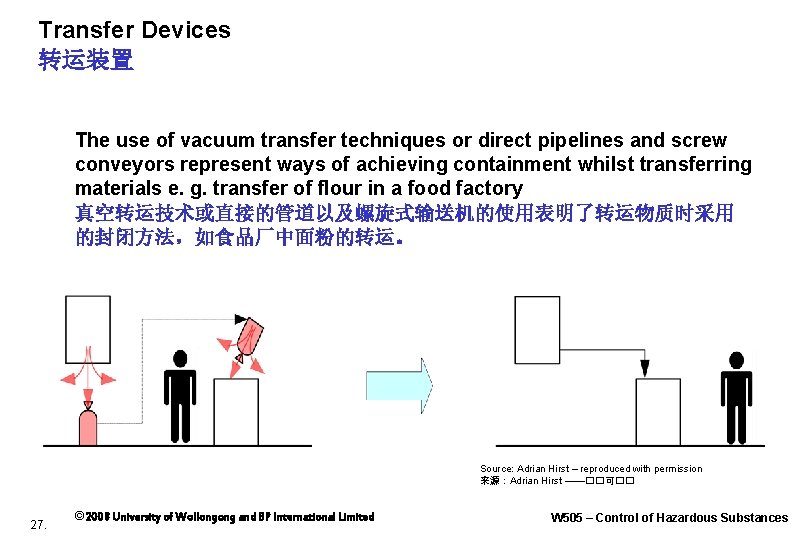
Transfer Devices 转运装置 The use of vacuum transfer techniques or direct pipelines and screw conveyors represent ways of achieving containment whilst transferring materials e. g. transfer of flour in a food factory 真空转运技术或直接的管道以及螺旋式输送机的使用表明了转运物质时采用 的封闭方法,如食品厂中面粉的转运。 Source: Adrian Hirst – reproduced with permission 来源:Adrian Hirst ——��可�� 27. © 2008 University of Wollongong and BP International Limited W 505 – Control of Hazardous Substances
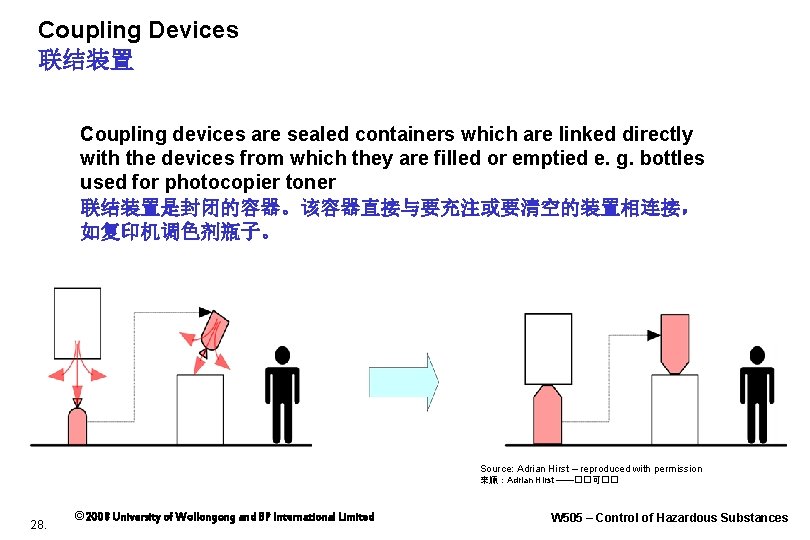
Coupling Devices 联结装置 Coupling devices are sealed containers which are linked directly with the devices from which they are filled or emptied e. g. bottles used for photocopier toner 联结装置是封闭的容器。该容器直接与要充注或要清空的装置相连接, 如复印机调色剂瓶子。 Source: Adrian Hirst – reproduced with permission 来源:Adrian Hirst ——��可�� 28. © 2008 University of Wollongong and BP International Limited W 505 – Control of Hazardous Substances
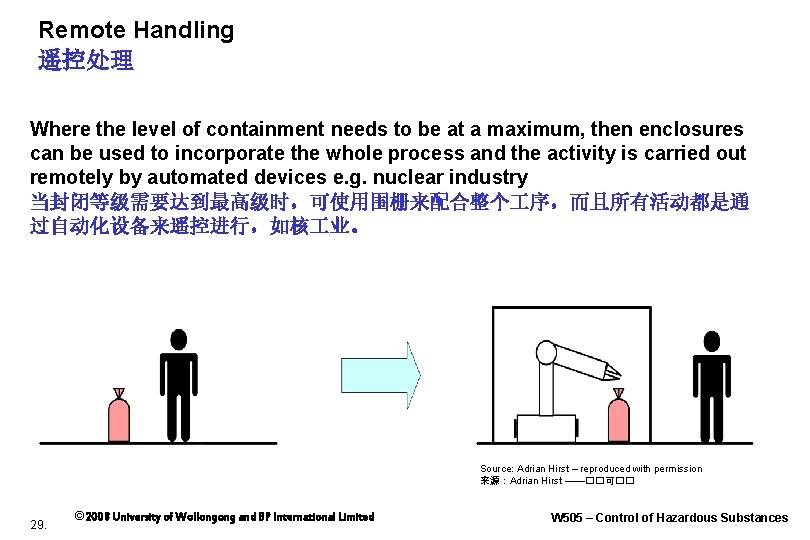
Remote Handling 遥控处理 Where the level of containment needs to be at a maximum, then enclosures can be used to incorporate the whole process and the activity is carried out remotely by automated devices e. g. nuclear industry 当封闭等级需要达到最高级时,可使用围栅来配合整个 序,而且所有活动都是通 过自动化设备来遥控进行,如核 业。 Source: Adrian Hirst – reproduced with permission 来源:Adrian Hirst ——��可�� 29. © 2008 University of Wollongong and BP International Limited W 505 – Control of Hazardous Substances
Design of Containment Systems 封闭系统的设计 • Requires thorough understanding of hazardous substances involved & the processes which they are used 要求深入了解所涉及的危险物质以及采用的 艺流程。 • Use of models, full scale “mock ups” and 3 D imagery allows evaluation of all potential issues e. g. ergonomics 模型的使用,实际规模的“模拟” 以及3 D 模拟都有助于评估所有潜在的问题,如人 类 程学。 • Control banding can be used to determine the level of containment required 控制能力也可用于确定要求封闭的等级。 30. © 2008 University of Wollongong and BP International Limited W 505 – Control of Hazardous Substances
High Level Containment Systems 高级封闭系统 • High levels of containment tend to be used when potent materials are used which have low exposure limits or where larger quantities of more dusty or volatile materials are present 使用低暴露限值的烈性物质,或存在大量尘土或挥发物质的地方,采用高级封闭 • Examples 例如 – Storage of flammable liquids 易燃液体的存贮 – Biological laboratories 生物实验室 – Nuclear industry 核 业 31. © 2008 University of Wollongong and BP International Limited W 505 – Control of Hazardous Substances
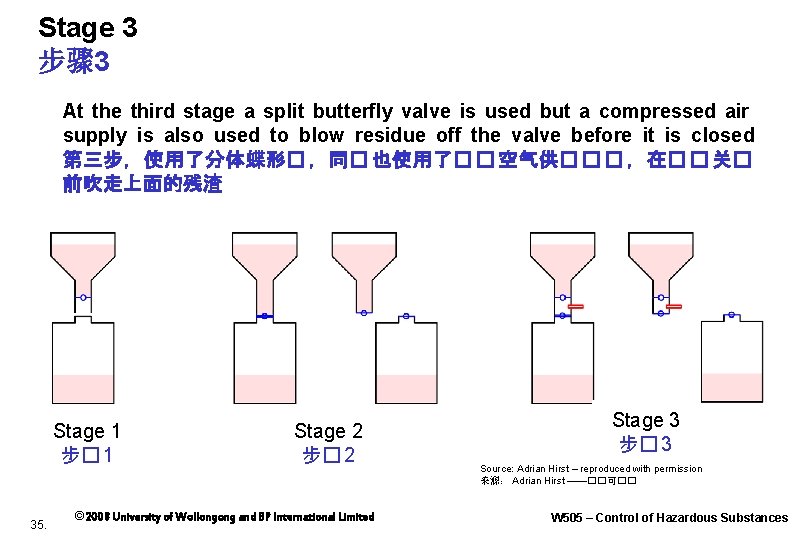
High Level Containment Systems (cont) 高级封闭系统(续) • The level of containment achieved at this level is refined by using increasingly more complex forms of engineering 高级封闭采用更复杂的 程形式实现。 • Example 例如 – three different levels of containment used for shutting off the supply of powder when filling containers by gravity feed 当利用重力自流进料的方式充注容器时,可采用了三种不同级别的封闭来避免 粉尘的产生。 32. © 2008 University of Wollongong and BP International Limited W 505 – Control of Hazardous Substances
Stage 1 步骤 1 • At the first stage a simple butterfly valve cuts off the gravity feed of powder from above 第一步,一个简单的蝶形阀切断了从上部供应的粉末的自流输送 • This prevents mass leakage of the material but leaves the container open some residue at the mouth of the butterfly valve 这将防止大量原料的泄漏,但会使容器打开,在蝶形阀入口处留下 一些残留物 33. © 2008 University of Wollongong and BP International Limited W 505 – Control of Hazardous Substances
Stage 2 步骤 2 • At the second stage the container is physically connected to the dispensing unit and a split butterfly valve is fitted 第二步,容器实际上和分发设备相连,并装有分体蝶形阀 • The split butterfly valve seals both the supply and the container but leaves the possibility that small quantities of material are left at the point where the two valves meet 分体蝶形阀密封了供应装置和容器,但是有可能在两个阀门结合处 留有少量的物质 34. © 2008 University of Wollongong and BP International Limited W 505 – Control of Hazardous Substances
Stage 3 步骤 3 At the third stage a split butterfly valve is used but a compressed air supply is also used to blow residue off the valve before it is closed 第三步,使用了分体蝶形� ,同� 也使用了� � 空气供� � � ,在� � 关� 前吹走上面的残渣 Stage 1 步� 1 35. Stage 2 步� 2 © 2008 University of Wollongong and BP International Limited Stage 3 步� 3 Source: Adrian Hirst – reproduced with permission 来源: Adrian Hirst ——��可�� W 505 – Control of Hazardous Substances
Types of Equipment used in High Level Containment 高级封闭中使用的设备类型 • Isolators 隔离装置 • Clean room technology 无尘室技术 • In process cleaning – washing & cleaning facilities to clean equipment in situ 进程内清洗——清洗设备,以在现场保持设备干净 • In process maintenance – Designs which allow activities such as glove or filter changing on an isolator without having to clean whole apparutus 进程内维护——设计允许进行隔离装置上的手套或过滤器更换等活动时,无需清 洁整个设备 36. © 2008 University of Wollongong and BP International Limited W 505 – Control of Hazardous Substances
Types of Equipment used in High Level Containment (cont) 高级封闭中使用的设备类型(续) • Split butterfly valves 分体蝶形阀 • Docking systems 对接系统 • Pass boxes – antechambers to isolators which allow controlled conditions for materials to enter & exit the isolator 传递箱——隔离装置的前室,满足进出隔离装置的物质的可控条件 37. © 2008 University of Wollongong and BP International Limited W 505 – Control of Hazardous Substances
Other Considerations 其它考虑事项 • Control of Waste and Emissions 废物和排放物控制 – Any materials which are removed from a containment system, whether they are products or waste products have the potential to be contaminated with hazardous materials 任何从封闭系统清除的、可能受有害物质污染的物质,无论是产物还是废物 – Any form of containment will therefore require appropriate consideration to be given to the treatment of materials as they are removed from it 任何形式的封闭系统都要求对清除出去的物质进行适当的处理 38. © 2008 University of Wollongong and BP International Limited W 505 – Control of Hazardous Substances
Wastes from Containment Systems 封闭系统产生的废物 • Empty sacks, drums and liners etc will contain traces of the materials which were held within them 空袋子、筒和管衬等都保留它们所装物质的痕迹 • The handling of these materials can give rise to significant exposures e. g. : the rolling of an empty sack for disposal 处理这些物质会严重暴露在危险环境中, 比如:碾压空袋 子进行处理 39. © 2008 University of Wollongong and BP International Limited W 505 – Control of Hazardous Substances
Containment of Filter Elements & Media 滤芯和过滤介质的密封 • It will be necessary to change consumable items such as filter media which will then need to be disposed of 有必要改变使用后需要处置的耗材,比如:过滤介质 • This can result in exposure as well as a temporary failure of the containment system 这将导致暴露和封闭系统的临时故障 40. © 2008 University of Wollongong and BP International Limited W 505 – Control of Hazardous Substances
Contaminated Clothing 受污染的衣物 • Clothing and other forms of PPE/RPE may be contaminated and will require specific controls in order to ensure their safe handling, cleaning and/or disposal 衣物和其它形式的个人防护设备/呼吸器可能受污染,因而 需要特别控制以确保安全处理、清洗和/或处置 41. © 2008 University of Wollongong and BP International Limited W 505 – Control of Hazardous Substances
Exhaust Gases Containing Hazardous Vapours or Particulates 含有害蒸汽或颗粒的废气 • These may be generated by the process or induced as part of the containment equipment 这些气体可能是 艺流程产生的或部分封闭设备产生的 • The subsequent cleaning and discharge of the gases will need to be considered 需要考虑气体的后续清洁和排放 • Where high levels of containment are needed then the level of filtration will need to be high – e. g. use of HEPA filtration on isolators in the pharmaceutical industry 如果要求高级封闭,则过滤标准也应相应提高——比如,在制药业 中使用隔离物上的HEPA过滤结构 42. © 2008 University of Wollongong and BP International Limited W 505 – Control of Hazardous Substances
Contaminated Drainage & Cleaning Liquids 受污染的排水系统和清洗液 • Liquids will invariably need to be used for cleaning purposes 液体总是需要用于清洁目的 • These pose very different considerations when it comes to potential exposure and eventual disposal 有关潜在的暴露和最终处置, 提出了完全不同的注意事项 43. © 2008 University of Wollongong and BP International Limited W 505 – Control of Hazardous Substances
Explosion Prevention and Control 爆炸防控 • The build up of high concentrations of dust, flammable gases and vapours can give rise to the potential of explosion 灰尘、可燃气体和蒸汽的高度集中可能会导致爆炸 • The act of containment means that substances are held in a smaller space which in turn means the localised concentrations are higher 封闭行为指物质存放在较小的空间,反过来,即:局域浓度会较高 • This means that introducing the concept of containment can increase the likelihood as well as severity of explosion 这就意味着封闭概念的引入可能增加爆炸的可能性和严重性 44. © 2008 University of Wollongong and BP International Limited W 505 – Control of Hazardous Substances
Explosion Prevention and Control (cont) 爆炸防控(续) • The design of any containment system which involves potentially explosive atmospheres should incorporate design features which prevent the occurrence of an explosion as well as mitigate the effects in the event of one taking place 与潜在爆炸环境相关的任何封闭系统的设计应具有以下特 点:防止爆炸的发生并,在万一发生爆炸时缓解其后果 45. © 2008 University of Wollongong and BP International Limited W 505 – Control of Hazardous Substances
Explosion Prevention 防止爆炸 This may be achieved using a variety of techniques such as: 这可能通过系列技术来实现: • The elimination of ignition sources: electrical sources, heat, static electricity etc. 消除引火源:电源、热量、静电等 • The prevention of explosive concentrations 防止爆炸物的集中 46. © 2008 University of Wollongong and BP International Limited W 505 – Control of Hazardous Substances
Mitigation Measures 缓和措施 • Explosion suppression – the use of sensors and fire extinguishants to react quickly and put out explosions as they start 抑制爆炸——使用传感器和灭火器在爆炸开始时将其快速扑灭 • Compartmentalisation – the division of a containment into smaller units to prevent the spread of an explosion to other parts of the system 划分小单元——将污染物分为几个较小的单元以防止一种爆炸扩散 到系统的其它部分 47. © 2008 University of Wollongong and BP International Limited W 505 – Control of Hazardous Substances
Operation and Maintenance of Containment Devices 封闭设备的操作和维护 • As with all forms of exposure control the correct operation and maintenance of containment devices is essential if they are to be effective 和所有形式的暴露控制一样,如果能产生效力,封闭设备 的正确操作和维护也是非常必要的 – Information, instruction and training on correct use of device - Operating procedures. 有关正确使用设备的资料、说明和培训——作业程序 48. © 2008 University of Wollongong and BP International Limited W 505 – Control of Hazardous Substances
Operation and Maintenance of Containment Devices (cont) 封闭设备的操作和维护(续) – Regular checks and thorough examination. In the UK the COSHH regulations require that all forms of control measure are inspected and tested on a regular basis 定期检查和彻底检验。在英国,健康危害物质控制法规要求所有控制措施都需 定期检验和测试 – The maintenance and repair of containment devices may present greater potential for exposure than their actual use. The cleaning of devices and activities such as changing consumable parts should be considered at the design stage as much as the normal operation of the devices 封闭设备的维护和维修可能产生比其实际使用更大的。设备的清洁和更换消耗 性零件等行为应在设计阶段给予和设备正常运行时同样的考虑。 49. © 2008 University of Wollongong and BP International Limited W 505 – Control of Hazardous Substances
Limitations of Containment Systems 封闭系统的局限性 • Containment systems have inherent weaknesses which stem from the nature of their design 封闭系统有其内在的弱点,这源于它们的设计特性 – Transfer points: potential for release of substances 转运点:可能释放物质 – Seals: potential leaks 密封口:可能产生泄露 – Cleaning 清洁 – Quality assurance sampling: possible break in containment 质保抽样:可能破坏封闭性 – Ergonomic issues: may influence way work is performed 人机控制事件:可能影响作业方式 50. © 2008 University of Wollongong and BP International Limited W 505 – Control of Hazardous Substances
Future Developments 发展前景 There a number of factors which mean that in the future containment is likely to become an increasingly important method of controlling exposure 一系列因素决定了未来的封闭可能成为日益重要的暴露控制方法 The trend of continually reducing exposures as legislative requirements become more stringent means that containment will need to be used instead of less effective or less desirable methods of control; eg: reducing reliance on RPE 随着日益严格的法制要求而逐渐降低的暴露趋势意味着:封闭用于 控制,而非越来越无影响力,越来越不可取的方法; 比如:减少对呼 吸器的依赖 51. © 2008 University of Wollongong and BP International Limited W 505 – Control of Hazardous Substances
Future Developments (cont) 发展前景(续) The development of more potent compounds in the pharmaceutical and chemical industries means that improved levels of control will be required as active ingredients are developed which have lower exposure limits 在医药和化 业越来越多的有效物质的开发意味着: 随着有效成分的 开发,将需要暴露极限更低的较高控制水平 The emergence and growth of nanotechnology presents a new array of hazards which can only be confidently controlled by using containment 纳米技术的出现和发展产生了一系列危害,这些危害只能通过封闭 技术才能得以有效控制 52. © 2008 University of Wollongong and BP International Limited W 505 – Control of Hazardous Substances
Testing and Validation of Containment 封闭测试及其有效性 • It is important to ensure that any control measure which is introduced is working effectively 确保所采用的控制办法有效是非常重要的 • The act of demonstrating the efficacy of a containment solution is termed “Validation” and consists of the visual examination of the controls as well as undertaking objective tests such as air monitoring, leak testing and the use of dust lamps 表明封闭方案效果的行为被定义为“有效性” 。该行为由表观检查和 客观检测(如:空气监测、泄露检测和粉尘灯)组成。 53. © 2008 University of Wollongong and BP International Limited W 505 – Control of Hazardous Substances
Testing and Validation of Containment (cont) 封闭测试及其有效性 • Specific validation may be required for a number of reasons: 特定的有效性需要一些依据: – It may not be possible to visually determine that containment is effective e. g. where potent compounds with low OEL’s are used such as in the pharmaceutical industry 在视觉上确定封闭措施是否有效是不大可能的。比如:在制药业 使用的具有较低职业接触极限的有效物质。 – Containment may need to be validated to ensure that it is protecting the product (process control) as well of the operator (exposure control) 封闭要经过验证以确保它是在保护产品(过程控制)和操作员( 暴露控制) 54. © 2008 University of Wollongong and BP International Limited W 505 – Control of Hazardous Substances
Some Specific Examples of Containment 关于封闭的一些特殊范例 • Petrochemical Industry examples 石化产业中的范例 – Enclosed transfers designed to prevent leaks e. g. self-draining transfer lines 封闭转运以防止泄露,比如:自动排放转运管 – High integrity methods of material loading and unloading (e. g. dry lock couplings, vapour capture and recovery) 高度完整的原料装卸方法(如: 干式锁扣接头、蒸汽捕获和回收) – High integrity (low emission) valve packings and flange seals 高度完整(低排放)的阀门包装和凸缘密封 55. © 2008 University of Wollongong and BP International Limited W 505 – Control of Hazardous Substances
Petrochemical Industry Examples (cont) 石化产业中的范例(续) – Plant designed to facilitate the draining and flushing of plant equipment items prior to maintenance, with recycle and/or suitable disposal of wastes 厂是为能在维护之前辅助 程设备的排水和冲洗而设计的,这是通过回收 和/或废物处置实现的 – In-line process controls and/or contained systems for process sampling 处理样本的在线流程控制和/或封闭系统 – Low emission pumps e. g. canned, magnetic, mechanical seals 低排放泵,比如:罐储、磁性和机械密封 – Routine monitoring and inspection for leaks to reduce fugitive emissions 常规泄露检测和检查以降低逃逸排放 56. © 2008 University of Wollongong and BP International Limited W 505 – Control of Hazardous Substances
Petrol Station Example 加油站范例 • The fuel filler nozzle fits your car and has a device to cut off the delivery when it is full 加油喷嘴接到汽车上,并具有一个在加满油时切断输油的设备。 • There is a sheath around the top of the nozzle which helps to reduce splash back and disperse vapours 在喷嘴顶部有一个护层,可以帮助减低溅射回来和气体疏散的可能性。 • The underground storage tanks have linked tanks and are fitted with filters to equalize pressures and reduce emissions as they are filled and emptied 地下储油罐具有相连的罐并配有过滤器,以平衡压力并在加注油和倒空时减少排 放。 57. © 2008 University of Wollongong and BP International Limited W 505 – Control of Hazardous Substances
Fine Chemicals Industry Examples 精细化 业范例 • Material transfers via enclosed systems (e. g. semi-bulk containers such as IBC’s) 物质通过封闭系统转移(比如: 像IBC集装箱一样的半散货集装箱) • Enclosed and vented charging systems (e. g. bag slitters with integral package disposal) 封闭和通风的充电系统(如: 进行完整包装废弃物处置的制袋机) • Discharging arrangements designed to minimise emissions (e. g. into drums/kegs via pneumatic filling heads and continuous liners; vented booths with exhaust scrubbing) 排放设备为最小化其排放量而设计(如:使用气动充填头和连续套衬注入桶中; 含有废涤气的通风室) 58. © 2008 University of Wollongong and BP International Limited W 505 – Control of Hazardous Substances
Fine Chemicals Industry Examples (cont) 精细化 业范例(续) • Plant designed to facilitate the draining and flushing (and detoxification) of equipment items prior to maintenance 厂设计为能在维护前支持设备排放和清洗(和消毒) • Maximal use made of automated process control systems to minimise manual interventions 最大限度使用自动程序控制系统以将手动干扰降到最低 • Contained process sample systems (e. g. vented cabinets or sample bombs) 封闭流程样本系统(如:通风室或样本储存器) 59. © 2008 University of Wollongong and BP International Limited W 505 – Control of Hazardous Substances
Pharmaceutical Industry Examples 制药业中的范例 • Engineered Airflow Device 程气流设备 • Ventilated enclosures e. g. laminar flow/powder containment booth 通风机壳 比如:层流/封闭喷粉室 • Vertical process trains 垂直 艺过程 • Specialised valving such as split butterfly valves 专用阀门 比如:分体蝶形阀 60. © 2008 University of Wollongong and BP International Limited W 505 – Control of Hazardous Substances
Pharmaceutical Industry Examples (cont) 制药业中的范例(续) • Vacuum transfer of materials 物质的真空转运 • Intermediate bulk containers 中型散装容器 • Isolation technology eg: isolators 隔离技术 比如:隔离装置 • Soft Wall Isolators (Glove bags) 软壁隔离装置(手套袋) 61. © 2008 University of Wollongong and BP International Limited W 505 – Control of Hazardous Substances
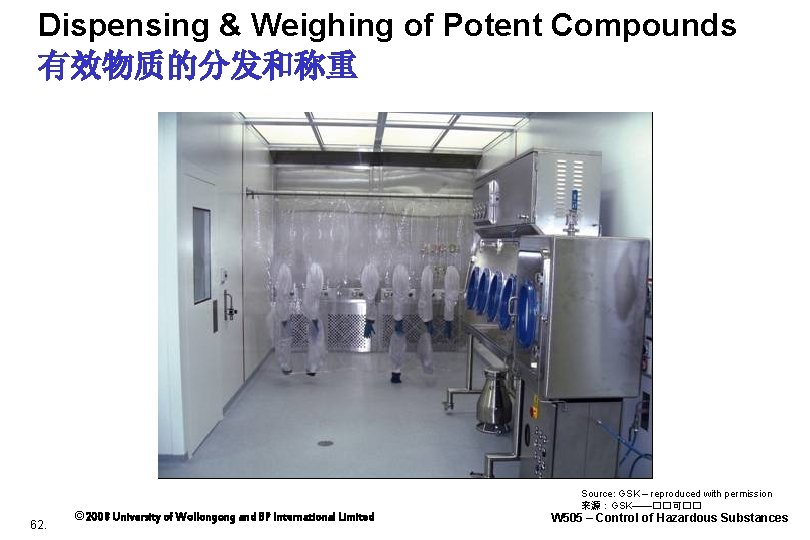
Dispensing & Weighing of Potent Compounds 有效物质的分发和称重 62. © 2008 University of Wollongong and BP International Limited Source: GSK – reproduced with permission 来源:GSK——��可�� W 505 – Control of Hazardous Substances
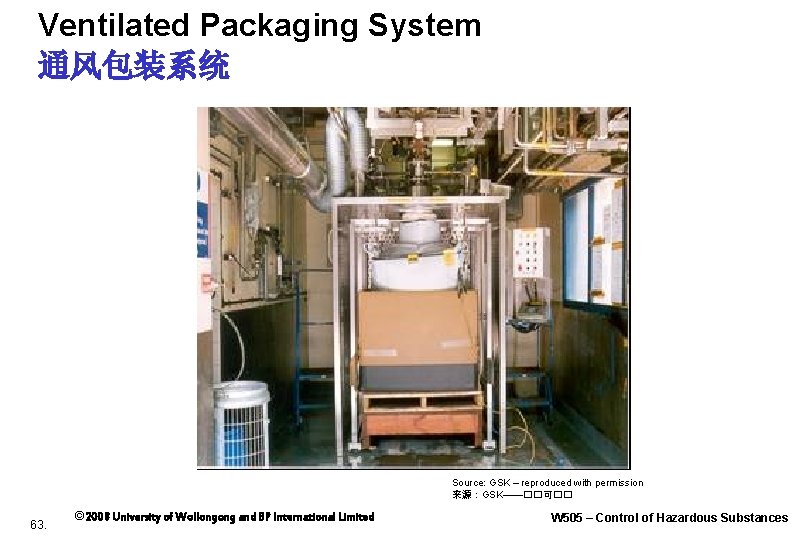
Ventilated Packaging System 通风包装系统 Source: GSK – reproduced with permission 来源:GSK——��可�� 63. © 2008 University of Wollongong and BP International Limited W 505 – Control of Hazardous Substances
Typical Isolator 典型隔离装置 Source: GSK – reproduced with permission 来源:GSK——��可�� 64. © 2008 University of Wollongong and BP International Limited W 505 – Control of Hazardous Substances
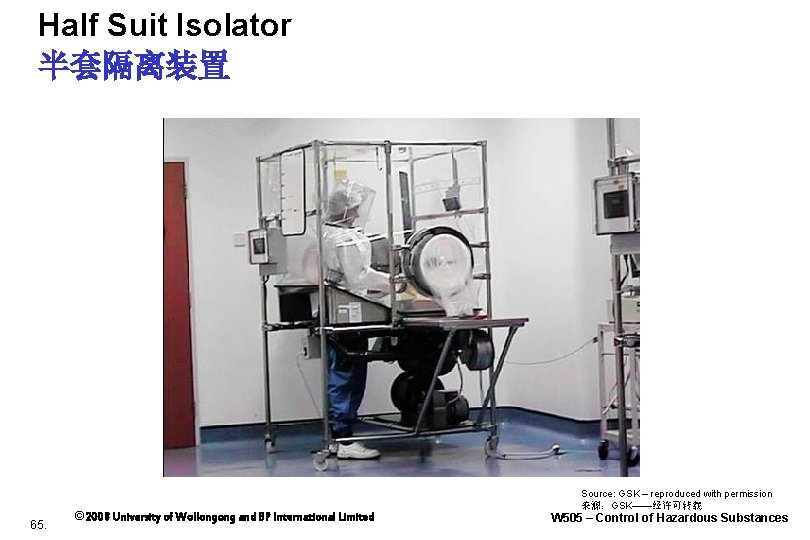
Half Suit Isolator 半套隔离装置 65. © 2008 University of Wollongong and BP International Limited Source: GSK – reproduced with permission 来源:GSK——经许可转载 W 505 – Control of Hazardous Substances
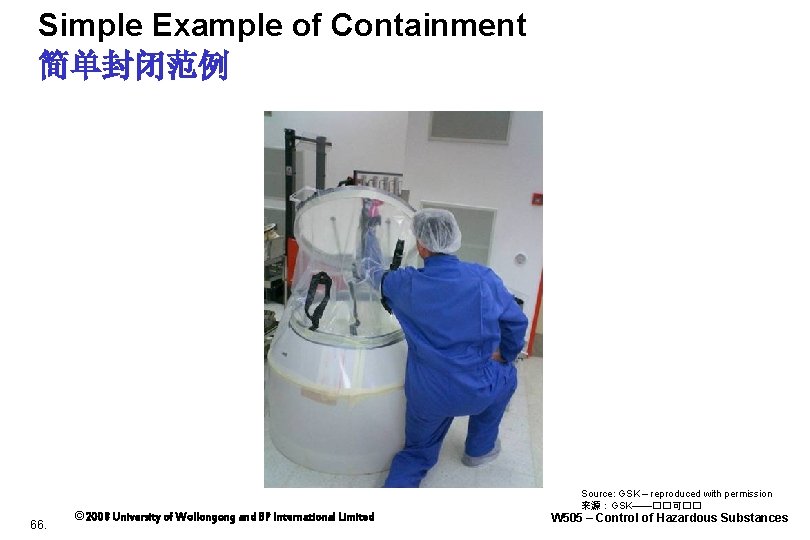
Simple Example of Containment 简单封闭范例 66. © 2008 University of Wollongong and BP International Limited Source: GSK – reproduced with permission 来源:GSK——��可�� W 505 – Control of Hazardous Substances
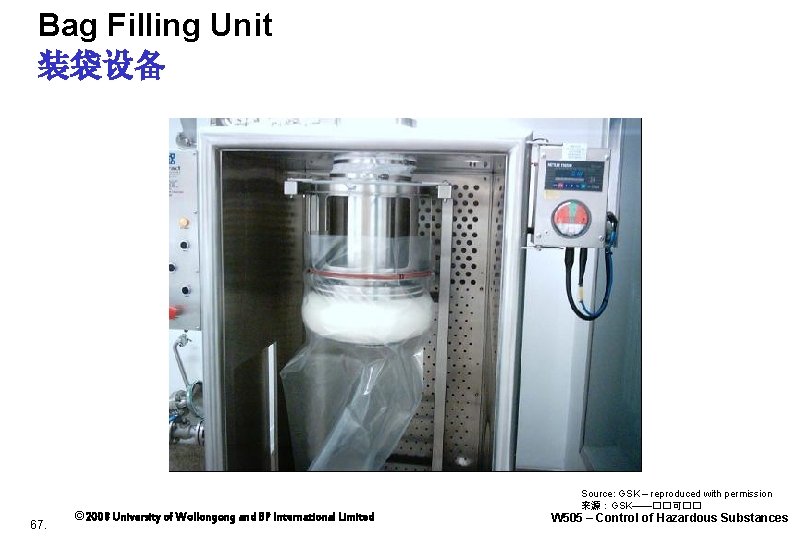
Bag Filling Unit 装袋设备 67. © 2008 University of Wollongong and BP International Limited Source: GSK – reproduced with permission 来源:GSK——��可�� W 505 – Control of Hazardous Substances
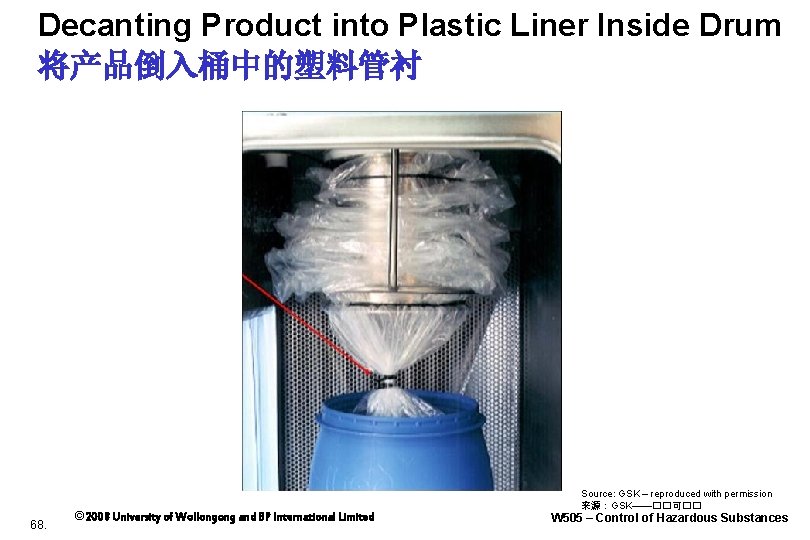
Decanting Product into Plastic Liner Inside Drum 将产品倒入桶中的塑料管衬 68. © 2008 University of Wollongong and BP International Limited Source: GSK – reproduced with permission 来源:GSK——��可�� W 505 – Control of Hazardous Substances
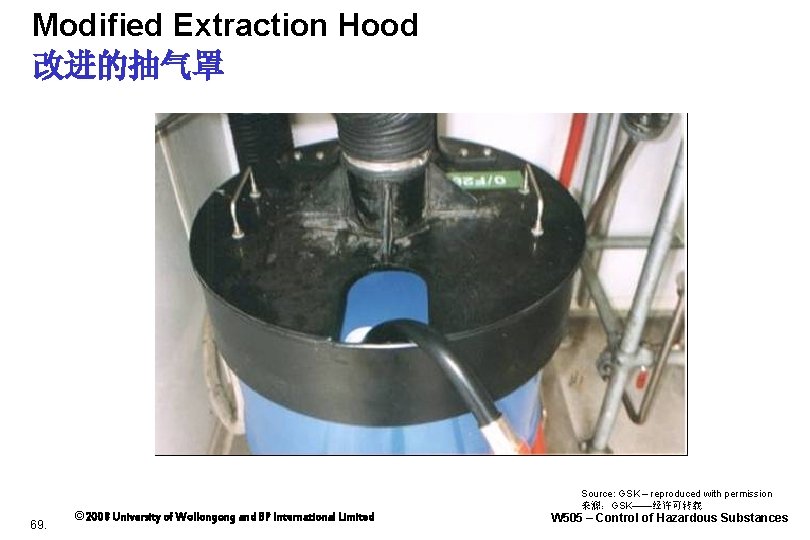
Modified Extraction Hood 改进的抽气罩 69. © 2008 University of Wollongong and BP International Limited Source: GSK – reproduced with permission 来源:GSK——经许可转载 W 505 – Control of Hazardous Substances