
Principles of Chemical Reactivity The Elements Tom Lehrer
- Slides: 22
Principles of Chemical Reactivity The Elements Tom Lehrer Did you read chapter 20 before coming to class? A. Yes B. No
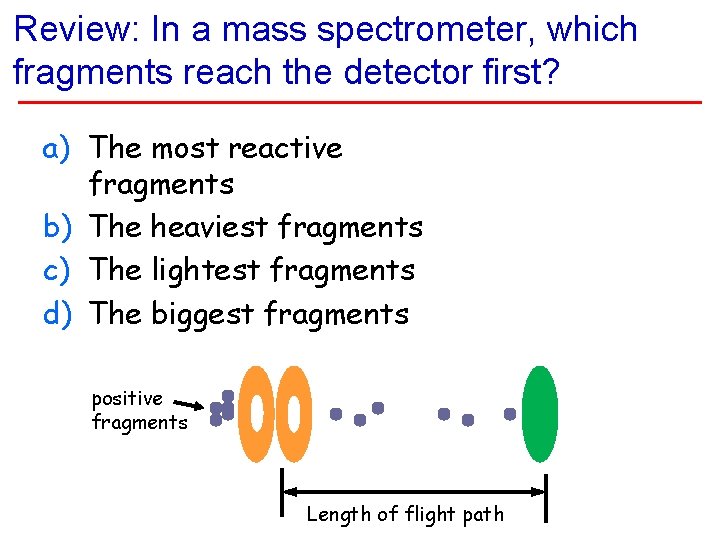
Review: In a mass spectrometer, which fragments reach the detector first? a) The most reactive fragments b) The heaviest fragments c) The lightest fragments d) The biggest fragments positive fragments Length of flight path
Learning objectives § Why do atoms form chemical bonds? § Why are some reactions fast, and others slow? § How do energy and entropy play a role? § What is equilibrium?
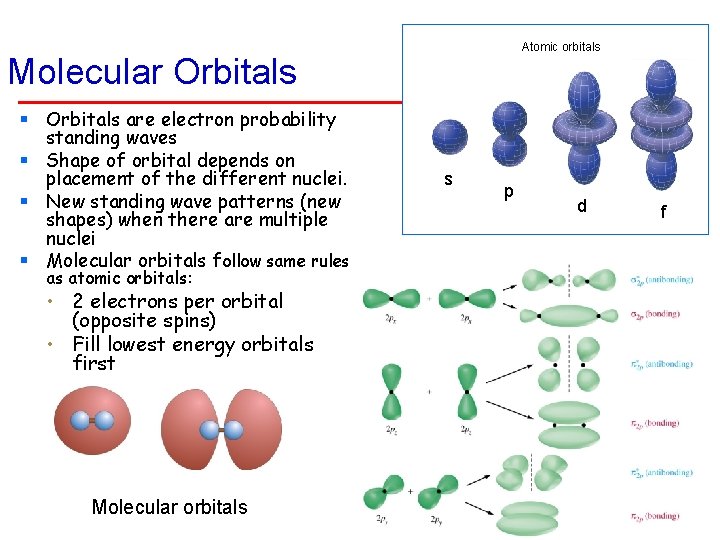
Atomic orbitals Molecular Orbitals § Orbitals are electron probability standing waves § Shape of orbital depends on placement of the different nuclei. § New standing wave patterns (new shapes) when there are multiple nuclei § Molecular orbitals follow same rules as atomic orbitals: • 2 electrons per orbital (opposite spins) • Fill lowest energy orbitals first Molecular orbitals s p d f
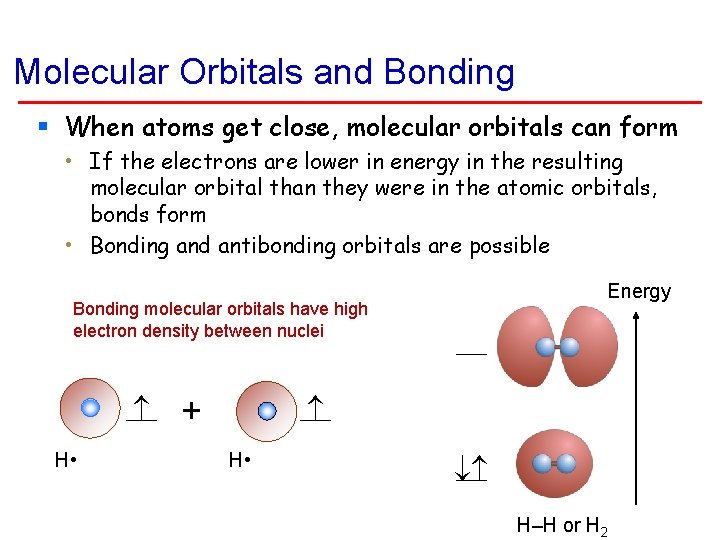
Molecular Orbitals and Bonding § When atoms get close, molecular orbitals can form • If the electrons are lower in energy in the resulting molecular orbital than they were in the atomic orbitals, bonds form • Bonding and antibonding orbitals are possible Energy Bonding molecular orbitals have high electron density between nuclei H • + H • H–H or H 2
A Thermodynamic View of Bonding § Bond formation is favorable if it leads to decreased energy for the system, and/or increased entropy for system + surroundings § 3 ways to accomplish this • Lots of atoms share lots of electrons: metals • Nonmetals “take” electrons from metals: ionic materials • Nonmetals share electrons with each other: covalent materials
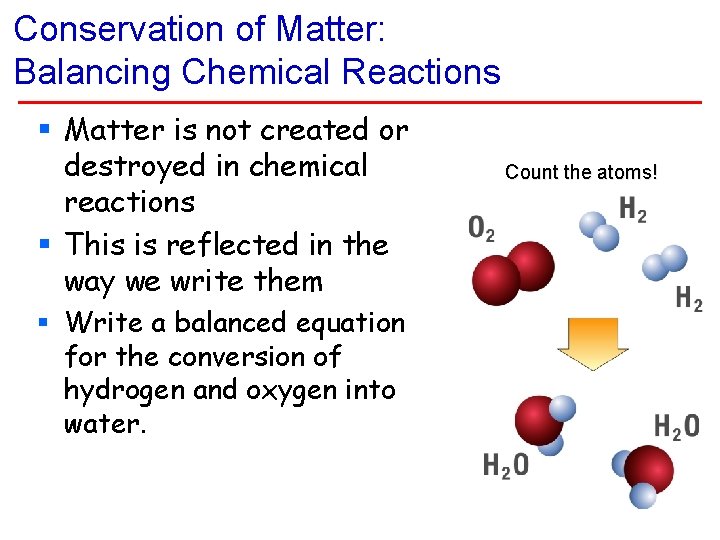
Conservation of Matter: Balancing Chemical Reactions § Matter is not created or destroyed in chemical reactions § This is reflected in the way we write them § Write a balanced equation for the conversion of hydrogen and oxygen into water. Count the atoms!
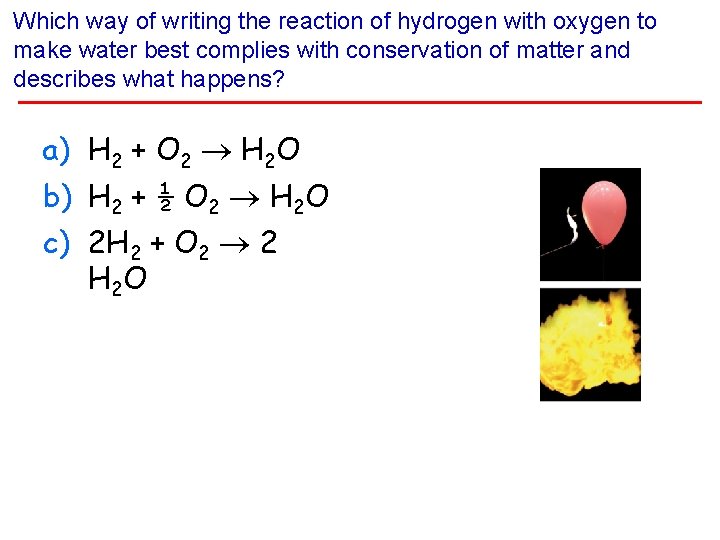
Which way of writing the reaction of hydrogen with oxygen to make water best complies with conservation of matter and describes what happens? a) H 2 + O 2 H 2 O b) H 2 + ½ O 2 H 2 O c) 2 H 2 + O 2 2 H 2 O
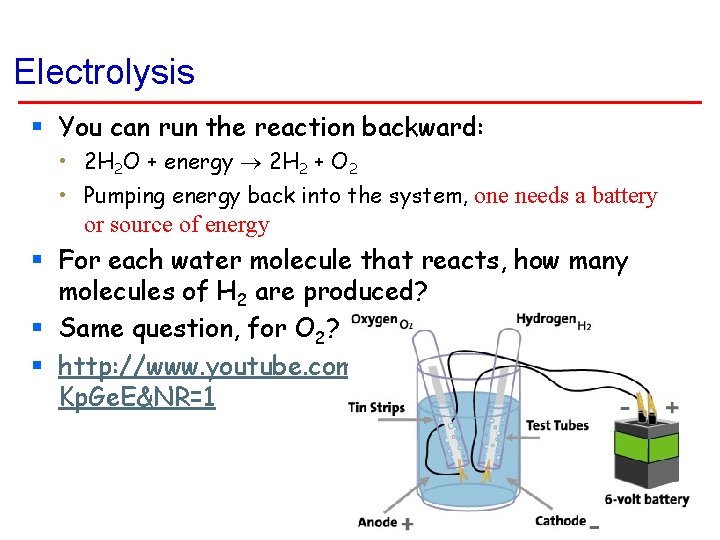
Electrolysis § You can run the reaction backward: • 2 H 2 O + energy 2 H 2 + O 2 • Pumping energy back into the system, one needs a battery or source of energy § For each water molecule that reacts, how many molecules of H 2 are produced? § Same question, for O 2? § http: //www. youtube. com/watch? v=2 t 13 SKp. Ge. E&NR=1
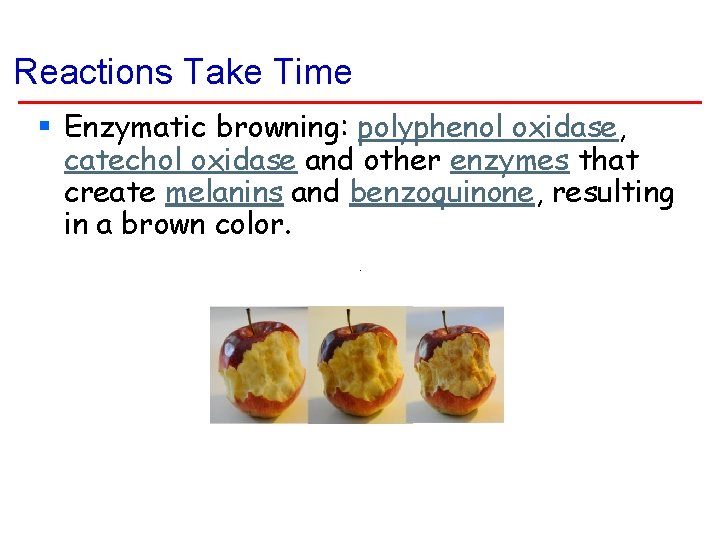
Reactions Take Time § Enzymatic browning: polyphenol oxidase, catechol oxidase and other enzymes that create melanins and benzoquinone, resulting in a brown color.
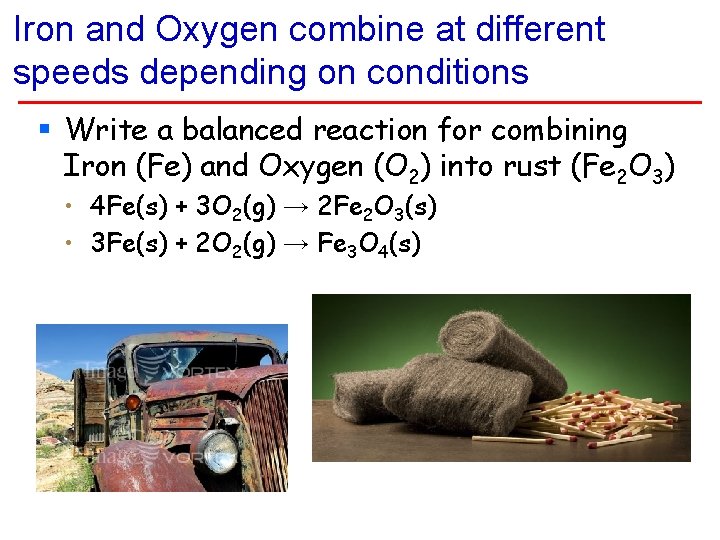
Iron and Oxygen combine at different speeds depending on conditions § Write a balanced reaction for combining Iron (Fe) and Oxygen (O 2) into rust (Fe 2 O 3) • 4 Fe(s) + 3 O 2(g) → 2 Fe 2 O 3(s) • 3 Fe(s) + 2 O 2(g) → Fe 3 O 4(s)
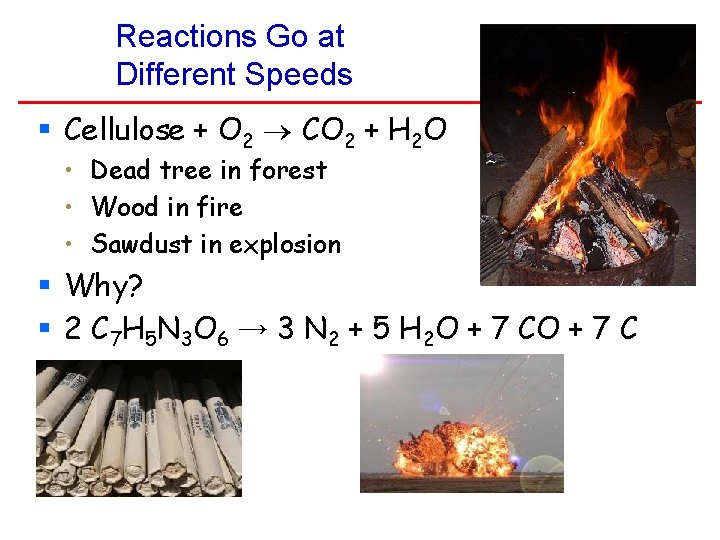
Reactions Go at Different Speeds § Cellulose + O 2 CO 2 + H 2 O • Dead tree in forest • Wood in fire • Sawdust in explosion § Why? § 2 C 7 H 5 N 3 O 6 → 3 N 2 + 5 H 2 O + 7 C
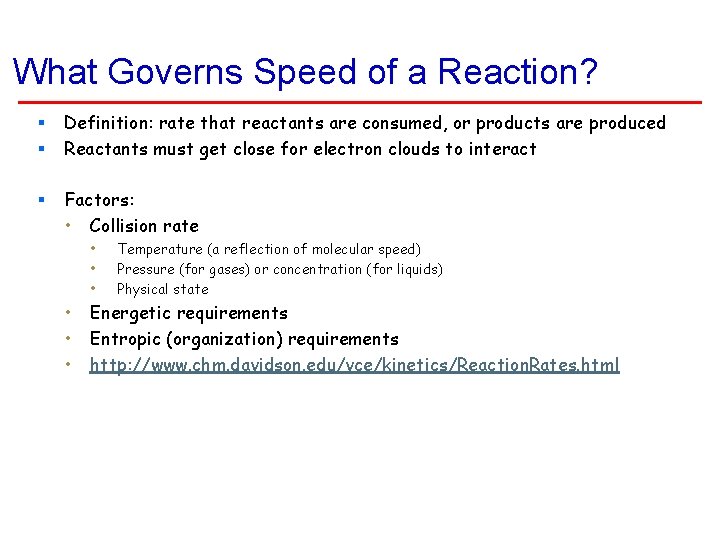
What Governs Speed of a Reaction? § § Definition: rate that reactants are consumed, or products are produced Reactants must get close for electron clouds to interact § Factors: • Collision rate • • • Temperature (a reflection of molecular speed) Pressure (for gases) or concentration (for liquids) Physical state • Energetic requirements • Entropic (organization) requirements • http: //www. chm. davidson. edu/vce/kinetics/Reaction. Rates. html
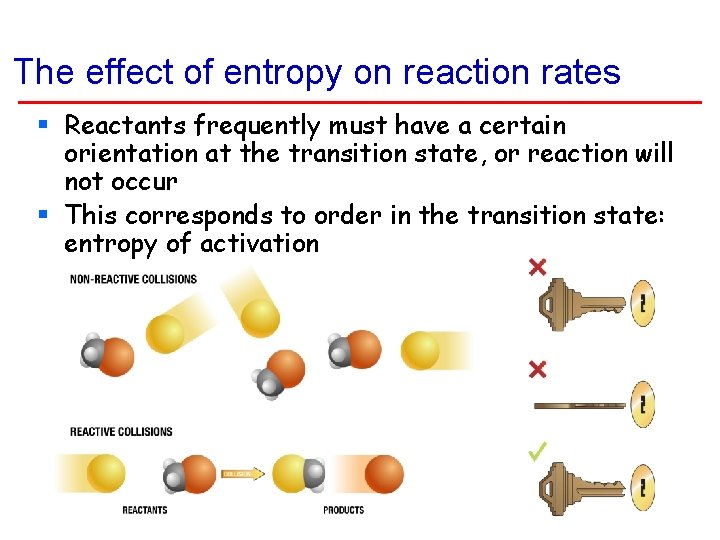
The effect of entropy on reaction rates § Reactants frequently must have a certain orientation at the transition state, or reaction will not occur § This corresponds to order in the transition state: entropy of activation
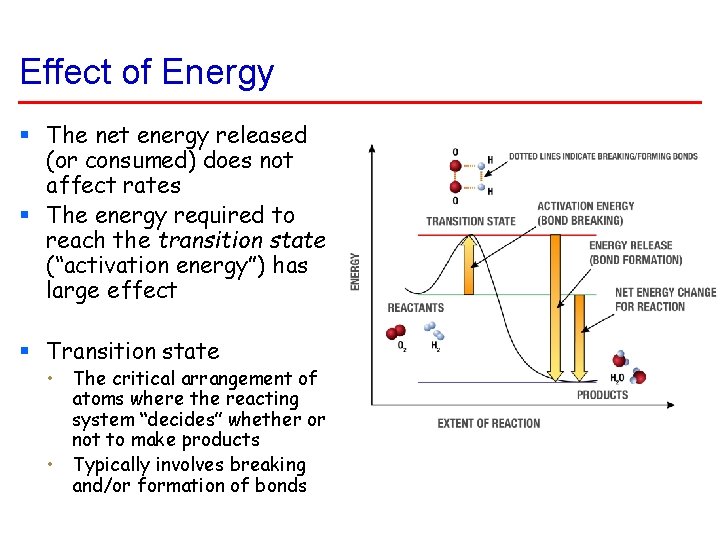
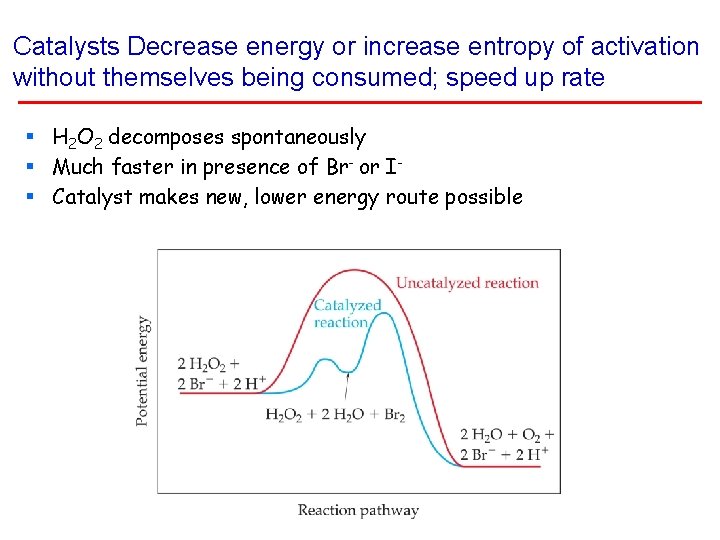
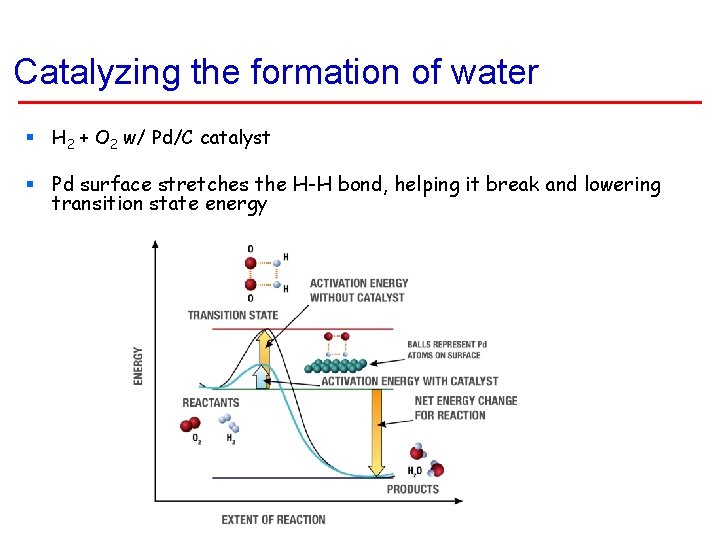
Effect of Energy § The net energy released (or consumed) does not affect rates § The energy required to reach the transition state (“activation energy”) has large effect § Transition state • The critical arrangement of atoms where the reacting system “decides” whether or not to make products • Typically involves breaking and/or formation of bonds
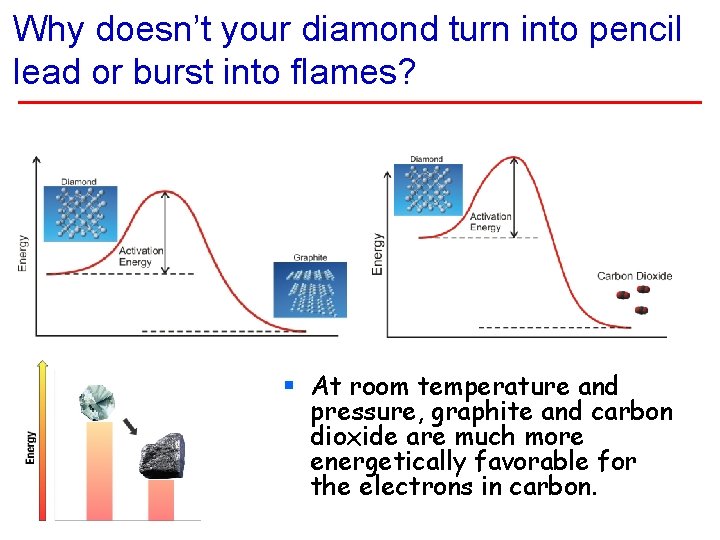
Why doesn’t your diamond turn into pencil lead or burst into flames? § At room temperature and pressure, graphite and carbon dioxide are much more energetically favorable for the electrons in carbon.
Catalysts Decrease energy or increase entropy of activation without themselves being consumed; speed up rate § H 2 O 2 decomposes spontaneously § Much faster in presence of Br- or I§ Catalyst makes new, lower energy route possible
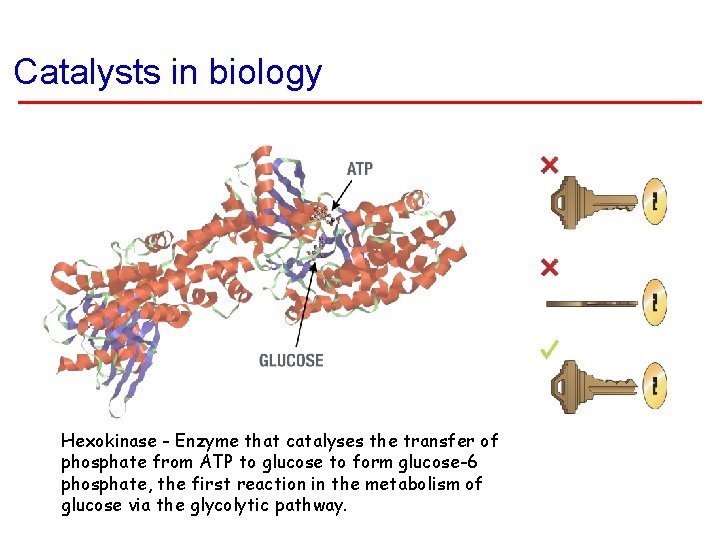
Catalysts in biology Hexokinase - Enzyme that catalyses the transfer of phosphate from ATP to glucose to form glucose-6 phosphate, the first reaction in the metabolism of glucose via the glycolytic pathway.
Catalyzing the formation of water § H 2 + O 2 w/ Pd/C catalyst § Pd surface stretches the H-H bond, helping it break and lowering transition state energy
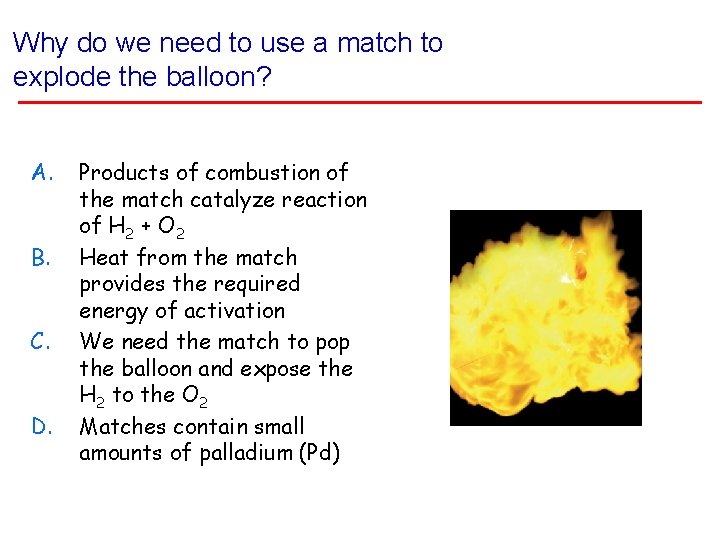
Why do we need to use a match to explode the balloon? A. B. C. D. Products of combustion of the match catalyze reaction of H 2 + O 2 Heat from the match provides the required energy of activation We need the match to pop the balloon and expose the H 2 to the O 2 Matches contain small amounts of palladium (Pd)
Reactions are more likely to occur if 1. There are more collisions between atoms and the collisions are more vigorous Increase the concentration of atoms Increase the pressure Increase the temperature 2. The energy of the system will decrease 3. The entropy of the system will increase PS 100 F 09 Chapter 20 21
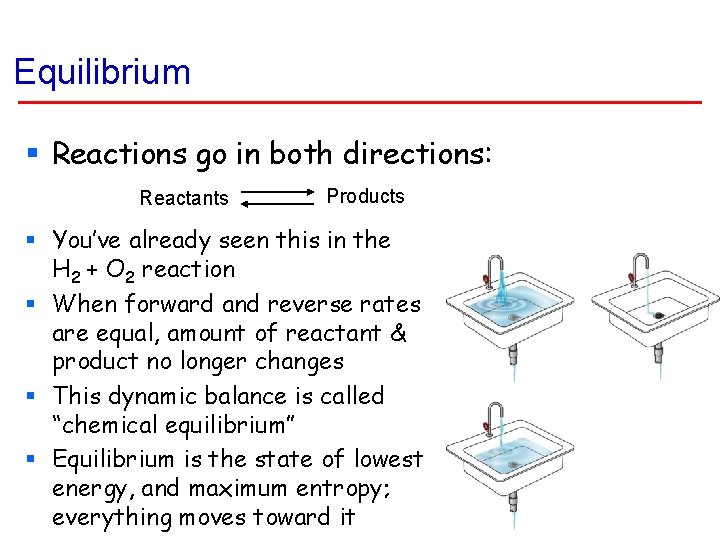
Equilibrium § Reactions go in both directions: Reactants Products § You’ve already seen this in the H 2 + O 2 reaction § When forward and reverse rates are equal, amount of reactant & product no longer changes § This dynamic balance is called “chemical equilibrium” § Equilibrium is the state of lowest energy, and maximum entropy; everything moves toward it