
Principles of Bonding Chapter 5 DEN 256 Dental

Principles of Bonding Chapter 5 DEN 256 Dental Materials
Principles of Bonding ► The basic principles of the bonding process involve preparing the surface of the tooth or restoration. ► Preparing the tooth surface includes removing decay, plaque, and debris. ► The tooth then is etched or conditioned with a 10% to 42% solution of phosphoric acid. ► This conditioning removes microns of tooth to provide a rough surface to which bonding can occur.

Bonding In dentistry, the term bond, or bonding, is used to describe the process of attaching restorative materials to the tooth by adhesion. When describing cosmetic restorations such as porcelain or composite veneers, patients often use the term bonding.
Primary and Secondary Bonds ► The primary or chemical bond occurs through adhesion when the bonding agent and the composite resin material adhere to each other. ► The chemical bond is stronger than a secondary or physical bond. § Example: adhesion of paint to a metal surface
Surface Wetting ► Etching increases the ability of the bonding material to wet the tooth surface by creating a high surface energy. ► Good wetting increases the contact of the material and the tooth; poor wetting prevents complete contact. ► For this reason, bonding agents are typically made of a low-viscosity material.
Bond Strength ► The strength of the bond is determined by the amount of force needed to break the two materials apart. ► This is accomplished by pulling the two materials apart or by applying force until the bond fails. ► An enamel bond is typically stronger than a dentinal bond.

Enamel Etching • Etching of the enamel removes a small portion of the surface, reduces enamel rods, and opens porosities among the rods. • Etching also removes the smear layer, which is made up of debris on the enamel or dentinal surface that results from the cutting of tooth structure during the cavity preparation. • The smear layer comprises bacteria, salivary components, and tooth dust
Smear Layer The dentin has a higher water content because of its organic makeup. It also contains collagen and other fluids from the pulp chamber. ► The smear layer, which is made up of debris on the enamel or dentinal surface resulting from the cutting of tooth structure during cavity preparation, must be removed before the bonding procedure is performed. ► The smear layer comprises bacteria, salivary components, and tooth dust. ►
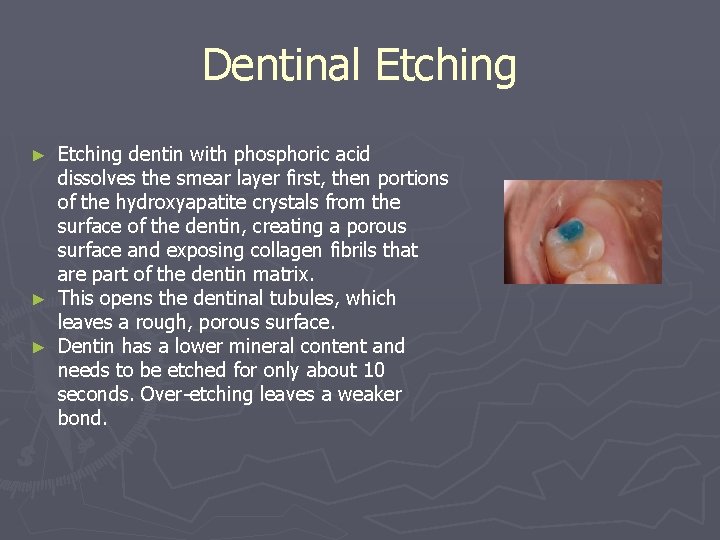
Dentinal Etching dentin with phosphoric acid dissolves the smear layer first, then portions of the hydroxyapatite crystals from the surface of the dentin, creating a porous surface and exposing collagen fibrils that are part of the dentin matrix. ► This opens the dentinal tubules, which leaves a rough, porous surface. ► Dentin has a lower mineral content and needs to be etched for only about 10 seconds. Over-etching leaves a weaker bond. ►
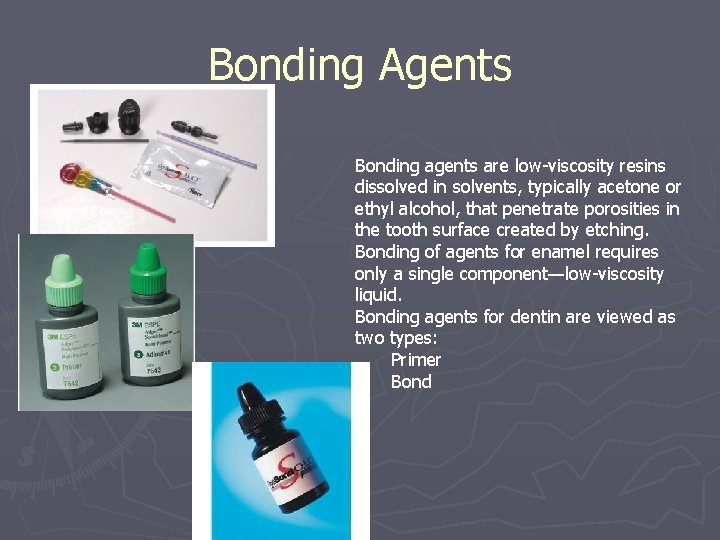
Bonding Agents Bonding agents are low-viscosity resins dissolved in solvents, typically acetone or ethyl alcohol, that penetrate porosities in the tooth surface created by etching. Bonding of agents for enamel requires only a single component—low-viscosity liquid. Bonding agents for dentin are viewed as two types: Primer Bond

Types of Bonding Agents ► Self-etching: Some two-component bonding agents have incorporated acidic groups in the primer that will etch enamel and dentin and allow penetration of the resin without the need for rinsing and drying. § These are called self-etching primers. ► These materials work well on prepared surfaces but are not as effective on unprepared surfaces. § Sealants and veneers
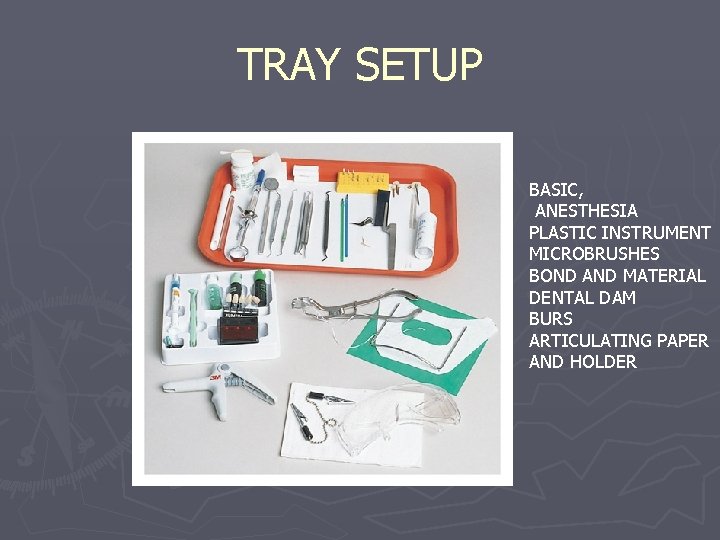
TRAY SETUP BASIC, ANESTHESIA PLASTIC INSTRUMENT MICROBRUSHES BOND AND MATERIAL DENTAL DAM BURS ARTICULATING PAPER AND HOLDER
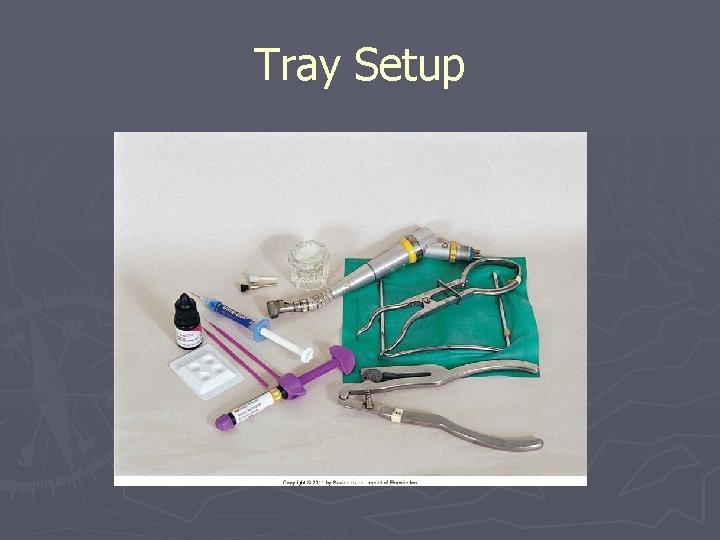
Tray Setup
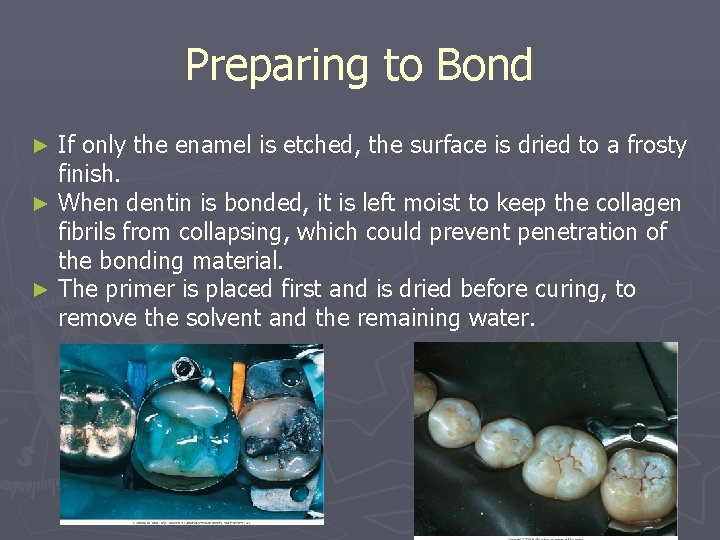
Preparing to Bond If only the enamel is etched, the surface is dried to a frosty finish. ► When dentin is bonded, it is left moist to keep the collagen fibrils from collapsing, which could prevent penetration of the bonding material. ► The primer is placed first and is dried before curing, to remove the solvent and the remaining water. ►
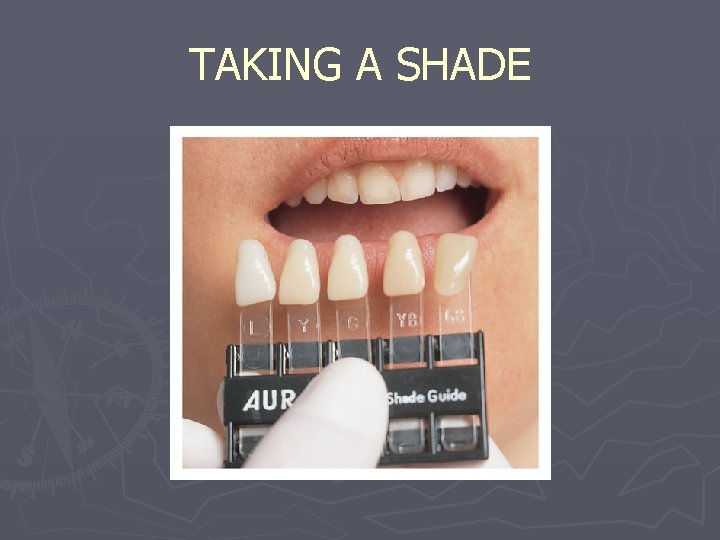
TAKING A SHADE
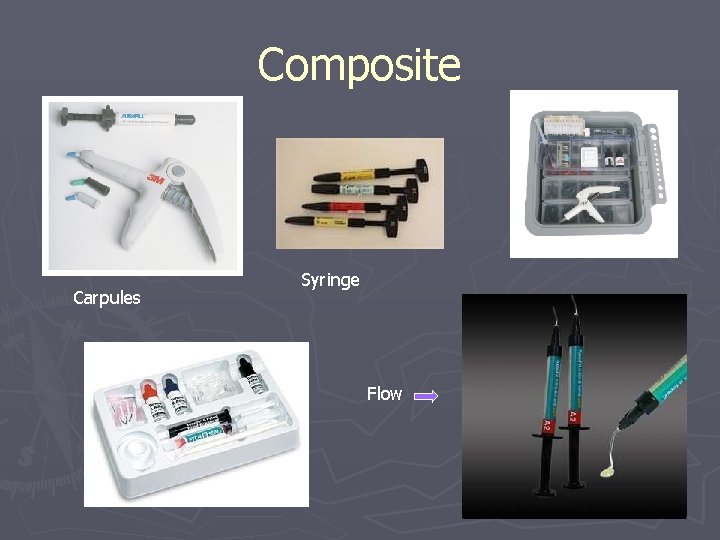
Composite Carpules Syringe Flow
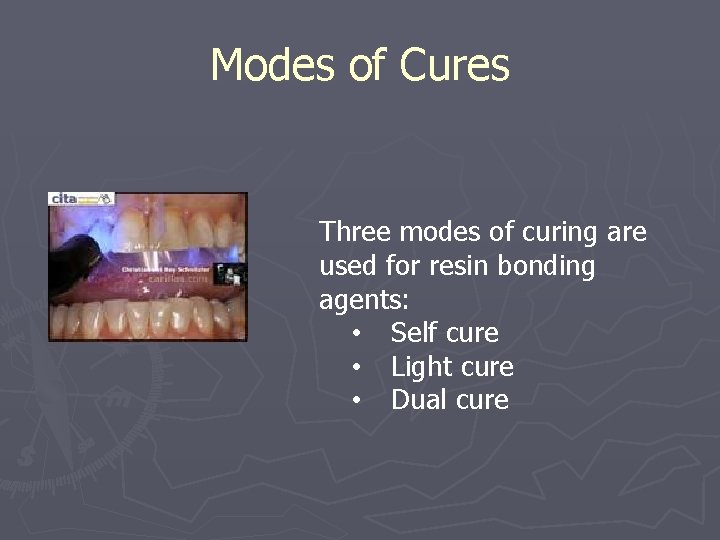
Modes of Cures Three modes of curing are used for resin bonding agents: • Self cure • Light cure • Dual cure
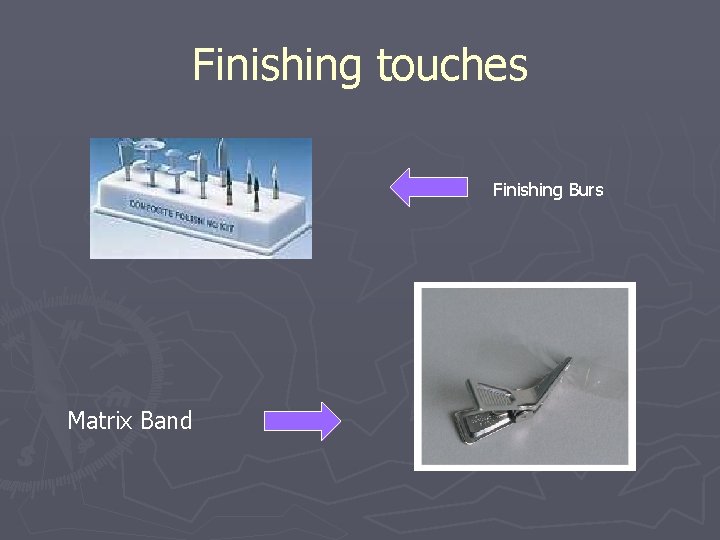
Finishing touches Finishing Burs Matrix Band
Tooth Hypersensitivity ► Some patients may experience transient tooth sensitivity after a bonded restoration. § Usually lasts only a short time ► Common causes of tooth hypersensitivity include the following: § Tooth is over-dried during the bonding process (desiccation). § Tooth has been over-etched and not properly sealed. § Composite resin is cured in too large segments.

Orthodontic Brackets
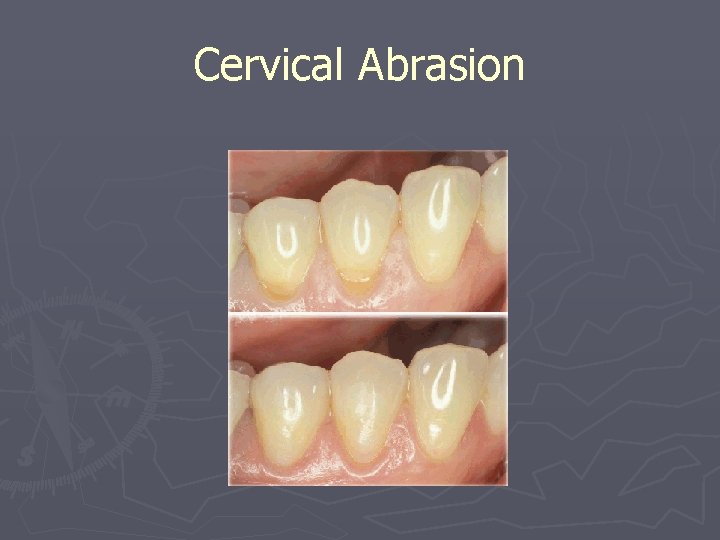
Cervical Abrasion
Summary ► Bonding of resins permits restorative materials to stick to tooth structure by way of micromechanical retention or chemical bonds. ► Phosphoric acid is used on both enamel and dentin to remove the smear layer and provide a rough surface to which to bond. ► Tooth sensitivity may occur but should be minimal when correct techniques are used.
- Slides: 22