
Principles of Behavior Modification Note Set 2 Gary
Principles of Behavior Modification Note Set 2 Gary L. Cates, Ph. D. , N. C. S. P.
Applied Research Methods Single Case Designs
Terms • Independent Variable: What is manipulated • Dependent Variable: What is measured (Always Y Axis) • Confounding Variable: Unintended independent variable that affects interpretations • Internal Validity: Extent to which IV unambiguously affects DV (i. e. no confounds) • External Validity: Extent to which Results generalize
Why Evaluate Interventions? • To determine if our practices are effective • To determine if our practices are as efficient as another practice • To provide support with regard to resistance • To learn something about the person/behavior • To learn something about the intervention • To ensure honest service delivery with integrity
How do I Evaluate Interventions? • Verbal reports • Annual tests • Pre-test (baseline) Post-Test (after some intervention) • Repeated measurement of behavior over time
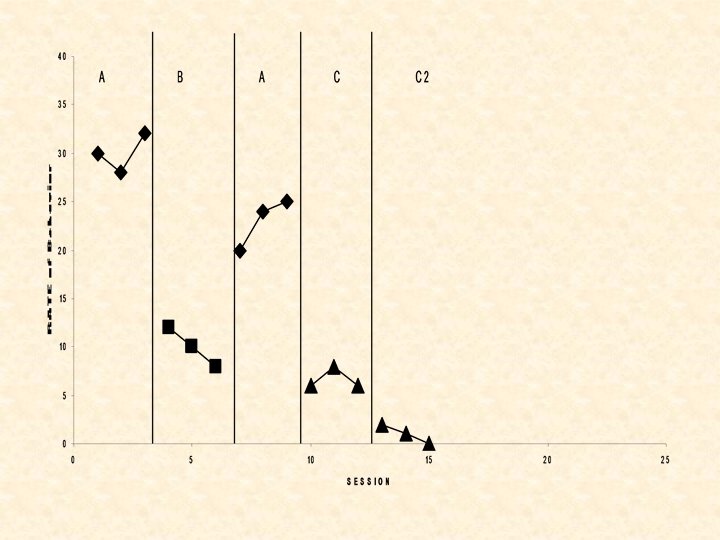
What Do the Letters and Numbers Mean? • • • A = Baseline B = Treatment C = Treatment 2 etc. 1 = first level of treatment 2 = second level of treatment etc.
A-B Design Case Study Design
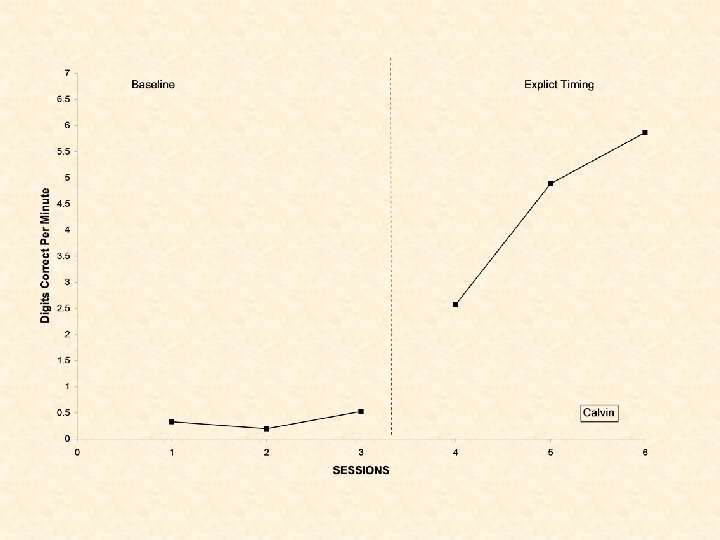
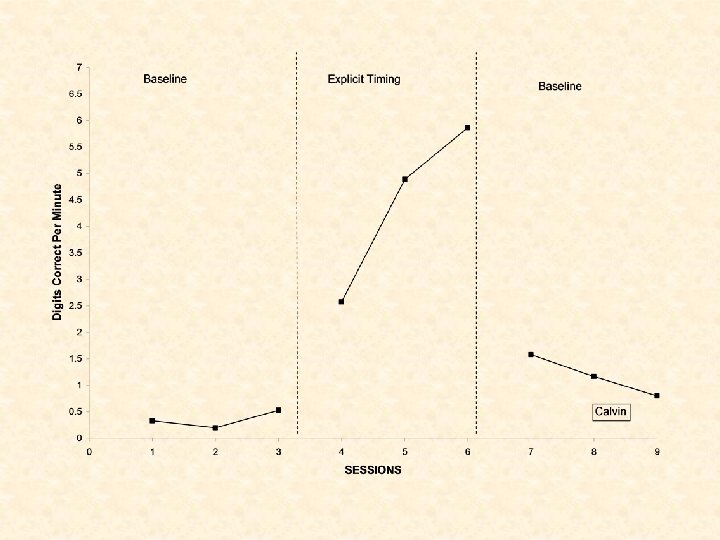
A-B-A design What happens when you take the treatment away?
A-B-A-B Let’s Put the Treatment Back Please?
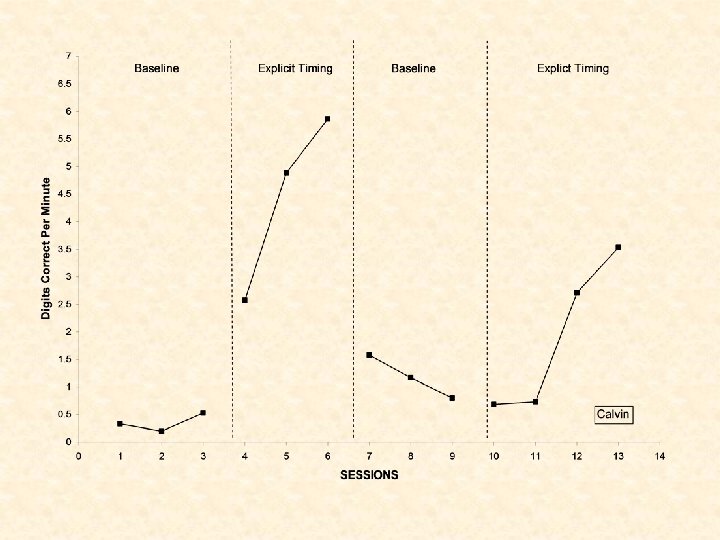
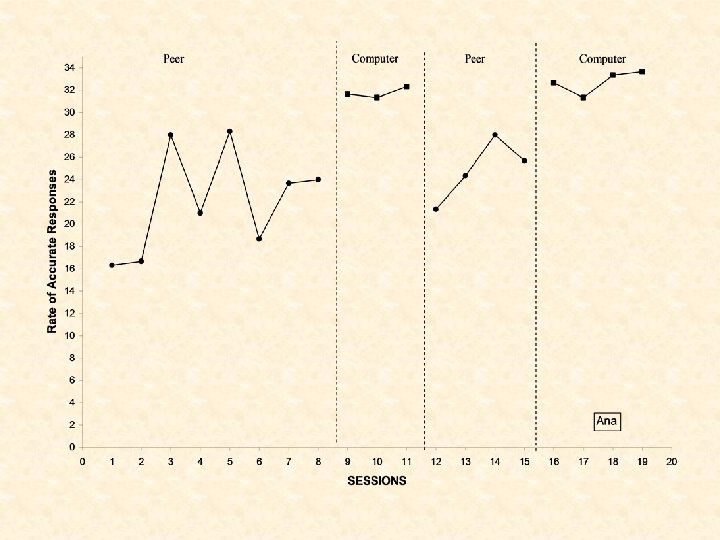
B-C-B-C Let’s not spend so much time in baseline alright?
Multiple Baseline Design Across: Behaviors, therapists, settings
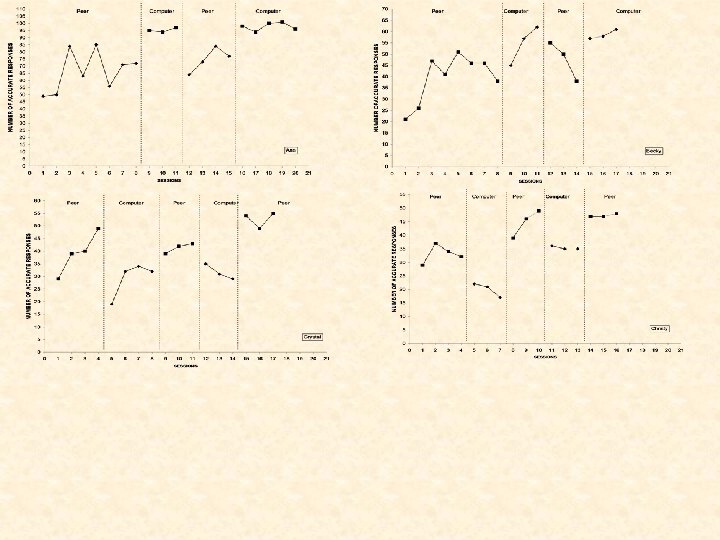
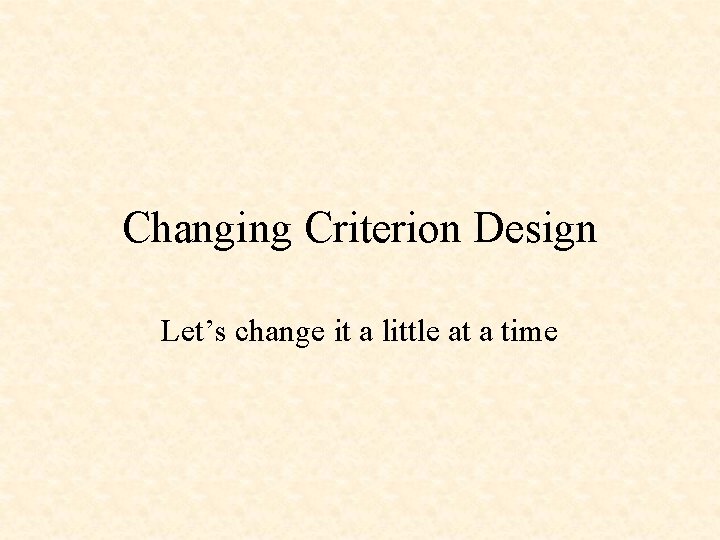
Changing Criterion Design Let’s change it a little at a time
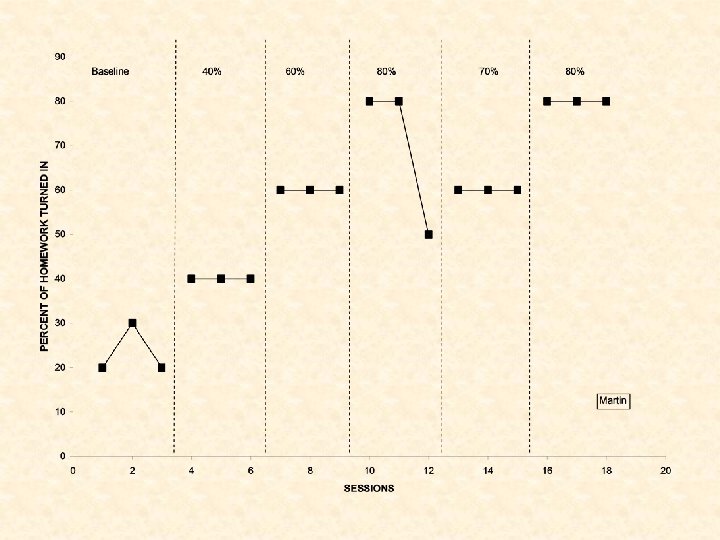
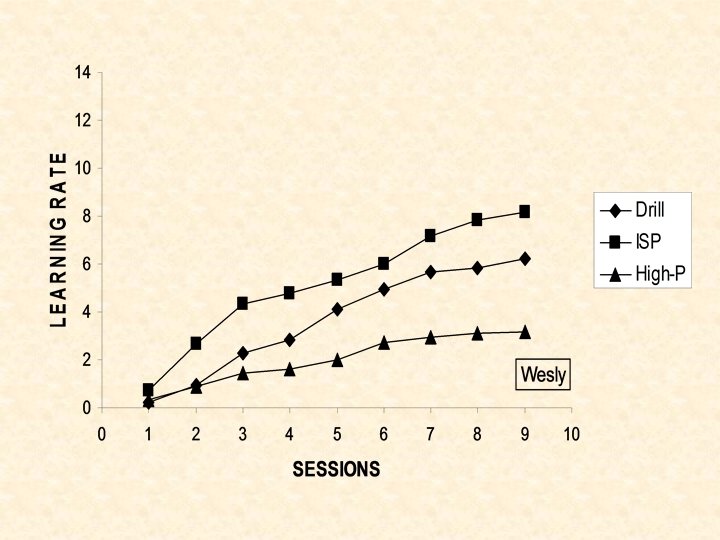
Alternating Treatments Design
Data Interpretation • • Replication demonstrations Overlapping data points Immediacy, stability, trend Effect size Description of procedures Reliability in response measurement Consistency with previous data and theory
Behavioral Assessment and Functional Analysis
General Phases of a Treatment Program • Intake Phase (5 reasons) - Should I take this case? - Explain Policies - Screen for crisis - Diagnose client (I don’t do this – only two reasons for me to do so) - Choose “Target” behaviors
General Phases of a Treatment Program • Baseline Phase - To understand possible controlling variables • Treatment Phase - Collecting data during the treatment to monitor it closely √ Not just a pre-test (baseline) and post-test (followup) • Follow-up Phase - Determine if progress made is maintained. √ Are the changes somewhat permanent?
Sources of Information for baseline assessment • Indirect Assessment Procedures -Interviews - Questionnaires: Life history, self-report, survey, third-party checklists and rating scales. – Role Playing – Information from other professionals – Client Self-monitoring: Journals etc.
Sources of Information for baseline assessment • Direct Assessment - Direct observation of behavior and collect data - Most projects in this class
Sources of Information for baseline assessment • Experimental Analysis Procedures – Manipulate the environment and assess the effects on behavior
Why Collect Data? • • • Decide if the behavior warrants your help. Identify best treatment strategy: Reinforcers Determining IV effectiveness May facilitate modification of behavior itself: Self feedback, R+ May facilitate modifiers to adhere and implement procedures
Behavioral Assessment Versus Traditional Assessment • Specific Behavior not Ambiguous syndrome or disorder • Repeated Measurement • Can be linked to treatment • Refocuses treatment on behavior not person • Evaluate intervention efficacy
Direct Behavior Assessment
Let’s watch some video • You’re a psychologist. • Use your skills up to this point to give me the best psychological profile of the target child in the video.
Characteristics of Behavior to be recorded • Topography: Shape or form of behavior
Characteristics of Behavior to be recorded • Amount - Frequency: How many times? - Rate: How many times per unit of time? - Duration: How long?
Characteristics of Behavior to be recorded • Amount - Frequency: How many times? - Rate: How many times per unit of time? - Duration: How long?
Characteristics of Behavior to be recorded • Intensity – Sound measurement – Rating Scales
Characteristics of Behavior to be recorded • Latency e. g. time between being asked a question and responding
Characteristics of Behavior to be recorded • Quality – Rating scales
Methods for Recording Behavior • Continuous: Recording every instance of a behavior – Talley Marks
Methods for Recording Behavior • Interval recording: Recording based on equal time intervals
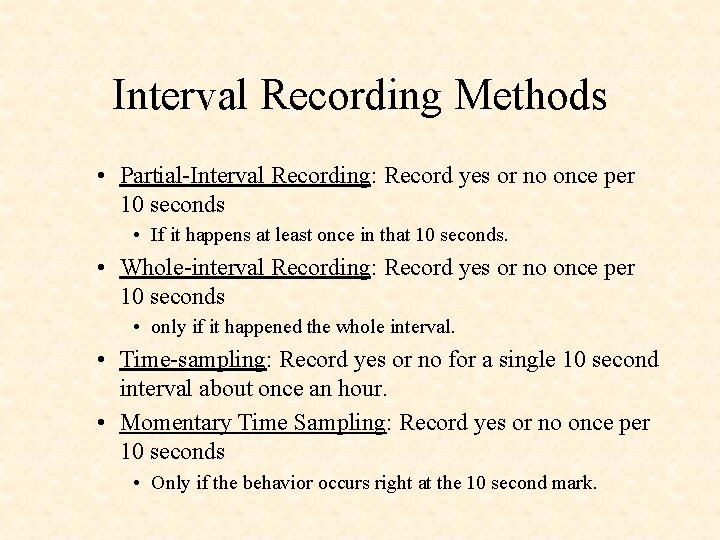
Interval Recording Methods • Partial-Interval Recording: Record yes or no once per 10 seconds • If it happens at least once in that 10 seconds. • Whole-interval Recording: Record yes or no once per 10 seconds • only if it happened the whole interval. • Time-sampling: Record yes or no for a single 10 second interval about once an hour. • Momentary Time Sampling: Record yes or no once per 10 seconds • Only if the behavior occurs right at the 10 second mark.
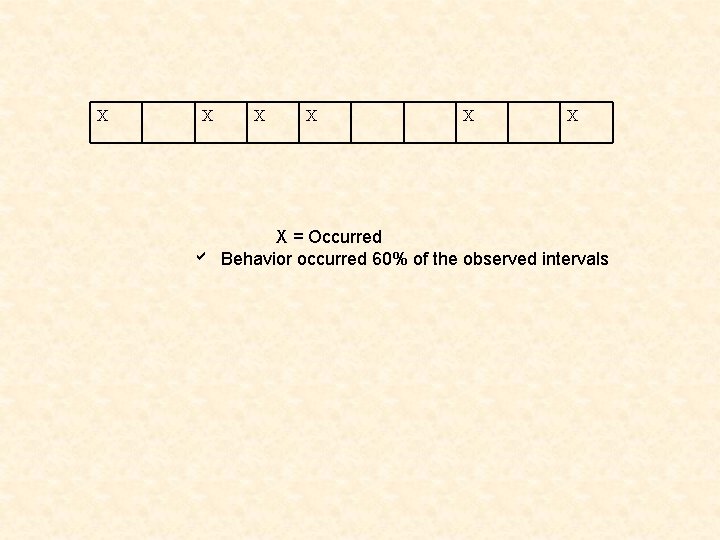
X X X X = Occurred Behavior occurred 60% of the observed intervals
Let’s watch the video again • This time take data using either – Rate measurement – Frequency recording – Partial interval recording – Whole interval recording
What did you come up with? • • Rate? Frequency? Partial? Whole? • Which way was best for this situation?
Assessing the Accuracy of Observations • Interobserver Reliability (IOR) • 2 Independent observers record for a session and compare accuracy
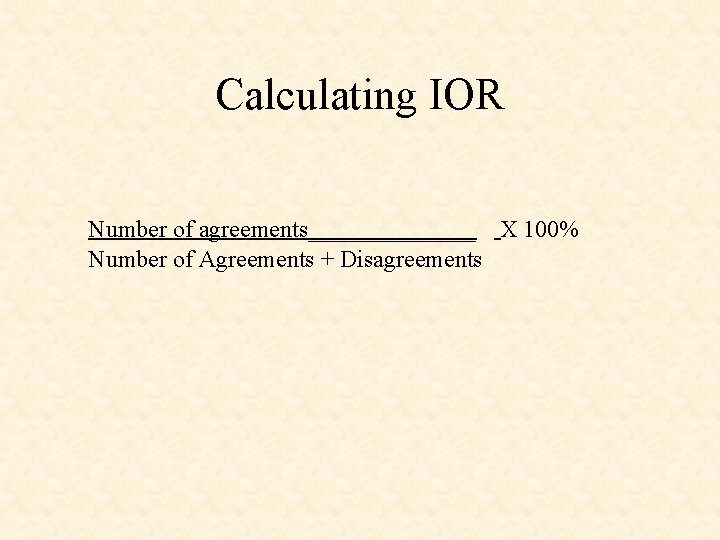
Calculating IOR Number of agreements_______ X 100% Number of Agreements + Disagreements
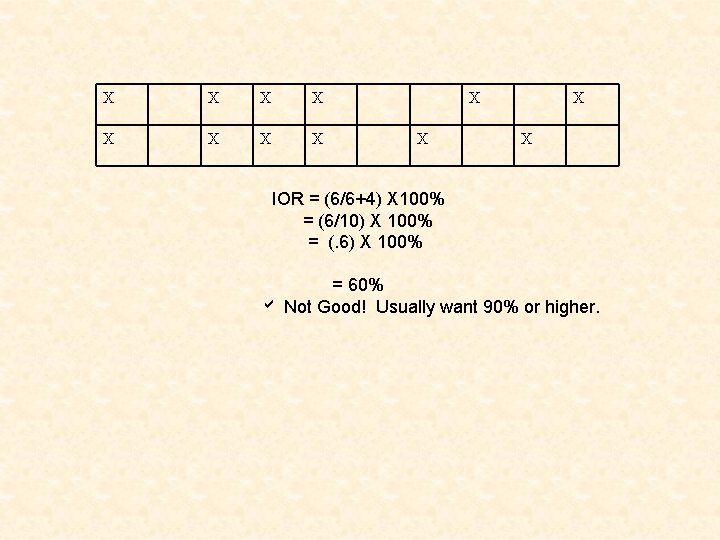
X X X IOR = (6/6+4) X 100% = (6/10) X 100% = (. 6) X 100% = 60% Not Good! Usually want 90% or higher.
Your turn • What is your reliability with another person recording data the same way that you recorded?
Functional Assessment
What was going on with the child’s behavior? • What caused it? • What was maintaining it?
Functional Assessment • Determining what the antecedents and consequences are for a give behavior • Focuses on maintenance not cause!
Approaches to Functional Assessment • Questionnaire: Have others tell you what happens • Observational Assessment: Watch and describe AB-C’s • Experimental Functional Analysis: Do a test of hypothesis I usually do a bit of all three of the above
Functions of Behavior • • • Tangible Reinforcement Attention Escape Physical Stimulation (internal or external) Respondent? Not clear Medical Causes: Rapid Onset and no association with A-D
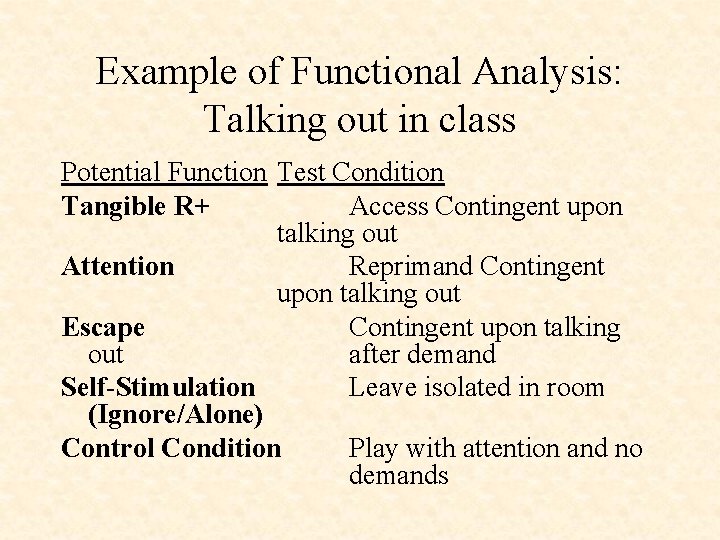
Example of Functional Analysis: Talking out in class Potential Function Test Condition Tangible R+ Access Contingent upon talking out Attention Reprimand Contingent upon talking out Escape Contingent upon talking out after demand Self-Stimulation Leave isolated in room (Ignore/Alone) Control Condition Play with attention and no demands
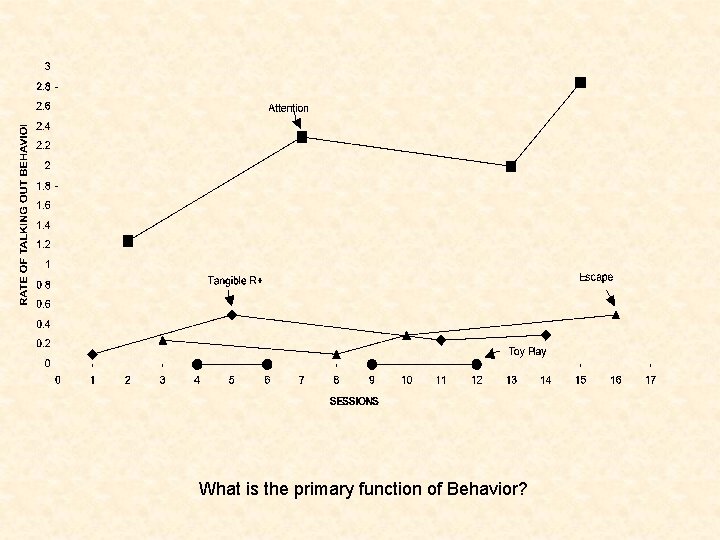
What is the primary function of Behavior?
Chapter 4: Conditioned Reinforcement
What is the difference? • Unconditioned Reinforcer: Stimuli reinforcing without conditioning (i. e. learning) - e. g. , food, water, sex - AKA Unlearned or primary reinforcers • Conditioned Reinforcers: Stimuli that are reinforcers due to experience (i. e. , learning) – e. g. , money, tokens, clothes, Praise
Back-up Reinforcers • Tokens • Money • Points
Factors Influencing the Effectiveness of Conditioned Reinforcement • Strength of Back up reinforcer • Variety of Backup Reinforcers • Schedule of Pairing with Backup Reinforcer • Extinction of the Conditioned Reinforcer
Pitfalls of Conditioned Reinforcement • Making punishers Reinforcers – Who likes to get spanked? • Extinction of Conditioned Reinforcement – Chucky Cheese prizes for adults?
Extinction
Extinction • The removal of a reinforcer from a previously reinforced behavior which causes the behavior to decrease
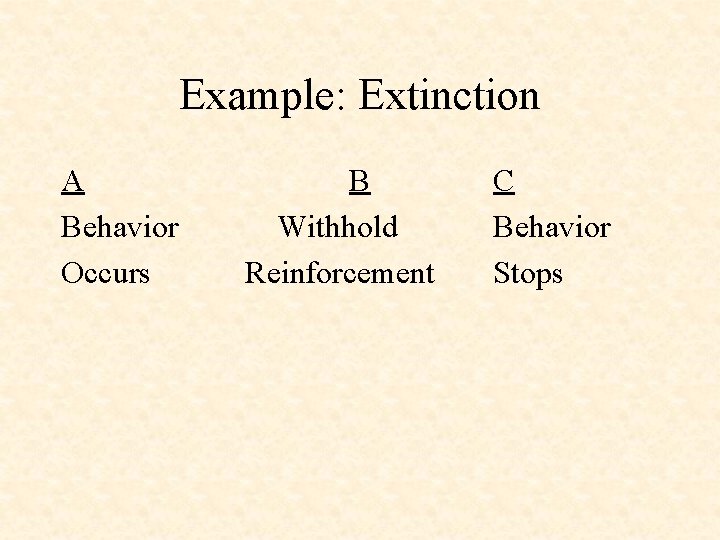
Example: Extinction A B Behavior Withhold Occurs Reinforcement C Behavior Stops
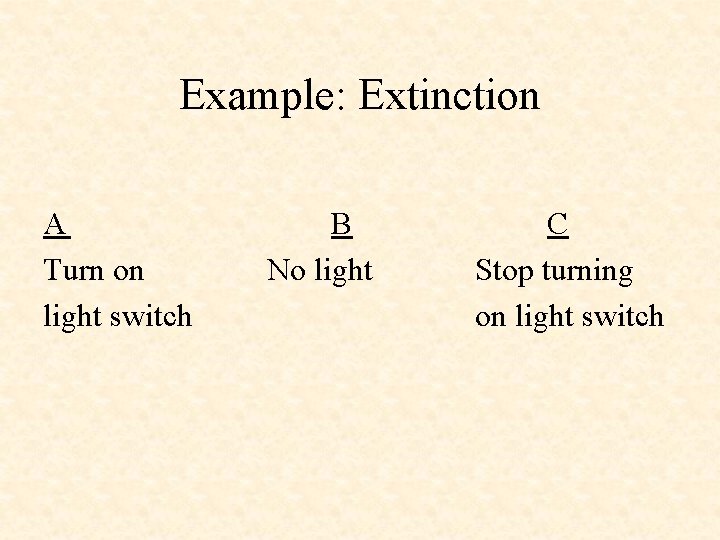
Example: Extinction A Turn on light switch B C No light Stop turning on light switch
Extinction Burst – Temporary increase in responding as a result of the introduction of extinction. – Sometimes a change in topography may occur.
Example: Extinction Burst A B Turn on No Light light switch C Turn on/off light switch Repeatedly and then Stop or do a new behavior
Extinction Examples • Vending Machine • Head banging * What does this suggest about ignoring behavior?
Your Turn • Come up with an example of how Reinforcement has been withheld from your behavior and what followed. Share with your peers.
Spontaneous Recovery • Temporary recovery of an extinguished behavior that follows the initial treatment session. – An extinguished Behavior will come back, but usually less intense and shorter duration. • √ Must wait out the storms
Factors that influence the Effectiveness of Extinction Controlling reinforcers – e. g. Accidental reinforcement The Setting in which Extinction is Carried out – e. g. Tantrums in Wal*Mart Rules – E. g. Make use of our capabilities The schedule of reinforcement – The thinner the schedule the more resistance to extinction Extinction Burst • e. g. Tantrums
Differential Consequences
Differential Reinforcement • Definition: Reinforcing one set of responses and extinguishing another set of responses.
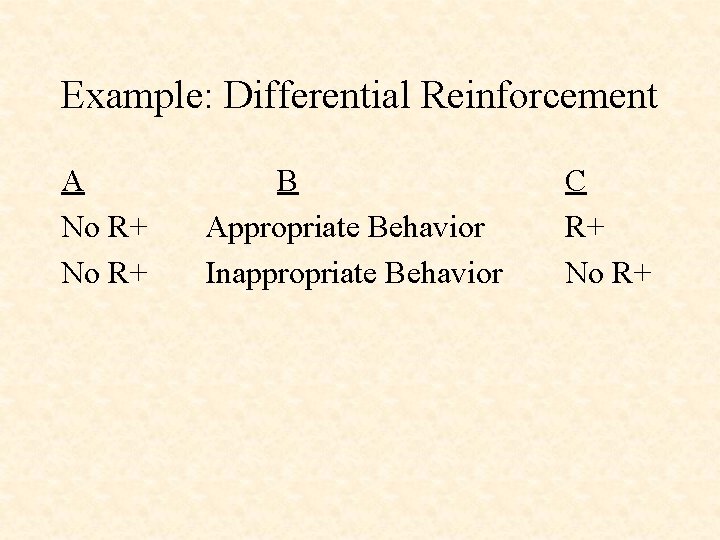
Example: Differential Reinforcement A No R+ B C Appropriate Behavior R+ Inappropriate Behavior No R+
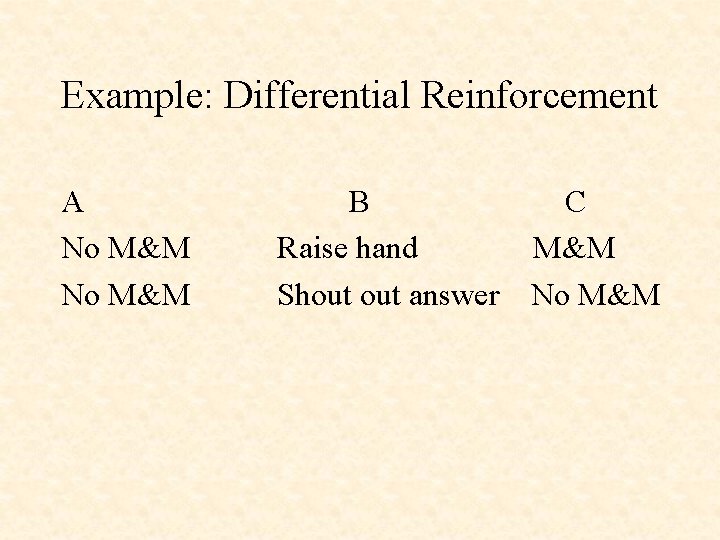
Example: Differential Reinforcement A No M&M B C Raise hand M&M Shout answer No M&M
Your Turn Think up an example where your behavior has been differentially reinforced and share with your peers.
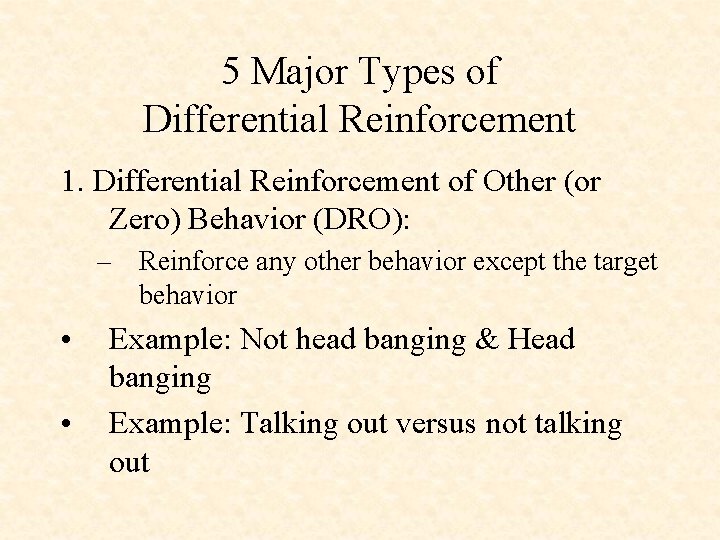
5 Major Types of Differential Reinforcement 1. Differential Reinforcement of Other (or Zero) Behavior (DRO): – Reinforce any other behavior except the target behavior • • Example: Not head banging & Head banging Example: Talking out versus not talking out
5 Major Types of Differential Reinforcement 2. Differential Reinforcement of Alternate Behavior (DRA): – Reinforce a single specific behavior that is not the target behavior • Example: Chewing gum versus Smoking
5 Major Types of Differential Reinforcement 3. Differential Reinforcement of an Incompatible Behavior (DRI): – Reinforce a specific behavior that when emitted can not allow the target response. • Example: Finger stretching & OCD
5 Major Types of Differential Reinforcement of Low rates of Behavior (DRL): – Reinforce a lower rate of behavior as compared to a baseline. • Example: Head banging revisited - Spaced Responding – Must restart interval if too often
5 Major Types of Differential Reinforcement of High Rates of Behavior (DRH): – Reinforce a higher rate of behavior as compared to baseline. • Example: Multiplication facts
Differential Reinforcement Effect • One behavior always increases. Another usually (i. e. almost always) decreases.
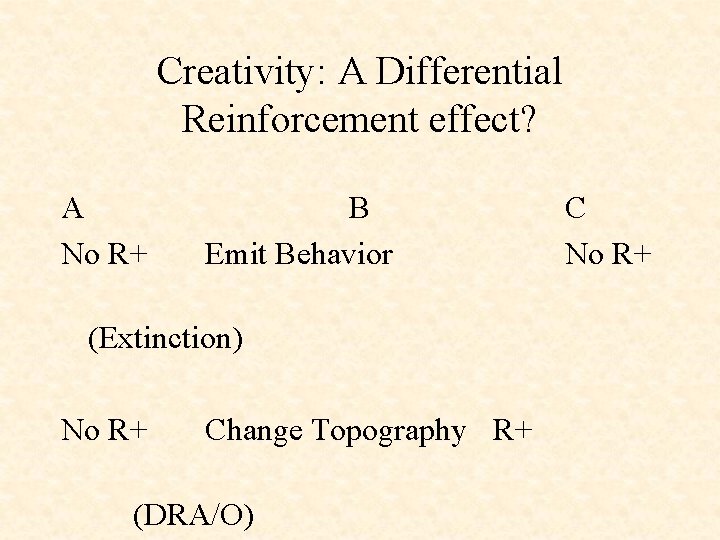
Creativity: A Differential Reinforcement effect? A No R+ B Emit Behavior C No R+ (Extinction) No R+ Change Topography R+ (DRA/O)
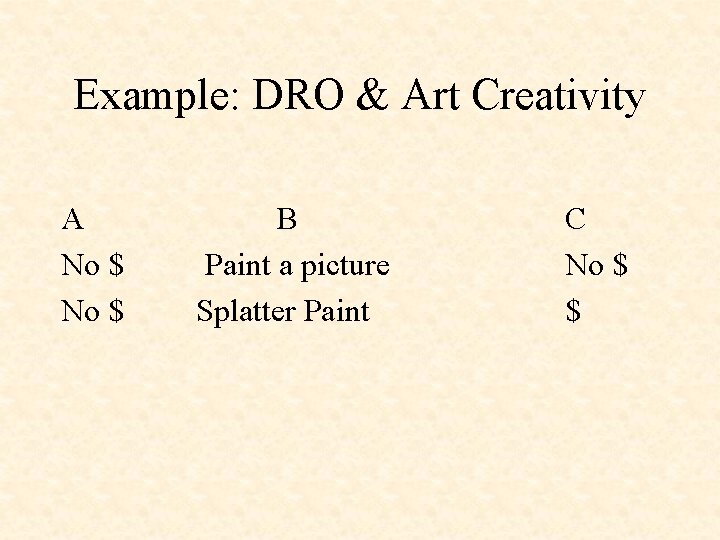
Example: DRO & Art Creativity A B No $ Paint a picture No $ Splatter Paint C No $ $
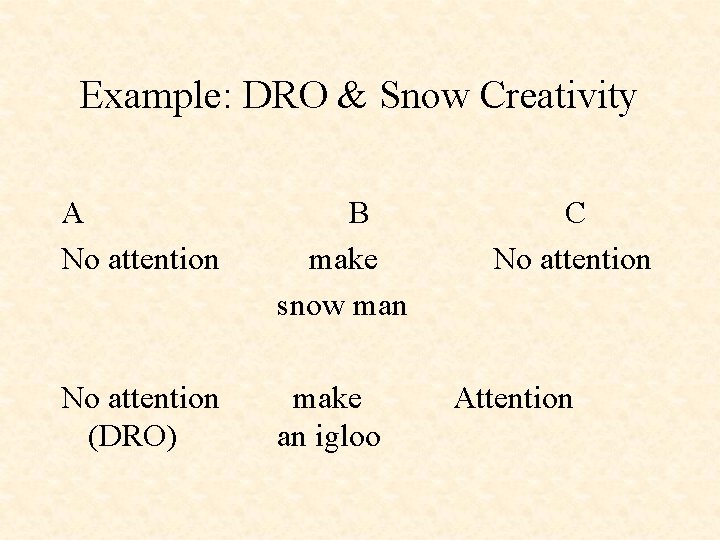
Example: DRO & Snow Creativity A No attention B make snow man No attention (DRO) make an igloo C No attention Attention
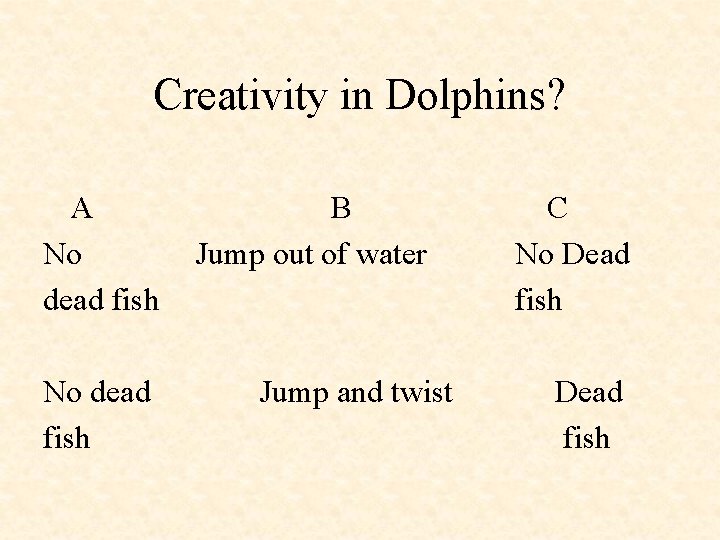
Creativity in Dolphins? A B No Jump out of water dead fish C No Dead fish No dead fish Dead fish Jump and twist
Pitfalls of and Considerations to be made when using DR-Schedules • • • Potential to decrease appropriate behavior too much. Takes practice to choose the right DRSchedule. DR? , DRI? DRL? Must remember to fade slowly
- Slides: 86