
Principles of Anatomy and Physiology 14 th Edition


- Slides: 45
Principles of Anatomy and Physiology 14 th Edition CHAPTER 4 The Tissue Level of Organization Copyright © 2014 John Wiley & Sons, Inc. All rights reserved.
Introduction The purpose of this chapter is to: § Learn about the various types of tissues and their origins § Discuss how cells of a tissue are held together § Compare and contrast epithelial, connective, muscular, and nervous tissue § Learn about the structure and function of membranes § Understand tissue repair Copyright © 2014 John Wiley & Sons, Inc. All rights reserved.
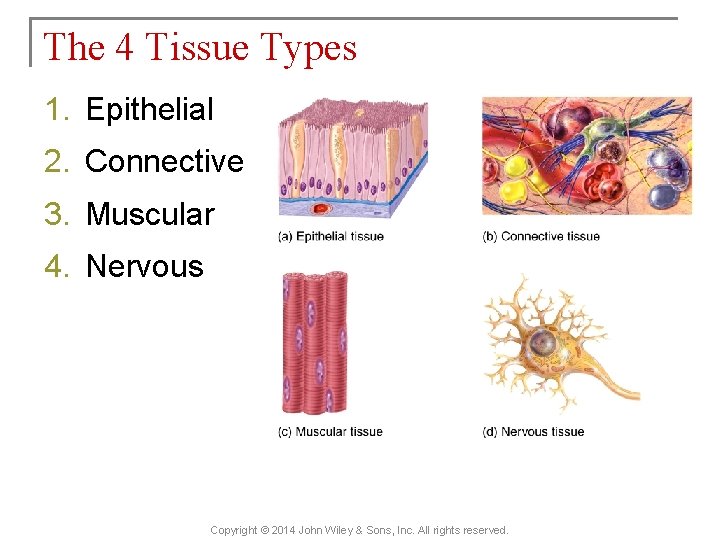
The 4 Tissue Types 1. Epithelial 2. Connective 3. Muscular 4. Nervous Copyright © 2014 John Wiley & Sons, Inc. All rights reserved.
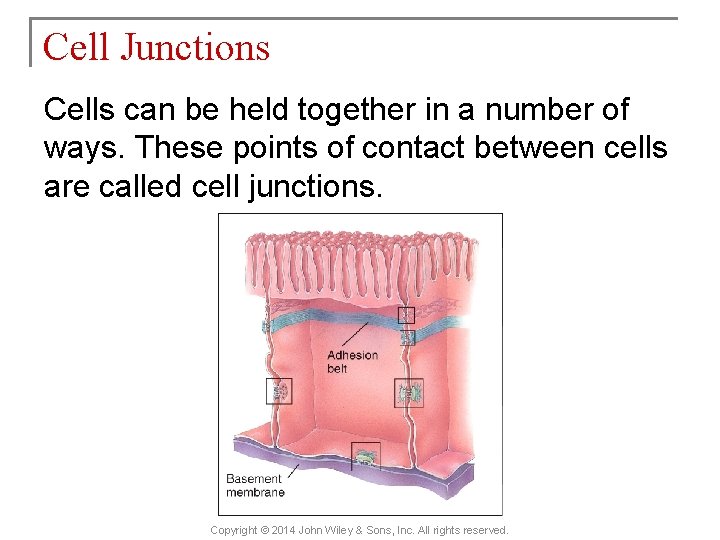
Cell Junctions Cells can be held together in a number of ways. These points of contact between cells are called cell junctions. Copyright © 2014 John Wiley & Sons, Inc. All rights reserved.
Intercellular Junctions Interactions Animation: Intercellular Junctions You must be connected to the Internet and in Slideshow Mode to run this animation. Copyright © 2014 John Wiley & Sons, Inc. All rights reserved.
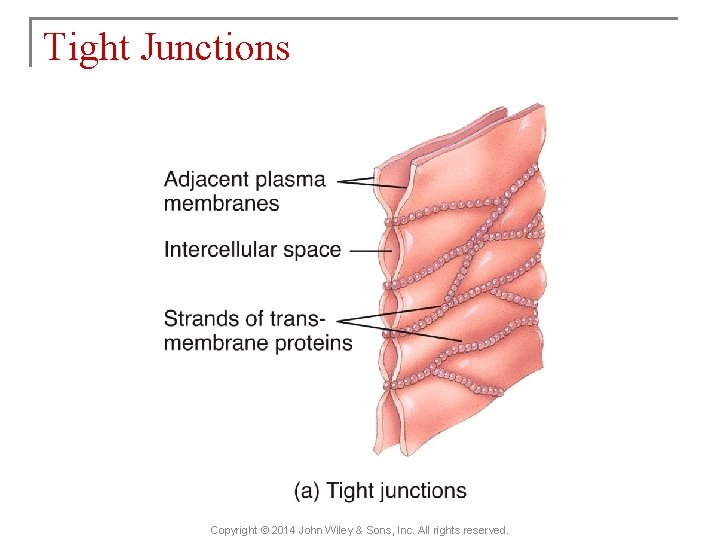
Tight Junctions Copyright © 2014 John Wiley & Sons, Inc. All rights reserved.
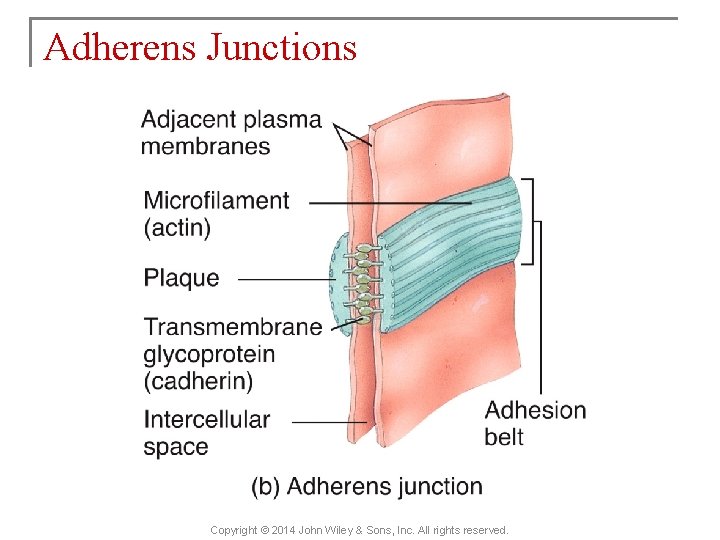
Adherens Junctions Copyright © 2014 John Wiley & Sons, Inc. All rights reserved.
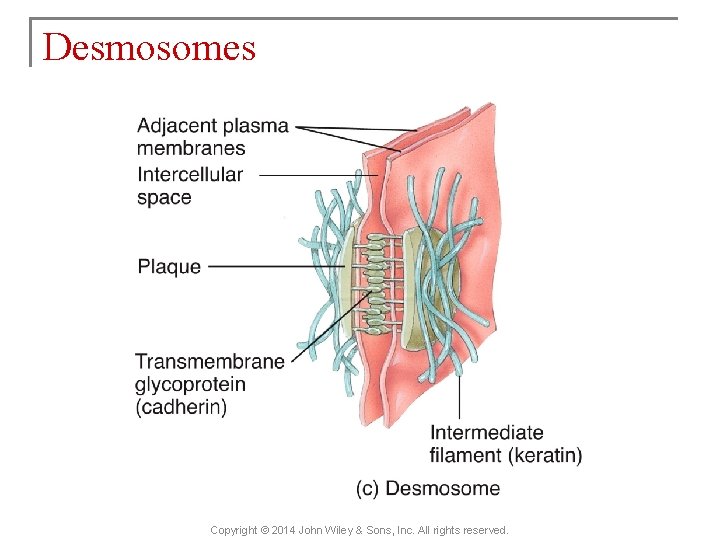
Desmosomes Copyright © 2014 John Wiley & Sons, Inc. All rights reserved.
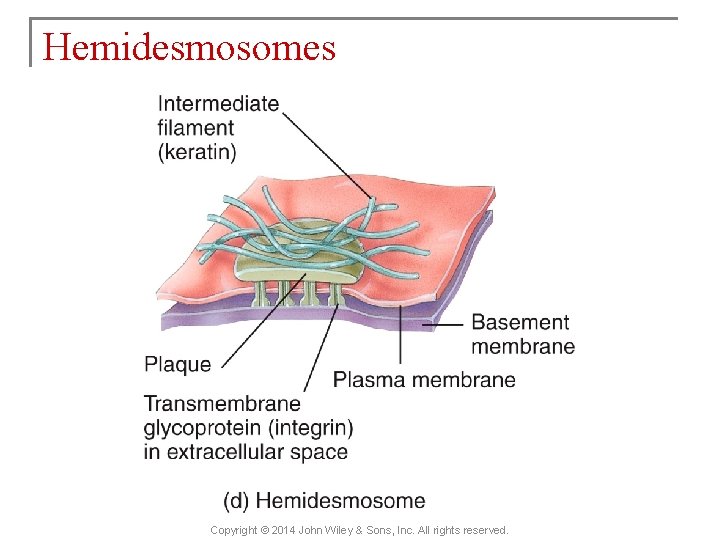
Hemidesmosomes Copyright © 2014 John Wiley & Sons, Inc. All rights reserved.
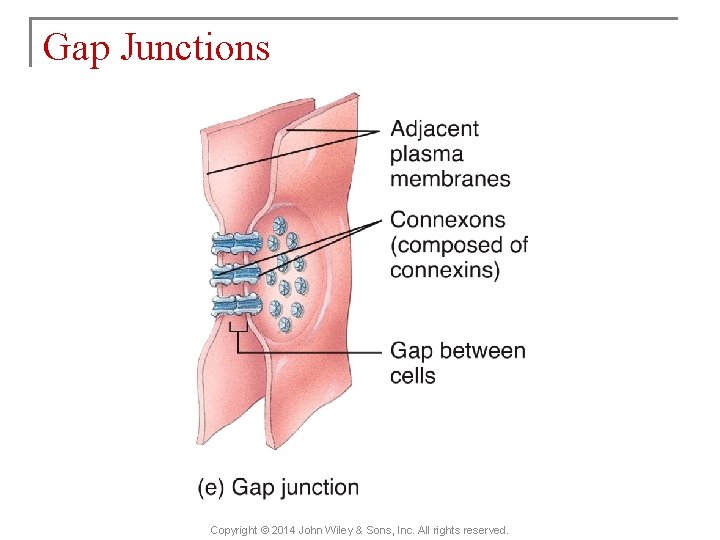
Gap Junctions Copyright © 2014 John Wiley & Sons, Inc. All rights reserved.
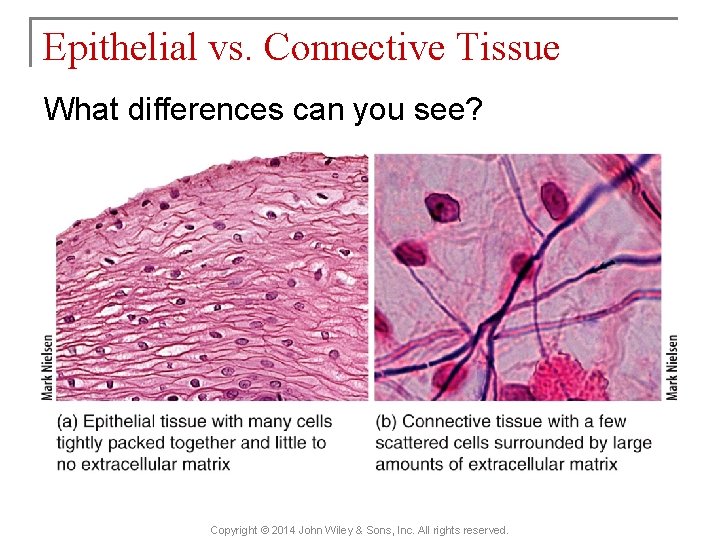
Epithelial vs. Connective Tissue What differences can you see? Copyright © 2014 John Wiley & Sons, Inc. All rights reserved.
Epithelial Tissue Copyright © 2014 John Wiley & Sons, Inc. All rights reserved.
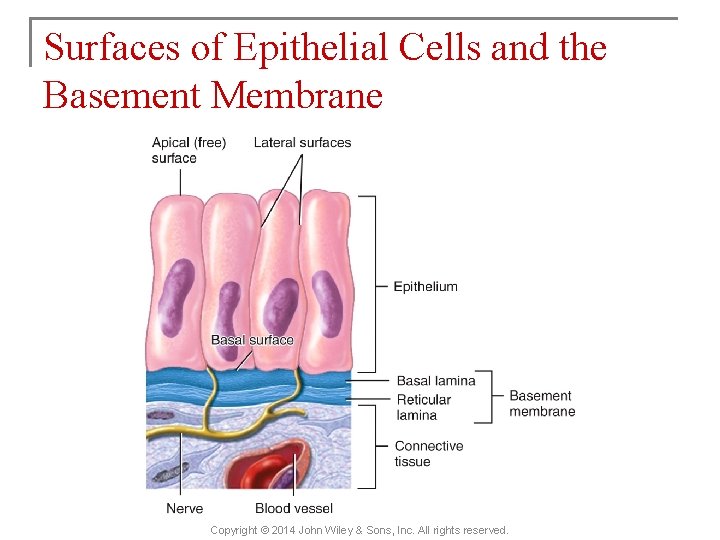
General Features of Epithelial Tissue § Cells are arranged in sheets § Cells are densely packed § Many cell junctions are present § Epithelial cells attach to a basement membrane § Epithelial tissue is avascular but does have a nerve supply § Mitosis occurs frequently Copyright © 2014 John Wiley & Sons, Inc. All rights reserved.
Surfaces of Epithelial Cells and the Basement Membrane Copyright © 2014 John Wiley & Sons, Inc. All rights reserved.
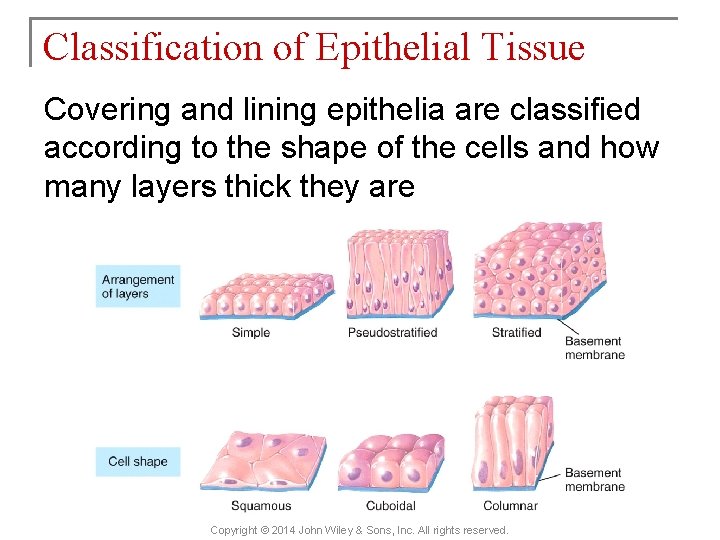
Classification of Epithelial Tissue Covering and lining epithelia are classified according to the shape of the cells and how many layers thick they are Copyright © 2014 John Wiley & Sons, Inc. All rights reserved.
Covering and Lining Epithelial Tissue The name of the specific type of stratified epithelial tissue depends on the shape of the apical cells § Table 4. 1 in your textbook shows examples of each of the epithelial tissues – notice the similarities and differences! Copyright © 2014 John Wiley & Sons, Inc. All rights reserved.
Epithelial Tissue Anatomy Overview: Epithelial Tissues You must be connected to the Internet and in Slideshow Mode to run this animation. Copyright © 2014 John Wiley & Sons, Inc. All rights reserved.
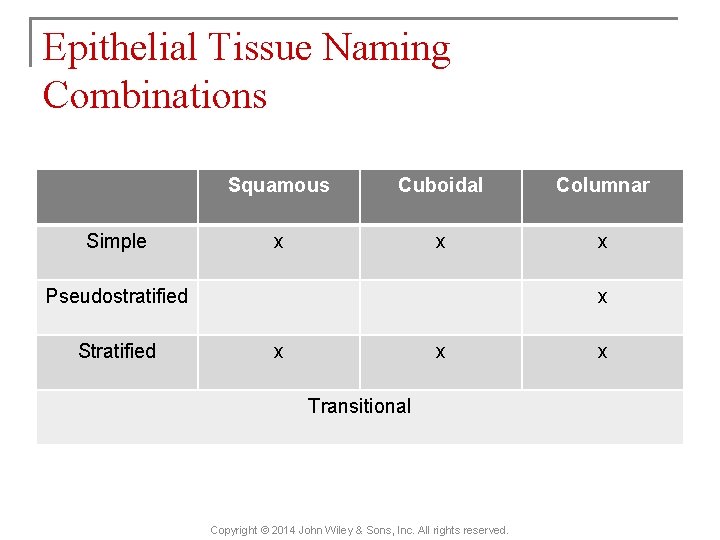
Epithelial Tissue Naming Combinations Simple Squamous Cuboidal Columnar x x x Pseudostratified Stratified x x x Transitional Copyright © 2014 John Wiley & Sons, Inc. All rights reserved. x
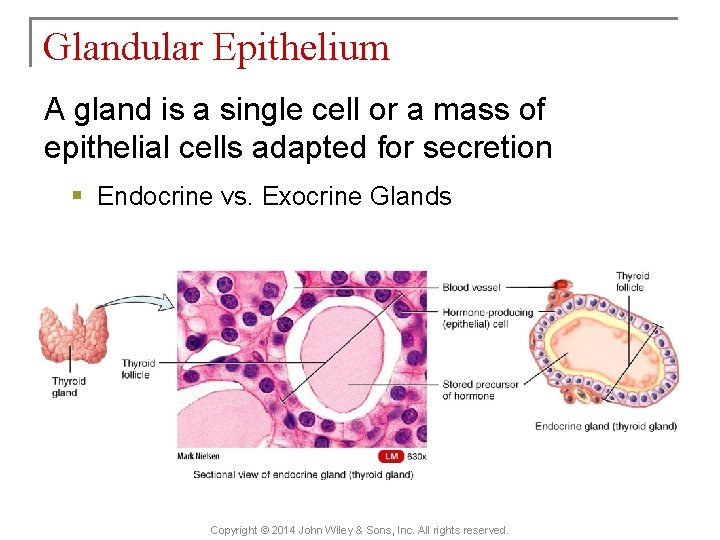
Glandular Epithelium A gland is a single cell or a mass of epithelial cells adapted for secretion § Endocrine vs. Exocrine Glands Copyright © 2014 John Wiley & Sons, Inc. All rights reserved.
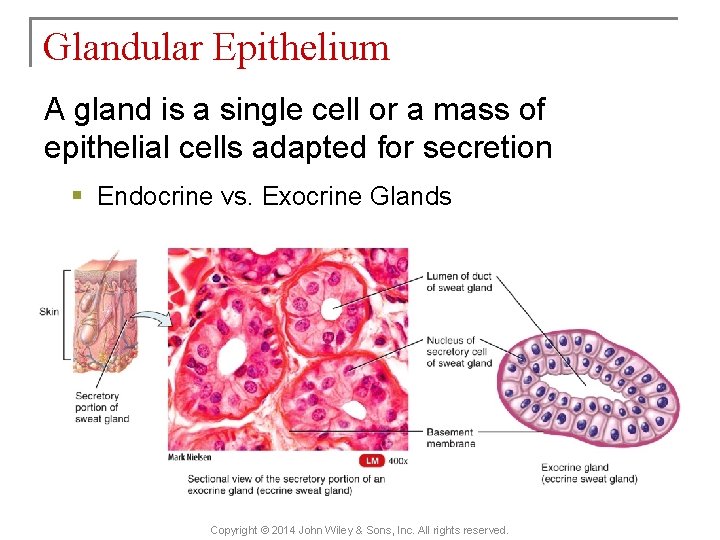
Glandular Epithelium A gland is a single cell or a mass of epithelial cells adapted for secretion § Endocrine vs. Exocrine Glands Copyright © 2014 John Wiley & Sons, Inc. All rights reserved.
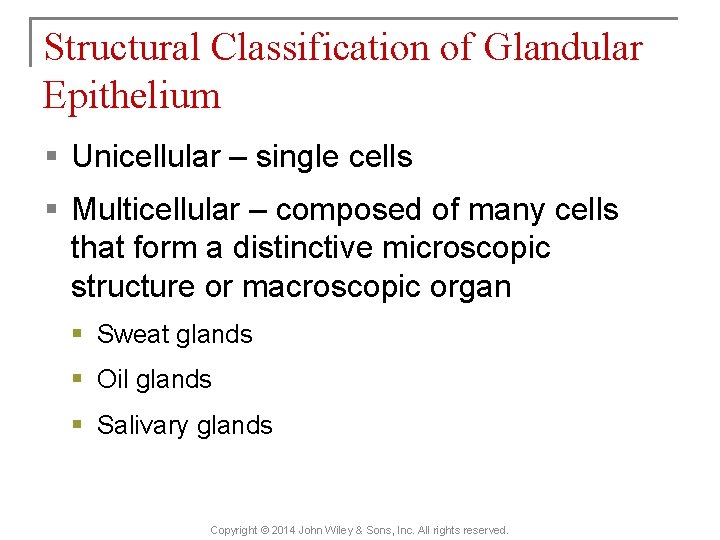
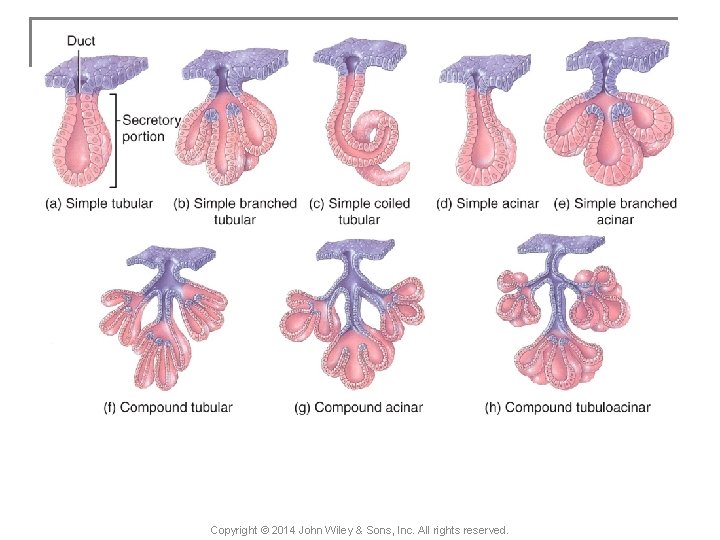
Structural Classification of Glandular Epithelium § Unicellular – single cells § Multicellular – composed of many cells that form a distinctive microscopic structure or macroscopic organ § Sweat glands § Oil glands § Salivary glands Copyright © 2014 John Wiley & Sons, Inc. All rights reserved.
Copyright © 2014 John Wiley & Sons, Inc. All rights reserved.
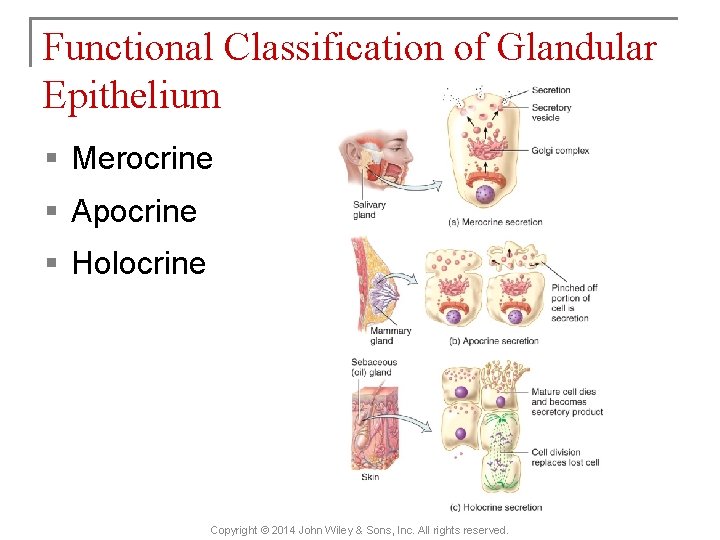
Functional Classification of Glandular Epithelium § Merocrine § Apocrine § Holocrine Copyright © 2014 John Wiley & Sons, Inc. All rights reserved.
Connective Tissue Copyright © 2014 John Wiley & Sons, Inc. All rights reserved.
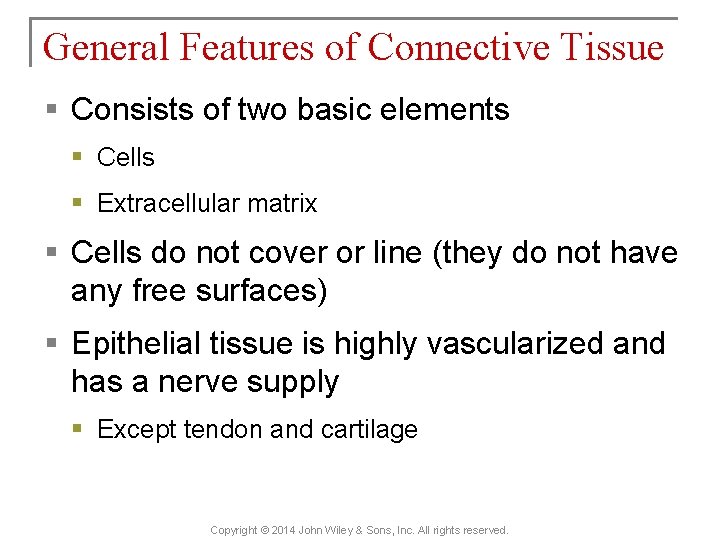
General Features of Connective Tissue § Consists of two basic elements § Cells § Extracellular matrix § Cells do not cover or line (they do not have any free surfaces) § Epithelial tissue is highly vascularized and has a nerve supply § Except tendon and cartilage Copyright © 2014 John Wiley & Sons, Inc. All rights reserved.
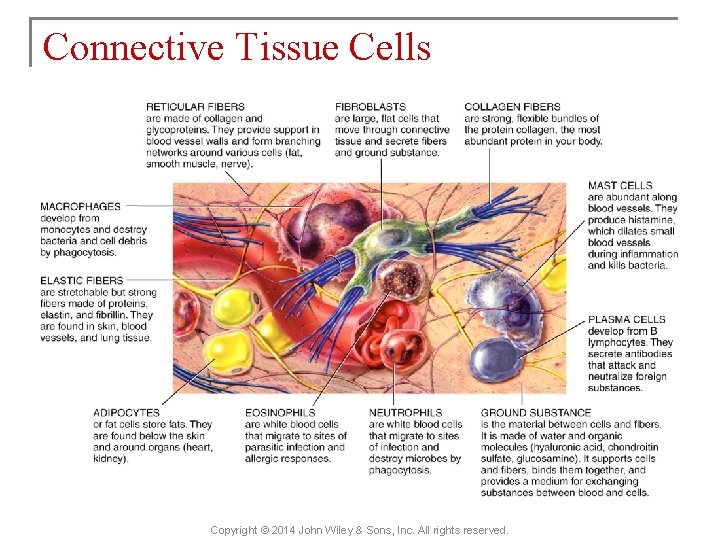
Connective Tissue Cells Copyright © 2014 John Wiley & Sons, Inc. All rights reserved.
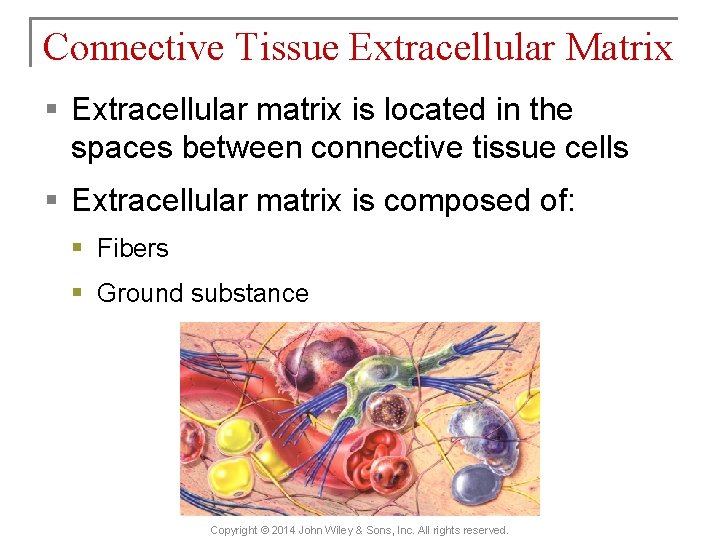
Connective Tissue Extracellular Matrix § Extracellular matrix is located in the spaces between connective tissue cells § Extracellular matrix is composed of: § Fibers § Ground substance Copyright © 2014 John Wiley & Sons, Inc. All rights reserved.
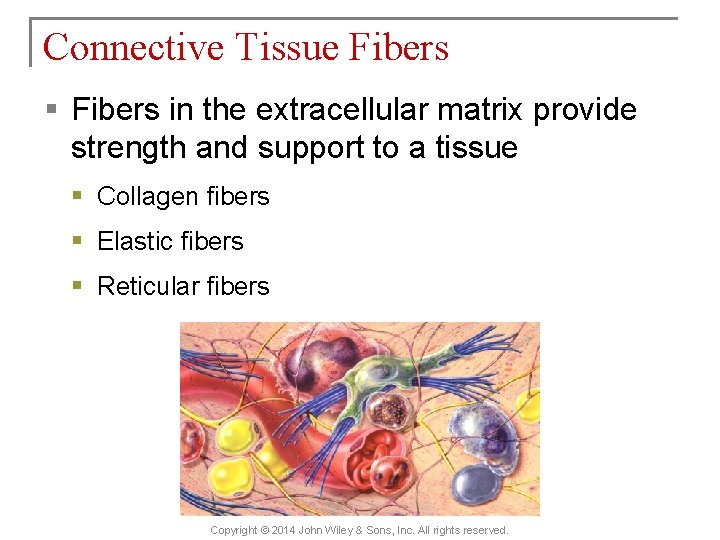
Connective Tissue Fibers § Fibers in the extracellular matrix provide strength and support to a tissue § Collagen fibers § Elastic fibers § Reticular fibers Copyright © 2014 John Wiley & Sons, Inc. All rights reserved.
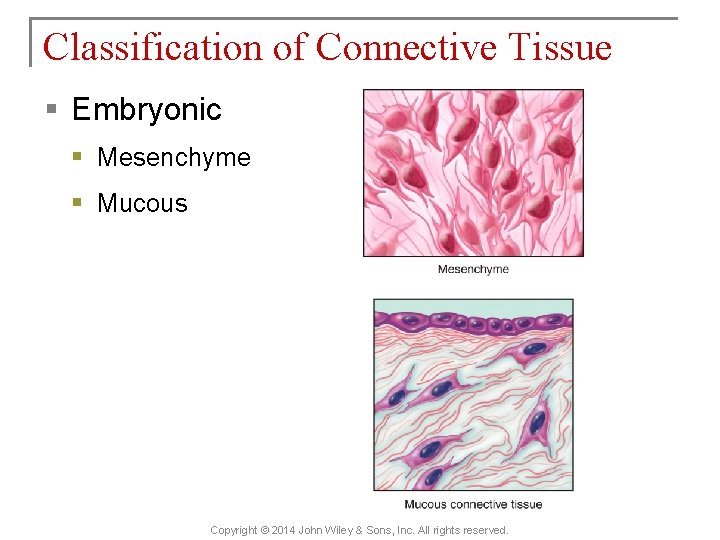
Classification of Connective Tissue § Embryonic § Mesenchyme § Mucous Copyright © 2014 John Wiley & Sons, Inc. All rights reserved.
Classification of Connective Tissue § Mature § Loose § Dense § Cartilage § Bone § Blood Copyright © 2014 John Wiley & Sons, Inc. All rights reserved.
Connective Tissue Anatomy Overview: Connective Tissues You must be connected to the Internet and in Slideshow Mode to run this animation. Copyright © 2014 John Wiley & Sons, Inc. All rights reserved.
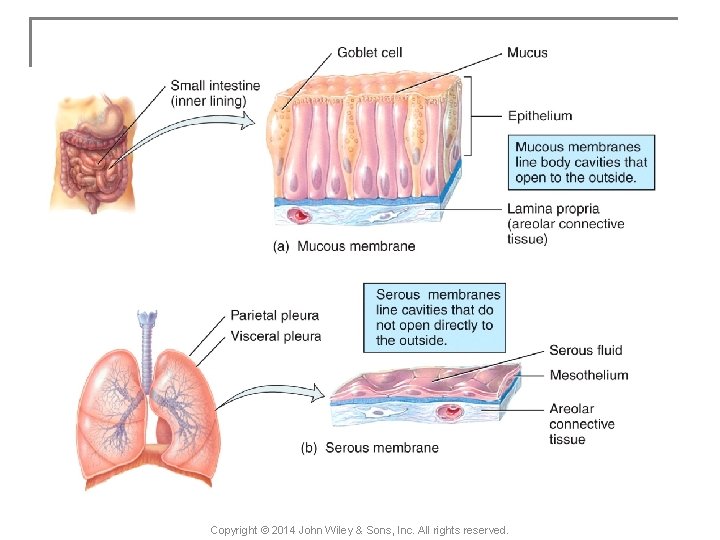
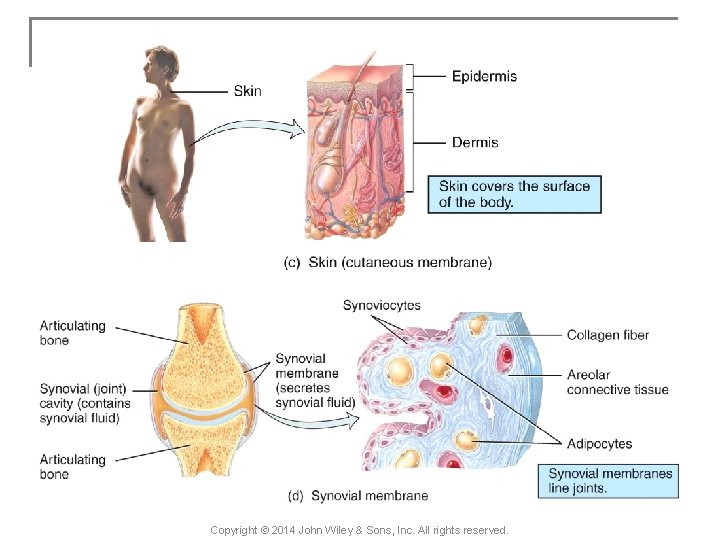
Membranes § Membranes are flat sheets of pliable tissue that cover or line a part of the body § 2 types of membranes 1. Epithelial membranes § Mucous membranes § Serous membranes § Cutaneous membranes 2. Synovial membranes Copyright © 2014 John Wiley & Sons, Inc. All rights reserved.
Copyright © 2014 John Wiley & Sons, Inc. All rights reserved.
Copyright © 2014 John Wiley & Sons, Inc. All rights reserved.
Muscle Tissue Copyright © 2014 John Wiley & Sons, Inc. All rights reserved.
General Characteristics of Muscular Tissue § Muscle tissue consists of fibers that provide motion, maintain posture, and produce heat § 3 types of muscle tissue 1. Skeletal muscle 2. Cardiac muscle 3. Smooth muscle Copyright © 2014 John Wiley & Sons, Inc. All rights reserved.
Muscle Tissue Anatomy Overview: Muscle Tissue You must be connected to the Internet and in Slideshow Mode to run this animation. Copyright © 2014 John Wiley & Sons, Inc. All rights reserved.
Nervous Tissue Copyright © 2014 John Wiley & Sons, Inc. All rights reserved.
General Characteristics of Nervous Tissue § Two kinds of cells: 1. Neurons 2. Neuroglia § Most neurons have a cell body, dendrites, and axons. They carry sensory and motor information and perform integrative functions. § Neuroglia protect and support neurons Copyright © 2014 John Wiley & Sons, Inc. All rights reserved.
Nervous Tissue Anatomy Overview: Nervous Tissue You must be connected to the Internet and in Slideshow Mode to run this animation. Copyright © 2014 John Wiley & Sons, Inc. All rights reserved.
Tissue Repair, Aging, and Disorders Copyright © 2014 John Wiley & Sons, Inc. All rights reserved.
Tissue Repair § Tissue repair is the process that replaces worn out, damaged, or dead cells. § Epithelial cells are replaced by the division of stem cells or undifferentiated cells § Not all connective tissue cells have the ability to repair § Muscle cells can perform limited repair § Some nervous cells can perform limited repair, others cannot § Fibrosis is the formation of scar tissue Copyright © 2014 John Wiley & Sons, Inc. All rights reserved.
Aging § Younger bodies generally experience: § A better nutritional state § A better blood supply to tissues § A faster metabolic rate § Aging slows the process of tissue repair Copyright © 2014 John Wiley & Sons, Inc. All rights reserved.
Disorders § Disorders of epithelial tissues tend to be specific to individual organs § Skin cancer § Disorders of connective tissues tend to be autoimmune in nature § Lupus § Disorders of muscular and nervous tissues will be discussed in later chapters Copyright © 2014 John Wiley & Sons, Inc. All rights reserved.
End of Chapter 4 Copyright 2014 John Wiley & Sons, Inc. All rights reserved. Reproduction or translation of this work beyond that permitted in section 117 of the 1976 United States Copyright Act without express permission of the copyright owner is unlawful. Request for further information should be addressed to the Permission Department, John Wiley & Sons, Inc. The purchaser may make back-up copies for his/her own use only and not for distribution or resale. The Publishers assumes no responsibility for errors, omissions, or damages caused by the use of these programs or from the use of the information herein. Copyright © 2014 John Wiley & Sons, Inc. All rights reserved.