
Principles of 2 D Image Analysis BMS 524
Principles of 2 D Image Analysis BMS 524 - “Introduction to Confocal Microscopy and Image Analysis” 1 Credit course offered by Purdue University Department of Basic Medical Sciences, School of Veterinary Medicine Part 1 Notes prepared by Dr. Bartek Rajwa, Prof. John Turek & Prof. J. Paul Robinson These slides are intended for use in a lecture series. Copies of the graphics are distributed and students encouraged to take their notes on these graphics. The intent is to have the student NOT try to reproduce the figures, but to LISTEN and UNDERSTAND the material. All material copyright J. Paul Robinson unless otherwise stated, however, the material may be freely used for lectures, tutorials and workshops on non-commercial nature. They may not be used for any commercial purpose including for profit courses. www. cyto. purdue. edu Last UPDATED January 2007 © 1997 -2007 B. Rajwa, J. Turek, & J. Paul Robinson, Purdue University
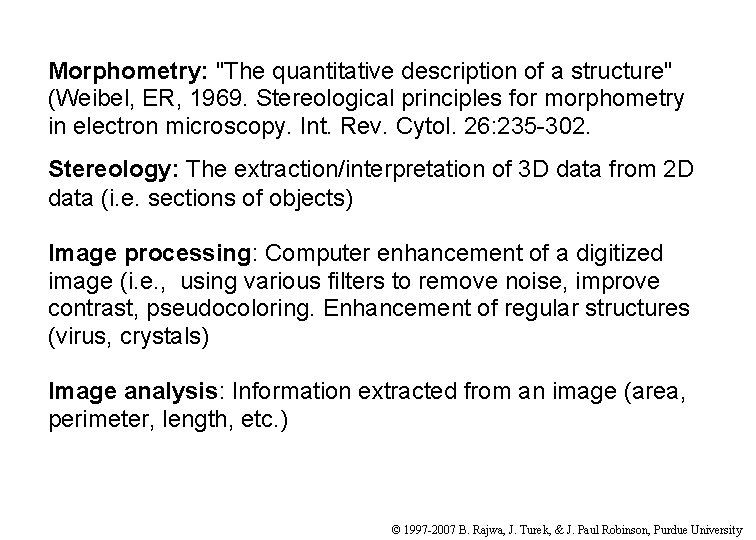
Morphometry: "The quantitative description of a structure" (Weibel, ER, 1969. Stereological principles for morphometry in electron microscopy. Int. Rev. Cytol. 26: 235 -302. Stereology: The extraction/interpretation of 3 D data from 2 D data (i. e. sections of objects) Image processing: Computer enhancement of a digitized image (i. e. , using various filters to remove noise, improve contrast, pseudocoloring. Enhancement of regular structures (virus, crystals) Image analysis: Information extracted from an image (area, perimeter, length, etc. ) © 1997 -2007 B. Rajwa, J. Turek, & J. Paul Robinson, Purdue University
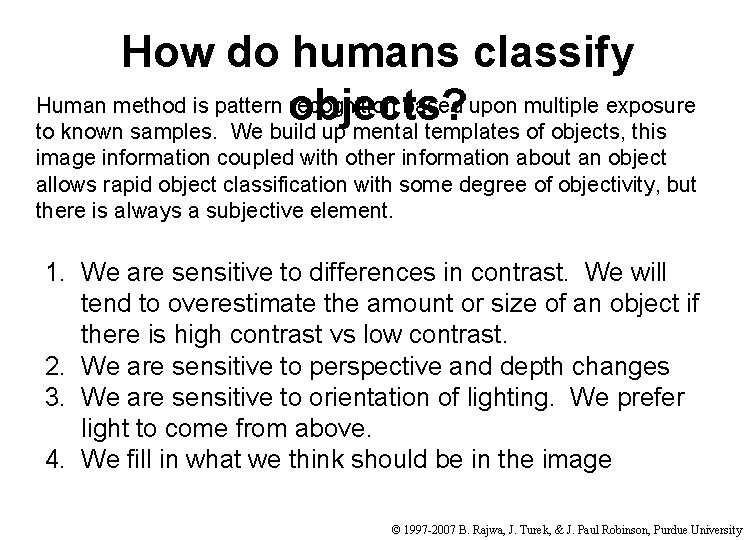
How do humans classify Human method is pattern recognition based upon multiple exposure objects? to known samples. We build up mental templates of objects, this image information coupled with other information about an object allows rapid object classification with some degree of objectivity, but there is always a subjective element. 1. We are sensitive to differences in contrast. We will tend to overestimate the amount or size of an object if there is high contrast vs low contrast. 2. We are sensitive to perspective and depth changes 3. We are sensitive to orientation of lighting. We prefer light to come from above. 4. We fill in what we think should be in the image © 1997 -2007 B. Rajwa, J. Turek, & J. Paul Robinson, Purdue University
Biological structures present a continuous spectrum of change. Morphometry eliminates subjectivity, it is more reproducible, and has greater limits of detection. © 1997 -2007 B. Rajwa, J. Turek, & J. Paul Robinson, Purdue University

© 1997 -2007 B. Rajwa, J. Turek, & J. Paul Robinson, Purdue University
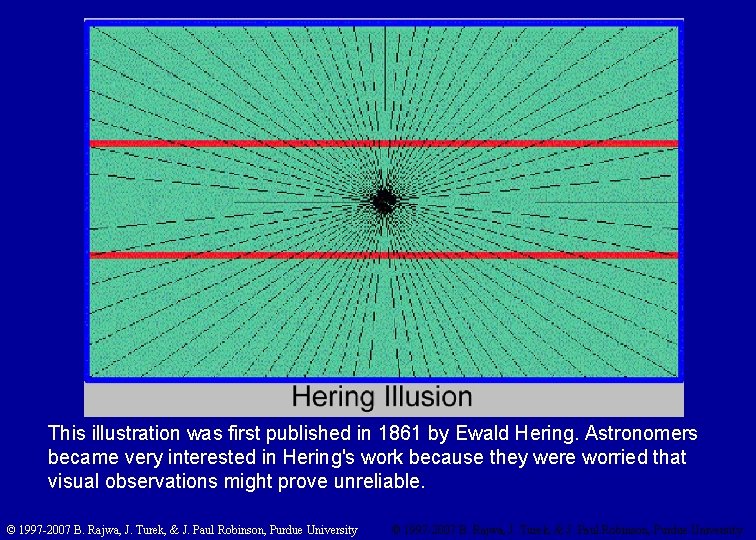
This illustration was first published in 1861 by Ewald Hering. Astronomers became very interested in Hering's work because they were worried that visual observations might prove unreliable. © 1997 -2007 B. Rajwa, J. Turek, & J. Paul Robinson, Purdue University
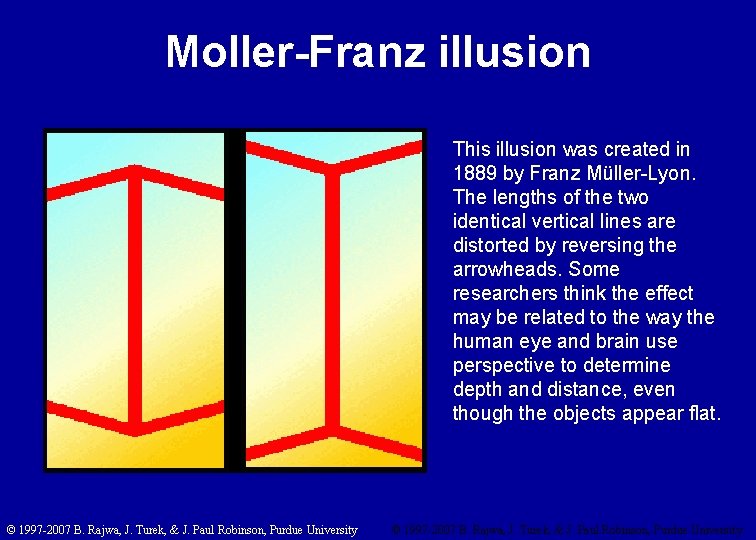
Moller-Franz illusion This illusion was created in 1889 by Franz Müller-Lyon. The lengths of the two identical vertical lines are distorted by reversing the arrowheads. Some researchers think the effect may be related to the way the human eye and brain use perspective to determine depth and distance, even though the objects appear flat. © 1997 -2007 B. Rajwa, J. Turek, & J. Paul Robinson, Purdue University
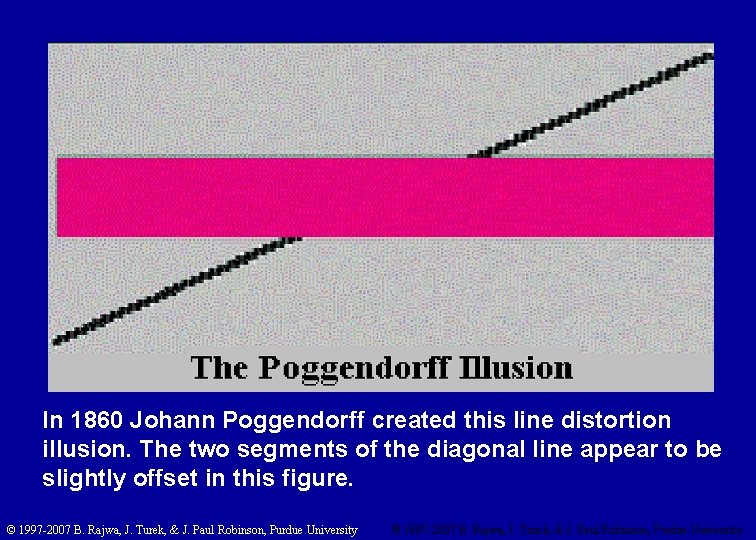
In 1860 Johann Poggendorff created this line distortion illusion. The two segments of the diagonal line appear to be slightly offset in this figure. © 1997 -2007 B. Rajwa, J. Turek, & J. Paul Robinson, Purdue University
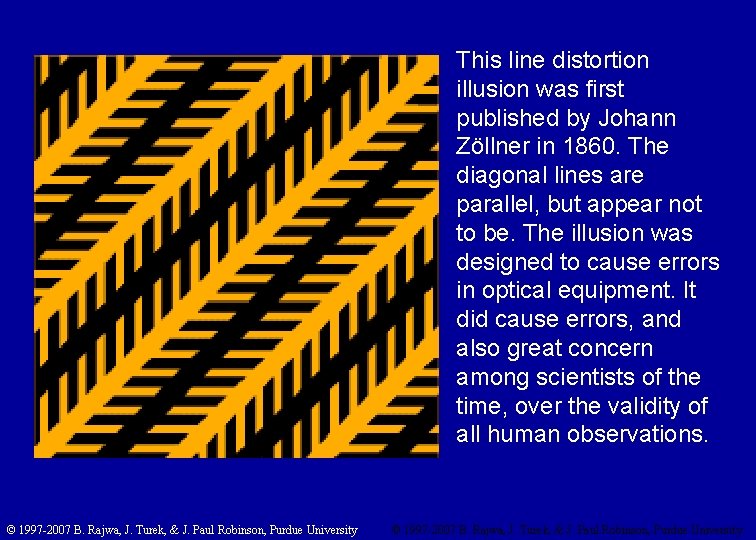
This line distortion illusion was first published by Johann Zöllner in 1860. The diagonal lines are parallel, but appear not to be. The illusion was designed to cause errors in optical equipment. It did cause errors, and also great concern among scientists of the time, over the validity of all human observations. © 1997 -2007 B. Rajwa, J. Turek, & J. Paul Robinson, Purdue University
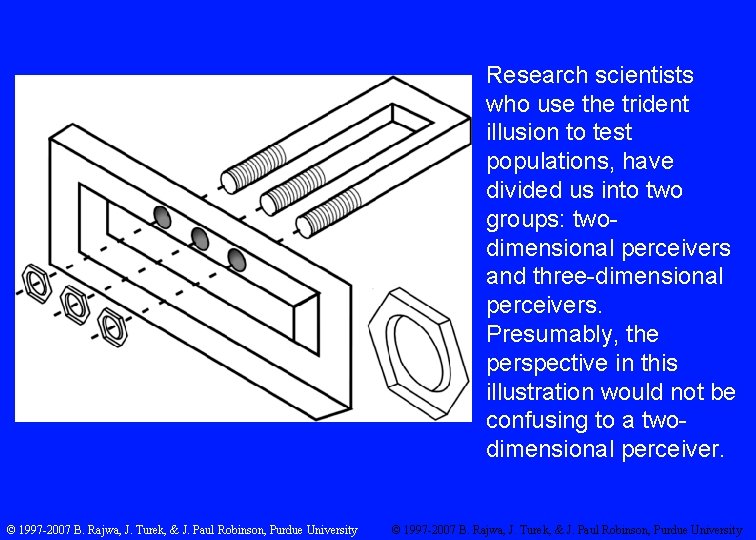
Research scientists who use the trident illusion to test populations, have divided us into two groups: twodimensional perceivers and three-dimensional perceivers. Presumably, the perspective in this illustration would not be confusing to a twodimensional perceiver. © 1997 -2007 B. Rajwa, J. Turek, & J. Paul Robinson, Purdue University
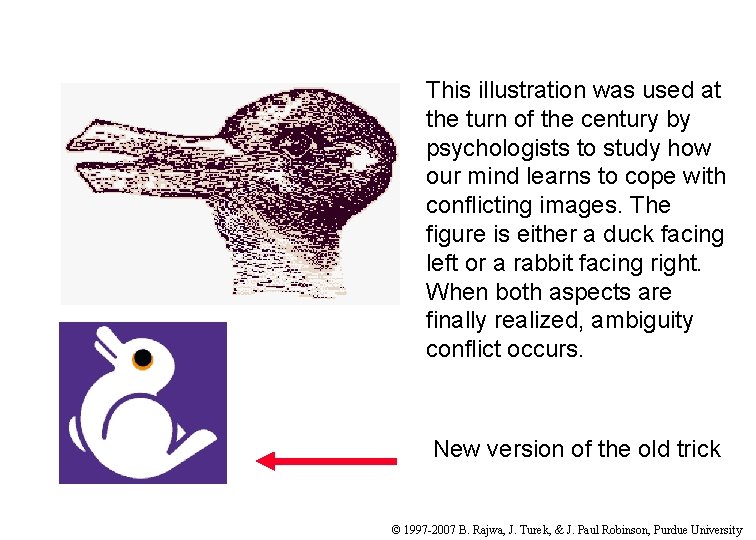
This illustration was used at the turn of the century by psychologists to study how our mind learns to cope with conflicting images. The figure is either a duck facing left or a rabbit facing right. When both aspects are finally realized, ambiguity conflict occurs. New version of the old trick © 1997 -2007 B. Rajwa, J. Turek, & J. Paul Robinson, Purdue University
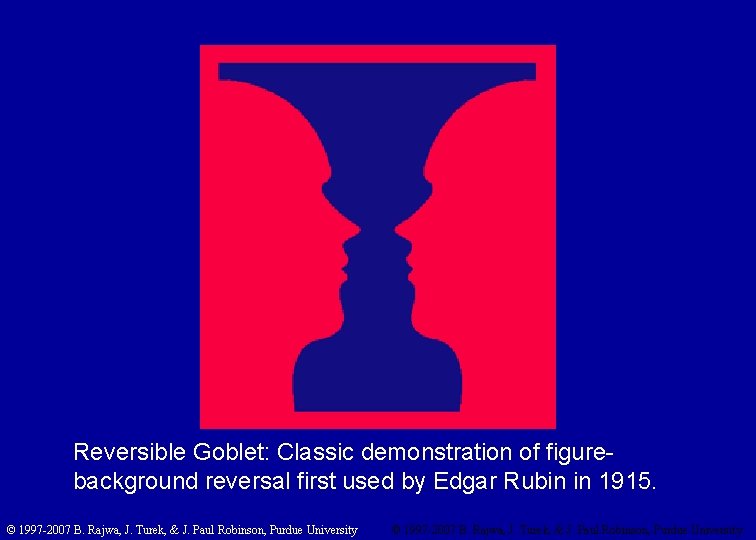
Reversible Goblet: Classic demonstration of figurebackground reversal first used by Edgar Rubin in 1915. © 1997 -2007 B. Rajwa, J. Turek, & J. Paul Robinson, Purdue University
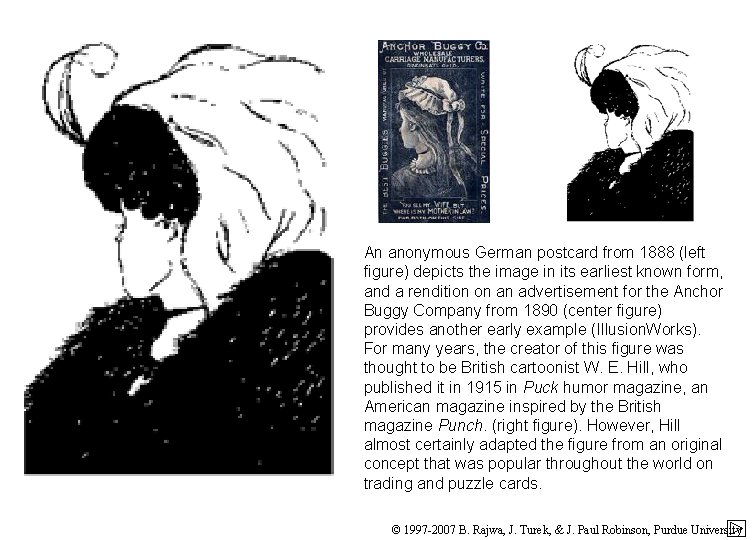
An anonymous German postcard from 1888 (left figure) depicts the image in its earliest known form, and a rendition on an advertisement for the Anchor Buggy Company from 1890 (center figure) provides another early example (Illusion. Works). For many years, the creator of this figure was thought to be British cartoonist W. E. Hill, who published it in 1915 in Puck humor magazine, an American magazine inspired by the British magazine Punch. (right figure). However, Hill almost certainly adapted the figure from an original concept that was popular throughout the world on trading and puzzle cards. © 1997 -2007 B. Rajwa, J. Turek, & J. Paul Robinson, Purdue University
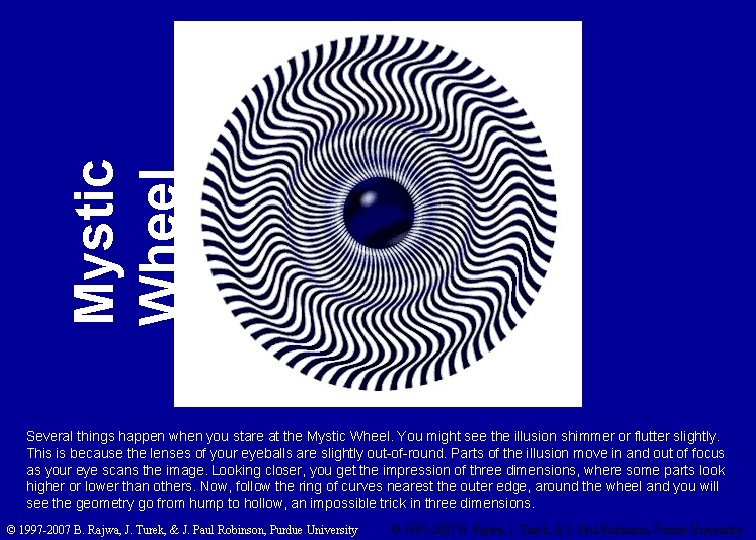
Mystic Wheel Several things happen when you stare at the Mystic Wheel. You might see the illusion shimmer or flutter slightly. This is because the lenses of your eyeballs are slightly out-of-round. Parts of the illusion move in and out of focus as your eye scans the image. Looking closer, you get the impression of three dimensions, where some parts look higher or lower than others. Now, follow the ring of curves nearest the outer edge, around the wheel and you will see the geometry go from hump to hollow, an impossible trick in three dimensions. © 1997 -2007 B. Rajwa, J. Turek, & J. Paul Robinson, Purdue University
© 1997 -2007 B. Rajwa, J. Turek, & J. Paul Robinson, Purdue University
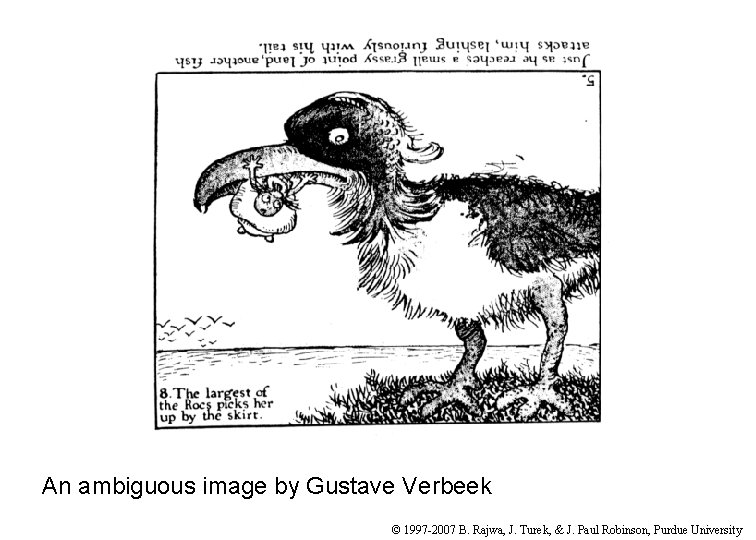
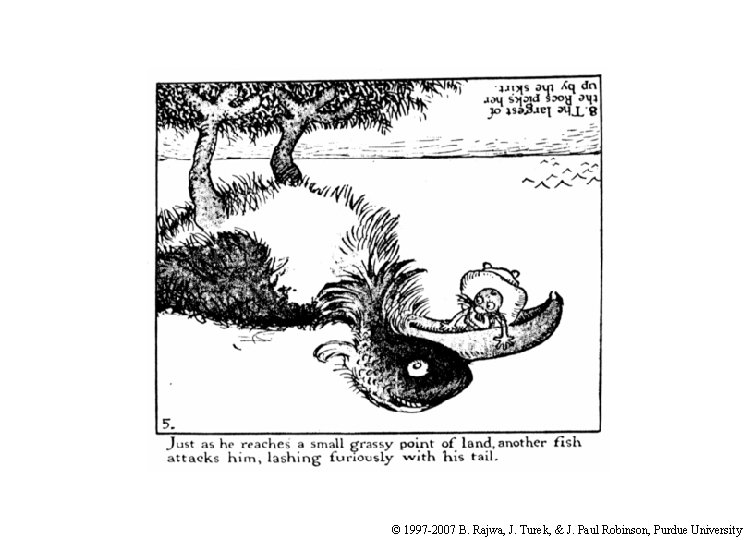
An ambiguous image by Gustave Verbeek © 1997 -2007 B. Rajwa, J. Turek, & J. Paul Robinson, Purdue University
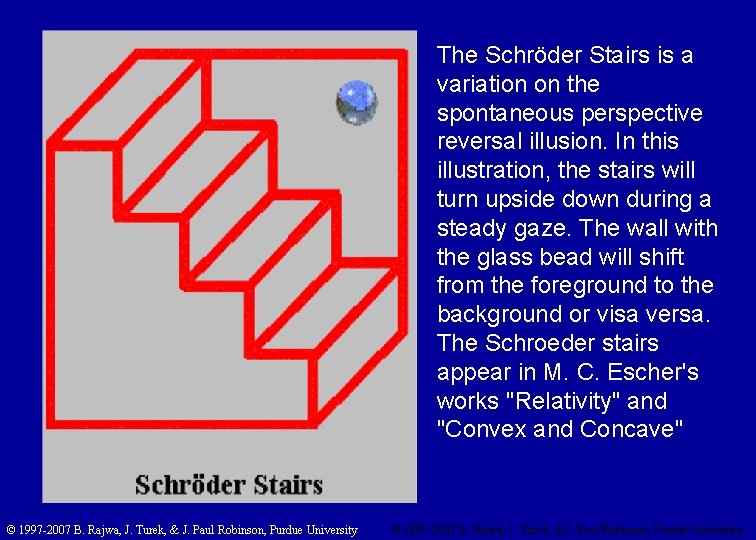
The Schröder Stairs is a variation on the spontaneous perspective reversal illusion. In this illustration, the stairs will turn upside down during a steady gaze. The wall with the glass bead will shift from the foreground to the background or visa versa. The Schroeder stairs appear in M. C. Escher's works "Relativity" and "Convex and Concave" © 1997 -2007 B. Rajwa, J. Turek, & J. Paul Robinson, Purdue University
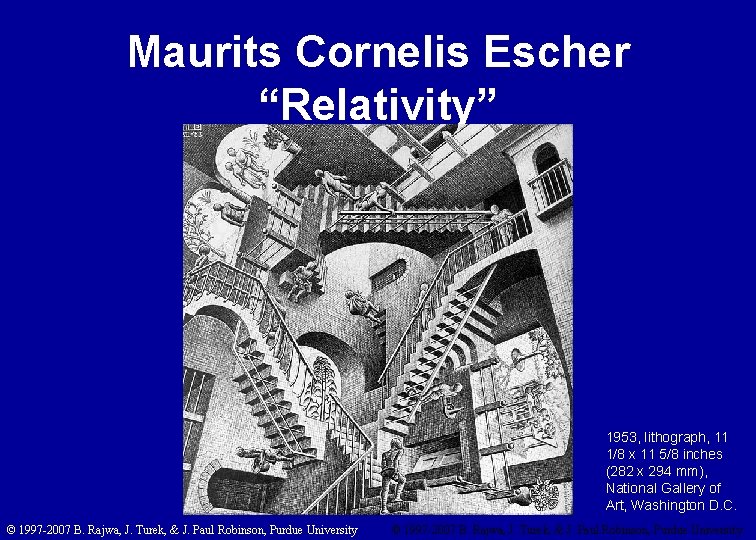
Maurits Cornelis Escher “Relativity” 1953, lithograph, 11 1/8 x 11 5/8 inches (282 x 294 mm), National Gallery of Art, Washington D. C. © 1997 -2007 B. Rajwa, J. Turek, & J. Paul Robinson, Purdue University
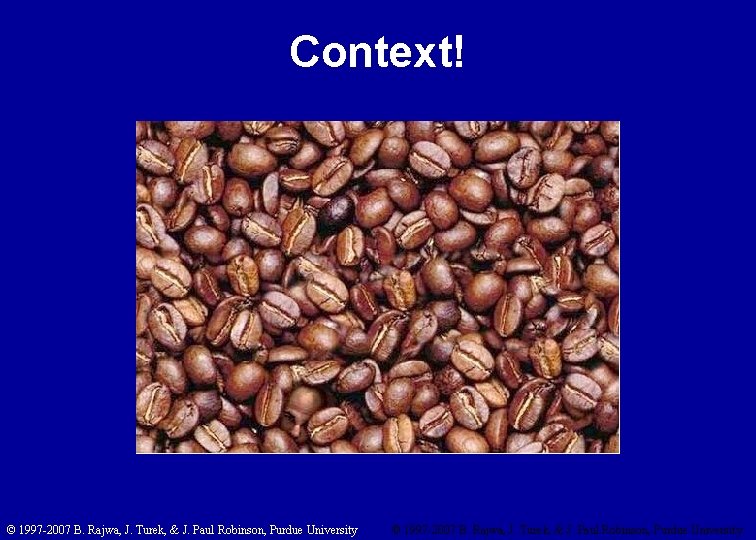
Context! © 1997 -2007 B. Rajwa, J. Turek, & J. Paul Robinson, Purdue University
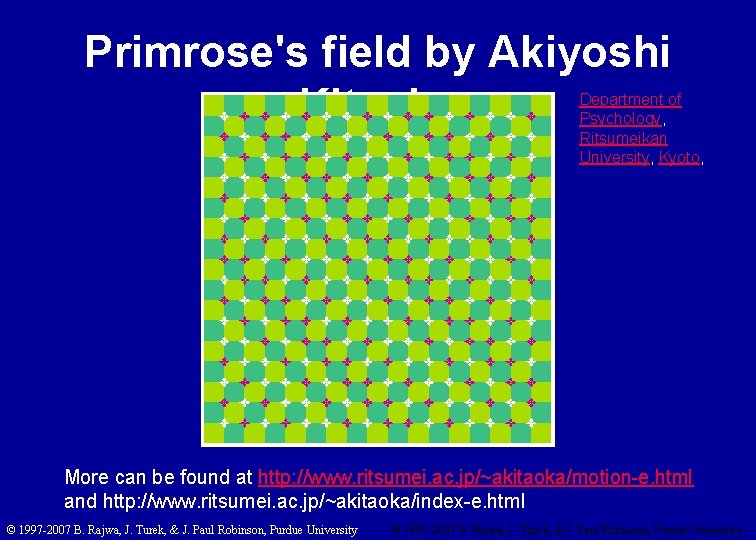
Primrose's field by Akiyoshi Kitaoka Department of Psychology, Ritsumeikan University, Kyoto, More can be found at http: //www. ritsumei. ac. jp/~akitaoka/motion-e. html and http: //www. ritsumei. ac. jp/~akitaoka/index-e. html © 1997 -2007 B. Rajwa, J. Turek, & J. Paul Robinson, Purdue University
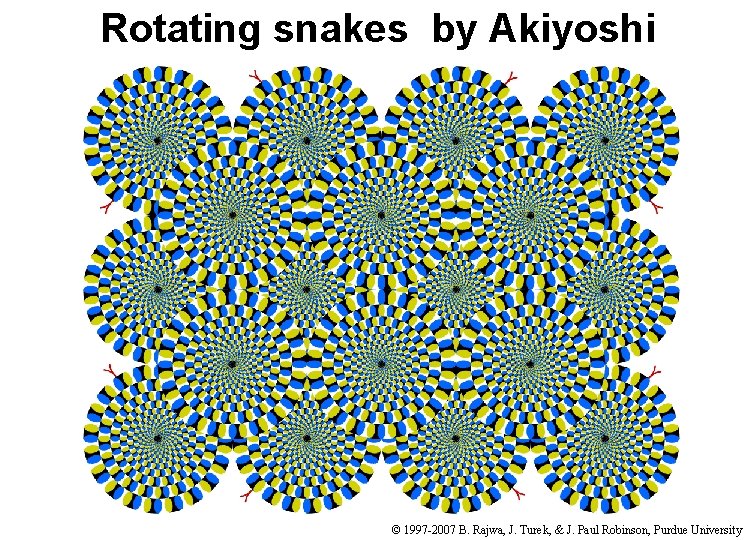
Rotating snakes by Akiyoshi Kitaoka © 1997 -2007 B. Rajwa, J. Turek, & J. Paul Robinson, Purdue University
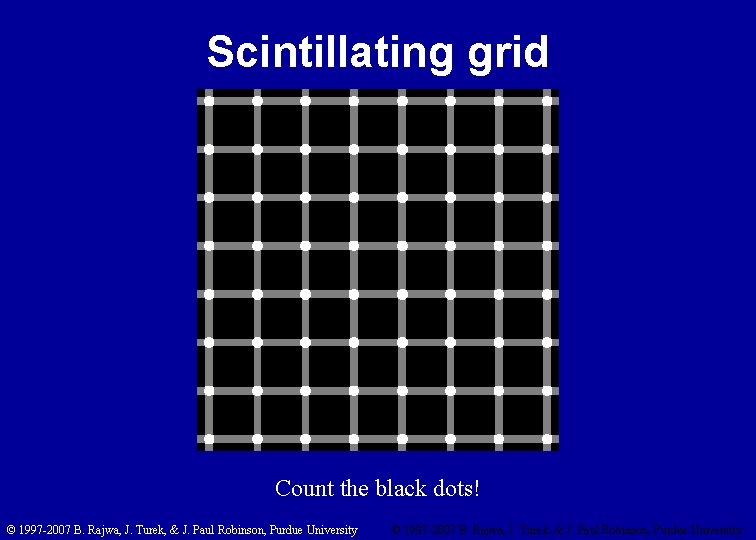
Scintillating grid Count the black dots! © 1997 -2007 B. Rajwa, J. Turek, & J. Paul Robinson, Purdue University
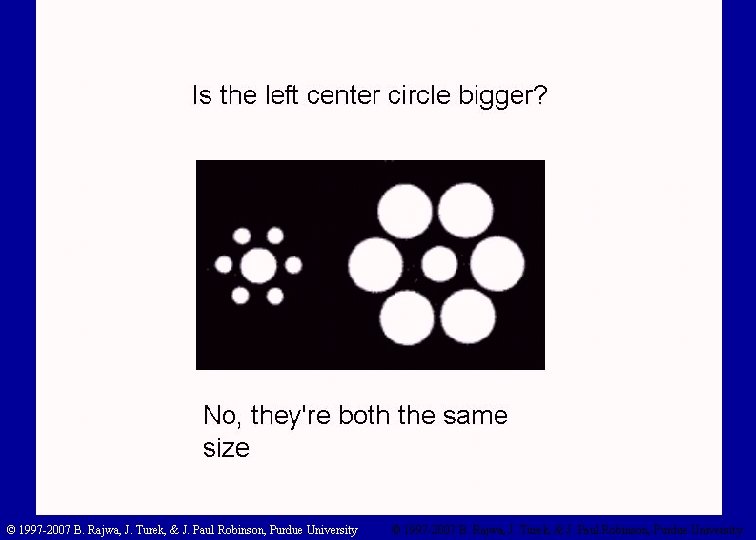
© 1997 -2007 B. Rajwa, J. Turek, & J. Paul Robinson, Purdue University
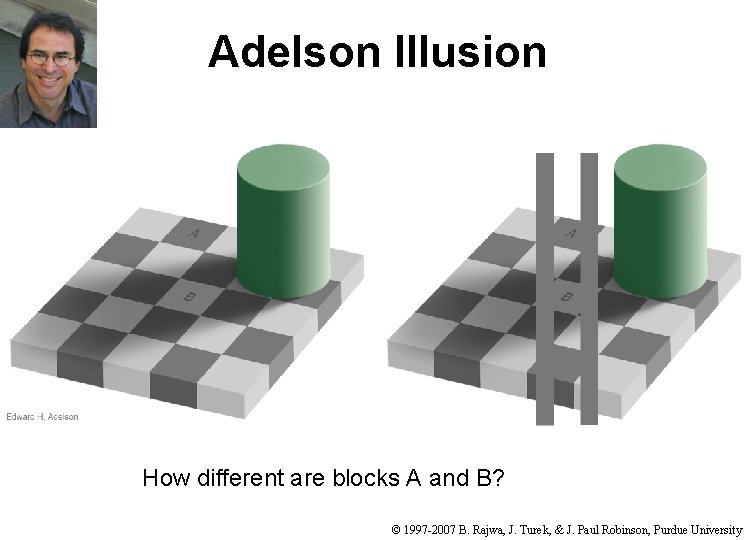
Adelson Illusion How different are blocks A and B? © 1997 -2007 B. Rajwa, J. Turek, & J. Paul Robinson, Purdue University
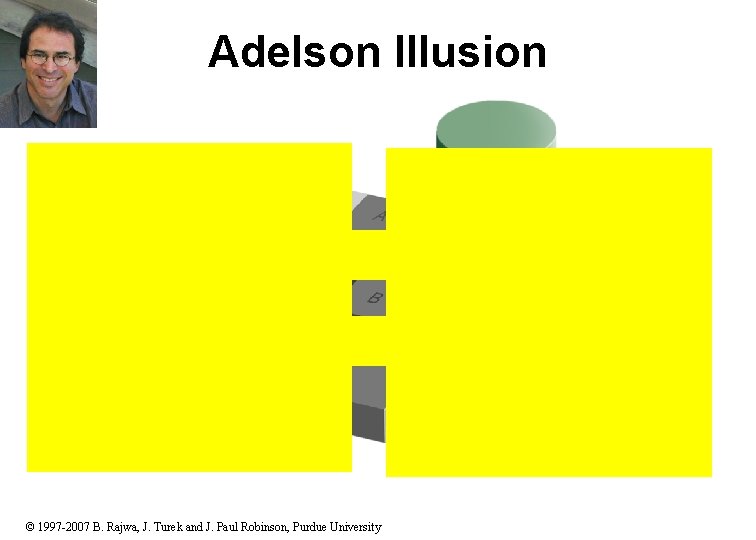
Adelson Illusion © 1997 -2007 B. Rajwa, J. Turek and J. Paul Robinson, Purdue University
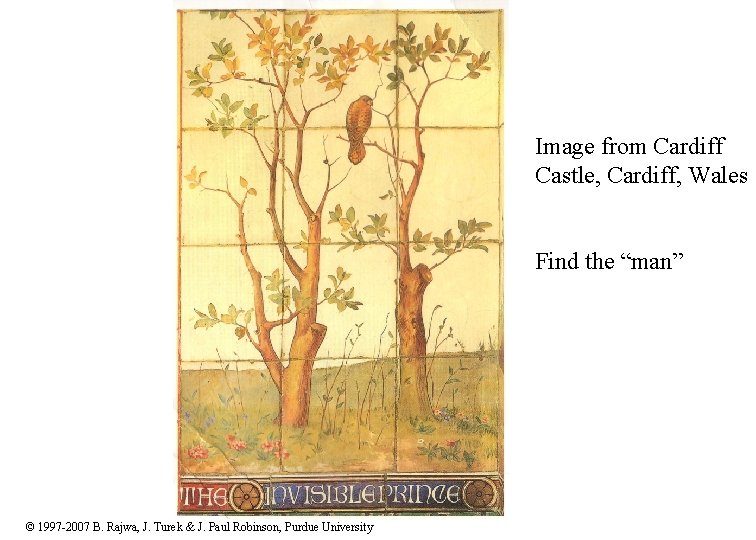
Image from Cardiff Castle, Cardiff, Wales Find the “man” © 1997 -2007 B. Rajwa, J. Turek & J. Paul Robinson, Purdue University
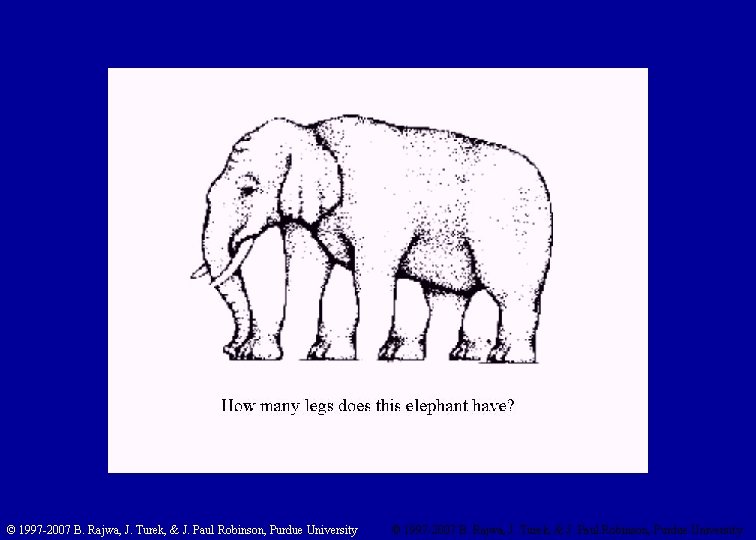
© 1997 -2007 B. Rajwa, J. Turek, & J. Paul Robinson, Purdue University
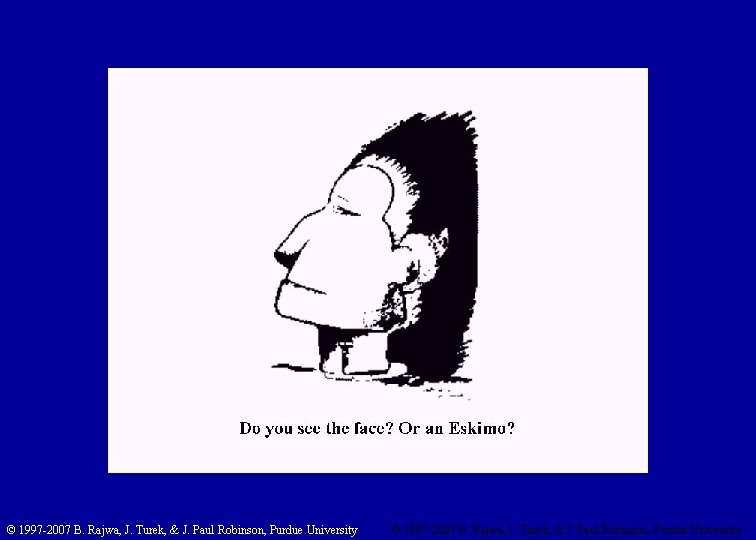
© 1997 -2007 B. Rajwa, J. Turek, & J. Paul Robinson, Purdue University
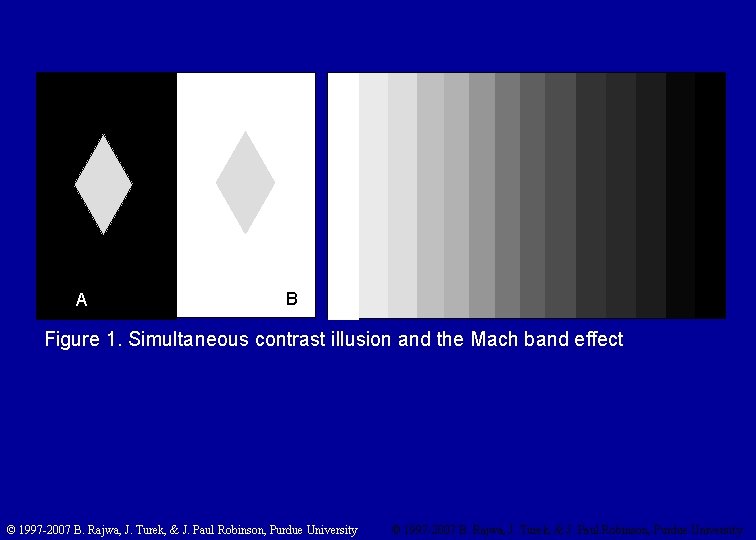
A B Figure 1. Simultaneous contrast illusion and the Mach band effect © 1997 -2007 B. Rajwa, J. Turek, & J. Paul Robinson, Purdue University
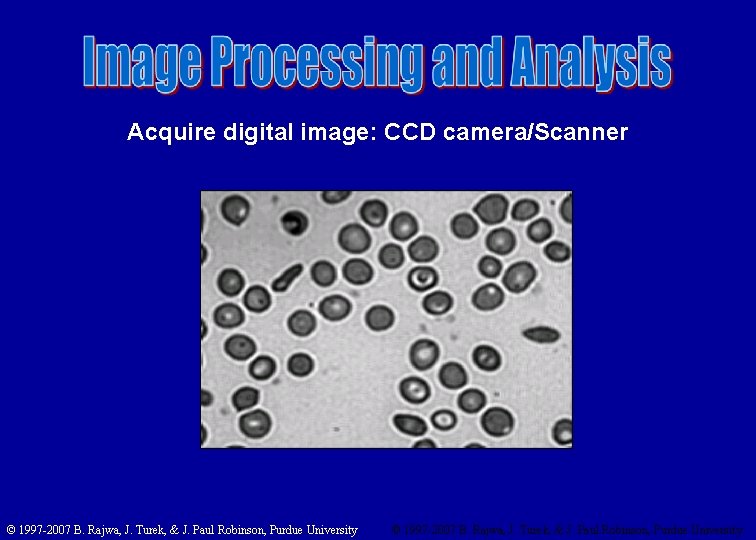
Acquire digital image: CCD camera/Scanner © 1997 -2007 B. Rajwa, J. Turek, & J. Paul Robinson, Purdue University
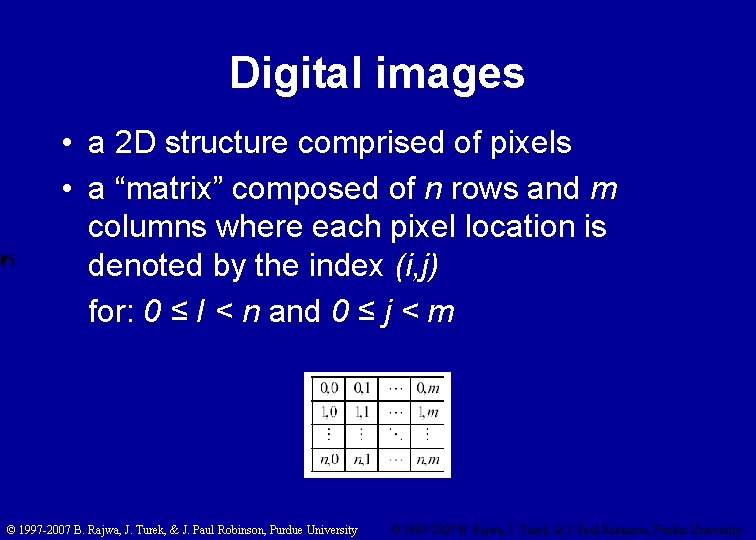
Digital images • a 2 D structure comprised of pixels • a “matrix” composed of n rows and m columns where each pixel location is denoted by the index (i, j) for: 0 ≤ I < n and 0 ≤ j < m © 1997 -2007 B. Rajwa, J. Turek, & J. Paul Robinson, Purdue University
Resolution Microscopy • Rayleigh criterion • Sparrow criterion • FWHM © 1997 -2007 B. Rajwa, J. Turek, & J. Paul Robinson, Purdue University Digital image processing The spatial resolution of an image is the physical size of a pixel in an image © 1997 -2007 B. Rajwa, J. Turek, & J. Paul Robinson, Purdue University
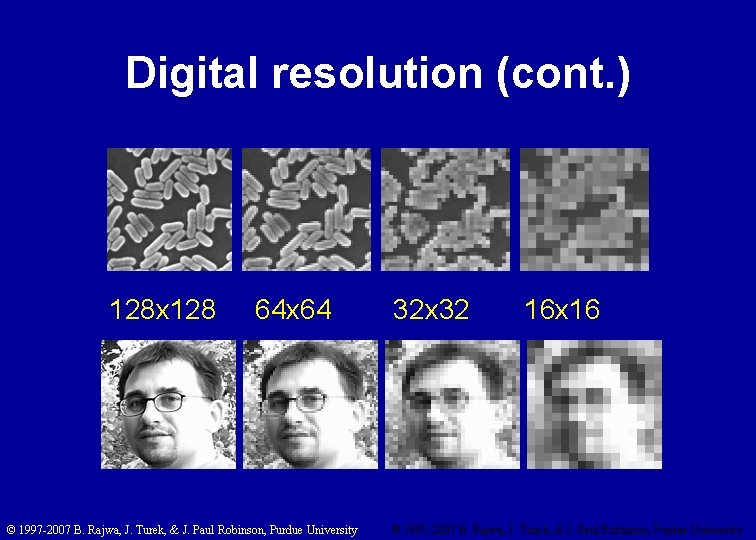
Digital resolution (cont. ) 128 x 128 64 x 64 32 x 32 16 x 16 © 1997 -2007 B. Rajwa, J. Turek, & J. Paul Robinson, Purdue University
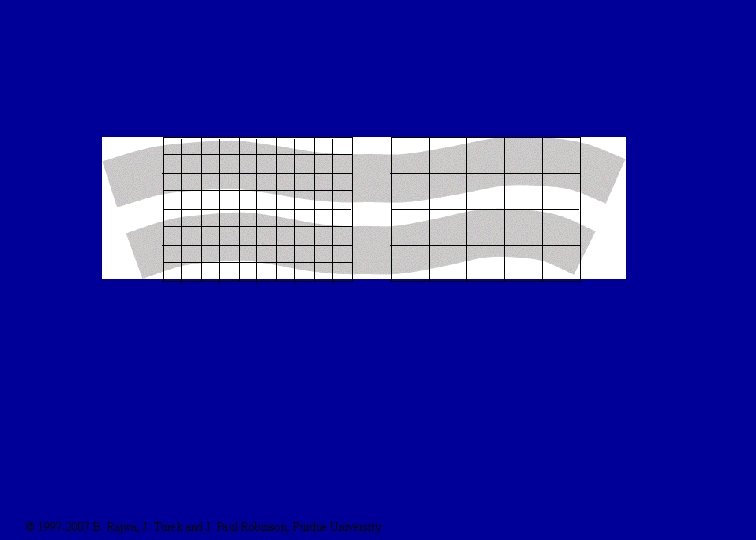
• • • Image resolution in electronic publishing Image resolution is measured in pixels per inch (ppi). An image with a resolution of 100 ppi, contains 10, 000 pixels in a square inch (100 pixels wide x 100 pixels high = 10, 000). The higher the resolution, the more pixels in the image. A 2 -by-2 -inch image with a resolution of 100 ppi would have 40000 pixels. The same image with a resolution of 300 ppi would have 360, 000 pixels in the same 2 -by-2 -inch area. To perform image analysis it is necessary that the features of interest are captured so that the measurements are performed on images that are not “pixelated”. A round object when pixelated will have jagged edges. © 1997 -2007 B. Rajwa, J. Turek, & J. Paul Robinson, Purdue University
![Resolution 1 20% intensity drop Intensity [A. U. ] 0. 8 0. 6 0.](http://slidetodoc.com/presentation_image_h/fd8854b03fa1cada98964bbb27719095/image-35.jpg "Resolution 1 20% intensity drop Intensity [A. U. ] 0. 8 0. 6 0.")
Resolution 1 20% intensity drop Intensity [A. U. ] 0. 8 0. 6 0. 4 0. 2 0 -10 -8 -6 -4 -2 0 2 4 Spatial coordinate [A. U. ] 6 8 10 The Rayleigh criterion is the generally accepted, although arbitrary, criterion for the minimum resolvable detail – the imaging process is said to be diffraction-limited when the first diffraction minimum of the image of one source point coincides with the maximum of another. © 1997 -2007 B. Rajwa, J. Turek and J. Paul Robinson, Purdue University
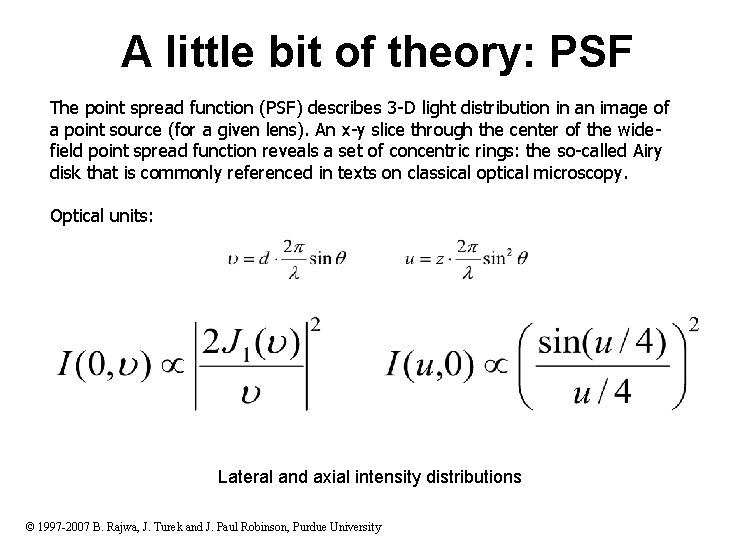
A little bit of theory: PSF The point spread function (PSF) describes 3 -D light distribution in an image of a point source (for a given lens). An x-y slice through the center of the widefield point spread function reveals a set of concentric rings: the so-called Airy disk that is commonly referenced in texts on classical optical microscopy. Optical units: Lateral and axial intensity distributions © 1997 -2007 B. Rajwa, J. Turek and J. Paul Robinson, Purdue University
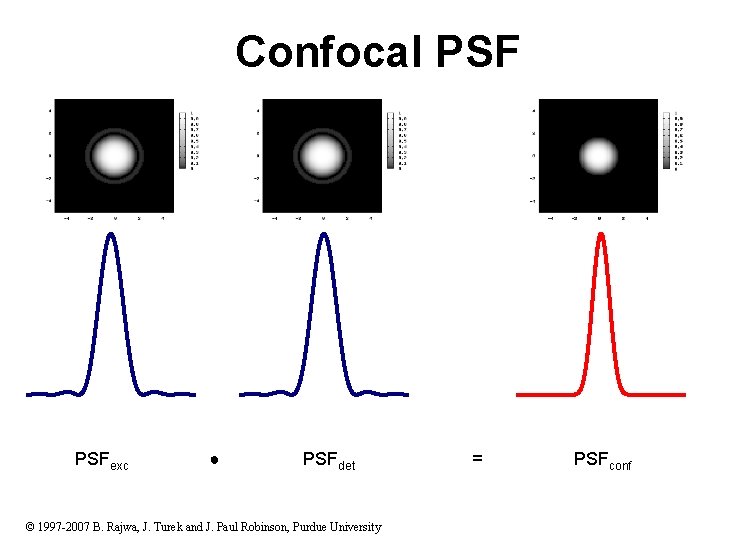
Confocal PSFexc ● PSFdet © 1997 -2007 B. Rajwa, J. Turek and J. Paul Robinson, Purdue University = PSFconf
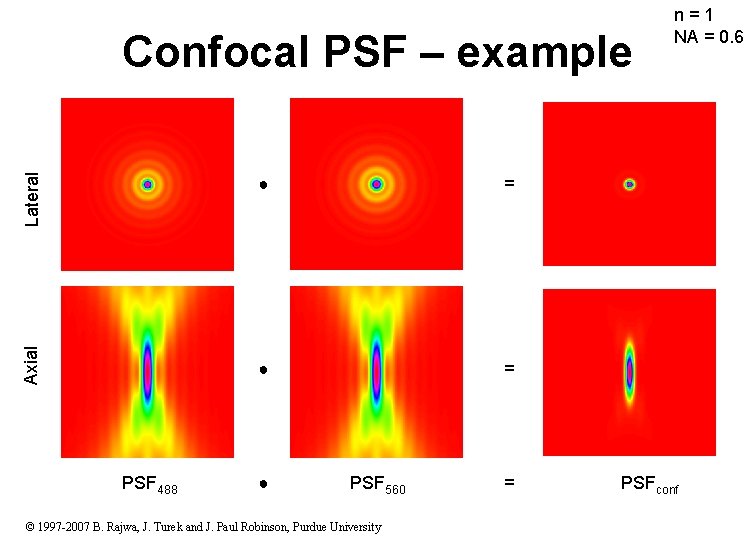
Axial Lateral Confocal PSF – example PSF 488 ● = ● PSF 560 © 1997 -2007 B. Rajwa, J. Turek and J. Paul Robinson, Purdue University = n = 1 NA = 0. 6 PSFconf
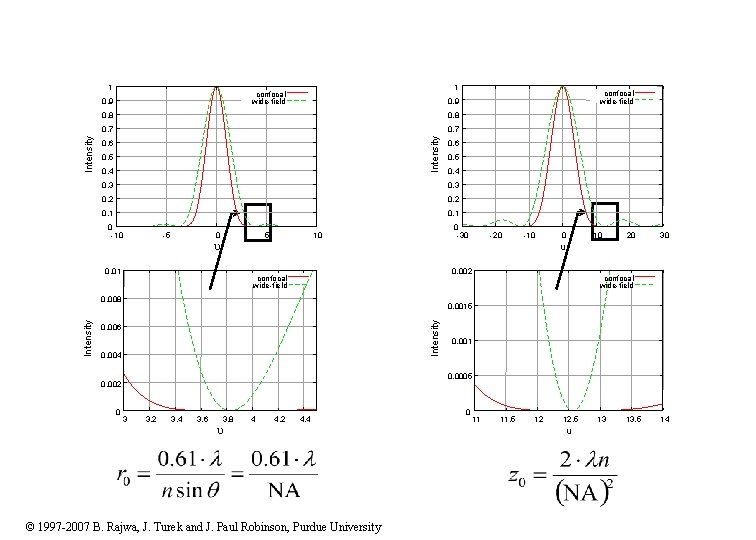
Wide-field and confocal intensity distributions 1 0. 9 0. 8 0. 7 0. 6 0. 5 0. 4 0. 3 0. 2 0. 1 -5 0 5 u 0 -30 10 20 30 confocal wide-field Intensity 0. 0015 0. 006 0. 004 0. 001 0. 0005 0. 002 3 -10 0. 002 confocal wide-field 0. 008 0 -20 u 0. 01 Intensity 0. 6 0. 3 0 -10 confocal wide-field 0. 9 Intensity 1 confocal wide-field 3. 2 3. 4 3. 6 3. 8 u 4 4. 2 4. 4 © 1997 -2007 B. Rajwa, J. Turek and J. Paul Robinson, Purdue University 0 11 11. 5 12. 5 u 13. 5 14
![1 1 0. 8 Intensity [A. U. ] Resolution – confocal microscope 0.](http://slidetodoc.com/presentation_image_h/fd8854b03fa1cada98964bbb27719095/image-40.jpg "1 1 0. 8 Intensity [A. U. ] Resolution – confocal microscope 0.")
1 1 0. 8 Intensity [A. U. ] Resolution – confocal microscope 0. 6 0. 4 0. 2 0 -10 0. 6 0. 4 0. 2 -8 -6 -4 -2 0 2 4 Spatial coordinate [A. U. ] 6 8 10 0 -10 -8 -6 -4 -2 0 2 4 Spatial coordinate [A. U. ] 6 8 10 Rayleigh criterion cannot be used directly to define the improvement of resolution in a confocal microscope. The position of the first minimum does not change. The drop in intensity is much larger, though. In fact, we can move two intensity distributions a little bit closer (1. 4 times), and still get the required 20% drop in intensity. © 1997 -2007 B. Rajwa, J. Turek and J. Paul Robinson, Purdue University
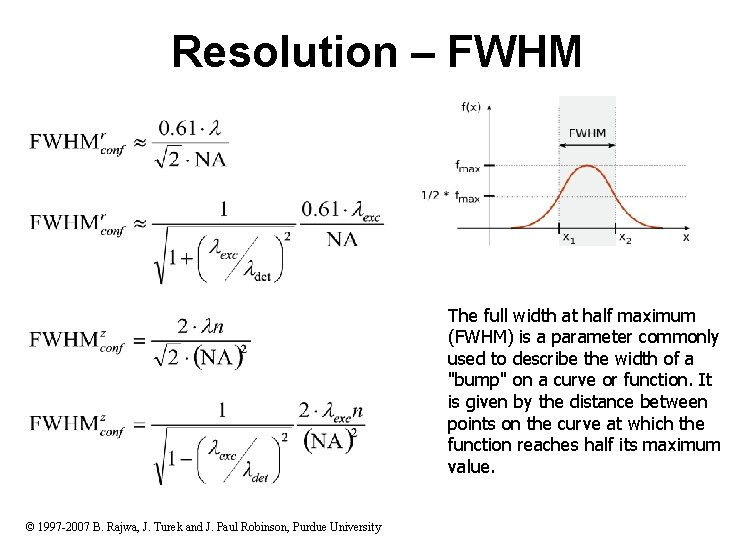
Resolution – FWHM The full width at half maximum (FWHM) is a parameter commonly used to describe the width of a "bump" on a curve or function. It is given by the distance between points on the curve at which the function reaches half its maximum value. © 1997 -2007 B. Rajwa, J. Turek and J. Paul Robinson, Purdue University
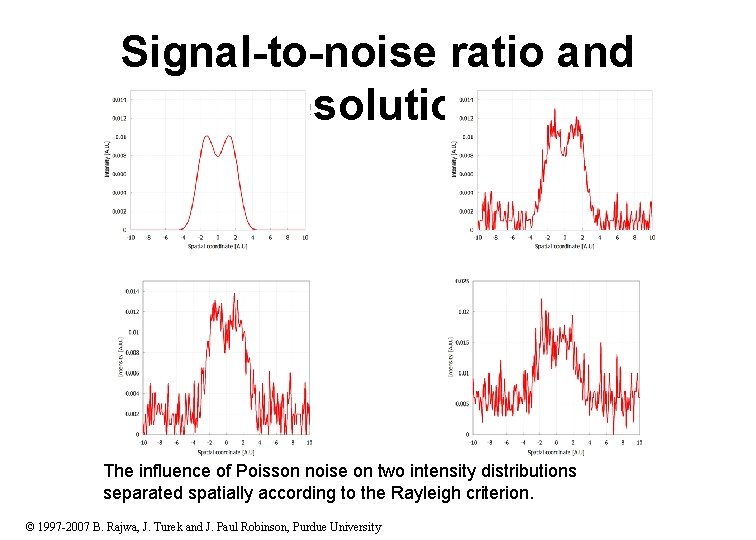
Signal-to-noise ratio and resolution The influence of Poisson noise on two intensity distributions separated spatially according to the Rayleigh criterion. © 1997 -2007 B. Rajwa, J. Turek and J. Paul Robinson, Purdue University
”What dpi do I need to preserve all of the detail in my image"? In practice, the dpi necessary to preserve image detail can be quickly determined empirically. The sampling rate (dpi) that is used will depend upon how the image is going to be displayed. If a printed copy of an image is going to be made, there is little value in sampling with a dpi greater than the dpi capability of the printer. An exception to this is if the image is going to be magnified or enlarged in a manner analogous to optical photographic enlargement prior to printing. © 1997 -2007 B. Rajwa, J. Turek and J. Paul Robinson, Purdue University
cont… An image 3 x 4 inches that is digitized at a rate of 600 dpi will only be 300 dpi if enlarged 2 X and printed. Therefore, a practical sampling guideline for printed images is that the final image should have at least the resolution of the printing device. For light and electron micrographs of biological tissue, prints with a final resolution of 600 dpi will preserve most detail. However, fine granular structures such as autoradiography silver grains or colloidal gold particles used in immunolabeling will not be as sharp as those in a traditional photograph. For very fine granular structures, the final print resolution may need to be 1200 dpi or higher. © 1997 -2007 B. Rajwa, J. Turek and J. Paul Robinson, Purdue University
© 1997 -2007 B. Rajwa, J. Turek and J. Paul Robinson, Purdue University
Bit resolution or pixel depth • • • This is a measurement of the number of bits of information per pixel. The pixel depth will determine how much color or gray scale information is available for each pixel. Greater pixel depth means more available colors and more accurate color representation. Pixels in binary images have a depth of 1 (on or off), and are black and white images A pixel with a bit depth of 8 has 28, or 256, possible values; and a pixel with a bit depth of 24 has 224, or 16 million possible values (Red=8, Green=8, Blue=8). Common values for pixel depth range from 1 to 24 bits per pixel. © 1997 -2007 B. Rajwa, J. Turek and J. Paul Robinson, Purdue University
Quantization • A set of n quantization levels comprises the integers: 0, 1, 2, …, n-1 • 0 and n-1 are usually black and white respectively, with intermediate levels rendered in various shades of gray. • Quantization levels are commonly referred to as gray levels. • n is usually an integral power of two: n=2 b, where b is the number of bits used for quantization. • If b=1 then the image is binary © 1997 -2007 B. Rajwa, J. Turek, & J. Paul Robinson, Purdue University
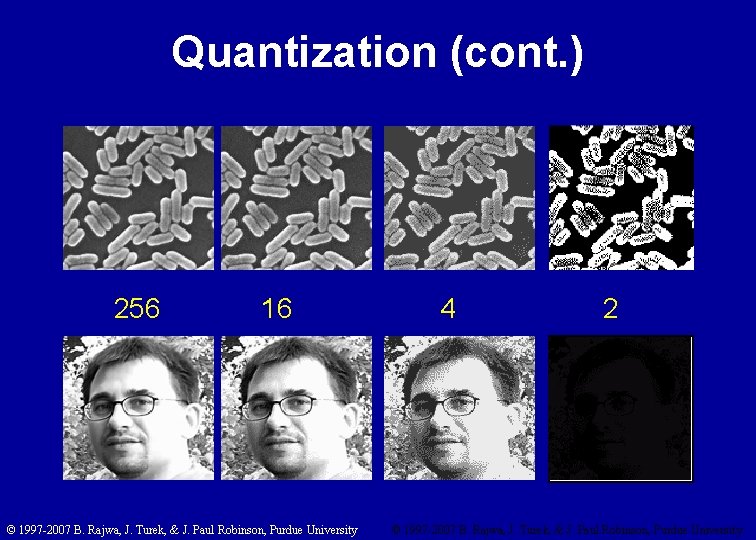
Quantization (cont. ) 256 16 4 2 © 1997 -2007 B. Rajwa, J. Turek, & J. Paul Robinson, Purdue University
Principles of 2 D Image Analysis • End of Part 1 • Part 2 is the next lecture © 1997 -2007 B. Rajwa, J. Turek & J. Paul Robinson, Purdue University
- Slides: 49