
Principles fundamental to successful curriculum design and implementation

- Slides: 10
Principles fundamental to successful curriculum design and implementation
Certain principles are fundamental to successful curriculum design and implementation in all situations : 1 - the school curriculum should deliver a broad , balanced and consistent program of learning with clear and smooth progression routes designed for the needs of all learners.
Certain considerations are however , universally significant : • the values and educational aims of the school must guide all decisions about the curriculum. • quality is more important than quantity. • Progression through the curriculum must be consistent. • A spiral approach to skill development is supported.
• Consistency- this is concerned with progression in knowledge and skills from one stage to the next. • Balance – the concept of breadth and balance will be illuminated by the school’s vision and education aims preparation for higher education. • Combining curricula – if the school combining cambridge qualifications with others it is important to consider compatibility issues. • Effectiveness – our syllabuses , teacher support material.
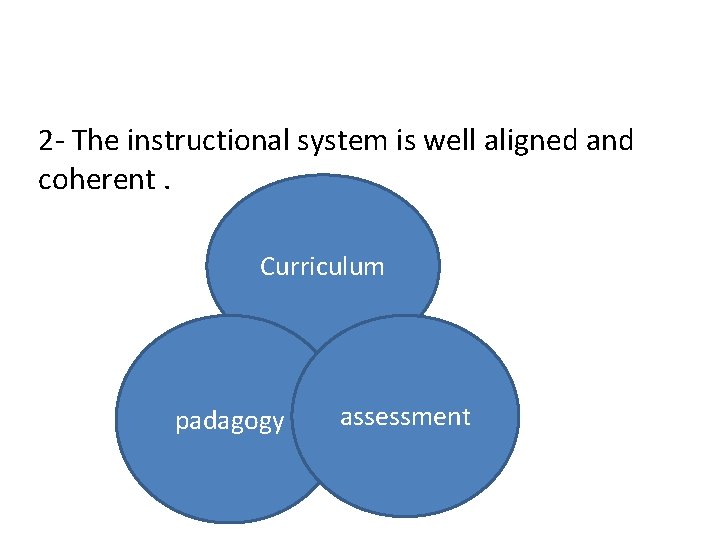
2 - The instructional system is well aligned and coherent. Curriculum padagogy assessment
3 -The curriculum supports the development of learners and teachers who are confident , responsible , reflective , innovative and engaged. 4 - Each subject curriculum should provide learners and teachers with inspiring and relevant content and an appropriate breadth and depth of subject knowledge.
5 - The school curriculum should recognize the language background of learners and provide them with the support they need to access the curriculum. 6 - Assessment has a number of purposes that are essential to the educational process. 7 - Clear and meaningful educational standards are essential to ensure accurate measurement of progress and achievement, and allow for international benchmarking and comparability.
8 - Teachers are the most powerful influence on student learning. 9 - The pedagogy required to optimize learning using Cambridge curricula requires the active engagement of the learner. 10 - Strong leadership is a necessary condition for sustained school improvement and curriculum development.
11 - Curriculum development involves an ongoing process of evidence gathering and evaluation. 12 - The curriculum needs to ensure all learners fulfil their potential.