
Principles for Experimental Algorithmics Michael T Goodrich Dept


- Slides: 11
Principles for Experimental Algorithmics Michael T. Goodrich Dept. of Computer Science based, in part, on the following papers: Towards a Discipline of Experimental Algorithmics, by Bernard M. E. Moret A Theoretician’s Guide to the Experimental Analysis of Algorithms, by David S. Johnson
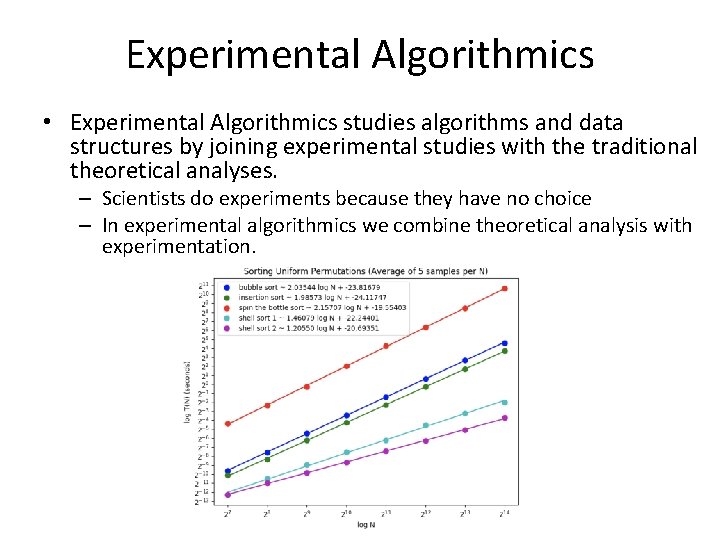
Experimental Algorithmics • Experimental Algorithmics studies algorithms and data structures by joining experimental studies with the traditional theoretical analyses. – Scientists do experiments because they have no choice – In experimental algorithmics we combine theoretical analysis with experimentation.
Experimental Algorithmics • Experimentation with algorithms and data structures can prove to be indispensable for the following tasks: – The assessment of heuristics for hard problems – The characterization of asymptotic behavior of complex algorithms – The comparison of competing designs for tractable problems – The formulation of new combinatorial conjectures – The evaluation of optimization criteria – The transfer of research results from paper to production code
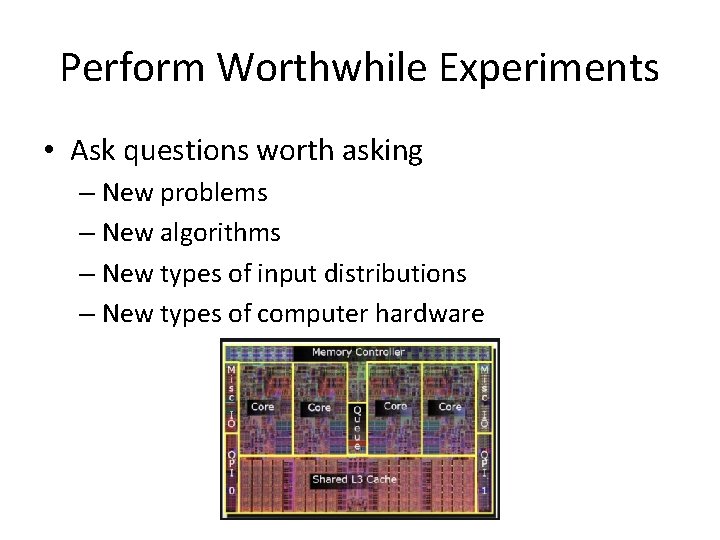
Perform Worthwhile Experiments • Ask questions worth asking – New problems – New algorithms – New types of input distributions – New types of computer hardware
Measuring Actual Performance • Random instances should be motivated from real-world data • Also use real-world data when possible • http: //dimacs. rutgers. edu/programs/challenge/ • http: //snap. stanford. edu/
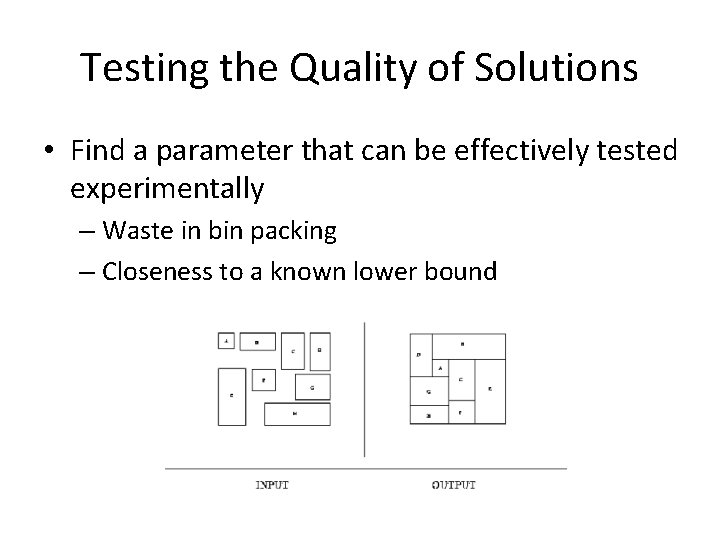
Testing the Quality of Solutions • Find a parameter that can be effectively tested experimentally – Waste in bin packing – Closeness to a known lower bound
Experimental Setup Have clear objectives Gather data to answer the questions posed Choose hardware appropriately Code solutions consistently to allow for good conclusions • Generate useful problem instances • Analyze your data • •
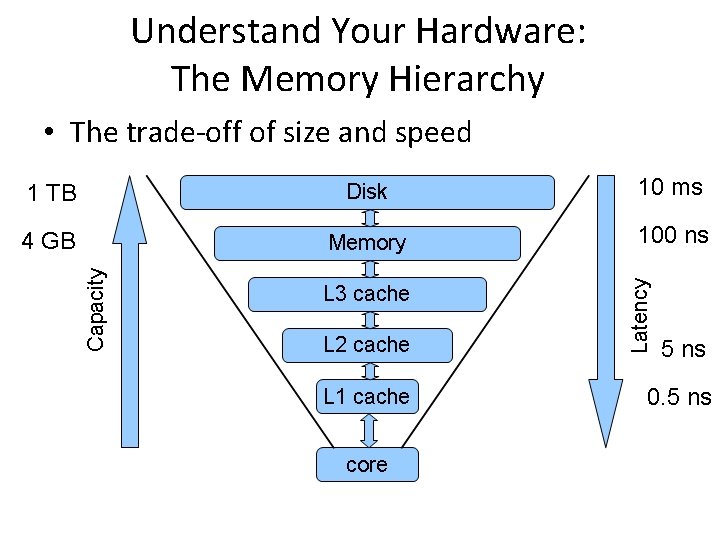
Understand Your Hardware: The Memory Hierarchy • The trade-off of size and speed 1 TB 10 ms 4 GB 100 ns 5 ns 0. 5 ns
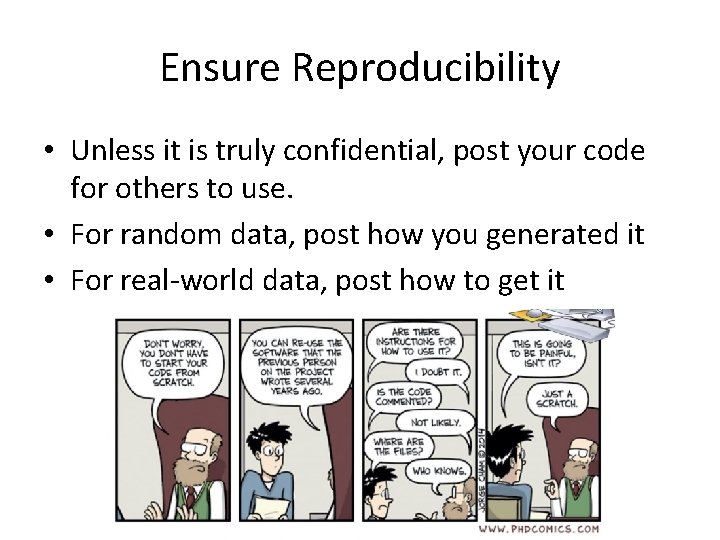
Ensure Reproducibility • Unless it is truly confidential, post your code for others to use. • For random data, post how you generated it • For real-world data, post how to get it
Ensure Comparability • Perform all experiments on the same hardware • Report the type of hardware used • Code all algorithms with the same level of code optimizations and tuning
Present your Data in Meaningful Ways • Use tables only for small data sets