
PRINCIPLES FOR BUILDING GOOD DIGITAL COLLECTIONS Spotlight Metadata
PRINCIPLES FOR BUILDING GOOD DIGITAL COLLECTIONS Spotlight: Metadata Allison Schein LIS 882/Spring 2012 Metadata for Internet Resources
Before we begin… Keep in mind that there are no hard and fast rules to create a good digital collection. A successful project does not travel one set path, plan strategically, while making appropriate choices to support your unique collection A good object has associated metadata
Some questions to consider Purpose/objective? Goal? Users? Collection, individual level? Both? Which standards to apply?

Six Principles of Metadata for Good Digital Collection Metadata Principle 1: Good metadata conforms to community standards in a way that is appropriate to the materials in the collection, users of the collection, and current and potential future uses of the collection. Metadata Principle 2: Good metadata supports interoperability. Metadata Principle 3: Good metadata uses authority control and content standards to describe objects and collocate related objects.

Six Principles of Metadata for Good Digital Collection cont'd Metadata Principle 4: Good metadata includes a clear statement of the conditions and terms of use for the digital object. Metadata Principle 5: Good metadata supports the long-term curation and preservation of objects in collections. Metadata Principle 6: Good metadata records are objects themselves and therefore should have the qualities of good objects, including authority, authenticity, archivability, persistence, and unique identification.
Principle 1 Points of Interest Consider at what level the collection will be described, then create an application profile that shows scheme implementation.
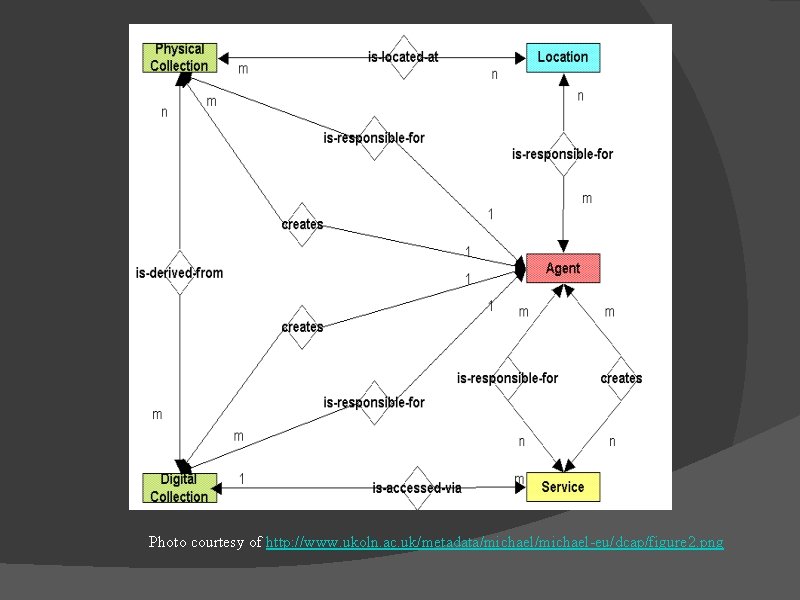
Photo courtesy of http: //www. ukoln. ac. uk/metadata/michael-eu/dcap/figure 2. png
Principle 2 Points of Interest Good metadata should be mindful of global contexts as well. Do not assume that your users know the main content of your collection. 3 tools that assist metadata interoperability : Crosswalks (maps out between the schemas) Harvesting metadata through OAI-PMH Cross systems searching/Metasearch
Principle 3 Point of Interests Whenever possible use standard, controlled terms. Consider the following when selecting: ○ Future needs of the users ○ Available tools to support vocabulary ○ Maintaining vocabulary
Principle 4 Points of Interest Rights metadata Rights description Rights licensing Rights workflow
Principle 5 Points of Interest Administrative Technical metadata Preservation metadata Recordkeeping metadata Structural metadata
Principle 6 Point of Interest Make sure that you supply institutional information and include schema documentation.
Bibliography Library of Congress "Metadata for Digital Content" group. Access Through Metadata: Library Group Tackels the Challenge - Digital Preservation. http: //www. digitalpreservation. gov/series/challenge/metadata_digita l_content_challenge. html (accessed 01 16, 2012). Morgan, Eric Lease, et al. "Index of /mylibrary. " Designing, Implementing, and Maintaining Digital Library Services and Collections with My. Library. 01 28, 2010. http: //dewey. library. nd. edu/mylibrary/ (accessed 01 17, 2012). National Information Standards Organization (NISO) Framework Working Group. A Framework of Guidance for Building Good Digital Collections. White paper, Baltimore: National Information Standards Organization (NISO), 2007.
Recommended Readings Morgan, Eric Lease, et al. Designing, Implementing, and Maintaining Digital Library Services and Collections with My. Library. 01 28, 2010. http: //dewey. library. nd. edu/mylibrary/ Library of Congress Meeting the Challenge: The Library of Congress: Meeting the Challenge of Digital Preservation http: //www. digitalpreservation. gov/series/challenge/index. html Institute of Museum and Library Services Digital Collections and Content Metadata Resources and Documentation http: //imlsdcc. grainger. uiuc. edu/resources. asp National Information Standards Organization (NISO) Framework Working Group. A Framework of Guidance for Building Good Digital Collections. White paper, Baltimore: National Information Standards Organization (NISO), 2007. www. niso. org/publications/rp/framework 3. pdf
- Slides: 14