
Principles at the Fundamental Level of a Systemsbased
Principles at the Fundamental Level of a Systems-based Sustainability Framework David Kettle, D&B Kettle Consulting Ltd 2 nd International Conference on Sustainability Engineering and Science, 21 – 23 February 2007, Auckland NZ
Outline Ø What are Principles? Ø The Author’s Principle Based Framework Ø Sustainability as a Global Issue Ø Conclusions
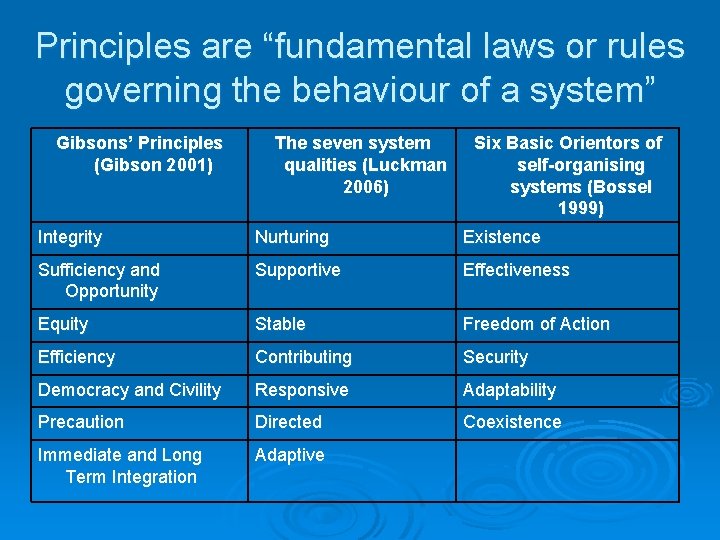
Principles are “fundamental laws or rules governing the behaviour of a system” Gibsons’ Principles (Gibson 2001) The seven system qualities (Luckman 2006) Six Basic Orientors of self-organising systems (Bossel 1999) Integrity Nurturing Existence Sufficiency and Opportunity Supportive Effectiveness Equity Stable Freedom of Action Efficiency Contributing Security Democracy and Civility Responsive Adaptability Precaution Directed Coexistence Immediate and Long Term Integration Adaptive
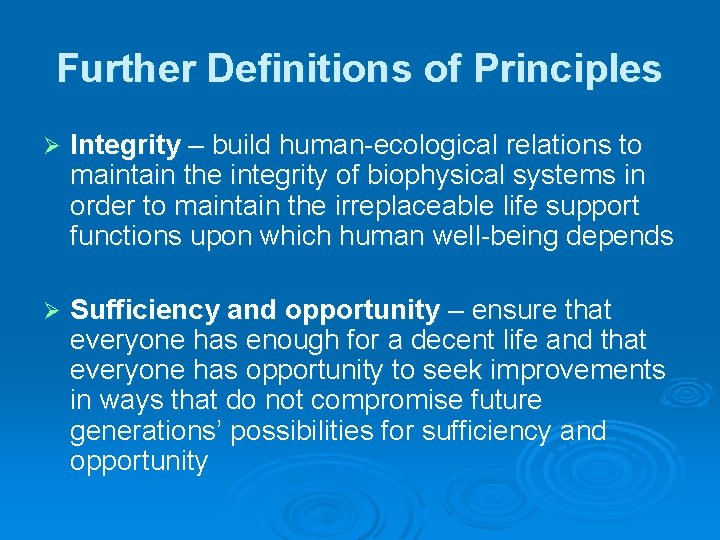
Further Definitions of Principles Ø Integrity – build human-ecological relations to maintain the integrity of biophysical systems in order to maintain the irreplaceable life support functions upon which human well-being depends Ø Sufficiency and opportunity – ensure that everyone has enough for a decent life and that everyone has opportunity to seek improvements in ways that do not compromise future generations’ possibilities for sufficiency and opportunity

Principles – Systems Thinking “Analysis means taking something apart in order to understand it; systems thinking means putting it into the context of a larger whole” (Capra 1996, p. 30) Qualities rather than individual measured quantities
“The great shock of twentieth-century science has been that systems cannot be understood by analysis. The properties of the parts are not intrinsic properties, but can be understood only within the context of the larger whole. Thus the relationship between the parts and the whole are reversed. In the systems approach, the properties of the parts can be understood only from the organisation of the whole. Accordingly, systems thinking does not concentrate on basic building blocks but rather on basic principles of organisation. ” (Capra 1996, p. 29)
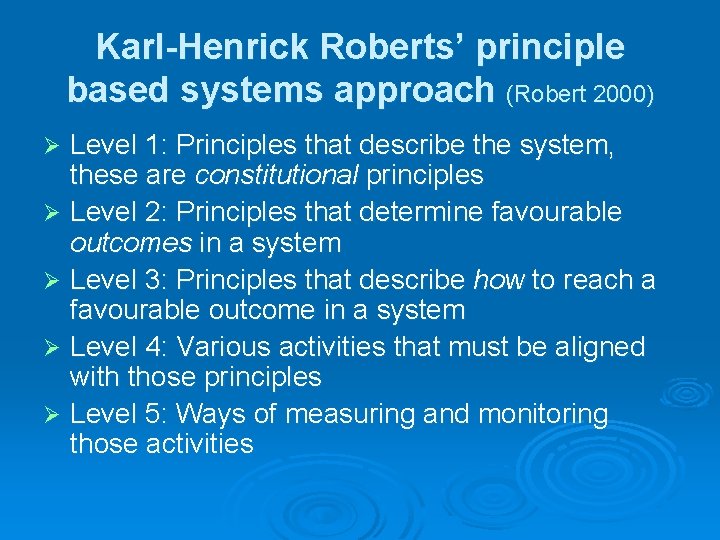
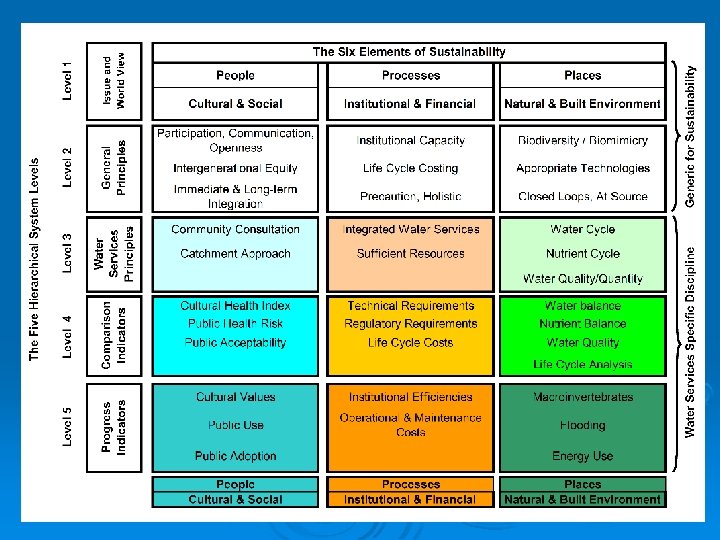
Karl-Henrick Roberts’ principle based systems approach (Robert 2000) Level 1: Principles that describe the system, these are constitutional principles Ø Level 2: Principles that determine favourable outcomes in a system Ø Level 3: Principles that describe how to reach a favourable outcome in a system Ø Level 4: Various activities that must be aligned with those principles Ø Level 5: Ways of measuring and monitoring those activities Ø
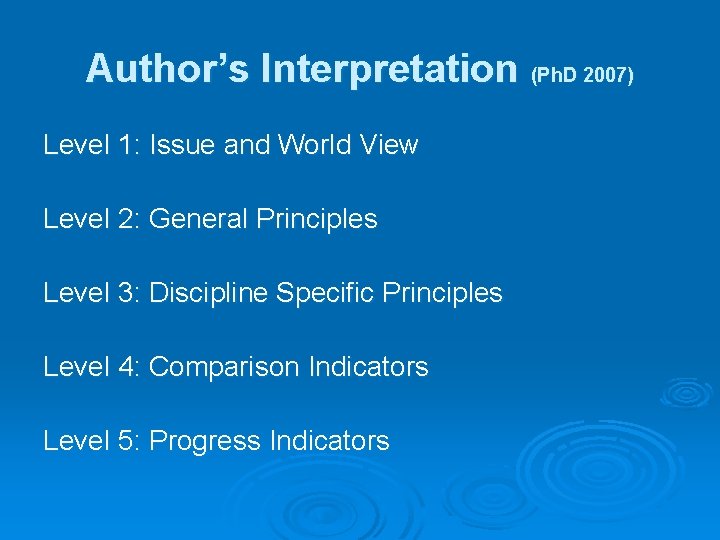
Author’s Interpretation (Ph. D 2007) Level 1: Issue and World View Level 2: General Principles Level 3: Discipline Specific Principles Level 4: Comparison Indicators Level 5: Progress Indicators
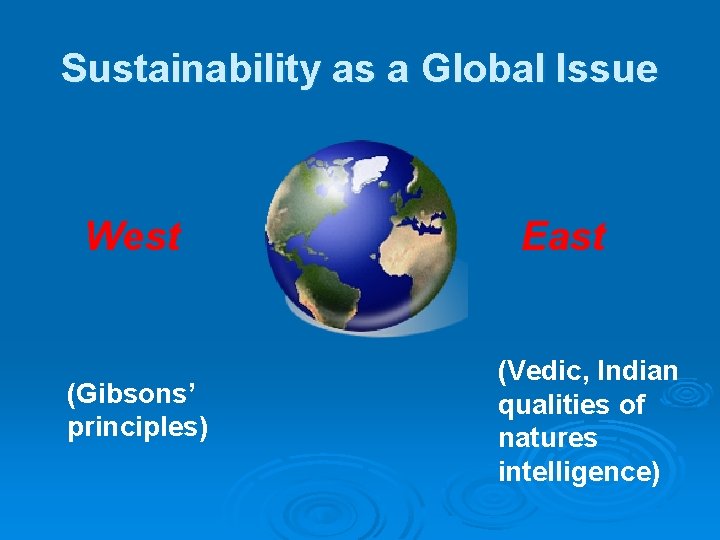
Sustainability as a Global Issue West (Gibsons’ principles) East (Vedic, Indian qualities of natures intelligence)
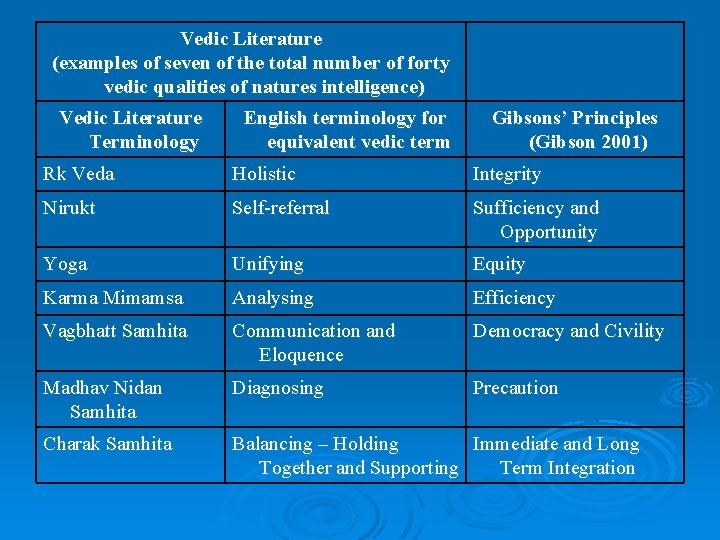
Vedic Literature (examples of seven of the total number of forty vedic qualities of natures intelligence) Vedic Literature Terminology English terminology for equivalent vedic term Gibsons’ Principles (Gibson 2001) Rk Veda Holistic Integrity Nirukt Self-referral Sufficiency and Opportunity Yoga Unifying Equity Karma Mimamsa Analysing Efficiency Vagbhatt Samhita Communication and Eloquence Democracy and Civility Madhav Nidan Samhita Diagnosing Precaution Charak Samhita Balancing – Holding Immediate and Long Together and Supporting Term Integration
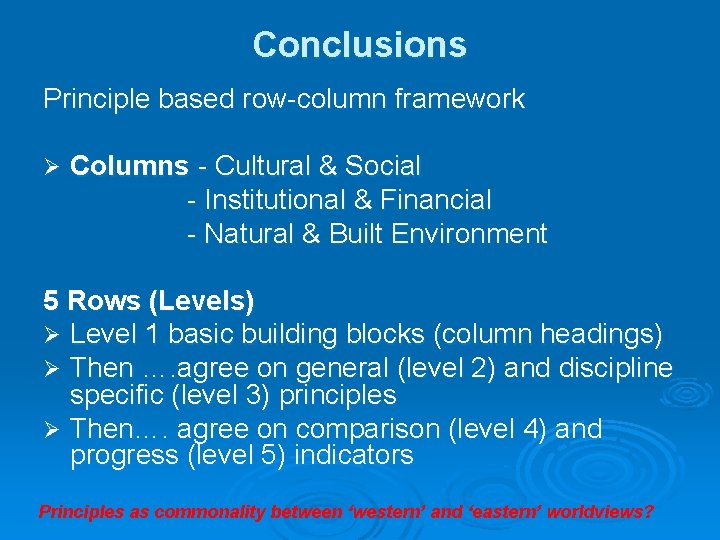
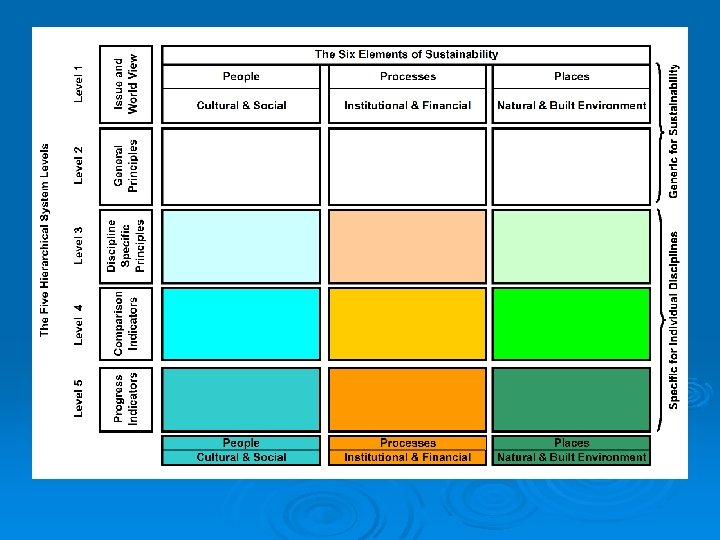
Conclusions Principle based row-column framework Ø Columns - Cultural & Social - Institutional & Financial - Natural & Built Environment 5 Rows (Levels) Ø Level 1 basic building blocks (column headings) Ø Then …. agree on general (level 2) and discipline specific (level 3) principles Ø Then…. agree on comparison (level 4) and progress (level 5) indicators Principles as commonality between ‘western’ and ‘eastern’ worldviews?
- Slides: 13