
Principles and Practices of Light Microscopy II Brightfield
Principles and Practices of Light Microscopy II: Brightfield optics, resolution, and aberrations
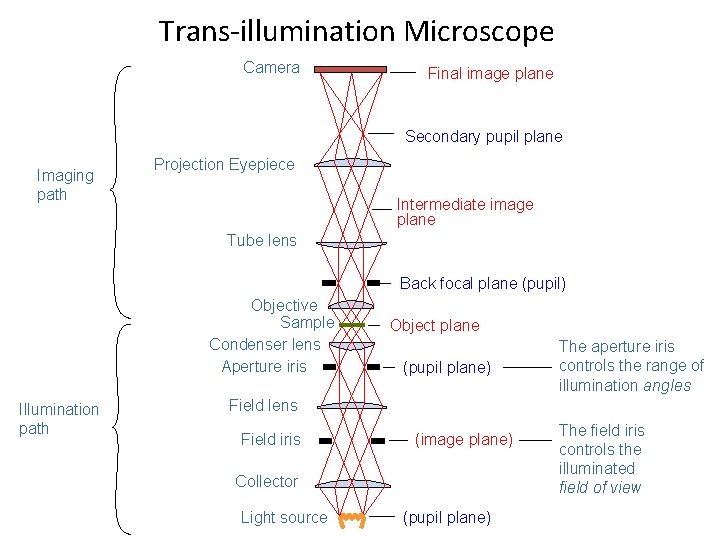
Trans-illumination Microscope Camera Final image plane Secondary pupil plane Imaging path Projection Eyepiece Intermediate image plane Tube lens Back focal plane (pupil) Objective Sample Condenser lens Aperture iris Illumination path Object plane (pupil plane) The aperture iris controls the range of illumination angles Field lens Field iris (image plane) Collector Light source (pupil plane) The field iris controls the illuminated field of view
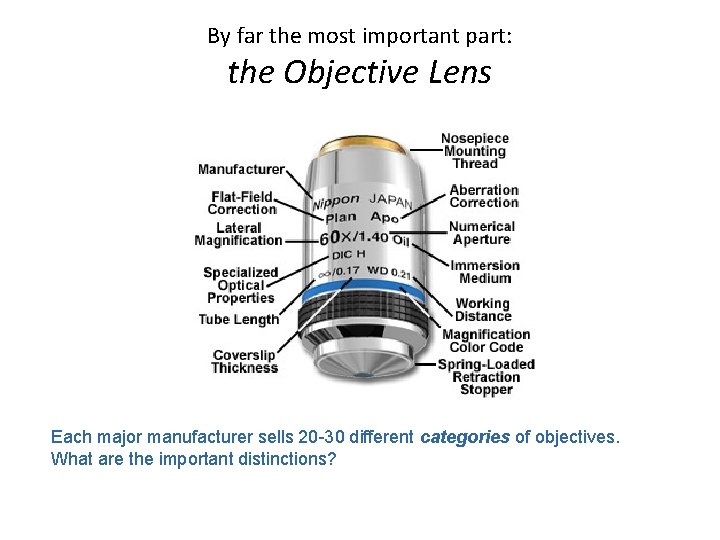
By far the most important part: the Objective Lens Each major manufacturer sells 20 -30 different categories of objectives. What are the important distinctions?
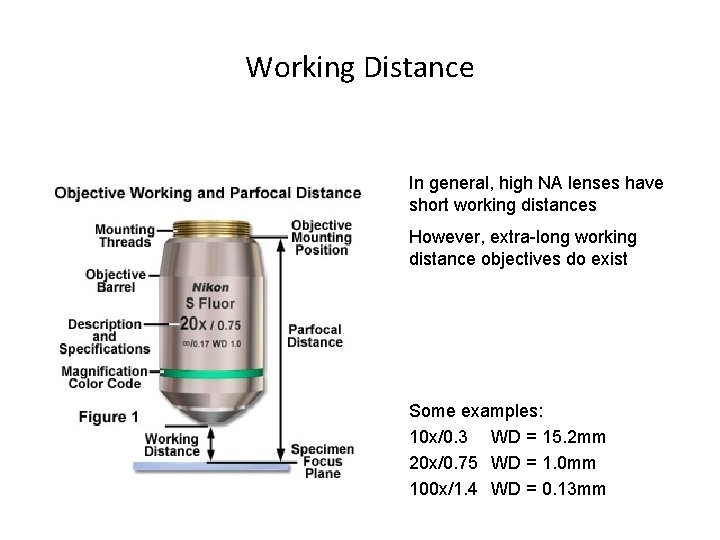
Working Distance In general, high NA lenses have short working distances However, extra-long working distance objectives do exist Some examples: 10 x/0. 3 WD = 15. 2 mm 20 x/0. 75 WD = 1. 0 mm 100 x/1. 4 WD = 0. 13 mm
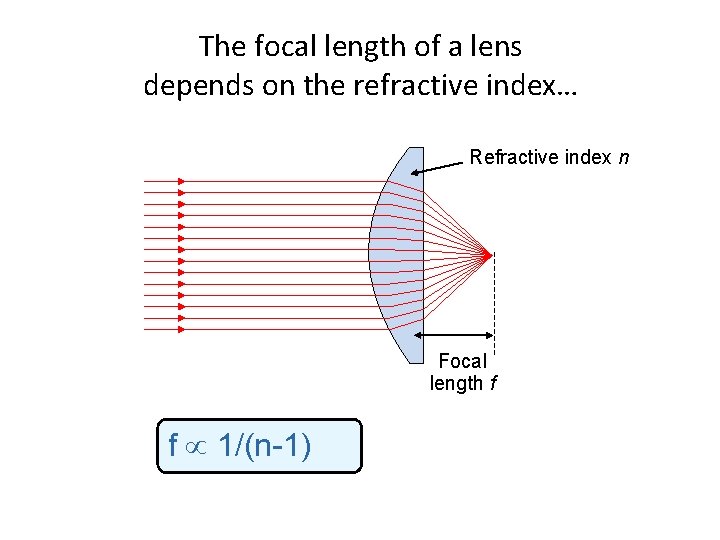
The focal length of a lens depends on the refractive index… Refractive index n Focal length f f 1/(n-1)
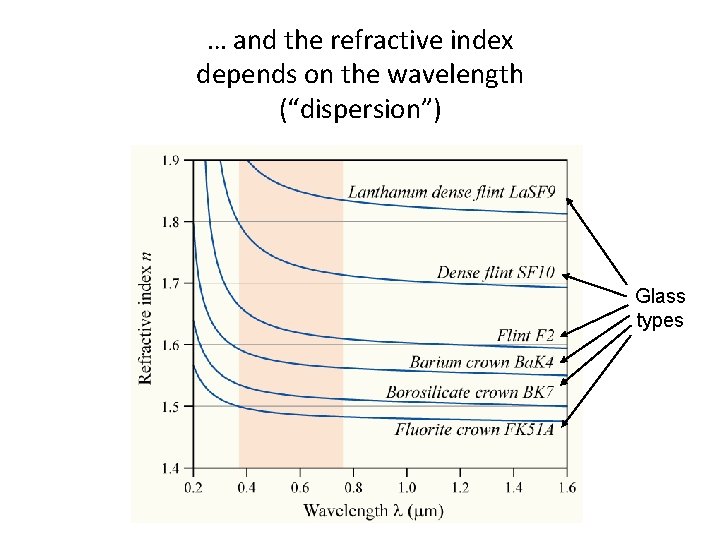
… and the refractive index depends on the wavelength (“dispersion”) Glass types
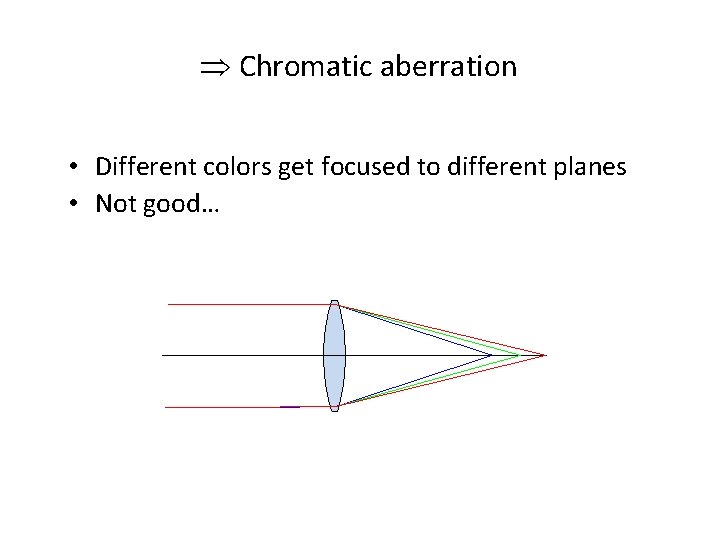
Chromatic aberration • Different colors get focused to different planes • Not good…
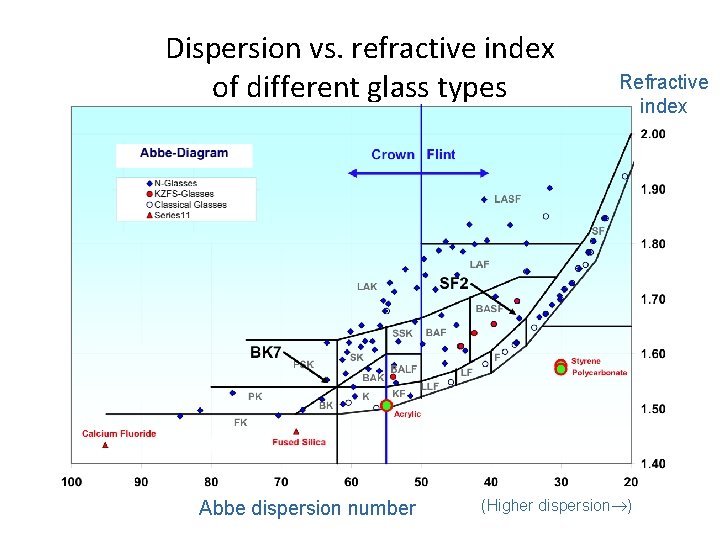
Dispersion vs. refractive index of different glass types Abbe dispersion number Refractive index (Higher dispersion )
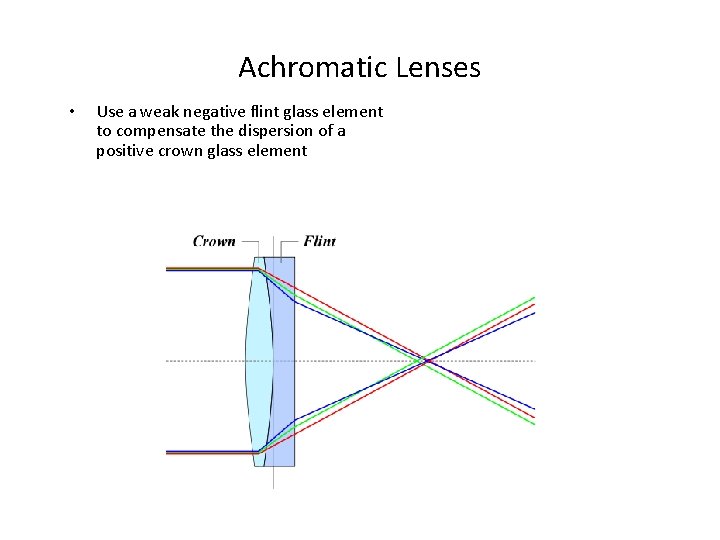
Achromatic Lenses • Use a weak negative flint glass element to compensate the dispersion of a positive crown glass element
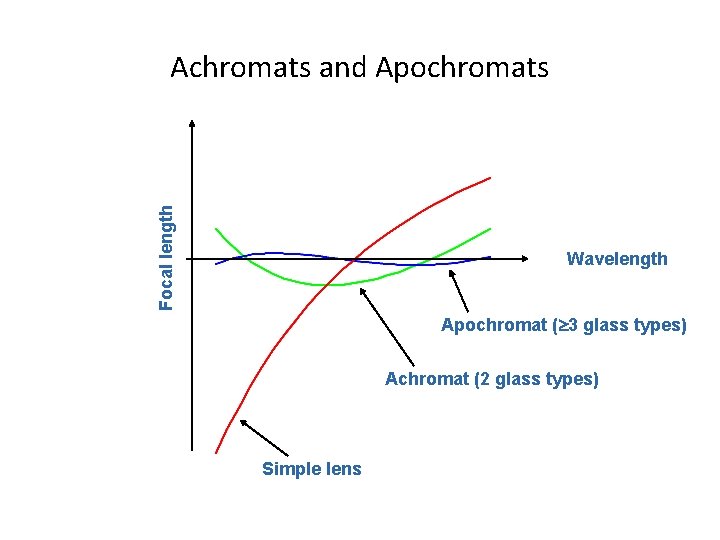
Focal length Achromats and Apochromats Wavelength Apochromat ( 3 glass types) Achromat (2 glass types) Simple lens
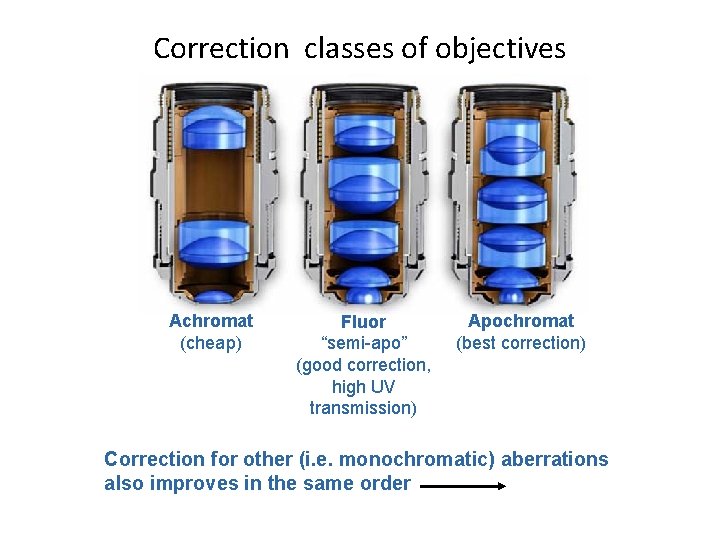
Correction classes of objectives Achromat (cheap) Fluor “semi-apo” (good correction, high UV transmission) Apochromat (best correction) Correction for other (i. e. monochromatic) aberrations also improves in the same order
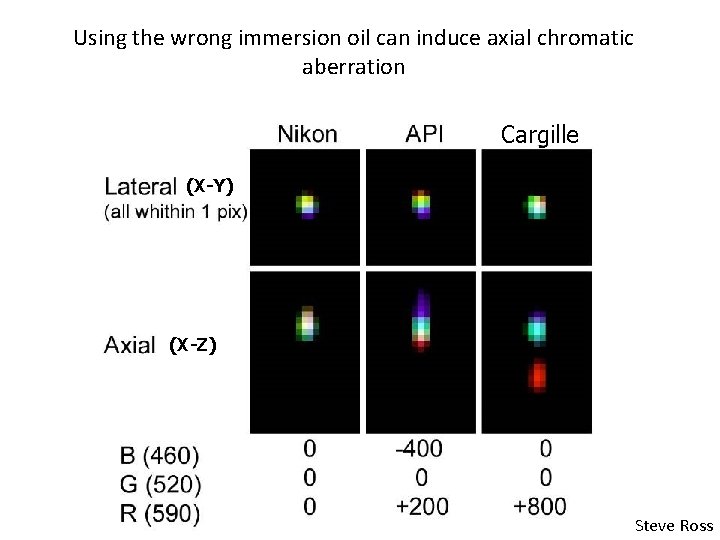
Using the wrong immersion oil can induce axial chromatic aberration Cargille (X-Y) (X-Z) Steve Ross
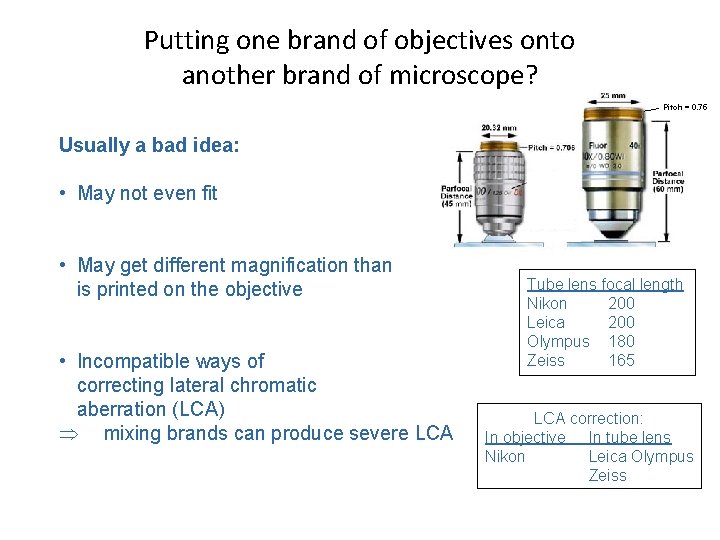
Putting one brand of objectives onto another brand of microscope? Pitch = 0. 75 Usually a bad idea: • May not even fit • May get different magnification than is printed on the objective • Incompatible ways of correcting lateral chromatic aberration (LCA) mixing brands can produce severe LCA Tube lens focal length Nikon 200 Leica 200 Olympus 180 Zeiss 165 LCA correction: In objective In tube lens Nikon Leica Olympus Zeiss
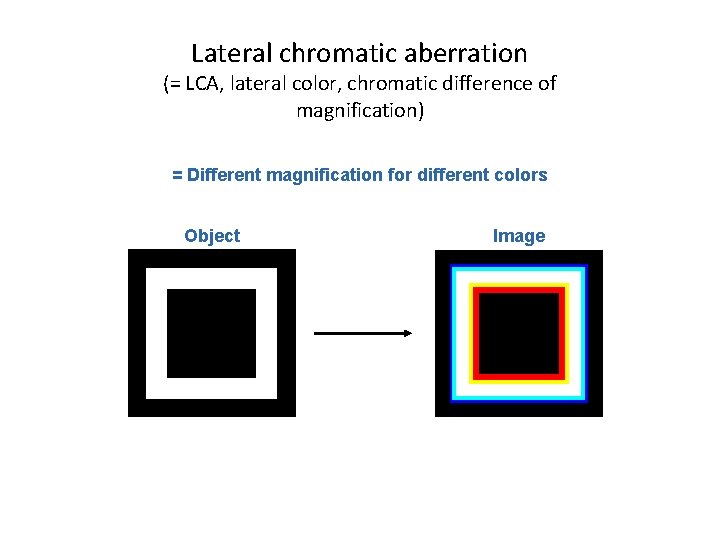
Lateral chromatic aberration (= LCA, lateral color, chromatic difference of magnification) = Different magnification for different colors Object Image
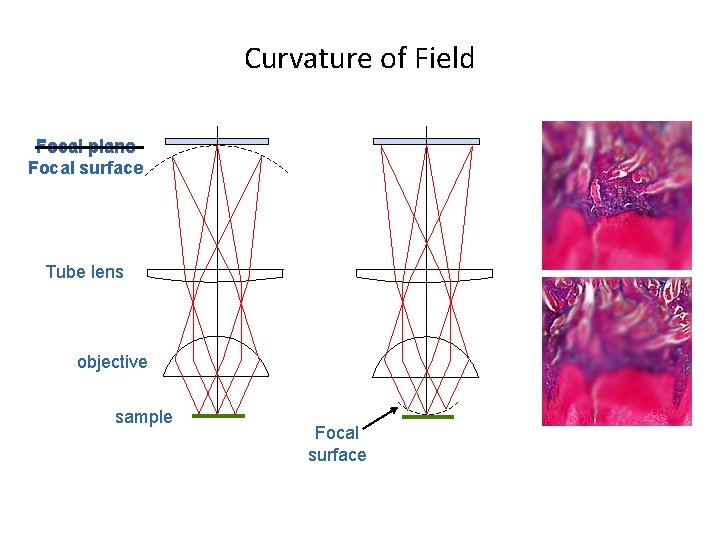
Curvature of Field Focal plane Focal surface Tube lens objective sample Focal surface
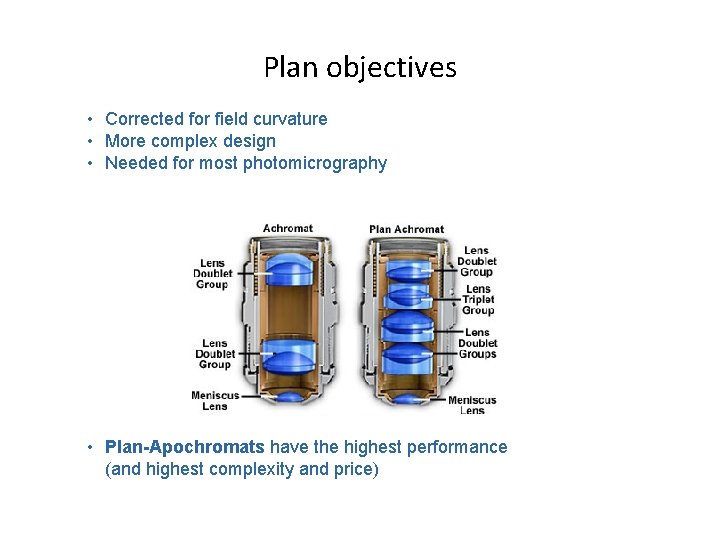
Plan objectives • Corrected for field curvature • More complex design • Needed for most photomicrography • Plan-Apochromats have the highest performance (and highest complexity and price)
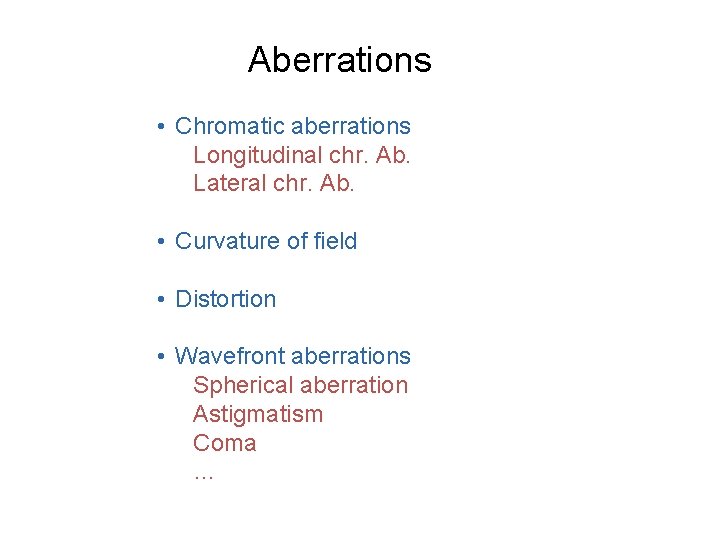
Aberrations • Chromatic aberrations Longitudinal chr. Ab. Lateral chr. Ab. • Curvature of field • Distortion • Wavefront aberrations Spherical aberration Astigmatism Coma …
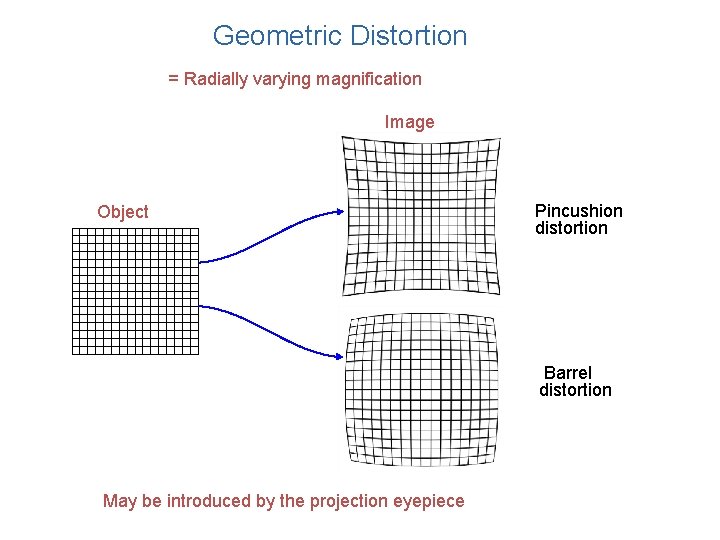
Geometric Distortion = Radially varying magnification Image Object Pincushion distortion Barrel distortion May be introduced by the projection eyepiece
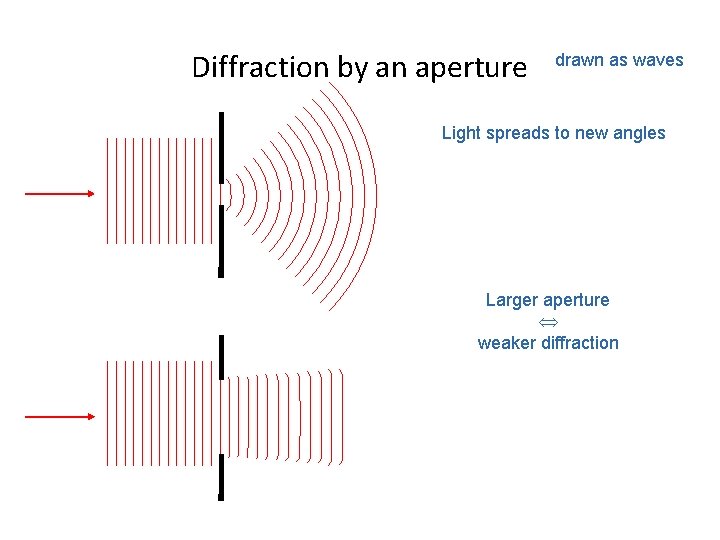
Diffraction by an aperture drawn as waves Light spreads to new angles Larger aperture weaker diffraction
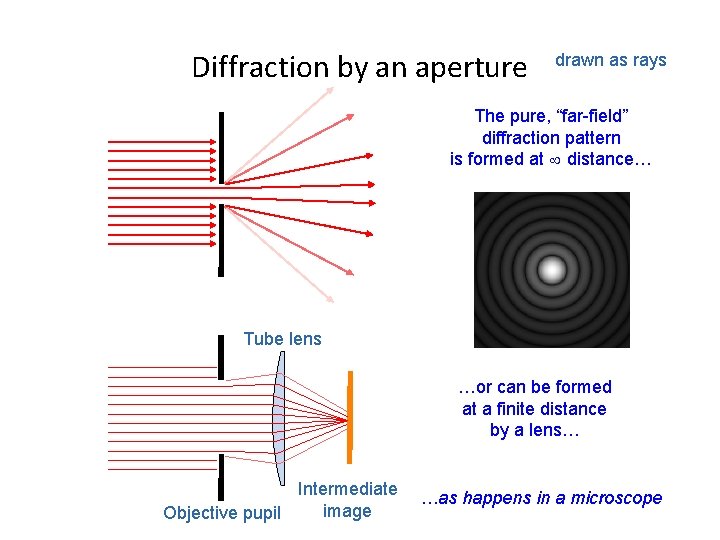
Diffraction by an aperture drawn as rays The pure, “far-field” diffraction pattern is formed at distance… Tube lens …or can be formed at a finite distance by a lens… Intermediate image Objective pupil …as happens in a microscope
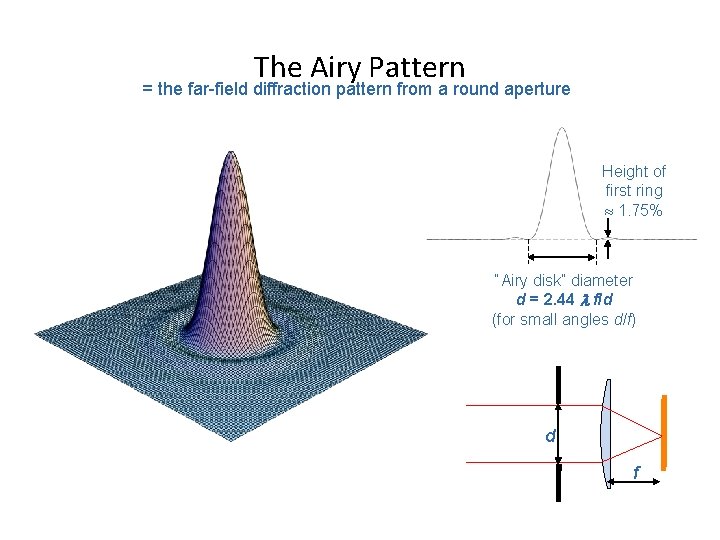
The Airy Pattern = the far-field diffraction pattern from a round aperture Height of first ring 1. 75% “Airy disk” diameter d = 2. 44 f/d (for small angles d/f) d f
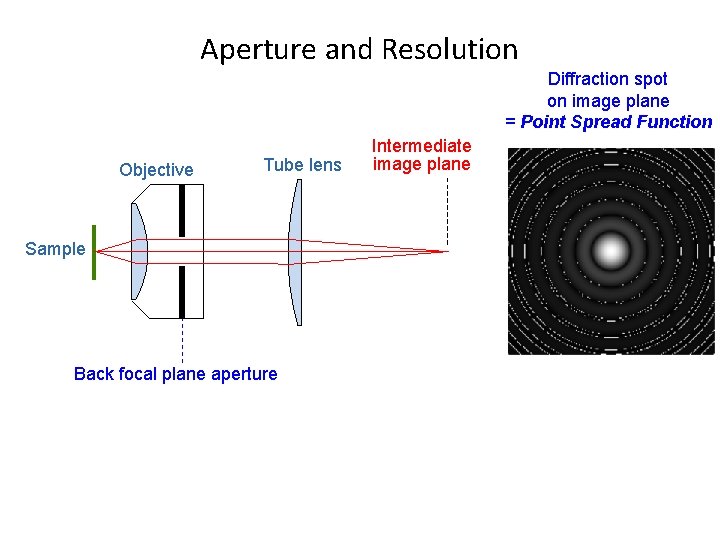
Aperture and Resolution Diffraction spot on image plane = Point Spread Function Objective Tube lens Sample Back focal plane aperture Intermediate image plane
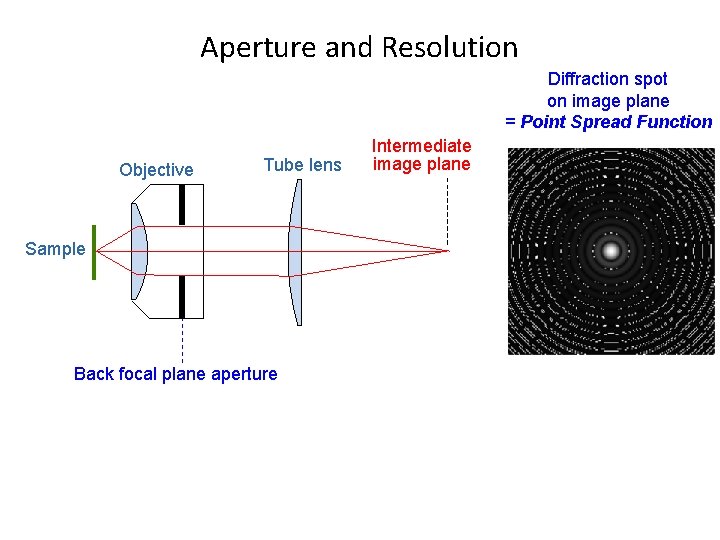
Aperture and Resolution Diffraction spot on image plane = Point Spread Function Objective Tube lens Sample Back focal plane aperture Intermediate image plane
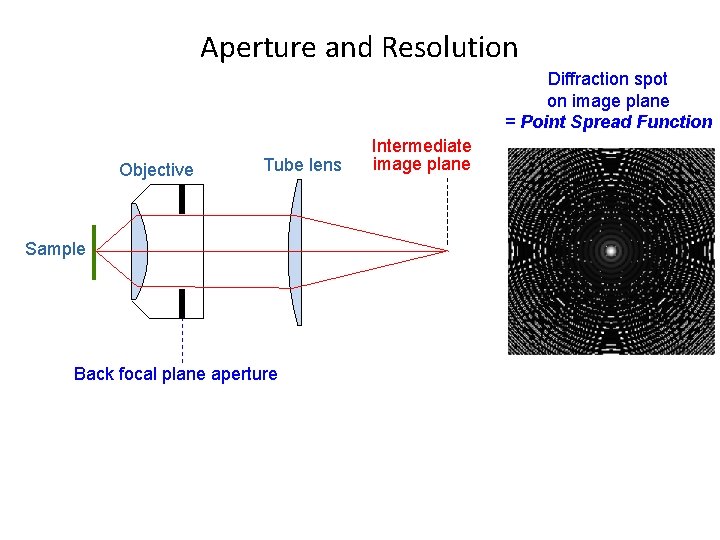
Aperture and Resolution Diffraction spot on image plane = Point Spread Function Objective Tube lens Sample Back focal plane aperture Intermediate image plane
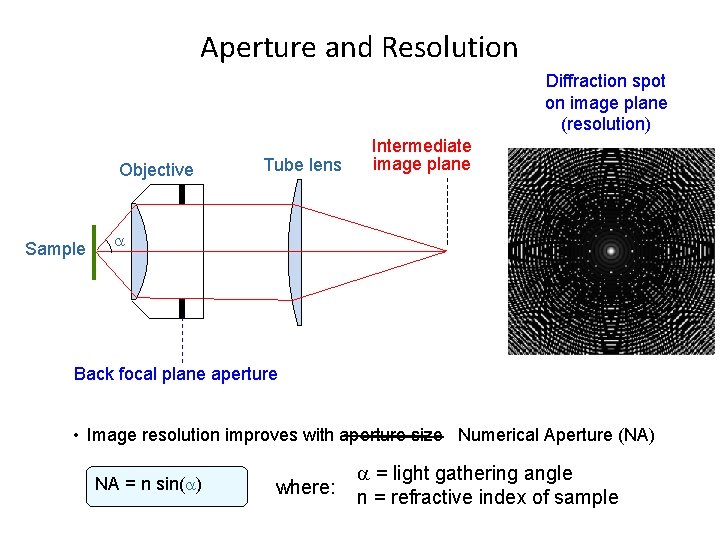
Aperture and Resolution Diffraction spot on image plane (resolution) Objective Sample Tube lens Intermediate image plane Back focal plane aperture • Image resolution improves with aperture size Numerical Aperture (NA) NA = n sin( ) where: = light gathering angle n = refractive index of sample
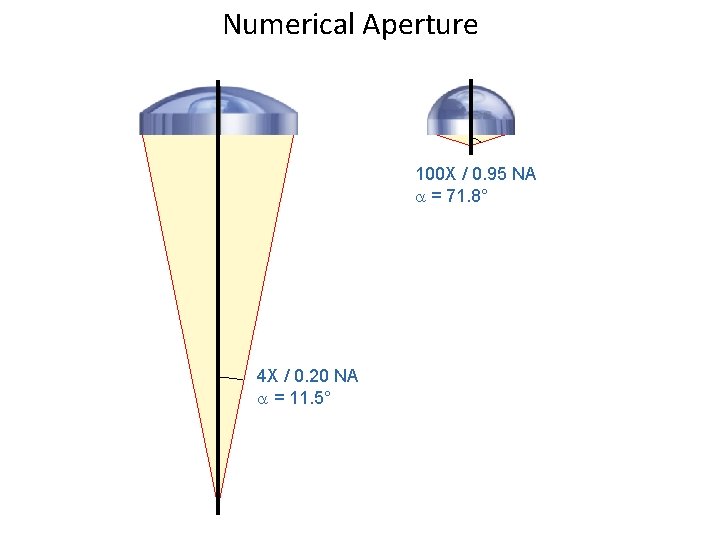
Numerical Aperture 100 X / 0. 95 NA = 71. 8° 4 X / 0. 20 NA = 11. 5°
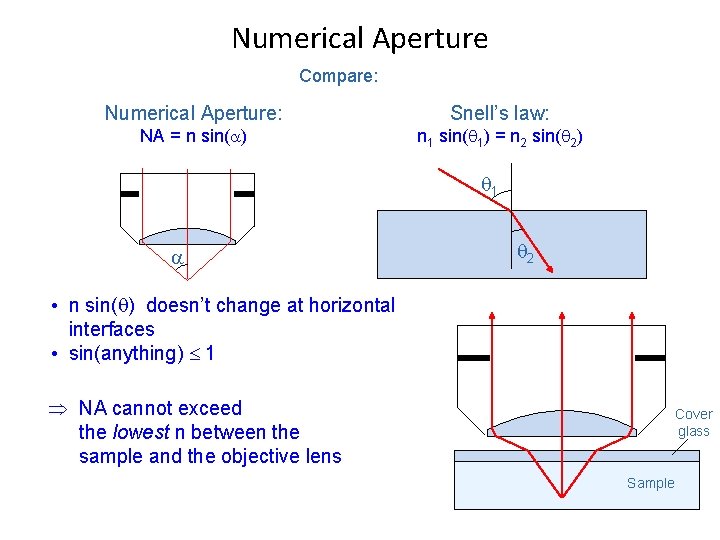
Numerical Aperture Compare: Numerical Aperture: Snell’s law: NA = n sin( ) n 1 sin( 1) = n 2 sin( 2) 1 2 • n sin( ) doesn’t change at horizontal interfaces • sin(anything) 1 NA cannot exceed the lowest n between the sample and the objective lens Cover glass Sample
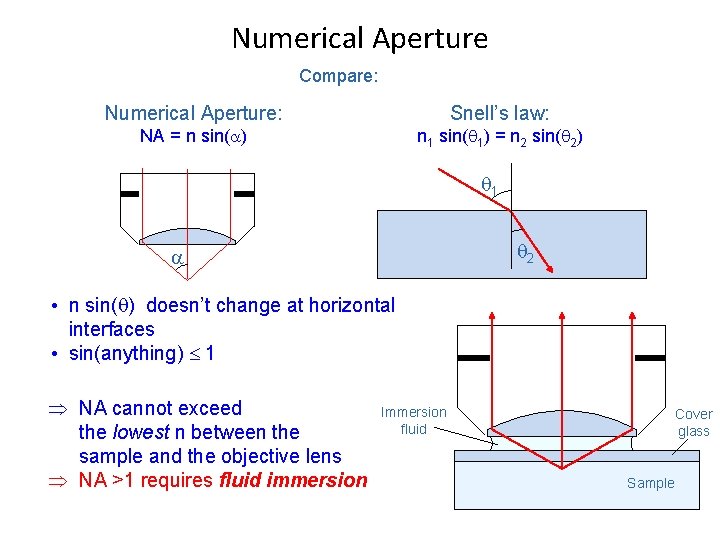
Numerical Aperture Compare: Numerical Aperture: Snell’s law: NA = n sin( ) n 1 sin( 1) = n 2 sin( 2) 1 2 • n sin( ) doesn’t change at horizontal interfaces • sin(anything) 1 NA cannot exceed the lowest n between the sample and the objective lens NA >1 requires fluid immersion Immersion fluid Cover glass Sample
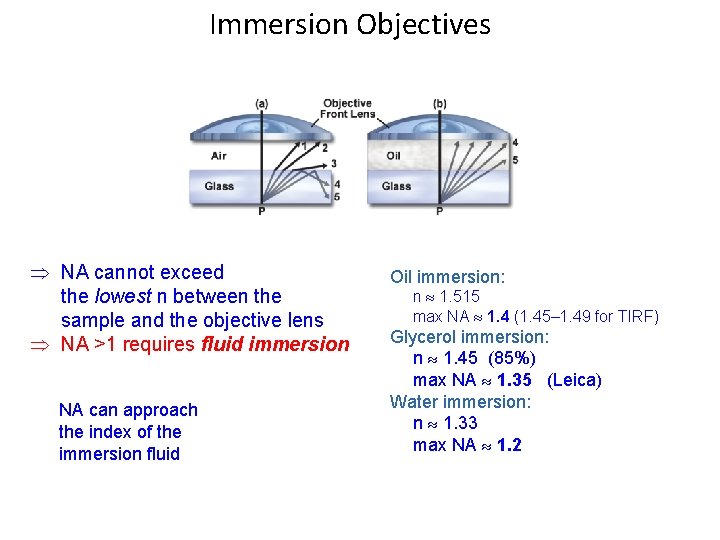
Immersion Objectives NA cannot exceed the lowest n between the sample and the objective lens NA >1 requires fluid immersion NA can approach the index of the immersion fluid Oil immersion: n 1. 515 max NA 1. 4 (1. 45– 1. 49 for TIRF) Glycerol immersion: n 1. 45 (85%) max NA 1. 35 (Leica) Water immersion: n 1. 33 max NA 1. 2
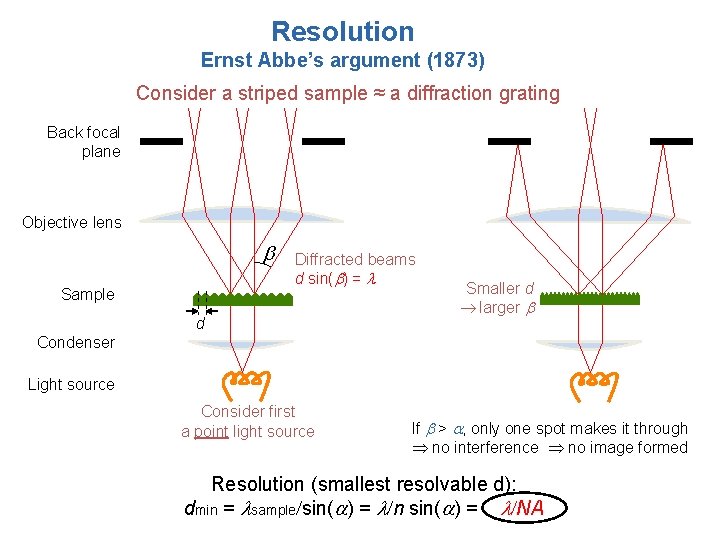
Resolution Ernst Abbe’s argument (1873) Consider a striped sample ≈ a diffraction grating Back focal plane Objective lens b Sample Diffracted beams d sin(b) = d Smaller d larger b Condenser Light source Consider first a point light source If b > , only one spot makes it through no interference no image formed Resolution (smallest resolvable d): dmin = sample/sin( ) = /n sin( ) = /NA
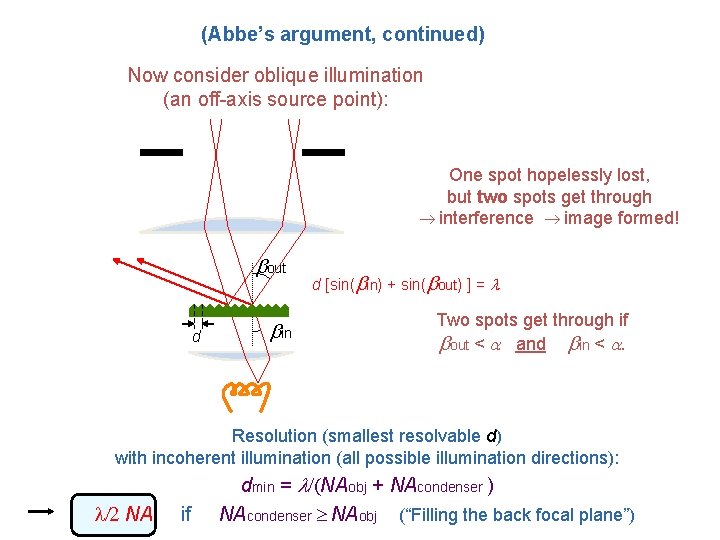
(Abbe’s argument, continued) Now consider oblique illumination (an off-axis source point): One spot hopelessly lost, but two spots get through interference image formed! bout d bin d [sin(bin) + sin(bout) ] = Two spots get through if bout < and bin < . Resolution (smallest resolvable d) with incoherent illumination (all possible illumination directions): l/2 NA if dmin = /(NAobj + NAcondenser ) NAcondenser NAobj (“Filling the back focal plane”)
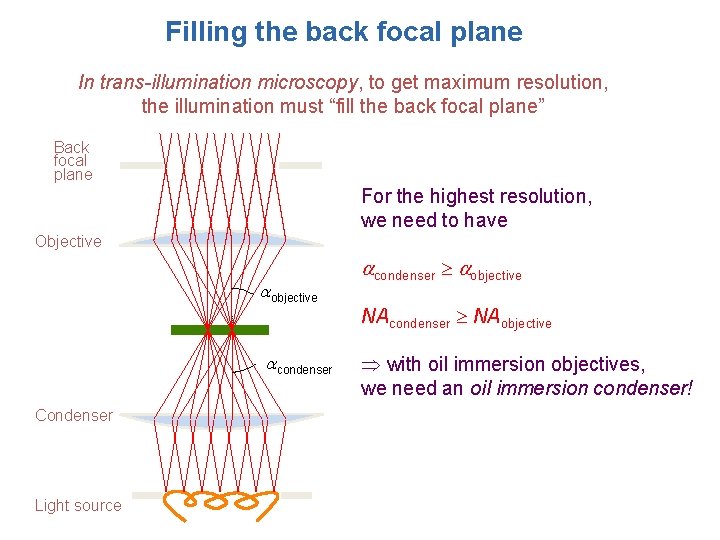
Filling the back focal plane In trans-illumination microscopy, to get maximum resolution, the illumination must “fill the back focal plane” Back focal plane For the highest resolution, we need to have Objective objective condenser Condenser Light source condenser objective NAcondenser NAobjective with oil immersion objectives, we need an oil immersion condenser!
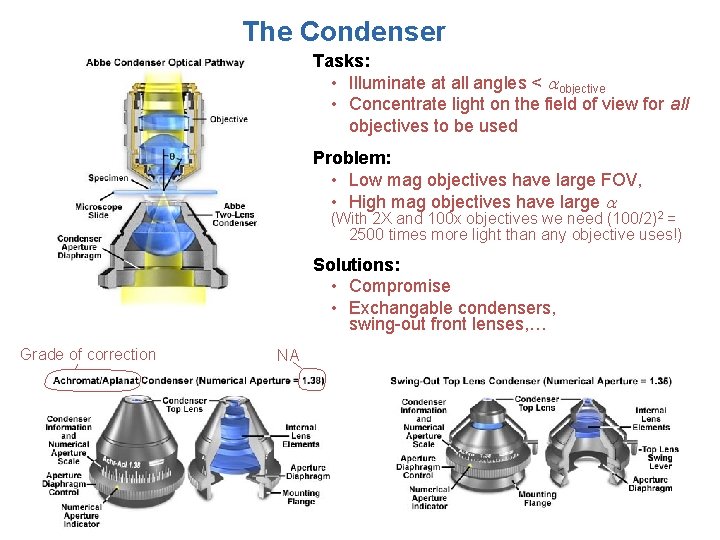
The Condenser Tasks: • Illuminate at all angles < objective • Concentrate light on the field of view for all objectives to be used Problem: • Low mag objectives have large FOV, • High mag objectives have large (With 2 X and 100 x objectives we need (100/2)2 = 2500 times more light than any objective uses!) Solutions: • Compromise • Exchangable condensers, swing-out front lenses, … Grade of correction NA
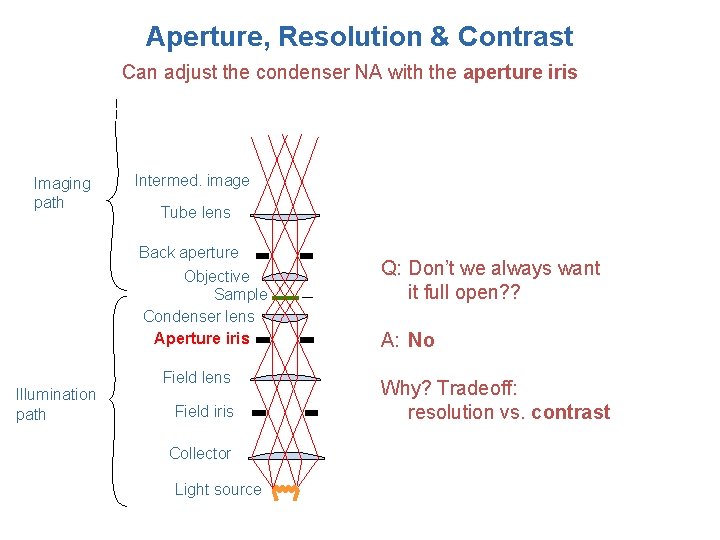
Aperture, Resolution & Contrast Can adjust the condenser NA with the aperture iris Imaging path Intermed. image Tube lens Back aperture Objective Sample Condenser lens Aperture iris Illumination path Field lens Field iris Collector Light source Q: Don’t we always want it full open? ? A: No Why? Tradeoff: resolution vs. contrast
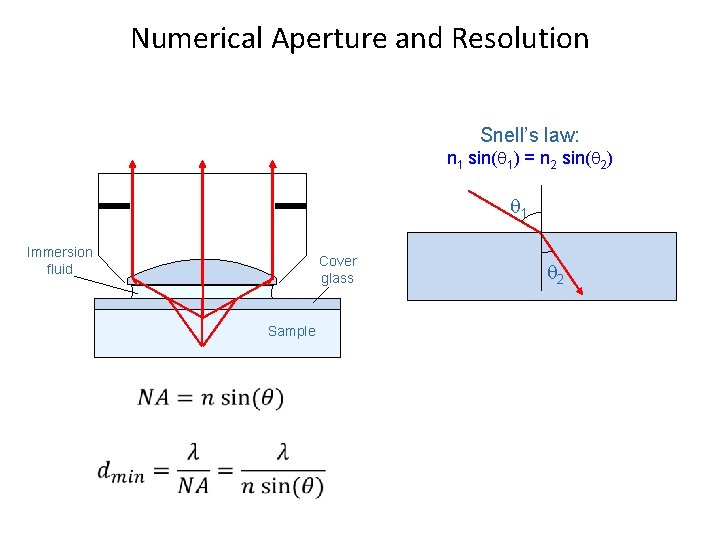
Numerical Aperture and Resolution Snell’s law: n 1 sin( 1) = n 2 sin( 2) 1 Immersion fluid Cover glass Sample 2
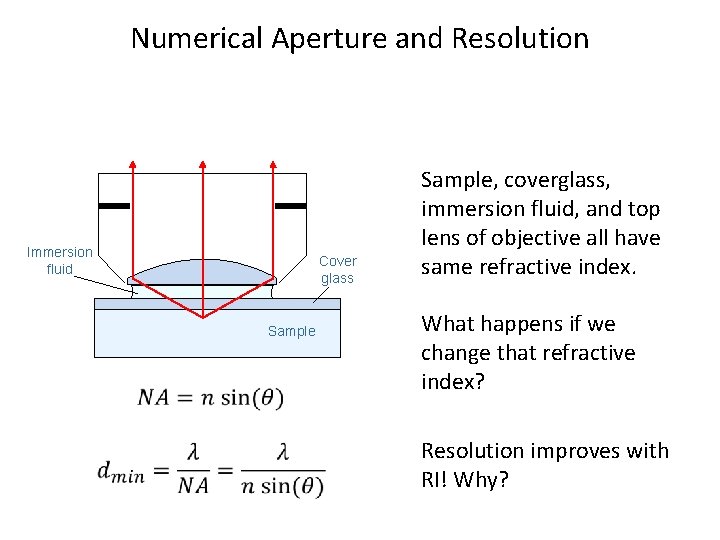
Numerical Aperture and Resolution Immersion fluid Cover glass Sample, coverglass, immersion fluid, and top lens of objective all have same refractive index. What happens if we change that refractive index? Resolution improves with RI! Why?
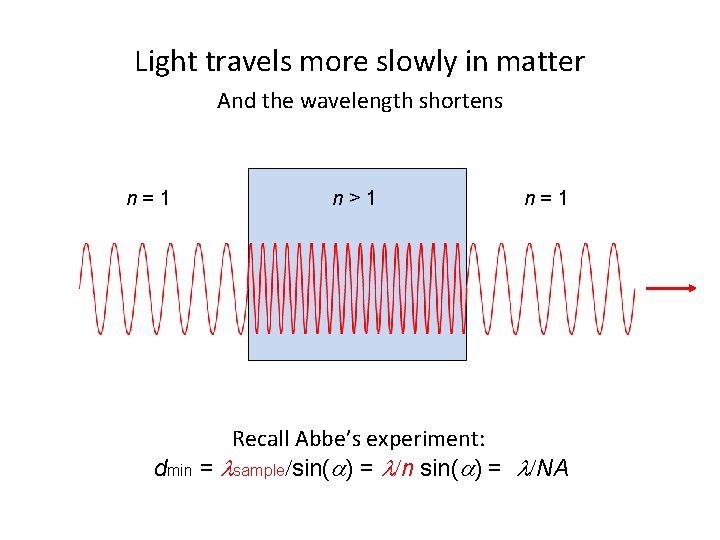
Light travels more slowly in matter And the wavelength shortens n=1 n>1 n=1 Recall Abbe’s experiment: dmin = sample/sin( ) = /n sin( ) = /NA
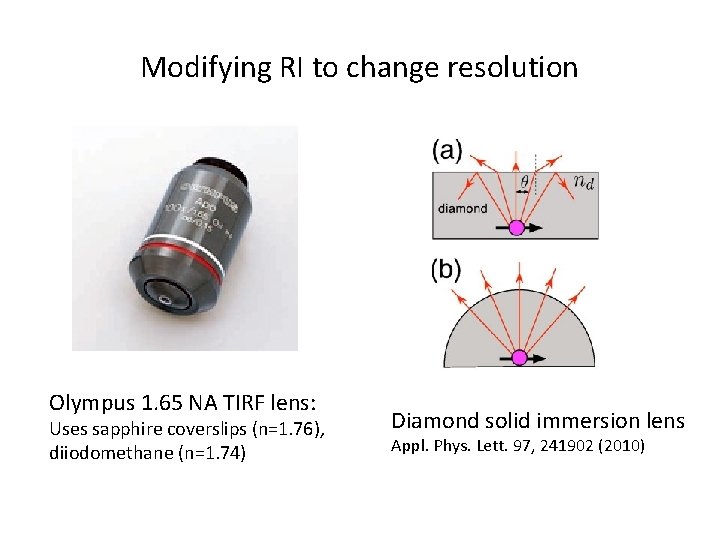
Modifying RI to change resolution Olympus 1. 65 NA TIRF lens: Uses sapphire coverslips (n=1. 76), diiodomethane (n=1. 74) Diamond solid immersion lens Appl. Phys. Lett. 97, 241902 (2010)
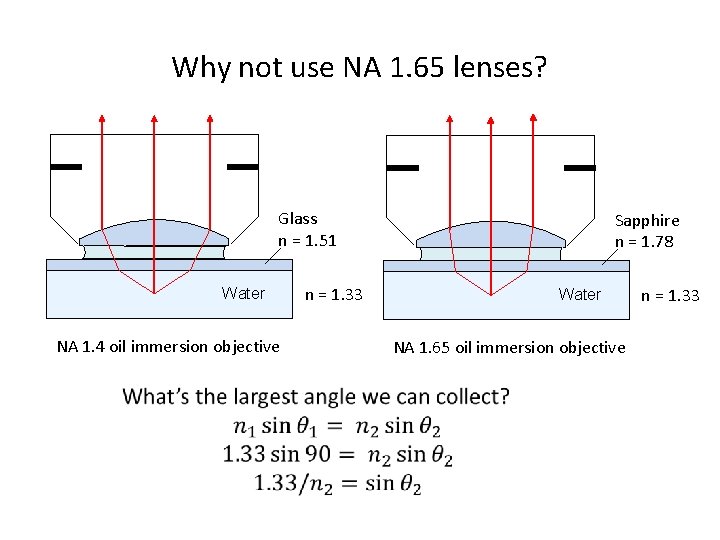
Why not use NA 1. 65 lenses? Glass n = 1. 51 Water NA 1. 4 oil immersion objective n = 1. 33 Sapphire n = 1. 78 Water NA 1. 65 oil immersion objective n = 1. 33
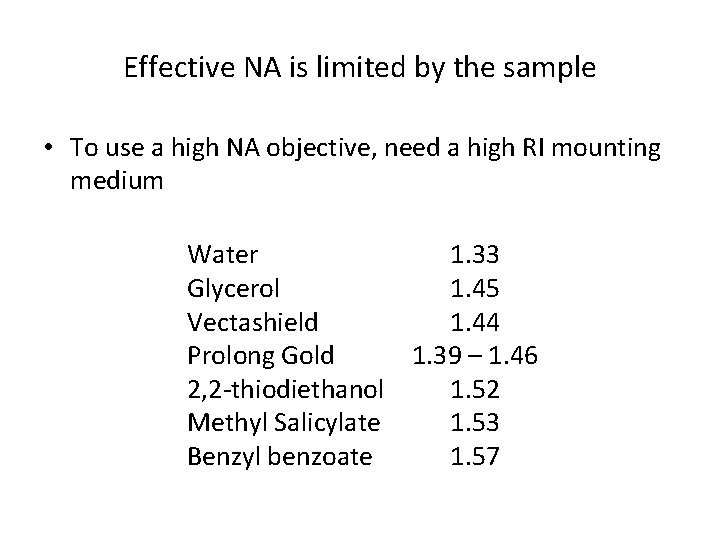
Effective NA is limited by the sample • To use a high NA objective, need a high RI mounting medium Water 1. 33 Glycerol 1. 45 Vectashield 1. 44 Prolong Gold 1. 39 – 1. 46 2, 2 -thiodiethanol 1. 52 Methyl Salicylate 1. 53 Benzyl benzoate 1. 57
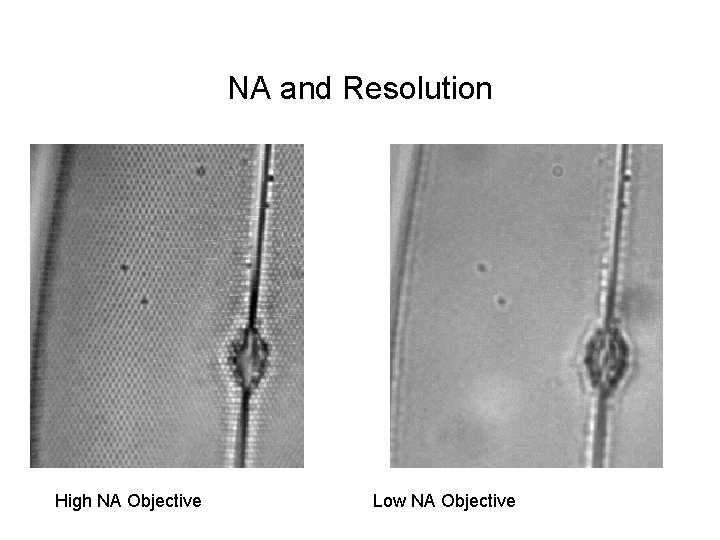
NA and Resolution High NA Objective Low NA Objective
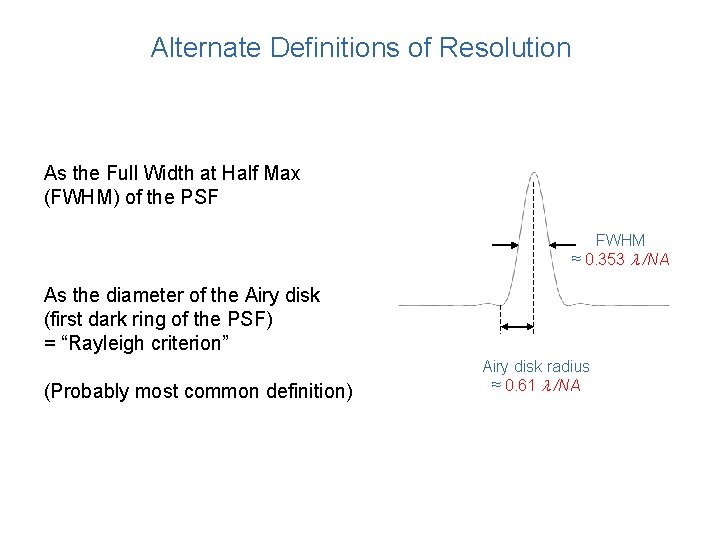
Alternate Definitions of Resolution As the Full Width at Half Max (FWHM) of the PSF FWHM ≈ 0. 353 /NA As the diameter of the Airy disk (first dark ring of the PSF) = “Rayleigh criterion” (Probably most common definition) Airy disk radius ≈ 0. 61 /NA
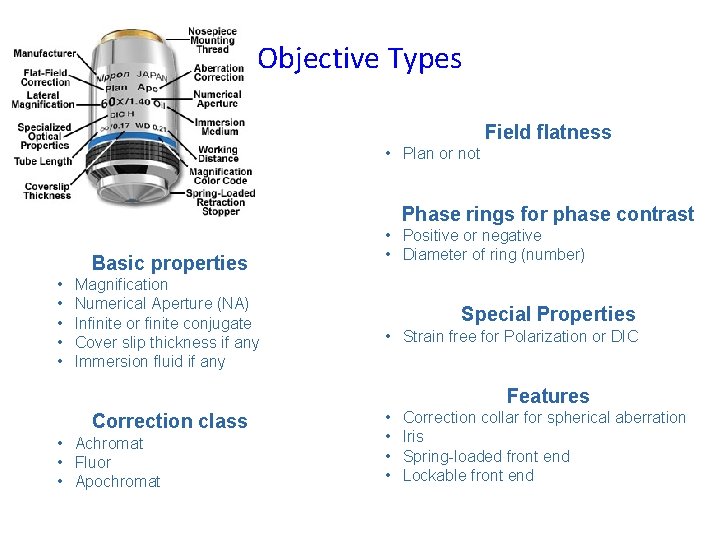
Objective Types Field flatness • Plan or not Phase rings for phase contrast Basic properties • • • Magnification Numerical Aperture (NA) Infinite or finite conjugate Cover slip thickness if any Immersion fluid if any • Positive or negative • Diameter of ring (number) Special Properties • Strain free for Polarization or DIC Features Correction class • Achromat • Fluor • Apochromat • • Correction collar for spherical aberration Iris Spring-loaded front end Lockable front end
Further reading www. microscopyu. com micro. magnet. fsu. edu Michael W. Davidson and Douglas B. Murphy “Fundamentals of Light Microscopy and Electronic Imaging” James Pawley, Ed. “Handbook of Biological Confocal Microscopy, 3 rd ed. ” Acknowledgements Ron Vale / Mats Gustafsson / Steve Ross
- Slides: 44