
Principles and Methods of Drug Administration CHAPTER 3
- Slides: 32
Principles and Methods of Drug Administration CHAPTER 3 -3 Dr. Dipa Brahmbhatt VMD Mp. H dbrahmbhatt@vettechinstitute. edu
Parenteral vs. Non-Parenteral Administration Routes Parenteral Administration Non-Parenteral Routes • Literally means “administered in the space between the enteric canal (the GI tract) and the surface of the body” • Drugs given by mouth = Oral administration (PO) • Rectally • Sublingual
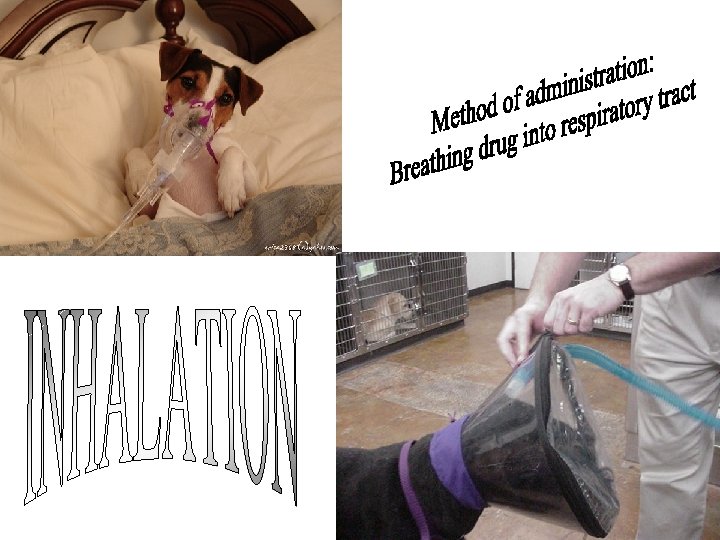
Other Parenteral Administration Routes • Inhalation administration introduces drug to the animal by having it breathe drug into the lungs – Particles diffuse across the alveolar membrane • Topical medication goes on the surface of skin or mucous membrane – Forms of topical medication are summarized in Table 3 -2 in your textbook • Other parenteral administration routes are listed in Table 3 -1 in your textbook
Route of Administration • Injectable / Parenteral • Local Routes – ‘Applied or given directly where the action of the drug is desired’ – Inhalation, topical (skin, eye, ear), other routes (rectal, vaginal, transdermal patches) • Oral Route
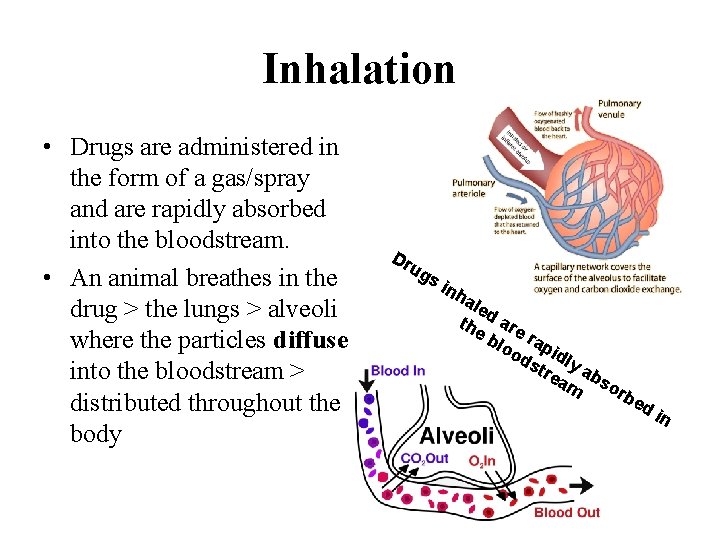
Inhalation • Drugs are administered in the form of a gas/spray and are rapidly absorbed into the bloodstream. • An animal breathes in the drug > the lungs > alveoli where the particles diffuse into the bloodstream > distributed throughout the body Dr ug si nh ale d the are blo rap od idl str y a ea bs m or be di n
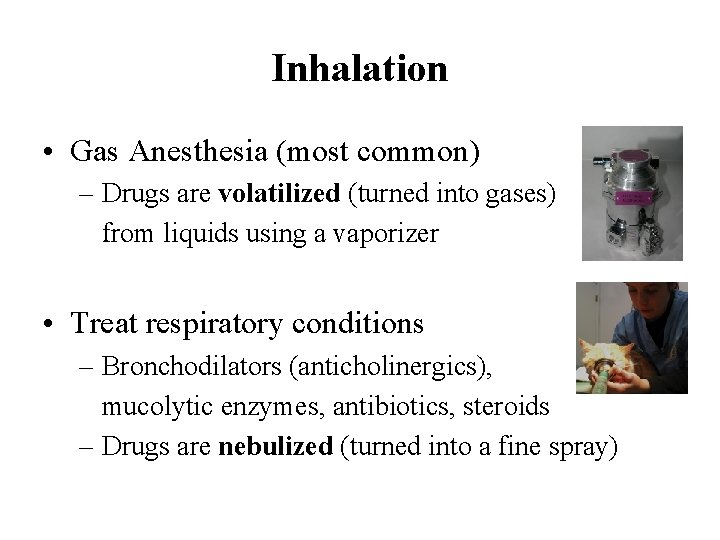
Inhalation • Gas Anesthesia (most common) – Drugs are volatilized (turned into gases) from liquids using a vaporizer • Treat respiratory conditions – Bronchodilators (anticholinergics), mucolytic enzymes, antibiotics, steroids – Drugs are nebulized (turned into a fine spray)
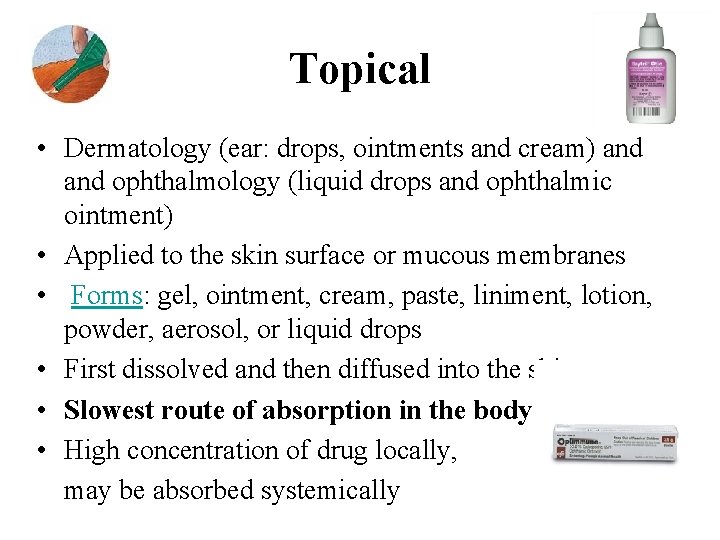
Topical • Dermatology (ear: drops, ointments and cream) and ophthalmology (liquid drops and ophthalmic ointment) • Applied to the skin surface or mucous membranes • Forms: gel, ointment, cream, paste, liniment, lotion, powder, aerosol, or liquid drops • First dissolved and then diffused into the skin • Slowest route of absorption in the body as a whole • High concentration of drug locally, may be absorbed systemically
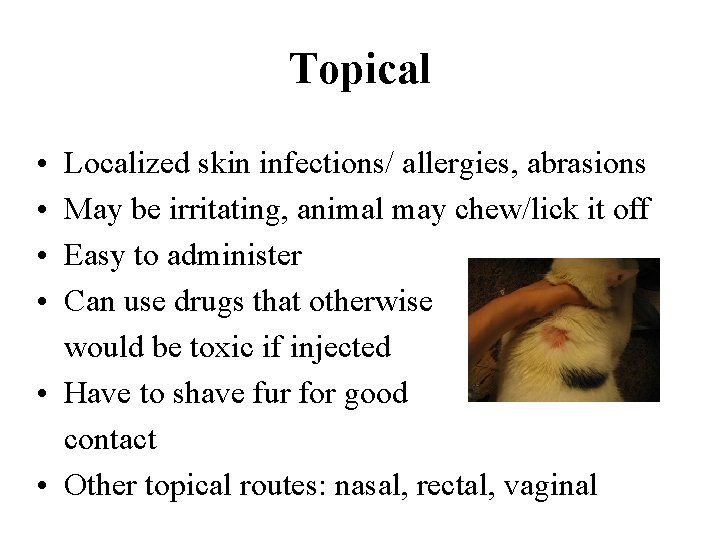
Topical • • Localized skin infections/ allergies, abrasions May be irritating, animal may chew/lick it off Easy to administer Can use drugs that otherwise would be toxic if injected • Have to shave fur for good contact • Other topical routes: nasal, rectal, vaginal
Topical • Solution: Clear liquid preparation, 1/more solutes and 1/more solvents – Solvent: the dissolving substance of a solution – Solute: the dissolved substance of a solution • Emulsion: A mixture of 2 immiscible liquids, one dispersed throughout the other in small droplets – Water – oil emulsion • Suspension: A finely divided, undissolved substance dispersed in water/oil. Liquid preparation that contains solid drug particles suspended in a suitable medium
FORMS OF TOPICALS Drug suspended in…. • • Aerosols – solvent packaged under pressure CREAM – water-oil emulsion GEL – semisolid or jelly-like substance Liniments – oily, soapy, or alcohol-based substance. Applied with friction Lotions – liquid for dabbing, brushing, or dripping on skin without friction OINTMENT – semisolid, lipid - based preparation that melts at body temp PASTE – semisolid that retains its state at body temp Powder – powder for external lubrication or absorption
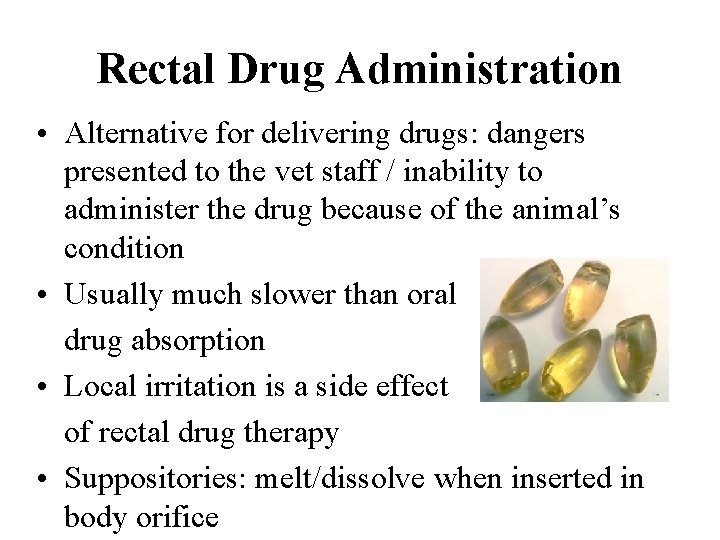
Rectal Drug Administration • Alternative for delivering drugs: dangers presented to the vet staff / inability to administer the drug because of the animal’s condition • Usually much slower than oral drug absorption • Local irritation is a side effect of rectal drug therapy • Suppositories: melt/dissolve when inserted in body orifice
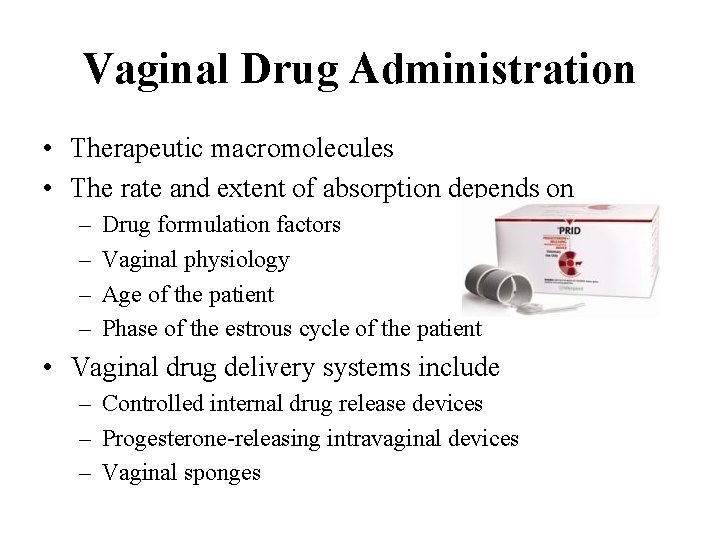
Vaginal Drug Administration • Therapeutic macromolecules • The rate and extent of absorption depends on – – Drug formulation factors Vaginal physiology Age of the patient Phase of the estrous cycle of the patient • Vaginal drug delivery systems include – Controlled internal drug release devices – Progesterone-releasing intravaginal devices – Vaginal sponges
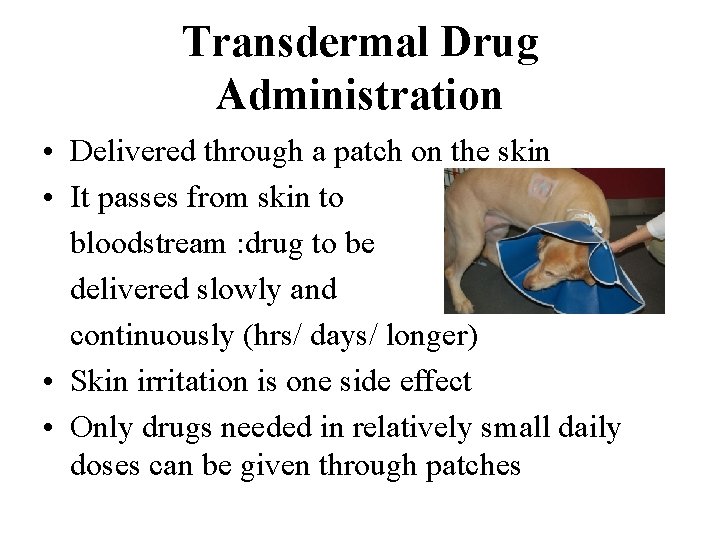
Transdermal Drug Administration • Delivered through a patch on the skin • It passes from skin to bloodstream : drug to be delivered slowly and continuously (hrs/ days/ longer) • Skin irritation is one side effect • Only drugs needed in relatively small daily doses can be given through patches
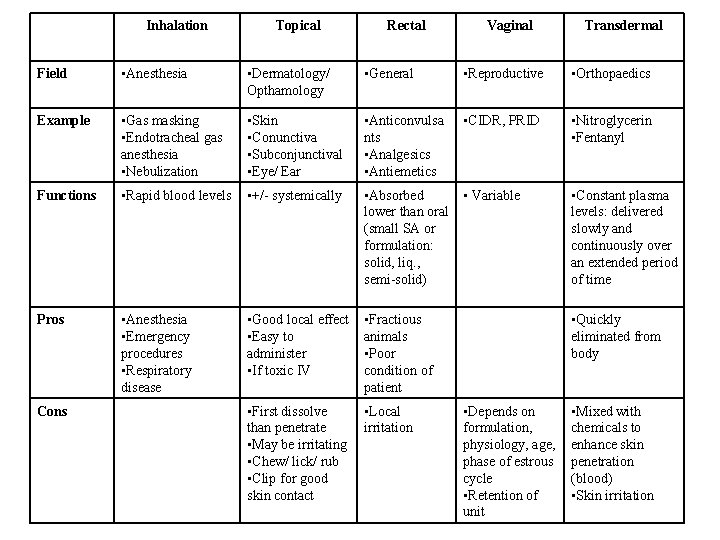
Inhalation Topical Rectal Vaginal Transdermal Field • Anesthesia • Dermatology/ Opthamology • General • Reproductive • Orthopaedics Example • Gas masking • Endotracheal gas anesthesia • Nebulization • Skin • Conunctiva • Subconjunctival • Eye/ Ear • Anticonvulsa nts • Analgesics • Antiemetics • CIDR, PRID • Nitroglycerin • Fentanyl Functions • Rapid blood levels • +/- systemically • Absorbed • Variable lower than oral (small SA or formulation: solid, liq. , semi-solid) • Constant plasma levels: delivered slowly and continuously over an extended period of time Pros • Anesthesia • Emergency procedures • Respiratory disease • Good local effect • Easy to administer • If toxic IV • Fractious animals • Poor condition of patient • Quickly eliminated from body • First dissolve than penetrate • May be irritating • Chew/ lick/ rub • Clip for good skin contact • Local irritation Cons • Depends on formulation, physiology, age, phase of estrous cycle • Retention of unit • Mixed with chemicals to enhance skin penetration (blood) • Skin irritation
Nonparenteral Administration Routes • Delivered directly to the GI tract • Most convenient (owner can do) • Before entering the bloodstream: oral drug must be released from the dose form, transported across the GI tract, and passed through the liver (reduces amount) • Long duration of activity, slow onset of action • Relatively safe (less likely for adverse effects) • No need for sterility • Gastric acid and disease may affect absorption rate • Ruminants have questionable absorption • Must get through GI mucosa
Oral Meds • Orally administered drug gets into bloodstream – Dissolving the drug form (solid / liquid) • Solid: tablet (sustained released, molded), capsule, powder, bolus, lozenges • Liquid: Solution, suspension, emulsion – Transport across GI tract – Drug passage through the liver
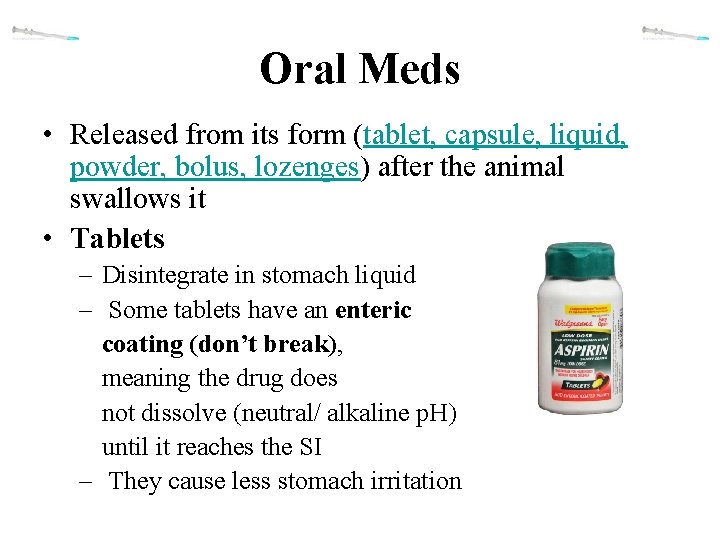
Oral Meds • Released from its form (tablet, capsule, liquid, powder, bolus, lozenges) after the animal swallows it • Tablets – Disintegrate in stomach liquid – Some tablets have an enteric coating (don’t break), meaning the drug does not dissolve (neutral/ alkaline p. H) until it reaches the SI – They cause less stomach irritation
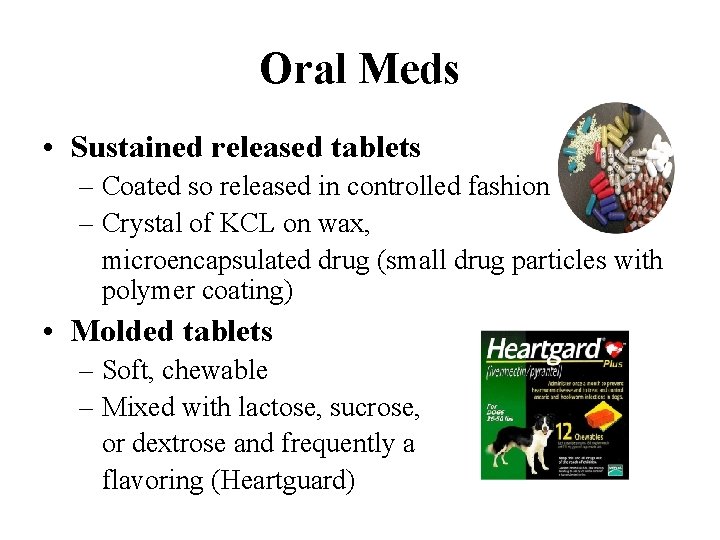
Oral Meds • Sustained released tablets – Coated so released in controlled fashion – Crystal of KCL on wax, microencapsulated drug (small drug particles with polymer coating) • Molded tablets – Soft, chewable – Mixed with lactose, sucrose, or dextrose and frequently a flavoring (Heartguard)
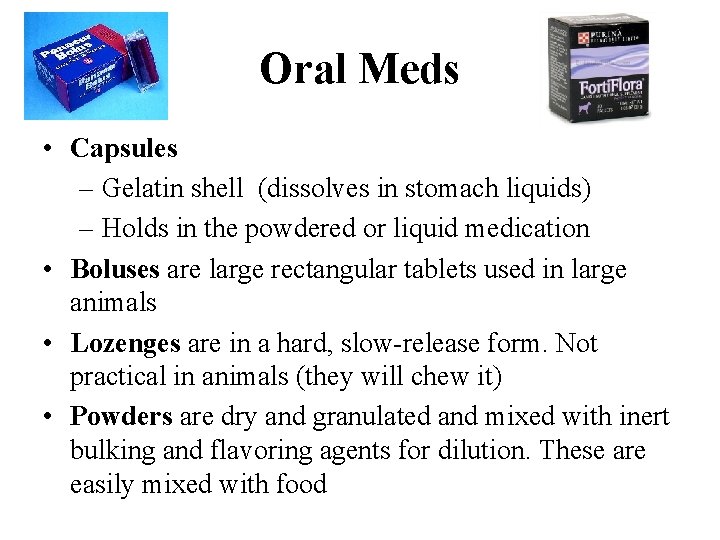
Oral Meds • Capsules – Gelatin shell (dissolves in stomach liquids) – Holds in the powdered or liquid medication • Boluses are large rectangular tablets used in large animals • Lozenges are in a hard, slow-release form. Not practical in animals (they will chew it) • Powders are dry and granulated and mixed with inert bulking and flavoring agents for dilution. These are easily mixed with food
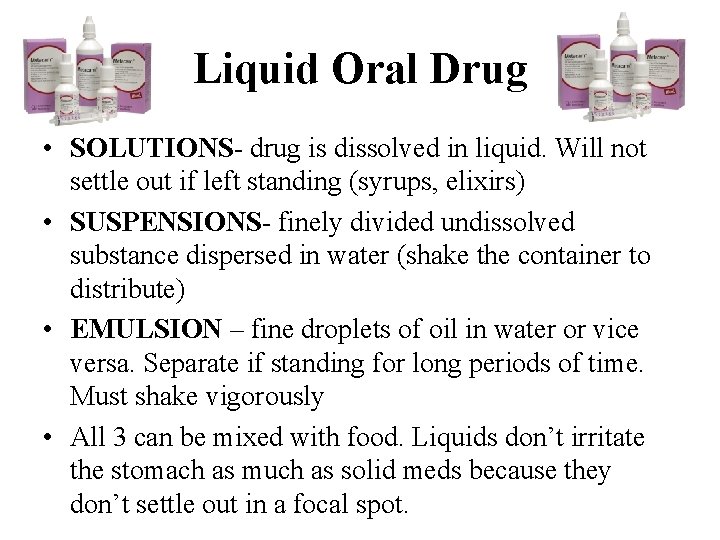
Liquid Oral Drug • SOLUTIONS- drug is dissolved in liquid. Will not settle out if left standing (syrups, elixirs) • SUSPENSIONS- finely divided undissolved substance dispersed in water (shake the container to distribute) • EMULSION – fine droplets of oil in water or vice versa. Separate if standing for long periods of time. Must shake vigorously • All 3 can be mixed with food. Liquids don’t irritate the stomach as much as solid meds because they don’t settle out in a focal spot.
Liquid Oral Drug • Solutions, Suspensions and Emulsions – Mixed with food – Don’t irritate the stomach as much as solid meds because they don’t settle out in a focal spot – Not as accurate dose in food – Option for aggressive patient
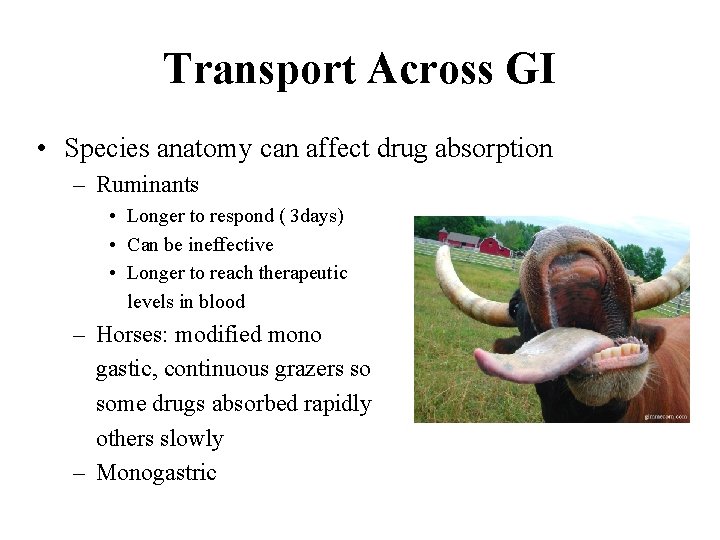
Transport Across GI • Species anatomy can affect drug absorption – Ruminants • Longer to respond ( 3 days) • Can be ineffective • Longer to reach therapeutic levels in blood – Horses: modified mono gastic, continuous grazers so some drugs absorbed rapidly others slowly – Monogastric
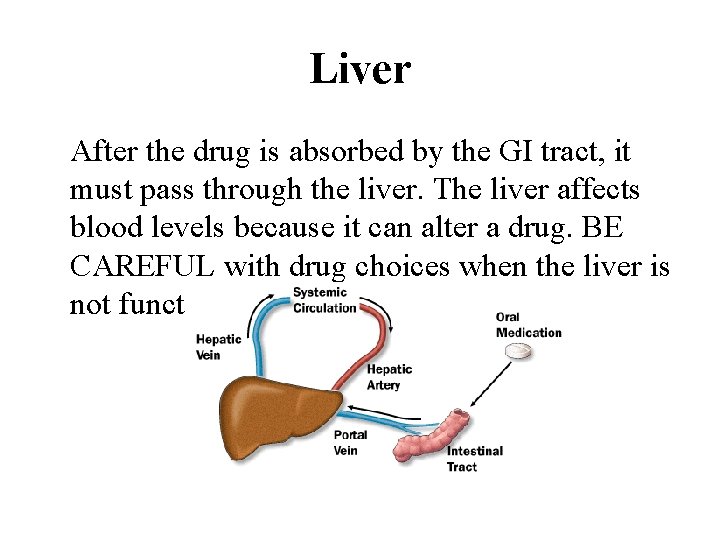
Liver After the drug is absorbed by the GI tract, it must pass through the liver. The liver affects blood levels because it can alter a drug. BE CAREFUL with drug choices when the liver is not functioning properly.
General Guidelines • Table 3 -5: Pharmacological Aspects of Nursing Care
Therapeutic Range • Drug Factors –Route of administration –Drug dosage –Dosage interval
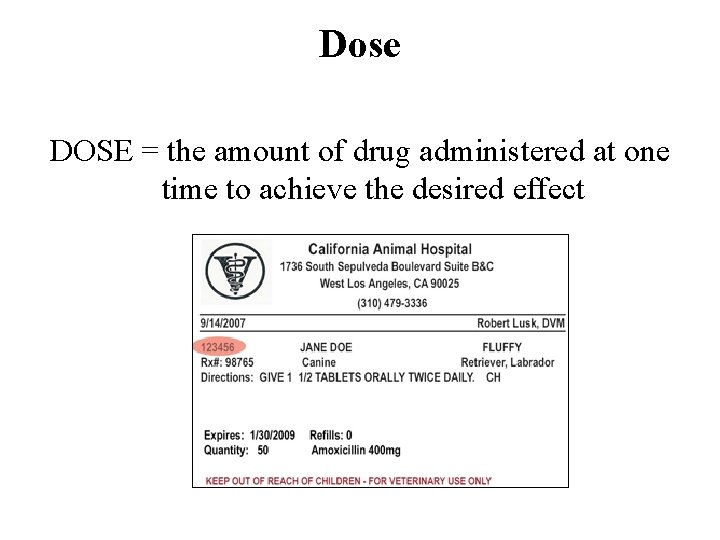
Dose DOSE = the amount of drug administered at one time to achieve the desired effect m. L, cc, mg, Tablets
Drug Dose – LOADING DOSE – • the initial dose of a drug given to achieve drug levels in therapeutic range in a short period of time • Large amount of drug initially / normal amount more often – MAINTENANCE DOSE – dose maintains drug in therapeutic range – TOTAL DAILY DOSE – amount of drug given in 24 hours (ex: 1200 mg per day)
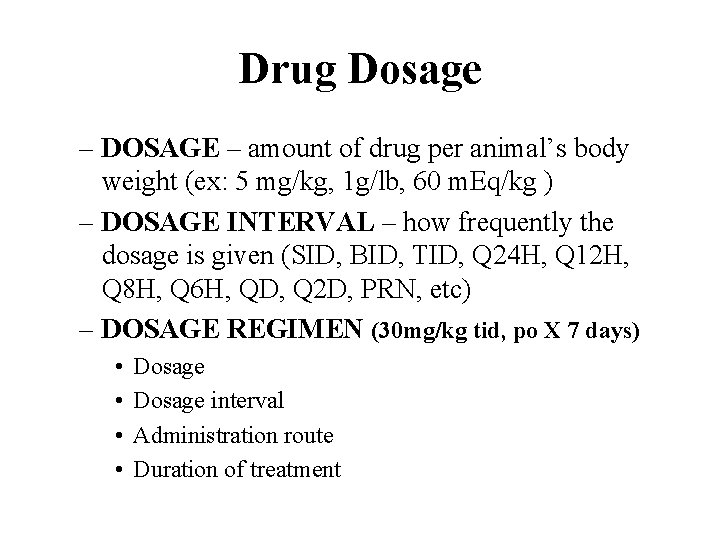
Drug Dosage – DOSAGE – amount of drug per animal’s body weight (ex: 5 mg/kg, 1 g/lb, 60 m. Eq/kg ) – DOSAGE INTERVAL – how frequently the dosage is given (SID, BID, TID, Q 24 H, Q 12 H, Q 8 H, Q 6 H, QD, Q 2 D, PRN, etc) – DOSAGE REGIMEN (30 mg/kg tid, po X 7 days) • • Dosage interval Administration route Duration of treatment
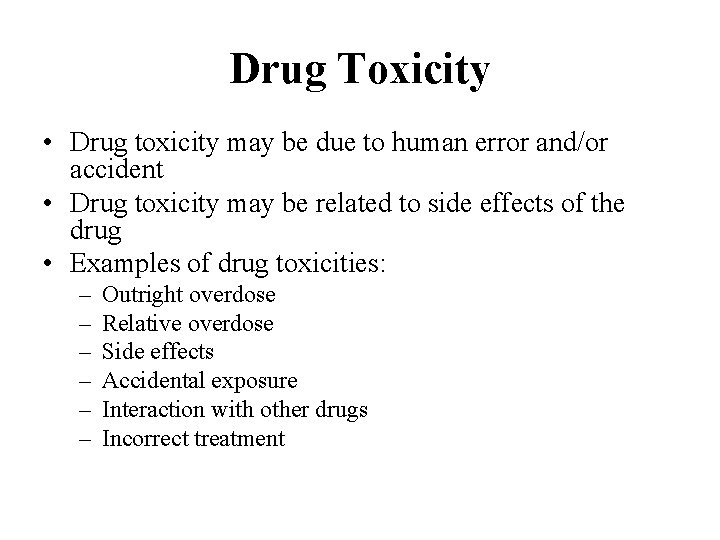
Drug Toxicity • Drug toxicity may be due to human error and/or accident • Drug toxicity may be related to side effects of the drug • Examples of drug toxicities: – – – Outright overdose Relative overdose Side effects Accidental exposure Interaction with other drugs Incorrect treatment
Your patient is reacting to the medication, now what? • Directly remove the drug – Wash off the topicals, induce emesis for those ingested • Activated charcoal to bind what cannot be vomited • IV fluids to support the kidneys • Give an antidote if there is one • Provide care until the animal is through the toxicity
KEEP YOUR PATIENTS SAFE!