
Principles and Laws that Explain Electron Behavior SC
Principles and Laws that Explain Electron Behavior SC 1: Students will use the modern atomic theory to explain the characteristics of atoms.
Aufbau Principle n n n States that electrons fill an atom based on energy levels, starting at lowest energy level and moving out to higher energy levels. The further an electron is from the nucleus, the higher the energy level and energy of that electron. Electron configuration is a way to represent this principle.
Pauli’s Exclusion Principle n n n States that electrons may NOT have the same exact quantum number, which means that if two electrons occupy the same orbital, they MUST have opposite spins. This principle is BEST represented by the orbital -filling diagrams. Chemists represent the opposite spins in three ways: 1. arrows (one up and one down) 2. +1/2 and -1/2 3. CW and CCW
Hund’s Rule n n Due to the negative charge on all electrons, electrons prefer to be alone if possible. This means that if additional orbitals are available, then electrons will go to an open orbital before pairing up with another electron. Pairing starts when all orbitals have their FIRST electron present. Represented by orbital-filling diagrams and Lewis dot diagrams.
Heisenberg Uncertainty Principle n n n States that it is impossible to determine simultaneously both the position and velocity of an electron or any other particle. This means that if one knows the position of an electron, then one cannot know the velocity it is traveling in the atom. If one knows the electron’s velocity, then one cannot know the position at that moment.
Schrodinger Wave Equation n This equation was developed by an Austrian physicist Erwin Schrodinger who believed that electrons had a dual wave-particle nature like light. In conjunction with the Heisenberg Uncertainty Principle, his work led to the Quantum Theory. The Quantum Theory describes mathematically the wave properties of electrons and other very small particles. From the Quantum Theory came the concept of quantum numbers and what those would represent.
Quantum Numbers Quantum numbers specify the properties of atomic orbitals and the properties of electrons in orbitals. n There are four quantum numbers: 1. Principal 2. Angular 3. Magnetic 4. Spin n
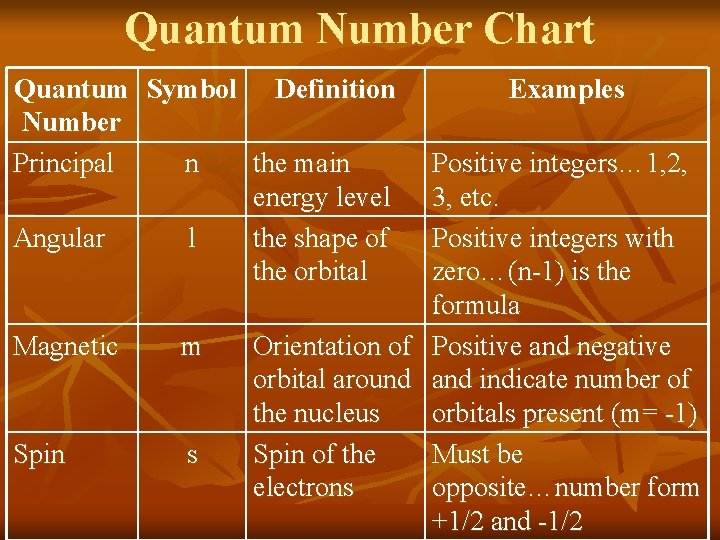
Quantum Number Chart Quantum Symbol Definition Number Principal n the main energy level Angular l the shape of the orbital Magnetic m Spin s Examples Positive integers… 1, 2, 3, etc. Positive integers with zero…(n-1) is the formula Orientation of Positive and negative orbital around and indicate number of the nucleus orbitals present (m= -1) Spin of the Must be electrons opposite…number form +1/2 and -1/2
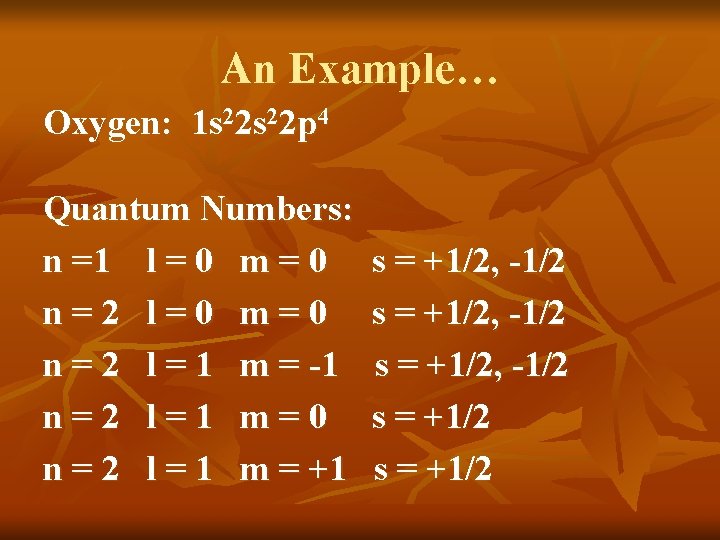
An Example… Oxygen: 1 s 22 p 4 Quantum Numbers: n =1 l = 0 m = 0 n=2 l=0 m=0 n = 2 l = 1 m = -1 n=2 l=1 m=0 n = 2 l = 1 m = +1 s = +1/2, -1/2 s = +1/2
- Slides: 9